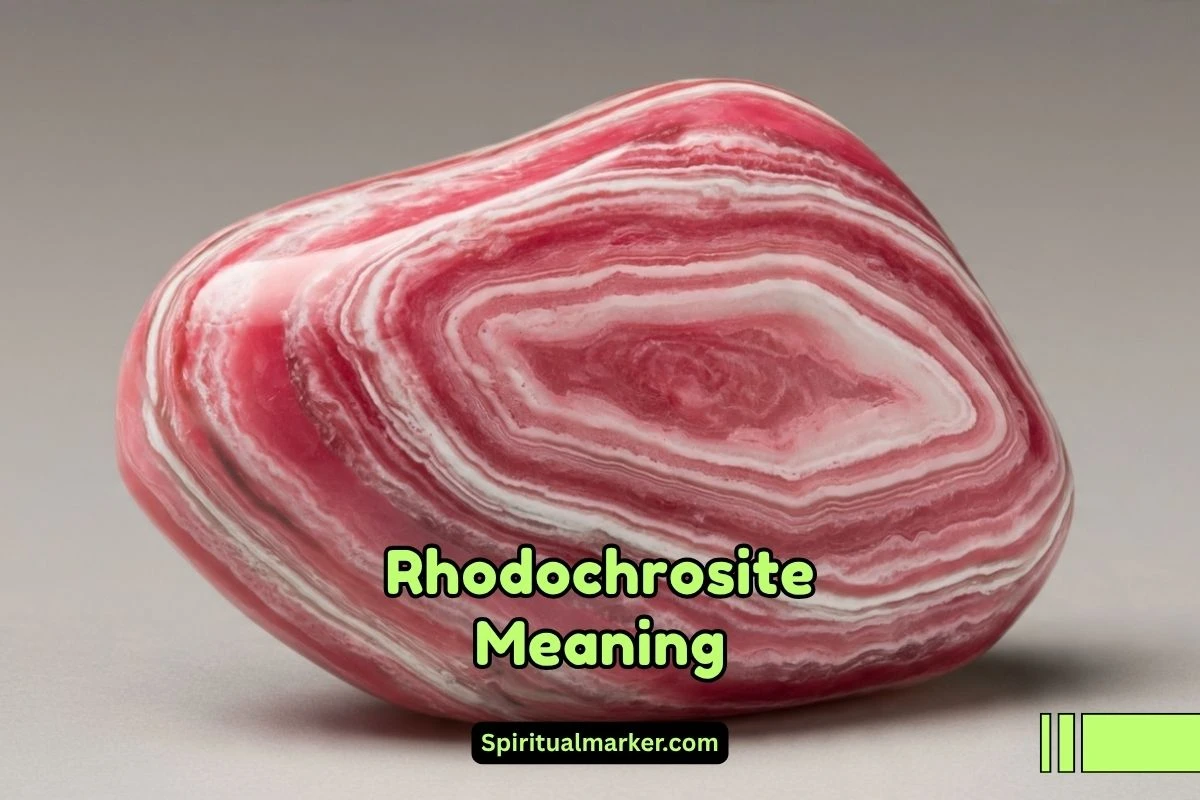
Have you ever seen a rhodochrosite crystal and felt something stir deep inside you? Many people describe an immediate emotional pull toward this stone. Its swirling layers of pink, rose, and cream feel warm, personal, and quietly intimate.
Rhodochrosite is not a stone that sits quietly on a shelf unnoticed. Its bold, layered beauty draws attention. But beyond its striking appearance lies a meaning that resonates deeply with those going through emotional healing, self-discovery, and personal transformation.
For centuries, people across different cultures have associated rhodochrosite with the heart. Not just romantic love, but the deeper, more complex kind of love. The kind that turns inward. The kind that asks you to face your own emotional wounds with patience and compassion. Spiritual traditions from South America to Europe have long recognized this stone as a powerful companion during emotional recovery.
Unlike gemstones associated with ambition or power, rhodochrosite carries something more vulnerable. Its energy centers on emotional courage. It invites you to look honestly at your inner world without judgment. That combination of beauty and emotional depth is why healers, crystal practitioners, and spiritual seekers continue to value it deeply.
This article covers the full meaning of rhodochrosite, its spiritual symbolism, healing properties, historical background, and how people use it for emotional and spiritual growth. You will also learn how to wear rhodochrosite jewelry and care for it properly.
5 Key Takeaways
- Rhodochrosite symbolizes self-love, emotional healing, inner child recovery, and compassionate transformation.
- It is strongly associated with the heart chakra and solar plexus chakra.
- Spiritual traditions in Argentina and beyond have honored rhodochrosite for centuries as a sacred healing stone.
- People use rhodochrosite during meditation, grief recovery, self-worth work, and emotional release practices.
- Rhodochrosite rates between 3.5 and 4 on the Mohs hardness scale, making it one of the softer gemstones that requires careful handling.
What is Rhodochrosite?
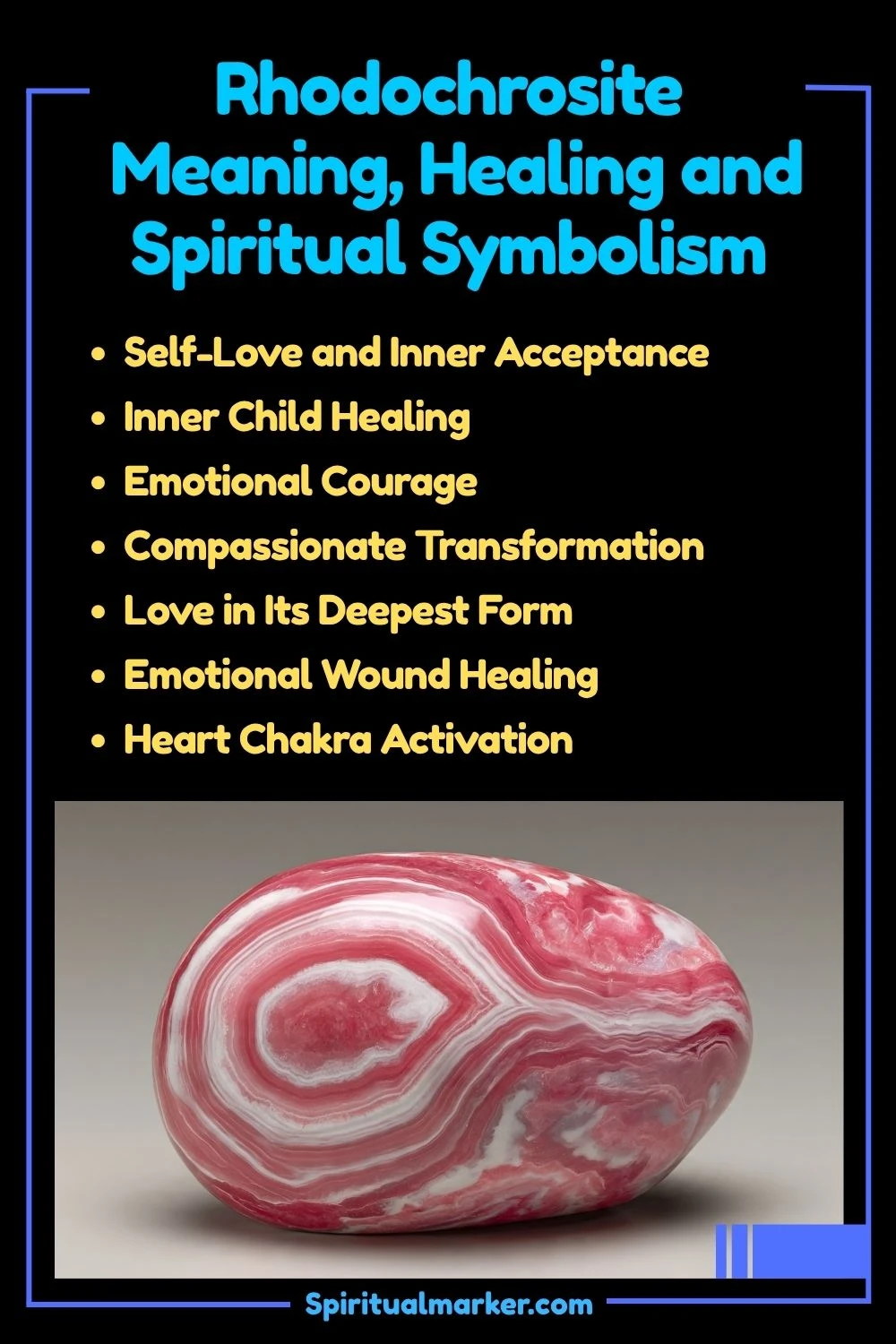
Rhodochrosite is a manganese carbonate mineral prized for its vivid pink, rose red, and cream-colored banding. Its name comes from the Greek words rhodon meaning rose and chroma meaning color. Together, they translate to “rose-colored,” which perfectly describes its warm, layered appearance.
The stone forms in stalactitic, botryoidal, or massive habits inside silver, copper, and lead ore deposits. Its banded patterns develop as mineral-rich water deposits alternating layers of manganese carbonate and impurities over long geological periods. These concentric rings create the distinctive swirling appearance that makes rhodochrosite unmistakable.
Many people confuse rhodochrosite with rose quartz because both stones carry pink tones and emotional symbolism. However, they differ significantly. Rose quartz has a milky, translucent appearance with a single uniform tone. Rhodochrosite displays rich, layered banding in deep pinks, reds, and whites that create a visually dynamic pattern. Spiritually, rhodochrosite is considered more emotionally complex and is often linked with deeper emotional work around self-love, inner child healing, and emotional courage.
Origins and Formation
Rhodochrosite forms through hydrothermal processes inside silver and base metal ore veins. Manganese-rich solutions move through rock fractures and slowly deposit manganese carbonate over thousands of years. The layered banding reflects changes in mineral concentration during this slow formation process.
Argentina remains the world’s most celebrated source of rhodochrosite. The Incas believed rhodochrosite was the blood of their ancestral rulers turned to stone. They called it Inca Rose, and it carried powerful spiritual and royal significance throughout Andean culture. Argentine rhodochrosite from the Capillitas mine is considered among the finest in the world, displaying deep rose and cream-colored stalactitic formations.
Other notable sources include Colorado in the United States, where rhodochrosite serves as the official state mineral. Peru, South Africa, Romania, China, and Russia also produce significant deposits. Each regional source varies slightly in color depth, banding pattern, and overall clarity.
The stone’s formation through slow geological processes adds symbolic weight to its spiritual meaning. Just as rhodochrosite builds layer by layer over time, emotional healing also builds gradually through patience, self-awareness, and consistent inner work.
Key Properties
| Property | Details |
|---|---|
| Color | Pink, rose red, raspberry, cream, banded white |
| Composition | Manganese carbonate (MnCO3) |
| Hardness | 3.5 to 4 on the Mohs scale |
| Chakra Association | Heart chakra and solar plexus chakra |
| Symbolism | Self-love, emotional healing, inner child healing, compassion |
| Common Sources | Argentina, Colorado (USA), Peru, South Africa, Romania |
| Transparency | Translucent to opaque |
| Energy Style | Warm, emotionally courageous, nurturing |
Historical Use
Rhodochrosite carries a rich history tied primarily to Andean civilizations. The Incas revered this stone deeply. According to oral tradition, they believed rhodochrosite was the petrified blood of ancient Inca rulers and warriors. This connection gave it a sacred, royal status. The stone was found in Inca ruins, burial sites, and spiritual ceremonial spaces.
In Argentina, rhodochrosite stalactites were discovered inside pre-Columbian silver mines centuries after the Incas had worked them. These formations developed over roughly 500 years inside abandoned mine shafts. When rediscovered in the 20th century, they created international fascination among gemologists and spiritual practitioners alike.
In Colorado, silver miners in the 19th century regularly encountered rhodochrosite deposits. The stone’s striking appearance eventually attracted attention far beyond mining communities. Colorado officially adopted rhodochrosite as its state mineral in 2002, recognizing its geological and cultural significance.
Modern metaphysical traditions began embracing rhodochrosite heavily during the late 20th century. Crystal healers connected its strong pink color with heart-centered healing, emotional recovery, and love-based spiritual practices. Today it appears in healing practices worldwide, particularly those focused on self-love, emotional trauma recovery, and inner child work.
5 Spiritual Meanings of Rhodochrosite
1. Self-Love and Inner Acceptance
Self-love sits at the absolute center of rhodochrosite’s spiritual meaning. Many crystals carry loving energy directed outward toward others. Rhodochrosite directs that same loving energy inward. It asks you to look honestly at yourself, including the painful, unresolved, and imperfect parts, and respond with compassion rather than judgment.
This distinction is important. Self-love in a shallow sense often sounds like positive affirmations or surface-level confidence. Real self-love, the kind rhodochrosite symbolizes, requires emotional courage. It means facing parts of yourself that you may have hidden, suppressed, or felt ashamed of for years.
Many people carry deeply buried emotional wounds from childhood, past relationships, or prolonged self-criticism. These wounds quietly shape behavior, relationship patterns, and self-perception without always rising to full conscious awareness. Rhodochrosite spiritually represents the willingness to acknowledge those wounds honestly. It does not rush that process. Its symbolism centers on gradual, patient self-acceptance rather than forced positivity.
Research in psychology consistently shows that self-compassion reduces anxiety, depression, and emotional reactivity. Dr. Kristin Neff’s extensive work at the University of Texas identifies self-compassion as one of the most powerful buffers against emotional suffering. Rhodochrosite’s spiritual symbolism aligns naturally with these findings. It represents the same emotional orientation that psychological research identifies as genuinely healing.
For many people, rhodochrosite becomes a daily reminder that healing begins inside. You cannot sustainably love others well while constantly at war with yourself. The stone symbolizes that loving yourself is not selfish. It is emotionally necessary.
2. Inner Child Healing
Rhodochrosite is widely regarded in spiritual traditions as one of the most powerful stones for inner child healing. The inner child concept refers to the emotional imprint created during early life experiences. Childhood joy, pain, fear, love, abandonment, and emotional neglect all shape the emotional patterns that adults carry unconsciously into their relationships and daily lives.
When childhood experiences involved emotional neglect, instability, criticism, or trauma, those early emotional wounds often remain active inside the adult psyche. A person may feel unexplainably triggered by small things. They may struggle with emotional intimacy, fear abandonment, or feel persistently unworthy without understanding why. Inner child healing involves returning emotional awareness to those early wounds with compassion and care.
Spiritually, rhodochrosite is believed to help with this process by creating a safe emotional space for buried feelings to surface gently. It does not force confrontation. Instead, practitioners describe its energy as emotionally warming, patient, and deeply compassionate. The stone symbolizes the act of sitting with your younger self and offering the love that may have been absent or insufficient early in life.
Many crystal healers pair rhodochrosite with inner child meditation specifically because of this quality. During these meditations, practitioners sometimes place rhodochrosite on the heart or hold it gently while visualizing early memories through the lens of adult compassion rather than childhood helplessness.
The Inca belief that rhodochrosite contained the blood of ancestors also resonates here. Ancestral healing and inner child healing share similar themes. Both involve reconnecting with deep roots of identity, emotional inheritance, and the parts of yourself that formed long before conscious self-awareness developed.
3. Emotional Courage
Emotional courage is one of rhodochrosite’s most distinctive spiritual qualities. Many healing crystals emphasize emotional softening, calm, or peace. Rhodochrosite adds something bolder to that picture. It symbolizes the courage required to face emotional truth directly.
Emotional courage does not mean emotional toughness in the traditional sense. It does not mean suppressing pain or pretending difficult feelings do not exist. Instead, it means choosing to feel and process difficult emotions even when avoidance feels easier. It means asking hard questions about your own patterns. It means allowing yourself to be emotionally vulnerable when vulnerability feels terrifying.
Rhodochrosite’s deep rose-red tones reflect this quality visually. Unlike soft, pale pink stones associated purely with gentleness, rhodochrosite carries a richness and depth in its color that suggests warmth combined with strength. Many practitioners describe its energy as loving but not passive. It encourages forward emotional movement rather than emotional stagnation.
In situations where people have spent years numbing themselves to emotional pain through distraction, busyness, or emotional withdrawal, rhodochrosite spiritually represents the turning point. It symbolizes the moment when emotional honesty becomes more important than emotional comfort. That turning point is not always comfortable, but it marks the true beginning of deep healing.
Spiritual teachers across traditions have long emphasized that emotional courage is inseparable from authentic growth. Rhodochrosite carries this teaching in gemstone form. Its energy encourages you to stop running from what hurts and begin moving through it with love.
4. Compassionate Transformation
Rhodochrosite is associated with transformation, but not the kind that arrives through force, urgency, or dramatic upheaval. Its symbolism centers on change that flows from compassion, emotional honesty, and patient self-awareness. This distinction makes it a particularly meaningful stone during long healing journeys.
Many people approach personal transformation with harsh standards. They expect rapid change, punish themselves for slow progress, and feel defeated when emotional patterns reappear after they thought they had healed. Rhodochrosite spiritually pushes back against this mindset. Its meaning suggests that true transformation requires kindness toward yourself throughout the process.
The stone’s layered banding reinforces this symbolism beautifully. Each ring took time to form. Each layer reflects a different mineral moment in geological history. No layer arrived before the conditions for it were ready. Human emotional transformation works similarly. Each phase of growth builds on what came before. Healing rarely skips steps.
Many spiritual traditions describe transformation as a spiral rather than a straight line. You revisit similar emotional themes at different depths as you grow. What felt unbearable at one stage of healing becomes manageable at the next. Rhodochrosite symbolizes trust in this spiral process. It encourages patience and self-compassion throughout each repeated encounter with old emotional wounds.
Its connection with the Inca tradition deepens this symbolism. The Incas understood rhodochrosite as a stone connected to ancestral life force. Transformation, in that context, was never individual. It was communal, generational, and spiritual. Modern healing traditions echo this idea by recognizing that personal emotional growth ripples outward into relationships, families, and communities over time.
5. Love in Its Deepest Form
Rhodochrosite is sometimes called a stone of love, but the love it symbolizes goes far deeper than romance. Its spiritual meaning encompasses the full spectrum of love including self-love, compassionate love, love for humanity, love toward past versions of yourself, and love directed toward those who have caused pain.
This broader understanding of love is what separates rhodochrosite from stones like rose quartz, which focuses more specifically on romantic and interpersonal affection. Rhodochrosite holds a more complex, philosophically rich meaning around love as a transformative spiritual force.
In many spiritual traditions, love in its deepest form requires releasing resentment, judgment, and emotional guardedness. The Bible describes this quality in 1 Corinthians 13, stating that love “bears all things, believes all things, hopes all things, endures all things.” This kind of love is not naïve or passive. It is emotionally mature, rooted in genuine compassion, and requires ongoing practice.
Rhodochrosite symbolizes this matured form of love. It does not encourage ignoring harm or accepting mistreatment. Instead, it represents the emotional depth that develops when a person has done enough inner work to respond to life and relationships from a place of genuine compassion rather than unresolved fear or pain.
Many practitioners believe rhodochrosite strengthens the capacity for emotional generosity. When your own emotional wounds are acknowledged and healing, giving love to others becomes a genuine overflow rather than an anxious performance. The stone reflects that inner abundance of love as a spiritual ideal worth working toward consistently.
6 Healing Properties of Rhodochrosite
1. Emotional Wound Healing
Rhodochrosite is perhaps best known in crystal healing communities for its powerful connection to emotional wound healing. People often turn to this stone after experiences that left deep emotional marks. Heartbreak, betrayal, grief, childhood trauma, and prolonged emotional neglect all leave residue inside the emotional body. Rhodochrosite is believed to help create the conditions for that residue to surface and release.
Unlike emotional healing that relies on intellectual analysis alone, the kind symbolized by rhodochrosite is felt at an emotional level. It does not bypass the pain. It moves through it gently. Many practitioners describe this as emotional warmth entering areas of the heart that have been closed, frozen, or defended for years.
This healing process often begins with emotional recognition. You cannot heal what you refuse to acknowledge. Rhodochrosite spiritually encourages emotional honesty first. It creates a symbolically safe environment for vulnerability without requiring you to expose yourself before you feel ready.
The stone’s connection with manganese is also worth noting. Manganese plays a biological role in regulating neurotransmitters and reducing oxidative stress in brain tissue. While crystal healing does not operate through direct biochemical pathways, the symbolic parallel between manganese’s biological calming role and rhodochrosite’s emotional calming symbolism has not gone unnoticed in integrative wellness discussions.
Over time, many people who work with rhodochrosite report greater emotional openness, reduced reactivity, and a gradually stronger ability to engage with painful memories without feeling overwhelmed. This shift happens slowly. But that slowness is itself part of what rhodochrosite represents. Healing is a patient process.
2. Heart Chakra Activation
Rhodochrosite is strongly linked with the heart chakra, known in Sanskrit as Anahata. This energy center governs love, compassion, emotional trust, empathy, forgiveness, and the capacity for meaningful human connection. When the heart chakra is open and balanced, emotional life tends to feel richer, relationships feel more authentic, and inner life feels more integrated.
Many people carry heart chakra blockages without fully realizing it. These blockages often appear as difficulty trusting others, emotional detachment, chronic feelings of loneliness, defensiveness in relationships, or an inability to fully give or receive love. Previous emotional wounds, repeated disappointments, or unprocessed grief frequently contribute to these blockages.
Rhodochrosite’s energy is believed to work directly within this chakra because its warm pink vibration resonates with the heart center’s frequency. Crystal healers often place rhodochrosite directly on the chest during heart chakra balancing sessions. The goal is not to force emotional opening but to create gradual conditions where the heart feels safe enough to begin releasing stored emotional tension.
When the heart chakra begins opening more fully, people often notice increased emotional sensitivity at first. Feelings that were previously numb may surface more readily. Tears may come more easily. This is generally understood within crystal healing traditions as a positive sign. Emotional feeling means emotional thawing. Rhodochrosite is believed to support this process while maintaining emotional gentleness.
Many spiritual practitioners combine rhodochrosite with green aventurine or emerald to create a balanced heart chakra healing environment. Green stones carry the expansive quality of the heart chakra’s healing capacity, while rhodochrosite’s pink energy adds the specific element of self-love and compassionate courage to that foundation.
3. Solar Plexus Strengthening
Beyond the heart chakra, rhodochrosite is also associated with the solar plexus chakra, located in the upper abdomen. This energy center governs personal power, confidence, emotional resilience, and a healthy sense of identity and self-worth. It determines how firmly a person stands in their own emotional truth.
This dual chakra connection makes rhodochrosite particularly meaningful. Many crystals address either the heart or the solar plexus but not both simultaneously. Rhodochrosite bridges these two centers in a way that reflects real emotional experience. Love and personal power are not separate. When self-worth is weak, loving yourself and others sustainably becomes much harder. When personal power is strong, love becomes more generous and less fearful.
Individuals struggling with chronic self-doubt, people-pleasing tendencies, or emotional over-dependency on others often carry imbalanced solar plexus energy alongside heart chakra wounds. Rhodochrosite is believed to gently address both layers by combining emotional warmth with subtle empowerment.
This solar plexus connection also explains why some practitioners describe rhodochrosite as energetically activating rather than purely calming. It does not simply soothe. It also encourages. It nudges you toward emotional honesty, healthy self-assertion, and the emotional resilience needed to sustain genuine healing.
4. Anxiety and Emotional Overwhelm Relief
Many people use rhodochrosite specifically because they associate its energy with relief from emotional overwhelm and anxiety. While it does not carry the heavy sedative quality of stones like amethyst or lepidolite, rhodochrosite brings a particular kind of emotional steadiness that many anxiety sufferers find deeply supportive.
Anxiety often involves the mind racing between fears, regrets, and worst-case scenarios. It keeps emotional energy in a state of constant agitation. Rhodochrosite’s symbolism centers on returning emotional awareness to the present moment and the heart center rather than allowing the mind to spiral into anxious storytelling.
Anxiety and emotional overwhelm frequently have roots in unresolved emotional pain. When emotional wounds are not addressed, the nervous system often remains in a state of low-level alert. This alert state interprets minor stresses as significant threats. Rhodochrosite healing work addresses these underlying emotional roots rather than simply managing surface-level anxiety symptoms.
Practitioners often use rhodochrosite during breathing exercises, heart-focused meditation, or emotional journalingbecause the stone’s symbolism encourages emotional grounding combined with gentle self-awareness. Sitting quietly with rhodochrosite while focusing on slow, deep breaths and placing a hand over the heart represents a simple but meaningful anxiety regulation practice in crystal healing traditions.
The warm visual quality of rhodochrosite itself plays a role here. Research in environmental psychology consistently shows that warm colors reduce perceived stress and promote emotional calm. Rhodochrosite’s rich pink and rose tones carry this visual warmth in a form that many people find emotionally comforting during anxious periods.
5. Grief Processing and Loss Recovery
Rhodochrosite appears frequently in grief healing practices because its spiritual energy is particularly aligned with processing loss with compassion rather than suppression. Grief takes many forms. It may follow the death of a loved one, the end of a relationship, the loss of a career, or the quiet grief of realizing that childhood did not provide what you needed.
Many cultures condition people to move through grief quickly. They encourage emotional stoicism, rapid recovery, and the appearance of functional stability even when internal emotional pain remains significant. Rhodochrosite spiritually represents the opposite approach. It honors grief as a legitimate emotional process that deserves full acknowledgment rather than premature closure.
The stone is believed to create space for grief to move through the emotional body rather than becoming stuck inside it. Stuck grief often transforms into chronic sadness, emotional numbness, physical tension, or emotional irritability that surfaces in unrelated situations. Rhodochrosite’s symbolism encourages honest emotional engagement with loss rather than pushing through it artificially.
Many grief counselors and integrative therapists who incorporate crystal healing suggest rhodochrosite as a companion during bereavement. It is not used as a substitute for professional grief support when that is needed. Instead, it serves as a symbolic anchor that reminds grieving individuals to treat themselves gently throughout what is often an unpredictable and emotionally nonlinear process.
Its connection with the Inca tradition of honoring ancestral blood and royal lineage also carries quiet grief symbolism. The Incas understood that those who came before leave an emotional inheritance. Honoring that inheritance, including its painful parts, was considered spiritually important. Rhodochrosite in grief work touches this same recognition that loss and love are permanently intertwined.
6. Boosting Self-Worth and Emotional Resilience
Rhodochrosite carries a long-standing reputation for supporting self-worth because many of its core spiritual themes directly address the emotional roots of low self-esteem. Criticism, comparison, repeated disappointment, and unresolved childhood wounds frequently erode a person’s sense of their own value over years and even decades.
What distinguishes rhodochrosite’s approach to self-worth from simpler affirmation-based practices is its emphasis on emotional depth. Many self-improvement approaches focus on changing thoughts about yourself. Rhodochrosite symbolically invites something deeper. It encourages you to feel your own value from the inside out, rooted in emotional honesty rather than intellectual convince.
People with genuinely strong self-worth do not need constant external validation. They carry a quiet internal assurance that remains relatively stable across different emotional circumstances. Building that internal stability requires doing the emotional work that rhodochrosite symbolizes. Facing old wounds. Releasing self-judgment. Extending real compassion toward your own struggling, imperfect self.
Emotional resilience, the ability to recover from setbacks without losing yourself, grows alongside self-worth. Research from the American Psychological Association consistently identifies strong self-compassion as one of the most reliable predictors of emotional resilience. Rhodochrosite’s spiritual symbolism mirrors this relationship precisely. As inner compassion deepens, the capacity to withstand difficulty without emotional collapse gradually strengthens.
Many practitioners keep rhodochrosite nearby during challenging life transitions specifically to reinforce this emotional resilience. Job loss, relationship endings, health challenges, and identity shifts all test emotional foundation. Rhodochrosite symbolizes the inner love and self-worth that sustains a person through those tests rather than collapsing beneath them.
How to Wear Rhodochrosite Jewelry for Spiritual Growth
People wear rhodochrosite jewelry in several meaningful ways depending on their spiritual intentions. Because of its strong connection to the heart chakra, pendants and necklaces worn close to the chest remain most popular. Placing rhodochrosite near the heart symbolically aligns its energy with emotional healing, compassion, and self-love throughout the day.
Rhodochrosite bracelets are also widely used. Many practitioners choose bracelets because they allow ongoing skin contact during stressful moments. Touching the stone consciously during challenging situations is believed to encourage emotional grounding and self-awareness.
Rings made with rhodochrosite appear less commonly because of the stone’s relative softness. However, some people wear rhodochrosite rings on the left hand, traditionally associated with receiving energy, to symbolize their openness to healing and emotional growth.
Many people wear rhodochrosite specifically during emotionally significant experiences. Therapy sessions, difficult conversations, grief rituals, inner child meditation, journaling, and healing retreats are common contexts where the stone gets worn with intention.
Some crystal practitioners pair rhodochrosite with rose quartz to amplify love energy and emotional softness. Others combine it with black tourmaline for energetic protection alongside emotional healing. Malachite combined with rhodochrosite creates a pairing associated with deep heart transformation. These combinations are personal and vary widely between practitioners.
Caring for Rhodochrosite Jewelry
Rhodochrosite requires more careful handling than many popular gemstones because of its relatively low hardness rating of 3.5 to 4 on the Mohs scale. This softness means it scratches more easily, chips under impact, and can be damaged by common jewelry care practices that work fine for harder stones.
Store rhodochrosite pieces separately from other jewelry. Harder gemstones like quartz, topaz, or sapphire can scratch its surface if stored together in the same compartment. Soft fabric pouches or individually padded jewelry boxes protect the stone well.
Avoid water exposure as much as possible. Rhodochrosite contains carbonate that can react to prolonged moisture and acidic substances. Remove the stone before swimming, showering, or washing dishes. Avoid exposing it to perfume, hairspray, lotions, or household cleaning products.
Clean rhodochrosite gently using a dry or very lightly damp soft cloth. No ultrasonic cleaners, steam machines, or harsh chemicals. These methods can crack, dissolve surface details, or permanently damage the stone’s internal structure.
Avoid strong sunlight exposure for extended periods. Prolonged UV exposure can fade rhodochrosite’s rich pink coloring over time. Keep it away from extreme heat or cold as well, since sudden temperature changes may cause internal stress within the crystal structure.
For energetic cleansing, many people prefer moonlight exposure, particularly during the full moon. Sound cleansing with singing bowls or bells works well because it requires no direct contact with water. Some practitioners bury rhodochrosite briefly in clean, dry soil to reconnect it with earth energy. Others simply place it near dried herbs such as lavender or rose petals.
Table: Rhodochrosite at a Glance
| Aspect | Details |
|---|---|
| Primary Meaning | Self-love, emotional healing, inner child healing |
| Chakra Association | Heart chakra and solar plexus chakra |
| Main Spiritual Symbolism | Compassion, emotional courage, transformation |
| Common Colors | Pink, rose red, raspberry, cream, banded white |
| Hardness | 3.5 to 4 Mohs |
| Main Sources | Argentina, Colorado USA, Peru, South Africa, Romania |
| Emotional Associations | Self-worth, grief recovery, emotional resilience |
| Popular Jewelry Types | Pendants, necklaces, bracelets |
| Spiritual Uses | Inner child meditation, heart healing, grief work |
| Care Needs | No water, soft cloth only, store separately |
| Historical Name | Inca Rose |
A Final Note
Rhodochrosite is not a stone for emotional avoidance. It is a stone for emotional courage. Its layered beauty reflects the complexity of real healing. Each pink and cream band carries its own depth, just like the emotional layers a person moves through during genuine inner work.
Its spiritual meaning centers on self-love that runs deeper than comfort, inner child healing that requires patience, and compassionate transformation that unfolds gradually rather than all at once. Whether you approach rhodochrosite through a spiritual lens or simply appreciate its remarkable visual beauty, its symbolic power remains consistent. It asks you to be honest with yourself. It asks you to be gentle with yourself. It asks you to keep going.
If rhodochrosite draws you in, that feeling likely reflects something meaningful in your current emotional chapter. Some people wear it as a daily reminder to love themselves more honestly. Others keep it nearby during healing work as a grounding companion. Many simply find that its presence creates a subtle but genuine shift in how they relate to their own emotional life.
Wherever you are in your healing journey, rhodochrosite symbolizes one enduring truth. Loving yourself fully is not where the journey ends. It is where it begins.