A single white rose can stop you in your tracks. Maybe it sat on a loved one’s casket. Maybe it appeared in a dream you can’t shake off. Either way, you felt something deeper than its fragrance.
The white rose spiritual meaning runs far beyond simple beauty. Across centuries, cultures, and faiths, this flower has stood for purity, new beginnings, divine love, and eternal peace. People have carried it into weddings, funerals, prayers, and quiet moments of grief. Each time, the white rose speaks a language that words often fail to capture.
This post breaks down the full symbolism of white roses, from biblical references to dream interpretations. You will learn what this flower represents, why it shows up at certain moments in your life, and how different traditions have honored its sacred presence for generations.
Now let’s get into the heart of it.
Key Takeaways
- The white rose symbolizes purity, innocence, and spiritual renewal across nearly every major culture and religion.
- In Christianity, the white rose often represents the Virgin Mary, divine grace, and the soul’s purity before God.
- Seeing or dreaming of a white rose can signal closure, peace, or a spiritual message from someone who has passed.
- Ancient mythologies, including Greek and Roman traditions, linked the white rose to love, secrecy, and rebirth.
- White roses commonly appear at funerals and memorials, symbolizing honor, reverence, and eternal remembrance for the departed.
What Is a White Rose and Does It Hold Spiritual Power?
Botanically, a white rose is simply a rose bred or cultivated to bloom without pigment. But spiritually, people have never treated it as “simple.” Across history, white has represented light, truth, and the divine. When that color appears on a rose, a flower already tied to love and emotion, the result becomes something sacred.
Many cultures believe flowers carry vibrational energy tied to their color and form. White, lacking the intensity of red or the warmth of yellow, is often associated with clarity and spiritual cleansing. The rose itself, with its layered petals and thorny stem, has long symbolized the balance between beauty and struggle. Put the two together, and you get a flower that many believe channels higher consciousness and inner stillness.
Whether or not you believe flowers hold literal power, the white rose’s symbolism has shaped religious art, wedding traditions, and grief rituals for thousands of years. That kind of staying power suggests something more than coincidence.
What Does Seeing a White Rose Symbolize or Represent?
When a white rose crosses your path unexpectedly, it rarely feels random. You might spot one growing where no one planted it, or receive one from a stranger at just the right moment. Many spiritual traditions interpret this as a sign of guidance or reassurance.
A white rose often represents a need for emotional cleansing. It can appear when you are healing from loss, starting fresh after a hard chapter, or seeking clarity in a confusing situation. Some believe it signals the presence of an angel or departed loved one, offering comfort without words.
Others view the white rose as confirmation that you are on the right spiritual path. It encourages patience and trust in timing you cannot yet see. The flower’s pure color reminds you to release guilt, forgive old wounds, and approach your next step with a clear, open heart.
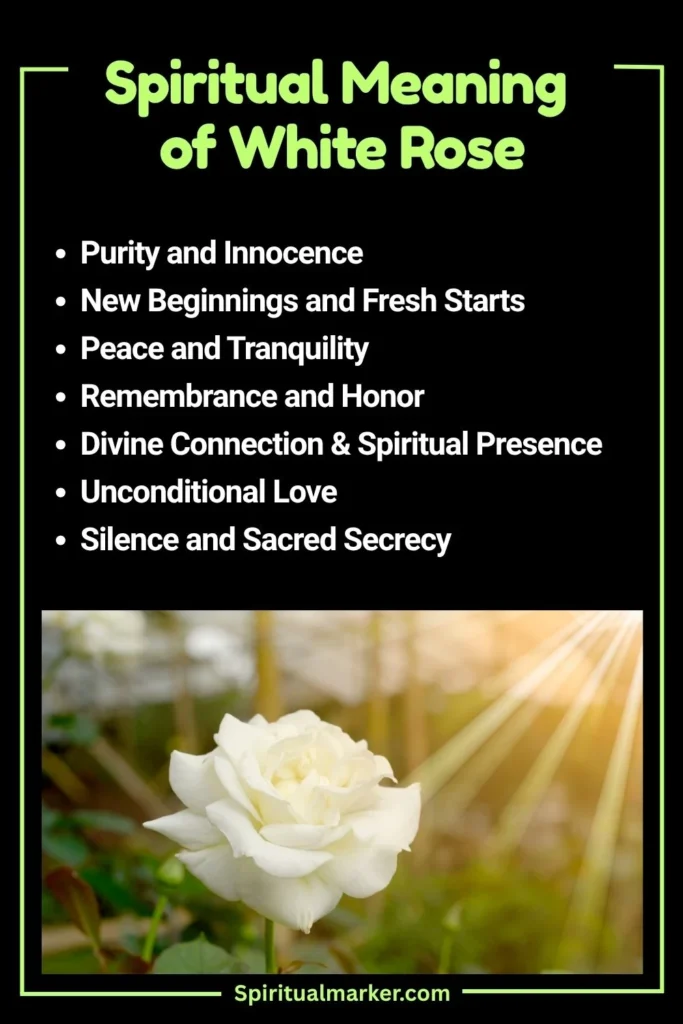
7 Spiritual Meanings of White Roses
1. Purity and Innocence
Among all white rose spiritual meanings, purity and innocence remain the most widely recognized. Across cultures, the white rose has long symbolized a heart untouched by deception, resentment, or harmful intentions. Its pristine petals create an immediate visual connection to cleanliness, honesty, and moral clarity. For centuries, people have associated white roses with life’s most sacred moments because they reflect qualities that many traditions consider spiritually valuable.
In Christianity, white roses often represent purity of soul and devotion to God. They frequently appear in religious artwork connected to the Virgin Mary, where the flower symbolizes virtue and divine grace. Similar ideas appear in other spiritual traditions, where white flowers signify a state of inner harmony and freedom from negative influences. Because of these associations, white roses are commonly present at baptisms, christenings, and ceremonies celebrating spiritual growth.
On a personal level, the white rose can remind us of the innocence we possessed before life’s disappointments, conflicts, and hardships shaped our perspectives. Rather than suggesting naivety, this symbolism points toward authenticity. It reflects the ability to approach life with sincerity, kindness, and a genuine heart despite past experiences. Many people view the appearance of a white rose as a symbol of returning to what is honest and true within themselves.
2. New Beginnings and Fresh Starts
The spiritual meaning of a white rose is also closely tied to new beginnings. Unlike brightly colored flowers that carry strong emotional associations, white often represents a blank page waiting to be written upon. Because of this, the white rose has become a powerful symbol of transition, renewal, and the possibility of starting again.
This symbolism explains why white roses appear so frequently at weddings. A marriage marks the beginning of a shared journey, and the flower serves as a visual representation of hope, commitment, and a future yet to unfold. Likewise, people often use white roses during graduations, house blessings, baby celebrations, and other milestones that signal a new chapter in life.
From a spiritual perspective, new beginnings involve more than external changes. They also reflect inner transformation. Many traditions teach that growth requires releasing old habits, outdated beliefs, or emotional burdens. The white rose represents this process of renewal. Its symbolism suggests leaving behind what no longer serves us and moving forward with greater clarity and purpose.
For individuals experiencing significant life changes, the white rose can serve as a reminder that endings and beginnings often occur together. While one chapter closes, another quietly opens, bringing opportunities for healing, learning, and personal evolution.
3. Peace and Tranquility
Another profound spiritual meaning of white roses is peace and tranquility. The color white naturally evokes feelings of calmness, simplicity, and stillness. As a result, many people associate white roses with emotional balance and spiritual serenity.
Throughout history, peaceful spaces such as monasteries, meditation gardens, and sacred retreats have incorporated white flowers to encourage contemplation and reflection. The gentle appearance of the white rose creates an atmosphere that feels less demanding and more restorative. It draws attention away from chaos and toward quiet awareness.
Spiritually, peace does not necessarily mean the absence of challenges. Instead, it often refers to maintaining inner stability despite external difficulties. In this context, the white rose symbolizes the ability to remain grounded during uncertainty. It reminds us that calmness can exist even when life feels complicated.
Many people report feeling a sense of comfort when they encounter white roses during emotionally difficult periods. Whether viewed as a spiritual sign or simply a meaningful symbol, the flower often serves as a visual reminder to slow down, reflect, and reconnect with a deeper sense of inner calm. Its presence encourages stillness in a world that constantly pushes us toward distraction and urgency.
4. Remembrance and Honor
White roses also carry a powerful connection to remembrance and honor. This symbolism becomes especially visible during funerals, memorial services, and ceremonies dedicated to celebrating the lives of those who have passed away. The flower expresses respect, dignity, and heartfelt appreciation without relying on dramatic displays of emotion.
Historically, white flowers have been used in mourning rituals because they communicate reverence and peace. Their quiet beauty reflects the solemn nature of remembrance while also conveying hope and spiritual continuity. For many families, white roses become a meaningful way to honor cherished memories and acknowledge the lasting impact of a loved one’s life.
Beyond funeral traditions, remembrance symbolism extends to everyday acts of gratitude. A white rose may represent appreciation for mentors, ancestors, friends, or anyone whose influence continues to shape our lives. In this sense, the flower serves as a bridge between past and present.
Spiritually, remembrance involves more than recalling events. It includes recognizing the wisdom, lessons, and love that continue to exist long after physical separation occurs. The white rose symbolizes this enduring connection, reminding us that meaningful relationships often leave a lasting imprint on the soul.
5. Divine Connection and Spiritual Presence
Many spiritual traditions associate white roses with divine connection and communication with higher realms. Because white symbolizes light, purity, and transcendence, the flower frequently appears in religious symbolism, mystical experiences, and accounts of spiritual encounters.
In Christian traditions, white roses often represent heavenly grace and divine love. In mystical literature, they sometimes symbolize spiritual awakening or the soul’s journey toward greater closeness with God. Similar themes appear across various faiths and belief systems, where white flowers signify sacred energy, enlightenment, or the presence of spiritual beings.
For some individuals, encountering white roses repeatedly during periods of prayer, meditation, or personal transformation feels deeply meaningful. While interpretations vary, many people view such experiences as reminders that they are supported, guided, or connected to something larger than themselves.
The white rose’s delicate appearance also reflects an important spiritual principle: profound truths often arrive quietly rather than dramatically. Instead of demanding attention, the flower invites contemplation. Its symbolism encourages individuals to look beyond everyday distractions and become more aware of spiritual dimensions that may already exist within their lives.
6. Unconditional Love
When people think of roses, romantic love often comes to mind. However, the white rose represents a different and often deeper form of affection: unconditional love. This type of love is not based on achievement, appearance, status, or personal gain. Instead, it reflects acceptance, compassion, and devotion that remain steady despite imperfections.
Many spiritual teachings identify unconditional love as one of humanity’s highest ideals. It appears in the bond between parents and children, lifelong friendships, acts of selfless service, and devotion to faith. The white rose symbolizes this pure expression of care because its beauty feels gentle rather than possessive or demanding.
In relationships, the white rose can represent forgiveness, trust, and emotional sincerity. It suggests a love rooted in mutual respect rather than expectation. This symbolism makes white roses popular choices for anniversaries, reconciliations, and meaningful family celebrations.
Spiritually, unconditional love extends beyond human relationships. It also refers to compassion toward oneself and others. The white rose reminds us that genuine love often involves patience, understanding, and grace. Its symbolism encourages a broader perspective, one that values connection and kindness above judgment and control.
7. Silence and Sacred Secrecy
The final spiritual meaning of the white rose centers on silence and secrecy. This symbolism traces back to ancient Rome, where roses were reportedly hung above meeting places to indicate that discussions should remain private. From this practice emerged the Latin phrase sub rosa, meaning “under the rose,” which became synonymous with confidentiality and discretion.
Over time, this historical tradition gained spiritual significance. Silence came to represent wisdom, restraint, and the recognition that not every truth needs immediate expression. Many spiritual paths teach that periods of quiet reflection allow deeper insights to emerge. In this context, the white rose symbolizes sacred knowledge protected from unnecessary exposure.
This meaning differs from secrecy rooted in fear or deception. Instead, it emphasizes respect for personal experiences, spiritual revelations, and confidential matters. Some aspects of life require contemplation before they can be fully understood or shared with others.
The white rose reminds us that silence can possess tremendous power. While modern culture often values constant communication, spiritual traditions frequently highlight the importance of stillness and thoughtful reflection. Through its connection to sub rosa, the white rose symbolizes the wisdom of knowing when to speak and when to remain quietly attentive.
White Rose Meaning and Symbolism Across Cultures and Religions
In Christianity, the white rose is closely tied to the Virgin Mary, often called the “Mystical Rose.” Catholic tradition associates the flower with her purity and grace, and white roses frequently appear near statues or images of Mary during prayer and devotion.
Victorian England developed an entire language around flowers, known as floriography. Within that system, the white rose communicated reverence and “I am worthy of you,” often given during courtship to express respect rather than passion. Eastern traditions, including parts of Chinese culture, link white flowers more broadly to mourning and the spirit world, making white roses a respectful choice at funerals and ancestral ceremonies.
In Islamic tradition, white holds strong associations with purity and the afterlife, and white flowers, including roses, often appear at burial sites as a mark of respect. Hindu spiritual practice ties white to Saraswati, the goddess of wisdom and purity, making white roses fitting offerings during prayer rituals focused on clarity and learning. Across nearly every belief system, the color consistently signals something sacred and untouched.
White Rose Symbolism in World Mythology
Greek mythology offers one of the most famous origin stories for the rose itself. According to legend, Aphrodite, the goddess of love, created the rose from the foam of the sea and her own tears, with white roses specifically tied to her grief over the death of Adonis. This myth cemented the flower’s link between love and loss, a pairing that still shapes its symbolism today.
Roman mythology absorbed and expanded this story, connecting the white rose to Venus and using it during secret meetings, as mentioned earlier with the “sub rosa” tradition. In some Norse legends, white flowers symbolized the presence of light spirits or guardians, believed to protect sacred spaces from darkness.
Persian poetry, particularly the works of Rumi and Hafiz, frequently used the rose as a metaphor for the soul’s longing for the divine. White roses, in this context, represented the purest form of that longing, untouched by ego or worldly desire. These myths, though separated by geography and centuries, point to the same conclusion. The white rose has always carried weight far beyond its petals.
White Rose Color Meaning Compared to Other Rose Colors
Color changes everything when it comes to rose symbolism. A red rose speaks of passionate, romantic love, while a yellow rose leans toward friendship and joy. Pink roses often represent gratitude and admiration, sitting somewhere between romance and platonic affection.
The white rose stands apart by representing something less personal and more universal. Where red burns with desire, white offers stillness and clarity. It does not demand attention the way bold colors do. Instead, it invites reflection, making it the natural choice for weddings, baptisms, funerals, and spiritual ceremonies where the focus shifts away from individual passion toward something larger.
This contrast explains why white roses appear at both the happiest and saddest moments of life. Birth and death, joy and grief, all share a need for purity and peace, and no other rose color captures that dual purpose quite as well.
White Rose Biblical Meaning and Significance
Scripture does not mention the white rose by name, since roses as we know them today were not common in biblical-era Israel. However, biblical symbolism around the color white speaks directly to the values the flower now represents. Revelation 19:8 describes saints clothed in “fine linen, bright and clean,” explicitly stating that the linen “stands for the righteous acts of God’s holy people.”
Isaiah 1:18 offers another powerful connection, with God declaring that sins, “though they are like scarlet,” will become “as white as snow.” This verse ties the color white directly to spiritual cleansing and forgiveness, a theme the white rose has come to represent in modern Christian symbolism. The Song of Solomon also references roses poetically when describing beauty and devotion, though scholars debate the exact flower meant in the original Hebrew text.
Because of these scriptural ties, many Christian communities now associate the white rose with baptism, communion, and the purity of the soul before God. It has become a visual extension of biblical promises around redemption and renewal, even without a direct verse naming the flower itself.
Dreaming About White Roses: Spiritual and Psychological Meanings
A dream featuring a white rose often carries weight that lingers long after you wake up. Spiritually, this dream frequently signals a coming season of peace after struggle. If you have been carrying grief, anxiety, or unresolved guilt, the white rose may appear as a gentle sign that healing is underway.
Some dream traditions interpret a white rose as a message from a deceased loved one, especially if the dream feels unusually vivid or peaceful. This interpretation aligns with widespread beliefs that white flowers act as bridges between the physical and spiritual worlds. Psychologically, Carl Jung’s work on dream symbolism suggests flowers often represent the unconscious mind processing emotional growth, with white specifically reflecting a desire for simplicity and emotional clarity.
A wilting or fading white rose in a dream can suggest the opposite, pointing toward unresolved tension or fear of loss. Context matters here. Who gave you the rose? Where did it appear? These details shape whether the dream points toward comfort or warns of something you have not yet addressed.
Seeing a White Rose After Someone Dies
Grief has a way of making people more attuned to small, meaningful signs, and the white rose ranks among the most reported. Many people describe finding a white rose blooming unexpectedly near a grave, a hospital, or a quiet corner of their home shortly after a loved one’s passing.
Spiritually, this is often interpreted as a message of comfort, a way for the departed to signal that they remain close. The flower’s association with peace and purity makes it a fitting symbol for a soul that has moved beyond earthly suffering. Funeral traditions across Christian, Jewish, and secular ceremonies frequently feature white roses for exactly this reason, honoring the deceased while offering quiet reassurance to those left behind.
You do not need to believe in literal signs to find comfort here. Even as a symbol rather than a message, the white rose offers grieving hearts a tangible way to express love that words cannot fully hold.
A Final Note
The white rose has carried sacred weight for thousands of years, and that weight has not faded with time. From biblical promises of cleansing to ancient myths of love and loss, this flower keeps showing up wherever people search for peace, purity, or connection to something greater than themselves.
If a white rose has recently crossed your path or appeared in a dream, sit with what it might be telling you. Consider keeping a journal of these moments, noting when and where they happen. You might also bring a white rose into your own space, whether through a fresh bloom, a planted bush, or simple art, as a daily reminder of clarity and calm. Whatever form it takes, let this flower’s quiet symbolism guide you toward a little more stillness in your day.