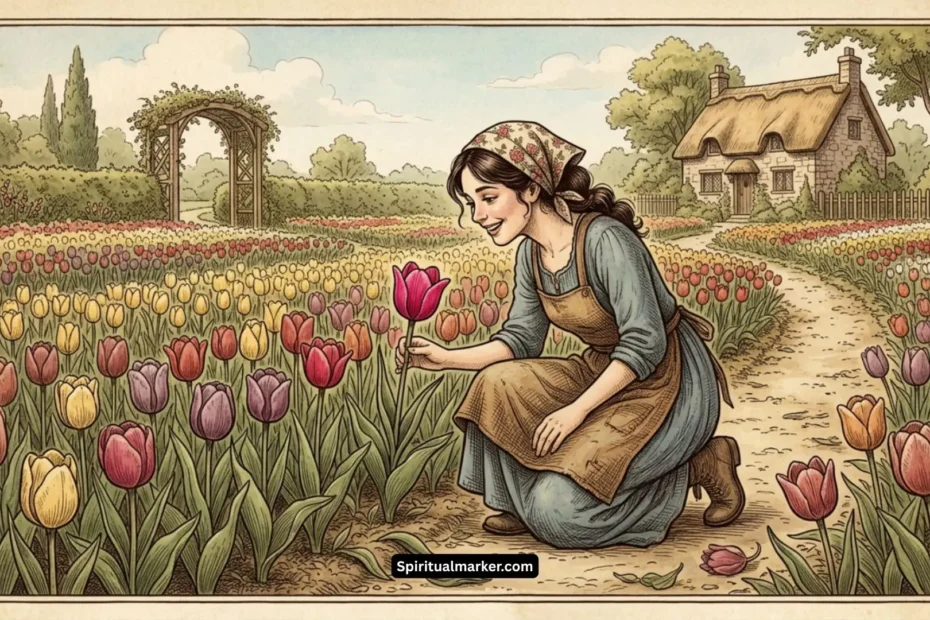
You have probably looked at a tulip and felt something shift inside you. That cup-shaped bloom, standing tall and bold after winter’s cold, stirs something deeper than simple admiration. It always has. Long before tulips decorated dinner tables and spring gardens, they held sacred space in the poetry of Persia, the palaces of Ottoman sultans, and the spiritual writings of Christian scholars. The tulip spiritual meaning runs far deeper than most people realize.
Across centuries, the tulip has carried the weight of perfect love, divine connection, renewal, and transformation. Its elegant cup shape was seen as a vessel for passion, a container of divine light, and a symbol of the open heart reaching toward God. The Ottoman word for tulip, lale, shares the same Arabic letters as the word for Allah, a connection that deepened the flower’s sacred resonance across the Islamic world. That kind of spiritual weight does not come from a pretty petal. It comes from centuries of human beings projecting their deepest longings onto a single, magnificent bloom.
This post walks through the spiritual symbolism of tulips in full depth. You will learn what the tulip means spiritually, how different colors shift that meaning, what role tulips play in world religions and mythologies, what it means to see tulips in your dreams, and why, even today, this flower carries one of the richest symbolic legacies in the natural world. Whether you grow tulips in your garden, received them as a gift, or keep returning to them in meditation and ritual, what follows will transform the way you see them.
Key Takeaways
Before diving deep, here are five core truths about tulip spiritual meaning and symbolism:
- The tulip is one of the world’s oldest symbols of perfect love and divine beauty, originating in Persian and Ottoman spiritual traditions where it represented paradise on earth and the heart longing for God.
- Each tulip color carries its own distinct spiritual message, from red for passionate love and sacrifice to white for forgiveness, purple for royalty, and yellow for cheerfulness and renewed hope.
- The Ottoman word for tulip (lale) shares the same letters as “Allah” in Arabic script, giving the flower a uniquely sacred linguistic connection to the divine in Islamic culture.
- In Christian and biblical tradition, tulips align with themes of resurrection, divine grace, and the fleeting beauty of earthly life, appearing in Easter symbolism and Dutch religious art.
- Dreaming of tulips is widely interpreted as a positive spiritual omen, signaling new beginnings, incoming love, emotional healing, or a call to forgive and release the past.
What Is the Tulip and Why Does It Hold Spiritual Power?
The tulip belongs to the genus Tulipa and the lily family, Liliaceae. It originated in the wild mountain slopes of Central Asia before being cultivated in Persia as early as the 10th century. Historians trace the tulip’s journey from Central Asia through the Ottoman Empire, where it became a symbol of paradise, and then westward into Europe through the 16th century diplomatic routes. Its name traces back to the Turkish word tülbänd, meaning turban, because of the flower’s resemblance to that wrapped headwear worn across the Ottoman world.
What makes the tulip spiritually powerful is a combination of qualities rarely found in a single flower. It emerges from a dormant bulb buried in cold, dark earth. It pushes through frozen ground and blooms with extraordinary speed. Its cup shape acts as a vessel, and in the language of spiritual metaphor, vessels hold meaning. Ancient poets and mystics saw that cup as holding the fire of passion, divine light, or the sacred longing of the human soul. The tulip’s annual return from apparent death gives it an undeniable association with resurrection, renewal, and the cyclical nature of life.
Spiritual traditions across cultures recognized that the tulip’s beauty was never permanent. It bloomed brilliantly and faded quickly. That brevity made it a powerful teacher. It mirrored the fragility of human existence, the fleeting nature of earthly beauty, and the enduring power of love that transcends physical form. When something beautiful is gone too soon, the memory of it deepens. The tulip has always known that.
What Does Seeing a Tulip Symbolize or Represent?
When you see a tulip, whether in a garden, a dream, a piece of art, or a bouquet placed in your hands, you are receiving a layered message. At its most essential level, the tulip symbolizes perfect love. Not the possessive, anxious kind of love, but the complete, devoted, sacrificial kind. Persian poets wrote of lovers who became tulips after death, their blood feeding the red blooms that rose from the earth in their memory. That image is not morbid. It is a declaration that love strong enough to die for leaves something beautiful behind.
Seeing a tulip also signals renewal and spiritual awakening. Since the flower emerges in spring after winter’s long darkness, it carries the energy of things beginning again. Spiritually, it asks you to consider what in your own life is ready to bloom after a period of stillness or struggle. Spiritual teachers across traditions have used the tulip’s growth cycle as a metaphor for the soul’s journey, from dormancy through darkness, toward light and full expression.
There is also a message of elegance and divine grace embedded in seeing a tulip. The flower does not shout. It stands with quiet confidence. It opens when the sun rises and closes when darkness falls, a behavior that philosopher Francis Bacon linked to an awareness of time’s passage. In that sense, the tulip asks you to be present, to open fully in the light, and to rest when the day is done. That rhythm is deeply spiritual.
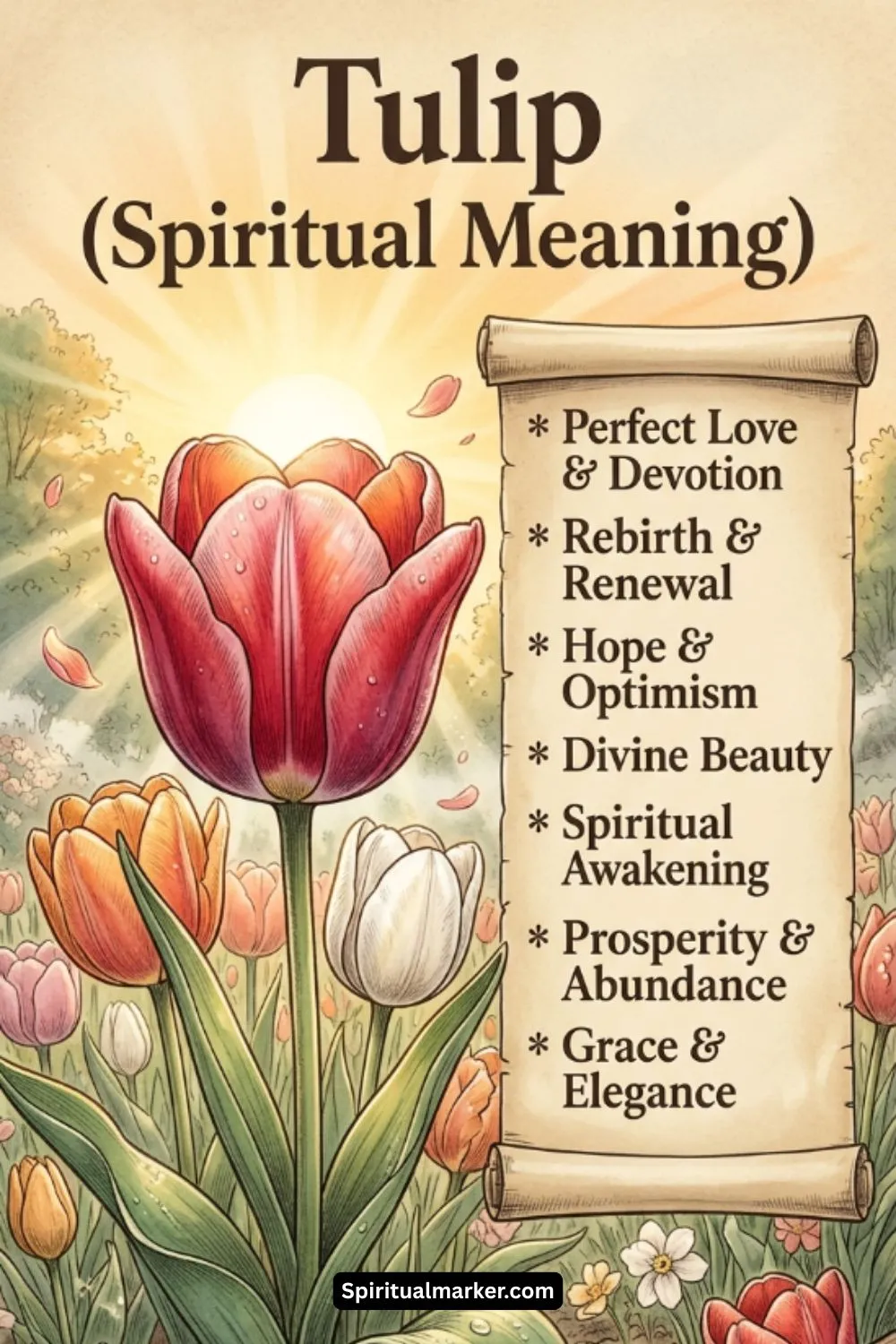
7 Spiritual Meanings of the Tulip
1. Perfect Love and Devoted Sacrifice
The tulip’s most ancient and powerful spiritual meaning is perfect love. This is not casual affection. Persian poetry, particularly the work of the 14th-century poet Hafez, used the red tulip repeatedly as a symbol of love so complete it transcended death. In the famous legend of Farhad and Shirin, a stonemason fell so deeply in love with a princess that when he was falsely told she had died, he rode his horse off a cliff. Where his blood touched the earth, red tulips grew. That image burned itself into Persian and Turkish cultural identity for centuries.
The cup shape of the tulip reinforced this symbolism. Persian mystics described the tulip’s dark center as a heart burned by love, scorched by the very intensity of its devotion. The cup itself was a vessel holding that fire of passion. In Sufi Islamic mysticism, that same cup represented the receptive heart, open and longing for union with the divine. Love, in its purest spiritual form, is both painful and transcendent, and the tulip holds both qualities without contradiction.
Modern spiritual practitioners continue to work with this meaning. A red tulip placed on an altar, carried as a token, or meditated upon becomes a powerful anchor for the intention of deep, unconditional love. It reminds you that love is not a comfortable state. Real love requires full presence, full surrender, and the willingness to be transformed by what you feel. The tulip is not gentle in its symbolism here. It is fierce.
2. Renewal, Rebirth, and Spiritual Awakening
The tulip’s emergence from a cold, buried bulb is one of the most powerful natural metaphors for spiritual renewal. Every autumn, the bulb goes into the ground. It sits through winter in darkness, cold, and apparent stillness. Then, at just the right time, something shifts. The bulb cracks open. Life pushes upward through the soil. The tulip does not fight this process. It trusts it completely. That trust in the timing of resurrection is the core spiritual lesson of the tulip’s growth cycle.
In numerology, tulips connect to the number seven, considered the perfect spiritual number, associated with inner wisdom, intuition, and enlightenment. Seven reminds us that spiritual awakening follows its own divine timing. You cannot rush the bulb to bloom before winter has finished. You cannot force the soul to awaken before it is ready. The tulip teaches patience with your own spiritual process. It teaches faith in what cannot yet be seen.
Across spiritual traditions, the tulip’s spring bloom represents the soul emerging from darkness into light. In Buddhist teaching, the flower’s brief life cycle illustrates the principle of impermanence, or anicca. A tulip in full bloom is perfect and temporary. Clinging to that bloom would cause suffering. Receiving it, honoring it, and releasing it when the time comes is the spiritually mature response. In this way, the tulip becomes a teacher of non-attachment as well as renewal.
3. Divine Connection and Mystical Union
Few flowers carry as direct a linguistic connection to the divine as the tulip. In Ottoman Turkish, the word for tulip, lale, shares the same Arabic letters as the name of God, Allah, when written without diacritical marks. This was not a coincidence that Ottoman spiritual scholars ignored. It became a source of profound reflection. The tulip’s very name pointed toward the divine. Its presence was a reminder of God’s beauty and perfection embedded in the natural world.
In Sufi mysticism, the tulip’s cup shape carried specific spiritual weight. Sufi teachers described it as the receptive, open heart longing for union with God. The mystic’s path involves dissolving the ego and opening completely to divine love. The tulip, with its wide-open cup facing upward toward the sky, was the perfect visual metaphor for that spiritual posture. It does not hide. It does not close itself to what the heavens might send. It opens, fully and completely, and receives.
In astrology, tulips are associated with the planet Venus, ruler of love, beauty, and spiritual harmony. Venus governs the heart’s capacity to give and receive love, to appreciate beauty in all its forms, and to seek connection with something greater than the self. That planetary association reinforces the tulip’s role as a spiritual bridge between human longing and divine fulfillment. When you bring tulips into your sacred space, you invite the Venusian quality of open-hearted, beauty-centered devotion.
4. Forgiveness, Purity, and Emotional Healing
White tulips hold a particular spiritual meaning that extends far beyond their color. They represent forgiveness, purity, and emotional cleansing. In Germanic folklore, a white tulip placed under a pillow was believed to ward off nightmare spirits, its pale color confusing dark entities that could not see past the flower’s luminous energy. Contemporary spirit workers have retained this practice, pairing white tulips with selenite for dream protection and emotional purification during sleep.
The healing power of the white tulip works on a deep emotional level. Spiritual practitioners describe it as the neutral healer of the tulip world. It holds neither the fire of red love nor the grief of wilting blooms. White tulips occupy the space between, where wounds are acknowledged, processed, and released. Placing white tulips on an altar with the written name of someone you need to forgive, and watching them open a little more each day, is a practice that many report produces genuine emotional shifts.
The Christian tradition aligns with this meaning. White tulips in Christian symbolism represent forgiveness and divine grace. They also connect to the concept of redemption through purity, the idea that the soul washed clean can start again. In Christian art, white flowers appearing in spring scenes have long been read as symbols of resurrection and the mercy of God extended to those who seek it. The white tulip carries that mercy quietly and without drama.
5. Prosperity, Abundance, and Earthly Blessings
The tulip has been a symbol of wealth and abundance for centuries, and that association is not merely material. In the Ottoman Empire, the tulip decorated the tilework of palaces, the silk textiles worn by royalty, and the calligraphy adorning sacred manuscripts. To the Ottomans, the tulip represented not just physical wealth but the abundance that comes from divine favor. A life blessed by God would naturally be beautiful, ordered, and full. The tulip was the visual representation of that blessed fullness.
In the Netherlands, the tulip became so strongly associated with prosperity that its economic history mirrors its spiritual meaning in striking ways. The 17th-century Tulip Mania saw single bulbs selling for the equivalent of a skilled craftsman’s annual salary. While that bubble ultimately crashed and warned against greed, the underlying reality remained: people across cultures have consistently perceived the tulip as something worth pursuing, worth protecting, and worth celebrating. That instinct reflects a deeper recognition of the flower’s energy of abundance.
In the Victorian Flower Oracle tarot, the tulip represents prosperity and the state of self-actualization. In the Gratitude Tarot, it appears as the Ace of Thankfulness, representing abundance about to blossom. These spiritual and divination traditions link the tulip to a state of being in which you are fully present, fully grateful, and fully open to receiving what life has to offer. That state of openness is itself a form of spiritual abundance.
6. Transformation and the Courage to Change
The tulip’s annual cycle of burial, dormancy, and blooming makes it a potent symbol of transformation. It does not bloom once and remain. It returns to the earth, rests in darkness, and rises again, often stronger than before. This is not passive change. The tulip actively breaks through soil. It pushes against weight and resistance. It stretches toward light even when that light is not yet visible. That active quality of transformation is what makes the tulip’s symbolism so personally challenging and so deeply inspiring.
Many spiritual teachers who work with seasonal energies use the tulip specifically at the threshold between winter and spring, around the Pagan festival of Ostara, as a symbol of resurrection and returning life force. The tulip blooms exactly at the liminal point between cold and warmth, between darkness and full light. Liminal spaces, in spiritual terms, are the most powerful places for transformation. They are where the old self ends and the new self begins. The tulip marks that threshold with color and grace.
On a personal level, the tulip asks you to trust your own transformation even when you cannot see its outcome. The bulb in the ground has no evidence that spring is coming. It does not know what the bloom will look like. It simply responds to the conditions around it and grows. That is the spiritual invitation of the tulip: to transform without needing proof of the destination.
7. Elegance, Balance, and the Beauty of Impermanence
The tulip is neither too showy nor too plain. Its form is balanced, its colors bold but not garish. Spiritual symbolism experts note that the tulip’s symmetrical form represents emotional and spiritual balance. It models a way of being in the world that is neither suppressed nor excessive, present and beautiful without demanding to be the center of everything. In a world that often rewards extremes, the tulip’s balanced elegance is a genuinely countercultural spiritual message.
The poet Hafez captured the tulip’s wisdom about impermanence most memorably. Its petals are vibrant and brief. Its bloom is complete and temporary. Rather than making the tulip less beautiful, that brevity concentrates its beauty into something almost unbearably vivid. Spiritual teachers across traditions have returned to this quality repeatedly. The Buddhist principle of anicca, the impermanence of all things, finds its most persuasive natural argument in a field of tulips at peak bloom.
You are meant to receive the tulip’s beauty fully and let it go without grief when the time comes. That practice, repeated each spring, trains the soul in one of its most essential skills: the ability to love what is temporary without being destroyed by its passing. The tulip blooms, teaches, and releases, asking you to do the same with everything you love.
Tulip Spiritual Meaning by Color
Color is not decoration in the language of the tulip. It is the message itself. Each shade shifts the flower’s core meaning in a specific direction, giving you a more precise spiritual communication depending on which color you encounter or choose.
Red tulips carry the deepest and most ancient meaning: passionate, devoted, sacrificial love. In magical traditions, red tulips are used in love rituals, spells for deepening connection, and workings related to truth and authentic emotional expression. The red tulip does not ask whether love is convenient. It declares love without reservation.
White tulips speak of forgiveness, purity, and new beginnings after a period of difficulty or estrangement. White tulips on altars honor ancestors, support grief work, and create a spiritually clean space for healing conversations. They carry the energy of a slate wiped clean.
Purple tulips represent royalty, spiritual authority, and admiration. They have been used on ancestral altars in some spiritual traditions to honor the dignity of those who came before. Purple tulips placed in a space elevate its energy toward refinement and wisdom.
Yellow tulips have shifted their meaning over centuries. Once associated with jealousy, they now carry joy, cheerfulness, friendship, and hopeful new beginnings. Yellow tulips bring solar energy into a space, lifting mood and signaling that brighter days are ahead.
Pink tulips express affection, gratitude, and tender care. They are the flowers of warm, nurturing relationships rather than passionate romance. Orange tulips radiate enthusiasm, encouragement, and the energy needed to draw something or someone you desire closer. Cream or ivory tulips carry a message of eternal love, quieter and more enduring than red’s fire.
The dark purple variety known as Queen of the Night stands apart from all others. Its color is so deep it appears almost black. Practitioners use this tulip in full moon rituals, workings related to power and ambition, and banishing ceremonies. It occupies the space between the visible and invisible worlds.
Tulip Meaning and Symbolism Across Cultures and Religions
No other flower has traveled quite so far spiritually or geographically. The tulip’s symbolism shifted in significant ways as it moved from Central Asia through Persia, the Ottoman Empire, Europe, and eventually the wider world. Each culture received the same flower and found something different in it, something that reflected their own deepest values and spiritual needs.
In Persian culture, the tulip known as laleh became one of the most emotionally charged symbols in all of literary history. Persian poets such as Ferdowsi and Saadi wove tulips into narratives of love and heroism, using the flower as a metaphor for the fleeting brilliance of a well-lived life. After the Islamic Revolution of 1979, the red tulip appeared on Iranian banknotes and official emblems as a symbol of revolutionary martyrdom, a direct continuation of the Hafez tradition carried into modern political life. In contemporary Iran, tulips remain central to Nowruz, the Persian New Year, placed in homes as symbols of renewal and divine blessing.
In Ottoman Turkish culture, the tulip reached its most elaborate spiritual and artistic expression. During the Lale Devri, the Tulip Age of 1718 to 1730, Sultan Ahmed III made tulip cultivation the supreme aristocratic obsession of his court. Tulip motifs appeared on the tilework of the Topkapi Palace, in silk textiles, in book illuminations, and across the calligraphic tradition. To the Ottomans, the tulip represented the gardens of heaven described in the Quran, a visible taste of paradise available on earth.
In the Netherlands, the tulip became a symbol of national identity and commercial power. The Dutch Golden Age transformed the tulip from an exotic Eastern import into a cultural cornerstone. Today, the Netherlands produces millions of tulip bulbs annually. The Amsterdam Keukenhof Gardens, covering over 79 acres, remains one of the world’s largest flower gardens, a living testament to the Dutch spiritual relationship with the tulip as a symbol of abundance, spring, and national pride.
In Victorian England, the language of flowers known as floriography gave tulips specific emotional meanings. Red tulips declared romantic love. Yellow ones communicated cheerful thoughts. Victorian lovers used flower arrangements to say what social convention would not allow them to speak aloud. The tulip became one of the most versatile instruments in that silent emotional vocabulary.
Tulip Symbolism in World Mythologies
The richest mythological associations with the tulip come from Turkish and Persian folklore, where the flower grew directly from the stories of star-crossed lovers. The legend of Farhad and Shirin, told across both traditions with slight variations, tells of a stonemason so devoted to a princess that her father set him an impossible task to keep them apart. In some versions, Farhad completed the task only to be told falsely that Shirin had died. He took his own life, and from his blood, red tulips sprang from the earth. The story permanently coded the red tulip as the flower of love stronger than death.
In Greek and Roman mythology, the tulip holds a more subtle presence. Some sources connect the tulip to the goddess Cybele, the Phrygian great mother deity who was often depicted with floral crowns. The tulip’s association with Venus and Aphrodite, goddesses of love and beauty, is stronger and more consistently recorded in Western spiritual traditions. The flower’s cup shape, its bold color, and its brief but intense bloom season all align with Venus’s qualities: beautiful, passionate, and fully present in the moment.
Central European folk magic, particularly Hungarian and Transylvanian traditions, embroidered tulip motifs onto protective household items to ward off the evil eye and bless the home. The tulip appeared on clothing, ceramics, and furniture as a guardian symbol. This use extended the tulip’s spiritual meaning beyond love and renewal into active protection, making it a flower that could shield a household from harm through the power of its symbolism alone.
In Turkish folklore, the tulip was said to represent the love between two separated souls eventually reunited. That narrative of separation, longing, and return mirrors the mystic’s journey in Sufi tradition: the soul separated from its divine source, longing through earthly life for reunion, and ultimately finding its way back. The tulip, both in folklore and Sufi mysticism, holds that entire spiritual arc within its petals.
Tulip Biblical Meanings and Significance
The Bible does not mention the tulip by name. However, biblical scholars have noted that when Jesus spoke of the lilies of the field in Matthew 6:28-29, the Greek word likely referred to a broad category of wildflowers, including tulips. Wild tulips, including Tulipa systola and Tulipa sharonensis, grow natively in the fields of Israel today. When Jesus declared that not even Solomon in all his glory was dressed like one of these, he was, in the most literal reading, speaking about flowers that include the tulip.
That context carries enormous weight. Jesus used wildflowers, quite possibly tulips, to teach one of his most important spiritual lessons: do not worry about your material needs, because the God who clothes the fields in this beauty will take care of you. The tulip, in that reading, becomes a direct symbol of divine provision, of God’s active care for creation, and of the peace that comes from trusting that care fully.
Beyond that passage, Christian symbolic tradition has associated the tulip with resurrection and divine grace. The three petals of a tulip are said in some Christian interpretations to represent the Holy Trinity. The tulip’s annual return from burial in the earth mirrors the resurrection of Christ, making it a natural symbol for the Easter season. In European Christian art, particularly the Dutch still life paintings of the 17th century, tulips appeared as reminders of God’s beauty and the transient nature of earthly pleasures, intended to direct the viewer’s attention toward eternal truths rather than perishable things.
Christian writers have also drawn on the tulip’s growth process as a metaphor for faith. The bulb in the ground, waiting through winter in darkness without evidence of spring, becomes a picture of the believer holding onto God’s promises during spiritually difficult seasons. Like the bulb, the faithful person does not quit. The ground may feel frozen and the wait may seem endless, but the bloom is coming. That is the faith the tulip embodies.
In Reformed theology, the acronym TULIP itself has come to represent the five points of Calvinism: Total Depravity, Unconditional Election, Limited Atonement, Irresistible Grace, and Perseverance of the Saints. The Huguenots carried tulip bulbs when they fled religious persecution in France to England in the late 17th century. Dutch immigrants brought them to America. The tulip became, quite literally, a flower carried by people of faith into exile, a portable piece of home and hope during seasons of profound hardship.
Dreaming About Tulips: Spiritual and Psychological Meanings
Tulips in dreams are widely considered positive omens. Because of their strong cultural and psychological association with spring and new beginnings, tulips in dream states often signal that a fresh chapter is approaching. Dream symbolism traditions interpret a tulip dream as a sign that you are on the right path, that your efforts are bearing fruit, and that the abundance you have been patient for is beginning to arrive.
The color of the tulip in your dream shifts the message significantly. Red tulips in dreams may signal incoming love or the deepening of an existing romantic connection. White tulips often point toward a need for healing, forgiveness, or a clean emotional start. Yellow tulips signal that happiness, friendship, or a soulmate connection may be near. Purple tulips in a dream suggest faithfulness, loyalty, and spiritual depth in a current or approaching relationship. Orange tulips bring a message of happiness and new sources of joy entering your life.
A field of blooming tulips in a dream is a particularly powerful image. Spiritual interpreters read this as a representation of abundance, new beginnings, and a season of flourishing. It suggests that multiple areas of your life are opening simultaneously, that you have arrived at a moment of genuine blossoming after a period of dormancy or difficulty. Withered or dying tulips carry the opposite message, inviting you to look at a relationship, project, or aspiration that needs attention before it fades completely.
From a psychological perspective, dreaming of tulips connects to themes of aesthetic awakening and heightened emotional richness. The dream may reflect your mind processing a recent experience of beauty, a desire for deeper connection, or the internal emergence of something that has been growing quietly within you. Persian mythology added another dimension: in the dream tradition rooted in the Farhad and Shirin legend, the red tulip in a dream may ask you to examine the depth of your own capacity for devotion, asking whether you are fully committed to what you claim to love.
In Victorian flower oracle traditions, a tulip appearing in a dream or in a reading signals a time of heightened spiritual senses and clear personal energy. It asks you to use that heightened awareness to assess the people and situations around you honestly. The tulip in this context is a truth-teller, a flower that clears away illusion and helps you see what is actually present rather than what you wish were there.
A Final Note
The tulip is not a simple flower. It never has been. It carries within its cup-shaped bloom a thousand years of human longing, devotion, grief, joy, spiritual searching, and divine encounter. From the Persian poets who wrote of love strong enough to turn a man into a bloom, to the Ottoman mystics who saw in its name the name of God, to the Christian believers who carried its bulbs through exile and planted them as acts of hope, the tulip has always been more than what it appears on the surface.
What the tulip offers you spiritually is a complete vocabulary for what it means to be fully alive. It speaks of perfect love, seasonal renewal, divine grace, courageous transformation, and the practice of receiving beauty without clinging to it. Those are not small lessons. They are, arguably, the central lessons of a meaningful human life.
When you next encounter a tulip, whether in a garden, a dream, a painting, or a bouquet placed in your hands, you might take a moment to receive what it carries. You might consider keeping tulips in your meditation or prayer space to anchor intentions of renewal and love. Planting tulip bulbs in autumn, trusting they will bloom in spring without you being able to see the progress, is itself a spiritual practice. And if you find yourself drawn to a particular color, pay attention. The tulip has been communicating in color for centuries, and it may have something specific to say to you right now.
References
- BloomsyBox. “Tulip Symbolism Across Cultures: A Global Perspective.” bloomsybox.com
- Dayli Floral. “Tulip Flower Symbolism: Love, Prosperity, and History Across Cultures.” daylilyfloral.com
- Urban Flowers. “The Meaning and Symbolism of Tulips.” urbanflowers.co.th
- Hello Fearless. “Tulip Flower Meaning, Spiritual Symbolism, Color Meaning & More.” hellofearless.com
- Wisdom of the Spirit. “Tulip Flower Meaning & Symbolism in Mythology, Folklore & Spirit Work.” wisdomofthespirit.com
- SymboNest. “Tulip Symbolism: The Deep Spiritual Meaning of Love, Renewal, and Perfect Balance.” symbonest.com
- Spirituality Shepherd. “Blossoming with Spirituality: The Symbolic Meaning of Tulips.” spiritualityshepherd.com
- Well Live Florist. “Tulip Symbolism Across Cultures: Beauty with Meaning.” wellliveflorist.com
- Blooming Expert. “Tulip Meaning: Symbolism, Colour Meanings and Cultural History.” bloomingexpert.com
- Flowers Valley. “Tulips: Color Meanings, Symbolism & Flower History.” flowersvalley.com
- Tenth Presbyterian Church. “A Short Theology of the Tulip.” tenth.org
- Flower Pursuits. “What Do Tulips Represent in the Bible?” flowerpursuits.com
- Garden in Delight. “Trust the Lord in Tulips.” gardenindelight.com
- Ligonier Ministries. “What Is TULIP?” learn.ligonier.org
- Learn Religions. “Tulip Magic, Legends and Folklore.” learnreligions.com
- Mirror Within. “Tulip Dream Meaning & Interpretation.” mirrorwithin.org
- Foliage Friend. “Tulip Flower Meaning, Spiritual Symbolism & Significance.” foliagefriend.com
- Building Beautiful Souls. “Tulip Meaning & Symbolism.” buildingbeautifulsouls.com
- Wisdom of the Spirit. “White Tulip Meaning & Symbolism.” wisdomofthespirit.com
- SunSigns. “Seeing A Tulip In Your Dream: Meaning, Interpretation And Symbolism.” sunsigns.org