The eagle has soared through human imagination for thousands of years, and it rarely shows up by accident. You look up, catch sight of those wide wings cutting across the sky, and something in you stills. That moment feels personal, almost like a message aimed directly at you.
Across continents and centuries, people have treated the eagle as far more than a bird of prey. Ancient priests in Rome read its flight paths to predict the will of the gods. Norse warriors believed it perched atop the World Tree itself. Native American elders still honor it as the closest creature to the Creator.
This article walks through the eagle spiritual meaning and symbolism found in cultures, religions, mythologies, biblical texts, and even dreams, so you can understand exactly why this bird commands such reverence wherever it appears.
Key Takeaways
- The eagle symbolizes strength, vision, courage, and a direct connection to the divine in nearly every major culture.
- Ancient Rome, Egypt, Norse mythology, and Native American traditions each gave the eagle a sacred, often god-linked role.
- In the Bible, the eagle represents renewal, divine protection, and unwavering faith during difficult seasons.
- Seeing an eagle often signals a spiritual nudge toward higher perspective, confidence, and personal transformation.
- Dreaming about eagles tends to reflect your own ambition, freedom, or a need to rise above current struggles.
What Is the Eagle and Why Does It Hold Spiritual Power?
The eagle is a large bird of prey known for its sharp eyesight, powerful wingspan, and ability to fly at extreme heights. Biologically, it sits at the top of its food chain with almost no natural predators. That dominance alone explains part of its symbolic weight. Humans have always assigned spiritual meaning to creatures that master a realm we cannot reach, and the open sky has always represented the divine, the unknown, and the unreachable.
Spiritually, the eagle holds power because it bridges two worlds. It belongs to the earth, yet it spends most of its life closer to the heavens than any other animal. Many traditions view this bird as a messenger between humans and higher powers, a courier carrying prayers upward and wisdom back down. Its keen eyesight, capable of spotting prey from miles away, became a metaphor for spiritual clarity and foresight. You will notice this theme repeating itself across Roman, Christian, Hindu, and Native American belief systems, even though these cultures never shared direct contact.
Researchers in comparative mythology often point out that birds capable of flying highest tend to attract the deepest spiritual symbolism, since ancient people associated altitude with proximity to gods. The eagle, flying higher than almost any other bird and able to stare directly into the sun without flinching, naturally became a symbol reserved for kings, warriors, and deities. That reputation has not faded. It has simply traveled forward through scripture, folklore, and modern spiritual practice.
Lifespan adds another layer to the eagle’s spiritual reputation. Some species live well past thirty years in the wild, far longer than most birds their size. Ancient observers noticed this longevity and connected it to wisdom accumulated over time, treating older eagles almost like elders within the animal kingdom. This idea still surfaces today when people describe an eagle sighting as feeling wise or knowing, rather than simply wild.
What Does Seeing an Eagle Symbolize or Represent?
Spotting an eagle in the wild, especially when it feels unexpected, often carries a spiritual nudge rather than pure coincidence. Many people describe the encounter as a sudden shift in mood, a feeling of being watched over or reminded of something bigger than daily routine. The eagle’s presence usually points toward themes of strength, freedom, vision, and renewal.
If an eagle crosses your path during a hard season, it often signals that you have the strength to rise above your current circumstances. If it appears while you are deep in thought or facing a decision, it may represent a call toward clearer judgment. Some spiritual teachers describe the eagle as a sign to trust your instincts and stop second-guessing a choice you already know is right. Others interpret it as confirmation that your prayers or intentions have been heard.
Context shapes the message just as much as the sighting itself. An eagle circling overhead while you sit with a heavy decision feels different from one gliding past during a peaceful walk. Pay attention to your emotional state the moment you see it, since your inner reaction often holds the real clue to what the sighting means for your life right now.
The number of eagles you see can shift the message as well. A single eagle often points toward personal strength or an individual decision waiting on your attention. Two eagles flying together frequently relate to partnership, balance, or a relationship reaching a turning point. Several spiritual practitioners also note the direction of flight matters. An eagle climbing higher into the sky tends to represent expanding opportunity, while one descending toward the ground may suggest it is time to bring an idea down from theory into action.
Location plays a role too. An eagle spotted near water often combines its usual symbolism with themes of emotional clarity, since water traditionally represents feeling and intuition across most spiritual systems. An eagle near mountains or high cliffs tends to reinforce themes of ambition and long-term vision, reminding you that real achievement usually requires patience above quick wins.
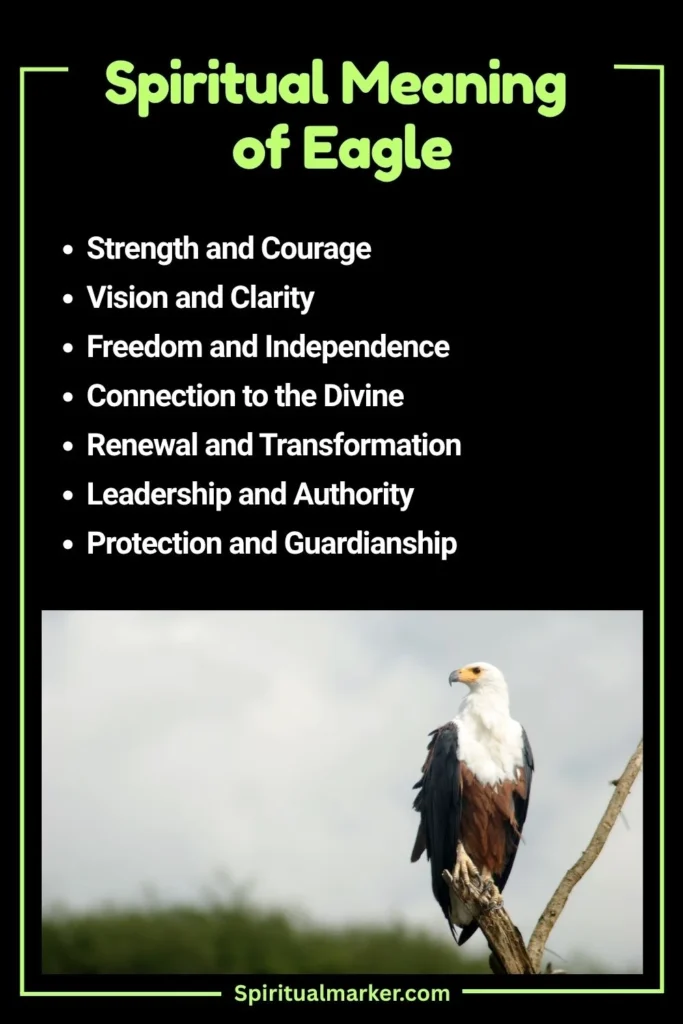
7 Spiritual Meanings of the Eagle
1. Strength and Courage
Few birds command respect the way an eagle does. Whether soaring through powerful winds or pursuing prey that appears far beyond its size, the eagle embodies a remarkable combination of confidence, resilience, and fearlessness. For centuries, cultures around the world have viewed the eagle as a symbol of inner strength because it confronts challenges rather than avoiding them. It does not wait for ideal conditions before taking flight. Instead, it rises above storms and uses difficult circumstances to gain greater altitude.
Spiritually, the eagle often appears during periods of uncertainty, fear, or personal struggle. Many people encounter eagle symbolism when they face decisions that require bravery, such as changing careers, ending unhealthy relationships, speaking difficult truths, or stepping into unfamiliar territory. In this context, the eagle serves as a reminder that courage is not the absence of fear. Rather, courage is the willingness to move forward despite fear.
This symbolism also points toward hidden reserves of strength. During challenging seasons, people often underestimate their own abilities. The eagle’s presence suggests that resilience already exists within you, even if current circumstances make it difficult to recognize. Instead of focusing on obstacles, the eagle encourages a mindset centered on capability, determination, and trust in one’s own power.
2. Vision and Clarity
The eagle’s extraordinary eyesight has fascinated humanity for generations. It can identify movement from incredible distances and focus with remarkable precision. Because of this unique ability, the eagle became a powerful spiritual symbol of vision, wisdom, and higher perception.
In spiritual traditions, vision extends far beyond physical sight. It refers to the ability to recognize truths that are not immediately obvious. While many people become distracted by short-term concerns, emotional reactions, or external pressures, eagle energy encourages a broader perspective. It asks us to rise above immediate circumstances and see the bigger picture.
This symbolism often becomes relevant when someone feels confused about a decision or uncertain about the future. The eagle reminds us that clarity frequently exists before confidence arrives. Sometimes the answer is already visible, but fear, overthinking, or outside influences create mental fog. The eagle’s message is not necessarily that new information is needed. Instead, it suggests that a higher vantage point may reveal what has been there all along.
Many spiritual interpretations also associate eagle vision with intuition. The bird’s sharp focus symbolizes the ability to recognize opportunities, avoid potential pitfalls, and distinguish truth from illusion. As a result, the eagle represents discernment, wisdom, and the confidence to trust what you genuinely see rather than what others expect you to see.
3. Freedom and Independence
One of the most striking characteristics of an eagle is its preference for soaring alone. Unlike many birds that travel in large flocks, eagles often navigate vast distances independently, relying on their own instincts and abilities. This behavior has made them enduring symbols of freedom, self-reliance, and personal sovereignty.
Spiritually, eagle symbolism frequently appears during times when individuals are reassessing the limitations in their lives. These limitations may take many forms, including restrictive beliefs, unhealthy relationships, social expectations, or environments that no longer support personal growth. The eagle’s flight represents the desire to move beyond those boundaries and claim greater authenticity.
Freedom in this context is not simply about physical independence. It also involves emotional and spiritual liberation. Many people spend years carrying fears, guilt, obligations, or identities that no longer reflect who they truly are. The eagle symbolizes the courage required to release those burdens and create space for personal evolution.
At the same time, eagle symbolism highlights the responsibilities that accompany freedom. Independence requires self-trust, accountability, and the willingness to make choices based on personal values rather than external approval. Through its solitary flight, the eagle reminds us that genuine freedom often begins when we stop allowing others to define our path.
4. Connection to the Divine
Across civilizations and spiritual traditions, the eagle has long served as a bridge between the earthly and the sacred. Because it flies at extraordinary heights, often appearing closer to the heavens than other creatures, many cultures viewed the eagle as a messenger between humanity and the divine realm.
Ancient societies frequently associated eagle sightings with divine favor, spiritual guidance, or sacred communication. In Native American traditions, eagle feathers often held ceremonial significance and symbolized prayers rising toward the Creator. In ancient Rome, the eagle represented divine authority and celestial power. Within biblical literature, eagles appear as symbols of God’s protection, strength, and spiritual renewal.
Spiritually, the eagle’s appearance often carries themes of heightened awareness and connection to something greater than ordinary daily concerns. Many interpret eagle symbolism as a reminder to pay closer attention to intuition, spiritual practices, or meaningful synchronicities occurring around them.
The eagle’s ability to soar above mountains, valleys, and landscapes also reflects a transcendent perspective. While humans often become absorbed in immediate problems, the eagle symbolizes a viewpoint that extends beyond temporary struggles. In this way, it represents faith, spiritual insight, and the belief that larger forces may be guiding events even when their purpose is not immediately apparent.
5. Renewal and Transformation
Transformation rarely happens without discomfort. Growth often requires letting go of familiar habits, identities, relationships, or beliefs before something stronger can emerge. This reality lies at the heart of eagle symbolism related to renewal and personal rebirth.
A popular piece of folklore claims that aging eagles undergo a difficult process of renewal in order to extend their lives. Although scientists debate the biological accuracy of this story, the symbolic lesson has resonated with people across generations. The narrative emphasizes sacrifice, endurance, and the willingness to endure temporary hardship for long-term growth.
Spiritually, the eagle represents those pivotal moments when life demands change. Such transitions may involve career shifts, spiritual awakenings, personal healing, or major life adjustments. During these periods, individuals often feel caught between an old version of themselves and an emerging new identity.
The eagle reminds us that transformation is rarely comfortable because it requires releasing what once felt safe. Yet those periods of change frequently produce greater wisdom, resilience, and purpose. Much like an eagle replacing worn feathers with stronger ones, people often emerge from significant life transitions with a deeper understanding of themselves and a renewed sense of direction.
6. Leadership and Authority
Throughout history, powerful civilizations have chosen the eagle as a symbol of leadership, authority, and strength. From ancient empires to modern nations, the image of the eagle has appeared on military standards, royal insignia, and national emblems. This widespread use reflects humanity’s long-standing admiration for the bird’s commanding presence and natural confidence.
Spiritually, eagle symbolism often relates to leadership that arises from wisdom rather than control. The eagle does not dominate through constant aggression. Instead, it commands respect through competence, awareness, and strength. This distinction is important because true leadership involves guidance, responsibility, and vision rather than mere power.
People frequently encounter eagle symbolism when they are being called to take on greater responsibility. This may involve leading a family, guiding a community, managing a team, or serving as a source of support for others. In many cases, individuals do not initially recognize their own influence. The eagle serves as a reminder that leadership often begins long before a title or position officially confirms it.
This meaning also highlights personal authority. The eagle encourages individuals to trust their judgment, stand firm in their values, and make decisions with confidence. Rather than seeking constant validation from others, eagle energy emphasizes self-respect and the ability to act from a place of inner certainty.
7. Protection and Guardianship
The image of the eagle as a guardian appears in spiritual traditions throughout the world. Its exceptional eyesight, powerful wings, and formidable hunting abilities naturally positioned it as a symbol of protection. Many indigenous cultures viewed the eagle as a watchful spirit capable of safeguarding individuals, families, and entire communities.
Unlike symbols of protection that emphasize physical defense alone, the eagle often represents awareness as the first line of protection. Because it can detect danger from great distances, it symbolizes vigilance, wisdom, and preparedness. This connection suggests that protection often comes through insight and foresight rather than force.
Spiritually, eagle symbolism can provide reassurance during periods of vulnerability. People commonly report feeling drawn to eagle imagery when facing uncertainty, grief, major transitions, or situations that feel overwhelming. In these moments, the eagle serves as a reminder that support may exist beyond what is immediately visible.
Many traditions also associate the eagle with ancestral guidance and spiritual guardianship. Whether interpreted literally or symbolically, the eagle represents the comforting belief that individuals are not navigating life’s challenges entirely alone. Its watchful presence reflects strength, security, and the enduring idea that protection often surrounds us even when we cannot directly see it.
Eagle Meaning and Symbolism Across Cultures and Religions
Ancient Egypt linked the eagle and falcon-like birds closely with the sky god Horus, whose eyes were said to represent the sun and moon watching over the land. Egyptian royalty often adopted bird-of-prey imagery to project divine authority, since the people believed pharaohs ruled with a god’s direct blessing. The bird’s unmatched eyesight reinforced the idea of an all-seeing ruler who could not be deceived.
In ancient Rome, the eagle stood as the supreme symbol of Jupiter, the king of the gods. Roman legions carried eagle standards called aquilae into battle, and losing one in combat was considered a devastating disgrace. Soldiers believed the eagle carried the souls of dying emperors up to the heavens, sealing its role as a bridge between mortal rule and divine destiny.
Native American nations across North America hold the eagle as one of the most sacred animals in their spiritual framework. Many tribes consider it the closest creature to the Creator because it flies higher than any other bird. Eagle feathers are earned through acts of bravery, leadership, or honor, and receiving one is treated as a deeply significant spiritual milestone rather than a casual gift.
Hindu tradition gives the eagle-like Garuda a central role as the mount of the god Vishnu. Garuda represents speed, devotion, and the destruction of evil forces that threaten dharma. Texts describe Garuda as massive enough to block the sun with his wings, a detail that captures how seriously ancient writers took the eagle’s symbolic scale and power.
Christianity, Islam, and Judaism all reference the eagle as a symbol of strength drawn from faith rather than physical effort alone. The bird’s ability to renew its energy through stillness and patient waiting became a spiritual lesson repeated across centuries of religious teaching, encouraging believers to trust divine timing instead of forcing outcomes through sheer willpower.
Celtic spiritual tradition treats the eagle as one of the oldest and wisest creatures in existence. Old Welsh and Irish tales describe the eagle as a keeper of ancient memory, sometimes outliving entire generations of humans while quietly observing the world below. Celtic druids associated the bird with the upper realms of the cosmos, placing it alongside the salmon and the stag as one of the wisest beings in their nature-based belief system.
Several African cultures, particularly across West and Southern Africa, link eagles and large birds of prey to chieftainship and ancestral guidance. Among certain Zulu and Yoruba traditions, a bird of prey appearing over a village or a gathering is treated as a visit from an ancestor checking on the wellbeing of their descendants. This belief reinforces a theme found almost everywhere the eagle appears, the idea that this bird sees what humans on the ground cannot.
Eagle Symbolism in World Mythologies
Norse mythology places an unnamed eagle at the very top of Yggdrasil, the World Tree connecting the nine realms. This eagle sits perched above the tree, locked in an eternal feud with a serpent gnawing at the roots below, while a squirrel named Ratatoskr races messages between them. The myth positions the eagle as a guardian of cosmic order, watching from the highest possible vantage point over all of existence.
Greek mythology assigns the eagle directly to Zeus, the ruler of all gods. Stories describe Zeus transforming into an eagle to carry the young prince Ganymede up to Mount Olympus. The bird also famously delivered the liver-devouring punishment to Prometheus as Zeus’s enforcer, a detail that highlights how the eagle represented both reward and consequence depending on divine will.
Aztec mythology ties the eagle directly to the founding of Tenochtitlan, the capital that became modern Mexico City. Legend says the Aztecs were told to build their city wherever they spotted an eagle perched on a cactus while devouring a serpent. That exact image still appears today on the Mexican flag, proving how deeply this myth shaped national identity centuries later.
Japanese folklore connects large birds of prey with Tengu spirits, supernatural beings associated with mountains, martial skill, and spiritual discipline. While Tengu are often depicted with human-bird hybrid features rather than pure eagle form, the underlying symbolism still reflects sharp vision, fierce protection, and a connection between sky and mountain realms found throughout Japanese spiritual tradition.
Egyptian mythology extends beyond Horus into the broader belief that sky deities needed a bird of prey to represent their reach over the living and the dead. Temple carvings frequently show outstretched wings shielding pharaohs during ceremonial moments, a visual promise that divine protection extended over the ruler at all times. This imagery later influenced how later cultures, including Rome, framed their own eagle-based protection myths.
Slavic mythology features a related figure, Zhar-Ptitsa or the Firebird, often depicted with eagle-like proportions and fiery, glowing feathers. While technically distinct from a true eagle, the Firebird shares the same symbolic core found in eagle mythology worldwide, representing transformation, hidden knowledge, and rewards that only come to those brave enough to chase something dangerous and rare.
Eagle as a Spirit Animal and Totem
People who feel a strong pull toward the eagle as a spirit animal often describe themselves as ambitious, independent, and uncomfortable staying in one place too long. The eagle totem encourages you to trust your own judgment rather than constantly seeking outside approval. It rewards confidence and patience, but it punishes hesitation, since this bird only eats after committing fully to the dive.
If the eagle resonates as your totem, you likely value freedom over comfort and prefer leading rather than following. You probably notice details others miss, much like the bird spotting prey from impossible distances. This sharp awareness can make you an excellent strategist, though it sometimes isolates you from people who move at a slower pace than you do.
Working with eagle energy often means learning to balance soaring ambition with grounded patience. The eagle does not waste energy flapping constantly. It rides air currents, conserving strength until the right moment arrives. That single lesson alone offers tremendous value for anyone feeling burned out from forcing progress instead of timing it wisely.
People drawn to eagle medicine in shamanic traditions often go through a noticeable period of withdrawal before a major breakthrough. Practitioners describe this phase as necessary distance, similar to how an eagle retreats to a high perch before a hunt rather than chasing prey from the ground. If you have recently pulled back from social obligations or felt an unexplained urge for solitude, eagle energy may be guiding you toward a clearer view of your next move rather than away from connection itself.
Types of Eagles and Their Spiritual Meanings
The bald eagle, native to North America, represents national pride, freedom, and resilience. It became the official emblem of the United States in 1782 specifically because of its strength and long lifespan, and it remains one of the most recognized spiritual symbols of liberty in the modern world.
The golden eagle carries a more fierce, warrior-like energy in spiritual traditions, especially across Europe, Central Asia, and the Middle East. Falconry traditions built entirely around the golden eagle treat it as a symbol of nobility, hunting skill, and aristocratic power passed down through generations.
The harpy eagle, found in Central and South American rainforests, symbolizes raw, untamed strength. Indigenous Amazonian communities associate this massive bird with forest guardianship, since its presence often signals a healthy, undisturbed ecosystem watched closely by spiritual protectors of the land.
The white-tailed eagle, common across Europe and parts of Asia, carries strong associations with renewal and rebirth in Celtic and Norse folklore. Its size and coastal hunting habits link it symbolically to the meeting point between water and sky, two elements long associated with emotional and spiritual transition.
The Philippine eagle, one of the rarest birds of prey on earth, holds a near-sacred status in Filipino culture as a national symbol of resilience. Local communities often treat its survival as a direct reflection of their own, since both the bird and the surrounding forest face constant pressure from outside forces. Spiritually, this eagle represents the kind of strength that persists quietly, without needing recognition to remain powerful.
The African crowned eagle, one of the most powerful hunters in its size class anywhere in the world, symbolizes precision and decisive action in several Central African spiritual traditions. Hunters and warriors historically invoked this bird’s focus before major undertakings, treating its hunting style as a model for committing fully once a decision has already been made rather than hesitating mid-action.
Eagle Feather Symbolism Explained
Eagle feathers hold some of the deepest spiritual weight of any natural object across Native American culture. A feather is not simply collected. It is earned through honorable action, bravery in battle, leadership, or significant personal achievement. Receiving one marks a turning point treated with the same seriousness as a graduation or a sacred initiation in other traditions.
Finding a stray feather, eagle or otherwise, often carries spiritual significance for people outside indigenous traditions too. Many interpret it as a sign of protection, encouragement, or confirmation that they are on the right path. The feather acts almost like a small, physical proof that the bird’s strength and clarity briefly touched your life.
Eagle Tattoo Meaning and Symbolism
People choose eagle tattoos for many of the same reasons ancient cultures honored the bird itself. A full eagle in flight, wings spread wide, usually represents freedom, ambition, and a refusal to stay confined by other people’s expectations. This design remains one of the most requested bird tattoos worldwide, partly because the image translates so cleanly across both large back pieces and smaller forearm placements.
An eagle head shown in close detail, often with a sharp, focused gaze, tends to symbolize vigilance, precision, and mental clarity. Military veterans frequently choose this version to represent discipline and unwavering focus under pressure. A perched eagle, by contrast, usually leans toward themes of patience and quiet authority, suggesting strength that does not need constant motion to prove itself.
Combining an eagle with other symbols changes the meaning further. An eagle paired with a flag often emphasizes patriotism or national pride. An eagle alongside a snake references the older mythological theme of order triumphing over chaos, a motif borrowed directly from Aztec and Greek symbolism. Whatever the design, most people who choose this tattoo want a permanent, visible reminder to keep rising above whatever tries to hold them down.
Eagle Biblical Meaning and Significance
Scripture repeatedly uses the eagle to describe strength renewed through faith rather than effort alone. Isaiah 40:31 promises that those who trust in the Lord will rise with wings like eagles, run without growing weary, and walk without fainting. This verse remains one of the most quoted in Christian teaching about endurance during hardship.
Exodus 19:4 describes God carrying the Israelites out of Egypt the way an eagle carries its young, a tender image of protection paired with raw strength. Deuteronomy 32:11 repeats this metaphor, comparing divine care to an eagle that stirs up its nest and spreads its wings to catch its young mid-flight, teaching independence without abandoning protection.
The book of Revelation describes a vision involving four living creatures around God’s throne, one bearing the face of an eagle, symbolizing watchfulness and divine perspective beyond human limitation. Many theologians interpret this eagle-faced figure as representing God’s far-reaching vision over all creation, untouched by the limits that restrict human sight.
Together, these passages position the eagle as a biblical symbol of faith-fueled renewal, divine protection, and an elevated perspective unavailable through human strength alone. The recurring theme across both Old and New Testament references centers on rising above circumstances through trust rather than self-reliance.
Job 39:27 also raises the eagle directly in conversation between God and Job, asking whether it is Job’s command that sends the eagle soaring and building its nest high on the rocks. The passage reinforces that the eagle’s power belongs entirely to divine design, not human control, a humbling reminder woven throughout the wisdom literature of the Old Testament. Read together, these scriptures suggest that whenever you feel weary, the eagle stands as a built-in biblical promise that strength returns to those who wait on faith rather than force.
Dreaming About Eagles: Spiritual and Psychological Meanings
Dreaming about an eagle soaring freely often reflects a desire for greater independence in your waking life. Your subconscious may be processing feelings of restriction, whether from a job, relationship, or personal habit holding you back from growth you already sense is possible.
An eagle attacking or hunting in a dream can symbolize ambition pushing aggressively toward a goal, though it may also point toward unresolved tension you are avoiding during the day. Psychologists who study dream symbolism often link predator imagery to suppressed assertiveness, suggesting your mind wants you to claim authority you have been hesitant to use.
A dream featuring an injured or caged eagle frequently signals feelings of powerlessness or a temporary loss of confidence. This image tends to surface during periods of burnout, grief, or major life transition, when your sense of strength feels disconnected from your actual circumstances.
Watching an eagle build or guard a nest in a dream often relates to family responsibility, protection, or concerns about providing stability for people who depend on you. This particular dream theme appears frequently among new parents and people navigating major caretaking transitions in their personal lives.
A dream where an eagle speaks, stares directly at you, or seems to communicate intentionally often points toward a message your waking mind has been avoiding. Dream researchers describe this type of vivid, communicative animal imagery as a sign that your subconscious has gathered enough information to draw a conclusion you have not yet allowed yourself to admit. Writing the dream down immediately after waking, before the details fade, tends to reveal patterns that a single dream alone cannot show you.
Frequently Asked Questions About Eagle Symbolism
Does seeing an eagle always mean something spiritual? Not every sighting carries deep meaning, especially if you live near eagle habitats and see them regularly. Spiritual significance tends to stand out most when the sighting feels unusually timed, emotionally charged, or paired with a specific question already on your mind.
Is the eagle a good or bad omen? Across nearly every tradition covered in this article, the eagle leans overwhelmingly positive. It represents strength, protection, and divine attention rather than warning or danger, which separates it from omens tied to creatures like owls or crows in certain folklore.
What does it mean if an eagle crosses your path while driving? Many people treat this as a strong sign to trust a current decision or stay alert to an approaching opportunity. The sudden, close encounter often feels impossible to ignore, which is usually the entire point of the message.
Can two different cultures share eagle symbolism without contact? Yes. Rome, Native American nations, and ancient Egypt developed eagle reverence independently, with no shared contact between them. This pattern suggests the symbolism grew naturally from the bird’s universal traits rather than cultural borrowing alone.
A Final Note
The eagle has carried sacred meaning through nearly every era of human history, from Roman battle standards to biblical scripture, from Native American ceremony to modern dream interpretation. Its strength, vision, and connection to the divine continue to speak to people seeking clarity, courage, or a reminder of their own resilience. If an eagle has recently crossed your path, take a quiet moment to notice what was happening in your life at that exact time.
Consider keeping a short journal of moments when this bird appears to you, since patterns often reveal themselves only with time. You might also explore which type of eagle resonated most with you in this article and reflect on why that particular energy felt familiar.