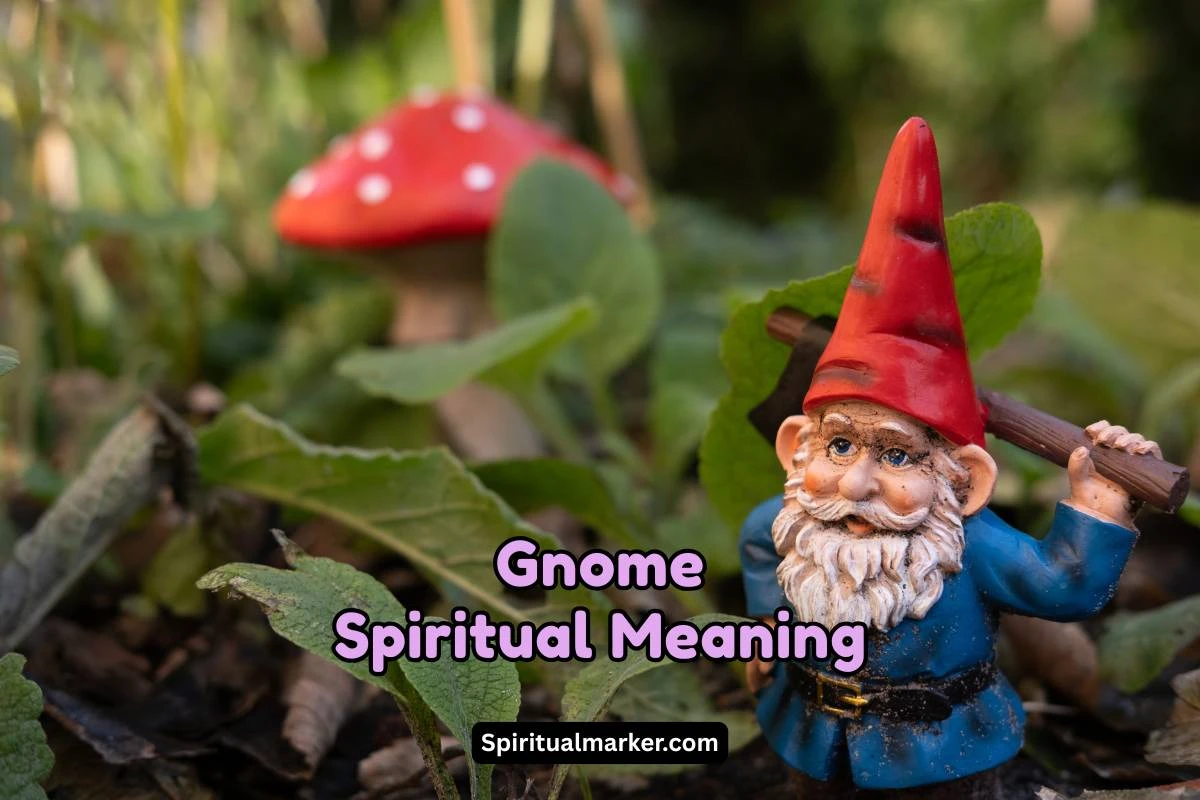
Gnomes are small, earth-dwelling creatures of folklore. Their pointed hats and long beards make them instantly recognizable. Across cultures and mythologies, gnomes carry deep spiritual meaning.
The gnome spiritual meaning often involves protection, hidden knowledge, and connection to the earth. Gnomes are guardians of treasure and the natural world. A spiritual meaning of fairies shares that elemental-creature focus, though fairies carry a more ethereal energy.
Some traditions view gnomes as symbols of good luck, hard work, and domestic peace. Others see them as a reminder to respect the earth. The gnome's appearance can add detail.
If a gnome appears in your life, it may bring a message of grounding. A spiritual meaning of a mushroom also deals with earth symbolism, though mushrooms carry a more hidden energy.
Key Takeaways
- Gnomes are ancient earth elemental spirits whose symbolism spans alchemy, Norse mythology, Celtic tradition, and modern spirituality.
- The gnome spiritual meaning centers on themes of protection, grounding, hidden wisdom, abundance, and guardianship of natural spaces.
- Different cultures interpret gnome symbolism in unique ways, but nearly all agree these beings hold a deep connection to the earth and its regenerative power.
- Seeing a gnome in a dream often carries a spiritual message about stability, inner resources, patience, or the need to reconnect with nature.
- Gnomes in the home or garden are traditionally seen as protective guardians that attract good fortune, ward off negative energy, and bless the land they inhabit.
What Are Gnomes and Do They Hold Spiritual Power?
The word “gnome” comes from the Renaissance Latin term gnomus, which Paracelsus coined in the 16th century. He used it to describe the earth elementals in his theory of the four elemental spirits. Salamanders ruled fire, undines ruled water, sylphs ruled air, and gnomes ruled earth. Paracelsus described gnomes as small beings who could move through solid earth as easily as a fish moves through water. They were not bound by the physical limitations that humans know. They operated within a dimension of earth energy that most people cannot perceive.
But the spiritual concept behind gnomes is far older than Paracelsus. Ancient Norse traditions described dwarves and earth spirits who lived beneath mountains and inside the roots of the world tree Yggdrasil. Celtic cultures spoke of earth faeries and hidden folk who guarded the land. Germanic folklore described small, wizened beings who protected underground treasures and had special knowledge of plant medicine and the cycles of nature. All of these traditions point to the same spiritual archetype: a small, ancient, earthy being with deep knowledge and quiet power.
Do gnomes hold real spiritual power? Many spiritual practitioners, pagans, and nature-based spiritual communities would say yes. Gnomes, as elemental spirits, are understood to be the consciousness of the earth itself. They embody the intelligence that guides roots through soil, that signals animals before earthquakes, and that governs the slow, steady rhythm of natural cycles. Whether you see them as literal beings or powerful spiritual archetypes, their energy carries meaning. Working with gnome symbolism connects you to earth consciousness in a way that few other symbols can.
What Does Seeing a Gnome Symbolize or Represent?
When a gnome appears in your life, whether as a figurine, an image, a recurring dream, or a spontaneous thought, it carries a message. The most immediate gnome symbolism is one of grounding. A gnome is asking you to slow down. It is telling you to plant your feet firmly on the earth and stop rushing through life without awareness. Many people encounter gnome energy during times of instability, anxiety, or disconnection from nature. The gnome appears as a gentle but firm reminder to get back to basics.
Gnomes also symbolize hidden knowledge. Just as they live underground and out of sight, they represent the wisdom that lies beneath the surface of things. Seeing a gnome can be a prompt to look deeper. Look beyond appearances. Trust what you know intuitively, even if others cannot see it yet. Many traditions associate gnomes with alchemical wisdom, the kind of knowledge that transforms raw, earthy experience into spiritual gold. Gnomes know what lies underground, what is buried, and what is yet to emerge.
Another powerful thing that gnome symbolism represents is protection. Garden gnomes were originally placed in gardens and around homes as protective talismans. They were believed to guard crops, ward off thieves, protect livestock, and bless the land with fertility. In this sense, seeing a gnome signifies that you are protected. You are watched over. Some unseen but steady force has your back. That is a deeply comforting spiritual message for anyone navigating a difficult season of life.
9 Spiritual Meanings of Gnomes
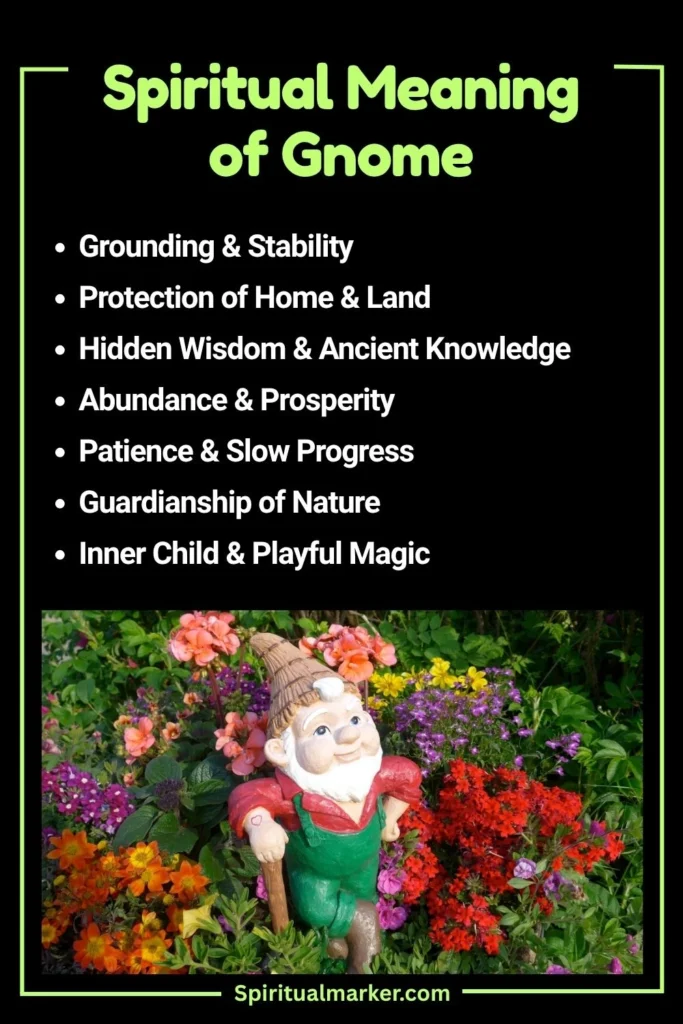
1. Grounding and Stability
The most fundamental gnome spiritual meaning is grounding. Gnomes live entirely within the earth element. They do not fly. They do not drift. They root themselves deep into the soil and draw power from stillness and stability. When gnome energy enters your awareness, it is calling you back to your roots. It is a spiritual nudge to reconnect with the physical world, your body, your home, and the earth beneath you.
In many spiritual traditions, being ungrounded is understood as the root cause of anxiety, confusion, and spiritual imbalance. Gnomes carry the medicine of the opposite: total groundedness. They teach you that stability is not a limitation. It is a foundation. Everything you want to build, whether a business, a relationship, or a spiritual life, requires the kind of solid footing that gnomes embody. Their short, sturdy stature is not accidental. It is a symbol of the power of being close to the earth.
Gnome symbolism invites you to ask honest questions. Are you scattered? Are you living too much in your head, too far from your body? Are you neglecting the simple, physical rhythms of life, like good food, rest, and time outdoors? The gnome does not judge you for this. It simply stands firm and waits for you to return. It holds the energy of patient, rooted presence, and that is one of the most powerful gifts any spiritual symbol can offer.
2. Protection of the Home and Land
Across Europe, gnomes were placed at the entrances of homes, in gardens, and near barns as guardians. This was not superstition for the sake of it. It reflected a genuine spiritual understanding that the land around a home holds energy. That energy needs tending. Gnomes were believed to be the spiritual caretakers of that energetic boundary. They kept negative influences out and held blessings in.
In German and Scandinavian folklore, household spirits very similar to gnomes were believed to protect the family. They warded off illness, kept pests away from crops, and even helped with farmwork at night. These protective earth spirits asked very little in return: respect, an offering of food or milk, and acknowledgment of their presence. Dishonoring them, however, could bring misfortune. This speaks to the reciprocal nature of gnome energy. They protect those who respect the earth and the home.
When you place a gnome near your front door or in your garden with spiritual intention, you are participating in a tradition thousands of years old. You are inviting protective earth energy into your space. You are signaling to the spiritual world that your home is a sacred place. Many people today report that their gardens feel more peaceful and their homes feel safer after consciously working with gnome symbolism as a protective force.
3. Connection to Hidden Wisdom and Ancient Knowledge
Gnomes in most cultural traditions are described as ancient beings with knowledge far surpassing that of humans. They know the secrets of the earth. They understand minerals, metals, roots, and the underground networks through which the natural world communicates. In alchemical tradition, gnomes were the keepers of prima materia, the raw spiritual substance from which all transformation begins. That is not a small thing.
Spiritually, the gnome represents the wisdom you carry deep within yourself. Much like the gnome lives beneath the surface, your deepest knowing lives beneath the noise of everyday life. When gnome symbolism appears prominently in your life, it is often a sign that buried wisdom is ready to surface. Something you have known intuitively for a long time is about to become clear. Pay attention to quiet insights. Trust what comes to you in stillness and solitude.
There is also a dimension of ancestral wisdom in gnome symbolism. As beings tied to ancient earth cycles, gnomes represent the accumulated knowledge of those who came before you. They hold the memory of the land. Working with gnome energy can connect you with the wisdom of your ancestors, the traditions of your lineage, and the deep, unhurried intelligence of the natural world. This is not intellectual knowledge. It is embodied, earthy wisdom that you feel before you think.
4. Abundance, Prosperity, and Fertile Energy
Gnomes are deeply associated with material abundance. In folklore, they are guardians of underground treasure, gold, precious gems, and mineral wealth. On the surface, they bless gardens with fertile soil, healthy crops, and thriving plants. This dual role, guarding what is below and nurturing what grows above, makes them powerful symbols of prosperity in both spiritual and material dimensions.
The spiritual meaning of gnome abundance goes deeper than money or crops. It speaks to the idea that the earth is inherently generous. When you align with earth energy, with the patient, consistent, deeply rooted approach that gnomes embody, abundance flows naturally. You do not force it. You cultivate it. You plant seeds, tend the soil, and trust the natural process. Gnome energy teaches that sustainable prosperity is earned slowly and tended carefully, not grabbed quickly.
Many people working with earth spirituality, Wicca, paganism, and folk magic traditions use gnome imagery or invoke elemental earth spirits to attract abundance and fertility. Placing a gnome in your garden with the intention of welcoming growth and prosperity is a time-honored practice. The gnome acts as a living symbol of your alignment with the earth’s generative power. That alignment, held with sincerity and gratitude, has a way of manifesting in real, tangible ways.
5. Patience and the Power of Slow Progress
Gnomes do not rush. Nothing about them suggests haste. They are ancient, deliberate, and deeply committed to the long game. In spiritual terms, gnome energy represents the immense power of patience and slow, consistent effort. They are symbols of the truth that real growth takes time. Real transformation happens underground, invisibly, over long stretches of time, before it ever surfaces into the light.
In a world that rewards speed and instant results, gnome symbolism is a counter-cultural message. It says: slow down. Trust the process. The seed does not become a tree in a week. The mineral does not become a gemstone overnight. True value takes time to form. If gnome energy is showing up in your life, it may be asking you to be more patient with yourself. Stop measuring progress by what is visible. Recognize the deep work happening beneath the surface.
The gnome’s legendary stubbornness in folklore is actually a spiritual virtue. It represents commitment to a path regardless of how slow the results appear. Gnomes do not abandon a mine halfway through because the treasure has not appeared yet. They dig steadily, patiently, with full faith in what lies ahead. That kind of devoted patience is a spiritual practice in itself. It requires trust, discipline, and a deep relationship with the present moment rather than a fixation on future outcomes.
6. Guardianship of Nature and the Environment
Gnomes are not just associated with the earth in a general sense. They are specifically understood as guardians of ecosystems. In Scandinavian and Germanic folklore, gnomes (called tomte, nisse, or erdgeister) were believed to be stewards of forests, meadows, rivers, and farmlands. They watched over animals, prevented disease in livestock, and helped maintain the balance of natural environments. Harming the land was believed to harm the gnomes, and harming the gnomes was believed to invite the decline of the land.
This guardianship symbolism is remarkably relevant today. In an era of environmental crisis, gnome energy speaks directly to the spiritual responsibility humans have toward the natural world. The gnome spiritual meaning of guardianship asks you to consider your relationship with nature. Are you treating the earth as a resource to extract from, or as a living being to tend and protect? Gnomes embody the consciousness of the earth as a sacred, sentient space deserving of reverence and care.
Many modern pagans and earth-based spiritual practitioners actively work with gnome or earth elemental energy as part of environmental healing practices. They visualize gnomes tending damaged ecosystems. They invoke earth elemental power in rituals for environmental restoration. The underlying belief is that the spiritual and the physical are not separate. Healing the earth’s spiritual body and honoring its guardians contributes to healing in the physical world. Gnomes hold a central place in that understanding.
7. The Inner Child and Playful Magic
There is another dimension of gnome symbolism that is easy to overlook: joy, play, and the magic of childhood wonder. Gnomes in many folklore traditions are depicted as mischievous, playful, and full of a kind of earthy humor. They play tricks on those who take themselves too seriously. They reward those who approach life with lightness and wonder. This points to a profound spiritual truth: the ability to experience awe, delight, and playful curiosity is itself a form of spiritual power.
Many children are instinctively drawn to gnomes. This is not accidental. Children are naturally more attuned to earth energy. They play in the dirt. They talk to animals. They believe in magic without needing proof. Gnome symbolism honors that instinct. It says that the inner child is a spiritual resource, not something to outgrow. The gnome energy that delights a child also lives in every adult who allows themselves to be fully present, fully curious, and fully alive to the mystery of the natural world.
When gnomes appear in your life alongside feelings of heaviness, burnout, or spiritual dryness, they may be calling you back to playful engagement with life. They are reminding you that magic is not always solemn and serious. Sometimes it is a child’s laughter in a garden. Sometimes it is the delight of noticing a mushroom ring or a dew-covered spider web at dawn. Gnome energy invites you to bring your full, wondering self to everyday moments and to see the sacred in the small.
Gnome Spiritual Meaning and Symbolism Across Cultures
Germanic and Central European Traditions
In German-speaking cultures, earth spirits known as Erdgeister (earth spirits) or Erdmänneken (earth-little-men) were a central part of folk belief. These beings were thought to live deep within the earth, particularly in mines and underground spaces. Miners prayed to them and left offerings of food and light. They believed these spirits either helped or hindered their work depending on the respect shown to them. A miner who worked with reverence and care would be guided toward rich ore veins. One who was careless or disrespectful risked accidents and misfortune.
Above ground, the Heinzelmännchen were a type of house gnome from Cologne folklore. These beings were said to complete household chores overnight while the family slept. They worked silently and invisibly, asking only for privacy and a small food offering. The moment someone tried to spy on them, they vanished forever. This story carries a powerful spiritual teaching: some forms of help and grace operate beyond the reach of human analysis or control. You must trust and receive, not grip and interrogate.
Scandinavian Traditions: The Tomte and Nisse
In Scandinavia, the equivalent of the gnome is the tomte (Sweden) or nisse (Norway and Denmark). These beings were the spiritual protectors of the family farm. They were described as small, bearded figures wearing gray or red clothing. A tomte lived in the farmhouse or barn and watched over the family and animals through every season. They were loyal, ancient, and deeply tied to the land of a specific place. They did not travel. They belonged to the land in a way that felt almost ancestral.
The relationship between the family and the tomte was reciprocal. Farmers left out a bowl of porridge, usually with butter on top, every Thursday evening and on Christmas Eve. In return, the tomte protected the farm from fire, illness, and misfortune. Ignoring or insulting the tomte, however, would bring disaster. Animals would fall ill. Crops would fail. The family would begin to experience a string of unexplained bad luck. This reflects the spiritual principle of reciprocity: what you give to the earth and its guardians, you receive in return.
Slavic and Eastern European Folk Traditions
In Slavic cultures, beings similar to gnomes appear under names like domovoi (Russia) and skrzat (Poland). The domovoi was a protective household spirit that lived near the hearth. He appeared as a small, hairy man or sometimes as a shadow with glowing eyes. Like the Scandinavian tomte, the domovoi was tied to a specific family and home. He protected the family from harm and warned them of danger through sounds or by pulling hair during the night. A domovoi well-treated was a powerful ally. One neglected was a source of chaos.
What stands out across all these Slavic and Eastern European traditions is the consistent spiritual understanding that the home is a living spiritual space. It has a guardian. It has consciousness. The gnome-like figures in these traditions are the visible face of that invisible spiritual protection. Honoring them was not superstition. It was a practical spiritual act of maintaining relationship with the unseen caretakers of the most important physical space in a person’s life.
Celtic Traditions
Celtic spiritual traditions, particularly those of Ireland, Scotland, Wales, and Brittany, have a rich tradition of earth-dwelling spirits that align closely with gnome symbolism. The Leprechaun of Irish folklore, though often reduced to a commercial caricature, is originally a gnome-like earth spirit. He is a solitary fairy who guards hidden treasure and possesses deep knowledge of the land. He is not to be trifled with. His connection to hidden gold and earth energy mirrors the core gnome archetype almost exactly.
Celtic traditions also speak of the Coblynau of Wales, small mine faeries who lived underground and helped indicate where ore could be found. Like their German counterparts, they responded to the attitude of those who encountered them. Respectful miners were guided. Careless ones were misled. Across Celtic traditions, the earth spirits carry a consistent message: the natural world is intelligent, conscious, and responsive to human behavior. Gnome energy in Celtic spirituality is an invitation into right relationship with the living earth.
Gnome Symbolism in World Mythologies
Norse Mythology: Dwarves and Earth Spirits
In Norse mythology, the beings most closely related to gnomes are the dwarves (dvergar). These beings lived in Nidavellir, a realm deep within the earth. They were the greatest craftsmen in all the nine worlds. The dwarves created Mjolnir, Thor’s hammer. They forged the magical spear Gungnir for Odin. They made Gleipnir, the unbreakable chain that bound the Fenrir wolf. Their creations were not ordinary tools. They were objects of sacred spiritual power, woven from the deepest knowledge of earth’s materials.
The dwarves’ connection to hidden knowledge and transformative craftsmanship is a key dimension of gnome spiritual meaning within Norse tradition. They did not create their masterworks through brute force. They worked with deep understanding of the nature of materials. They understood how to bring out the hidden potential in raw substances. This mirrors the spiritual work of transformation: taking the raw, unformed material of life experience and working with it patiently until something of lasting beauty and power emerges.
There are also the landvaettir in Norse belief: land spirits that protected specific territories, mountains, rivers, and farms. These spirits were so important that the prow of a Viking longship had to be removed before approaching Norway’s coast. Arriving with a fearsome dragon prow might frighten the landvaettir away, and no Viking wanted to lose the protection of those spirits. This shows how seriously the Norse took the spiritual guardianship of the land and the beings that embodied it.
Alchemical and Renaissance Mythology
Paracelsus placed gnomes at the center of his elemental cosmology in the 16th century. In this system, the four elemental spirits were not mythological creatures. They were actual spiritual intelligences governing the four classical elements. Gnomes, as earth elementals, were responsible for the physical structure and stability of the material world. They maintained the mineral kingdom. They governed the transformation of rock and soil. Without them, the earth itself would lose coherence.
This alchemical tradition gave rise to a rich body of gnome symbolism in Renaissance art, literature, and esoteric writing. Gnomes appeared in alchemical treatises as symbols of the prima materia, the first matter, the dense, dark, earthly substance from which all spiritual transformation begins. The alchemical maxim “as above, so below” found one of its most grounded expressions in gnome energy: what happens in the spiritual realm is mirrored in the physical earth, and vice versa. The gnome is the living symbol of that correspondence.
Asian and Indigenous Earth Spirit Traditions
While the word “gnome” is specifically European, the archetype of the earth-dwelling guardian spirit appears across many world cultures. In Japanese Shinto tradition, there are spirits called Kodama that inhabit specific trees and forest spaces. There are also Zashiki-warashi, house spirits who bring luck and prosperity to the homes they inhabit, quite similar to the tomte and domovoi traditions of Europe.
In many Indigenous American traditions, there are references to little people or earth dwellers. The Cherokee speak of the Yunwi Tsunsdi, small supernatural beings who live in rocky mountain places and can be helpful or harmful depending on how humans relate to them. The Lakota have the Canotila, tree-dwelling spirits. While these are distinct traditions with their own cultural contexts, they reflect the same universal spiritual understanding: the earth is inhabited by intelligent spirits. Those spirits influence the lives of humans. Respect and relationship with those spirits is essential to living well.
Garden Gnomes: From Spiritual Guardian to Cultural Icon
The garden gnome as you know it today has an interesting history. The first mass-produced garden gnomes appeared in Germany in the 1800s, in the town of Gräfenroda. A man named Phillip Griebel began making terracotta gnome figurines that were placed in gardens across Germany. The tradition spread rapidly across Europe. By the late 19th century, garden gnomes were appearing in England, France, and beyond. They were not purely decorative. They carried with them the centuries-old tradition of placing earth spirit effigies in the garden to attract protection and abundance.
The garden gnome’s distinctive appearance, the tall pointed hat, the long beard, the short stature, all carry spiritual symbolism. The pointed hat is found across many magical and shamanic traditions. It often represents a cone of power, a tool for channeling spiritual energy. The beard represents wisdom and age beyond ordinary human years. The short stature and close-to-the-ground posture represents the gnome’s intimate connection with the earth itself. Nothing about the traditional gnome design is accidental. Each feature encodes spiritual meaning.
Over the 20th century, the garden gnome became something of a pop culture figure, appearing in films, advertising, and gardens worldwide. Some might see this commercialization as a loss of spiritual power. But many spiritual practitioners argue the opposite. They say the widespread presence of gnomes in human environments is itself a sign that earth elemental energy is making itself known to a culture that desperately needs grounding. Even if a garden gnome is placed without conscious spiritual intention, it still carries the archetypal energy of its tradition.
Gnome Colors and Their Spiritual Meanings
Gnomes are most commonly depicted wearing red hats, though they also appear in blue, green, gray, and white. Each color carries its own spiritual significance. The red hat is the most traditional and is associated with vitality, protection, and the warmth of the earth’s core. Red is a grounding color in many spiritual traditions. It connects to the root chakra, the energy center associated with safety, survival, and physical embodiment. A red-hatted gnome is the most powerful symbol of rooted, protective earth energy.
A blue gnome carries the energy of communication, wisdom, and spiritual insight. Blue connects to the throat and third eye chakras. A blue gnome in your garden or home may indicate a connection between earth wisdom and higher understanding. It bridges the grounded intelligence of the earth with the expanded awareness of the spirit. A green gnome, meanwhile, speaks directly to growth, healing, and fertility. Green is the color of plant life, of new growth, of the healing power of nature. Green gnome energy is particularly potent for healing practices and garden work.
White gnomes are associated with purity, spiritual protection, and ancestral connection. White is the color of bones, of snow, of the stripped-back truth beneath surfaces. A white gnome connects deeply with the ancestral guardian aspect of gnome symbolism. It represents the wisdom of those who came before, preserved in the earth like fossils. Gray gnomes carry the energy of neutrality, balance, and ancient age. They are the most alchemical of gnome colors, representing the lead of the prima materia before it is transformed into gold.
Gnome Spiritual Meaning in Dreams
Dreaming about a gnome is a significant spiritual event. It is rarely random. The gnome dream meaning depends heavily on the context, but several themes appear consistently. Seeing a friendly gnome in a dream often signals that you are entering a period of grounded stability and quiet abundance. Something you have been working toward, slowly and patiently, is about to yield its fruit. The gnome in this context is a messenger of good news from the deep places where your work has been quietly taking root.
Dreaming of a gnome working in a garden or mine carries the spiritual message of diligent, purposeful effort. You are being invited to continue your current path with patience and focus. Do not be distracted by what others are doing or how quickly they seem to be moving. Your pace is right for you. Your underground work is accumulating value. A gnome at work in a dream says: trust the process. The treasure is there. Keep digging.
A mischievous or trickster gnome in a dream may signal that something in your life is not what it appears to be. You may be ignoring something important beneath the surface. The trickster gnome reveals hidden truths through disruption. It may also indicate that you are taking life too seriously and need to reconnect with a sense of playfulness and wonder. A threatening gnome in a dream can reflect a feeling of being disconnected from the earth, your body, or your roots. It may signal unresolved issues related to home, family, or foundational security.
Psychologically, gnome dreams often appear during periods of significant transition. When your foundations are shifting, when you are changing homes, careers, or relationships, the gnome appears in the dream space as a stabilizing archetype. It is the unconscious mind’s way of reminding you that you have inner resources you have not yet fully drawn on. The earth beneath you is solid even when the surface feels unstable. The gnome in your dreams is saying: you are more rooted than you feel.
Gnomes in Modern Spiritual Practice and Earth-Based Spirituality
Today, gnomes and earth elemental spirits play an active role in many modern earth-based spiritual traditions. In Wicca and other forms of neo-paganism, the four elemental guardians are called upon at the four corners of the ritual circle. Gnomes are the guardians of the North, the direction associated with earth, winter, midnight, and the body. Invoking gnome energy at the start of a ritual sets the foundation for all the spiritual work that follows. It grounds the circle in the physical world and invites the intelligent consciousness of the earth into the sacred space.
In crystal healing and earth medicine, working with gnome elemental energy is associated with using earth-based stones like obsidian, hematite, smoky quartz, jasper, and tourmaline. These stones are believed to carry dense, protective earth energy. Meditating with them while visualizing gnome energy can help clear energetic debris, strengthen the aura, and deepen connection with the physical body. Many practitioners place these stones in the four corners of a room or around a garden to create a protective elemental grid.
Forest bathing and nature immersion practices, while not always explicitly connected to gnome mythology, often invoke the same energy. When you walk barefoot on the earth, sit with your back against a tree, or simply spend time in a forest with conscious presence, you are engaging with the same elemental earth energy that gnomes represent. Many people who spend regular time in nature report feeling more stable, more creative, and more connected to their inner knowing. That is gnome energy at work, whether you name it that or not.
Gnome Spiritual Meaning: What It Means for Your Life
When gnome energy shows up in your life with persistence, through dreams, repeated encounters with gnome imagery, or a sudden inexplicable fascination with these earthy figures, it is worth pausing to consider what the message might be. In nearly every tradition that features gnomes, they show up when something important is happening beneath the surface. They appear when the foundations of your life are being reset, rebuilt, or revealed.
Gnome spiritual meaning asks you to consider your relationship with the physical world. Are you nourishing your body? Are you tending your home with love and intention? Are you honoring the earth that sustains you? Are you patient with the slow, invisible growth happening in your life right now? Gnomes do not rush. They do not seek recognition. They work steadily in the dark, trusting that the light will come in its own time. That is a spiritual practice worth adopting.
Gnome energy also invites you to protect what matters. Protect your home as a sacred space. Protect the land you live on. Protect the people and animals under your care. The gnome’s role as guardian is not passive. It is an active, vigilant, devoted form of love. When you step into that guardian role in your own life, whether for your family, your community, or your local environment, you are embodying the most essential gnome spiritual teaching: that the sacred is not somewhere distant. It is here, in the earth beneath you, in the home around you, in the life you are living right now.
A Final Note
The gnome spiritual meaning is far richer than most people realize. These small, earthy beings carry the wisdom of thousands of years of human relationship with the natural world. They speak of grounding, protection, hidden knowledge, patience, abundance, and the sacred intelligence of the earth itself. Across Germanic, Scandinavian, Celtic, Slavic, Norse, alchemical, and many other traditions, gnomes stand as one of the most consistent and powerful spiritual archetypes of the earth element.
If gnome energy has found its way into your awareness, take it seriously. Pay attention to your foundations. Tend your home and garden with spiritual intention. Slow down and trust the invisible work taking root in your life. Spend more time outdoors, barefoot if you can. Leave offerings of gratitude for the earth that sustains you. Notice what is growing slowly but surely beneath the surface of your everyday experience. The gnome has been watching over that growth all along.
You might consider placing a gnome in your garden or near your front door with a clear spiritual intention of protection and abundance. You might work with earth stones like hematite or red jasper to connect more deeply with gnome elemental energy. You might start a daily practice of standing barefoot on the earth for a few minutes, breathing slowly, and letting its deep, stable presence anchor you. These small acts of earth reverence are not trivial. They are the very thing that gnome wisdom has been pointing toward for centuries: a life lived in conscious, grateful, protective relationship with the sacred ground beneath your feet.