
Fairies are enchanting figures from folklore. Their tiny wings and mischievous natures capture the imagination. Across cultures, fairies carry deep spiritual meaning and symbolism.
The fairies spiritual meaning often involves nature, magic, and the unseen realms. Fairies are guardians of the natural world, so they can signal a need to reconnect with nature. A spiritual meaning of a gnome shares that elemental-creature focus, though gnomes carry a more grounded energy.
Some traditions view fairies as messengers of the divine or spirits of the dead. Others see them as a reminder to respect the earth. The fairy's behavior can add detail.
If fairies appear in your life, it may be a call to play. A spiritual meaning of a mushroom also deals with nature symbolism, though mushrooms carry a more hidden energy.
Key Takeaways
- Fairies symbolize the sacred connection between the human world and the spirit realm. They have served as messengers and guardians across dozens of cultures for thousands of years.
- Encountering fairy symbolism often signals transformation. When fairies appear in your life, pay attention. Change, growth, and spiritual awakening are usually close behind.
- Fairies carry both light and shadow energy. Spiritual traditions across Celtic, Slavic, and Asian cultures recognize both protective fairies and trickster fairies. Not every fairy encounter brings comfort.
- Fairy symbolism is deeply rooted in nature. Fairies represent the living intelligence of rivers, forests, mountains, and seasons. Their presence calls you back to the natural world.
- Dreaming of fairies carries specific spiritual messages. The color, behavior, and setting of fairies in your dreams all point to meaningful guidance about your current life path.
What Are Fairies and Do They Hold Real Spiritual Power?
Fairies are supernatural beings that appear in the folklore, mythology, and spiritual traditions of cultures worldwide. The word “fairy” comes from the Old French word faerie, meaning enchantment or magic. In Celtic traditions, fairies were known as the Aos Sí or the people of the mounds. They were not small. They were powerful, ancient, and deeply tied to the land itself.
Across different traditions, fairies take many forms. Some appear as radiant beings of light. Others take the shape of tiny winged creatures in forests. Still others appear as shapeshifters who can look fully human. What remains consistent across cultures is the idea that fairies exist in a liminal space. They live between the physical and spiritual worlds. They bridge what the human eye can see and what exists just beyond it.
Many spiritual practitioners today treat fairies as nature spirits or elemental beings. They believe fairies are the living consciousness of natural environments. A forest fairy might represent the spirit of an old-growth wood. A water fairy might embody the energy of a particular river or spring. This idea aligns with animist traditions from Ireland to Japan, where every natural feature was believed to hold a living spiritual essence. In this sense, fairies are not fantasy. They are a framework for understanding the intelligence and power of the natural world.
Whether you take fairies literally or symbolically, their spiritual power is hard to deny. Legends of fairy encounters have shaped laws, rituals, and entire systems of belief. The Irish built roads around fairy mounds to avoid disturbing them. Scottish fishermen refused to say certain words at sea for fear of offending fairy spirits. That kind of cultural gravity does not come from creatures people dismissed as imaginary. Fairies hold real spiritual power. They always have.
What Does Seeing a Fairy Symbolize or Represent?
Seeing a fairy, whether in real life, in a vision, or as a recurring symbol, is rarely random. Most spiritual traditions treat fairy sightings as significant events. They mark moments of transition, heightened awareness, or spiritual invitation. When a fairy appears to you, something in your life is shifting. The question is always: shifting toward what?
In Celtic spirituality, seeing a fairy was a sign that you were standing close to a thin place. Thin places are locations where the veil between the physical world and the spirit world is almost transparent. Fairy encounters at such sites were considered sacred. They meant you were spiritually sensitive enough to perceive what most people could not. That sensitivity was seen as a gift, not a curse.
Fairies also represent a call to pay attention. They appear when you have been too focused on the material world. They nudge you back toward wonder, creativity, and inner knowing. Seeing fairy imagery in unexpected places, such as on a random sign, in a cloud formation, or in the pattern of a leaf, can signal that your intuition is activating. The spiritual world is asking you to look closer, listen deeper, and trust what you feel even when you cannot explain it.
A fairy sighting can also symbolize protection. Many folk traditions held that seeing a fairy meant a guardian spirit was nearby. This was especially common during dangerous journeys, difficult pregnancies, or times of illness. The fairy’s presence signaled that unseen forces were working in your favor. You were not alone, even when everything around you felt uncertain.
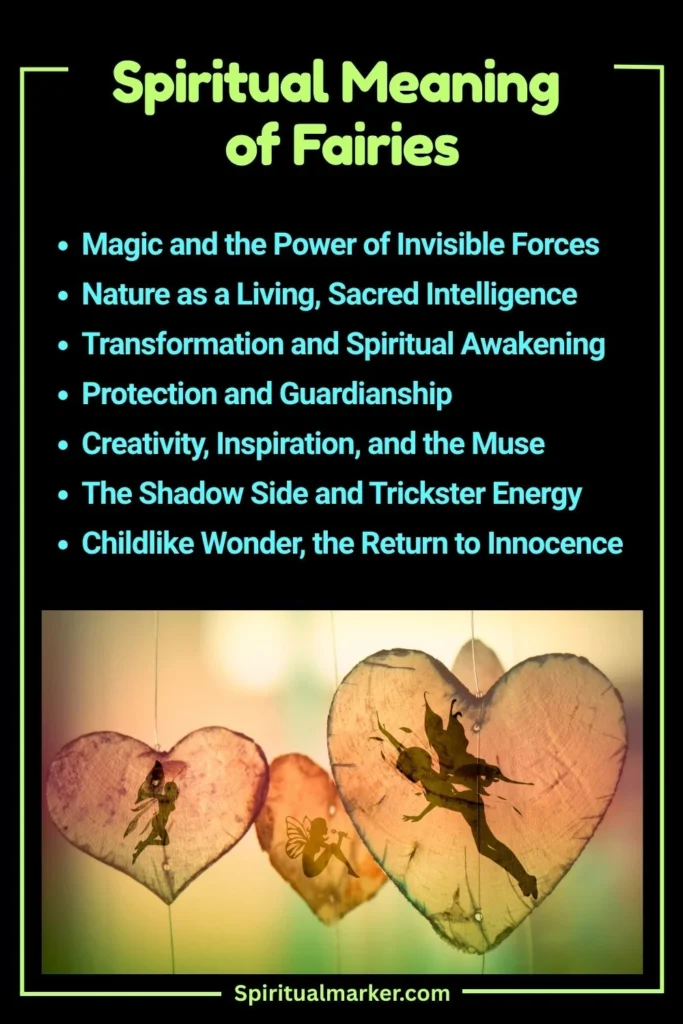
7 Spiritual Meanings of Fairies
1. Magic and the Power of Invisible Forces
The most fundamental spiritual meaning of fairies is magic itself. Fairies represent the idea that the world holds more than what you can measure, explain, or prove. They are living reminders that invisible forces shape visible reality. Every tradition that includes fairy beings acknowledges a layer of existence beyond ordinary human perception. Fairies make that layer personal and present.
This is not magic in a theatrical sense. It is the deeper understanding that intention, energy, and unseen spiritual forces play a real role in everyday life. When you encounter fairy symbolism, it often arrives as an invitation to take your inner life more seriously. Your thoughts, feelings, and spiritual practices carry more power than the rational mind admits. The fairy energy is the energy of possibility, of potential, of reality bending toward what your spirit truly needs.
Many practitioners of earth-based spirituality work with fairies specifically to amplify their intentions. Leaving offerings in a garden, speaking aloud under a tree, or performing small rituals at dusk are all ways of inviting fairy magic into daily life. The underlying belief is consistent: the world is alive with intelligence, and that intelligence responds to sincere, heartfelt engagement. Fairies are the face that intelligence wears when it wants you to pay attention.
When fairy symbols flood your awareness, ask yourself where you have been dismissing the magical. Where have you stopped believing in the unseen? That is exactly where the fairy spiritual meaning wants to take root. It calls you back to a sense of wonder you may have buried under stress, routine, or cynicism. Magic does not disappear when you stop believing. It waits.
2. Nature as a Living, Sacred Intelligence
Fairies and nature are inseparable. In nearly every tradition that features fairy beings, they are tied to specific natural environments. They live in forests, rivers, mountains, meadows, and caves. They guard ancient trees and sacred springs. They disappear when those natural places are destroyed. This is not coincidence. It carries a deep spiritual message about the sanctity of the natural world.
When fairy symbolism appears in your life, it often signals a need to reconnect with nature. Modern life pulls people away from natural rhythms. Work schedules, screens, and artificial environments create a kind of spiritual numbness. Fairies cut through that numbness. Their presence asks whether you have walked barefoot on grass recently. Whether you have sat quietly beside a body of water. Whether you have let the wind carry your worries without reaching for your phone.
The spiritual meaning of fairies in nature also points to reciprocity. Ancient peoples understood that humans and nature exist in a relationship of mutual respect. You take from the forest, and you give back. You draw from the river, and you protect it. Fairies were the spiritual enforcers of that relationship. Disrespect nature, and fairies caused mischief. Honor it, and they rewarded you with abundance, health, and guidance. This ancient wisdom maps directly onto what ecologists now confirm: healthy ecosystems require balanced relationships.
Feeling drawn to fairy symbolism is often the spirit’s way of nudging you toward environmental awareness. It is the land itself sending a signal through a form your heart recognizes. Every fairy is, at its core, a nature being. Honoring fairy energy means honoring the living world around you with the same reverence you would bring to any sacred relationship.
3. Transformation and Spiritual Awakening
Fairies are deeply associated with transformation. Stories from Ireland, Scotland, and across Europe describe humans who encountered fairies and were forever changed. They returned from fairy encounters with new gifts, new sight, or new purpose. Some came back with the ability to heal. Others returned with prophecy. The encounter itself was the catalyst. It broke something open and made spiritual growth possible.
In spiritual terms, fairy energy often arrives at moments of major life transition. You may notice fairy symbols appearing when you are leaving a relationship, starting a new career, moving to a new place, or facing a loss. These are the moments when the old self is dying and a new one is being born. Fairies are the spiritual midwives of that birth. They hold the space between what you were and what you are becoming.
The transformative power of fairies is not always comfortable. Many fairy tales involve tests, trials, and confusion before the gift is revealed. The trickster quality of fairy energy serves a purpose. It shakes you loose from rigid thinking. It challenges assumptions. It forces you to navigate uncertainty with creativity and trust. When life feels inexplicably chaotic, fairy symbolism in transformation suggests that a higher order is at work, even when the pattern is not yet visible.
Trust the process. That is the core message fairies carry for those in transformation. The confusion is part of the design. The disorientation you feel in a life transition mirrors the moment in a fairy tale when the hero is lost in the forest. That forest is never the end of the story. It is always the place where the real journey begins. Fairy energy promises that what comes next is worth the difficult passage through what is happening now.
4. Protection and Guardianship
Across Celtic, Slavic, and Germanic traditions, certain fairy beings served as guardian spirits for families, homes, and communities. The Irish Bean Sídhe (Banshee) warned families of coming death. The Scottish Brownie protected homes and helped with chores if treated well. The Slavic Domovoi was a household fairy spirit that guarded the family from harm. These were not beings to fear. They were beings to cultivate a relationship with.
The protective spiritual meaning of fairies speaks to the human need for unseen help. You are not navigating life’s dangers alone. Spiritual traditions worldwide affirm that helpful, invisible presences accompany human beings through difficult terrain. Fairies are one of the oldest expressions of that truth. Feeling a sudden sense of safety in a threatening situation, or narrowly escaping harm without explanation, has been attributed to fairy guardianship in folk tradition for centuries.
Protective fairies also appear when you need to establish or enforce spiritual boundaries. Just as fairy guardians were said to keep negative energies away from a home, engaging with protective fairy symbolism can help you define what you allow into your personal energy field. This is not superstition. It is a deeply intuitive practice of spiritual self-care. You set boundaries. You call in protectors. You create space where only what serves your highest good can enter.
If you feel a fairy presence hovering near your home or family, take it seriously as a spiritual signal. You may be in a season where protective energy is gathering around you. The fairy guardian symbolism invites you to acknowledge that support, express gratitude for it, and consciously align with the protective forces that are already at work in your life. The protection is real. The only question is whether you choose to receive it.
5. Creativity, Inspiration, and the Muse
Many artists, poets, and musicians throughout history have credited fairy inspiration for their most powerful work. Irish bards were said to receive songs directly from the fairy world. William Blake described his creative visions as encounters with spiritual beings that most would call fairies. Shakespeare’s A Midsummer Night’s Dream drew directly from the cultural belief that fairies were sources of divine creative energy.
The fairy symbolism of creativity points to something specific. Fairies represent the part of the creative process that cannot be forced or manufactured. Real inspiration arrives unbidden, from somewhere outside the thinking mind. It feels like a gift rather than a product. That quality of creative experience, sudden, luminous, surprising, maps almost perfectly onto the fairy archetype. Fairies come when they choose. Inspiration works the same way.
When fairy energy shows up in your creative life, it often arrives alongside a burst of unusual ideas or unexpected artistic drive. You might wake at 3 a.m. with a fully formed concept. You might stumble onto a creative solution that solves a problem you had been wrestling with for weeks. The fairy spiritual meaning in these moments is clear: something beyond your ordinary mind is contributing to your creative output. The invitation is to stay open, stay humble, and keep creating.
Creative blocks often dissolve when people consciously invite fairy energy into their practice. This might look like spending time in nature before sitting down to work. It might mean creating a small altar with natural objects or keeping a journal of synchronicities and unusual ideas. The fairy muse responds to intention and playfulness. Approach your creative life with childlike wonder, and the inspiration often follows.
6. The Shadow Side and Trickster Energy
Not all fairies are benevolent. This is one of the most important truths in fairy spiritual symbolism, and it is the one most modern portrayals get completely wrong. Traditional fairy lore is full of trickster fairies who mislead travelers, steal children, cause illness, and lead humans into confusion. The Irish Puca, the Welsh Pwca, and the English Puck are all trickster figures from the fairy world. They were not evil, but they were not safe either.
The shadow side of fairy energy in spiritual symbolism represents the disruptive forces of growth. Not all disruption is negative. Sometimes the trickster has to tip over the table before you see what has been hiding underneath it. Fairy trickster energy arrives in your life as unexpected reversals, confusing situations, or plans that collapse at the last moment. These disruptions are rarely random. They tend to expose what is not working, what you have been avoiding, and where you need to redirect your energy.
The spiritual wisdom here is nuanced. When trickster fairy energy enters your life, the instinct is to resist, panic, or fight what is happening. The wiser response is to get curious. Ask what is being revealed. Look at what the disruption is pointing toward. Every classic fairy tale has a trickster moment where the hero must choose between fighting the chaos and learning from it. The ones who learn always find their way to the reward. The ones who fight often remain lost.
Acknowledging the shadow side of fairies also teaches spiritual discernment. Not every spiritual encounter is comfortable. Not every invisible force is working in your favor at first glance. Learning to sit with the discomfort, read the situation with honesty, and respond with wisdom rather than reaction is itself a form of spiritual maturity. The trickster fairy is one of the most powerful spiritual teachers precisely because it refuses to be convenient.
7. Childlike Wonder and the Return to Innocence
Fairies universally carry the energy of childlike wonder. They invite you back to a state of openness, curiosity, and delight that most adults gradually lose. Children see fairies more often than adults do in folk tradition. That is no accident. Children have not yet learned to dismiss the invisible. They have not yet decided what is real and what is not. Their spiritual perception is unfiltered, and fairies move freely within that perceptual openness.
The spiritual symbolism of fairies as innocence is not about naivety. It is about returning to a state of genuine presence and radical openness. Adults lose this not because they become wiser but because they become more defended. Stress, disappointment, and cultural conditioning build walls around the inner child. Fairies are drawn to cracks in those walls. They appear when something in you is ready to become soft and open again.
Psychologist Carl Jung described the inner child archetype as one of the most important aspects of the human psyche. Reconnecting with that archetype through play, creativity, nature, and imagination is a fundamental part of psychological and spiritual wholeness. Fairy symbolism operates in exactly this space. It does not ask you to become childish. It asks you to recover the capacity for wonder that makes life feel sacred instead of simply functional.
When you feel a pull toward fairy imagery or find yourself drawn to whimsy, color, natural beauty, and playful expression, pay attention. Your spirit is telling you something important. The fairy energy of innocence is healing you. It is dissolving protective layers that have kept you from fully inhabiting your own joy. Let it work. The return to wonder is one of the most profound spiritual journeys a person can take.
Fairy Symbolism Across World Cultures and Religions
The spiritual meaning of fairies is not limited to any single culture. Beings matching the fairy archetype appear across the globe with remarkable consistency. This cross-cultural presence suggests that fairy symbolism taps into something universal in human spiritual experience. These are not isolated regional myths. They are different languages expressing the same fundamental spiritual truth.
In Celtic tradition, fairies were called the Aos Sí, believed to be ancient divine beings who retreated underground when humans arrived. They were neither fully good nor fully evil. They operated by their own moral code, one that demanded respect, honesty, and proper ritual acknowledgment. The Irish built fairy forts, circular earthworks that were never disturbed for fear of fairy retribution. Even today, road construction projects in Ireland sometimes detour around known fairy mounds out of cultural respect.
In Japanese Shinto tradition, forest spirits called Kodama inhabit ancient trees. Water spirits called Kappa live in rivers. Mountain spirits called Tengu guard sacred peaks. These beings serve a function nearly identical to fairies in Western tradition. They are the spiritual intelligence of natural environments. Disturbing their homes without proper ritual respect was believed to bring misfortune. Honoring them brought blessing and protection.
Hindu tradition features the Apsaras, celestial beings of extraordinary beauty who inhabited forests and rivers. They were associated with dance, music, and divine inspiration. The Yakshi were female nature spirits who lived in trees, particularly sacred fig trees. Both types of beings carried spiritual power over fertility, beauty, and the natural world, mirroring the Western fairy’s domain almost exactly. In Islamic tradition, the Jinn occupy a similar ecological and spiritual role, existing between the human world and the divine, capable of both help and harm depending on how they were engaged.
What this global convergence reveals is profound. Every major human civilization, regardless of geography or religion, developed a concept of spiritual beings that mediate between humans and the natural world. Fairies are the Western expression of a universal spiritual category. They reflect the deep human intuition that you are not the only conscious presence in the ecosystem. You share this world with intelligences that operate on frequencies your ordinary senses were not designed to detect.
Fairy Symbolism in World Mythologies
Mythology gives fairies a genealogy. In Greek mythology, the Nymphs were nature spirits who inhabited specific natural features. Naiads lived in fresh water. Dryads lived in trees. Oreads inhabited mountains. Each Nymph was the spiritual embodiment of a physical place, inseparable from her environment. They were immortal or near-immortal, capable of prophesy, capable of love, and capable of devastating consequences when disrespected. Their mythological role is functionally identical to the fairy across every dimension.
Norse mythology features the Álfar, the elves. These were divided into Ljósálfar (Light Elves) and Dökkálfar (Dark Elves), reflecting the dual nature of fairy energy that appears across all traditions. The Light Elves were associated with beauty, nature, and divine inspiration. The Dark Elves carried shadow energy, residing underground and working in more hidden, mysterious ways. This light-shadow division in Norse mythology mirrors the protective versus trickster distinction found in Celtic fairy lore.
In Slavic mythology, the Rusalki were water spirits, often the spirits of young women who died untimely deaths. They lived in rivers and lakes, capable of both blessing and drowning those they encountered. The Leshy was a forest spirit who could lead travelers astray or guide them safely depending on whether they showed proper respect for the forest. These Slavic beings carry the same moral ambiguity and nature-guardianship role that defines fairies across traditions.
The consistent mythological pattern is revealing. In every culture’s mythology, fairy-type beings stand at the intersection of the human world and the wild natural world. They are the spiritual representatives of places humans enter but do not fully control. Forests, rivers, mountains, and wild coasts are fairy territory in mythology worldwide. Entering those spaces required spiritual preparation, proper intention, and a respectful attitude. Modern spirituality would call this setting an intention before entering sacred space. Ancient mythology called it not angering the fairies. The practice is the same.
Types of Fairies and Their Spiritual Meanings
Not all fairies carry the same spiritual energy. Different types of fairy beings correspond to different spiritual messages and domains. Knowing which type of fairy energy is showing up in your life helps you interpret the message more precisely.
Elemental fairies are tied directly to the four classical elements: earth, air, fire, and water. Gnomes are earth fairies, associated with stability, grounding, and material abundance. Sylphs are air fairies, carrying messages of communication, clarity, and mental agility. Undines are water fairies, connected to emotion, intuition, and the flow of feeling. Salamanders are fire fairies, representing passion, will, transformation, and creative force. When you feel drawn to a particular element, the corresponding elemental fairy energy is often active in your spiritual work.
Guardian fairies attach to specific places or family lineages. The Scottish Brownie, the Slavic Domovoi, and the Irish Fairy Godmother figure are all guardian types. Their spiritual meaning centers on protection, domestic harmony, and ancestral connection. Encountering guardian fairy energy often signals that ancestral support is active in your life, or that a specific place holds significant spiritual energy that is working in your favor.
Trickster fairies include the Irish Puca, the English Puck, and the Scandinavian Tomte in its mischievous form. These beings deliver their spiritual gifts through disruption, confusion, and unexpected reversals. Their spiritual meaning is growth through challenge. When trickster energy appears, the spiritual message is to release attachment to how things should go and remain flexible enough to receive what life is actually offering.
Healing fairies appear in traditions worldwide as beings who restore health, vitality, and spiritual balance. The Irish Bean Sídhe originally had a role in guiding souls, not just warning of death. The Welsh fairy physicians of the Physicians of Myddfai were believed to have learned their healing arts directly from a fairy woman of the lake. These beings carry the spiritual meaning of restoration, of wholeness returned after illness, loss, or spiritual fragmentation. Feeling drawn to healing fairy imagery often signals that your body, mind, or spirit is in a phase of deep recovery.
Fairies in the Bible and Christian Spiritual Tradition
The Bible does not mention fairies by name. That is an important starting point. However, the broader Christian spiritual tradition has a complex and evolving relationship with fairy beings. Early Christian missionaries in Celtic lands did not immediately erase fairy beliefs. Instead, they often reframed them within a Christian cosmology. Fairies became fallen angels, beings who were neither good enough for heaven nor wicked enough for hell, left to inhabit the earth as a kind of middle tier of spiritual existence.
This theological framing appears in Scottish and Irish folklore repeatedly. The fairy mounds were said to hold beings who fell with Lucifer but were not fully damned. This gave fairies a specific spiritual status within Christian thought. They were spiritually significant but morally ambiguous, requiring the same careful approach that the Bible prescribes for engaging with any spiritual being outside of God. Proverbs 3:5-6 instructs believers to trust God fully rather than relying on their own understanding, a principle that many Christian folk practitioners applied to fairy encounters: proceed with prayer, not presumption.
Some Christian theologians connected fairies to the biblical concept of principalities and powers described by Paul in Ephesians 6:12. These are spiritual forces that inhabit the unseen realm and interact with the physical world. Whether one calls them nature spirits, elemental beings, or fairies, the underlying spiritual category is consistent: there are non-human intelligences occupying the spiritual dimensions of the natural world. The Bible acknowledges that category exists, even if it uses different terminology.
The Christian fairy tradition also produced a rich body of protective folk practice. Iron was believed to repel harmful fairies, and iron horseshoes hung over doorways served a dual purpose as both fairy protection and Christian blessing. Prayers before entering forests or crossing water were standard practice in Christian communities throughout medieval Europe. These practices blended seamlessly because the underlying spiritual concern was the same: acknowledging the invisible world and moving through it with respect and spiritual protection.
Dreaming About Fairies: Spiritual and Psychological Meanings
Dreams involving fairies are considered high-significance spiritual experiences in many traditions. The fairy’s appearance in your dream state, when the conscious mind is relaxed and the spirit is most receptive, carries a different kind of weight than a waking encounter. Your subconscious and your spiritual guides can communicate more directly when your analytical mind steps aside. Fairy dreams are one of the vehicles for that communication.
A dream of a benevolent fairy offering you something, whether a gift, a direction, or simply a smile, typically signals incoming good fortune, creative breakthrough, or spiritual protection. Pay attention to what the fairy offers you. A fairy handing you a flower might symbolize new love or beauty entering your life. A fairy pointing toward a path suggests spiritual direction is available to you if you are willing to follow your intuition. A fairy singing or playing music often means creative inspiration is flowing into your life at the spiritual level before it becomes tangible.
A dream of a trickster or dark fairy carries a different message but is equally valuable. Being chased by a fairy in a dream often reflects a spiritual truth you are avoiding in waking life. A fairy leading you in circles suggests you are stuck in a repetitive pattern that is not serving your growth. A fairy that transforms from beautiful to threatening mirrors the shadow self archetype described by Carl Jung, the parts of your personality you have rejected but that demand integration for true wholeness.
The colors of fairies in dreams also carry specific meanings. Green fairies are deeply connected to nature, healing, and abundance. White or silver fairies signal spiritual purity, guidance from higher realms, and clear intuitive messages. Blue fairies represent communication, truth, and spiritual clarity. Red or orange fairies carry passionate, transformative, fiery energy. Black or dark fairies, while alarming at first glance, often represent shadow integration, the invitation to acknowledge and heal the parts of yourself you have kept hidden. The setting of the dream matters too. A fairy in a forest speaks to your wild, untamed self. A fairy in your home addresses your intimate personal life and domestic reality. A fairy hovering above you in open sky signals spiritual ascension and expanded awareness moving into your life.
A Final Note
Fairies are not a children’s story. They are one of the oldest and most consistent spiritual archetypes in human history. They represent the living intelligence of nature, the power of magic and invisible forces, the transformative energy of life’s most challenging transitions, and the deep human need for protection, inspiration, and wonder. Every culture that has ever populated this earth developed a concept of fairy-like beings. That universality is not coincidence. It is spiritual convergence.
When fairy symbolism enters your life, take it seriously. Ask what it is pointing toward. Look at where you need more magic, more nature, more protection, or more playful wonder. Consider where trickster energy might be trying to shake you loose from a pattern that no longer serves you. Notice whether you are in a creative dry spell that fairy inspiration could revive. Pay attention to the dreams, the synchronicities, the unexpected appearances of fairy imagery in unexpected places.
The most practical thing you can do with this knowledge is create space for fairy energy in your daily life. Spend meaningful time in nature. Keep a dream journal and track recurring fairy imagery. Create a small nature altar with stones, flowers, or leaves that carry personal meaning. Practice gratitude for the unseen forces that protect and guide you. These are not superstitions. They are ancient, tested practices for staying in relationship with the spiritual dimension of reality. Fairies have been pointing humans toward that relationship for thousands of years. They are pointing toward it now, in you.