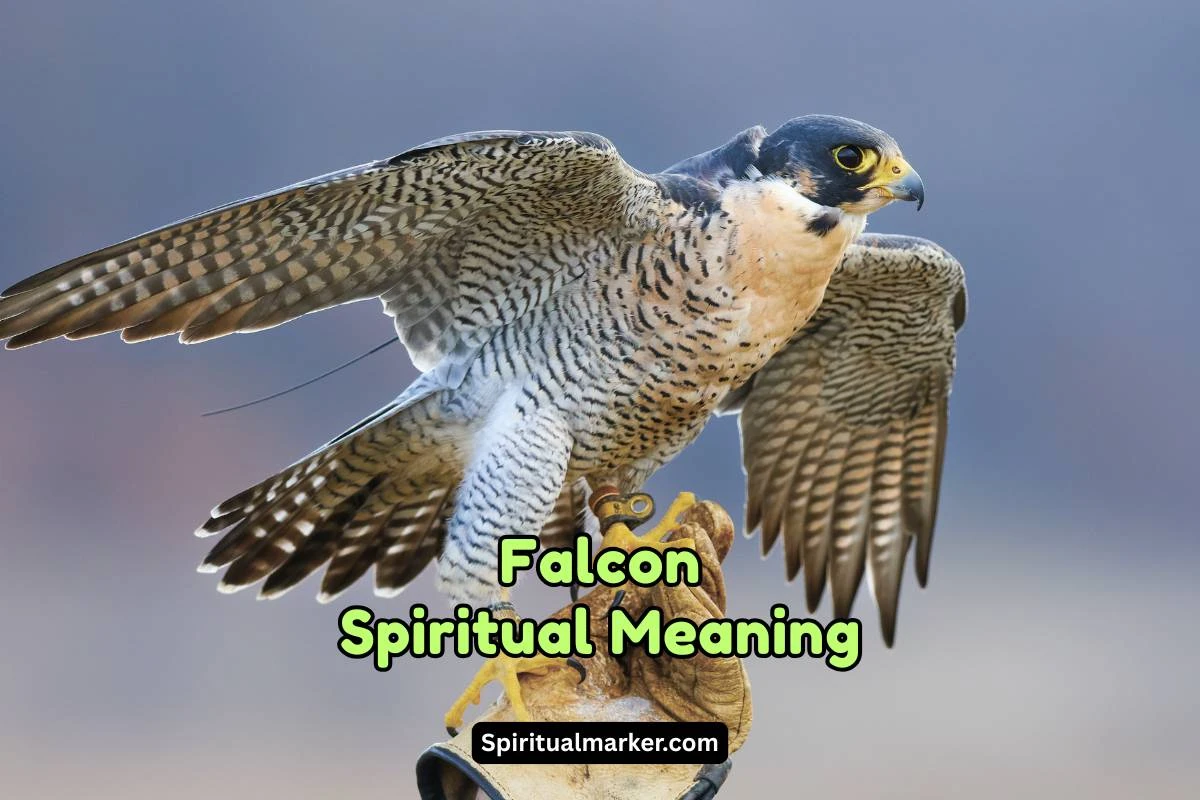
The falcon is a master of the sky. Its speed, precision, and fierce eyesight make it a powerful symbol. Across cultures, falcons carry deep spiritual meaning and are seen as messengers.
The falcon spiritual meaning often involves focus, determination, and spiritual guidance. Falcons are swift hunters, so they can signal a need to act with precision. A spiritual meaning of a hawk flying over you shares that bird-of-prey focus, though hawks carry a different, broader energy.
Some traditions view falcons as symbols of royalty, victory, and higher vision. Others see them as guides for those on a mission. The falcon's behavior can add detail to the message.
If a falcon appears in your life, it may be a call to focus. A spiritual meaning of a red-headed woodpecker also deals with powerful birds, though woodpeckers carry a more persistent energy.
Key Takeaways
- The falcon is a universal symbol of divine vision, spiritual awakening, and focused power across cultures.
- In ancient Egypt, the falcon was the embodiment of the god Horus, representing the soul of the king and the eye of the heavens.
- Dreaming of a falcon often signals a call to sharpen your focus, claim your freedom, or rise above confusion.
- The falcon’s exceptional eyesight is spiritually interpreted as the ability to see truth beyond illusion.
- Across Native American, Celtic, Norse, and Islamic traditions, the falcon represents spiritual authority, speed of divine will, and the bridge between earth and sky.
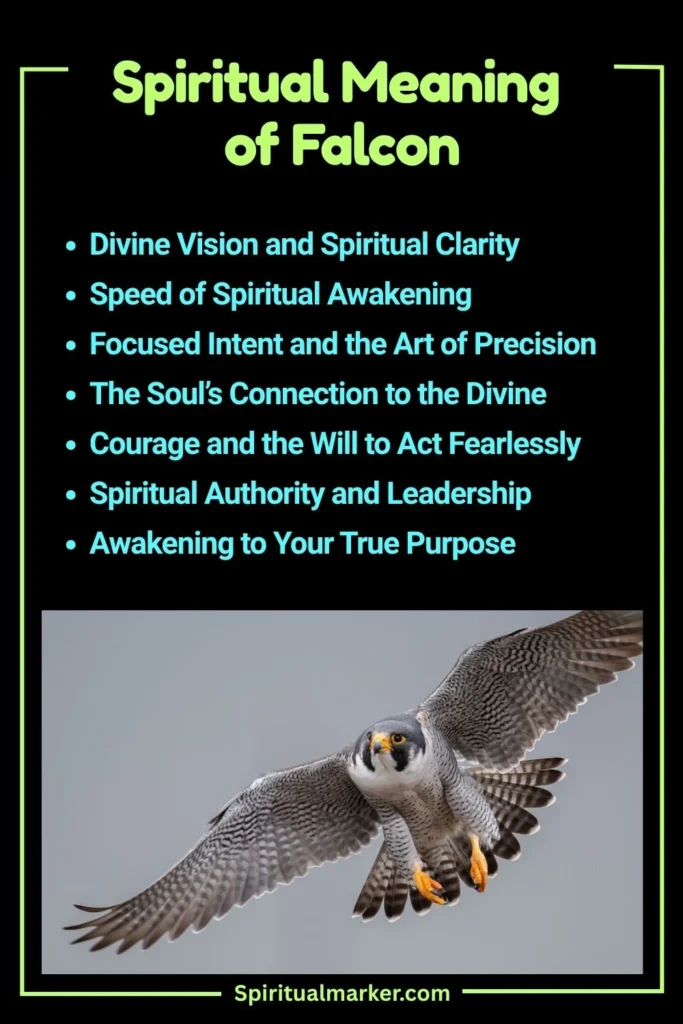
What Is the Falcon and Does It Hold Spiritual Power?
The falcon belongs to the genus Falco, a group of powerful birds of prey found on every continent except Antarctica. There are around 40 species of falcons globally, including the peregrine falcon, the lanner falcon, the merlin, and the kestrel. Each species carries its own energy, but all falcons share the same core spiritual signature: swift, focused, divine.
The peregrine falcon is the most spiritually significant across traditions. It is the fastest animal on Earth in a dive. It can spot prey from over a mile away. These physical facts are not spiritually neutral. Every ancient culture that observed the peregrine falcon interpreted its capabilities as evidence of a higher power working through nature.
But does the falcon truly hold spiritual power? The answer depends on your framework. From a psychological perspective, the falcon functions as a powerful archetype in the collective human unconscious. Carl Jung would classify it under what he called the “animus” archetype, representing active intelligence, willpower, and the higher self in its most focused form. From a spiritual and metaphysical perspective, many traditions hold that certain animals serve as totem guides, carrying specific energetic frequencies that resonate with human souls at particular stages of growth.
What makes the falcon unique is that both frameworks converge on the same conclusion. Whether you approach this from Jungian psychology, shamanism, religious symbolism, or personal intuition, the falcon consistently represents clarity, power, and spiritual elevation. That convergence across entirely different knowledge systems is itself meaningful. The falcon is not a symbol invented by one culture. It was recognized independently by dozens of civilizations across thousands of years. That is the definition of a universal spiritual truth.
What Does Seeing a Falcon Symbolize?
Seeing a falcon, especially unexpectedly, is rarely considered a coincidence by spiritual traditions. Most cultures interpret the appearance of a falcon as a direct message from the spiritual realm. The question is always: what is the message?
The answer depends heavily on context. Where did you see the falcon? What were you feeling or thinking at that moment? Was it flying freely, perched and watching, or diving toward something? Each of these scenarios carries a distinct spiritual signal.
A falcon flying high overhead is almost universally interpreted as a sign of elevation. Your spirit is being called upward. You are being invited to take a broader perspective on whatever challenge or situation you are currently facing. The falcon’s altitude is your cue to stop operating from ground level emotionally or mentally.
A falcon perched and watching you carries a very different energy. This is a sign of divine observation. Something in the spiritual realm is paying close attention to you right now. Many traditions interpret this as a sign that a spirit guide or ancestor is nearby. You are being seen, assessed, and supported.
A falcon in a dive is perhaps the most dramatic signal. This represents decisive action. The message is clear and urgent: the time for waiting is over. You have gathered enough information. You have prepared long enough. Now it is time to move with precision and commitment toward your goal. The diving falcon does not hesitate, and neither should you.
When you see a falcon repeatedly over days or weeks, most spiritual traditions interpret this as a sustained call to awakening. Something significant is shifting in your life path. The falcon is ensuring you do not miss the signal.
9 Spiritual Meanings of the Falcon
1. Divine Vision and Spiritual Clarity
The falcon’s most celebrated physical trait is its extraordinary eyesight. It can see ultraviolet light. It can detect movement from over a mile away. It can track a single small target against a complex background at tremendous speed. Spiritually, this translates directly into the meaning of divine vision and higher perception.
When the falcon appears as a spiritual symbol in your life, it is often carrying the message that you need to see beyond the surface. Something in your current situation is not what it appears to be. A relationship, a career decision, a personal belief may be obscuring a deeper truth. The falcon urges you to activate your spiritual discernment and look more carefully.
Many spiritual teachers who work with animal totems describe the falcon as the “truth-seer” of the sky. Its vision does not get fooled by camouflage, distance, or distraction. In your spiritual journey, the falcon invites you to strip away illusion and perceive reality with the same uncompromising clarity. This is not a comfortable process. Clarity often requires you to see things you have been avoiding. But the falcon’s gift is that it sees clearly and acts decisively anyway.
Ancient Egyptian priests understood this deeply. The falcon-headed god Horus was literally called “the one who sees all.” His eyes represented the sun and the moon, giving him both solar clarity and lunar intuition. The spiritual tradition of connecting falcon vision to divine truth is one of the oldest and most consistent in human religious history.
2. Speed of Spiritual Awakening
The peregrine falcon dives at over 240 mph, making it the fastest moving creature on the planet. This breathtaking speed is not just a biological fact. Across traditions, it carries deep spiritual significance about the nature of awakening and transformation.
When the falcon enters your spiritual life as a symbol or totem, it often signals that your awakening is accelerating. Things that would have taken years to understand are arriving in months. Patterns you struggled to see are suddenly obvious. The spiritual timeline you expected is being compressed. The falcon says: move with it, not against it.
Speed in a spiritual context does not mean rushing or skipping necessary steps. It means responding to the moment with full presence. The falcon does not overthink its dive. It reads the situation, commits, and executes with complete accuracy. This is a model for how you are being asked to approach your spiritual growth right now.
Many indigenous traditions use the falcon feather in ceremonies designed to accelerate spiritual development. The feather is thought to carry the bird’s energy of speed and precision. Holding or wearing a falcon feather during ritual is believed to sharpen the spirit’s ability to cut through confusion and arrive at truth quickly.
3. Freedom and the Power of the Untethered Spirit
Few images in the natural world communicate freedom as powerfully as a falcon in full flight. It moves through the sky as though gravity is merely a suggestion. Nothing in its physical environment constrains it. It covers vast distances with effortless mastery.
Spiritually, the falcon represents the part of you that cannot be caged. Every human soul carries an aspect that longs for freedom, not just physical freedom, but freedom of thought, freedom of belief, and freedom from the opinions of others. The falcon is the totem of that untethered inner self.
When the falcon appears during a period of restriction, whether you are trapped in a difficult relationship, a suffocating job, or a limiting belief system, it carries a liberating message. You are not as trapped as you feel. The falcon does not see the cage. It sees the open sky. It is showing you the part of yourself that is always free, regardless of your external circumstances.
This is why falconry, the ancient practice of training falcons for hunting, carries deep spiritual symbolism in cultures from Persia to medieval Europe. A trained falcon that returns willingly to its handler is seen as a symbol of free will choosing devotion. The falcon is not tamed. It chooses its relationship. This models a powerful spiritual truth: genuine freedom is not the absence of commitment. It is the ability to choose your commitments consciously.
4. Focused Intent and the Art of Precision
Watch a falcon hunt and you will witness one of nature’s most extraordinary demonstrations of focused intent. It does not scatter its attention across multiple targets. It locks onto one. It tracks that one target through every variable, wind shift, and evasive maneuver. Then it strikes with precision that borders on perfection.
This singular focus is one of the falcon’s most profound spiritual teachings. In a world designed to fragment your attention, the falcon offers the spiritual medicine of complete, undivided concentration. Many spiritual traditions associate the falcon totem with individuals who are called to master a specific gift, develop a particular skill to its highest level, or pursue a single goal with absolute dedication.
If the falcon has appeared in your life during a period of scattered energy or indecision, take the message seriously. Your power lies in concentration, not multitasking. The falcon does not hunt three things at once and catch nothing. It hunts one thing completely and catches it every time. This is the spiritual model being offered to you.
Buddhist philosophy actually mirrors this teaching closely, though it arrives from a completely different tradition. The concept of samadhi, or one-pointed concentration, describes a state of spiritual absorption where the mind becomes completely unified around a single point of awareness. The falcon lives this state physically. It models what concentrated spiritual energy looks like when fully expressed in the material world.
5. The Soul’s Connection to the Divine
Across more traditions than any other symbol in this post, the falcon is consistently identified as a bridge between the human soul and divine consciousness. It flies at extraordinary altitudes, literally closer to the heavens than almost any other creature that humans regularly encounter. This physical position became a powerful spiritual metaphor.
In ancient Egypt, the soul itself was depicted as a human-headed falcon called the Ba. The Ba was the part of a person that could travel between the physical and spiritual worlds. It left the body during sleep, visited other realms, and returned each morning. The falcon body represented the soul’s capacity for movement between dimensions.
Many shamanic traditions hold the same belief through entirely independent development. Siberian shamans, Native American medicine men, and African spiritual leaders all describe the falcon as a soul carrier, a spirit that transports human consciousness into higher planes of awareness during meditation, ceremony, or crisis. The falcon does not just represent the soul. In these traditions, it actively transports it.
This meaning is especially relevant if you are on an active spiritual path. The falcon appearing in your life may signal that you are ready for a deeper experience of the divine. Your consciousness is ready to travel further than it has before. The falcon is not just a symbol at this stage. It is an invitation to cross a threshold in your spiritual development.
6. Courage and the Will to Act Fearlessly
The falcon hunts birds its own size and sometimes larger. It dives into full flocks without hesitation. It attacks prey in mid-flight at speeds that would shatter a less aerodynamically perfect creature. This is not recklessness. This is structured courage, the willingness to act decisively in the face of real risk.
Spiritually, the falcon carries the medicine of fearless action. This does not mean the absence of fear. It means the ability to act with full commitment despite fear. Many people recognize the right action but hesitate endlessly out of fear of failure, judgment, or loss. The falcon’s spiritual message is direct: your hesitation is costing you more than your action ever could.
Celtic warriors decorated their weapons and shields with falcon imagery specifically for this reason. They wanted to carry the energetic signature of fearless precision into battle. The falcon does not circle indefinitely while building courage. It assesses, commits, and goes. That is the spiritual template.
This meaning of the falcon is particularly relevant to people facing major life decisions. Leaving a relationship that no longer serves you. Starting the business you have been planning for years. Speaking a difficult truth. The falcon says: you already know what to do. The clarity is there. What is needed now is the will to act on what you already see.
7. Spiritual Authority and Leadership
In nearly every culture where falconry was practiced, the falcon was the exclusive symbol of royalty and spiritual authority. In medieval Europe, falconry was so strictly class-coded that only kings could fly the peregrine falcon. Knights flew the lanner. Priests flew the lanneret. The species of your falcon announced your position in the social and spiritual hierarchy.
This was not arbitrary elitism. It reflected a deep spiritual understanding that the falcon embodies a quality of leadership that is earned through excellence, not inherited through comfort. The falcon leads the hunt not by commanding other birds but by being the most capable, most focused, and most courageous creature in the sky.
When the falcon appears as your spirit animal or totem, it often signals that you are being called into a position of spiritual leadership. This may not mean leading thousands of people. It may mean leading your family through a difficult transition. Leading yourself through a dark period. Leading a community of seekers toward deeper truth. The scale does not diminish the spiritual authority.
Many spiritual practitioners who identify the falcon as their totem animal report a recurring experience: people naturally come to them for guidance. They find themselves in mentoring roles without seeking them. They are trusted with information and responsibility that exceeds their official position. This is the falcon’s authority manifesting through them in daily life.
8. Resurrection and the Triumph Over Darkness
The falcon has a consistent and fascinating relationship with solar symbolism across multiple unconnected cultures. The ancient Egyptians linked the falcon to Ra, the sun god, and to Horus, whose right eye was the sun and whose left eye was the moon. The falcon was seen as the creature that carried the sun across the sky each day, ensuring its resurrection each morning after the darkness of night.
This solar connection gives the falcon a profound spiritual meaning related to overcoming darkness, death, and despair. The sun dies each night and is reborn each morning, carried by the falcon. This cycle became a spiritual model for the human experience of loss, suffering, and renewal. No darkness lasts forever. The falcon ensures the light returns.
When the falcon appears during one of life’s darkest seasons, including grief, illness, defeat, or spiritual depression, this is the meaning it carries most powerfully. You will rise. The darkness is not the end. Just as surely as the falcon carries the sun back into the sky each morning, your light will return. The falcon is the promise of resurrection made visible in the natural world.
This symbolism appears with remarkable consistency in traditions that had no contact with ancient Egypt. Aztec solar mythology features eagle and falcon imagery in cycles of cosmic death and rebirth. Norse traditions connect the falcon to Freya, who uses a falcon cloak to travel between worlds, including the world of the dead. The resurrection meaning of the falcon appears to be genuinely universal.
9. Awakening to Your True Purpose
Perhaps the most personally relevant meaning of the falcon is its connection to purposeful living. The falcon does not exist to wander aimlessly. Every aspect of its biology, its aerodynamic form, its extraordinary vision, its precise talons, is designed for a single function executed with perfection. It is, from a spiritual perspective, a creature that lives in complete alignment with its purpose.
This alignment is what most human souls deeply crave and rarely experience fully. The falcon’s appearance in your life is often interpreted as a wake-up call about purpose. You may be living someone else’s vision of your life. You may be operating far below your actual capacity. You may be drifting when you are designed to dive. The falcon asks: are you living in alignment with who you actually are?
Indigenous traditions that work with falcon medicine describe the bird as a soul mirror. When the falcon appears, it reflects back the deepest, most authentic version of you: the one that is focused, capable, free, and operating at the height of its gifts. It is not showing you who you should become. It is showing you who you already are at your core, beneath the fear, doubt, and distraction.
Aligning with the falcon’s energy means making daily choices that reflect your genuine values, not the expectations placed on you. It means pursuing excellence in what you are genuinely built for. The falcon does not compare itself to the eagle or the owl. It is completely, fearlessly itself. That is its final and most enduring spiritual teaching.
Falcon Symbolism Across Cultures and Religions
The falcon holds sacred status in an extraordinary range of human civilizations. What makes this remarkable is that many of these cultures had no contact with each other. Yet independently, they arrived at strikingly similar spiritual conclusions about this bird.
Ancient Egypt
No culture treated the falcon with greater spiritual reverence than ancient Egypt. The falcon-headed god Horus was one of the most important deities in the entire Egyptian pantheon. Horus represented the living pharaoh, divine kingship, and the protection of the Egyptian people. His eyes literally illuminated the world. The right eye was the sun; the left was the moon.
The Eye of Horus, one of the most recognizable symbols in human history, is a stylized falcon eye. It represents protection, healing, and royal power. Millions of Egyptians wore amulets shaped like the Eye of Horus for spiritual protection throughout their lives. The symbol was placed in the wrappings of mummies to protect the dead in the afterlife.
Ra, the supreme sun god, was also depicted as a falcon or a falcon-headed man. His daily journey across the sky in his solar barque, the boat that carried the sun from east to west, was protected by falcon spirits. The falcon was, for ancient Egyptians, the literal vehicle of the sun’s power through the world.
Native American Traditions
Across the many distinct Nations of North America, the falcon held sacred status as a messenger and spiritual warrior. Different tribes had different specific relationships with the bird, but certain themes appeared consistently.
The Lakota and many Plains Nations regarded the falcon as a spirit of speed and warrior power. Falcon feathers were earned through acts of courage and worn as symbols of spiritual achievement. The feather was not decoration. It was evidence of alignment with the falcon’s spirit through lived experience.
Among Pacific Northwest tribes, the falcon was associated with clarity and decisive leadership. A leader who embodied the falcon’s qualities, sharp vision, quick judgment, and fearless action, was considered spiritually endowed for their role. The falcon confirmed the rightness of their authority.
The concept of the falcon as a totem in Native American traditions means more than personal identification. The totem is a spiritual guardian, a protector that travels with you through life and activates its qualities within you when you face challenges that require them. A person with the falcon totem is understood to carry gifts of perception, courage, and purposefulness as core soul qualities.
Celtic and Norse Traditions
Celtic cultures across Ireland, Scotland, Wales, and Gaul associated the falcon with solar power and warrior spirituality. The falcon appeared in Celtic art as a symbol of the warrior’s elevated spirit: someone who fights not from rage but from vision, who acts not from fear but from focused will.
In Norse mythology, Freya, the goddess of love, fertility, and war, possessed a magical falcon cloak called the Fjaðrhamr. This cloak allowed her to transform into a falcon and travel between the Nine Worlds at will. When the falcon cloak was borrowed by other gods, notably by Loki in multiple myths, it enabled journeys that were otherwise impossible. The cloak represents divine permission to transcend boundaries, to travel beyond the limits of ordinary consciousness.
The Valkyries, Odin’s divine warrior women who chose the slain in battle, were sometimes depicted with falcon features. This connected the falcon directly to the bridge between life and death, reinforcing its role as a soul carrier across the threshold.
Middle Eastern and Islamic Traditions
In Arabian and Persian culture, the falcon occupied a position of profound respect as the noble hunter and symbol of refined power. Falconry originated in Central Asia and the Middle East over 4,000 years ago, and in these cultures it was never purely sport. It was a spiritual practice, a training in patience, precision, and the relationship between freedom and devotion.
The Quran does not directly address falcons as spiritual symbols, but Islamic culture developed a rich symbolic tradition around the bird. The falcon was seen as an embodiment of noble qualities that the believer should cultivate: focus in worship, precision in action, and the ability to rise above earthly distraction toward the divine.
Persian poetry, particularly in the Sufi tradition, frequently uses the falcon as a metaphor for the soul’s longing for God. The trained falcon that has been separated from its royal master and longs to return is a recurring Sufi image of the human soul yearning to return to divine union. The haunting call of the falcon becomes the call of the soul to its Creator.
Chinese and Japanese Traditions
In Chinese culture, the falcon is associated with military prowess and noble character. The ancient Chinese military manual The Art of War by Sun Tzu uses imagery that aligns with the falcon’s qualities, though not always the bird by name. The concept of striking at the precise moment with total focus is quintessentially falcon energy.
Japanese culture elevated falconry, called takagari, to an art form with deep ceremonial and spiritual dimensions. The shogun and samurai class used falconry as both physical training and spiritual discipline. The falcon’s qualities of focus, elegance, and lethal precision were the same qualities cultivated in bushido, the warrior’s code. Presenting a falcon as a gift between noble families was a profound gesture of respect and spiritual alliance.
Falcon Symbolism in World Mythologies
Beyond the cultural and religious traditions, the falcon appears in specific myths from around the world that encode specific spiritual teachings about the bird’s nature and power.
The Myth of Horus and Set
The most elaborate falcon myth in human history is the Egyptian battle between Horus and Set. After Set murdered Osiris (Horus’s father), the young falcon-headed god Horus spent years fighting to reclaim his father’s throne and restore divine order to Egypt. The battle was long, difficult, and costly. Horus lost his left eye in combat.
But Horus did not stop. He pursued Set with the relentless precision of a falcon on the hunt. Eventually, Horus prevailed. His lost eye, the Eye of Horus, was restored and became an even more powerful symbol than before: a symbol of healing, protection, and the power of spiritual vision recovered through struggle.
This myth encodes a teaching about the falcon’s spiritual role in times of loss and battle. The eye that is lost and restored represents the spiritual clarity that is temporarily obscured by suffering but returned through perseverance. When you are in your own battle with darkness, the falcon myth of Horus assures you: your vision will be restored. Your power will return. Hold the course.
Freya’s Falcon Cloak in Norse Mythology
The story of Freya’s falcon cloak appears multiple times in Norse myths, each time illuminating a different aspect of the falcon’s spiritual power. In one story, Loki borrows the cloak to rescue the goddess Idunn from the giant Thiazi. Loki transforms into a falcon, flies into the realm of the giants, transforms Idunn into a nut, and carries her back to Asgard.
The falcon cloak as a symbol of divine escape and rescue is a consistent theme. What is notable is that the cloak works for anyone who wears it, but it belongs to Freya. The falcon’s transformative power is available to those who are in right relationship with divine feminine wisdom, represented by Freya. This suggests that accessing the falcon’s spiritual gifts requires a quality of wisdom and intentionality, not just raw courage or desire.
The Vedic Falcon (Syena) and Soma
In the ancient Hindu Vedas, one of humanity’s oldest sacred texts, a falcon-like bird called the Syena plays a crucial mythological role. The Syena steals soma, the divine nectar of immortality, from the heavens and brings it to humanity. This is one of many ancient “celestial theft” myths found across world mythologies, including the Greek myth of Prometheus stealing fire.
What is spiritually significant is that in the Vedic tradition, the falcon specifically is chosen as the vehicle for divine grace reaching humanity. The soma that the Syena brings enables humans to experience divine consciousness. The falcon carries the experience of the divine down from the heavens and delivers it into human hands. This positions the falcon as one of the most important spiritual messengers in one of the world’s oldest religious traditions.
Falcon Biblical Meaning and Significance
The Bible mentions birds of prey including hawks and falcons in multiple passages, though the cultural context of the Hebrew scriptures draws on different symbolism than Egyptian or Mesopotamian traditions. The Hebrew word netz, often translated as “hawk” or “falcon,” appears in several significant passages.
In Job 39:26, God speaks from the whirlwind and asks: “Does the hawk fly by your wisdom, or does the eagle mount up at your command?” This passage uses the falcon’s flight as evidence of divine mystery beyond human comprehension. The falcon’s extraordinary capabilities are cited as proof of God’s creative power that transcends human understanding. The falcon here is not a symbol humans can claim. It is a reminder of how far divine intelligence exceeds human wisdom.
The Book of Isaiah uses birds of prey as symbols of God’s swift judgment and purposeful action. The swiftness and precision with which a falcon acts is used as a metaphor for the speed and inevitability of divine will working in history. When God moves, it is with falcon-like directness: purposeful, unstoppable, and precisely aimed.
In the New Testament, while the falcon is not mentioned directly, the Holy Spirit appearing as a dove is often contrasted spiritually with the falcon’s power. Where the dove represents peace, gentleness, and the Spirit’s approachability, the falcon represents the Spirit’s power, precision, and capacity to cut through darkness. Many Christian mystics and spiritual writers have used falcon imagery to describe the active, penetrating quality of divine grace working in the soul.
Christian falconry during the medieval period was deeply spiritualized. Monks kept falcons and wrote extensively about the spiritual parallels between training a falcon and training the soul. The medieval treatise The Book of Saint Albans (1486) connected each stage of falcon training to a corresponding stage of spiritual development. The patience required to train a falcon was seen as a form of contemplative prayer, a practice in humility, persistence, and trust.
Falcon as a Spirit Animal and Totem
If the falcon is your spirit animal, you carry a distinctive energetic signature that others often sense before you name it. People with the falcon totem tend to be naturally perceptive, often noticing details and patterns that others overlook entirely. This perception is not paranoia. It is genuine heightened spiritual awareness functioning as a consistent feature of your consciousness.
Falcon totem people are typically driven by purpose. They do not find fulfillment in aimless activity. They need to know that their energy is directed toward something meaningful. When they find their purpose, they pursue it with an intensity that can seem almost superhuman to those around them. This is the falcon’s focused dive manifesting in human form.
The challenge of the falcon totem is learning to rest. The falcon in nature is not always hunting. It perches, observes, and conserves energy with as much mastery as it demonstrates in the dive. Falcon totem people who have not integrated this lesson often burn out at high altitude, pushing too hard for too long without allowing the stillness that makes the next great action possible.
If the falcon has appeared in your life recently and you do not normally consider it your totem, it may be functioning as a messenger totem, a temporary guide that arrives for a specific reason and a specific season. The message it carries is calibrated to what you most need right now. Pay attention to what question or challenge was most present in your life when the falcon appeared. That is the area where the falcon’s medicine is most needed.
Dreaming of a Falcon: Spiritual and Psychological Meanings
Dreams about falcons carry some of the most consistently positive and powerful spiritual content in the entire lexicon of animal dream symbolism. Both spiritual traditions and modern dream psychology agree that the falcon in a dream is never a casual visitor.
Flying with a Falcon in Your Dream
If you dream of flying alongside a falcon, or experiencing flight from the falcon’s perspective, this is one of the most spiritually elevated dream experiences possible. It represents your consciousness temporarily accessing a higher level of awareness. You are being given a glimpse of your situation from divine perspective, the way things look from the altitude of spiritual truth.
This dream often arrives at major crossroads in life. When you are confused about which direction to take, the flying falcon dream offers clarity not through words or logical reasoning, but through the sensation of elevated perspective. The problems that seemed enormous from ground level suddenly look navigable from this height. Take the clarity this dream offers seriously.
A Falcon Perched and Watching You
Dreaming of a falcon perching quietly and watching you carries strong protective energy. In the dream language of most spiritual traditions, this image means a powerful guardian is present in your life. You may not feel protected right now in your waking life. You may feel exposed and vulnerable. But the falcon’s steady gaze in your dream is a direct reassurance from your spiritual support system: you are being watched over.
This dream can also signal that it is time for self-assessment. The falcon’s penetrating gaze turns your own spiritual clarity back at you. Are you being honest with yourself? Are you living in alignment with what you know to be true? The watching falcon is not judging you. It is inviting you to apply your own sharp vision inwardly.
A Falcon Attacking or Diving Toward You
This dream can feel alarming, but its spiritual meaning is almost entirely positive. A falcon diving toward you in a dream is one of the clearest possible signals of imminent breakthrough. Something powerful is about to enter your life at great speed. A realization, an opportunity, a relationship, or a period of rapid spiritual growth is on its way.
The speed of the falcon’s dive in the dream often corresponds to how quickly this change will arrive. If the dive felt almost instantaneous, brace yourself. Your life is about to shift very rapidly. Do not resist the speed. The falcon teaches you that the dive is the most elegant part of the journey.
Holding a Falcon in Your Dream
Dreaming of holding a falcon on your arm, as in the ancient tradition of falconry, is a powerful symbol of spiritual authority and mastery. You have earned a relationship with a level of power and clarity that is not common. The falcon is choosing to work with you. This represents a significant milestone in your spiritual development.
This dream often arrives when someone has done genuine spiritual work, years of practice, discipline, or inner transformation and is ready to move into a more active role in their spiritual journey. You are not just receiving the falcon’s gifts anymore. You are working in partnership with the divine qualities it represents.
A Wounded or Dead Falcon in a Dream
A wounded or dead falcon in a dream is a signal that requires honest attention. It represents a compromise of your authentic power. Something in your current life is suppressing your genuine gifts. You may be in an environment that does not support your full expression. You may be operating according to someone else’s definition of success at the cost of your own purpose and clarity.
This dream is not a prophecy of permanent loss. It is a diagnostic signal. The falcon’s injury or death in the dream points to where the damage is happening in your waking life. Once you identify and address the source of suppression, the falcon’s energy can be restored and reactivated.
A Final Note
The falcon is one of the most complete spiritual symbols that the natural world offers. It holds within its wings the full spectrum of qualities that the human soul is called to develop: vision, courage, freedom, precision, authority, and the capacity to rise above the limitations of ordinary consciousness.
Every time a falcon appears in your life, whether in the sky, in a dream, in art, or as a sudden thought, it is worth pausing. Ask yourself what the falcon’s specific quality is pointing to in your current situation. Is the message about seeing more clearly? Acting more decisively? Claiming more freedom? Aligning more completely with your genuine purpose?
You do not need to belong to any particular spiritual tradition to work with the falcon’s symbolism. The bird has spoken to human souls across every culture and every century. That universal resonance is itself the message. Some symbols transcend religion, geography, and time because they point at something genuinely true about the nature of human consciousness and its relationship to the divine.
The falcon is one of those rare symbols. Let it teach you what it has been teaching humanity for thousands of years. Aim high. See clearly. Move with purpose. Trust the dive.