
A bluebird flashing across a field feels like a small miracle. Its bright feathers and gentle song bring a moment of joy. Many people sense a spiritual message when this bird appears.
The bluebird spiritual meaning often involves happiness, hope, and new beginnings. Bluebirds are symbols of spring and renewal, so they can signal a season of positive change. A spiritual meaning of seeing a cardinal and blue jay together shares that bird-sign focus, though cardinals and jays carry different messages.
Some traditions view bluebirds as messengers of love or guides for the heart. Others see them as a reminder to focus on joy. The bluebird's behavior can add detail to the message.
If a bluebird visits you, it may bring a blessing. A spiritual meaning of a bird sitting on windowsill also deals with bird visits, though the windowsill carries a more direct message.
Key Takeaways
Before we go deep, here are five essential points to hold in mind as you read.
- The bluebird is a universal symbol of happiness, hope, and spiritual renewal across dozens of cultures.
- Its blue color is directly linked to the sky, divine protection, and spiritual clarity in most world traditions.
- Many Native American tribes regard the bluebird as a direct messenger from the spirit world, especially connected to the sun and dawn.
- Seeing a bluebird after a loss is widely interpreted as a sign from a deceased loved one, offering comfort and assurance.
- The bluebird as a spirit animal or totem calls you toward authenticity, joy, and living with an open heart.
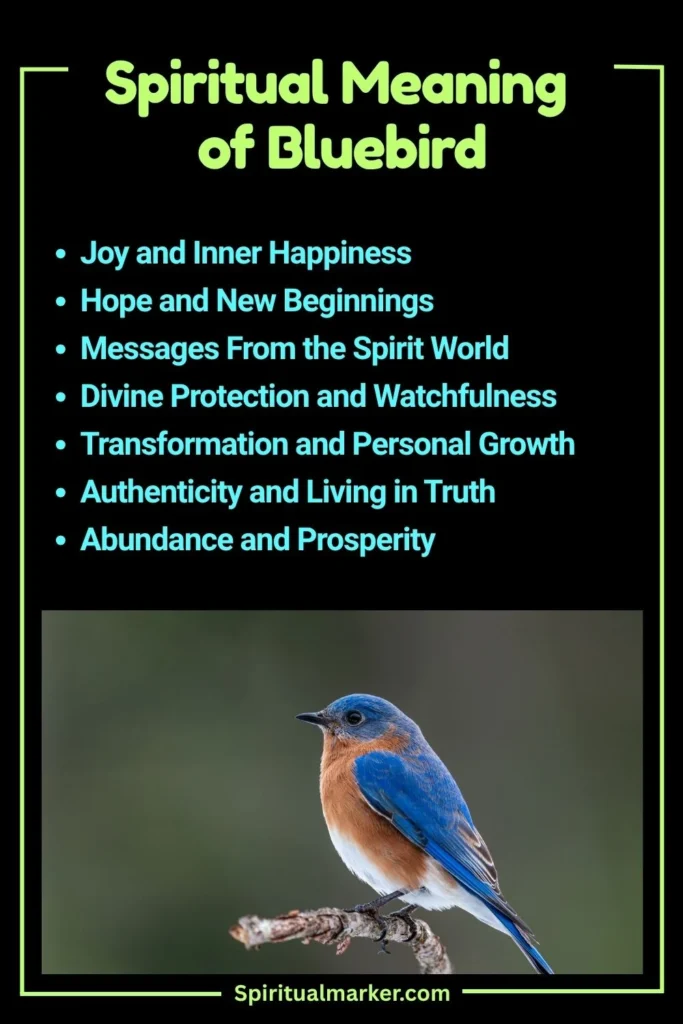
What Is the Bluebird and Why Does It Carry Spiritual Weight?
The bluebird belongs to the thrush family and is native to North America and parts of Asia. Three main species exist: the Eastern Bluebird, the Western Bluebird, and the Mountain Bluebird. Each one shares that signature burst of blue that has made them objects of wonder for thousands of years. Their feathers do not contain blue pigment. Instead, the blue color comes from a structural phenomenon called light scattering. Light hits the feathers and blue wavelengths reflect back. Even the bird’s color is a kind of spiritual metaphor. What you see is not what is physically there. It is a perception of something deeper.
That quality alone has made the bluebird spiritually significant. Ancient peoples saw things in nature and asked why. A bird that carries the color of the sky without being the sky. A creature that sings in joy even after cold winters. A small animal that returns when the frost breaks. These patterns did not go unnoticed. Across North America, Asia, and Europe, people began connecting the bluebird to renewal, divine presence, and answered prayer.
The bluebird is also known for its gentle temperament. It does not screech or fight. It sings. It nests in open fields. It raises its young with visible care. That behavior gave ancient observers the impression of a creature aligned with peace, family, and harmony. These are not arbitrary associations. They are observations that built into a rich spiritual tradition over centuries.
What Does Seeing a Bluebird Mean Spiritually?
Seeing a bluebird is rarely considered a neutral event in spiritual traditions. Most frameworks treat it as a meaningful sign. The context matters. Where you see it, when you see it, and what you are going through at that moment all shape the message.
When a bluebird appears during a difficult season of life, many spiritual teachers interpret it as a reminder that joy is still available. The bird does not erase the pain. It signals that transformation is near. When one appears at your window, many traditions read that as a visit from someone in the spirit realm. When one crosses your path unexpectedly, it is often seen as a prompt to pay attention to your inner world.
Seeing two bluebirds together often points to love, partnership, and divine union. A bluebird singing near you is frequently linked to good news on the way. A bluebird landing close to you without fear is read as a sign that you are protected and watched over. Each appearance carries a distinct layer of meaning, and the bluebird spiritual meaning sharpens when you consider the full context of your life at that moment.
7 Spiritual Meanings of the Bluebird
1. Joy and Inner Happiness
The bluebird is perhaps most universally associated with joy. Not the fleeting kind that depends on circumstances, but a deeper, soul-level happiness that exists regardless of what is happening around you. In many Native American cultures, the bluebird was called the “bird of happiness” well before the phrase became a Western cliché. The Navajo people incorporated the bluebird into morning songs and ceremonial rituals specifically to invite harmony and contentment into the day ahead.
The bluebird’s song is a key part of this association. It sings early. It sings often. Its call is soft and melodic, not aggressive. Many spiritual traditions teach that joy is a spiritual discipline, not simply an emotion. The bluebird models that teaching. It sings through seasons, through change, and through uncertainty. Psychologically, its presence in nature has been shown to lower stress responses, which suggests that the ancient association between bluebirds and happiness was not purely metaphorical. It carried a real and measurable effect on human wellbeing.
When the bluebird appears as a spiritual symbol of joy, it is often a call to stop searching for happiness in external achievements. The bird already has what it needs. It sings not because everything is perfect, but because song is its nature. The spiritual message is clear: return to your own nature. Find what makes your spirit sing. Then do that thing, not later, but now.
2. Hope and New Beginnings
The bluebird arrives with spring. After long, cold winters, the sighting of a bluebird was historically one of the first signs that warmth and life were returning. This made it a powerful symbol of hope long before anyone wrote it down. Farmers depended on these signs. Communities celebrated them. The bluebird became the living proof that hard seasons end.
In a spiritual sense, the bluebird carries that same energy of renewal and fresh starts. Many people report seeing bluebirds at the beginning of significant life transitions. Starting a new job. Moving to a new city. Recovering from illness. Beginning therapy or a spiritual practice. In each case, the bluebird appears not as a reward for getting through the hard part, but as a signal that the turning point is here.
The spiritual teaching embedded in this meaning is powerful. Hope is not passive. It is not wishful thinking. The bluebird does not wait in a hollow log hoping spring will come. It moves with the season. It acts in alignment with the change it trusts is coming. That is the kind of hope this bird symbolizes. Active, confident, and rooted in deep trust in the divine order of life’s cycles.
3. Messages From the Spirit World
Across many traditions, birds are viewed as intermediaries between the physical and spiritual realms. They occupy both heaven and earth. They move between the world of the living and the world beyond. The bluebird, with its heavenly blue color, holds a particularly strong association with spirit communication.
Many grieving people report seeing a bluebird shortly after the death of a loved one. This is not a rare occurrence. Grief counselors and spiritual advisors hear this account regularly. The bluebird appears at the window. It lingers. It makes direct eye contact. Then it leaves. In many spiritual frameworks, this is interpreted as the spirit of the deceased reaching through the veil to offer comfort. The blue color of the bird reinforces the idea of a message from higher realms.
Several Native American nations, including the Iroquois and the Cherokee, teach that birds carry prayers to the Creator. The bluebird, in particular, was seen as a bird that travels between the world of ancestors and the world of the living. When one appears unexpectedly, especially in an unusual location or at a meaningful time, many people take it as confirmation that their prayers have been heard and that their loved ones are at peace.
4. Divine Protection and Watchfulness
The bluebird has long been linked to the idea of being watched over. In several traditions, the appearance of a bluebird near your home was taken as a sign that your household was under divine protection. Families would sometimes build nesting boxes to attract bluebirds, not just for aesthetic reasons, but because having a bluebird nest nearby was considered a spiritual blessing and a protective omen.
The Sioux regarded the bluebird as a creature that kept evil spirits at bay. The bird’s connection to the sky and the sun made it a natural ally in protecting the sacred space of the home. In Chinese tradition, the blue bird was associated with the goddess Xi Wangmu, the “Queen Mother of the West,” who sent blue birds as her messengers and guardians. Their presence signaled that the divine was present and actively watching.
When you feel alone or uncertain about your safety, the sighting of a bluebird can carry the reassurance that you are not walking through life unguarded. Many spiritual practitioners who work with animal totems emphasize that the bluebird asks you to release fear and trust the protective presence that surrounds you. You are held. You are seen. The bluebird is the visible reminder of that invisible truth.
5. Transformation and Personal Growth
The bluebird undergoes its own transformation. The juvenile Eastern Bluebird has spotted, dull-colored feathers. Over time, those feathers shift into the brilliant blue and russet-orange that define the adult bird. This natural process mirrors one of the most important spiritual teachings in human life: transformation takes time, and it produces beauty.
In spiritual symbolism, the bluebird represents the journey from confusion to clarity, from heaviness to lightness, from ordinary to spiritually awakened. Many people who experience a major spiritual shift report a sudden and unusual closeness with bluebirds during that period. The bird seems to appear more often. It feels like a confirmation from the universe that the internal work is real and that the change is genuine.
The bluebird also does not resist the process. It does not try to stay spotted and dull. It grows into its color. That is the spiritual call this bird makes to you. Stop resisting your own becoming. The growth you are moving through right now is producing something more vivid than you can currently see. Trust the process. The blue is coming.
6. Authenticity and Living in Truth
The bluebird does not perform. It does not mimic other birds. It does not pretend to be something it is not. Its song is its own. Its color is its own. Its path is its own. In spiritual symbolism, this makes the bluebird a powerful symbol of authentic selfhood. Many traditions that work with animal spirits point to the bluebird as a guide for people who are struggling to live in alignment with their true identity.
When the bluebird appears as your spirit animal or totem, it challenges you to examine the places where you are living a performance rather than a life. Where are you saying yes when you mean no? Where are you wearing a mask? Where are you shrinking your color to fit into someone else’s nest? These are the questions the bluebird spiritually raises. Its very existence is a rebuke to inauthenticity.
In many wisdom traditions, living in truth is considered a form of spiritual courage. The bluebird, despite its small size, does not hide its color. It cannot be missed. That visibility requires a kind of boldness. The spiritual meaning here is a direct invitation to stop making yourself invisible. Your gifts, your voice, and your truth are not burdens to manage. They are blue feathers meant to be seen.
7. Abundance and Prosperity
In many cultures, the appearance of a bluebird near your home was taken as a sign of incoming prosperity. This connection runs deep in both Eastern and Indigenous American traditions. In China, the blue bird has been linked to fortune and favorable outcomes for centuries. In certain Native American traditions, a bluebird singing near you at the start of a new project or journey was considered a blessing on the work ahead.
The abundance the bluebird symbolizes is not just material. It also points to emotional richness, relational fullness, and spiritual overflow. Many spiritual frameworks teach that true prosperity flows from alignment with your purpose. The bluebird models this perfectly. It lives in its nature. It attracts what it needs. It gives its song freely and receives sustenance in return. That cycle of giving and receiving in alignment is the essence of spiritual abundance.
When the bluebird appears during a period of financial worry or creative drought, it carries a quiet but firm message: scarcity is not your permanent state. The fields will fill again. The season of harvest is approaching. Hold your position, keep giving what you have, and watch as the abundance that matches your spirit finds its way to you.
Bluebird Symbolism Across Cultures and Religions
The bluebird spiritual meaning stretches across nearly every major civilization that had contact with the bird or its color archetype. What is remarkable is how consistent the themes are. Joy. Hope. Heaven. Protection. Divine presence. These threads appear independently in cultures that had no contact with each other, which points to something deeply human in the way we perceive this creature.
In Chinese culture, the blue bird was a sacred messenger. The goddess Xi Wangmu, the Queen Mother of the West, was said to communicate through three blue birds. These birds served as her eyes, her voice, and her presence in the mortal world. Seeing a blue bird near your door in ancient China was considered one of the highest spiritual favors a household could receive. It meant the goddess herself was watching over you.
In Korean tradition, the bluebird is called “Parangse” and has long been associated with good news and happiness. Korean folklore treats the bluebird sighting as a sign of answered longing, particularly for people who have been waiting for positive change. The bird appears when the wait is about to end. It carries the announcement of relief.
Among the Lorraine people of France, a famous fairy tale titled “L’Oiseau Bleu” (The Blue Bird) became a central cultural narrative. The bluebird was a prince under an enchantment who remained faithful and loving despite his form. The story cemented the bluebird in French culture as a symbol of enduring love and noble devotion. Maurice Maeterlinck later expanded this idea in his 1908 play “The Blue Bird,” where two children search the world for happiness only to find it waiting at home. The bluebird, in that narrative, became the symbol of happiness that already exists within reach.
In Russian folklore, the Zhar-Ptitsa (Firebird) shares characteristics with the bluebird archetype. Magical blue birds in Slavic tradition carried the dual role of omen and guide, appearing to signal both warning and favor depending on the context. The blue color in Slavic mythology was always tied to the divine sky and its mysteries, making any blue bird a figure of significant spiritual gravity.
Bluebird Symbolism in Native American Traditions
No cultural tradition engages the bluebird spiritual meaning more directly than Native American peoples. The bluebird holds sacred status in multiple nations, and its symbolism is both specific and deeply integrated into ceremony, story, and daily life.
The Navajo Nation holds the bluebird in particularly high esteem. The bluebird appears in one of the most important Navajo songs, known as the Bluebird Song, which is sung at dawn to welcome the rising sun. The lyrics celebrate the bluebird as a symbol of beauty, harmony, and alignment with nature’s sacred order. In Navajo cosmology, the bluebird is the bird of the rising sun, making it a creature that stands at the intersection of earth and sky, night and day, darkness and light. Singing about the bluebird at dawn was a way of inviting divine harmony into the new day.
The Cochiti Pueblo people used the bluebird as a clan symbol. The bird represented the qualities the clan aspired to hold: gentleness, faithfulness, and spiritual attunement. Clan animals in Pueblo tradition were not just totems. They were teachers whose attributes the clan actively practiced and honored.
The Pima people of the Southwest have a creation story involving the bluebird. According to this story, the bluebird was once an ugly and dull-colored bird. It bathed in a sacred lake for four mornings while singing sacred songs. On the fourth morning, it emerged with its brilliant blue plumage, transformed by its devotion and faith. The Pima story is a direct teaching about how spiritual practice and persistence produce beauty and transformation. The bluebird’s color was earned, not given. That teaching carries enormous weight.
The Iroquois tradition links the bluebird to the spirit world and views its appearance as a communication from ancestors. When a bluebird was seen near a grieving family, it was not regarded as a random occurrence. It was treated as a direct message from those who had passed, assuring the living that the deceased were at peace and still present in spirit. This understanding brought enormous comfort and helped communities move through loss with a framework that honored both worlds.
Bluebird Symbolism in World Mythologies
Beyond specific cultures, the bluebird weaves through global mythology in ways that reveal a universal human instinct to assign sacred meaning to this creature. The color blue itself holds mythological significance in nearly every ancient tradition. It is the color of the sky, the ocean, the divine, and the infinite. When that color appears on a living creature that sings and soars, the mythological imagination activates immediately.
In ancient Mesopotamia, blue was associated with the divine realm and was often used to color the figures of gods and sacred animals in artistic representations. Birds in that tradition frequently served as omens and divine messengers, and blue birds specifically were associated with favorable outcomes and celestial favor.
In Hindu mythology, Lord Vishnu and Lord Krishna are both depicted with blue or blue-tinged skin, representing their divine nature and transcendence of the ordinary human experience. Birds in Hindu tradition, particularly the Garuda, serve as divine vehicles and messengers. The association of the color blue with divinity in this tradition reinforces why blue birds, including the bluebird, carry such spiritual resonance in Eastern spiritual frameworks.
Celtic mythology, while not featuring the bluebird directly, associated birds broadly with the Otherworld and the souls of the departed. Blue, in Celtic symbolism, represented truth, wisdom, and the sky realm where divine knowledge resided. Blue-colored birds in Celtic stories were almost always messengers or guides from the Otherworld, carrying instruction or comfort from beyond the veil. The symbolic logic that applies to the bluebird fits perfectly into this Celtic framework.
In Japanese mythology, the Bluebird of Happiness concept traveled through Belgian playwright Maeterlinck’s work and became deeply embedded in Japanese culture. The phrase “shiawase no aoi tori” (the blue bird of happiness) became a cultural touchstone, used in literature, music, and everyday conversation to refer to the elusive but achievable state of true contentment. The bluebird in Japan symbolizes a happiness that is real, nearby, and possible, not distant or unattainable.
Bluebird Biblical Meaning and Significance
The bluebird does not appear by name in the Bible, but the spiritual symbolism it carries aligns deeply with biblical themes. Birds throughout scripture serve as powerful symbols of divine care, spiritual freedom, and heavenly messengers. The traditions around the bluebird parallel these biblical teachings in meaningful ways.
In Matthew 6:26, Jesus points to birds as evidence of God’s provision: “Look at the birds of the air; they do not sow or reap or store away in barns, and yet your heavenly Father feeds them.” The bluebird, which neither hoards nor panics, which sings in plenty and in lean times, embodies this teaching with striking precision. Its existence is a living sermon on trust and divine provision.
The color blue holds significant biblical weight as well. In Exodus 28, God commanded the use of blue thread in the priestly garments of Aaron. Blue in Hebrew scripture (tekhelet) represented heaven, divinity, and the presence of God. When you see a bluebird through a biblical lens, its color alone carries that same sacred association. The bird wears the color of heaven on its feathers.
The bluebird’s joyful song aligns with the psalmist’s frequent call to sing praises regardless of circumstances. Psalm 98:4 declares, “Shout for joy to the Lord, all the earth, burst into jubilant song with music.” The bluebird does exactly that. It does not wait for perfect conditions. It sings. Many Christian spiritual teachers have used the bluebird as a natural illustration of faith-filled joy, the kind that exists not because life is easy, but because the soul is rooted in something larger than circumstances.
Many Christians who see a bluebird at a significant moment interpret it as a gentle reminder from the Holy Spirit that God is near. The bird’s sudden appearance, its direct gaze, and its brief but meaningful presence can feel like a personal touch from the divine. Whether or not one takes a strictly theological view, the bluebird’s spiritual resonance within Christian experience is real, widely reported, and deeply comforting.
The Bluebird as a Spirit Animal and Totem
In spiritual and shamanic traditions, a spirit animal is a creature that mirrors your soul’s core qualities and offers guidance suited to your life’s journey. The bluebird as a spirit animal is one of the most encouraging and life-affirming guides you can have.
People with the bluebird as their spirit animal tend to be naturally joyful, creative, and community-oriented. They have a gift for seeing beauty in ordinary moments. They often serve as sources of encouragement for those around them, offering warmth without effort. The challenge for bluebird people is often that they can absorb the heaviness of others and lose their own lightness in the process. The bluebird spirit animal calls them back to their own song when they have been humming someone else’s tune for too long.
The bluebird totem also carries a specific call to use your voice. The bluebird does not stay silent. Its song is its most defining attribute. If the bluebird is your totem, you are being called to speak, create, teach, or lead in a way that reflects your truest inner voice. Silence, in this context, is not humility. It is a withholding of your gift from a world that needs to hear it.
As a power animal, the bluebird brings the medicine of lightness and renewal. When you call on bluebird energy, you are invoking the capacity to release what is heavy and return to what is essential. The bluebird does not carry yesterday’s weather into today’s song. It starts fresh each morning. That daily renewal is available to you too, and the bluebird as your power animal helps you access it.
Dreaming About Bluebirds: Spiritual and Psychological Meanings
Dreams featuring bluebirds are considered highly positive omens in most spiritual and psychological frameworks. The subconscious mind uses symbols with deep meaning, and the bluebird carries one of the clearest positive signal profiles in dream symbolism.
Dreaming of a bluebird flying freely is widely interpreted as a sign that your spirit is beginning to break free from limitations. Something that has held you back is loosening. Freedom, creative expression, or a new opportunity is opening up in your waking life. The bluebird in this dream is your subconscious cheering you forward.
Dreaming of a bluebird sitting near you or in your hand is one of the most powerful dream scenarios. This image suggests that happiness and peace are not far off. They are already within reach. You may have been searching externally for something that has actually been available to you internally all along. The dream is an invitation to stop the search and receive what is already present.
Dreaming of a bluebird singing is linked to receiving a message. In spiritual dream interpretation, this often means that guidance is being communicated to you, possibly from your higher self, a spirit guide, or a deceased loved one. Pay attention to what the bird sings in the dream, or what feelings arise when you hear it. The emotion often carries more information than the visual image itself.
Dreaming of a caged bluebird carries a cautionary message. It points to suppressed joy, unexpressed creativity, or a life lived within too many restrictions. The caged bluebird in your dream is not a negative omen about the world. It is a mirror image of what you have done to yourself. The dream calls you to identify what cage you have built and to open the door before the song inside you fades.
From a Jungian perspective, the bluebird in dreams represents the anima or the soul’s deepest longing. Its appearance in the dream world suggests that the psyche is actively processing themes of identity, freedom, and authentic expression. The bluebird shows up in dreams precisely when the soul is ready to move toward greater wholeness, and its appearance is a green light from the deep self to take the next step.
Bluebird Spiritual Meaning After the Death of a Loved One
Of all the contexts in which the bluebird appears spiritually, the grief context is perhaps the most powerful. Thousands of people across the world share accounts of seeing a bluebird immediately after the death of someone they loved. The bird arrives at the window. It sits on the fence near the grave. It appears in the yard on the morning of the funeral. The timing is too precise to dismiss.
Many grief counselors who incorporate spiritual frameworks into their work take these accounts seriously. The bluebird in this context is understood as a sign of continued connection. Death, in many spiritual traditions, is not the end of relationship. It is a transformation of the relationship. The bluebird serves as the visible bridge between the world of the living and the world of those who have passed.
Native American traditions, as noted earlier, explicitly teach that birds carry the prayers and presence of ancestors. When a bluebird appears after a death, it is not a coincidence to be explained away. It is a deliberate communication from a loving presence that wants you to know they are well, that love does not die, and that the connection between you remains unbroken. That is a message that grief desperately needs. The bluebird delivers it without words, but with unmistakable clarity.
Different Colors of Bluebirds and Their Spiritual Meanings
While the blue plumage defines the bluebird’s spiritual identity, different bluebird species carry slight color variations that add nuance to their symbolic meaning.
The Eastern Bluebird features deep blue on the back and wings with a warm russet-orange chest. The orange or chestnut color adds an element of passion, vitality, and warmth to its spiritual meaning. This species is associated with joy that is also grounded and full-bodied, not merely airy or idealistic. The combination of blue (heaven, spirit) and orange (earth, fire) creates a bird that symbolizes the sacred marriage of the spiritual and the earthly.
The Western Bluebird shares the blue and orange pattern but appears slightly more muted. Its spiritual meaning centers on quiet wisdom and steady grace. Where the Eastern Bluebird might burst into your awareness dramatically, the Western Bluebird tends to suggest a more meditative form of spiritual communication. It calls you inward rather than outward.
The Mountain Bluebird is the most visually stunning of the three. The male is an almost entirely vivid turquoise-blue with no orange markings. This bird carries the purest form of sky and heaven symbolism. It appears higher in elevation, closer to the divine in a literal geographic sense. Its spiritual meaning leans most strongly toward transcendence, spiritual elevation, and direct divine communication. Seeing a Mountain Bluebird is often interpreted as one of the clearest spiritual messages a person can receive in the natural world.
A Final Note
The bluebird spiritual meaning is not a relic of ancient superstition. It is a living, breathing tradition that continues to bring comfort, direction, and beauty to people all over the world. Whether it appears at your window after loss, sings outside your door at a new beginning, or visits your dreams with a message you needed to hear, the bluebird shows up with intention.
Pay attention the next time you see one. Notice where you are. Notice what you have been carrying. Notice what you have been praying or hoping for. The bluebird rarely appears without reason, and the reason is almost always something worth receiving.
If the bluebird is calling to you as a spirit animal or totem, consider spending time in meditation with the image of the bluebird and asking what message it carries specifically for your season of life. Keep a journal and note when and where bluebirds appear in your world. Over time, patterns will emerge that offer remarkably clear guidance.
You can also study the Navajo Bluebird Song and incorporate its themes of harmony and gratitude into your morning routine. Simply stepping outside at dawn and setting an intention of beauty and alignment, as the Navajo tradition teaches, can shift your entire day. The bluebird does not carry its message only for those who already believe. It carries its message for anyone with eyes open enough to see it.
The world sends you signs constantly. The bluebird is one of its most beautiful and consistent ones. Do not let it pass unnoticed.