St. Patrick's Day brings green hats, parades, and shamrocks. Behind the celebration sits a story of faith, migration, and Irish identity.
The true spiritual meaning of St. Patrick’s Day, history and background, reaches back to a young man taken into slavery and later returned as a missionary. His feast day marks courage, forgiveness, and spiritual purpose. The horseshoe is another Irish-linked symbol, and spiritual meaning of horseshoe covers its luck.
Over time, the day became a mix of Catholic tradition, folklore, and cultural pride. Green, shamrocks, and rainbows each gained their own layer of meaning.
Some symbols connected to the day also appear in home protection. Red door spiritual meaning and symbolism shows how a simple color can carry sacred weight.
What Is St. Patrick’s Day and When Is It Celebrated?
St. Patrick’s Day is a Christian feast day held every year on March 17. It honors the life and mission of Saint Patrick, the patron saint of Ireland.
The date marks the traditional anniversary of his death in the fifth century. Originally, the day focused on prayer, reflection, and church services. Families attended Mass. Communities gathered to remember Patrick’s missionary work and spiritual legacy.
Over time, the celebration expanded. Irish immigrants carried their traditions abroad. As a result, March 17 became both a religious observance and a cultural festival. However, its spiritual foundation still stands at the center of its meaning.
The Historical Background and Origins of St. Patrick’s Day
To understand the spiritual depth of the day, we must step into Patrick’s early life.
Patrick was not born in Ireland. He was born in Roman Britain during the late fourth century. When he was sixteen, Irish raiders kidnapped him and took him to Ireland as a slave. He spent years tending sheep in isolation. During that painful period, he turned to prayer. His faith grew stronger in hardship.
Eventually, he escaped and returned home. Yet something unexpected happened. He felt called to go back to Ireland, not in anger, but with compassion. He chose forgiveness over revenge. He returned as a missionary.
Patrick dedicated his life to spreading Christianity throughout Ireland. He baptized thousands, built churches, and helped shape the spiritual future of the island. According to tradition, he used the shamrock to explain the concept of the Holy Trinity. Whether literal or symbolic, this story reflects his ability to teach complex truths in simple ways.
By the early seventeenth century, the Church officially recognized March 17 as a feast day in his honor. What began as a solemn religious remembrance slowly evolved into a broader celebration of Irish identity and faith.
10 Spiritual Meanings of St. Patrick’s Day
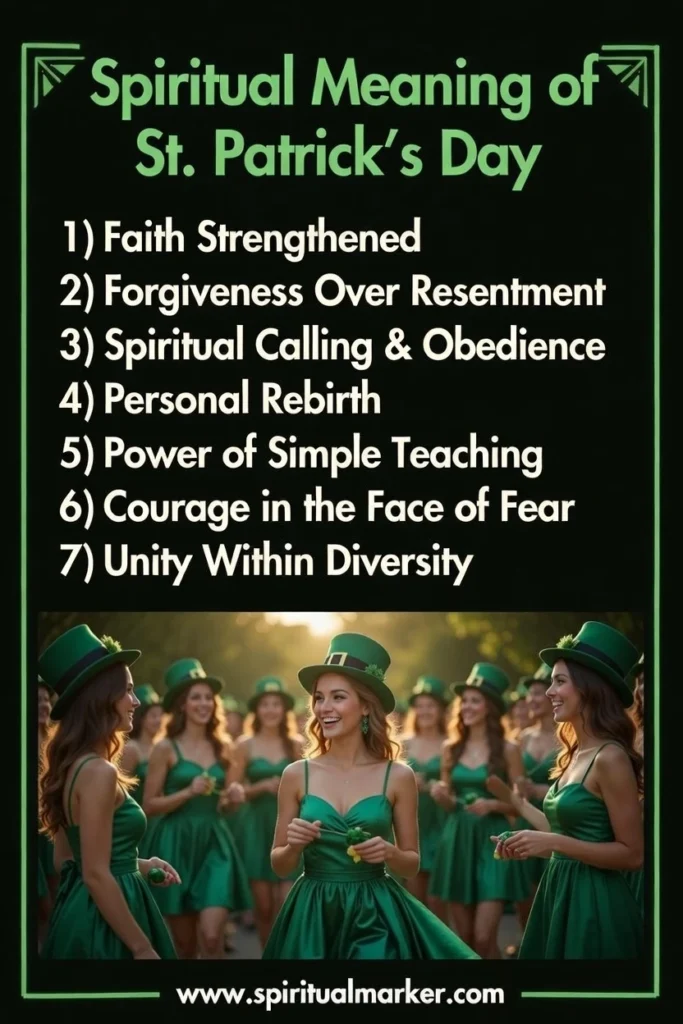
St. Patrick’s Day carries deep spiritual significance rooted in the life of St. Patrick, the patron saint of Ireland, who endured slavery, embraced faith, and spread Christianity.
1) Faith Strengthened Through Suffering
When we look at the life of Saint Patrick, we do not see comfort or privilege at the start. Instead, we see a frightened teenage boy captured from Roman Britain and sold into slavery in Ireland. He lived as a shepherd in harsh weather. He felt isolated. He had no family nearby.
Yet, in that lonely field, something shifted inside him. Before his capture, Patrick admitted that he did not take his faith seriously. However, suffering stripped away distractions. He began to pray daily, sometimes many times a day.
In his own writing, the Confessio, he described how constant prayer became his shelter. While his body endured hardship, his spirit grew stronger. Therefore, St. Patrick’s Day reminds us that pain can deepen faith rather than destroy it.
Trials often feel like punishment. Yet they can become training grounds. Hardship can teach endurance, humility, and trust. When everything else falls away, faith becomes real.
2) Forgiveness Over Resentment
After six years, Patrick escaped slavery and returned home. Most people would have closed that painful chapter forever. However, years later, he chose to go back to Ireland. Not as a slave, but as a missionary.
That decision carries enormous spiritual weight. He returned to the very land connected to his trauma. Instead of seeking revenge, he carried a message of grace. This choice reflects the teachings of Jesus Christ, who called followers to forgive their enemies.
Forgiveness does not erase memory. It transforms it. Patrick could have allowed bitterness to define his identity. Instead, he allowed mercy to define his mission.
Therefore, St. Patrick’s Day becomes a quiet reminder that forgiveness frees the heart. Resentment traps us in the past. Forgiveness opens a future.
3) Spiritual Calling and Obedience
According to tradition, Patrick experienced a vision in which the Irish people called him back. He believed God summoned him to serve there. That calling did not make logical sense. The land once held him captive. The risks were real. Nevertheless, he obeyed.
Obedience often requires courage before clarity. Patrick stepped into uncertainty because he trusted the One who called him. His life reflects a simple but powerful truth. When purpose becomes clear, comfort must step aside.
For many believers, St. Patrick’s Day highlights the importance of listening for divine direction. A calling may feel uncomfortable. It may challenge fear. Yet obedience turns vision into action. And action shapes history.
4) Transformation and Personal Rebirth
Patrick did not remain the same person who entered Ireland as a slave. His suffering reshaped him. His faith matured. Eventually, he became a bishop and missionary leader.
Christian tradition places strong emphasis on rebirth through baptism. Patrick preached this message widely. In fact, he baptized thousands. His own life mirrored that spiritual theme. He moved from spiritual apathy to passionate conviction. He moved from captive to shepherd of souls.
Because of this transformation, St. Patrick’s Day carries a message of renewal. No past defines the final chapter. A person can change direction. A broken story can grow into a redemptive one.
5) Courage in the Face of Fear
Ireland in the fifth century practiced Celtic pagan traditions. Missionary work involved real danger. Tribal leaders held power. Religious change threatened established authority. Still, Patrick preached openly.
Courage did not mean he felt no fear. Rather, courage meant he acted despite fear. His famous prayer, often called St. Patrick’s Breastplate, reflects deep trust in divine protection. He believed Christ surrounded him in every direction.
Therefore, the spiritual meaning here runs deeper than celebration. It speaks about boldness rooted in faith. When conviction grows strong, fear loses control. Courage then becomes a daily choice, not a personality trait.
6) The Power of Simple Teaching
One of the most famous symbols of the holiday is the shamrock. Tradition says Patrick used its three leaves to explain the Holy Trinity: Father, Son, and Holy Spirit. Whether or not every detail is historically exact, the image captures an important truth.
Patrick did not rely on complex philosophy. He spoke in ways ordinary people understood. Many Irish tribes relied on oral tradition rather than written texts. Therefore, storytelling mattered.
This approach highlights a powerful spiritual principle. Profound truth does not require complicated language. Clarity builds connection. When teaching becomes relatable, transformation becomes possible. St. Patrick’s Day celebrates that simplicity carries power.
7) Unity Within Diversity
Today, people across the globe celebrate St. Patrick’s Day. Parades fill streets in cities far from Ireland. Communities gather wearing green. Music plays. Food is shared.
Although the holiday carries cultural pride, it also carries spiritual unity. Patrick’s mission reached diverse tribes across Ireland. He worked among different clans with distinct customs. Yet he invited them into shared faith.
In this way, the day symbolizes unity without erasing identity. Cultural differences remain. Still, common belief builds connection. Faith becomes a bridge rather than a wall.
8) Divine Guidance and Protection
Legends surround Patrick’s life. Some stories describe angelic guidance. Others tell of miraculous protection. While historians separate legend from fact, these stories reveal how deeply people believed God guided his mission.
Patrick himself wrote about trusting God’s direction. He credited divine strength for every success. He saw himself as an instrument rather than a hero.
Spiritually, this meaning points toward reliance. When someone commits to a higher purpose, they trust guidance beyond their own wisdom. St. Patrick’s Day, therefore, becomes a reminder that faith includes surrender as well as action.
9) Cultural Identity Rooted in Faith
Over time, Christianity blended with Celtic heritage. Symbols, art, and seasonal festivals took on new meaning. Ireland developed a distinct Christian identity shaped by both local tradition and gospel teaching.
Patrick did not erase culture. Instead, he redirected it. He spoke into existing customs and reshaped them with new spiritual focus. That approach left lasting impact.
Because of this history, St. Patrick’s Day reflects how belief shapes culture. Faith does not float separate from daily life. It influences music, language, art, and celebration. Culture then becomes a living expression of conviction.
10) Renewal and Hope
St. Patrick’s Day falls near the beginning of spring. In Ireland, winter begins to loosen its grip. Green shoots push through the soil. Light lingers longer in the sky.
This timing strengthens the theme of hope. Patrick once returned to a land considered spiritually dark. Yet he carried confidence that transformation could occur. His mission symbolized new beginnings.
Spring mirrors that spiritual renewal. Cold seasons end. Growth returns. Communities gather with expectation. Therefore, the day whispers a quiet promise. Renewal remains possible. Faith can awaken what once seemed dormant.
Cultural Significance of St. Patrick’s Day Around the World
Although the holiday began in Ireland, it now spans continents. Large parades take place in cities like New York City, Chicago, and Sydney. In fact, New York City hosts one of the largest St. Patrick’s Day parades in the world.
Interestingly, the modern parade tradition grew stronger outside Ireland before it became common at home. Irish immigrants in America used the celebration to express pride and preserve identity. Through music, dance, and storytelling, they kept their heritage alive.
Meanwhile, Ireland itself transformed the day into a national festival that welcomes visitors from every background. The celebration now blends sacred and secular elements. Churches still hold services. Families still pray. At the same time, festivals promote Irish art, history, and tourism.
Because of globalization, even countries with small Irish communities now join the celebration. Landmarks glow green. People wear symbolic clothing. However, the heart of the day still whispers a spiritual message about faith and resilience.
Famous Legends, Popular Myths, and Superstitions of St. Patrick’s Day
St. Patrick’s Day carries a rich layer of folklore. Some stories inspire. Others entertain. A few stretch history into legend.
One of the most famous legends claims that Patrick drove all snakes out of Ireland. Scientifically, Ireland never had native snakes after the Ice Age. Therefore, many scholars interpret this story symbolically. The snakes may represent pagan beliefs that faded as Christianity spread.
Another popular myth centers on the shamrock. People believe Patrick used it to explain the Trinity. While historians debate the details, the symbol remains powerful. It represents unity and divine mystery.
Leprechauns also appear frequently in St. Patrick’s Day imagery. These tiny, mischievous figures come from Irish folklore, not Christian tradition. Over time, they became commercial symbols tied to luck and hidden treasure.
The idea of wearing green to avoid being pinched is another playful superstition. Some say green makes you invisible to leprechauns. If they see you, they pinch you. Therefore, wearing green protects you. This tradition likely developed in America.
Many associate the day with four leaf clovers, although Patrick’s symbol was the three leaf shamrock. The fourth leaf traditionally represents luck. Meanwhile, the three leaves symbolize faith, hope, and love.
Another myth claims that drinking on St. Patrick’s Day brings good fortune. Historically, Irish laws once required pubs to close on March 17 because the day was meant for worship. The heavy drinking culture emerged later.
Some believe that finding a rainbow on St. Patrick’s Day signals hidden blessings. Folklore connects rainbows with pots of gold guarded by leprechauns. Spiritually, however, the rainbow often represents promise and covenant.
There is also the tradition of lifting Lenten restrictions on the feast day. Since March 17 often falls during Lent, the Church allowed certain celebrations. This exception blended spiritual discipline with joyful remembrance.
Final Thoughts
St. Patrick’s Day means far more than green clothing and festive gatherings. At its core, it tells a story of captivity turned into calling. It speaks of forgiveness that overcomes bitterness. It highlights courage rooted in faith.
When Patrick returned to Ireland, he chose love over revenge. That decision shaped a nation’s spiritual identity. It also offers a lesson that remains relevant today.
The true spiritual meaning of St. Patrick’s Day rests in transformation, resilience, and faithful service. Beneath the music and laughter stands a reminder that hardship can shape purpose, and faith can turn wounds into wisdom.
As March 17 approaches each year, the world celebrates in many ways. Yet behind every shamrock lies a quiet invitation. Reflect. Renew. Strengthen your faith. That is the heart of the day.
You Might Also Like
1) Spiritual Meaning of Widow’s Peak, Myths & Superstitions
2) Spiritual Meaning of Hearing Birds Chirping at Night
3) Spiritual Meaning of Blood Moon (Red Moon) and Its Symbolism
4) Uneasy Feeling in Stomach Spiritual Meaning
5) Spiritual Meaning of Having the Same Dream Twice
References
- https://www.saintaidan.ca/2024/03/17/st-patrick-and-forgiveness-sunday/
- https://www.whatspiritual.com/spiritual-meanings-of-st-patricks-day/
- https://www.bible.com/reading-plans/55706-learning-about-forgiveness-with-st-patrick/day/4
- https://spiritualunravel.com/st-patricks-day-spiritual-meaning/
- https://www.facebook.com/groups/687678892212342/posts/1321563208823904/
- https://thetruthspirituality.com/st-patricks-day-spiritual-meaning/