Bay leaves are common in kitchens, but their history goes far beyond cooking. These fragrant leaves have been used in rituals, medicine, and spiritual practice for centuries. Across cultures, bay leaves carry deep meaning and sacred significance.
The bay leaves spiritual meaning often involves protection, victory, and manifestation. In ancient Greece, bay leaves crowned victors and honored gods. A spiritual meaning of burning sage shares that cleansing-herb focus, though sage carries a more ceremonial energy.
Some traditions view bay leaves as tools for attracting success and warding off negativity. Others see them as a reminder to claim your power. The leaf's condition and use can add detail.
If bay leaves appear in your life, they may signal a season of triumph. A spiritual meaning of black pepper also deals with kitchen spices, though pepper carries a more protective energy.
Key Takeaways
- Bay leaves symbolize protection, victory, wisdom, and manifestation across multiple spiritual traditions.
- Burning bay leaves is a common cleansing ritual used to clear negative energy and invite positive change.
- The herb appears in biblical scripture, Greek mythology, and Roman tradition as a symbol of honor and divine favor.
- Writing intentions on bay leaves before burning them is a popular manifestation practice in modern witchcraft and folk magic.
- Beyond spirituality, bay leaves carry physical health benefits, including anti-inflammatory and digestive properties backed by research.
What Are Bay Leaves and Why Do They Hold Spiritual Power?
Bay leaves come from the bay laurel tree, an evergreen native to the Mediterranean region. The tree thrives in warm coastal climates and produces aromatic, leathery leaves prized for both cooking and ceremony. Ancient civilizations didn’t separate the kitchen from the temple the way modern life does. A plant that smelled powerful, healed wounds, and burned with fragrant smoke naturally earned a place in sacred ritual.
You can trace the spiritual power of bay leaves back to their sensory intensity. The leaf releases a strong, warm aroma when crushed or burned, and ancient people associated strong scents with spiritual cleansing. Smoke carried prayers upward, and bay leaf smoke in particular was believed to open channels between the earthly and divine realms. Priests, healers, and oracles used it to sharpen intuition and create altered states of awareness.
The Oracle of Delphi, the most famous prophetess in ancient Greece, reportedly chewed bay leaves before delivering her prophecies to Apollo’s followers. Historians debate whether the leaves caused mild hallucinogenic effects or whether the ritual itself induced her trance state. Either way, the association between bay leaves and prophetic vision became permanent in Western spiritual history. This single historical detail explains why bay leaves still appear in candle magic, manifestation rituals, and intention-setting practices today.
Spiritual power doesn’t come from superstition alone. It comes from consistent symbolic use across centuries and cultures. When a plant repeatedly shows up in stories of victory, protection, and divine connection, that pattern becomes part of collective human consciousness. Bay leaves earned their spiritual reputation through real, repeated use, not random folklore.
What Does Burning or Carrying a Bay Leaf Symbolize?
When you burn a bay leaf, you’re tapping into a symbol of release and transformation. The act of burning represents letting go of what no longer serves you, while the smoke carries your intentions toward the universe or the divine. This is why so many manifestation rituals call for writing a wish on a bay leaf before setting it alight. The leaf becomes a vessel, and the fire becomes the messenger.
Carrying a bay leaf in your pocket or wallet symbolizes something different. It represents ongoing protection and luck. Folk traditions across Europe held that a bay leaf kept close to the body warded off illness, bad luck, and even lightning strikes. Sailors tucked bay leaves into their coats before long voyages. Travelers carried them for safe passage. The leaf, in this context, becomes a quiet guardian rather than a one-time ritual tool.
Placing bay leaves under your pillow symbolizes prophetic dreaming and clarity. This practice dates back centuries and connects directly to the Oracle of Delphi tradition. People hoping for guidance, answers, or insight into a difficult decision would sleep with a bay leaf nearby, trusting that their dreams would reveal what their waking mind couldn’t access.
Each method of using a bay leaf, whether burned, carried, or placed under a pillow, carries its own symbolic weight. The leaf adapts its meaning based on intention and action, which is part of why it remains such a versatile spiritual tool even today.
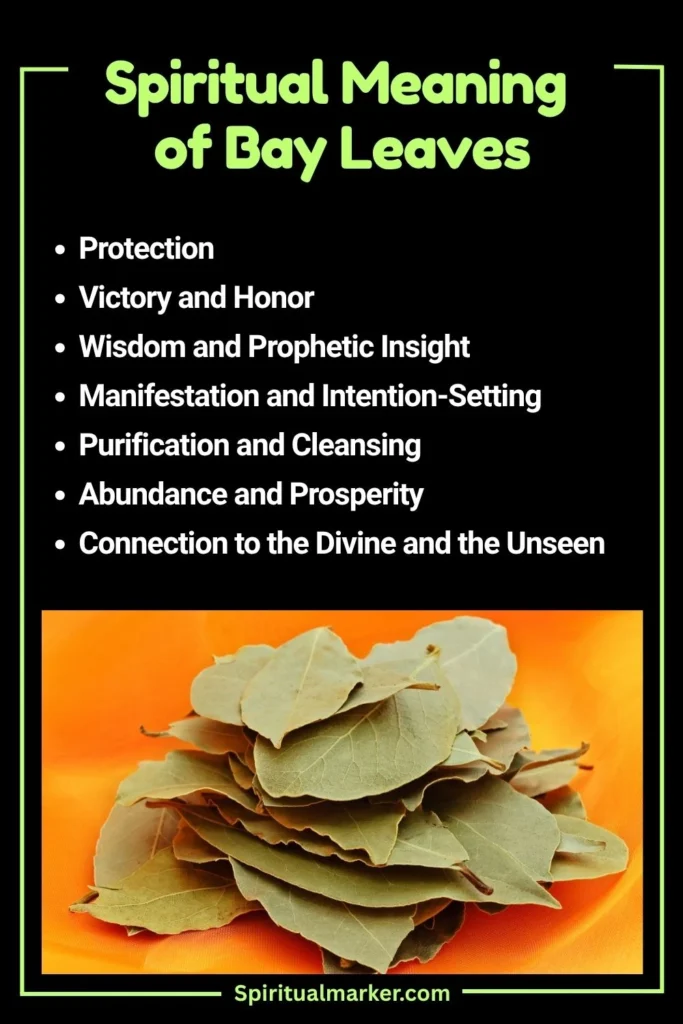
7 Spiritual Meanings of Bay Leaves
1. Protection
Protection is perhaps the oldest and most widespread spiritual meaning associated with bay leaves. Across ancient civilizations, people viewed the bay laurel not merely as a plant but as a powerful guardian against harmful influences. In ancient Rome, families planted laurel trees near their homes because they believed the tree created a spiritual barrier that kept negative forces away. Similarly, warriors often carried bay leaves into battle, trusting the plant’s sacred reputation to provide divine protection during uncertain and dangerous situations.
What makes this symbolism particularly meaningful is that protection was never viewed as passive. Ancient people actively incorporated bay leaves into rituals during storms, natural disasters, and times of fear. Burning the leaves was believed to create a protective shield around a person or place. The rising smoke symbolized the removal of unseen dangers while strengthening the connection between the physical and spiritual worlds.
Today, many people continue to associate bay leaves with energetic boundaries. Whether viewed through a spiritual, symbolic, or psychological lens, the leaf often represents the human desire to create safety, preserve peace, and guard against influences that threaten emotional or spiritual well-being.
2. Victory and Honor
Few plants carry a stronger association with success and achievement than the bay laurel. In both Greek and Roman culture, victorious athletes, scholars, poets, and military leaders received laurel wreaths as public recognition of their accomplishments. These crowns served as visible proof that dedication, discipline, and perseverance had led to success.
However, the spiritual meaning goes deeper than simple recognition. Ancient societies believed victory reflected more than human effort alone. Success often signified that divine forces had favored or blessed an individual’s journey. Wearing a laurel wreath symbolized alignment with higher principles such as courage, excellence, wisdom, and determination.
This symbolism remains relevant because many people still see bay leaves as reminders that meaningful achievements require persistence. The leaf represents the moment when hard work finally bears fruit, when challenges are overcome, and when personal growth becomes visible. In this sense, bay leaves symbolize not only external success but also the inner transformation that makes victory possible.
3. Wisdom and Prophetic Insight
The connection between bay leaves and wisdom originates largely from Greek mythology, particularly the story of Apollo and Daphne. After Daphne transformed into a laurel tree, Apollo declared the tree sacred. Because Apollo was associated with prophecy, knowledge, music, and truth, the laurel inherited these powerful symbolic qualities.
As a result, ancient oracles, priests, and spiritual seekers often used bay leaves during rituals designed to enhance intuition and divine guidance. Historical records suggest that some temple practices involved chewing or burning laurel leaves before prophetic ceremonies. Whether these practices produced spiritual experiences or simply helped participants enter a reflective state of mind, the association between bay leaves and higher knowledge became firmly established.
Spiritually, bay leaves often represent clarity in moments of uncertainty. People frequently turn to their symbolism when seeking answers, insight, or direction. The leaf serves as a reminder that wisdom often emerges when distractions fade and deeper truths become visible. Rather than predicting the future, the spiritual meaning focuses on developing greater awareness and trust in one’s perception.
4. Manifestation and Intention-Setting
Among modern spiritual practices, manifestation has become one of the most popular meanings connected to bay leaves. Many people write wishes, goals, or intentions directly onto a leaf before burning it. The ritual appears simple, yet its symbolism draws upon traditions that stretch back thousands of years.
The process reflects a powerful sequence of transformation. First, an intention takes physical form through written words. Then fire converts the leaf into smoke and ash, symbolizing the release of that intention into the universe. Throughout history, fire has represented change, purification, and spiritual communication, making it a natural partner in manifestation rituals.
Beyond supernatural interpretations, the practice also carries psychological significance. Writing down a goal creates focus. Burning the leaf can symbolize commitment and trust in the process. For many people, the ritual serves as a meaningful way to move from wishing toward intentional action. Spiritually, bay leaves become symbols of hope, purpose, and the belief that thoughts have the power to shape future outcomes.
5. Purification and Cleansing
Purification forms another important layer of bay leaf symbolism. Throughout many traditions, smoke has represented cleansing, renewal, and the removal of unwanted energies. Bay leaves became part of these practices because their aromatic smoke was believed to refresh both physical spaces and spiritual environments.
People often used bay leaves after periods of conflict, grief, illness, or major life transitions. The act of burning the leaves symbolized clearing away emotional residue and creating room for something new. Unlike protection, which focuses on preventing negative influences from entering, purification centers on removing what has already accumulated.
This distinction helps explain why bay leaves frequently appear during new beginnings. Whether someone moves into a new home, starts a new chapter of life, or seeks emotional healing after a difficult season, the symbolism of cleansing offers a sense of renewal. The leaf becomes a representation of release, encouraging people to let go of burdens that no longer serve them and make space for fresh opportunities.
6. Abundance and Prosperity
Many folk traditions associate bay leaves with wealth, prosperity, and financial well-being. People have long placed bay leaves in wallets, cash registers, business entrances, and storage areas where money was kept. These practices reflected the belief that the sacred qualities of the plant could attract favorable circumstances and steady growth.
Historically, prosperity was not viewed solely in terms of money. Wealth often included fertile land, healthy families, successful harvests, strong communities, and personal stability. Consequently, the spiritual meaning of abundance extended far beyond financial gain. Bay leaves symbolized a life marked by growth, reward, and sustained blessings.
This symbolism remains powerful because abundance speaks to a universal human desire for security and opportunity. Spiritually, bay leaves remind us that prosperity often emerges through a combination of effort, patience, and favorable circumstances. The leaf serves as a symbol of growth that unfolds steadily over time rather than appearing instantly.
7. Connection to the Divine and the Unseen
At its deepest level, the spiritual meaning of bay leaves centers on connection. Throughout history, the plant has appeared wherever people sought communication with higher powers, spiritual forces, ancestors, or divine wisdom. This role explains why bay leaves appear in rituals involving prophecy, prayer, protection, purification, and manifestation.
Ancient priests burned laurel leaves in sacred ceremonies. Oracles used them while seeking divine messages. Folk traditions incorporated them into prayers for guidance and blessing. Across cultures, the leaf repeatedly appeared at moments when humans reached beyond the ordinary world in search of something greater.
This enduring symbolism reflects the bay leaf’s unique position as a bridge between the visible and invisible realms. Whether one interprets this literally or symbolically, the message remains remarkably consistent. Bay leaves remind people that life contains dimensions beyond what can be immediately seen or measured. They represent faith, mystery, and the ongoing human search for meaning, guidance, and spiritual connection.
Bay Leaf Symbolism and Meaning Across Cultures and Religions
Different cultures developed their own relationship with bay leaves, yet certain themes repeat with striking consistency. In ancient Greece, the laurel tree belonged to Apollo, and laurel wreaths crowned poets, athletes, and oracles. The connection between bay leaves and achievement runs so deep in Greek culture that the term “laureate,” still used today for Nobel Prize winners and poet laureates, comes directly from this tradition.
Roman culture absorbed and expanded the Greek symbolism, turning bay laurel into a national emblem of imperial power and military success. Roman emperors wore laurel crowns during public appearances, and the wreath eventually became a recognizable symbol of Rome itself, appearing on coins, statues, and official seals. Romans also believed bay laurel offered protection from disease, and they planted the trees near temples and homes as a safeguard against plague and misfortune.
In Christian tradition, bay leaves and laurel wreaths took on a slightly different but related meaning, symbolizing resurrection, eternal life, and victory over death. Because the laurel tree stays green year-round, early Christians associated it with immortality and used it in religious art to represent triumph over sin and mortality. You’ll still find laurel imagery in Christian iconography, often surrounding images of saints or Christ himself.
Chinese feng shui practices incorporate bay leaves differently, focusing on their ability to attract wealth and positive chi when placed in specific areas of the home, particularly near entrances or in the wealth corner of a room according to the bagua map. This use reflects a more practical, energy-flow based spirituality compared to the mythological focus found in Greek and Roman traditions, yet it still treats the leaf as a carrier of beneficial spiritual force.
Hoodoo and folk magic traditions in the American South adopted bay leaves as a key ingredient in money-drawing spells, protection sachets, and wish-granting rituals. These practices blended African spiritual traditions with European herbalism, creating a uniquely American approach to bay leaf magic that remains active in folk practice today. Across every one of these traditions, you’ll notice the same threads reappearing: protection, victory, prosperity, and a connection to something greater than the self.
Bay Leaf Symbolism in World Mythology
Greek mythology offers the richest mythological story behind bay leaves through the tale of Daphne and Apollo. According to the myth, Apollo fell deeply in love with the nymph Daphne, who wanted nothing to do with his pursuit. As Apollo chased her through the forest, Daphne prayed to her father, the river god Peneus, to save her from this unwanted attention. Just as Apollo reached her, Daphne transformed into a laurel tree, her skin becoming bark and her arms becoming branches.
Heartbroken but reverent, Apollo declared the laurel tree sacred forever, vowing to wear its leaves as a crown and to honor it as a symbol of his eternal devotion. This myth explains why laurel wreaths became associated with Apollo’s domains, which include music, poetry, prophecy, and the sun. Every laurel wreath placed on a victor’s head, every poet crowned as “laureate,” traces back symbolically to this single transformative myth.
Roman mythology borrowed and adapted this story, with the goddess Victoria often depicted carrying laurel branches as she awarded honors to successful generals and athletes. The laurel became Victoria’s signature symbol, reinforcing the connection between bay leaves and triumph that had already been established through Greek tradition. Roman coins frequently featured Victoria holding laurel branches, cementing this imagery into the broader cultural consciousness of the empire.
Even outside the Greco-Roman world, evergreen trees and aromatic herbs frequently appear in mythology as symbols of resilience and divine favor, since their ability to stay green through harsh seasons made ancient people view them as touched by something eternal. While bay laurel doesn’t carry the same mythological weight in every culture, its evergreen nature alone earned it spiritual respect wherever it grew, reinforcing themes of endurance, immortality, and unwavering strength.
Bay Leaves in the Bible and Biblical Significance
Bay leaves and laurel appear in scripture as symbols of prosperity, wickedness’s temporary nature, and divine judgment, depending on the context. One of the most frequently cited references comes from Psalm 37:35-36, which reads, “I have seen a wicked and ruthless man flourishing like a luxuriant native tree, but he soon passed away and was no more.” Many translations render this “luxuriant native tree” as a reference to the bay tree, using its lush, evergreen growth as a metaphor for temporary worldly success that ultimately fades without righteousness behind it.
This biblical reference carries an important spiritual lesson. The bay tree’s vigorous, eye-catching growth represents how earthly power and success can appear permanent while remaining spiritually empty. The psalmist uses the tree’s eventual disappearance as proof that flourishing without godliness offers no lasting security. This interpretation transforms bay leaves from a purely positive symbol into a more nuanced one within Christian theology, reminding believers that outward success means little without inner righteousness.
Other biblical scholars connect laurel imagery to victory and triumph in a spiritual sense, particularly in relation to overcoming sin and death through faith. Since laurel crowns symbolized victory in the ancient world that early Christians lived within, the imagery naturally found its way into descriptions of spiritual triumph, even when the bay tree itself isn’t explicitly named. Crowns of righteousness, mentioned in passages like 2 Timothy 4:8, echo this same victorious symbolism, even though the specific plant referenced differs from classical laurel.
The presence of bay leaf symbolism in scripture, whether direct or interpretive, shows how deeply this plant embedded itself into the spiritual vocabulary of the ancient Near East and Mediterranean world. Biblical authors didn’t need to explain laurel symbolism to their original audiences because the meaning was already culturally understood, a testament to just how far bay leaf symbolism had spread by the time these texts were written.
Spiritual and Emotional Benefits of Bay Leaves
People who incorporate bay leaves into their spiritual practice often report a sense of grounded protection, particularly during stressful transitions like moving homes, starting new jobs, or recovering from emotional setbacks. This benefit connects directly to the herb’s historical reputation as a protective plant, and even skeptics often find comfort in the ritual itself, since the act of intentionally protecting your space can reduce anxiety regardless of the underlying mechanism.
Mental clarity ranks among the most commonly cited spiritual benefits, especially for people facing difficult decisions. Whether through the historical Oracle of Delphi connection or simply through the calming ritual of lighting a bay leaf and sitting with your thoughts, many practitioners describe feeling more focused and decisive after working with this herb. The repetitive, intentional nature of bay leaf rituals creates space for reflection, which naturally supports clearer thinking even without any mystical explanation required.
Emotional release comes through prominently in burning rituals, where writing down a fear, grudge, or unwanted emotion on a bay leaf before burning it offers a physical, symbolic way to let go. Psychologists recognize the power of ritual in processing emotions, and ceremonies like this one give people a structured outlet for feelings that might otherwise stay bottled up. The leaf becomes a stand-in for whatever you need to release, and the fire provides a definitive, irreversible end to that emotional weight.
Confidence and motivation spiritually connect to bay leaves through their long association with victory and achievement. Carrying or burning a bay leaf before a big presentation, interview, or competition taps into thousands of years of symbolic association between this plant and success. While no herb guarantees an outcome, the psychological boost from feeling spiritually supported can genuinely improve performance by reducing pre-event anxiety and increasing self-assurance.
How to Use Bay Leaves in Spiritual Practice
Writing wishes on bay leaves before burning them remains the most popular modern ritual, and the process is straightforward enough for beginners. You write a specific intention directly on the leaf using a pen, focus your mind clearly on that goal, then burn the leaf safely in a fireproof dish while visualizing your wish coming true. Some practitioners add this ritual to new moon ceremonies, since new moons symbolically represent fresh starts and new intentions taking root.
Burning bay leaves for space cleansing works similarly to sage smoke cleansing, though bay leaf smoke carries its own distinct, warm aroma. Light a single leaf or a small bundle, let it smoke (not flame) in a fireproof dish, and walk through your space allowing the smoke to drift into corners, doorways, and areas that feel energetically heavy. This practice works particularly well after arguments, illness, or whenever a space feels stagnant.
Carrying a bay leaf in your wallet or pocket offers a low-effort, ongoing form of protection and prosperity work. Some traditions suggest replacing the leaf monthly to keep the energy fresh, while others recommend simply carrying one until it naturally crumbles. Either approach honors the leaf’s protective symbolism without requiring elaborate ceremony.
Placing a bay leaf under your pillow before sleep connects to the prophetic dreaming tradition discussed earlier in this article. This works best when you set a clear intention before bed, perhaps asking a specific question or seeking guidance on a particular situation, then paying close attention to your dreams upon waking. Keeping a journal nearby to record dream details immediately helps capture insights that might otherwise fade quickly after waking.
Dreaming About Bay Leaves: Spiritual and Psychological Meanings
Dreams involving bay leaves often point toward upcoming success, recognition, or a turning point in waking life, drawing directly from the herb’s historical association with victory and achievement. If you dream about wearing a laurel wreath specifically, this often reflects a subconscious recognition of your own hard work, suggesting that your mind already senses an achievement on the horizon, even if you haven’t consciously acknowledged your progress yet.
Dreaming of cooking with bay leaves, or seeing them in a kitchen setting, frequently relates to nourishment, comfort, and emotional healing. Since bay leaves flavor food slowly, releasing their essence over time rather than instantly, this dream symbolism often points toward patience, suggesting that something you’ve been working toward needs more time before it fully develops or reveals its value.
From a psychological perspective, dreams about specific plants and herbs often reflect the dreamer’s waking associations with that plant rather than universal symbolism. If bay leaves remind you of family cooking traditions, the dream might simply be processing memories or comfort rather than delivering any deeper spiritual message. Context always matters more than any single symbol when interpreting dreams accurately.
Dreaming of burning bay leaves specifically tends to symbolize release and transformation, mirroring the waking ritual discussed earlier in this article. This dream often appears during periods of personal change, suggesting that your subconscious mind is actively processing a transition, whether that’s ending a relationship, leaving a job, or moving past a difficult emotional chapter in your life.
Physical and Health Benefits Behind the Spiritual Symbolism
Bay leaves carry genuine physical benefits that likely reinforced their spiritual reputation throughout history, since ancient people often viewed physical healing as evidence of spiritual power. Research has shown that bay leaf extracts contain compounds with anti-inflammatory and antioxidant properties, which may explain why traditional medicine systems across multiple cultures used the herb to treat digestive issues, joint pain, and respiratory complaints.
Digestive support stands as one of the most consistently documented traditional uses, with bay leaves commonly brewed into teas to soothe upset stomachs, reduce bloating, and support healthy digestion after heavy meals. This practical benefit likely contributed to the herb’s reputation as a protective plant, since ancient people who felt physically better after using bay leaves naturally attributed that relief to spiritual protection rather than purely biochemical processes.
Some preliminary research suggests bay leaf compounds may help regulate blood sugar levels, though more extensive clinical studies are needed before drawing firm conclusions. This potential benefit connects interestingly to the herb’s prosperity symbolism, since stable health has always been considered a foundation for prosperity and stability in traditional spiritual frameworks, where physical and financial wellbeing were rarely viewed as separate concerns.
The aromatic compounds released when bay leaves burn or steep likely contributed to stress reduction and relaxation, similar to aromatherapy benefits documented with other fragrant herbs. This calming effect probably reinforced ancient associations between bay leaves and mental clarity, since reduced stress naturally supports clearer thinking and better decision-making, qualities ancient cultures attributed to spiritual rather than chemical causes.
A Final Note
Bay leaves have survived thousands of years of changing religions, empires, and belief systems without losing their spiritual relevance, and that persistence tells you something important about this humble herb. From Apollo’s sacred laurel to biblical metaphors about fleeting success, from Roman victory wreaths to modern manifestation rituals, bay leaves keep showing up wherever humans seek protection, achievement, or connection to something greater than themselves.
If you’re curious about working with bay leaves spiritually, start small. Write one intention on a leaf and burn it mindfully. Carry a single leaf in your wallet for a month and notice how you feel. Place one under your pillow before a night when you need clarity. You don’t need elaborate rituals or perfect belief to begin exploring what this ancient herb might offer you. Sometimes the oldest practices endure precisely because they still work, quietly, leaf by leaf, century after century.