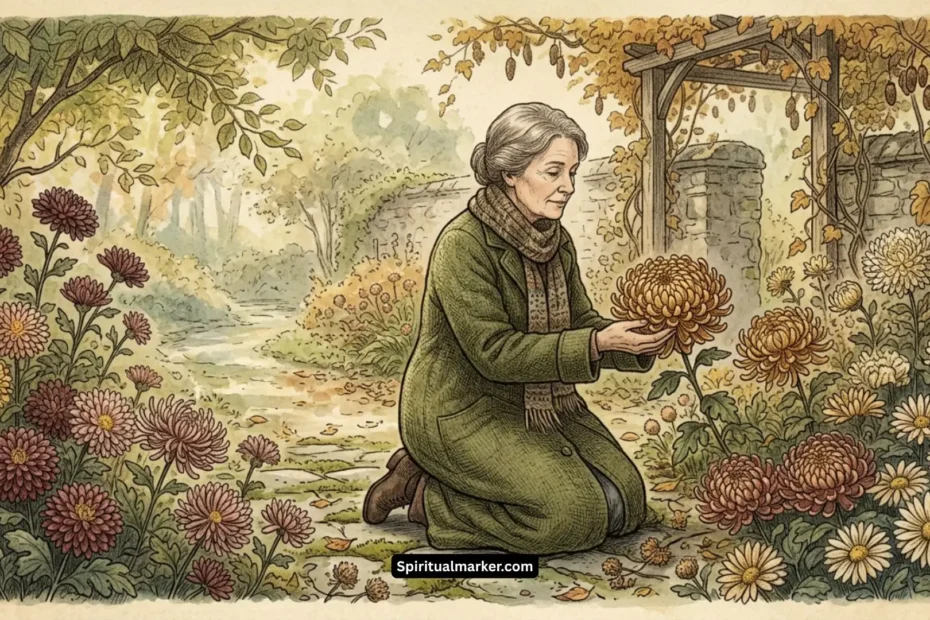
Have you ever held a chrysanthemum and felt something stir inside you? You are not alone. For thousands of years, people across the world have recognized that this flower carries a weight beyond its petals. It speaks to the soul in a language older than any written text.
The chrysanthemum is one of the most spiritually significant flowers on the planet. It has graced royal courts, sacred altars, ancient myths, and modern bouquets. Yet most people only scratch the surface of what this flower truly means. Its symbolism is layered, rich, and sometimes surprising.
Whether you received one as a gift, spotted it in a dream, or simply feel drawn to it, there is a reason. The chrysanthemum spiritual meaning is a vast tapestry woven from threads of death, rebirth, longevity, honor, truth, and divine light. This blog post unpacks every thread. By the end, you will see this flower through completely new eyes.
Key Takeaways
- The chrysanthemum symbolizes longevity, nobility, and resilience across many ancient cultures, particularly in Asia.
- In Western traditions, the flower is closely associated with death, mourning, and honoring departed souls.
- Spiritually, the chrysanthemum represents the sun, divine light, and the cycle of life and death.
- Different colors of chrysanthemums carry distinct spiritual messages, from purity and peace to passion and grief.
- Dreaming of a chrysanthemum often signals spiritual transformation, emotional healing, or a connection to ancestral energy.
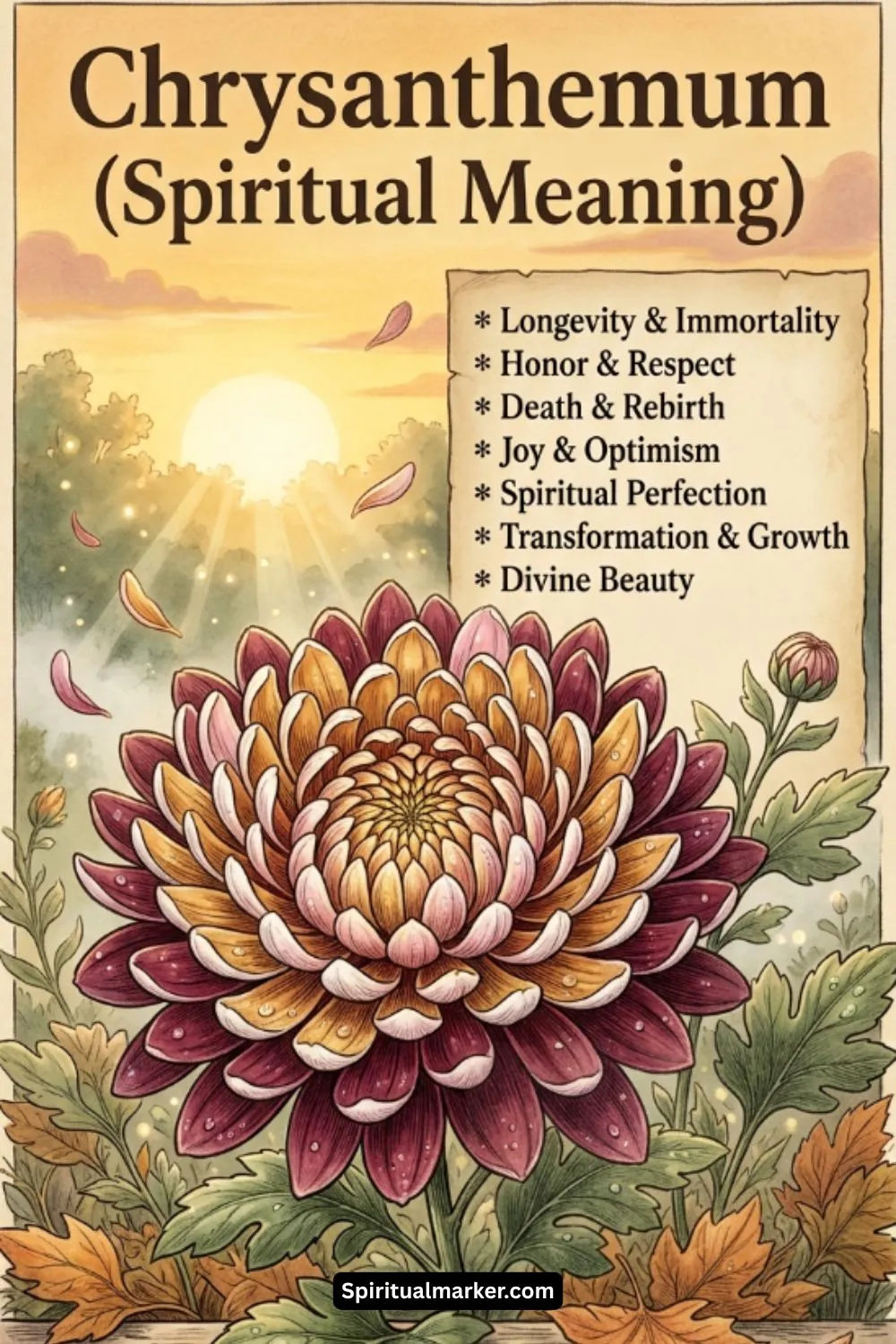
What Is the Chrysanthemum and Why Does It Hold Spiritual Power?
The chrysanthemum belongs to the genus Chrysanthemum in the Asteraceae family. Its name comes from the Greek words chrysos (gold) and anthos (flower), literally meaning “golden flower.” This etymology alone hints at its elevated spiritual status. Gold, across virtually every culture on earth, represents divinity, immortality, and the sun.
Native to East Asia, the chrysanthemum has been cultivated in China for over 2,500 years. From there, it spread to Japan, Korea, and eventually the Western world. Everywhere it traveled, it absorbed new layers of meaning. It did not simply become a pretty ornamental plant. It became a symbol of power, purity, and the sacred order of nature.
What makes a flower spiritually potent? Most traditions answer that question the same way. A flower earns spiritual significance through its behavior, its beauty, and its relationship with the natural world. The chrysanthemum blooms in autumn, when most other flowers have died. It thrives in cold. It endures frost. This remarkable resilience made ancient observers certain that the chrysanthemum was no ordinary plant. It was a symbol of spiritual strength and defiance against the natural order of decay.
Its perfectly symmetrical, sun-like bloom reinforced this belief. Cultures around the world saw the face of the divine in its radiating petals. The chrysanthemum became a living metaphor for enlightenment, for the soul’s journey, and for the light that persists even in the darkest seasons.
What Does Seeing a Chrysanthemum Symbolize or Represent?
When a chrysanthemum appears in your life, pay attention. Whether you see one in a garden, receive one unexpectedly, or notice it in art and poetry, the flower rarely shows up without meaning.
In its most universal sense, seeing a chrysanthemum symbolizes the beauty of perseverance. It reminds you that strength does not always look dramatic. Sometimes it looks quiet, steady, and blooming against the odds. The flower encourages you to keep going, even when your environment feels harsh.
Seeing a white chrysanthemum is often interpreted as a spiritual message about purity and peace. Many traditions associate it with the souls of the departed, suggesting that a white chrysanthemum appearing unexpectedly might represent a connection to an ancestor or a loved one who has passed. Some spiritual practitioners believe that the appearance of this flower signals that you are protected and guided by those who came before you.
A yellow chrysanthemum connects more directly to solar energy and optimism. Spotting one may signal that a period of difficulty is ending and that clarity and joy are approaching. Red chrysanthemums carry deeper messages about love and passion, while purple varieties often appear as symbols of spiritual wisdom and sacred honor.
The act of seeing a chrysanthemum can also be a prompt for self-reflection. In many Eastern philosophies, flowers are mirrors for the soul. The chrysanthemum, with its layered petals and radiant center, invites you to look inward, past your surface self, toward your true core.
9 Spiritual Meanings of the Chrysanthemum
1. Longevity and Immortality
The chrysanthemum’s connection to longevity is perhaps its oldest and most deeply rooted spiritual meaning. In ancient China, Taoist monks brewed chrysanthemum tea believing it extended life. The legendary Daoist text Shennong Bencao Jing recorded the flower as a sacred herb of immortality. Drinking its essence was not just a health practice. It was a spiritual ritual, a way of inviting eternal life-force into the body.
This belief spread across East Asia and took root deeply in Japanese culture. The chrysanthemum became the symbol of the Japanese Imperial Throne, where it has been associated with longevity and divine rule for over a thousand years. The 16-petal chrysanthemum crest, called the kikumon, graces the Imperial Seal of Japan to this day. This is not decorative. It is a declaration that the emperor, like the chrysanthemum, embodies timeless, enduring power.
The spiritual logic is clear. A flower that blooms when everything else dies must carry the secret of persistence. The chrysanthemum teaches you that true longevity is not just physical. It is the endurance of the soul through hardship, transformation, and seasons of loss.
2. Rebirth and Renewal
The chrysanthemum is a flower of cycles. It blooms in autumn, the season most cultures associate with death and endings. Yet within that context, it signals that endings are also beginnings. This paradox lies at the heart of its spiritual message.
In Chinese philosophy, the chrysanthemum represents the fifth season, a liminal space between the living world and the spirit world. It blooms at the threshold, making it a natural symbol for rebirth. Ancient Chinese festivals celebrated the chrysanthemum at the transition between the living and ancestral worlds, recognizing the flower as a bridge between two states of existence.
Many modern spiritual traditions continue to honor this symbolism. The chrysanthemum appears in Day of the Dead altars in Mexico, not simply as a decorative element but as a spiritual invitation for ancestral souls to return and visit the living. Its bright colors and strong scent are believed to guide spirits home, reinforcing the idea that death is a transition, not an end.
The chrysanthemum reminds you that every ending in your own life carries the seed of something new. When you feel like a chapter is closing, the appearance of this flower is a gentle spiritual nudge: you are in the process of becoming, not dissolving.
3. Solar Energy and Divine Light
The chrysanthemum mirrors the sun in almost every detail. Its round, radiant bloom with layers of petals extending outward from a golden center is a near-perfect representation of solar energy. This is not a coincidence that ancient cultures missed.
In East Asian iconography, the chrysanthemum is directly linked to the sun’s power and the masculine principle of yang energy. It represents clarity, warmth, and the illuminating force of divine truth. Spiritual practitioners who work with solar energy often use chrysanthemums in their rituals to invite light into spaces, relationships, and situations clouded by confusion or fear.
The flower’s association with the sun extends to the idea of divine consciousness. Just as the sun sustains all life without discrimination, the chrysanthemum symbolizes a kind of unconditional spiritual generosity. Its light belongs to everyone. In this sense, meditating with or near a chrysanthemum is said to open the solar plexus chakra, the energy center associated with personal power, confidence, and spiritual will.
Its golden petals carry a reminder that you are made of light. Even in your darkest seasons, something bright endures at your center, waiting to bloom again.
4. Honor and Nobility
Few flowers in history have been as closely associated with nobility and sacred honor as the chrysanthemum. In Japan, the annual Kiku no Sekku (Chrysanthemum Festival) was one of five major royal court celebrations. The emperor would receive chrysanthemum flowers on this day as symbols of blessings, long life, and divine favor.
In China, the chrysanthemum is one of the Four Gentlemen, a classical grouping of plants in Chinese art that represent the ideal virtues of a noble scholar. The other three are the plum blossom, orchid, and bamboo. Together, they represent integrity, humility, elegance, and perseverance. The chrysanthemum specifically embodies moral excellence and the courage to stand alone, particularly because it blooms in solitude during the harshest season.
This spiritual meaning of honor extends beyond royalty. On a personal level, the chrysanthemum asks you to recognize the nobility within yourself. You do not need a title or a throne to embody grace. The flower teaches that true nobility is an inner quality, a commitment to truth, beauty, and dignity even when circumstances pressure you to abandon them.
5. Grief, Death, and the Afterlife
In many Western European traditions, the chrysanthemum is the flower of the dead. In France, Italy, Spain, and Belgium, it is the primary flower brought to cemeteries on All Saints’ Day and placed on graves as offerings to departed souls. Giving someone a chrysanthemum in these countries outside of a funerary context is considered deeply bad luck.
This association is not a dark or morbid one in its full spiritual context. The chrysanthemum honors the reality of death as a sacred passage. It does not pretend death does not exist. Instead, it says: we see you, we honor you, and your journey continues. This is a profound spiritual act of love and respect.
In Chinese spiritual tradition, white chrysanthemums are placed on graves and altars to help guide the soul of the deceased toward the light. The flower acts as a spiritual lantern, cutting through the veil between worlds. Many shamanic and ancestral healing traditions use the flower in ritual work to communicate with the ancestral realm, to heal intergenerational wounds, and to release grief that has been carried too long.
The spiritual meaning here is not that death is the end. The chrysanthemum at the grave says that love crosses every threshold, and the bonds between souls do not break at the moment of physical death.
6. Meditation, Clarity, and Inner Peace
The chrysanthemum has been a companion to meditation for millennia. In China and Japan, monks grew chrysanthemums in monastery gardens specifically to support contemplative practice. The flower’s quiet beauty, combined with its subtle, clean fragrance, creates an environment that quiets mental noise and invites stillness.
Spiritually, the chrysanthemum is associated with mental clarity and the cultivation of inner peace. Its perfectly ordered layers of petals visually represent the mind moving from its chaotic outer layer toward a still, bright center. This is a natural mandala, a meditation object that has been used intentionally in Zen Buddhist practice for hundreds of years.
Studies on chrysanthemum aromatherapy suggest that its fragrance genuinely reduces cortisol and promotes a calm, focused mental state. Science and spirituality, in this case, agree. The chrysanthemum creates the conditions for inner knowing. When your mind is quiet, truth surfaces naturally.
In your own spiritual practice, placing a chrysanthemum in your meditation space or simply spending time with the plant can support deeper, more grounded awareness. The flower teaches that peace is not the absence of difficulty. It is the ability to bloom beautifully in the middle of it.
7. Truth, Authenticity, and Spiritual Integrity
The chrysanthemum has a long association with truth and moral integrity in Eastern philosophy. The great Chinese poet Tao Yuanming (365-427 CE) famously cultivated chrysanthemums and wrote about them as symbols of his refusal to compromise his integrity for political gain. He left his government position and retired to a simple life, living among chrysanthemums as a daily practice of authentic, principle-driven existence.
This became a cultural archetype. The chrysanthemum grower became synonymous with the person who chooses truth over comfort. In spiritual terms, the flower represents the courage to be exactly who you are, without pretense, without performance, and without bending your values to please others.
Many spiritual traditions teach that authenticity is the highest form of spiritual practice. The chrysanthemum embodies this teaching. It does not bloom when conditions are favorable. It blooms when it is meant to bloom, on its own schedule, in its own season, regardless of what every other plant is doing. Its spiritual message is direct: stop waiting for permission to be yourself.
When you see a chrysanthemum, it may be the universe asking you to return to your truth. Where in your life are you performing instead of living? Where are you waiting for conditions to improve before you allow yourself to bloom?
Chrysanthemum Meaning and Symbolism Across Cultures and Religions
China
In Chinese culture, the chrysanthemum holds an almost mythological status. It is one of the most beloved symbols in Chinese art, literature, and philosophy. The Double Ninth Festival (Chongyang Festival), celebrated on the ninth day of the ninth lunar month, centers around chrysanthemum wine, chrysanthemum viewing parties, and offerings of chrysanthemum flowers at ancestral graves.
The flower’s ability to bloom in late autumn aligned perfectly with Confucian ideals of endurance and virtue. Chinese scholars painted chrysanthemums on silk and porcelain as symbols of the ideal life: simple, beautiful, and morally upright. The chrysanthemum also represents the element of metal in Chinese Five Element theory, linking it to the west, to autumn, to grief, and to spiritual transformation.
Japan
In Japan, the chrysanthemum (kiku) is nothing short of the national symbol. The Imperial Chrysanthemum Seal has represented the Japanese royal family since Emperor Go-Toba formally adopted it in the late 12th century. The Order of the Chrysanthemum remains Japan’s highest order of chivalry to this day.
The chrysanthemum appears everywhere in Japanese culture, from samurai crests to traditional art forms like ikebana (flower arranging) and origami. In Japanese Buddhism, the flower is offered at temples and used in funeral rites, where it helps guide the soul toward enlightenment. It is simultaneously a symbol of the living emperor’s divine authority and the peaceful passage of the deceased into the spirit world.
Korea
In Korean tradition, the chrysanthemum appears frequently in folk art and royal emblems. It is associated with autumn beauty, long life, and the dignity of old age. Korean herbal medicine has used chrysanthemum for centuries, and the flower holds a quiet but steady presence in spiritual and artistic life.
Western Europe
In Western Europe, particularly France, Italy, and Belgium, the chrysanthemum is a funerary flower. It appears almost exclusively at cemeteries and memorial events. This association developed during the 19th century and became firmly entrenched in cultural practice. Gifting a chrysanthemum in France is considered deeply inappropriate unless it accompanies condolences.
This does not make the flower morbid. Rather, it reflects a European spiritual tradition that honors the dead with sincerity and beauty. The chrysanthemum in this context says that death deserves the same attention and love as life.
United States
In American culture, the chrysanthemum has a more cheerful reputation. It is associated with autumn, Thanksgiving, and school spirit. Chrysanthemum corsages are a longstanding tradition at American football games and homecoming events. The flower here represents abundance, community, and the warmth of harvest season. This is a beautiful example of how a single flower can carry radically different spiritual energies in different cultural contexts.
Chrysanthemum Symbolism in World Mythologies
Mythology has always found the chrysanthemum irresistible. Its remarkable resilience and sun-like appearance invited storytellers to weave it into narratives of gods, immortality, and sacred power.
In Chinese mythology, the chrysanthemum island is a legendary paradise. The Taoist story tells of a chrysanthemum-covered island in the eastern sea where immortals lived and where the flower’s juice gave eternal life. This myth directly informed the real-world practice of chrysanthemum cultivation in Taoist monasteries.
According to one Japanese legend, 300 young men and women sailed from China in search of the chrysanthemum island and, finding it, chose to remain there forever rather than return to a mortal world. The island became Japan in some versions of this story, giving the chrysanthemum a literally nation-founding mythological significance.
In ancient Greek mythology, though the chrysanthemum as we know it was not yet formally named, golden flowers in sun-drenched meadows often symbolized the realm of the blessed dead. The Elysian Fields were frequently described as filled with radiant golden blooms. It is not a stretch to see the chrysanthemum as a living echo of this image.
Victorian flower mythology, through the language of flowers called floriography, assigned specific meanings to the chrysanthemum based on color. A red chrysanthemum declared love. A white one spoke of truth and devoted loyalty. A yellow one carried cheerfulness and harmless indulgence. Victorian suitors used chrysanthemums to say things that social convention forbade them to speak aloud.
Types of Chrysanthemums and Their Spiritual Meanings
Not all chrysanthemums carry the same spiritual message. Color and form both significantly shape what the flower communicates on a spiritual level.
White chrysanthemums are universally associated with purity, peace, and the spirit world. They appear at funerals and on ancestral altars across Asia and Europe. Spiritually, white chrysanthemums clear negative energy and create a sacred, neutral space. They are ideal for meditation spaces and grief rituals.
Yellow and golden chrysanthemums connect directly to solar energy, joy, and abundance. These are flowers of friendship, optimism, and good luck in many traditions. Placing yellow chrysanthemums in your home is said to attract positive energy and mental clarity.
Red chrysanthemums carry the energy of deep love, courage, and passion. In some Asian traditions, they represent the intensity of devotion, particularly in spiritual practice. A practitioner who gives red chrysanthemums shows profound, heartfelt respect.
Purple chrysanthemums hold a special spiritual significance related to wisdom, honor, and healing. In many traditions, purple connects to the crown chakra, the energy center of spiritual connection and divine wisdom. A purple chrysanthemum is a flower of the spiritual elder, offered to those who carry great knowledge or have suffered greatly and survived.
Pink chrysanthemums speak to gentle love, grace, and the healing of emotional wounds. These are flowers of the heart chakra, associated with compassion, self-love, and the tender courage it takes to remain open after being hurt.
Bronze and copper chrysanthemums, which bloom in the deepest autumn colors, carry the energy of transformation and the letting go of what no longer serves. Their warm, earthy tones connect to the grounding energy of the earth element and the wisdom that comes from living a full life.
Chrysanthemum Biblical Meanings and Significance
The chrysanthemum is not specifically named in the Bible, but its spiritual resonances align deeply with several key biblical themes. Understanding these connections requires looking at the flower’s core qualities through a biblical lens.
The chrysanthemum’s golden, sun-like appearance echoes the biblical imagery of light as divine presence. In the Gospel of John, Jesus says, “I am the light of the world.” The chrysanthemum, with its radiant, sun-mimicking bloom, can be read as a natural embodiment of this light. Many Christian floral traditions use chrysanthemums in church arrangements specifically for this reason, particularly around All Saints’ Day and All Souls’ Day.
The flower’s endurance through harsh conditions parallels the biblical virtue of perseverance. The Apostle Paul writes in Romans 5:3-4 that “suffering produces perseverance; perseverance, character; and character, hope.” The chrysanthemum, blooming in frost while other flowers retreat, is a living parable of this scriptural teaching. Many Christian communities have adopted it as a symbol of hope and spiritual endurance.
The chrysanthemum’s association with death and the afterlife also connects naturally to Christian belief in resurrection. Placed on graves and used in funeral rites, the flower in a Christian context speaks to the belief that death is not the final word. Its persistent beauty at the end of the growing season whispers of resurrection, of life returning after the long winter of death.
In some Christian mystical traditions, particularly in Eastern Orthodox practice, flowers are understood as theophanies, moments where the divine speaks through natural beauty. The chrysanthemum’s extraordinary resilience and perfection make it a natural candidate for this kind of sacred attention.
Chrysanthemum Symbolism in Art and Literature
The chrysanthemum has inspired artists and writers for millennia. Its presence in art and literature is not merely decorative. Each appearance is loaded with intentional spiritual and philosophical meaning.
In classical Chinese painting, the chrysanthemum is one of the most painted subjects in the entire tradition. Artists like Zheng Xie (1693-1765) used chrysanthemum paintings as coded expressions of personal philosophy, political dissent, and spiritual longing. A painting of chrysanthemums blooming alone in autumn was an artist’s way of saying: I choose integrity over conformity. I choose the spiritual life over the political one.
Japanese ukiyo-e woodblock prints frequently featured chrysanthemums in combination with flowing water, autumn leaves, and full moons, all symbols of the Buddhist concept of mono no aware, the bittersweet awareness of impermanence. The chrysanthemum in these compositions reminded viewers to cherish the present moment, because beauty does not last.
The Nobel Prize-winning author Steinbeck wrote “The Chrysanthemums,” a short story in which the flower serves as a complex symbol of female creative power, longing, and suppression. The protagonist’s chrysanthemums represent her deepest self, her spirituality, her creativity, and her fierce longing to be seen and valued. When her chrysanthemums are discarded, something sacred in her is violated.
In Korean sijo poetry, the chrysanthemum appears as a symbol of the noble hermit, the person who has turned away from worldly success to pursue wisdom and simplicity. This poetic tradition reinforces the flower’s ancient association with authentic, spiritually driven living.
Chrysanthemum in Feng Shui and Energy Healing
In Feng Shui, the ancient Chinese practice of harmonizing environments with natural energy, the chrysanthemum holds significant power. It is considered a yang flower, carrying active, outward-moving solar energy.
Placing chrysanthemums in the south sector of a home or room invites fame, recognition, and spiritual clarity, since the south is associated with the fire element and the energy of visibility. In the east sector, chrysanthemums support health and family harmony. Yellow chrysanthemums in the northeast sector can activate the energy of spiritual knowledge and wisdom.
The chrysanthemum is also used in energy healing practices to clear stagnant or negative energy from a space. Its vibrant, solar energy acts as a natural spiritual purifier. Many practitioners place fresh chrysanthemums near the entrance of a home to prevent negative energy from entering and to welcome positive, life-affirming vibrations.
In crystal healing and chakra work, the chrysanthemum pairs naturally with citrine, amber, and clear quartz, amplifying its solar, clarifying energies. Practitioners who work with ancestral healing often combine white chrysanthemums with moonstone or labradorite to open channels of communication between the living and the ancestral realms.
Dreaming About Chrysanthemums: Spiritual and Psychological Meanings
Dreams involving chrysanthemums carry significant spiritual weight. Dream symbolism, in most traditions, reflects the language of the deeper self, and the chrysanthemum brings very specific messages when it appears in the dream space.
Dreaming of a blooming chrysanthemum generally signals personal growth and spiritual awakening. Your deeper self is showing you that you are moving through a period of transformation successfully. Even if your waking life feels difficult, the blooming flower says: something beautiful is emerging from this.
Seeing a white chrysanthemum in a dream often relates to messages from the spirit world. Many dreamers report seeing white chrysanthemums in vivid, emotionally significant dreams shortly after the death of a loved one. Spiritual traditions across Asia and Europe interpret these dreams as visits from the deceased, confirmation that the soul has passed safely and that the bonds of love persist beyond death.
A wilting or dying chrysanthemum in a dream asks you to examine what is fading in your life. This dream is rarely negative in its spiritual message. Most traditions interpret it as an invitation to release something that is no longer serving your growth. The dying chrysanthemum makes space for the next bloom.
Receiving a chrysanthemum as a gift in a dream is an exceptionally positive sign. It suggests that the universe, your spirit guides, or your ancestors are actively supporting you. You are not alone in your current journey. Something larger than yourself is working on your behalf.
Dreaming of a field or garden full of chrysanthemums points to spiritual abundance and divine protection. This dream often appears when the dreamer is undergoing a significant life transition and needs reassurance that they are on the right path. The chrysanthemum field is the psyche’s way of saying: you are held. Keep going.
From a psychological perspective, Carl Jung’s archetypal theory would recognize the chrysanthemum as a mandala symbol, representing the Self and the process of individuation. A chrysanthemum dream in this framework suggests that the dreamer is actively integrating different aspects of their personality, moving toward wholeness.
Chrysanthemum as a Birth Flower and Zodiac Symbol
The chrysanthemum is the birth flower of November, a month positioned precisely at the threshold between autumn and winter, between life and death, between the living and the ancestral worlds. This placement is entirely fitting for a flower that has always occupied spiritual thresholds.
People born in November, particularly Scorpio and Sagittarius, often feel a deep affinity for the chrysanthemum’s spiritual qualities. Scorpios, ruled by the planet Pluto and associated with death, transformation, and the occult, resonate with the chrysanthemum’s connection to the spirit world and rebirth. Sagittarians connect with its optimistic solar energy and its search for higher truth.
In Chinese astrology, the chrysanthemum is associated with autumn and the Metal element, connecting it to the signs of the Rooster and the Dog. These signs are known for their integrity, loyalty, and willingness to stand their ground, qualities the chrysanthemum embodies perfectly in its seasonal behavior.
Wearing chrysanthemum imagery, working with the flower in ritual, or simply keeping a chrysanthemum plant as a November-born person is said to amplify your natal spiritual gifts and connect you more deeply to your soul’s purpose.
Chrysanthemum in Modern Spirituality and Personal Practice
Modern spiritual practitioners have not abandoned the chrysanthemum. If anything, its relevance has grown as people seek meaningful, grounded ways to connect with nature-based spirituality.
In altar work and sacred space creation, the chrysanthemum appears frequently. White chrysanthemums honor ancestors. Yellow ones call in clarity and abundance. Purple ones invoke wisdom and spiritual protection. Many practitioners keep seasonal chrysanthemums on their altars during autumn, recognizing the flower as a natural gateway to the ancestral realm during the thinning of the veil.
Chrysanthemum tea remains a powerful ritual in modern spiritual practice. Brewing and drinking the tea slowly, with intention, is a form of meditation. It honors the ancient Taoist tradition of communing with the plant’s life-force for healing and longevity. Many herbalists and spiritual practitioners recommend chrysanthemum tea for clarity, calm, and emotional healing.
Flower essences made from chrysanthemum are used in vibrational healing. The Bach Flower Remedy tradition and similar systems recognize the chrysanthemum essence as helpful for people who are afraid of aging, overly attached to their youth or identity, or struggling with the concept of physical mortality. The flower’s essence gently supports the soul’s ability to embrace the full arc of life, including its inevitable end.
Creating art with chrysanthemums, pressing and displaying them, using them in journaling rituals, or simply sitting quietly with a fresh bouquet can become a powerful spiritual practice. The flower meets you where you are and offers exactly the medicine your soul needs in that moment.
A Final Note
The chrysanthemum is not a simple flower. It has never been. Across more than two millennia of human history, across dozens of cultures and spiritual traditions, across art and mythology and sacred ritual, this bloom has consistently pointed toward the same essential truths: life is sacred, resilience is holy, and love outlasts death.
When you encounter a chrysanthemum, whether in a garden, a dream, or a moment of grief, you are encountering one of the most spiritually dense symbols that the natural world offers. You can choose to walk past it. You can also choose to stop, look at its layered, sun-like face, and let it speak.
If you are drawn to work more deeply with the chrysanthemum’s spiritual energy, start simply. Place one in your home. Brew a cup of chrysanthemum tea. Sit with a white bloom and speak the name of someone you have lost. Or simply hold a golden chrysanthemum in your hands and ask yourself: where in my life am I waiting for better conditions before I allow myself to bloom?
The chrysanthemum has been answering that question for 2,500 years. The answer it gives, every single autumn, without exception, is this: now. Bloom now. Exactly as you are. In exactly this season.
This article draws from botanical research, cross-cultural spiritual traditions, art history, and symbolic interpretation. It is intended as an educational and reflective resource.