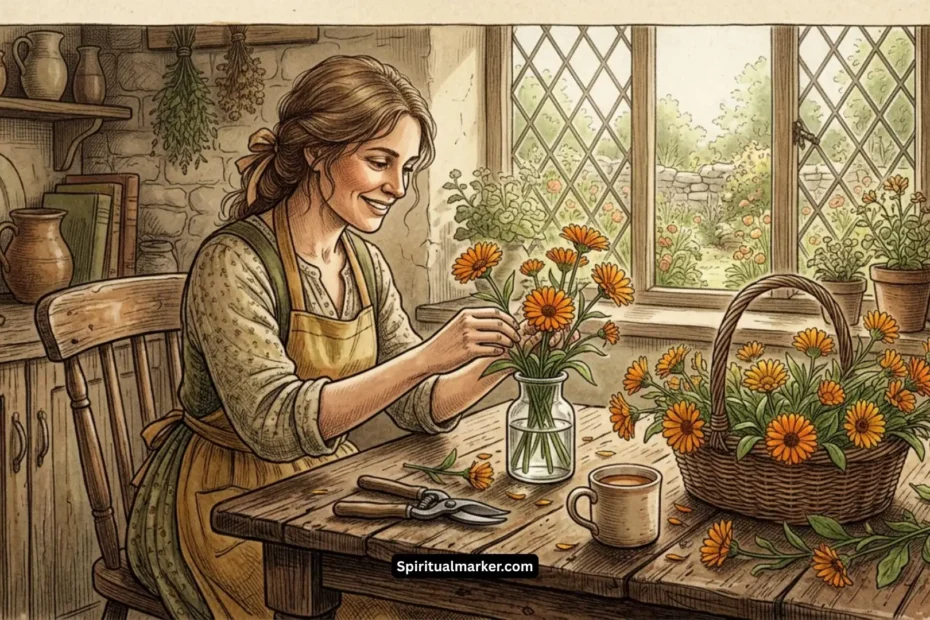
You have probably seen it growing in gardens, pressed into teas, or blended into skincare creams. But the calendula flower, known botanically as Calendula officinalis, carries a story far older and far richer than any modern wellness trend. This radiant, golden-orange bloom has been called the “herb of the sun,” “summer’s bride,” and most famously, “Mary’s Gold” — a name that reveals just how deeply it became woven into human spiritual life. Long before people gave it any botanical classification, ancient civilizations in Egypt, India, Greece, Rome, and the Americas were already reading its petals like a sacred text.
The calendula spiritual meaning is not a single, simple idea. It is a layered, cross-cultural body of symbolism built across thousands of years of human reverence. Ancient Egyptians placed it in temples to honor the sun god Ra. Medieval Christian monks planted it in monastery gardens and dedicated it to the Virgin Mary. Aztec healers used it to guide the dead. Hindu priests threaded it into garlands for the gods. Not one of these traditions borrowed the meaning from another. Each arrived at a remarkably similar conclusion independently — and that consistency is itself one of the most compelling facts about this flower. When multiple civilizations across different continents and eras attach the same spiritual weight to the same plant, it is worth paying attention.
The reason for this convergence is not mysterious. Calendula is heliotropic — it literally follows the sun, opening its petals at dawn and closing them at dusk. Every culture that observed this behavior drew the obvious conclusion: here was a flower in conversation with the divine. Add to that its brilliant golden color, its remarkable medicinal power, and its ability to bloom reliably month after month, and you have a plant that seems purpose-built for spiritual symbolism. Whether you are drawn to the calendula for its healing properties, its beauty, or its spiritual resonance, this article gives you the full picture — from its ancient roots to its living role in modern spiritual practice today.
Key Takeaways
- Calendula carries universal spiritual meaning. Ancient Egypt, Greece, Rome, India, and the Aztec civilization all independently associated calendula with solar energy, divine protection, and healing — making its symbolism one of the most consistent in botanical history.
- The flower is deeply connected to the sun. As a heliotropic plant, calendula tracks the sun from dawn to dusk. This physical behavior became the foundation of its spiritual identity — a living symbol of light, vitality, and divine awareness.
- Calendula is known as “Mary’s Gold” in Christian tradition. During the Middle Ages, the flower was dedicated to the Virgin Mary, symbolizing purity, devotion, and divine grace. Monks planted it extensively in monastery gardens, reinforcing its status as a sacred plant.
- It serves as a bridge between the living and the dead. In Mexican Day of the Dead traditions, calendula petals are scattered along pathways and on altars to guide the spirits of deceased loved ones back home — a role that positions it as a sacred connector between worlds.
- Calendula activates the solar plexus chakra. In metaphysical and energy healing traditions, calendula aligns with the third chakra, the center of personal power, confidence, and spiritual clarity. Working with this flower supports emotional balance and inner strength.
What Is Calendula and Why Does It Hold Spiritual Power?
Calendula officinalis, commonly called pot marigold, is a flowering plant in the daisy family (Asteraceae) native to the Mediterranean and parts of Asia. Its name carries an entire historical lesson within it. The word “calendula” derives from the Latin “calends” — the first day of the Roman lunar month — because the plant was observed to bloom with striking regularity at the start of each new month. Carl Linnaeus formalized this name in 1750, but the name had already been used informally for centuries. Some translations render it as “little clock” or “little calendar,” a nod to the flower’s uncanny relationship with time and light cycles.
Its folk names paint an even richer picture. People called it “summer’s bride” because the flower’s head visibly turns to follow the sun across the sky — a botanical phenomenon known as heliotropism. The name “Gold bloom,” “Holligold,” and “Bull’s Eyes” all appeared in various European traditions. Each of these names pointed to the same quality: this was a plant that seemed to worship the light. Ancient observers had no scientific vocabulary to describe heliotropism. They simply witnessed a flower in motion with the sun and concluded, reasonably, that something sacred was at work.
The spiritual power of calendula flows directly from its physical characteristics. Its golden-orange petals are the same color as fire and sunlight. Its daily cycle of opening and closing mirrors the human rhythm of waking and sleeping, effort and rest. Its medicinal potency — documented extensively in both ancient and modern herbalism — made healers regard it as a gift from higher forces. Astrologers classified it as a masculine plant ruled by the Sun and governed by the element of Fire, reinforcing its solar identity at every level. These qualities, stacked together, gave calendula an authority in the spiritual world that very few flowers have ever matched.
What Does Seeing Calendula Symbolize or Represent?
Seeing calendula — whether in a garden, in a dream, or appearing repeatedly in your life — carries real spiritual weight in many traditions. At its most basic level, the calendula flower symbolizes warmth, optimism, and resilience. Its sun-gold color radiates positivity. Its persistence in blooming from early spring through late autumn, and even into winter in mild climates, communicates a message about endurance that transcends language.
In folk magic traditions across Europe, seeing or encountering calendula was considered an omen of good fortune. Healers in the Middle Ages carried calendula as a talisman to protect them during plague outbreaks. The flower was also thought to be highly effective at silencing slander and gossip — a quality that made it both a spiritual and social protective tool. Many people who encountered the plant in old European village life would immediately associate it with protection against harm, both physical and spiritual.
When calendula appears repeatedly in your experience, spiritual traditions suggest it may be signaling a need for healing, renewal, or protection. It may indicate that you are being called to honor a cycle — a transition from one chapter of life to another. It may also carry a message from a loved one who has passed, since calendula plays such a prominent role in death and remembrance traditions globally. The flower asks you to stay open to light, even when circumstances push you toward darkness.
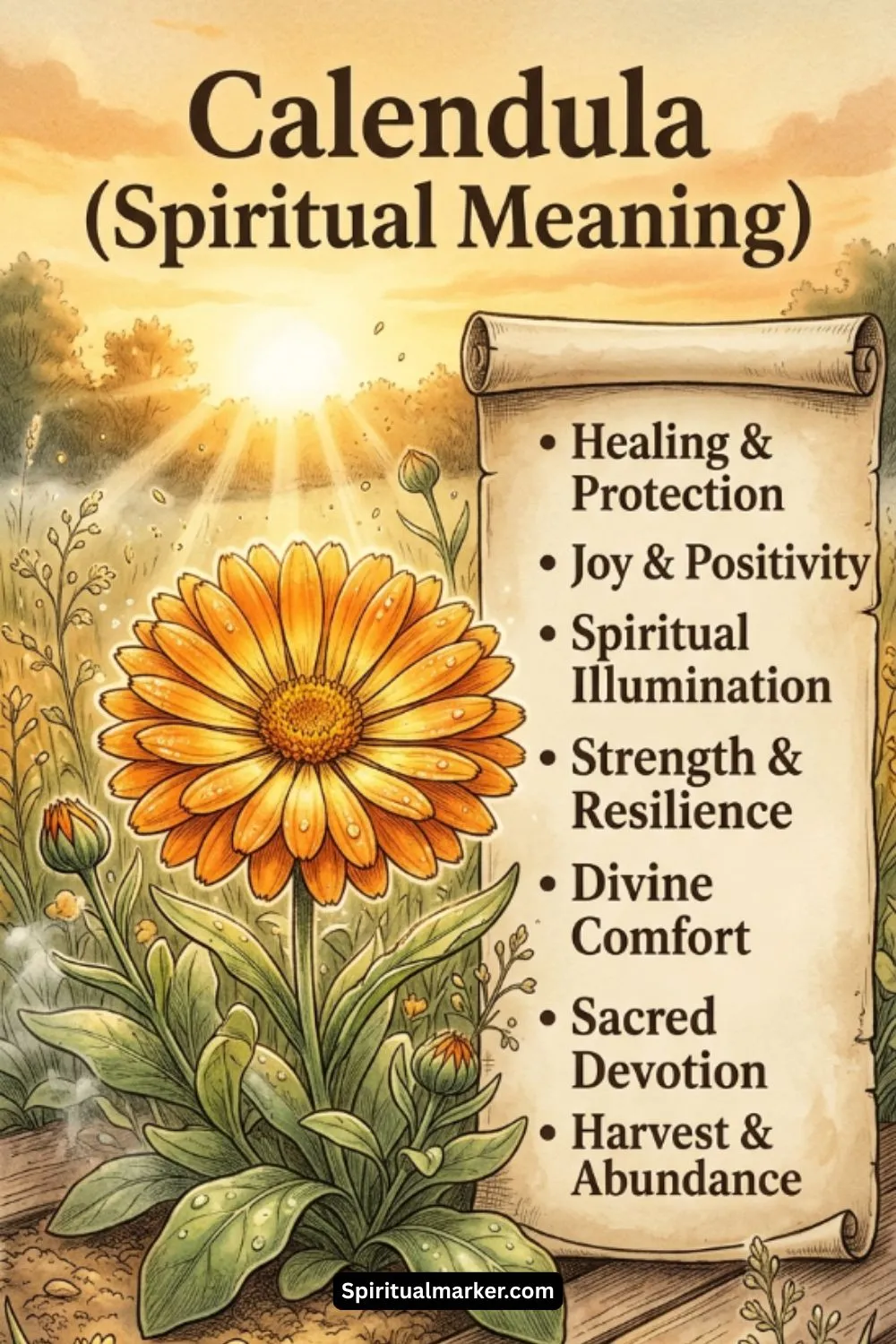
7 Spiritual Meanings of Calendula
1. Solar Energy and Divine Light
The most fundamental spiritual meaning of calendula is its connection to the sun. This is not metaphorical — it is rooted in the flower’s actual biology. Calendula opens its petals with the sunrise and closes them at sunset, day after day, season after season. Ancient cultures that noticed this behavior immediately assigned it sacred meaning. In ancient Egypt, calendula’s golden hue symbolized the sun’s power and energy, believed to bestow strength and vitality. Egyptians placed it in temples and tombs as an offering to solar deities, and its golden petals directly mirrored the radiance of Ra, the sun god.
This solar spiritual symbolism carries a specific message: you carry divine light within you. The calendula does not merely reflect the sun — it tracks it with intention. Spiritually, this is an invitation to remain oriented toward the light in all circumstances. When life becomes heavy, the calendula reminds you that even in the darkest seasons, the sun returns. Spiritual practitioners use calendula in meditation specifically to access solar energy — that quality of warmth, radiance, and outward expression that the sun represents across virtually every spiritual tradition on earth.
In astrology, calendula is ruled by the astrological sign of Leo and the element of Fire. Leo is the sign most directly associated with the sun’s qualities: confidence, generosity, creativity, and self-expression. The fire element amplifies these qualities, adding passion and transformative energy to the mix. Working with calendula in any spiritual context — tea, meditation, altar offering, or ritual — tunes you into this potent solar current. It is one of the few plants whose spiritual identity is so completely and consistently solar that it serves as a reliable bridge between human consciousness and the energy of the sun itself.
2. Healing and Spiritual Restoration
Calendula’s reputation as a healer operates on two levels simultaneously: the physical and the spiritual. On the physical level, its medicinal credentials are extraordinary. Calendula’s anti-inflammatory, antiseptic, and wound-healing properties have cemented its place in modern skincare, and traditional Ayurvedic and Chinese medicine systems have used it for centuries to treat skin conditions, fevers, and infections. The practical healing power of this plant gave birth to its spiritual healing symbolism — because cultures correctly observed that a plant with such extraordinary restorative properties must carry divine favor.
On the spiritual level, calendula is a flower of restoration. It does not simply treat the surface wound; it addresses the stagnation beneath it. Herbalist tradition describes calendula’s energetic quality as one that moves what has become stagnant — in the body, in the emotions, and in the life force itself. When grief, trauma, or illness has caused energy to pool and freeze, calendula’s warming, circulating nature encourages it to flow again. This is why herbalists throughout history recommended calendula tea not just for fever or cramps, but specifically for depression, sadness, and emotional heaviness after a traumatic experience.
The healing meaning of calendula extends into the realm of self-worth and personal boundaries. Calendula magic is described as the magic of reclaiming boundaries and making full use of the energy you already possess. It does not bring external healing from some outside source. It wakes up the healing capacity that already exists within you. This makes it particularly meaningful for those recovering from situations in which their personal power was diminished — through illness, grief, difficult relationships, or prolonged hardship. Calendula says: you already have what you need to heal. The flower simply helps you remember that.
3. Protection from Negative Energy
Across virtually every culture that has worked with calendula, protection stands as one of its core spiritual attributes. This makes practical sense. A plant with powerful antimicrobial and antifungal properties — one that healers used to ward off plague during some of the most devastating outbreaks in human history — would naturally acquire a reputation for spiritual protection as well. The physical and the spiritual were not separate categories in ancient medicine. A plant that protected the body was understood to protect the spirit by extension.
In medieval Europe, many believed that hanging a wreath of calendula flowers above your door would protect your home and the people in it. The protective energies within the flower kept negative spirits and harmful energy from entering the household. This practice was widespread enough to appear in multiple independent folk traditions across England, France, and Central Europe, none of which were in direct contact with each other. Wreaths of calendula hung over a door are said to keep evil and negativity from entering, and dried petals could be strewn to consecrate an area or burned as a purifying incense.
Powers of protection and prophecy have been attributed to calendula across many traditions. Scattering calendula under your bed was said to protect against robbers and thieves, and even to induce prophetic dreams if you had been the victim of a crime. Carrying dried calendula in a small pouch draws on these same ancient protective associations. In the Yoruba-influenced spiritual traditions of the Americas, calendula is associated with Oshun, the river goddess of healing and protection, reinforcing its role as a guardian energy in the spiritual ecosystem. The flower does not merely repel harm; it actively builds a field of warmth and light that negativity cannot penetrate.
4. Remembrance and Connection to Ancestors
Few flowers carry the weight of death and remembrance as beautifully as calendula. In Mexican tradition, the calendula flower is highly symbolic on the Day of the Dead, celebrated each year in late October and early November. Families scatter calendula petals from the doorway to the street and along staircases, creating a luminous pathway for the souls of deceased loved ones to follow back home. The belief is simple and profound: the bright color and the strong scent of calendula act as a beacon that the dead can perceive, guiding them through the veil between worlds to be with their families once more.
This role as a bridge between the living and the dead gives calendula a unique spiritual dimension that few Western flower traditions have assigned to a single bloom. The Day of the Dead celebration it anchors is not a somber occasion — it is a joyful reunion, and the calendula is central to making that reunion possible. Altars are decorated with the flowers, pathways are lined with petals, and garlands hang in doorways. The dead are not mourned; they are welcomed. Calendula’s role here represents remembrance, the afterlife, and eternal love — a spirituality of connection that refuses to accept death as a severance.
This ancestral connection extends beyond Mexican tradition. In ancient Aztec civilization, golden flowers were used in religious ceremonies that honored both the living and the dead. In India, calendula garlands have been used at funerals alongside weddings, recognizing that life and death are part of the same continuous cycle. When calendula appears in your life during a time of grief or while you are thinking of someone who has passed, many spiritual traditions read this as a direct message from that person — a sign that love does not end with physical death, and that the connection you shared remains intact across whatever distance separates the living from those who have gone before.
5. Renewal, Resilience, and New Beginnings
One of the most powerful spiritual lessons calendula teaches is the discipline of renewal. The flower opens every single morning without fail. It does not require ideal conditions. It does not wait for circumstances to be perfect before it blooms. Calendula officinalis genuinely thrives in difficult conditions, self-seeding readily, tolerating poor soil, and continuing to flower long after other plants have stopped. The spiritual symbolism here is earned by the biology itself. Resilience is not something calendula performs — it is something calendula lives.
For those navigating significant life transitions — the end of a relationship, a career change, a loss, a period of illness — the calendula spiritual meaning of renewal offers real comfort. The flower does not simply survive difficulty; it actively thrives within it. Its daily cycle of closing at night and opening again with the morning light is a direct spiritual metaphor for the human experience of grief and recovery. Rest is built into the cycle. Closing down for a season is not defeat — it is preparation for the next blooming. This rhythm gives calendula a particular relevance for anyone moving through a period of personal transformation.
Calendula magic is the magic of nurturing potential. The plant demonstrates that abundance is not reserved for those with perfect conditions, ideal timing, or extraordinary resources. It grows where it is planted and blooms regardless. Spiritually, this is an invitation to stop waiting for better circumstances before you begin living fully. The flower’s consistent blooming, month after month, from the first calends of spring through the last days of autumn, carries the message that persistence creates beauty. Every time you choose to show up again after difficulty, you are doing exactly what calendula does every dawn.
6. Devotion and Sacred Love
Calendula has served as a symbol of devotion in virtually every culture that has worked with it. In ancient Greece and Rome, it appeared at weddings and seasonal celebrations as an emblem of love, fidelity, and steadfast affection. Romans named it calendae because it bloomed regularly throughout the calendar year, and they read this consistency as a symbol of devotion that does not fade with changing seasons. A love symbolized by calendula is not the dramatic, volatile kind — it is steady, warm, and dependable, like the sun itself.
The most striking expression of this devotion symbolism appears in the Christian tradition. In Christian lore, calendula was called “Mary’s Gold” because its golden petals were offered to the Virgin Mary instead of coins. Worshippers who could not afford monetary offerings brought flowers to statues of Mary, and calendula — with its gold color that matched the coins they could not give — became the flower of choice. The name “marigold” is a direct contraction of “Mary’s Gold.” It was presented at the Feast of Annunciation on March 25th and used as a symbol of patience and faith in the coming of Jesus. Some folk traditions even claim it blooms where Mary’s tears fell to the earth.
This layer of sacred devotion gives calendula a spiritual role that transcends romantic love. Calendula represents the love you offer freely, without expectation of return. It represents the love that builds altars, lights candles, and brings flowers even when there is nothing else to give. Marigolds were common in love charms and often appeared in wedding decorations, aligning calendula with a goddess whose sheltering love blossoms with the sunrise. For those who work with Mary as a spiritual figure, or who revere divine feminine energy in any form, the calendula is among the most appropriate and powerful floral offerings available.
7. Prophecy, Intuition, and Psychic Clarity
The least commonly known but perhaps most fascinating aspect of calendula’s spiritual profile is its connection to prophecy and psychic ability. The genus name for calendula, Tagetes, comes from an ancient god named Tages, who in Roman mythology gave humanity the ability to use divination tools effectively. This origin story is not incidental — it suggests that from the very beginning of its named history, calendula was understood to carry a divinatory quality. Calendula’s magical attributes include prophecy, psychic energy, clairvoyance, and seeing into hidden realms.
In practical folk magic, dried calendula petals added to dream pillows are said to induce psychic visions and ward off negative spirits during sleep. Placing calendula in or near your mattress was said to bring prophetic dreams, and those who had been wronged were advised to sleep near the flower to receive vision-like insight about the cause of their troubles. These practices appear in multiple independent traditions — British folk herbalism, Central European witchcraft traditions, and Mexican curandera practice — suggesting this psychic quality was observed and respected broadly.
Spiritually, many practitioners have utilized calendula for its ability to bring in the energies of love, clairvoyance, and renewal. The connection makes intuitive sense. A flower that is exquisitely attuned to light — that opens and closes in perfect rhythm with the sun — would naturally be associated with the capacity for heightened perception and spiritual sensitivity. Calendula tea, consumed as a spiritual practice rather than simply a medicinal one, was believed to open intuition and deepen access to higher realms of awareness. For those who work with tarot, dream journaling, or any form of spiritual discernment, calendula is a powerful ally plant.
Calendula Symbolism Across Cultures and Religions
Ancient Egypt
In ancient Egypt, calendula was associated with rejuvenation and eternal life. Egyptians used it in beauty rituals and herbal remedies, and its golden petals mirrored the energy of the sun god Ra. The flower appeared in temple offerings and was placed in tombs as a companion for the dead on their journey into the afterlife. For the Egyptians, who organized their entire religious world around solar cycles, a flower that faithfully tracked the sun was naturally treated as sacred. Calendula’s role in Egyptian spirituality established the template that almost every subsequent culture would follow: this is a flower of life, light, and divine power.
Ancient Greece and Rome
In both ancient Rome and ancient Greece, calendula symbolized celebration and devotion. Romans named it calendae because it bloomed at the first of each month, creating a living calendar. It appeared at weddings, seasonal festivals, and religious ceremonies, and when introduced to Rome, marigolds were given to people born in October as birthday offerings. In Greek tradition, calendula was associated with Aphrodite and Hera, connecting it to love, beauty, and divine feminine power. The Greeks and Romans used it as a culinary garnish — one of the earliest examples of a plant carrying sacred status into everyday domestic life.
India and Hinduism
In India, calendula holds one of the most exalted positions of any flower in the spiritual tradition. Known as the “herb of the sun,” calendula is a sacred plant for Hindus, with flowers used extensively in auspicious ceremonies. The flower has been particularly associated with Lord Ganesha, the remover of obstacles, and is offered before beginning new endeavors to seek his blessing for patience and perseverance. To this day, you can find marigolds adorning holy statues of Lakshmi and Vishnu like living necklaces, celebrating nature in all its glory. In India, calendula represents thankfulness, excellence, and serenity — qualities befitting a flower offered to the highest divine beings.
Aztec Civilization and Mexico
The Aztecs encountered calendula entirely independently of the European and Asian traditions, yet arrived at strikingly similar conclusions about its power. The Aztecs used calendula in religious ceremonies and as a medicinal herb, associating it with protection against evil spirits. An Aztec herbal from the mid-1500s records its use in treatments and as a protective ward for those traveling dangerous waterways. From the Aztecs, the Spanish obtained calendula seeds and cultivated them in monastery gardens, ensuring the flower’s spiritual legacy passed seamlessly from one civilization to another. Today, Mexico’s Día de los Muertos celebration keeps this ancient Aztec reverence alive in one of the world’s most visually stunning spiritual traditions.
Victorian England
The Victorians developed an intricate language of flowers called floriography, and calendula held a specific place within it. Sending calendula communicated the message “I’m thinking of you.” It also conveyed sympathy, grief, hope, and the wish for happiness in another’s life. Joy and warmth were the primary associations, while grief and remembrance formed the secondary register. In the Victorian Flower Oracle, calendula represents sympathy and the light of hope for those left behind after a death. The Victorians used it to say what they could not say directly — and in an era when emotional expression was heavily coded, that made calendula a powerful communicative tool.
Calendula in World Mythology and Folklore
Mythology assigned calendula to the domain of gods and divine forces across multiple independent traditions. In Roman mythology, the flower’s genus name Tagetes connects it to Tages, a mysterious figure who emerged from the earth and taught the Etruscans the art of divination. This origin story gave calendula a mythological identity as a flower of hidden knowledge and prophetic power — qualities that followed it through centuries of folk tradition. The Spanish got calendula seeds from the Aztecs and named them after Spain’s patron saint, further embedding the flower in sacred narrative.
In Greek myth, calendula is sometimes linked to the story of Clytie, the water nymph who loved the sun god Helios with such devotion that after he rejected her, she sat watching the sun move across the sky for nine days without eating or drinking. The gods eventually transformed her into a heliotropic flower — one that forever turns to follow the sun. While scholars debate which flower Clytie specifically became, the heliotropic behavior of calendula makes it the most natural candidate in the popular imagination. Shakespeare’s love of the pot marigold was undeniable, referencing it throughout his writing and using it to evoke themes of devotion and constancy.
Folk traditions added their own mythological layer. Calendula received the lovely folk name “summer’s bride” because the flower’s head appeared to move in conjunction with the sun, as though the plant were in a devoted relationship with the light itself. In some European folk stories, calendula sprang from the tears of goddesses and mothers grieving lost children, giving it a mythological connection to both maternal love and sacred sorrow. These stories, varied as they are, all return to the same central truth: calendula was not treated as an ordinary plant. Myth elevated it to the level of divine symbol because its observable behavior seemed to demand that elevation.
Calendula Biblical Meaning and Significance in Christianity
While calendula does not appear by name in the Bible, its role in Christian tradition is profound and well-documented. During the Middle Ages, Christian symbolism absorbed calendula entirely. The flower became known as Mary’s Gold, and marigold is a direct contraction of that name. It was associated with the Virgin Mary in religious art and ceremony. Monks planted calendula extensively in monastery gardens, where its dual role as medicinal plant and sacred flower reinforced its spiritual authority. The garden was seen as a sacred space, and calendula’s place within it was honored.
Calendula was presented at the Feast of Annunciation on March 25th to the Virgin Mary, and it served as a symbol of patience and faith in the coming of Jesus. The offering practice grew from a beautiful and humble tradition: worshippers who could not afford gold coins brought the golden flower instead, and in Christian lore, some traditions say calendula blooms where Mary’s tears fell to the earth. The flower also carried the symbolism of purity and divine love. Its radiant gold was read as a color of divine grace, and its faithful blooming throughout the year was understood as a reflection of the constancy of God’s love.
In Christianity, calendula is also used during Easter celebrations as a symbol of resurrection, connecting its themes of renewal and rebirth directly to the central event of the Christian faith. The flower’s daily cycle of dying at dusk and being reborn at dawn became a natural visual aid for teaching the resurrection story. In Catholic practice, it honored the Virgin; in folk magic, it protected homes and purified spaces. Henry VIII reportedly used calendula as a medicine against pestilence, and his physicians prepared it in tea form, with the king believing it granted “God’s grace” for healing — a direct acknowledgment of the plant’s spiritual dimension within a Christian framework.
Calendula and the Solar Plexus Chakra: Energy Healing Connections
In the framework of chakra healing and energy medicine, calendula aligns powerfully with the solar plexus chakra, known in Sanskrit as “Manipura” — which translates as “resplendent gem.” Calendula is used to balance the solar plexus chakra, the energy distribution center located between the ribcage and navel, which governs the immune system, digestive systems, personal power, and emotional independence. The connection is immediately apparent: a golden flower ruled by the sun aligns with a golden chakra associated with solar energy and self-authority. The symbolism is not forced — it is coherent and deeply consistent.
When the solar plexus chakra is balanced, you move through the world with confidence. You interpret your experiences through your own perception rather than through fear of others’ judgment. You take action from a place of inner authority rather than anxiety. When this chakra is blocked or depleted — through stress, emotional suppression, or chronic self-doubt — calendula’s warm, circulating energy can support its restoration. Visualizing a calendula blossoming in the area of your solar plexus is said to open your personal power for transformation and jump-start your inner strength. The golden vibration of the flower feeds directly into the golden center of your energetic body.
In numerology, calendula is associated with the number four — the number of the Earth, elemental energies, and the realization of potential. The number four brings ideas into reality through order and balance. This numerological connection deepens the chakra alignment: just as the solar plexus translates intention into action in the energetic body, the number four translates vision into tangible form in the material world. Calendula, sitting at the intersection of solar energy, the third chakra, and the numerology of manifestation, becomes a powerful tool for anyone working to bring their intentions into reality through focused, consistent effort.
Dreaming About Calendula: Spiritual and Symbolic Meanings
Dreaming of calendula is generally regarded as a good sign. In the traditional interpretation carried through multiple folk traditions and dream dictionaries, calendula in a dream signals a meeting of significance on the horizon — an encounter with someone trustworthy, perhaps someone who will play an important role in a personal undertaking. The flower’s appearance in a dream may also function as a harbinger of marriage, longevity, or prosperity, reflecting its longstanding associations with commitment and abundance.
The condition of the calendula in the dream carries meaning as well. A vibrant, fully blooming calendula signals hope, healing in progress, and positive change moving toward you. A wilted or fading calendula may indicate emotional exhaustion — not a warning of permanent difficulty, but a signal that rest and restoration are needed before the next phase of blooming can begin. When calendula appears in dreams, it may symbolize healing, new beginnings, protection, or remembrance — particularly a message from ancestors or loved ones who have passed.
The color of the calendula in the dream adds another layer. Deep orange calendula in a dream typically signals vitality, creativity, and passion — energy moving powerfully in your direction. Yellow calendula points to optimism, mental clarity, and new ideas taking shape. White or cream calendula, rarer in dreams, suggests spiritual purification and a new beginning at a soul level. Dreaming of calendula is often associated with positivity, being true to oneself, and anticipating positive changes. If you are navigating a period of uncertainty and calendula visits your dreams, many traditions read this as direct encouragement from your spiritual guides: you are on the right path, and the light ahead is real.
Calendula Color Meanings and Spiritual Significance
Calendula comes in a range of colors, and each shade carries its own specific spiritual resonance. Orange calendula is the most common and the most spiritually charged. Its hue sits at the intersection of fire red and sun yellow, combining passion, vitality, and joy into a single visual experience. Orange is the color of the sacral chakra as well as the solar plexus, and orange calendula activates both — stimulating creativity, emotional warmth, and personal power simultaneously.
Yellow calendula carries the pure solar energy of the sun without the passion element of orange. It speaks to optimism, clarity, intellectual energy, and the kind of steady cheerfulness that is deeply healing for those in grief or depression. Herbalists who prepared calendula tea to lift the spirits of the depressed were most often using the yellow variety, and its color itself functions as a visual antidepressant. Yellow calendula is perfect for celebrating birthdays and promotions, or for uplifting someone moving through a difficult time.
Deep gold calendula is the most sacred of the varieties. Its color most directly evokes the gold associated with divine grace, sacred devotion, and the golden offerings given to Mary, to Lakshmi, and to the deities of the sun. Calendula’s golden hue historically connected it to coins and abundance, making it a symbol of luck and financial growth. A mixed bouquet of yellow and orange calendula carries layered meaning: it represents spiritual grounding combined with earthly prosperity, hope combined with action, divine connection combined with human warmth. For altar work, gifting, or intention-setting rituals, choosing the right color of calendula allows you to direct its energy with precision.
How to Use Calendula in Spiritual Practice
Working with calendula spiritually does not require elaborate rituals or specialized knowledge. The flower’s energy is accessible, generous, and responsive to simple, intentional engagement. The most important principle that folk traditions across cultures agree on: calendula is most powerful when harvested or worked with in full sunlight. Noon — the sun’s highest point — is the traditional peak time for calendula magic in British, Central European, and Latin American traditions alike.
For space protection and energy clearing, dry calendula petals and scatter them near doorways, windowsills, and thresholds. Hang a wreath of dried calendula above your front door to maintain a protective field around your home. For spiritual healing and emotional restoration, brew a simple tea from dried calendula flowers and drink it with the conscious intention of releasing what no longer serves you. You can place dried calendula flowers in a bowl of water overnight, then use the infused water to wash your face and hands the next morning while reciting an intention or prayer.
For dream work and psychic development, fill a small pillow or sachet with dried calendula petals and keep it near your bed. Set a clear intention before sleep — whether for clarity, prophetic insight, or contact with a loved one who has passed. For abundance and manifestation, anoint a gold or green candle with calendula oil and burn it while holding a clear vision of what you are calling into your life. Calendula oil rituals for prosperity are traditionally performed on Thursdays, the day associated with abundance in magical practice. These practices honor the full range of calendula’s spiritual gifts and make them actively available in your daily life.
A Final Note
The calendula spiritual meaning is not a single story. It is a chorus of voices from ancient Egypt, Greece, Rome, India, the Aztec empire, medieval Christian Europe, and modern spiritual practice — all saying essentially the same thing about the same golden flower. That kind of convergence does not happen by accident. When civilizations with no connection to each other independently assign the same sacred properties to the same plant, the conclusion is clear: something about calendula genuinely resonates with the deepest human intuitions about light, healing, protection, and the sacred.
You do not need to hold any particular spiritual belief to feel the truth of what calendula offers. Watch it open at sunrise. Notice how it turns its face toward the light all day. See how it returns, faithfully, morning after morning, season after season, through drought and cold, in poor soil and rich, year after year without fail. That is not just botany. That is a living lesson in resilience, devotion, and the quiet power of showing up every single day in full color, no matter what came before.
If you want to work with calendula’s energy more deeply, consider adding it to your altar or meditation space, growing it in your garden, or drinking it as a tea with conscious intention. Allow its color to lift your mood. Let its history remind you that you are part of a long human lineage of people who looked at this flower and saw something worth revering. Welcome it as an ally plant in your spiritual practice and pay attention to the dreams, the insights, and the moments of warmth it brings with it. The calendula has been keeping its light burning for thousands of years — and it has more than enough to share.