
The morning glory opens with the sunrise and closes by afternoon. Its vibrant petals and twining vines make it a symbol of resilience and renewal. Across cultures, this flower carries deep spiritual meaning and symbolism.
The morning glory spiritual meaning often involves new beginnings, love, and spiritual awakening. The flower’s daily cycle reminds us to embrace each day. A spiritual meaning of a sunflower shares that flower focus, though sunflowers carry a more loyal energy.
Some traditions view morning glories as symbols of fleeting beauty or eternal love. Others see them as a reminder to seize the moment. The flower's color can add detail.
If a morning glory appears in your life, it may bring a message of hope. A spiritual meaning of a tulip also deals with flower symbolism, though tulips carry a more romantic energy.
Key Takeaways
Before diving into the full detail, here are five essential truths about the morning glory flower spiritual meaning that shape everything in this post.
- The morning glory is a universal symbol of renewal and resurrection, opening fresh each day as a reminder that every dawn is a spiritual gift.
- Across cultures including Aztec, Chinese, and Victorian traditions, the flower carries powerful meanings tied to love, mortality, and the sacred.
- Its seven core spiritual meanings include transformation, hope, devotion, the fleeting nature of life, spiritual awakening, divine connection, and emotional healing.
- In Christian and biblical contexts, the morning glory symbolizes humility before God and the grace that begins each new morning.
- Dreaming of morning glories carries significant messages about your inner spiritual state, desires, and life transitions, depending on the color and context of the dream.
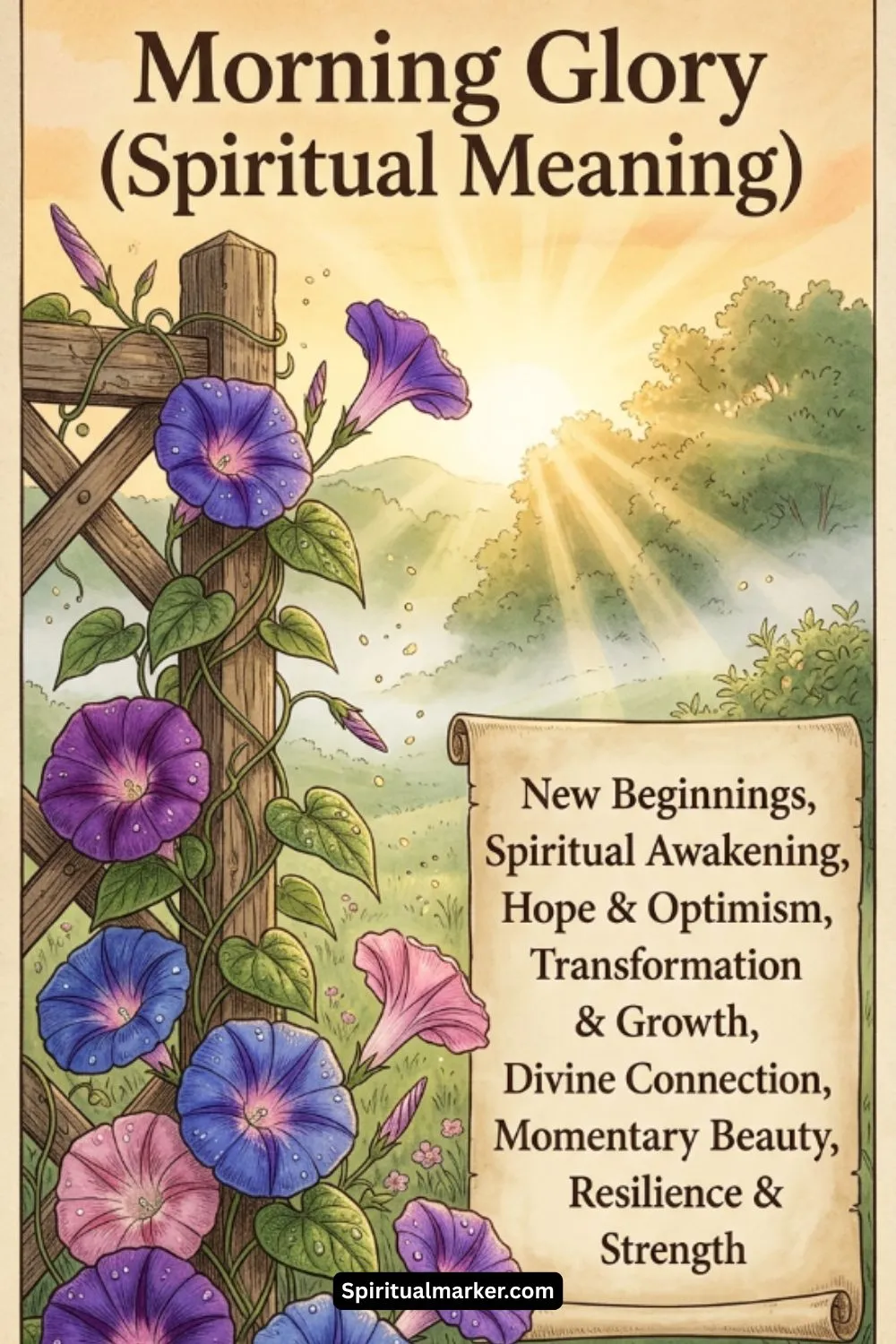
What Is the Morning Glory Flower and Why Does It Hold Spiritual Power?
The morning glory belongs to the Ipomoea family, a genus containing over 500 species of flowering plants found across tropical and subtropical regions worldwide. Its name alone tells a spiritual story. “Morning” signals its daily rebirth at sunrise. “Glory” points to the radiance and divine majesty that many spiritual traditions associate with God, the cosmos, or enlightened consciousness. Together, these two words form a name that is essentially a declaration of sacred beauty.
What gives the morning glory its undeniable spiritual power is its behavior. Unlike most flowers that stay open throughout the day, the morning glory opens its blooms at sunrise and closes them by midday or early afternoon. Each individual bloom lasts only one single day. This means that each flower you see is living its entire life in a matter of hours, making it a living metaphor for the preciousness of each moment. Many spiritual teachers across history have pointed to this very quality as proof that the natural world constantly teaches sacred lessons.
The vine also displays remarkable determination. It climbs, stretches, and reaches upward with every tool available to it, curling its tendrils around any support it can find. In botanical terms, this is simply a growth strategy. In spiritual terms, it mirrors the human soul’s relentless climb toward light, truth, and higher consciousness. The flower does not wait for ideal conditions. It grows where it can, blooms where it must, and reminds you that spiritual growth rarely happens under perfectly controlled circumstances.
What Does a Morning Glory Flower Symbolize or Represent?
At its core, the morning glory flower symbolizes new beginnings. Its daily ritual of opening and closing makes it nature’s most consistent teacher of impermanence and renewal. Each morning, when it unfurls its petals toward the light, it models the attitude that every day is a clean page, unmarked by yesterday’s failures or sorrows. This is why the flower appears in so many spiritual traditions as a symbol of hope and forward movement.
Beyond renewal, the morning glory also represents love and affection. During the Victorian era, flowers carried coded meanings in what was called the “language of flowers” or floriography. The morning glory specifically meant “affection” and was often given to express tender, deep love rather than passion. This association with love runs through multiple cultures, appearing in Japanese poetry, Chinese art, and folk medicine traditions from Central America.
The flower also carries a strong connection to the transience of life. Because each bloom lives for only a day, many cultures interpret it as a symbol of life’s brevity and the importance of living fully in the present moment. Far from being a morbid symbol, this meaning encourages a kind of joyful urgency. It tells you to love fiercely today. It calls you to notice beauty right now, not later. The morning glory, in this sense, is one of nature’s most honest spiritual messengers.
7 Spiritual Meanings of the Morning Glory Flower
1. Renewal and New Beginnings
The most powerful and widely recognized spiritual meaning of the morning glory is renewal. This flower does not simply grow once and finish. It performs a daily act of opening and closing, rising and resting, that mirrors the spiritual cycle all humans are invited to live. Each morning, the morning glory declares that yesterday is over and today is fresh. This is not wishful thinking. It is a biological truth that carries a sacred message.
Spiritually, renewal means more than a change in mood or circumstance. It means releasing the identity you built around your past struggles and stepping into an expanded version of yourself. The morning glory embodies this process physically. Each bloom that opens has never existed before. Each one is entirely new, unmarked, and full of potential. When you see this flower at dawn, it is not showing you the same flower from yesterday. You are witnessing a brand new creation.
Many spiritual practices around the world emphasize the power of morning rituals, from prayer and meditation to gratitude journaling, precisely because the morning carries unique energy. The morning glory is the botanical embodiment of that energy. If you feel stuck in repetitive patterns or burdened by old wounds, this flower serves as a spiritual invitation to try again. It tells you that nature itself resets daily, and you have permission to do the same.
In many healing traditions, particularly those that blend plant medicine with spirituality, the morning glory is used in rituals of release and renewal. Practitioners place the blooms on altars at dawn to mark intentional new beginnings. The flower opens as the sun rises, and the spiritual practitioner opens their heart to new possibilities at the same moment. This synchronicity between the natural and spiritual worlds is precisely why the morning glory holds such enduring sacred significance across so many traditions.
2. Transformation and Personal Growth
The morning glory vine begins as a tiny seed buried in soil. That seed cracks open, pushes through darkness, and climbs toward the sky with extraordinary determination. This process mirrors the spiritual journey of transformation that every soul undertakes. You do not begin your spiritual life fully formed. Growth requires breaking open, sometimes painfully, and reaching toward a light you cannot yet fully see.
What makes the morning glory particularly compelling as a symbol of transformation is the speed and persistence of its growth. Under the right conditions, some varieties can climb up to fifteen feet in a single growing season. This rapid ascent reflects the spiritual truth that transformation, once it begins in earnest, often accelerates beyond what you expect. When the conditions are right, growth becomes almost unstoppable.
The flower’s tendrils also play a significant spiritual role. They reach out carefully, testing surfaces, wrapping around whatever support they can find. This behavior mirrors the way human souls seek community, mentors, and spiritual support during periods of transformation. No vine grows tall without something to climb. No soul transforms in complete isolation. The morning glory physically demonstrates the wisdom of seeking support on your growth journey.
Interestingly, morning glory seeds contain natural alkaloids that in some indigenous cultures have been used in ceremonial contexts to facilitate visionary experiences, though these require careful, trained preparation. This connection between the plant and altered states of consciousness has historically reinforced its spiritual association with transformation and expanded awareness, underscoring the deep relationship between this flower and the shifting of human perception.
3. Hope and Unreserved Optimism
A flower that opens its face to the sun every single morning, without exception, carries an unmistakable message of hope. The morning glory does not skip a morning because the previous day was difficult. It does not stay closed because the weather is imperfect. It opens, fully and completely, every dawn, as if each new day is the very first day of existence. This is the spiritual definition of unreserved optimism.
Hope, in spiritual terms, is not the same as wishful thinking. It is a deep, rooted trust that life moves toward goodness, even when the present moment feels dark. The morning glory embodies this kind of hope because its opening is not conditional. It is structural. It is built into its very biology. Spiritually, this suggests that hope is not something you manufacture. It is something you access, like a flower accesses sunlight, when you turn your attention in the right direction.
Many people who keep morning glories in their gardens report feeling a daily lift in spirit when they see the first blooms of the morning. This is not coincidence. The color palette of the morning glory, which ranges from the deepest violet to pure white, with shades of blue, pink, and red in between, activates genuine emotional responses. Blue morning glories in particular are associated with serenity and the kind of calm, steady hope that sustains you through long seasons of uncertainty.
If you have been through a period of grief, loss, or spiritual dryness, the morning glory is one of nature’s most powerful symbols of comfort. Its message is not that pain does not exist. Its message is that after every dark night, the flower still opens. After every storm, dawn still comes. The morning glory asks you to practice the same faithfulness to the dawn that it demonstrates every single day.
4. The Sacred Impermanence of Life
Because each morning glory bloom lives for only one day, the flower has become a profound spiritual symbol of impermanence. In Eastern spiritual traditions, particularly Buddhist philosophy, impermanence is not something to fear or resist. It is the fundamental nature of reality, and recognizing it leads to both wisdom and liberation. The morning glory makes this abstract teaching visible and concrete.
Japanese poets and artists have long used the morning glory, known in Japan as asagao, to explore themes of mono no aware, the beautiful sadness of transient things. The Heian period poetess Ono no Komachi wrote of the morning glory in connection with the brief, brilliant nature of love and beauty. By the Edo period, the morning glory had become a cultural obsession in Japan, with thousands of cultivated varieties and entire festivals dedicated to its spiritual and aesthetic significance.
The spiritual lesson here is not sadness. It is presence. If you know a flower will only live one day, you pay closer attention to it. You notice the exact shade of its petals. You appreciate the way the light moves through it. You do not take it for granted. This is the gift the morning glory offers: a daily reminder to be fully present with the beautiful, temporary things in your life. Your relationships, your health, your youth, your moments of joy. All are morning glories in their own way.
Spiritually mature traditions across the world teach that embracing impermanence reduces suffering. The morning glory models this beautifully. It does not cling to the previous day’s bloom. It does not mourn the petals that fell. It simply opens again, fresh and complete, in the morning. This behavior is a gentle but powerful teaching about non-attachment, one of the most challenging and liberating spiritual practices a human being can develop.
5. Devotion and Deep Affection
The morning glory’s consistent daily opening carries a quality of faithful devotion that has made it a symbol of deep love across many cultures. In the Victorian language of flowers, morning glory specifically signified love and affection, particularly the kind of love that returns reliably, day after day, without drama or fading. This is the love that shows up, opens fully, and does so again tomorrow. It is not the love of grand gestures. It is the love of consistent, faithful presence.
In Chinese culture, the morning glory holds a particularly romantic spiritual significance. It appears in the legend of the Weaving Girl and the Cowherd, two lovers separated by the Milky Way who are permitted to meet only once a year. The morning glory became associated with this story’s themes of longing, devotion, and the painful beauty of love that transcends distance and circumstance. The flower’s brief daily bloom mirrors the lovers’ brief annual reunion.
Spiritually, devotion is not only romantic. It extends to one’s relationship with the divine, with one’s purpose, and with one’s spiritual practice. The morning glory models devotion as a daily act. It does not bloom only when conditions are perfect. It does not wait until it feels inspired. It opens every morning because that is what it does. This kind of committed daily practice is what many spiritual teachers point to as the foundation of genuine spiritual growth.
People who feel called to cultivate greater devotion in their spiritual lives often find the morning glory a powerful ally. Planting these flowers and watching them open each day creates a rhythm of intentional presence. Each morning, you wake with the flower. Each morning, you practice opening to the day with the same faithfulness. Over time, this simple ritual can profoundly shift how you approach not just your morning, but your entire spiritual orientation to life.
6. Spiritual Awakening and Divine Connection
The morning glory’s opening at dawn places it squarely within a universal spiritual archetype: the awakening of consciousness. Across human civilization, dawn has been treated as a sacred threshold. It is the moment when darkness becomes light, when the unconscious mind yields to waking awareness, when the material world is most receptive to the spiritual. The morning glory is the flower that lives at that exact threshold, making it a powerful symbol of spiritual awakening.
Its trumpet shape also plays a significant spiritual role. Many ancient cultures associated trumpet-shaped flowers with divine announcements or calls from the sacred realm. The shape literally looks like a horn raised to the sky, pointing upward toward the heavens. In this sense, the morning glory can be read as a biological prayer, a form raised toward the divine with its entire body, pointing every petal skyward in an act of wordless adoration.
The flower’s deep blue and purple varieties have particularly strong associations with higher consciousness and the third eye chakra in many spiritual systems. Purple flowers in many healing and energy traditions are linked to intuition, spiritual vision, and the ability to access deeper truths. When you grow or meditate with purple or violet morning glories, you may find that your intuitive faculties open more readily, your dreams become more vivid, or your sense of spiritual connection strengthens.
Morning glory has also played a role in the spiritual practices of indigenous peoples in Mexico and Central America for centuries. The Aztec priests used seeds of the Rivea corymbosa species, called ololiuqui, in sacred ceremonies to access divine visions and communicate with spiritual forces. This longstanding ceremonial relationship between humans and the morning glory underscores its deep connection to the theme of divine contact and spiritual revelation.
7. Emotional Healing and Inner Peace
The final and deeply personal spiritual meaning of the morning glory is its connection to emotional healing. The flower opens with the morning light, and light has been associated with healing across virtually every spiritual tradition in human history. When you tend morning glories, watch them open, or simply sit near them in the early hours, you participate in a quiet but powerful healing ritual that connects you to the restorative rhythms of the natural world.
In traditional herbal and plant medicine contexts, different parts of the morning glory plant have been used across cultures to address physical ailments. But beyond physical medicine, the flower itself carries what many spiritual healers call vibrational medicine. Its consistency, its daily renewal, its unapologetic opening toward the light, all these qualities transmit a frequency of healing to those who receive them with open awareness.
For people working through grief, trauma, or spiritual crisis, the morning glory offers a gentle but persistent message: you are allowed to begin again. You do not have to carry yesterday’s weight into today. The flower never does. Each bloom starts fresh, untouched by what came before, and lives its brief life in full expression. This simple truth, lived out daily in your garden or on your windowsill, can become one of the most healing spiritual practices you adopt.
Inner peace, in many spiritual traditions, is not the absence of difficulty. It is the deep-rooted trust that life continues, that beauty returns, that morning follows night. The morning glory does not produce inner peace through complexity or doctrine. It produces it through the simplest possible act: it blooms. Every morning. Without fail. And in that faithful, unhurried blooming, it offers you an image of the peace you are already capable of finding within yourself.
Morning Glory Meaning and Symbolism Across Cultures
The morning glory flower symbolism reaches across nearly every major culture, and what is remarkable is how consistent the themes are despite the vast geographic and historical distances between them. Almost universally, this flower is associated with the beginning of things, with love, and with the relationship between the human and the divine. These shared meanings suggest that the morning glory speaks to something deeply universal in the human experience.
In Chinese culture, the morning glory holds a dual meaning of love and mortality. It appears in classical Chinese poetry as a symbol of short-lived beauty, evoking both longing and acceptance. The flower is also connected to the Chinese Qixi Festival, which is often called the Chinese Valentine’s Day, celebrating the annual reunion of the two celestial lovers in the Weaving Girl legend. In this context, morning glory becomes the flower of bittersweet love, beautiful precisely because it does not last.
In Japanese culture, the morning glory or asagao has been cultivated for over a thousand years and holds deep cultural and spiritual significance. During the Edo period, growing morning glories became a sophisticated art form, with breeders competing to create the most unusual and beautiful varieties. The flower appears in countless haiku poems as a meditation on the beauty of the present moment. The most famous morning glory haiku by Matsuo Basho presents the flower as a teacher of mindfulness, its brief bloom catching the poet mid-task and pulling them into full presence.
Victorian England gave the morning glory one of its most enduring Western symbolic meanings through the language of flowers. Presented as a gift, morning glories conveyed sincere affection and emotional depth. They also carried a secondary meaning of “love in vain,” reflecting the flower’s brief life. This melancholic dimension added richness to the flower’s symbolism, acknowledging that love is beautiful even when it is fleeting and that emotional courage lies in loving fully despite impermanence.
In Aztec and Mesoamerican traditions, the morning glory held deeply sacred spiritual status. The Aztec god Tlaloc, associated with rain and fertility, was connected to the morning glory plant. Priests used the seeds in ceremonial preparations to enter sacred states of consciousness, communicate with deities, and access divine guidance. The plant was not used recreationally but reverently, as a bridge between human and divine realms. This tradition reflects a sophisticated spiritual understanding of the plant as a living portal to higher consciousness.
Morning Glory Symbolism in World Mythologies
The morning glory appears in the mythological traditions of multiple civilizations, and in each case it carries themes of transformation, divine love, and the journey between worlds. These myths encode spiritual wisdom that has been passed down through generations, often in the simple, memorable form of a story about a flower.
The most prominent mythological connection is the Chinese legend of Zhinü and Niulang, the Weaving Girl and the Cowherd. In this myth, two lovers who are also celestial beings are separated across the Milky Way as punishment for neglecting their heavenly duties. They are allowed to meet only once a year, when a bridge of birds forms between them. The morning glory became symbolically tied to this story as a flower of longing, opening daily toward the sky as if searching for a distant beloved.
In Aztec mythology, the morning glory was linked to Xochiquetzal, the goddess of beauty, love, and feminine creative power. She was associated with flowers, weaving, and the arts, and the morning glory’s daily blooming was seen as a reflection of her creative act of bringing beauty into the world each day. This mythological connection cemented the flower’s role as a symbol of divine feminine power and creative abundance in Mesoamerican spiritual life.
In some Native American traditions of the American Southwest, the morning glory vine was used in healing ceremonies and was believed to carry messages between the physical and spirit worlds. Its vine, which reaches in multiple directions simultaneously, was interpreted as a symbol of the soul’s ability to travel across spiritual boundaries. The flower’s opening at dawn was read as the moment when the veil between worlds is thinnest, making it a spiritually potent time for prayer and ritual.
European folk mythology, while less directly tied to the morning glory than Asian and Mesoamerican traditions, incorporated the flower into stories about fairies and elemental spirits. In some British folk traditions, the morning glory’s brief bloom was said to mark the window of time each morning when fairy activity was highest, and the flowers were planted around thresholds to invite protection and good fortune into the home. This mythological role as a guardian flower reflects the morning glory’s enduring association with sacred space and spiritual protection.
Morning Glory Color Symbolism and Spiritual Meanings
The color of a morning glory significantly shapes its spiritual meaning. Different hues carry distinct vibrations and messages, making the choice of which morning glory to grow or give a genuinely intentional spiritual act.
Blue and purple morning glories are the most spiritually potent varieties in many traditions. Blue represents communication, truth, and spiritual clarity. Purple carries the vibration of higher consciousness, intuition, and the divine. Together, the blue-purple spectrum of morning glories is associated with awakening the third eye, deepening meditation, and accessing spiritual wisdom. If you seek greater spiritual insight or clarity of mind, blue morning glories make a powerful ally.
White morning glories carry the spiritual energy of purity, clarity, and divine presence. White flowers across virtually all spiritual traditions are associated with the sacred, the angelic, and the transcendent. White morning glories in particular symbolize spiritual cleansing and new beginnings. They are often used in purification ceremonies and placed on altars during times of prayer, mourning, or spiritual transition. Their simple, unadorned beauty speaks of the divine without distraction.
Pink morning glories carry the vibration of the heart chakra: love, compassion, emotional healing, and self-nurturing. Pink is the color of gentle love, the kind that does not demand or control but simply gives and receives freely. Pink morning glories are spiritually associated with healing romantic wounds, opening the heart after loss, and cultivating self-love. They make a meaningful gift for anyone moving through grief or the end of a relationship.
Red morning glories carry the intensity of passion, vitality, and the life force itself. Red connects to the root chakra, the center of physical energy, survival instinct, and earthly vitality. Red morning glories symbolize bold love, courage, and creative fire. They are associated with passionate devotion and are appropriate in spiritual contexts involving setting strong intentions, calling in energy, or honoring one’s deep desires with boldness and clarity.
Morning Glory Biblical Meaning and Christian Significance
While the morning glory is not mentioned by name in the Bible, its spiritual qualities align powerfully with several key biblical themes. The connection between this flower and Christian spirituality has grown organically through centuries of devotional reflection and the theological interpretation of the natural world.
One of the most direct biblical connections is found in the book of Lamentations 3:22-23, which declares that God’s mercies are new every morning. This passage has been interpreted for centuries as a theological statement about the daily renewal of divine grace. The morning glory, which itself renews every morning, has become for many Christian gardeners and spiritual writers a living illustration of this scripture. The flower models theologically what the verse declares textually: that each morning is a new gift from God.
The brief life of the morning glory also resonates with James 4:14, which describes human life as a mist that appears for a short time and then vanishes. Rather than a message of despair, this biblical theme of life’s brevity calls Christians to humility, gratitude, and present-moment awareness. The morning glory embodies this call physically. Its single-day bloom is not tragic. It is complete. It lives fully and fades gracefully, modeling the spiritual posture of faithful presence without grasping.
In Christian contemplative traditions, the natural world is often read as a “second scripture”, a text written by God in the language of creation. This perspective, articulated by theologians from Saint Francis of Assisi to Thomas Aquinas, invites Christians to find spiritual revelation in plants, animals, and natural phenomena. Through this lens, the morning glory becomes a daily sermon without words, preaching the themes of resurrection, daily grace, faithful devotion, and the glory of the God who creates beauty that opens each morning and closes at dusk.
The flower’s climbing nature also carries biblical resonance. The image of a vine reaching upward, supported by something stronger than itself, mirrors the theological relationship between the believer and God expressed in John 15:5, where Jesus describes himself as the vine and his followers as branches. The morning glory, which cannot stand upright without support, physically enacts the spiritual posture of dependence on the divine that many Christian traditions identify as the foundation of genuine faith.
Morning Glory as a Spiritual Symbol in Dreams
Dreaming of morning glories carries significant spiritual and psychological messages. The meaning shifts based on the color of the flower, the context of the dream, and your personal relationship to themes of renewal, love, and transformation. Dream symbols drawn from nature consistently appear in the spiritual literature of many traditions as messages from the deeper self or from the divine.
If you dream of morning glories blooming in the morning light, this is almost universally a positive sign. It signals new opportunities arriving in your waking life, the beginning of a significant personal transformation, or the arrival of a season of emotional healing. Your subconscious mind may be processing a recent breakthrough or preparing you for one. Pay attention to what else appears in the dream, as those details help clarify which area of your life is about to open up.
Dreaming of wilted or closed morning glories carries a different message. This image may signal that you have been suppressing your authentic self, closing off your emotional expression, or refusing to take a risk that life is inviting you to take. The closed morning glory in a dream asks you to examine where you have stopped opening. What relationship, creative project, or spiritual practice has gone dormant in your life? The dream may be calling you back to it.
Dreaming of planting morning glory seeds is a powerful symbol of intentional creation. You are setting something in motion at a deep level, probably something whose full form you cannot yet see. This dream often arrives at turning points in life, when you are beginning a new career, relationship, or spiritual path. The act of planting seeds in the dream affirms that your intentions are taking root and that what you are building will grow, even if slowly at first.
The color of the morning glories in your dream adds another layer of meaning. Blue or purple morning glories in dreams are associated with spiritual awakening, creative inspiration, and messages from the higher self or divine. White morning glories point to a need for purification or a period of spiritual clarity approaching. Red morning glories in dreams often signal passionate new love, a surge of creative energy, or a call to take bold action in an area you have been hesitant about. According to dream symbolism research, flower dreams generally carry the emotional resonance of their real-world counterparts, which makes the morning glory’s associations with hope, renewal, and love particularly significant in the dream state.
Morning Glory as a Tattoo Symbol and Its Spiritual Meaning
The morning glory has become an increasingly popular tattoo choice for people drawn to its spiritual symbolism, and the reasons people choose it reveal how deeply the flower’s meaning resonates with human experience. A morning glory tattoo is rarely chosen for purely aesthetic reasons. Most people who permanently ink this flower onto their bodies are drawn to its specific spiritual message.
Many choose the morning glory tattoo to commemorate a period of personal rebirth. Survivors of illness, addiction, grief, or trauma find in this flower a symbol of their own daily renewal, the proof that they, like the flower, can open again after the night. The tattoo becomes a permanent reminder of their capacity for resilience and new beginnings. In this context, the morning glory is not just decorative. It is a spiritual testimony worn on the body.
Others choose morning glory tattoos to honor love and devotion, particularly the lasting love they feel for a partner, a child, or a parent. The flower’s association with faithful daily love makes it a natural choice for commemorating relationships built on consistency and presence rather than dramatic gesture. A morning glory tattoo in this context says, “I will open to you again every morning. My love does not fade with daylight.”
The vine element of morning glory tattoos adds further spiritual depth. A climbing vine suggests growth, journey, and the ability to navigate obstacles through persistence rather than force. Many people incorporate the vine into large-scale tattoo designs that travel across the body, creating a living map of personal growth that mirrors the flower’s own upward journey toward light and full expression.
How to Use Morning Glory in Your Spiritual Practice
You do not need to be an expert gardener or a lifelong spiritual practitioner to bring the morning glory’s spiritual energy into your daily life. The simplest and most powerful thing you can do is grow them. Plant morning glory seeds near a window, trellis, or fence where you will see them first thing each morning. Their daily opening will naturally anchor a morning spiritual practice without requiring any additional effort on your part.
You can also use morning glory in altar work and ritual. Fresh morning glory blooms placed on an altar at dawn carry the energy of new beginnings and spiritual receptivity. Because the blooms close by midday, there is something naturally intentional about gathering them early and offering them to your spiritual practice in that window of time. This built-in urgency makes the ritual feel alive and present rather than routine.
Morning glory also works beautifully in meditation practice. Sit near a blooming plant at dawn and allow your breath to synchronize with the stillness around you. Allow the flower’s open face, turned toward the light, to become a visual anchor for your meditation. Ask yourself: what does it mean for me to open fully today? What light am I turning toward? What parts of myself am I keeping closed that want to bloom? These reflections, held lightly in morning stillness, can yield powerful spiritual insight.
If you practice journaling as a spiritual discipline, consider keeping a morning glory journal during the growing season. Each morning, note what the flowers look like and what feels new or fresh in your own inner life. Over weeks and months, patterns will emerge that reveal how your own seasons of opening and closing mirror the flower’s rhythm. This practice connects you to natural cycles in a deeply personal way and builds the kind of self-awareness that is the foundation of lasting spiritual growth.
A Final Note
The morning glory flower spiritual meaning is not something imposed on the plant from the outside. It rises naturally from what the flower does, how it lives, and the rhythm it maintains with total, unwavering faithfulness. It opens every morning. It turns toward the light. It climbs steadily toward what it cannot fully see. And then it closes, releases, and trusts the darkness to yield once more to dawn.
In that faithful daily cycle, the morning glory carries more spiritual wisdom than many books combined. It teaches renewal without intellectualizing it. It models devotion without preaching it. It demonstrates the beauty of impermanence simply by living its brief, brilliant life in full color. You do not need to adopt a new philosophy to receive its teaching. You only need to pay attention.
If you feel drawn to the morning glory, trust that pull. Plant some seeds. Watch them climb. Let the daily opening of those petals become your morning ritual, your reminder that you, too, are invited to open again today. You are invited to turn toward the light. You are invited to let yesterday’s closed bloom fall away and offer the world the fresh, unrepeatable flower that is today’s version of you.
The morning glory has been teaching this lesson for centuries, in gardens, in temples, in poetry, and in dreams. Now it teaches it in yours. If you found this exploration of morning glory symbolism meaningful, consider reading about the spiritual meanings of other flowers that share the morning glory’s themes of transformation and divine connection, including the lotus, the white lily, and the sunflower. Each one carries a unique piece of the language that nature speaks to those who listen.