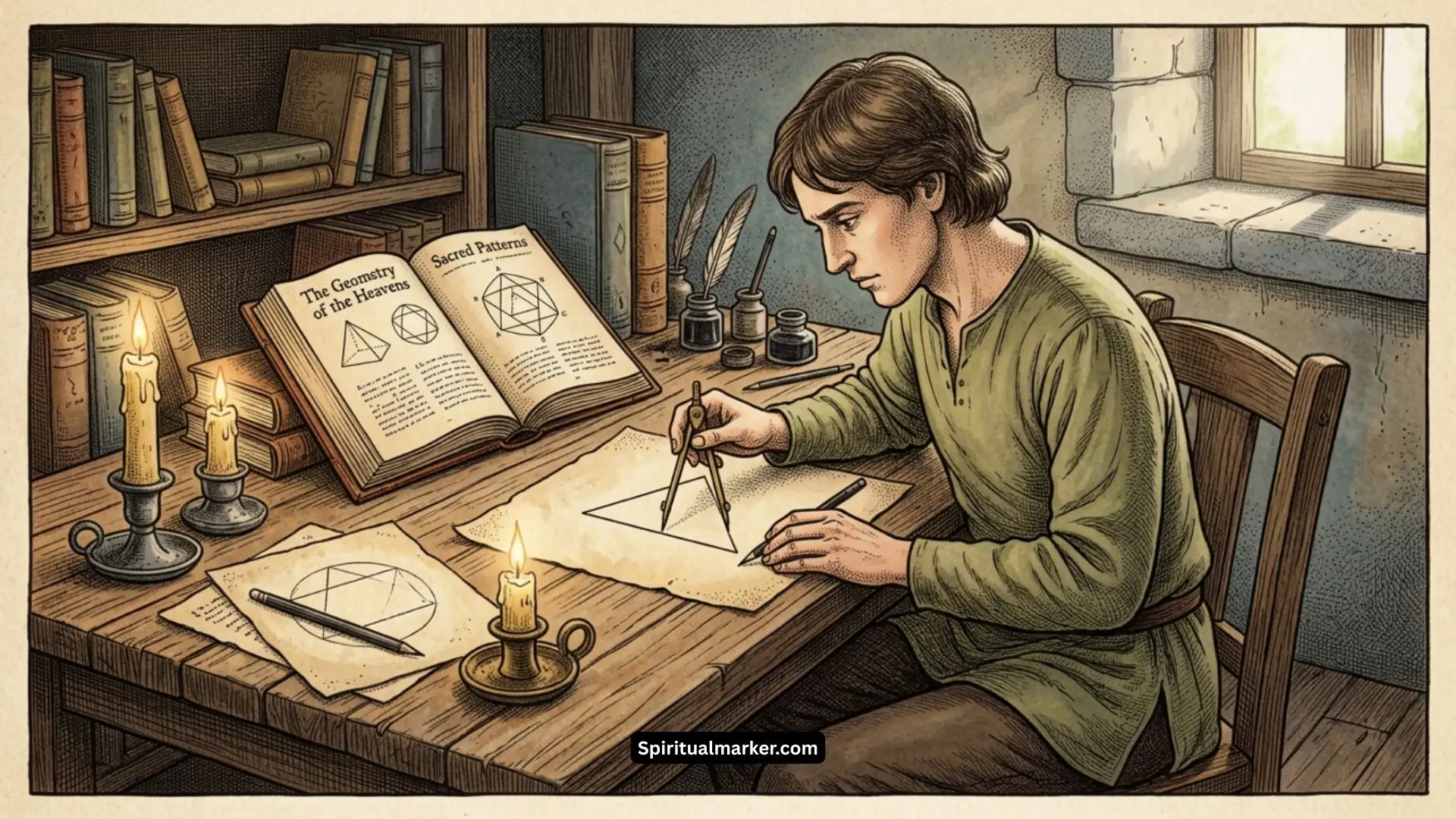
The triangle is a simple shape with three sides. It appears in art, architecture, and sacred geometry. Across cultures, this shape carries deep spiritual meaning and reveals hidden truths.
The triangle spiritual meaning often involves balance, strength, and spiritual ascent. The three sides can represent body, mind, and spirit. A spiritual meaning of a square symbol shares that geometric focus, though squares carry a more grounded energy.
Some traditions view the triangle as a symbol of the divine or the trinity. Others see it as a reminder to find balance. The triangle's orientation can add detail.
If the triangle keeps appearing, it may signal a need for alignment. A spiritual meaning of a circle symbol also deals with shapes, though circles carry a more unified energy.
Key Takeaways
Before moving deeper, here are five essential truths about triangle symbolism and spiritual meaning:
- The triangle universally represents the number three, a sacred number in virtually every world religion and spiritual tradition, symbolizing completeness, balance, and divine order.
- The direction a triangle points changes its spiritual meaning entirely. An upward-pointing triangle channels masculine energy, fire, and ascension. A downward-pointing triangle channels feminine energy, water, and grounding.
- Across Christianity, Hinduism, Buddhism, and ancient paganism, the triangle appears as a symbol of the divine and the relationship between the human and the sacred.
- In sacred geometry, the triangle is the first shape formed from straight lines, making it the foundational building block of all other geometric forms and spiritual diagrams.
- Dreaming of triangles often carries a message about balance, personal transformation, and spiritual awakening, pointing to areas of your life where three forces need alignment.
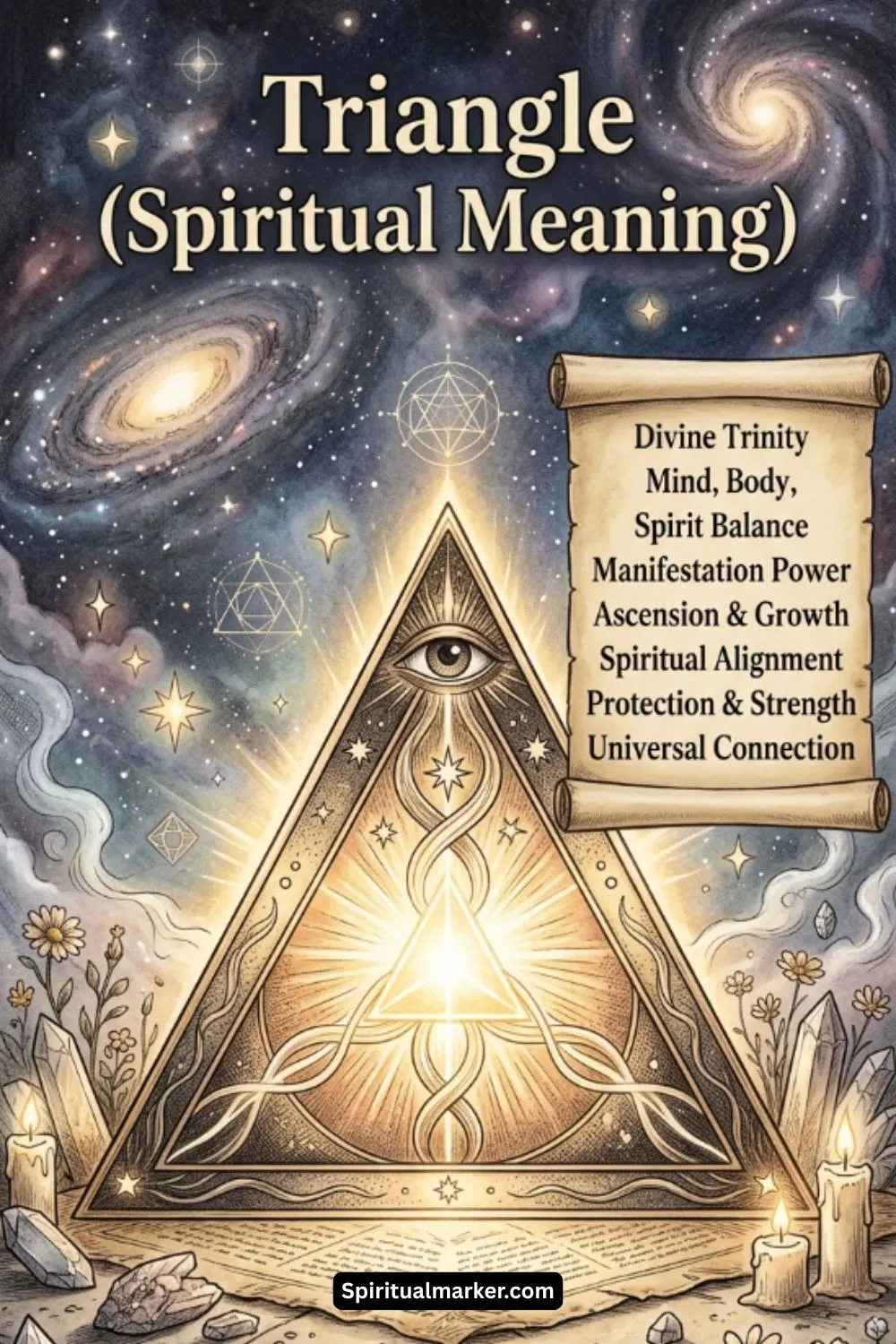
What Is the Triangle and Why Does It Hold Spiritual Power?
The triangle is the simplest closed polygon in existence. Three lines. Three angles. Three points. Yet this simplicity is precisely what gives it such tremendous spiritual power. Ancient philosophers recognized that the number three represents the minimum needed to create a stable structure. Two points create a line. Add a third point and you create a plane. You create dimension. You create reality.
The Greek philosopher Pythagoras considered the triangle a sacred shape. His school of thought treated geometric forms as windows into divine truth. The triangle, in his view, was the key that unlocked the structure of the cosmos. The Pythagoreans believed every triangle contained the secrets of proportion, harmony, and universal law. This was not mere math. It was spiritual investigation.
What makes the triangle spiritually potent is its ability to represent triads. Every significant spiritual concept seems to arrive in threes. Past, present, future. Mind, body, spirit. Birth, life, death. Father, Son, Holy Spirit. Creator, Preserver, Destroyer. These triads feel instinctively complete in a way that pairs or single concepts do not. The triangle gives those triads a visible, tangible home. It makes the invisible visible. That is the root of its spiritual authority.
Additionally, the triangle appears abundantly in nature. The shape of mountains. The form of certain crystals. The arrangement of atoms in stable molecular bonds. This natural resonance suggests the triangle is not a human invention but a universal truth that humanity simply noticed and named. When something appears both in ancient scripture and in molecular chemistry, its significance transcends the cultural. It touches something eternal.
What Does Seeing a Triangle Symbolize or Represent?
Seeing a triangle repeatedly in your daily life is rarely a coincidence in spiritual thinking. Many traditions consider repeated encounters with symbols to be messages from the universe, spirit guides, or your own higher self. The triangle, in particular, tends to appear when a person is at a crossroads. When three forces, choices, or aspects of life are demanding to be integrated.
In numerology, the number three vibrates with the energy of creativity, expression, and divine communication. The triangle, as the geometric embodiment of three, carries this same energy. Seeing triangles often signals that you are entering a creative or communicative phase. Your ideas are ready to be expressed. Your inner voice is ready to be heard. The universe uses the triangle to say: pay attention, something is aligning.
On a personal level, the triangle also symbolizes strength through tension. Structural engineers know that triangles are the most rigid and load-bearing shape in construction. Spiritually, this translates to the idea that three competing or complementary forces held in proper balance create something unshakeable. Seeing a triangle can be a reminder that the tensions in your life are not problems. They are the very things creating your structural integrity.
The orientation of the triangle you notice also matters enormously. An upward-pointing triangle suggests ascension, ambition, fire energy, and masculine principle. A downward-pointing triangle points toward the earth, the feminine, water, the subconscious, and receptivity. Two triangles interlocked, as in the Star of David, represent the perfect union of opposing forces. The specific form of the triangle you keep seeing carries its own distinct message for your life.
7 Spiritual Meanings of the Triangle
1. The Divine Trinity and Sacred Wholeness
The most universal spiritual meaning of the triangle is its representation of the divine trinity. This is not exclusive to Christianity. Virtually every major world religion structures its highest divine concepts in triads. In Christianity, the triangle directly represents the Father, Son, and Holy Spirit. Medieval Christian art frequently depicted God within or as a triangle to show the three-in-one nature of the divine. Early church iconography used the triangle as one of its central sacred symbols precisely because three expressed completeness in a way no other number could.
In Hinduism, the triangle embodies the Trimurti: Brahma the Creator, Vishnu the Preserver, and Shiva the Destroyer. These three are not separate gods but three faces of a single divine reality. The triangle makes that unity visible. In Celtic spirituality, the triquetra, a three-pointed triangular knot, represents the triad of land, sea, and sky. It also represents the triple goddess in her three phases. The theme is identical across these wildly different traditions: three forces united in one truth.
The deeper message here is that wholeness requires three. Not two, not four, but three. A triangle cannot be a triangle with fewer sides. Similarly, a complete spiritual life requires the integration of three aspects: the intellectual, the emotional, and the spiritual. Or the physical, the mental, and the divine. The triangle as divine trinity reminds you that true wholeness is not about choosing one aspect of yourself. It calls you to hold all three in conscious balance.
When the triangle appears to you as a symbol of divine wholeness, it often arrives at moments when you are living too heavily in one dimension of life. You may be all intellect and no feeling, or all feeling and no grounding. The triangle invites integration. It calls the three parts of your being back into their rightful sacred alignment.
2. Ascension, Growth, and Spiritual Elevation
The upward-pointing triangle is one of the oldest and most consistent symbols of ascension in human spiritual history. Its form naturally draws the eye from the broad base upward to a single, focused point. This visual movement mirrors the spiritual journey itself: beginning wide in the material world, narrowing through discipline and practice, and arriving at a single point of divine connection. The Egyptian pyramid is the most famous three-dimensional expression of this idea. Millions of tons of stone engineered to point at the sky.
In alchemy, the upward triangle is the symbol for fire. Fire moves upward. It transforms matter into energy. It purifies, refines, and elevates. Alchemists used this symbol to represent not just literal fire but the internal fire of spiritual transformation. The alchemical fire triangle meant that whatever it was placed on was in a state of being refined, burned away, and elevated into something higher. This is a profound metaphor for personal growth.
The triangular form of mountain peaks has always been associated with spiritual ascension in cultures worldwide. Moses received divine law on the triangular peak of Mount Sinai. Hindus consider Mount Meru, depicted as a pyramidal peak, the axis of the cosmos. Indigenous cultures on every continent have treated mountain peaks as sacred meeting places between the human and the divine. The upward triangle is geometry in harmony with this instinct.
For you personally, the upward triangle carries a powerful message: you are rising. Your situation may feel difficult, but difficulty is the wide base. The narrow point at the top is clarity, elevation, and arrival. The triangle as ascension symbol tells you that your struggles are not signs of failure. They are the broad foundation from which your highest self launches upward.
3. The Feminine Divine and Grounding Energy
The downward-pointing triangle carries the spiritual signature of the feminine divine. It points toward the earth, toward the depths, toward the womb, and toward the waters beneath. In ancient traditions across Egypt, Greece, and the pre-Christian Mediterranean world, the downward triangle was the symbol of the goddess. It represented the sacred feminine principle in all its forms: creation, intuition, receptivity, mystery, and the deep knowing that arises from stillness rather than action.
In alchemy, the downward triangle symbolizes water. Water moves downward. It seeks depth. It fills hollow spaces. It nourishes roots and sustains life invisibly beneath the surface. These are qualities associated with the feminine spiritual energy in most traditions: the capacity to nurture without demanding recognition, to sustain life through invisible labor, and to carry the wisdom of depth rather than the wisdom of height. The downward triangle honors all of this.
In Tantra and certain Hindu traditions, the downward-pointing triangle represents the yoni, the cosmic womb from which all creation emerges. The Sri Yantra, one of the most sacred and complex geometric diagrams in Hindu spirituality, is composed of nine interlocking triangles. Four of those triangles point upward to represent Shiva, the masculine. Five point downward to represent Shakti, the feminine. The entire universe, according to this tradition, is the interplay of these forces expressed through triangular geometry.
The appearance of a downward triangle in your life invites you to go inward. It calls you to trust your intuition over your logic. It asks you to receive rather than pursue. This symbol appears when your life needs more depth, more stillness, and more trust in the unseen. It reminds you that the feminine principle is not weakness. It is the very source from which all strength eventually flows.
4. Protection and Spiritual Shielding
Across many spiritual traditions, the triangle carries a strong association with protection. Its three sides form an enclosed, complete space. In magical traditions worldwide, drawing or visualizing a triangle around yourself or a sacred space creates a container that keeps harmful energies out and protective energies in. This is not superstition. It reflects a deep intuition about the nature of boundaries and the power of geometric intention.
In ceremonial magic and Hermeticism, the triangle was used to contain spiritual forces during ritual work. The practitioner would stand within a circle while spirits or energies were called into a triangle drawn nearby. The triangle served as a bounded, controlled space. It gave form to the formless. In this tradition, the triangle represents humanity’s ability to work with powerful forces by giving them structure. Structure is the source of safety.
In many Native American traditions, triangular shapes in beadwork, weaving, and painting carry protective power. The pointed tips of the triangle are understood as directional arrows that deflect negative energy away from the wearer or the home. The three points guard three directions simultaneously. This mirrors the widespread use of triangular amulets across ancient Egypt, the Middle East, and Asia, where triangle-shaped protective talismans were worn or hung above doorways to keep evil at bay.
The protection meaning of the triangle speaks to something foundational: true safety comes from balance. A triangle is structurally the most stable shape because its three sides distribute force evenly. When you feel spiritually unshielded or vulnerable, the triangle reminds you that protection does not come from building walls. It comes from establishing three points of stability in your life: your inner world, your relationships, and your connection to the divine.
5. Mind, Body, and Spirit Integration
One of the most practically useful spiritual meanings of the triangle is its representation of the three core dimensions of human experience: mind, body, and spirit. Each corner of the triangle holds one of these aspects. Each side represents the relationship between any two of them. A healthy, spiritually aligned life keeps all three sides of this triangle in balance. When any one corner is neglected, the entire triangle collapses. The shape itself teaches the lesson of integration.
This triadic model of human wholeness appears across healing traditions worldwide. Ayurvedic medicine in India views health as the balance of three fundamental energies, the three doshas. Traditional Chinese medicine organizes the body’s energy around three primary centers. Shamanic healing traditions across South America, Africa, and indigenous North America all work with a three-part model of the human being. The triangle, in each case, provides the geometric blueprint for wholeness.
Abraham Maslow’s famous hierarchy of needs, while a psychological rather than spiritual model, echoes this triangular wisdom. It is literally shaped as a pyramid, a three-dimensional triangle. Its message is that human fulfillment requires the sequential meeting of needs across multiple levels. You cannot live only at the peak. You need the broad, solid base. You need all three primary dimensions of your being to be acknowledged and nourished.
When the triangle appears to you carrying this meaning, it asks a direct question: which corner of your life triangle are you neglecting? Are you overly intellectual and spiritually disconnected? Are you physically depleted because you ignored your body for your ambitions? The triangle as a symbol of mind-body-spirit integration carries no judgment. It simply offers a clear, three-point diagnostic map for returning to wholeness.
6. Change, Transformation, and the Power of Three Phases
The triangle is a profound symbol of transformation. Its three points map onto the three universal phases of any change process: beginning, middle, and end. Or, in the language of many spiritual traditions: death, transition, and rebirth. Every meaningful transformation in life moves through exactly these three stages. Something must end before something new can begin. The middle stage, often the most uncomfortable, is the liminal triangle point between what was and what will be.
In alchemy, which was as much a spiritual practice as a proto-science, the triangular symbols for fire and water represented the forces of transformation. Fire transforms solid matter into energy. Water transforms energy into flow. Together, these two triangular forces represented the complete range of alchemical change. The Great Work of alchemy, the transformation of base metal into gold, was always understood as a metaphor for the transformation of the unconscious self into the enlightened self.
The triple goddess in Pagan and Wiccan traditions is often depicted with a triangular symbol. She moves through three phases: Maiden, Mother, and Crone. These phases mirror the moon’s three primary phases: waxing, full, and waning. They also mirror the human life cycle and the natural cycle of all living things. The triangle, in this context, is the shape of time itself. It is the container of all change, all growth, all loss, and all renewal.
For anyone in a season of major personal change, the triangle offers a deeply reassuring message. You are not lost. You are in the middle point of the triangle. The base of your old life still exists behind you. The apex of your new life is already ahead. Three points have always defined your journey. Trust the shape. Trust the process. The transformation is complete only when all three points are touched.
7. Enlightenment, the All-Seeing Eye, and Divine Wisdom
Perhaps the most visually iconic use of the triangle in spiritual symbolism is the Eye of Providence: an eye enclosed within a triangle, often surrounded by rays of light. This symbol appears on the United States dollar bill, in Freemasonic lodges, in medieval Christian art, and in esoteric traditions worldwide. The triangle here represents the divine perspective: an all-seeing awareness that transcends the limitations of ordinary human vision. The eye within the triangle is God, the universe, or the higher self watching over creation from above.
In Buddhist traditions, triangular arrangements appear in mandalas and sacred art to represent enlightenment and the movement from ignorance toward wisdom. The three jewels of Buddhism, the Buddha, the Dharma, and the Sangha, form a sacred triad that is often arranged visually in a triangular pattern. The triangle here maps the path: you begin at the base in ordinary consciousness, and through practice and devotion, you move toward the apex of awakened awareness.
The Greek letter delta, shaped as a triangle, has carried the meaning of change and wisdom since antiquity. In mathematics, it represents transformation from one state to another. In Hermeticism and esoteric philosophy, it represents the fire of divine intelligence that illuminates the mind. Plato used the triangle as one of his primary geometric metaphors for the structure of the soul and the cosmos. For Plato, wisdom was not an abstraction. It had a shape, and that shape was triangular.
The enlightenment meaning of the triangle speaks directly to your spiritual potential. You contain within you a point of pure witnessing awareness. It observes your thoughts, your emotions, and your circumstances without being consumed by them. The triangle with the eye at its center is a reminder that this witness exists within you. Activating it, sitting in that clear, elevated seeing, is what every genuine spiritual tradition calls enlightenment. The triangle is the map to that inner peak.
Triangle Meaning and Symbolism Across Cultures and Religions
The triangle symbol cuts across every major civilization with striking consistency. This cross-cultural universality is itself a spiritual statement. When people separated by oceans and centuries arrive at the same symbol independently, it suggests the triangle is not a cultural invention but a universal truth embedded in consciousness itself.
In ancient Egypt, the triangle took its most monumental form in the pyramids. These structures were not simply tombs. They were spiritual technologies. The pyramid’s triangular faces were angled precisely to align with specific stars and to channel cosmic energy downward into the burial chamber. The shape facilitated the soul’s journey between the earthly and the divine. Egyptians understood the triangular form as a machine for spiritual transformation.
In Hinduism, the triangle appears in some of the tradition’s most sacred imagery. The Sri Yantra, considered the most powerful of all yantras (sacred geometric diagrams), consists of nine interlocking triangles radiating from a central point. This diagram represents the entire cosmos and the interplay of masculine and feminine divine energy. Meditating on the Sri Yantra is considered a direct path to enlightenment in certain Tantric schools because it replicates the geometric structure of reality itself.
In Norse mythology, the Valknut, a symbol of three interlocked triangles, was associated with the god Odin and with warriors who died in battle. It represented the knot of the slain and was understood to mark those chosen for a special fate. Some scholars interpret it as a symbol of the interconnection of earth, heaven, and the underworld. The three triangles, bound together, suggest that no realm exists independently of the others.
In Islam, while representational art of divine figures is avoided, geometric patterns carry deep spiritual meaning. Triangular arrangements appear frequently in Islamic architecture and art. The number three holds significance as the basis of many of the 99 names of Allah are grouped conceptually in triads. The triangle’s inherent structural elegance reflects the Islamic understanding of divine order expressed through mathematical and geometric perfection.
Triangle Symbolism in World Mythologies
World mythologies are rich with triangular symbolism, even when the triangle itself is not named explicitly. The triadic structure of divine beings and cosmic forces appears so consistently across mythologies that scholars of comparative religion, notably Joseph Campbell in his work on the monomyth, have noted it as a universal archetype of human storytelling and spiritual thinking.
In Greek mythology, the cosmos is ruled by three primary divine brothers: Zeus of the sky, Poseidon of the sea, and Hades of the underworld. These three divided reality between them, each governing one fundamental domain. Reality itself, in the Greek mythological view, is a triangle. The three realms are not separate. They exist in constant relationship, tension, and exchange. Remove any one and the entire cosmic structure collapses into incompleteness.
In Celtic mythology, the importance of the number three and the triangle is impossible to overstate. The Celts organized virtually everything in triads. Their gods often appeared in triple form, such as the Morrigan, a triple goddess of war, fate, and sovereignty. Their oral tradition preserved knowledge in the form of triads, three-part proverbs that encoded wisdom in a format the triangle itself mirrors. The Celtic love of the triangle reflects a deep cultural understanding that truth requires three angles to be fully seen.
In Sumerian mythology, among the earliest recorded mythological traditions in human history, the cosmos was governed by three primary deities: Anu of the sky, Enlil of the wind and earth, and Enki of water and wisdom. This triangular divine structure is striking because it predates the Greek, Norse, and Celtic traditions by thousands of years. It suggests that the triangular model of divine reality is not borrowed. It is independently discovered by human consciousness reaching toward ultimate truth.
In Mesoamerican traditions, the pyramid, that three-dimensional triangle, was the central spiritual architecture of the Maya and Aztec civilizations. The stepped pyramids were not only temples but models of the cosmos. Each tier represented a different level of spiritual reality. Ascending the pyramid was a physical enactment of spiritual elevation. The triangular form was the path the soul traveled between the human and the divine, literally walked by priests and symbolically traveled by all believers.
Sacred Geometry and the Spiritual Power of the Triangle
In the world of sacred geometry, the triangle holds a foundational position unlike any other shape. Sacred geometry is the study of the mathematical patterns and ratios that appear throughout nature and that many spiritual traditions believe encode divine intelligence. The triangle is the first stable polygon. It is the geometric seed from which all other forms grow.
The equilateral triangle, in which all three sides and all three angles are equal, is considered the most spiritually potent triangular form. Its perfect symmetry represents the harmony of divine proportion. Leonardo da Vinci, who studied sacred geometry deeply, used triangular proportions extensively in his paintings. The famous composition of the Mona Lisa, the Virgin of the Rocks, and many other Renaissance masterpieces are structured around underlying triangular grids. These masters understood that the triangle creates a sense of stability and divine order that no other arrangement achieves.
The Flower of Life, one of the most recognized sacred geometric symbols, is composed of interlocking circles from which triangular patterns naturally emerge. The Star of David (Merkaba), which appears within the Flower of Life, is formed by two interlocking triangles. This shape represents the integration of heaven and earth, masculine and feminine, above and below. The triangle is the engine of sacred geometry’s most complex and spiritually significant patterns.
The Pythagorean theorem, which governs the relationship between the sides of a right triangle, was not just mathematics to Pythagoras. It was a divine law. The right angle of a triangle was considered sacred because it was the angle that defined the relationship between the earthly plane and the vertical reach toward the heavens. The right triangle is the geometric statement of humanity’s position: grounded in the earth, aspiring toward the sky, with the hypotenuse representing the actual path of the soul between the two.
Biblical Meanings of the Triangle and Its Significance
The triangle in Biblical and Christian symbolism is among the most studied uses of this shape in any religious tradition. While the word “triangle” does not appear in the Bible, the concept of three and its geometric expression runs through scripture with remarkable consistency. God reveals His nature in three persons. The Holy Trinity of Father, Son, and Holy Spirit is Christianity’s defining theological statement, and the triangle has served as its primary visual symbol since the early centuries of the church.
Early church fathers used the equilateral triangle to illustrate the mystery of the Trinity. All three sides equal, all three angles equal, yet forming a single unified shape. This was the perfect visual argument that three could be one without contradiction. The triangle appeared in medieval cathedrals, in illuminated manuscripts, and in the vestments of clergy as a constant reminder of the trinitarian nature of the divine. It was not decoration. It was theology made visible.
The number three appears throughout the Bible in spiritually significant ways. Jesus rose on the third day. Peter denied Christ three times. Paul prayed three times to have his “thorn in the flesh” removed. Jonah spent three days in the belly of the whale. The three wise men brought three gifts. Three crosses stood on Golgotha. These repetitions are not literary accidents. They reflect a deep biblical understanding that three is the number of divine completion and divine action.
The Eye of Providence, the all-seeing eye within a triangle that appears on American currency and in many Christian churches, has direct Biblical roots. It represents the omniscience of God described throughout scripture. Psalm 139 describes a God from whom nothing is hidden. The triangle surrounding the divine eye in this symbol represents the Trinity watching over creation. In many Catholic and Protestant churches built between the 15th and 19th centuries, this triangular eye symbol appears above altars as a central piece of sacred iconography.
Upward vs. Downward Triangle: The Spiritual Difference
The orientation of a triangle is not an aesthetic detail. It is a fundamental spiritual distinction. Upward and downward triangles carry opposite energies, opposite elemental associations, and opposite spiritual messages. Understanding this difference gives you a far more precise reading of the triangle symbol whenever it appears in your life, in art, in dreams, or in spiritual practice.
The upward-pointing triangle is associated with fire, the masculine principle, solar energy, the active force, yang energy in Taoism, and the movement from earth toward heaven. Its form mirrors the flame, which always rises. It represents the aspiration of the human spirit toward the divine, the drive to elevate, create, achieve, and transcend. In alchemy, this triangle was the symbol for fire itself. In spiritual practice, it represents the disciplined pursuit of enlightenment through effort and will.
The downward-pointing triangle carries the opposite charge. It is associated with water, the feminine principle, lunar energy, the receptive force, yin energy in Taoism, and the movement from heaven into earth. Its form mirrors the drop of water falling earthward and the womb opening to receive life. In alchemy, this triangle symbolized water itself. In spiritual practice, it represents surrender, depth, intuition, and the wisdom that comes from stillness. It asks you to receive rather than reach.
When these two triangles overlap, they form the hexagram, known in Judaism as the Star of David and in Hinduism as the Shatkona. This six-pointed star represents the perfect integration of opposites. Heaven and earth united. Masculine and feminine balanced. Fire and water harmonized. The hexagram is the triangle’s ultimate spiritual statement: that wholeness requires the sacred marriage of opposing forces, not the victory of one over the other.
Dreaming About Triangles: Spiritual and Psychological Meanings
Dreams speak in the language of symbols. The triangle in dreams is a particularly significant symbol because it bridges the personal and the universal. When a triangle appears in your dream, your subconscious is drawing on thousands of years of collective symbolic meaning to send you a message. The context, color, size, and behavior of the triangle all modulate the core message. But the core message is always about balance, integration, and the relationship between three forces in your life.
Dreaming of a bright, clear, upward-pointing triangle often signals that you are on the right path toward a goal or a spiritual aspiration. Your subconscious is affirming your direction. The upward movement encoded in the shape tells you that your current trajectory is one of growth and elevation. Pay attention to what surrounds the triangle in the dream. The surrounding landscape or figures often reveal which area of life this growth applies to most directly.
A downward-pointing triangle in a dream often arrives during periods when your inner life needs more attention than your external pursuits. It is a call to go inward. To rest, reflect, and receive. It may also signal that your intuition is trying to speak louder than your logical mind is allowing. The downward triangle in dreams asks you to trust the depths more than you currently do. Slow down. The answer you need is not out there. It is already within you.
Psychologically, Carl Jung’s framework of archetypes gives additional dimension to triangular dream imagery. Jung identified the number three as connected to the process of individuation, the integration of the shadow self into conscious awareness. In Jungian terms, dreaming of a triangle may indicate that you are approaching a critical phase of psychological wholeness. Two opposing aspects of your psyche are pressing toward a third synthesis. This is uncomfortable but enormously generative work. The triangle in your dream may be your psyche’s way of announcing that synthesis is imminent.
Dreaming of a broken or incomplete triangle often reflects feelings of imbalance or a sense that something essential is missing in one of the three key areas of life: mind, body, or spirit. Two sides are present but the third is absent. This dream calls you to identify the missing element and consciously work to restore it. It is not a warning of failure. It is a precise diagnostic tool offered by your own deep wisdom.
The Triangle in Tattoo Culture and Modern Spiritual Practice
The triangle has become one of the most popular symbols in contemporary spiritual tattoo culture. This is not coincidence. People are drawn to it because its meaning resonates deeply even when they cannot fully articulate why. A simple, clean triangle tattoo carries the weight of every tradition described in this article simultaneously. The person wearing it may consciously intend it to represent their personal trinity, such as past, present, and future, or mind, body, and soul. The symbol itself carries the full depth of its spiritual heritage regardless.
In modern New Age and neo-Pagan spiritual practice, the triangle is used extensively in ritual work, crystal grids, and energy healing. Crystal practitioners often arrange stones in triangular patterns to amplify and direct energetic intention. The three corners of the triangle are understood to create a harmonic resonance that a single stone or a pair of stones cannot achieve. Three is the number of active creation in these traditions, reflecting ancient wisdom dressed in contemporary spiritual language.
Many modern meditation teachers use the triangle as a visualization tool. Practitioners are guided to see a triangle of light surrounding them, providing protection and clarity. Others visualize the triangle as a container for intention, placing a desired outcome mentally at the apex and the two foundational requirements for achieving it at the base angles. This triangular intention-setting technique reflects the ancient understanding that the triangle is not just a shape. It is a technology for directing consciousness.
A Final Note
The triangle spiritual meaning is not one thing. It is a living, multidimensional symbol that shifts and deepens depending on your tradition, your orientation, and your life’s current chapter. What stays consistent across every culture, religion, mythology, and spiritual practice is the core truth: the triangle represents the divine power of three. Three as completeness. Three as stability. Three as the minimum architecture for wholeness.
The triangle has been with humanity since our earliest attempts to make sense of existence. It appears on cave walls and cathedral ceilings, in ancient alchemical manuscripts and modern logos, in dreams and in the night sky. Its persistence is a message in itself: this shape carries irreducible truth. Truth that no single tradition owns but that all traditions recognize.
If triangles are appearing in your life right now, pay attention. Notice which direction they point. Notice whether they feel stable or broken. Notice which three forces in your life are pressing toward integration. The triangle is not asking you to become something you are not. It is showing you the complete shape of who you already are: three essential dimensions waiting to be held in conscious, loving balance.
You may find it helpful to meditate with the triangle symbol by visualizing an equilateral triangle in your mind’s eye and placing one word or intention at each corner. Sit with the shape. Let it reveal which side needs strengthening and which connections need deepening. Work with triangular arrangements in your physical space, whether through crystal grids, art, or architecture, to invite this powerful sacred geometry into your daily environment. Most importantly, trust the wisdom that your repeated encounters with this symbol are trying to deliver. The triangle has been waiting patiently across millennia to say something specific to you. Now is the time to listen to its three-pointed truth.