
You walk into your bedroom late at night. The lights are low and the house is quiet. Suddenly, you catch a flicker of movement near the wall. It is only your own reflection staring back from the mirror. Still, your heart skips a beat for a second. That small jolt is not random at all. Across centuries and cultures, people have connected mirrors in the bedroom to spiritual energy, restless dreams, and even unwanted visitors from beyond the physical world.
The spiritual meaning of mirrors in the bedroom touches on self-reflection, soul protection, and energetic balance. Some traditions warn that a mirror facing your bed can trap your spirit while you sleep. Others see mirrors as tools for clarity, manifestation, and honest self-awareness. So which view is correct? Is a bedroom mirror a sign of good fortune or a quiet source of bad luck?
This article walks through the full symbolism, superstitions, and spiritual meanings of bedroom mirrors. You will learn what mirrors represent across different cultures and religions, what feng shui says about mirror placement, and what it might mean if a mirror appears in your dreams. By the end, you will have a grounded, practical answer about whether your bedroom mirror is helping your energy or quietly working against it.
Key Takeaways
- Mirrors amplify energy rather than create it. A bedroom mirror reflects and intensifies whatever energy already exists in the room, whether calm or chaotic.
- Many traditions consider mirrors facing the bed risky. Feng shui, Mexican folklore, and several spiritual systems link this placement to restless sleep and disturbed energy.
- Mirrors symbolize honest self-reflection. Spiritually, a mirror invites you to see who you truly are, beyond surface appearances and daily masks.
- Superstitions shift from culture to culture. What one tradition calls a warning sign, another treats as neutral or even protective.
- Placement matters more than the mirror itself. Nearly every spiritual tradition agrees that where you position a mirror determines whether it brings peace or disruption.
What Are Mirrors and Do They Hold Spiritual Power?
A mirror seems like a simple object. It is polished glass backed with a thin reflective layer, usually silver or aluminum. Yet throughout human history, mirrors have rarely been treated as ordinary furniture. Ancient Egyptians polished bronze and copper into reflective disks used in religious rites. The Aztecs carved obsidian mirrors for priests to use in divination, believing the dark glass opened a window into other realms. Greek and Roman households placed mirrors near altars, treating reflection as something close to sacred.
From a purely scientific view, a mirror has no consciousness and no energy of its own. It simply bounces light back toward its source. Spiritually speaking, though, many practitioners believe mirrors function differently. They argue that a mirror does not generate energy, but it does store, hold, and reflect whatever energy moves through the space around it. This idea explains why so many cultures treat mirrors with caution during emotionally charged moments such as illness, grief, or sleep.
Sleep itself adds another layer to this belief. Many spiritual traditions describe the body as vulnerable while you rest, with the soul or spirit loosely connected to the physical form. A mirror placed near a sleeping body is thought, in several of these traditions, to interact with that loosened spirit in ways a waking mind never would. This is the root of why bedroom mirrors carry more spiritual weight than mirrors in a hallway or bathroom.
What Does a Mirror in the Bedroom Symbolize?
A bedroom mirror symbolizes far more than personal grooming. On one level, it represents self-image and self-perception. You see your physical form reflected daily, and that habit shapes how you relate to your own identity over time. On a deeper level, mirrors symbolize duality, the constant relationship between the visible self and the hidden inner self that no reflection can fully capture.
Mirrors also symbolize thresholds. In folklore around the world, a mirror functions as a doorway between the physical and the unseen. This is why so many ghost stories and superstitions involve mirrors, broken glass, or reflections that seem slightly wrong. In the specific context of a bedroom, the mirror becomes a symbol of vulnerability, standing watch over you during the hours when you are least aware and least defended.
Finally, a bedroom mirror often symbolizes the state of a relationship for couples who share that space. Some spiritual teachers believe a mirror facing a shared bed can reflect tension, attract a third presence into the dynamic, or amplify whatever emotional energy already exists between partners. Whether you find that idea convincing or simply poetic, it points to a consistent theme. Bedroom mirrors are rarely viewed as neutral objects.
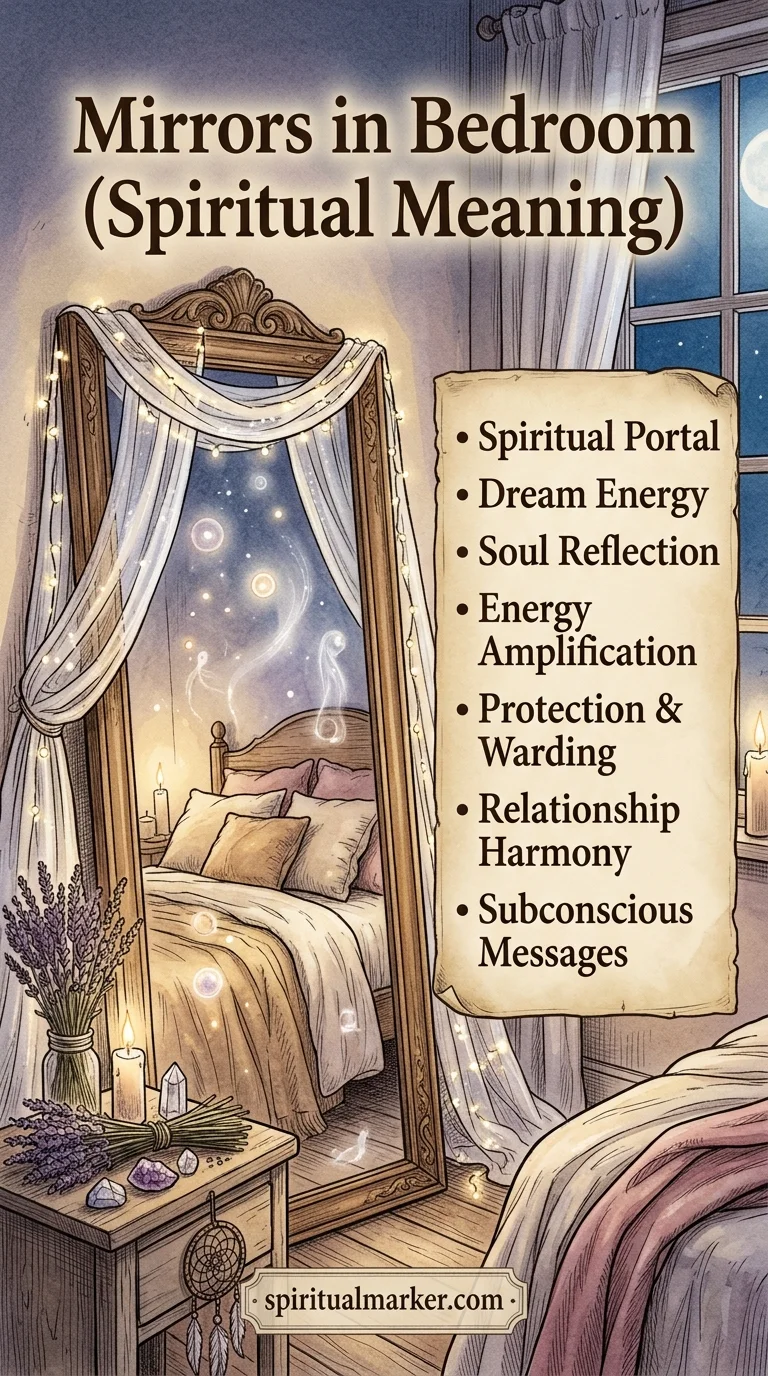
7 Spiritual Meanings of Mirrors in the Bedroom
Spiritual traditions assign several distinct meanings to a bedroom mirror, depending on its placement, condition, and the energy of the room around it. The seven meanings below cover the most widely shared interpretations found across spiritual and cultural practice.
1. A Window Into Self-Reflection and Inner Truth
A bedroom is one of the few places where we spend time without the expectations of the outside world. It is where we wake, rest, think, and often process emotions that remain hidden during the day. Because of this intimate setting, a mirror in the bedroom has long been viewed as more than a decorative object. Across many spiritual traditions, it represents an opportunity for honest self-reflection and a deeper encounter with our inner truth.
Unlike mirrors in public spaces, a bedroom mirror quietly witnesses our most authentic moments. We stand before it when we first wake, before we have stepped into our daily roles, and again before sleep, when the distractions of the day have faded. Many spiritual teachers view these moments as symbolic checkpoints. Rather than focusing only on physical appearance, they encourage people to ask deeper questions about their emotional, mental, and spiritual condition. The reflection becomes a reminder that true growth begins with seeing ourselves clearly.
This symbolism also appears in many religious and philosophical traditions. Buddhist teachings often describe self-awareness as the first step toward wisdom, while Christian spirituality frequently speaks of examining one’s heart with honesty. Ancient Greek philosophy similarly emphasized the importance of “knowing yourself” as the foundation of a meaningful life. Although these traditions differ in their beliefs, they all point toward the same principle. Genuine transformation starts with honest self-examination.
Spiritually, the bedroom mirror reminds us that the person staring back is more than a physical body. It reflects our habits, emotions, fears, hopes, and values. Many people find that periods of personal change naturally involve spending more time reflecting, both literally and figuratively. In this sense, the mirror becomes a quiet symbol of self-discovery, encouraging authenticity instead of perfection.
2. A Doorway for Wandering Spirits
One of the oldest and most widespread spiritual beliefs surrounding mirrors is the idea that they can function as gateways between the physical and spiritual worlds. This interpretation appears in folklore across Europe, Asia, Africa, and the Americas, where mirrors have often been treated with both fascination and caution. When placed inside a bedroom, the symbolism becomes even stronger because sleep has traditionally been viewed as a vulnerable state in which the soul is more spiritually open.
According to many folk traditions, a mirror facing the bed creates an energetic opening through which wandering spirits or unseen entities may enter. While there is no scientific evidence supporting this belief, it has remained remarkably consistent across generations. The concern is not necessarily about evil spirits alone but also about restless energies that disturb peace, influence dreams, or create an uneasy atmosphere within the room.
This belief helps explain several long-standing customs. In many cultures, families cover mirrors after the death of a loved one because they believe the departing soul could become trapped or distracted by its reflection. Some communities also cover mirrors during serious illness or periods of mourning, viewing these moments as spiritually delicate. The mirror, in these traditions, acts as a symbolic doorway that should remain closed until stability returns.
Even for people who do not believe in literal spirits, this symbolism carries psychological meaning. A mirror reflecting a dark room late at night can naturally heighten feelings of vulnerability or anxiety. Spiritual interpretations often blend these emotional responses with traditional beliefs, creating a rich layer of symbolism that has survived for centuries. Whether viewed literally or metaphorically, the mirror represents the mysterious boundary between the visible and the unseen.
3. A Symbol of the Subconscious Mind
Dreams have fascinated humanity throughout history because they seem to reveal thoughts and emotions that remain hidden during waking life. Since bedrooms are closely associated with sleep, dreams, and deep rest, many spiritual traditions connect bedroom mirrors with the subconscious mind. In this interpretation, the mirror symbolizes the hidden aspects of ourselves that quietly shape our thoughts, decisions, and emotional responses.
The subconscious stores memories, beliefs, fears, and desires that often operate beneath conscious awareness. Spiritually, a mirror reflects not only the face we present to the world but also the emotional patterns we may struggle to recognize. Looking into a mirror can therefore become a symbolic reminder that personal growth involves acknowledging both our strengths and our unresolved inner conflicts.
Many energy-based practices expand this symbolism by focusing on the condition of the mirror itself. A dusty, cracked, or neglected mirror is sometimes interpreted as representing mental confusion, emotional burdens, or unresolved experiences. By contrast, a clean and well-maintained mirror symbolizes clarity, emotional balance, and a willingness to face life honestly. Although these interpretations remain symbolic rather than factual, they encourage mindfulness about the environment we create around ourselves.
The connection between mirrors and dreams also appears in various mystical traditions. Some practitioners believe mirrors can amplify dream activity or increase awareness of recurring emotional themes. Others view them as reminders that dreams often serve as reflections of our inner world rather than predictions of future events. In either case, the bedroom mirror becomes a meaningful symbol of introspection, inviting us to pay closer attention to the hidden parts of our own minds.
4. An Amplifier of the Room’s Energy
Many spiritual systems describe mirrors as energetic amplifiers rather than passive objects. Instead of simply reflecting light, they are believed to reflect and strengthen the emotional atmosphere of the space around them. This idea appears most prominently in Feng Shui, although similar concepts exist in several cultural traditions that focus on harmony within the home.
According to these beliefs, whatever a mirror reflects symbolically becomes doubled. If the bedroom feels peaceful, organized, and filled with natural light, the mirror reinforces those qualities and contributes to a calming environment. On the other hand, if it reflects clutter, disorder, or emotional tension, the mirror is thought to magnify those conditions as well. This symbolic interpretation explains why mirror placement receives so much attention in traditional interior design practices.
Bedrooms hold particular importance because they serve as places of rest, healing, and emotional recovery. Many spiritual practitioners believe that restful energy should remain stable rather than constantly bouncing around the room. A large mirror facing the bed is therefore viewed as creating excess activity that interferes with relaxation. Whether interpreted spiritually or psychologically, the principle remains similar. The visual environment around us influences how calm, secure, and comfortable we feel.
This meaning also highlights the broader spiritual idea that our surroundings reflect our inner lives. A bedroom filled with intention, simplicity, and balance often supports emotional peace, while chaotic spaces can contribute to mental restlessness. The mirror becomes a symbolic reminder that our environment shapes our experience in subtle but meaningful ways.
5. A Reflection of Relationship Dynamics
For couples, a bedroom represents intimacy, trust, and emotional connection. Because mirrors symbolically multiply whatever they reflect, many spiritual traditions associate bedroom mirrors with the health and stability of romantic relationships. This interpretation appears in various forms across Asian, European, and Indigenous folklore, each emphasizing the importance of protecting the sacred space shared by two people.
One common belief suggests that a mirror facing a shared bed creates the symbolic presence of a third party. Rather than referring only to another person, this third presence may represent outside distractions, emotional distance, unresolved conflict, or competing priorities that gradually weaken intimacy. The symbolism encourages couples to consider what influences they allow into their relationship and whether those influences strengthen or weaken their bond.
Feng Shui also associates bedroom mirrors with relationship energy. Practitioners often suggest that mirrors reflecting the bed can increase restlessness, emotional imbalance, or misunderstandings between partners. These interpretations remain part of spiritual tradition rather than established scientific fact, yet many people appreciate the symbolism because it highlights the importance of creating a peaceful and private environment for emotional connection.
Beyond folklore, the mirror can also represent the way partners reflect one another’s behaviors and emotions. Healthy relationships often encourage personal growth, honesty, and mutual respect, while unhealthy dynamics can amplify insecurity or unresolved conflict. In this sense, the bedroom mirror becomes a powerful symbol of how relationships frequently mirror our own emotional patterns as much as they reveal the character of our partner.
6. A Marker of Vanity and Self-Image
Throughout history, mirrors have symbolized both healthy self-awareness and excessive self-focus. The balance between these two ideas appears repeatedly in mythology, literature, and spiritual teaching. Perhaps the best-known example is the Greek story of Narcissus, whose obsession with his own reflection ultimately became his downfall. This ancient tale continues to shape the spiritual symbolism of mirrors today.
A bedroom mirror can either encourage confidence or reinforce unhealthy patterns of comparison and self-criticism. Much depends on the intention brought to the act of looking. When a person constantly searches for flaws or bases their worth entirely on appearance, the mirror may become a symbol of insecurity rather than self-knowledge. Spiritual traditions often caution against allowing external appearance to define personal identity because lasting fulfillment comes from qualities that cannot be seen in a reflection.
Many religious teachings echo this message. Christian writings frequently emphasize the beauty of character over outward appearance, while Buddhist philosophy encourages freedom from attachment to the physical self. Hindu spiritual texts similarly remind followers that the true self extends beyond the temporary body. Although these traditions differ in theology, they share the belief that physical appearance should never become the sole measure of personal value.
The mirror therefore serves as both a warning and a reminder. It reflects what we choose to see. When approached with humility and balance, it supports healthy self-awareness. When approached through constant judgment or obsession, it can reinforce limiting beliefs that distract from deeper spiritual growth.
7. A Tool for Clarity and Manifestation
While many traditional beliefs focus on caution, modern spiritual practices often present bedroom mirrors in a far more positive light. Instead of viewing them as objects to fear, many practitioners use mirrors intentionally as tools for clarity, confidence, and manifestation. In this perspective, the reflection becomes a symbolic partner in personal transformation.
Mirror affirmations have become especially popular in personal development and spiritual communities. People speak encouraging words while looking into their own eyes, believing this practice strengthens self-belief and reinforces positive intentions. Although scientific research on manifestation remains limited, studies on self-affirmation suggest that positive self-directed statements can reduce stress and strengthen confidence when practiced consistently.
Spiritually, the mirror represents alignment between thoughts, words, and actions. Looking directly at oneself while expressing gratitude, forgiveness, or meaningful goals creates a symbolic commitment to living according to those values. The mirror does not possess magical power on its own. Rather, it becomes a physical reminder of the intentions we choose to carry into daily life.
Many contemporary spiritual teachers also describe mirrors as symbols of personal responsibility. The future begins with the person reflected in the glass. Every decision, habit, and mindset contributes to shaping the life that gradually unfolds. In this sense, the bedroom mirror becomes far more than a household object. It represents clarity, accountability, and the ongoing process of becoming the person we hope to be.
Mirror Symbolism Across Cultures and Religions
Chinese tradition treats mirrors with particular caution inside the bedroom. Feng shui, the ancient practice of arranging space to support harmonious energy flow, specifically warns against a mirror that faces the bed. Practitioners believe this placement disturbs the flow of qi, the vital life energy believed to move through every living space, and can lead to restless sleep, nightmares, and strained relationships between partners.
In Hindu households, mirrors are generally welcomed, but Vastu Shastra, the traditional Indian system of architecture, recommends avoiding mirrors directly opposite the bed for similar reasons tied to energy disruption during rest. Mexican and broader Latin American folklore carries a vivid related belief, often summarized as the fear that a mirror can capture a sleeping person’s soul, particularly the soul of a young child, if left uncovered facing the bed overnight.
Greek mythology contributes the cautionary tale of Narcissus, whose obsession with his own reflection became a lasting symbol of vanity’s danger. Victorian England developed an entire set of mourning customs around mirrors, including the practice of covering every mirror in a house after a death, based on the belief that a soul leaving the body could become trapped inside the glass if it caught a reflection during that transition.
African and Caribbean spiritual traditions, including Vodou and Santeria, also treat mirrors as sensitive spiritual tools. Practitioners sometimes use mirrors deliberately in protective work, while also warning that an unguarded mirror can reflect negative intentions back into a home rather than away from it. Across nearly every one of these traditions, the consistent thread is respect. Mirrors are rarely dismissed as ordinary glass.
Feng Shui and Mirror Placement in the Bedroom
Feng shui offers some of the most detailed guidance available on bedroom mirrors, and its core principle is consistent. A mirror should never directly face the bed. Practitioners describe this placement as creating a third, disruptive energy in the room, sometimes linked to a higher risk of conflict, infidelity, or chronic poor sleep. The reflected image of two sleeping bodies is believed to double whatever emotional energy already exists between them.
Beyond direct bed-facing placement, feng shui also raises concerns about mirrors positioned at the foot of the bed, mirrors that reflect the bedroom door, and mirrors mounted on the ceiling above the bed. Each of these positions is believed to create what practitioners call startling energy, a sudden, jarring reflection that can disturb the subconscious mind during the deepest, most vulnerable stages of sleep.
Traditional feng shui guidance suggests a few adjustments for households unwilling to remove a bedroom mirror entirely. Covering the mirror with a cloth or screen at night is a long-standing practice, as is angling the mirror so it reflects a wall, a piece of art, or open space rather than the bed itself. Wardrobe mirrors on closet doors receive special attention too, since these are frequently positioned in ways that accidentally face the bed without the owner realizing it.
Mirror Superstitions in the Bedroom: Good or Bad Luck?
The superstition that a mirror can trap a piece of your soul during sleep appears in multiple, unrelated cultures, which is part of why it has endured for so long. In several European and Latin American traditions, parents specifically cover mirrors in a child’s room, believing a young soul is more fragile and more easily caught by a reflection during the night.
A related superstition warns that a mirror facing the bed invites a kind of energetic third party into a relationship. This belief shows up in Chinese feng shui, Mexican folklore, and several Western spiritual circles, each describing slightly different mechanisms but landing on the same caution. A mirror reflecting two sleeping partners is thought to introduce instability rather than harmony.
Broken mirrors carry their own long-standing superstition, most famously the belief in seven years of bad luck following a shattered reflection. This idea traces back to ancient Roman belief, which held that mirrors reflected the soul and that life itself renewed in seven-year cycles. A broken bedroom mirror is treated by many as a particularly strong warning sign, since the bedroom already carries heightened spiritual sensitivity.
Not every mirror superstition leans negative, though. Some traditions treat a small, well-placed mirror as a tool of protection, capable of reflecting negative energy back out of a space before it settles. The honest answer to whether a bedroom mirror is good or bad luck depends almost entirely on placement, condition, and the specific tradition you are drawing from. Context decides the outcome far more than the object itself.
Biblical Meaning of Mirrors in the Bedroom
Scripture references mirrors several times, almost always as a metaphor for spiritual clarity or its absence. 1 Corinthians 13:12 states, “For now we see through a glass, darkly,” a passage that uses the limited mirror technology of the ancient world to describe humanity’s incomplete understanding of divine truth. The verse suggests that earthly perception, like an old polished metal mirror, only ever offers a partial, imperfect reflection.
James 1:23-24 compares a person who hears scripture without acting on it to someone who looks in a mirror and then immediately forgets what they saw. This passage treats the mirror as a symbol of self-examination, warning against shallow self-awareness that never leads to real change. The bedroom setting, as a space of daily reflection, fits naturally with this biblical theme of honest, ongoing self-examination.
2 Corinthians 3:18 offers a more hopeful image, describing believers as reflecting divine glory “as in a glass,” gradually being transformed into a clearer likeness of that glory over time. Read together, these passages suggest the Bible views mirrors less as supernatural objects and more as teaching tools, prompting reflection on character, growth, and spiritual maturity rather than fear of trapped spirits.
Where Should You Place a Mirror in Your Bedroom?
Spiritual traditions and feng shui practitioners generally point toward the same handful of placement principles. A mirror positioned on a side wall, reflecting open space rather than the bed, is considered the most neutral and stable option. This placement avoids the disruptive “startling energy” associated with direct bed-facing mirrors while still allowing full daily use of the glass.
Mirrors near a closet or dressing area tend to receive the fewest warnings across traditions, since this placement keeps the mirror’s function tied to daily preparation rather than constant reflection of the sleeping space. Many practitioners also recommend keeping bedroom mirrors clean, crack-free, and well-lit, treating physical clarity as a stand-in for energetic clarity.
For mirrors that cannot be moved away from the bed, covering them at night with a cloth, curtain, or folding screen remains the most widely shared traditional fix. This practice appears independently across feng shui, Latin American folklore, and Victorian mourning customs, which is a strong sign that many unrelated cultures arrived at the same practical solution.
Dreaming About Mirrors in the Bedroom: Spiritual and Psychological Meanings
Dreaming about a mirror in your bedroom often points toward themes of self-examination. Spiritually, this dream is frequently interpreted as a nudge to look honestly at a situation you have been avoiding, whether that involves a relationship, a personal habit, or an uncomfortable truth about your own behavior. The bedroom setting adds intimacy to the dream, suggesting the issue is personal rather than public.
A dream involving a cracked or broken mirror tends to carry heavier symbolism, often linked to a fractured sense of identity, a recent loss, or an unresolved fear about change. Many dream interpreters treat this image as a call to address whatever feels unstable in waking life before it grows worse, rather than a literal warning of misfortune.
Seeing a stranger or distorted reflection in a dream mirror is another common variation, frequently tied to anxiety about self-image or a sense of disconnect between how you see yourself and how others perceive you. From a psychological angle, Carl Jung wrote extensively about mirrors as symbols of the shadow self, the hidden parts of personality that consciousness tends to avoid examining directly.
Finally, dreaming of a mirror that faces your bed while you sleep within the dream itself often mirrors the very superstitions discussed earlier in this article. Many people report this specific dream during periods of relational tension or personal instability, suggesting that the subconscious mind may be processing the same themes that folklore has attached to bedroom mirrors for centuries.
A Final Note
Mirrors in the bedroom sit at an interesting crossroads between practical home design and centuries of spiritual belief. Whether you view them as simple glass or as energetic doorways, the patterns across feng shui, folklore, and scripture all point toward the same underlying message. Awareness and intention matter more than fear. A mirror reflects whatever you bring into its frame, including your own habits, emotions, and the general state of the room around it.
If any of these traditions resonate with you, consider a few small, practical steps. You might reposition your bedroom mirror so it faces a wall or open space rather than your bed. You could also try covering it at night with a simple cloth, a habit shared across multiple unrelated cultures for centuries. If you are working through a difficult season, you might use your mirror intentionally each morning, speaking one honest affirmation before you start your day. None of these steps require belief in the supernatural. They simply invite a little more mindfulness into a space where you spend nearly a third of your life.