
The raven is a creature of mystery and intelligence. Its black feathers and haunting call have inspired myths for centuries. Across cultures, ravens carry deep spiritual meaning and symbolism.
The raven spiritual meaning often involves prophecy, transformation, and hidden knowledge. Ravens are associated with death and the afterlife in many traditions. A spiritual meaning of a crow cawing in the morning shares that corvid focus, though crows carry a different, more common energy.
Some traditions view ravens as messengers of the gods or guides for the soul. Others see them as a sign to pay attention to your surroundings. The raven's behavior can add detail.
If a raven appears in your life, it may bring a message. A spiritual meaning of seven crows also deals with corvid symbolism, though seven crows carry a specific numeric message.
Key Takeaways
- Ravens symbolize transformation, intelligence, and the bridge between life and death in most spiritual traditions.
- Norse mythology links ravens directly to Odin, who used them to gather wisdom from across the nine realms.
- The Bible mentions ravens several times, often connecting them to provision and divine guidance rather than only doom.
- Dreaming about a raven often points to inner change, hidden truths, or a warning your subconscious wants you to notice.
- Seeing a raven repeatedly may signal that you are entering a period of spiritual awakening or major personal transition.
What Is a Raven and Does It Hold Spiritual Power?
Ravens belong to the corvid family, alongside crows, magpies, and jays. They are among the smartest birds on the planet, capable of solving puzzles and even mimicking human speech. Researchers at the University of Cambridge have documented ravens using tools and planning ahead, a trait once thought unique to humans and primates. This intelligence is part of why so many traditions treat the raven as more than just an animal. People have long sensed that a creature this perceptive must be tuned into something deeper than instinct.
Spiritually, the raven is viewed as a messenger between worlds. Its black feathers represent mystery, while its sharp gaze suggests insight beyond ordinary sight. Ancient cultures from Siberia to the Pacific Northwest saw ravens as guides who moved freely between the physical and spiritual realms. Whether or not you believe birds carry literal messages, the symbolism around ravens has stayed remarkably consistent across thousands of years and unrelated civilizations. That consistency alone makes the raven worth paying attention to when one crosses your path.
What Does Seeing a Raven Symbolize or Represent?
A raven sighting often represents a shift happening in your life, even if you cannot yet name it. Many spiritual teachers describe the raven as a herald of change, arriving just before something old ends and something new begins. You might notice one during a difficult decision, a loss, or right before a major opportunity appears. The timing usually matters more than the bird itself.
Ravens also represent hidden knowledge. Their dark color has long been tied to the unconscious mind, the parts of yourself you have not fully examined. Seeing one can suggest that answers you have been searching for are closer than you think. Instead of fear, many traditions encourage curiosity when a raven appears. It asks you to look beneath the surface of a situation rather than accept the first explanation you are given.
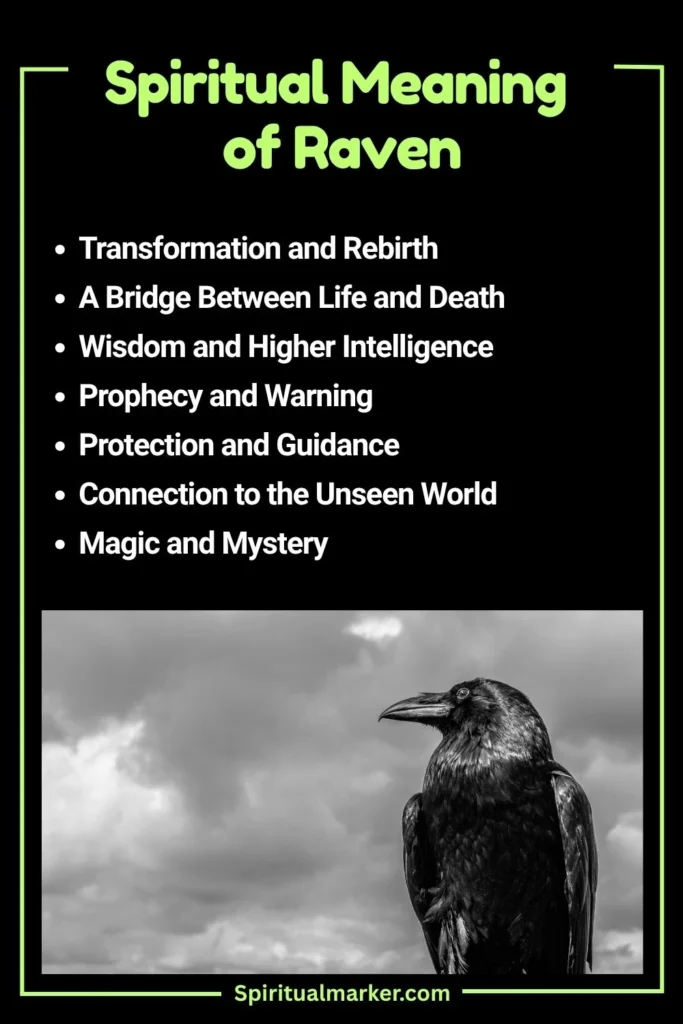
7 Spiritual Meanings of Ravens
1. Transformation and Rebirth
Among all raven spiritual meanings, transformation and rebirth stand out as the most widely recognized. Many people encounter ravens during periods of major change, whether they are leaving a difficult relationship, changing careers, healing from loss, or questioning their identity. In spiritual traditions, the raven’s dark plumage often symbolizes the unknown space between what was and what will be. It represents the fertile darkness from which new life emerges.
This symbolism appears in numerous mythologies and spiritual systems. Rather than fearing the darkness, ancient cultures often viewed it as a place of creation. Seeds grow beneath the soil before they become plants. A caterpillar enters a cocoon before becoming a butterfly. In much the same way, the raven reminds us that growth frequently happens out of sight before it becomes visible.
When a raven appears repeatedly during a challenging season, many interpret it as a sign that an old version of themselves is fading away. While this process can feel uncomfortable, spiritual traditions often describe it as a necessary stage of personal evolution. The raven symbolizes the courage required to release outdated beliefs, habits, and identities so that something more authentic can emerge in their place.
2. A Bridge Between Life and Death
Throughout history, ravens have been associated with the boundary between life and death. In Celtic, Norse, and Indigenous traditions, these birds often appeared in stories involving the transition of souls, the afterlife, or communication between worlds. Because ravens were commonly seen near battlefields and places of death, many cultures came to view them as messengers between the physical and spiritual realms.
However, this symbolism is not limited to physical death. In spiritual interpretation, death frequently represents endings of all kinds. A friendship may end. A career path may close. A long-held dream may no longer fit who you have become. These experiences often create emotional discomfort because they require letting go of something familiar.
The raven’s appearance during such times can symbolize transition rather than loss. It reminds us that every ending creates space for a beginning. While one chapter closes, another gradually unfolds. For this reason, many spiritual practitioners see the raven not as a symbol of fear, but as a guide through life’s inevitable cycles of change, closure, and renewal.
3. Wisdom and Higher Intelligence
Ravens are among the most intelligent animals on Earth. Scientific studies have shown that they can solve complex puzzles, use tools, recognize human faces, and even plan for future events. Their remarkable intelligence has shaped their spiritual symbolism for centuries.
As a spiritual symbol, the raven often represents wisdom, insight, and mental clarity. When people encounter a raven during a confusing situation, it is commonly interpreted as a reminder to trust reason alongside intuition. Fear tends to cloud judgment, while wisdom allows us to see circumstances more objectively.
Many traditions teach that true wisdom involves more than gathering information. It requires discernment, patience, and the ability to recognize deeper patterns beneath surface appearances. The raven embodies this kind of awareness. Rather than acting impulsively, it encourages thoughtful observation and careful consideration.
In this sense, a raven encounter may symbolize untapped knowledge already available within you. The answers you seek may not be as far away as they seem. The challenge is often not finding wisdom but trusting it enough to act upon it.
4. Prophecy and Warning
Few birds have been linked to omens as strongly as the raven. Ancient stories frequently portray ravens as messengers who arrive before significant events unfold. Because of this association, many people view raven sightings as warnings or signals that something important requires attention.
It is important to recognize that spiritual warnings are not necessarily predictions of disaster. In many traditions, a warning serves as an invitation to become more aware. It encourages vigilance rather than fear. The raven symbolizes heightened observation, urging individuals to notice details they may have overlooked.
For example, recurring tensions in a relationship, subtle signs of dishonesty, or ignored personal instincts may become more noticeable when viewed through the raven’s symbolic lens. Instead of forecasting a specific outcome, the raven encourages greater mindfulness regarding present circumstances.
This interpretation aligns with the bird’s natural behavior. Ravens are highly observant creatures that constantly monitor their surroundings. Spiritually, they reflect the importance of paying attention to what is happening around us and within us before making important decisions.
5. Protection and Guidance
While many people associate ravens with mystery or death, numerous traditions view them as protectors. One of the most famous examples comes from Norse mythology, where the god Odin was accompanied by two ravens, Huginn and Muninn. These birds traveled across the world gathering knowledge and returning with valuable information.
Because of these stories, ravens became symbols of guidance, awareness, and divine protection. They were seen as watchful companions capable of helping individuals navigate uncertainty. Rather than bringing harm, they provided insight that could prevent harm.
Spiritually, recurring raven encounters may symbolize unseen support during difficult periods. This does not necessarily imply supernatural intervention. Instead, the raven can represent the protective forces already present in life, such as wisdom gained through experience, supportive relationships, inner resilience, or guidance from trusted mentors.
When life feels uncertain, the raven’s presence often carries a reassuring message. Even if the path ahead remains unclear, you are not necessarily moving through it alone. Guidance may already be available, even if it has not fully revealed itself yet.
6. Connection to the Unseen World
Across many shamanic and mystical traditions, ravens are believed to move between visible and invisible realms. This symbolism connects them to intuition, dreams, spiritual awareness, and hidden knowledge. Because they appear comfortable in both the sky and the earth below, they often represent the ability to bridge ordinary reality with deeper levels of consciousness.
Many people report heightened intuition, vivid dreams, or meaningful coincidences during periods when ravens appear frequently in their lives. While interpretations vary, spiritual traditions often view these experiences as invitations to pay closer attention to subtle forms of guidance.
The unseen world does not always refer to spirits or supernatural phenomena. It can also represent aspects of ourselves that remain hidden beneath daily distractions. Unacknowledged emotions, inner wisdom, creative inspiration, and subconscious insights often exist outside our immediate awareness.
The raven symbolizes the journey inward. It reminds us that valuable answers may emerge not from external sources but from listening more carefully to our own intuition and inner experience.
7. Magic and Mystery
Few creatures embody mystery as completely as the raven. For centuries, literature, folklore, and spiritual traditions have linked ravens to magic, hidden knowledge, and unexplained phenomena. Their intelligence, dark appearance, and unusual behavior naturally contributed to their reputation as creatures connected to the unknown.
Yet the raven’s association with magic is not necessarily about spells or supernatural powers. More often, it reflects life’s mysteries that cannot be fully explained. Certain events, encounters, and opportunities appear at exactly the right moment. Some experiences challenge our understanding of reality and invite deeper reflection.
The raven symbolizes comfort with uncertainty. Rather than demanding immediate answers, it encourages patience and curiosity. Not every question has an instant explanation, and not every path reveals its destination from the beginning.
For this reason, the raven often appears as a reminder that mystery itself has value. Growth, wisdom, and transformation frequently unfold gradually. What seems unclear today may reveal its purpose with time, making the raven a powerful symbol of trust in life’s unfolding journey.
Raven Symbolism Across Cultures and Religions
Native American tribes, particularly along the Pacific Northwest coast, regard the raven as a trickster and creator figure. The Haida and Tlingit peoples tell stories of Raven stealing the sun and bringing light into a dark world. This portrays the raven as clever and resourceful rather than purely ominous. Its mischief often leads to positive outcomes for humanity, even when its methods seem questionable along the way.
In Celtic tradition, ravens were associated with the goddess Morrigan, who governed war, fate, and sovereignty. Seeing a raven near a battlefield was thought to confirm her presence and influence over the outcome. Celtic warriors respected the bird rather than fearing it, viewing it as a sign that larger forces were paying attention to their actions. This reverence still echoes in Irish and Scottish folklore today.
Hinduism does not center the raven the way crows are honored during Pitru Paksha, a period dedicated to ancestors. Yet corvids broadly are treated as messengers from departed relatives, and feeding them is considered an act of respect. Buddhist folklore in Tibet describes ravens guiding travelers safely through harsh mountain terrain, reinforcing the bird’s role as a protective guide rather than a frightening figure.
Raven Symbolism in World Mythology
Norse mythology gives the raven one of its most famous spiritual roles. Odin kept two ravens, Huginn and Muninn, meaning thought and memory. Every day he sent them across the world to gather information and return with knowledge no human could access alone. This story positions the raven as an extension of the mind itself, gathering wisdom that fuels good decisions and self awareness.
Greek mythology tells a different story. Ravens were originally white and served Apollo, the god of truth and prophecy. After a raven delivered a dishonest report, Apollo turned its feathers black as punishment. This myth ties the raven permanently to truth, consequence, and the price of deception, a theme that still surfaces in modern interpretations of the bird.
In Japanese Shinto belief, a three legged raven called Yatagarasu guided Emperor Jimmu through difficult terrain on his journey to found the nation. This raven represents divine guidance during moments of confusion or uncertainty. Each mythology approaches the bird differently, yet nearly all of them agree that ravens carry intelligence, purpose, and a connection to forces greater than ordinary nature.
Raven Biblical Meaning and Significance
The Bible references ravens directly, and the meaning is more layered than simple doom. In Genesis 8:7, Noah released a raven from the ark to check whether floodwaters had receded. The raven left and did not return immediately, often interpreted as a symbol of independence and restlessness compared to the dove that followed it. This early mention frames the raven as a creature of action rather than passive waiting.
Job 38:41 and Psalm 147:9 describe God feeding young ravens when they cry out, presenting the bird as proof of divine provision even for creatures society viewed as unclean. Luke 12:24 echoes this directly, with Jesus telling his followers to consider the ravens, who neither sow nor reap, yet are still fed. This passage uses the raven to teach trust in providence rather than anxiety over survival.
First Kings 17 describes ravens bringing food to the prophet Elijah during a famine, on direct instruction from God. This story stands out because it casts the raven as an obedient servant of divine will, delivering exactly what was needed at the right moment. Together, these passages paint a fuller picture. The biblical raven is independent, resourceful, and surprisingly tied to provision rather than only fear.
Raven Feather Spiritual Meaning
Finding a raven feather is treated as a smaller, quieter version of a full sighting. Many spiritual practitioners believe it carries a message about courage, since the feather represents the bird’s strength without its more intense presence. A black feather found unexpectedly is often read as encouragement to face something you have been avoiding.
Some traditions use raven feathers in protection rituals, placing them near doorways or altars to ward off negative energy. The feather’s color is linked to absorbing darkness rather than radiating it, almost like a spiritual filter. If you come across one during a walk, it may simply be confirming that you are on the right path, even if recent events have felt confusing or heavy.
Dreaming About Ravens: Spiritual and Psychological Meanings
Dream interpretation often treats ravens as messengers from the subconscious rather than random imagery. Carl Jung viewed dark birds in dreams as symbols of the shadow self, the parts of your personality you tend to suppress. A raven appearing in your dream might be asking you to acknowledge something true about yourself that you have been avoiding in waking life.
A raven speaking in a dream is frequently linked to a message you need to hear clearly, almost like your intuition forcing a conversation you have been postponing. A raven attacking you in a dream often points to internal conflict rather than an external threat, suggesting tension between who you are and who you feel pressured to become. A calm raven simply watching you can represent guidance, reassurance, or a sign that you are being observed by something protective during a transition.
Psychologically, recurring raven dreams can also reflect unresolved grief or anticipation of change. Because the bird carries such strong associations with endings, your mind may use it to process emotions you have not fully expressed elsewhere. Paying attention to the dream’s tone, calm, threatening, or curious, usually offers more insight than the raven’s appearance alone.
A Final Note
The raven spiritual meaning rarely points to something to fear. It points to attention, change, and the kind of wisdom that only shows up when you stop rushing past your own life. If a raven has been showing up for you lately, consider sitting with the moment instead of immediately searching for a negative explanation. You might journal about what was happening right before you saw it, or simply observe whether the feeling that followed was unease or unexpected calm. Either response can tell you something useful about where you currently stand.