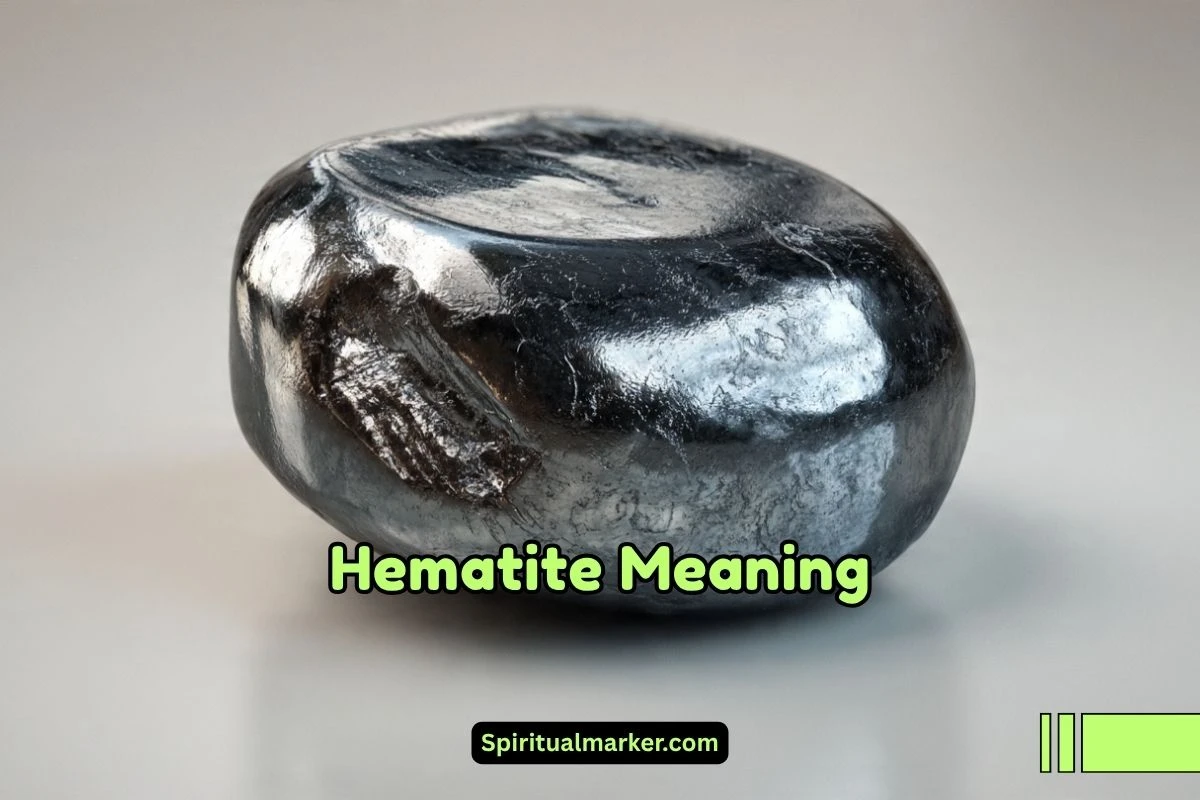
Have you ever picked up a piece of hematite and felt suddenly heavier? Not in a bad way. More like your feet finally found solid ground beneath you. That sensation is something many people report when they first hold this stone. It is dense, cool, and strangely calming all at once.
Hematite has been used by humans for tens of thousands of years. Ancient warriors smeared its red powder on their skin before battle. Egyptian priests buried it with pharaohs. Native American healers carried it for protection during spiritual rituals. Medieval alchemists believed it held the secrets of blood and iron. Today, crystal practitioners, energy healers, and everyday people use it for grounding, clarity, and emotional balance.
What makes hematite so enduring is its directness. It does not carry soft, dreamy energy. It does not whisper gentle affirmations. It brings you back to earth, back to your body, and back to the present moment with quiet but unmistakable force. That quality has made it one of the most respected stones in both historical and modern spiritual traditions.
This article covers the full meaning of hematite, its spiritual symbolism, healing properties, historical context, and practical ways to use and care for it. Whether you are new to crystal healing or deepening an existing practice, what follows will give you a thorough and grounded understanding of this remarkable stone.
5 Key Takeaways
- Hematite is one of the most powerful grounding and protective stones in crystal traditions worldwide.
- Its deep connection to the root chakra makes it especially effective for emotional stability and mental clarity.
- Ancient civilizations used hematite for warfare, burial rituals, healing, and spiritual protection across multiple cultures.
- Hematite’s iron oxide composition gives it its distinctive weight, metallic sheen, and blood-red streak.
- Wearing or carrying hematite is believed to strengthen willpower, reduce anxiety, and restore emotional balance.
What Is Hematite?
Hematite is an iron oxide mineral with the chemical formula Fe2O3. It is one of the most abundant iron-bearing minerals on Earth. Its name comes from the Greek word haima, meaning blood. That name reflects the stone’s striking red streak, which appears when hematite is scratched or powdered against a surface.
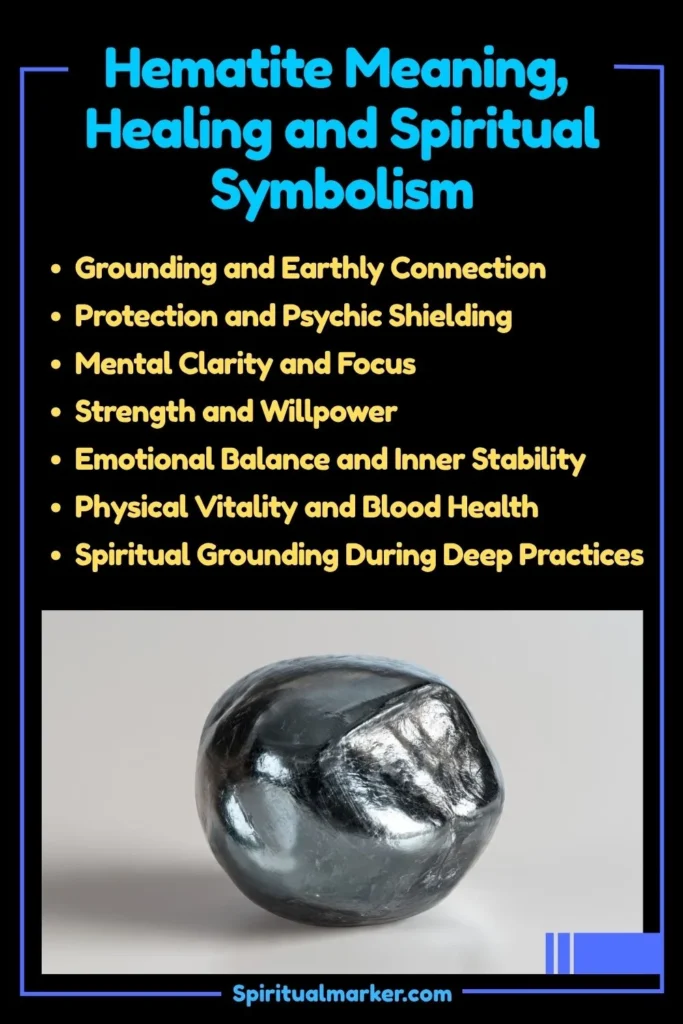
In its polished form, hematite has a dark, metallic gray surface that looks almost like a mirror. Unpolished specimens often appear dull, reddish-brown, or black. Both forms carry the same mineral composition, but their visual characters differ significantly. The polished variety feels almost futuristic in its smooth, reflective appearance. The raw form feels ancient, earthy, and rugged.
Many people confuse hematite with other dark stones like black tourmaline, obsidian, or magnetite. However, hematite stands apart through its weight. It is noticeably heavier than most similarly sized stones. That density is a direct result of its high iron content. When you hold hematite, you feel that weight immediately. For many crystal practitioners, that physical sensation is part of its grounding power.
Spiritually, hematite is most often associated with strength, stability, protection, and mental focus. Its earthy energy is less about emotional fluidity and more about emotional fortitude. Where some stones encourage emotional release, hematite encourages emotional steadiness. It grounds scattered thoughts, stabilizes emotional extremes, and reinforces a sense of personal resilience.
Origins and Formation
Hematite forms through several geological processes. It often appears in sedimentary deposits where iron-rich water slowly oxidizes over long periods. It also forms near volcanic activity and hydrothermal vents. Over millions of years, layers of iron oxide build up and solidify into the dense mineral we recognize today.
The most significant hematite deposits exist in Brazil, Australia, China, South Africa, the United States, Ukraine, and England. The Cumbrian deposits in northern England produced some of the finest hematite historically known, often used for jewelry and polishing. Brazilian deposits remain among the largest commercially mined sources in the world today.
Specularite, sometimes called specular hematite, is a glittering variety of hematite that contains tiny reflective flakes. It is considered more visually dynamic than standard polished hematite. Rainbow hematite displays iridescent surface color from aluminum phosphate coatings. Both varieties share the same core metaphysical associations.
Mars, sometimes called the Red Planet, gets its color from iron oxide, the same compound that makes up hematite. Some spiritual traditions connect hematite with Martian energy, linking it to courage, vitality, and warrior-like determination. That cosmic connection adds another dimension to the stone’s already rich symbolic history.
Key Properties
| Property | Details |
|---|---|
| Chemical Name | Iron oxide (Fe2O3) |
| Color | Metallic gray, silver, black, reddish-brown |
| Streak Color | Red to reddish-brown |
| Hardness | 5 to 6.5 on the Mohs scale |
| Chakra Association | Root chakra (Muladhara) |
| Primary Symbolism | Grounding, protection, strength, clarity |
| Main Sources | Brazil, Australia, South Africa, United States, China |
| Transparency | Opaque |
| Energy Style | Stabilizing, protective, grounding |
| Common Uses | Meditation, protection work, emotional balance |
Historical Use of Hematite
Hematite’s history stretches back at least 40,000 years. Archaeological evidence from South Africa’s Blombos Cave reveals that early humans ground hematite into red ochre pigment for ritual body painting. This makes hematite one of the oldest known materials used intentionally by human beings.
Ancient Egyptians ground hematite into powder for cosmetic uses and placed polished hematite stones inside tombs as protective talismans. They believed the stone guarded the deceased during the journey through the afterlife. The red pigment was also used in funeral art depicting the blood of the living world.
Roman soldiers are historically said to have rubbed hematite on their bodies before battle. They believed the iron-rich stone would protect them from fatal wounds and keep their minds focused during combat. The word iron itself carries a connection to hematite, and some historians link early iron metallurgy to regions where hematite deposits were heavily mined.
In ancient Mesopotamia and Babylon, hematite was carved into cylinder seals used by merchants and officials to authenticate documents. Its hardness and dense structure made it ideal for engraving. Beyond its practical use, hematite seals were often believed to carry protective power for the person who owned them.
Native American traditions recognized hematite as a stone of blood and life force. Healers used it in ceremonies connected with physical strength, protection, and the health of warriors. Red ochre made from hematite appeared in burial rituals, vision quests, and spiritual ceremonies across many indigenous North American cultures.
During the Middle Ages, hematite was believed to stop bleeding when pressed against wounds. Physicians and folk healers called it the “bloodstone” in some regions, though that name is also shared with a different green-and-red mineral. This belief in hematite’s ability to influence blood reflects both its physical composition and its long-standing spiritual associations with life, vitality, and physical strength.
5 Spiritual Meanings of Hematite
1. Grounding and Earthly Connection
Grounding is the most universally recognized spiritual meaning of hematite. Across dozens of crystal traditions, across continents and centuries, this stone consistently carries the same association: it connects you to the earth. That meaning is not accidental. It reflects the stone’s physical nature. Hematite is heavy. It is dense. It is composed of iron, one of the foundational elements of the planet itself.
In spiritual practice, grounding refers to a state of being fully present in your body and in the physical world. Many people spend significant portions of their daily lives disconnected from that presence. Anxiety keeps the mind trapped in future fears. Grief or trauma keeps attention anchored in the past. Stress fractures concentration into dozens of competing directions at once. Grounding energy counteracts this fragmentation. It brings awareness back to the present moment, back to the physical body, and back to a sense of personal stability.
Hematite symbolizes this process of returning to earth. Its weight and cool temperature create an almost immediate physical sensation when held. Many people describe holding hematite as feeling “settled” or “anchored.” Spiritual practitioners believe this reflects the stone’s grounding influence moving through the body’s energy field during meditation or quiet reflection.
This symbolism also connects to the root chakra, the energy center located at the base of the spine and associated with survival, safety, stability, and physical presence. When root chakra energy feels balanced, people often report feeling more emotionally secure, more physically present, and more capable of handling life’s challenges. When it feels disrupted, feelings of fear, instability, disconnection, and anxiety may intensify. Hematite is strongly associated with restoring balance to this foundational energy center.
Grounding is particularly important during periods of major life change. When routines collapse, relationships shift, or external circumstances become unpredictable, people often feel emotionally unmoored. Hematite spiritually symbolizes the anchor that holds during those storms. It does not promise to remove difficulty. It represents the inner steadiness that allows a person to face difficulty without losing their emotional footing.
2. Protection and Psychic Shielding
Protection is the second most prominent spiritual meaning connected with hematite. Throughout its long history, this stone has appeared in warrior traditions, protective amulets, burial rituals, and spiritual shielding practices across vastly different cultures. That consistency suggests the stone carries a deeply recognized protective energy that resonates across belief systems.
In modern crystal healing, protection work involves creating energetic boundaries between a person and external sources of emotional, psychic, or environmental negativity. Not everyone subscribes to the same metaphysical framework, but the underlying concept translates easily. Some environments feel energetically draining. Certain relationships leave a person feeling emotionally depleted. High-stress situations create mental and emotional noise that accumulates over time. Hematite symbolically represents the barrier that reduces that external impact on a person’s internal state.
Many practitioners describe hematite as a “mirror stone” in spiritual contexts because its reflective surface is believed to deflect negative energy back to its source rather than absorbing it. This is an important distinction in crystal healing philosophy. Some stones are considered absorbers of negative energy, meaning they take in emotional residue from environments or people. Hematite is generally classified differently. Rather than absorbing negativity, it is believed to reflect it, keeping the person carrying the stone insulated from external emotional interference.
This protective symbolism also connects deeply to the stone’s historical use by warriors. Soldiers across ancient Rome, indigenous North America, and parts of Africa used hematite or red ochre derived from it as a form of spiritual armor before battle. The symbolic logic is consistent: iron protects. Whether as physical metal in weapons and shields or as an iron-rich stone carried close to the body, the association between iron and protection runs through human history with remarkable consistency.
For sensitive individuals, empaths, or anyone who frequently absorbs the emotional states of people around them, hematite carries particular significance. Empaths often struggle with emotional boundaries because they feel others’ emotions as intensely as their own. Hematite spiritually represents the firm, stable boundary between self and other. It supports emotional discernment, helping people remain compassionate without becoming emotionally overwhelmed by external experiences.
3. Mental Clarity and Focus
Mental clarity ranks among the most practically valued spiritual associations of hematite. While many crystals are associated with emotional healing or spiritual awakening, hematite carries a noticeably intellectual quality. It is the stone people reach for when their thinking feels scattered, confused, or overwhelmed by too many competing ideas and responsibilities simultaneously.
The connection between hematite and mental clarity likely stems from its grounding properties. When the mind feels scattered, it is often because awareness has drifted far from the present moment. Anxiety drags attention into hypothetical futures. Rumination loops attention back through unresolved past experiences. Mental overstimulation from constant information intake creates cognitive fog. Grounding the energy field through hematite spiritually returns scattered awareness to a centered, focused state. The mental clarity that follows feels less like sudden inspiration and more like the clearing of unnecessary noise.
Many students, writers, researchers, analysts, and professionals dealing with complex decisions have historically valued hematite as a focus stone. In crystal traditions, placing hematite at a workspace or holding it during periods of concentrated mental effort is believed to sharpen logical thinking, improve decision-making, and reduce mental distraction. The stone’s symbolism supports analytical thought, sequential reasoning, and disciplined focus rather than creative inspiration or emotional exploration.
Hematite also symbolizes mental strength during difficult conversations. Emotionally charged interactions, difficult negotiations, or confrontational situations often disrupt clear thinking. People may say things impulsively or fail to communicate their true intentions under emotional pressure. Hematite’s grounding energy is believed to maintain mental composure during these moments. Its symbolism supports rational thinking even when emotional temperature rises.
This quality also extends to decision-making during periods of personal confusion. Major life decisions involving career changes, relationship endings, financial commitments, or personal reinvention require both emotional honesty and clear logical thinking. Hematite symbolically represents the mental steadiness that allows both to coexist without one overwhelming the other. It encourages deliberate, grounded decisions rather than reactive or fear-driven choices.
4. Strength and Willpower
Strength carries layered meanings in hematite’s spiritual symbolism. It refers to physical vitality, emotional resilience, mental endurance, and the sustained willpower that allows people to keep moving through difficulty without collapsing internally. Hematite has represented strength in this full-spectrum sense across countless cultures for thousands of years.
This meaning connects naturally to the stone’s iron content. Iron is culturally synonymous with toughness, durability, and determined force. Structures built with iron last. Weapons forged from iron withstand tremendous pressure. The symbolism carries over directly into hematite’s metaphysical reputation. Carrying or wearing hematite is believed to reinforce a person’s internal sense of strength, particularly during periods when that strength feels depleted or tested.
Spiritual willpower involves more than raw determination. It includes the ability to maintain commitments when motivation fades, resist harmful patterns of behavior, continue healing work when it becomes emotionally uncomfortable, and hold personal boundaries under social pressure. Many people experience moments where the desire for change is genuinely strong but the internal resources to sustain that change feel exhausted. Hematite symbolically represents the fortification of those inner reserves.
This dimension of hematite’s meaning resonates strongly with people in recovery from addiction, toxic relationships, self-destructive behavioral patterns, or chronic self-neglect. Building a new life after these experiences requires sustained internal effort over long periods. Progress is frequently nonlinear. Setbacks are common. The emotional and mental demands of sustained personal transformation can feel relentless. Hematite spiritually reflects the iron-like internal strength that keeps people moving through those demanding stages without giving up.
Hematite also symbolizes the courage to face difficult truths. Personal strength, in many spiritual traditions, is not just about enduring hardship. It includes the strength to be honest with yourself about patterns, choices, relationships, or habits that no longer serve your well-being. That kind of honest self-examination requires genuine courage. Hematite’s energy is often associated with this form of courageous clarity, the kind that leads to meaningful personal change rather than comfortable but stagnant self-deception.
5. Emotional Balance and Inner Stability
Emotional balance may be the most quietly transformative spiritual meaning associated with hematite. People often come to crystal healing during emotionally volatile periods, when feelings swing unpredictably between extremes, when reactions feel disproportionate to situations, or when emotional exhaustion begins affecting every area of life. Hematite symbolizes the stabilizing force that steadies those emotional extremes without numbing emotional experience entirely.
This meaning differs meaningfully from green opal’s emotional healing symbolism. Where green opal represents the gradual release and softening of emotional pain, hematite represents emotional steadiness beneath that pain. It does not promise to dissolve difficult feelings quickly. Instead, it symbolizes the stable inner ground that allows a person to feel difficult emotions without being consumed or destabilized by them.
Many people confuse emotional balance with emotional flatness. They believe stability means feeling little. Hematite’s symbolism challenges that assumption. A grounded person can feel grief deeply without losing their sense of self. They can feel anger without erupting destructively. They can feel love intensely without becoming emotionally dependent or irrational. Emotional balance, as hematite reflects it, is about full emotional experience within a stable internal container.
This symbolism also applies to the emotional drainage that accompanies difficult life circumstances. Caring for a seriously ill family member, navigating a painful divorce, managing a high-pressure professional environment, or recovering from personal trauma all demand sustained emotional output over extended periods. Without emotional anchoring, that sustained demand erodes a person’s internal reserves. Hematite spiritually represents the reinforcement of those emotional reserves, helping people remain emotionally available and functional even during exhausting circumstances.
Its root chakra connection reinforces this meaning significantly. The root chakra governs the most basic sense of safety and stability within a person’s energetic system. When this energy center feels secure, people are generally more emotionally resilient, more capable of managing stress, and less reactive to minor disturbances. Hematite’s grounding influence on the root chakra creates the foundational emotional stability from which genuine healing can grow.
6 Healing Properties of Hematite
1. Physical Vitality and Blood Health
Hematite’s most historically documented healing association involves blood and physical vitality. Ancient healers across multiple civilizations believed this iron-rich stone influenced the health of blood, the circulatory system, and overall physical energy. While modern medicine does not endorse crystal healing as medical treatment, the historical connection is deeply rooted and symbolically significant.
Iron is essential to human physiology. Hemoglobin, the protein in red blood cells that carries oxygen throughout the body, depends on iron for its function. Hematite’s composition as iron oxide created a natural symbolic link between the stone and blood health in pre-scientific healing traditions. Practitioners believed that carrying hematite close to the body helped stimulate healthy blood flow, support physical endurance, and restore energy to physically depleted individuals.
In modern crystal healing, hematite continues to be associated with physical vitality and stamina. Many practitioners recommend it for people experiencing chronic physical fatigue, low energy, or feelings of physical heaviness that cannot be explained by obvious medical causes. The stone’s symbolism focuses on strengthening the physical body’s foundational energy rather than treating specific medical conditions.
Athletes and physically demanding professionals sometimes incorporate hematite into their wellness routines for its symbolic associations with physical strength, endurance, and recovery. The stone’s earth energy is believed to reinforce physical resilience during demanding training periods or physically exhausting work environments.
It is important to state clearly that hematite is not a substitute for medical care. Anyone experiencing physical health concerns should consult qualified healthcare professionals. Hematite’s healing associations are rooted in spiritual and symbolic tradition, not clinical evidence.
2. Anxiety and Stress Reduction
Anxiety reduction is one of hematite’s most practically reported healing benefits in modern crystal use. Many people who experience chronic anxiety describe a persistent sense of physical restlessness and mental disconnection from the present moment. Racing thoughts, shallow breathing, emotional hypervigilance, and difficulty feeling safe are common features of anxiety. Hematite’s grounding energy directly counteracts many of these sensations.
By anchoring awareness to the physical body and the present moment, hematite symbolically interrupts the mental cycles that sustain anxiety. Anxiety often involves intense mental focus on hypothetical future scenarios. The mind rehearses potential disasters, replays feared outcomes, and struggles to distinguish genuine danger from perceived threat. Grounding brings awareness back to what is actually present right now, rather than what might occur in a feared future.
Many people hold or carry hematite during panic attacks, high-stress work periods, social anxiety situations, or emotionally overwhelming conversations. The physical weight of the stone in the hand serves as a tactile anchor, something concrete and present to focus on when mental activity becomes destabilizing. This tactile grounding strategy has parallels in evidence-based therapeutic approaches like mindfulness-based stress reduction (MBSR), which also uses physical sensation to interrupt anxious thought cycles.
Hematite’s cool, smooth surface creates an almost immediate physical sensation that redirects scattered mental attention. Crystal practitioners often refer to this as “stone-anchoring”, a practice of using the physical weight and temperature of grounding stones to restore present-moment awareness during acute stress. Hematite is among the most commonly recommended stones for this purpose because of its distinctive heaviness and its strong root chakra association.
3. Emotional Resilience After Trauma
Trauma recovery requires rebuilding a sense of safety within oneself and within the world. Traumatic experiences often shatter a person’s foundational sense of stability. The world that once felt predictable and navigable suddenly feels dangerous and unpredictable. The body that once felt like a safe home begins triggering alarm responses at unexpected moments. Hematite symbolically addresses this shattered foundation directly.
Because trauma fundamentally disrupts root chakra energy, and because hematite is the stone most strongly associated with root chakra stabilization, many trauma-aware practitioners incorporate hematite into emotional recovery work. The stone does not represent the processing of traumatic memories directly. Instead, it symbolizes the rebuilding of the inner ground that makes processing those memories gradually safer and more manageable.
This distinction matters practically. Trauma healing is complex and layered. The early stages often focus less on exploring traumatic content and more on restoring a basic sense of safety and physical presence. Hematite’s grounding energy symbolically supports this earlier stage, helping a person feel more anchored in their body and more emotionally stable before deeper healing work begins.
Its protective symbolism also applies meaningfully in trauma contexts. Many trauma survivors develop a heightened sensitivity to environmental emotional input. Crowded spaces, intense social situations, or emotionally charged environments can rapidly overwhelm internal resources. Hematite symbolically represents protective shielding around the person’s energy field, reducing the intensity of that environmental emotional impact during vulnerable recovery periods.
4. Mental Focus and Overcoming Mental Fog
Mental fog affects far more people than typically acknowledge it. Hormonal fluctuations, nutritional deficiencies, chronic stress, sleep disruption, and emotional overload all contribute to a state of reduced mental clarity that many people experience as normal simply because it has become so persistent. Hematite’s symbolism addresses mental fog by returning scattered energy to a coherent, focused state.
In crystal traditions, mental fog is often associated with ungrounded energy, specifically with too much awareness existing in the mental or emotional realms without sufficient anchoring in the physical body. When energy remains ungrounded for extended periods, thinking becomes disorganized, decision-making becomes difficult, and the ability to sustain focused effort dramatically decreases. Hematite’s grounding influence is believed to draw scattered energy back into the physical body, creating the energetic conditions for clearer, more organized thinking.
Many people find hematite particularly useful during creative blocks, professional burnout, academic pressure, or periods of decision-making paralysis. These situations often involve excessive mental activity without forward movement, creating frustration, self-doubt, and further mental confusion. Hematite symbolically cuts through that paralysis by reinforcing mental discipline and focused engagement with the task at hand.
Its association with the planet Mars in some astrological traditions reinforces this connection to focused, driven mental energy. Martian energy in spiritual symbolism is often associated with clarity of purpose, decisive action, and disciplined forward motion. Hematite carries that same quality at the mineral level, offering the symbolic equivalent of mental momentum to people stuck in patterns of mental avoidance or scattered thinking.
5. Building Self-Confidence and Personal Boundaries
Self-confidence and the ability to maintain healthy personal boundaries are among hematite’s most practically meaningful healing associations. Many people struggle not with a lack of desire for strong boundaries but with the internal resources to actually uphold them consistently. Hematite symbolically strengthens those internal resources.
Personal boundaries require several internal qualities working together. A person needs emotional self-awareness to recognize when their boundaries are being violated. They need the willpower to respond clearly and firmly when that violation occurs. They need enough emotional stability to tolerate the discomfort or conflict that sometimes follows boundary-setting. And they need sufficient self-worth to believe their needs deserve protection in the first place. Hematite’s symbolism supports all of these qualities simultaneously through its associations with grounding, strength, mental clarity, and emotional stability.
People who identify as empaths or natural caretakers often find hematite particularly meaningful in this context. The tendency to absorb others’ emotions or prioritize others’ needs at the expense of one’s own can create chronic emotional depletion and a progressive loss of personal identity. Hematite spiritually represents the return to self, the recognition of one’s own needs, emotional limits, and the legitimate right to protect them without guilt or excessive self-justification.
Self-confidence, in hematite’s symbolic language, is less about outward performance and more about inner certainty. It is the quiet knowledge that you are capable, that your perceptions are valid, and that you can navigate difficulty without collapsing. That internal certainty does not require external validation to remain stable. Hematite’s iron-like quality symbolizes exactly this form of quiet, unshakeable self-assurance.
6. Spiritual Grounding During Deep Practices
Spiritual grounding is essential during intense meditation, energy work, shamanic practices, and other spiritually intensive experiences. Deep spiritual practices can sometimes create a sense of disconnection from the physical body and ordinary reality. While spiritual expansion has genuine value, remaining anchored in physical presence throughout and after those experiences is equally important for integration and practical functioning.
Hematite is one of the most recommended grounding stones for practitioners who engage in advanced spiritual work precisely because its energy does not interfere with spiritual depth. It does not block spiritual experience. Instead, it ensures that spiritual experiences remain connected to physical reality through a strong energetic tether. This prevents the disorientation, emotional flooding, or disconnection that sometimes follows deep spiritual practice without adequate grounding.
Many meditators hold hematite in their non-dominant hand during practice to maintain physical awareness while deepening inward focus. Others place it at their feet or at the base of their spine during body-based energy work to strengthen the root chakra connection throughout the session. The stone’s weight and cool temperature serve as continuous physical reminders of bodily presence even as awareness moves into deeper levels of internal experience.
After intense spiritual sessions, hematite is often used in integration practices. Holding the stone, walking barefoot outdoors while carrying it, or simply resting with it on the body helps transition awareness smoothly back from deep inward states to ordinary physical consciousness. This integration quality is as important as the depth of the spiritual experience itself, because unintegrated spiritual experiences often leave people feeling emotionally raw, physically ungrounded, or temporarily disconnected from daily life.
How to Use Hematite for Spiritual and Emotional Support
People use hematite in several meaningful ways depending on their intentions and personal practices. Meditation is among the most common applications. Holding a hematite stone in each hand during seated meditation creates a strong grounding circuit that many practitioners find immediately effective. The weight of the stone in the palms keeps physical awareness active while the mind moves into deeper contemplative states.
Carrying hematite as a pocket stone throughout the day provides continuous grounding support in demanding environments. Office settings, crowded public spaces, emotionally draining social situations, and high-pressure professional contexts are all places where hematite’s stabilizing energy is believed to maintain inner balance.
Placing hematite at your workspace is a popular choice for writers, analysts, researchers, and professionals who require sustained mental focus. The stone’s symbolism for clarity and disciplined thinking makes it a natural companion for concentrated intellectual work.
Combining hematite with other crystals creates complementary energetic combinations. Black tourmaline deepens its protective qualities. Red jasper amplifies its physical vitality associations. Smoky quartz adds a dimension of emotional transmutation. Clear quartz enhances and clarifies hematite’s grounding influence. Each combination shifts the overall energetic emphasis depending on your current healing focus.
Some people wear hematite jewelry including rings, bracelets, and pendants. Hematite rings became particularly popular in the 20th century partly because the stone’s dense composition makes it satisfying to wear. However, hematite is relatively brittle despite its hardness rating, and rings especially can crack with significant impact. This is worth knowing before choosing hematite jewelry for daily wear.
Caring for Hematite
Hematite care requires awareness of its two primary vulnerabilities: moisture and impact. Despite its density, hematite can crack or chip when dropped onto hard surfaces. Its high iron content also means it can rust if left in prolonged contact with water or high humidity. Both factors require specific care adjustments compared to harder, more water-resistant gemstones.
Avoid soaking hematite in water for extended periods. Brief rinsing with clean water is acceptable, but the stone should be dried thoroughly and immediately afterward. Prolonged water exposure can cause oxidation on the surface, dulling its metallic sheen and potentially causing reddish rust marks.
Store hematite separately from harder stones to prevent surface scratching. Diamonds, sapphires, rubies, and even quartz varieties rank higher on the Mohs scale and can scratch hematite’s polished surface over time if stored together.
For energetic cleansing, many practitioners use moonlight, sound vibration from singing bowls, or dry sage smudging. Avoid water-based cleansing methods for the reasons described above. Sunlight is generally acceptable in short periods, but prolonged direct sunlight may gradually affect the stone’s surface over many years.
Hematite rings deserve special mention because they are among the most commonly broken crystal jewelry items. Many people notice their hematite rings cracking at unexpected moments. Some crystal traditions view this as the stone “absorbing” negative energy until it literally cannot hold any more. Whether viewed metaphysically or practically, hematite rings are fragile and should be removed before any physical activity that might create impact or pressure.
Table: Hematite at a Glance
| Aspect | Details |
|---|---|
| Primary Meaning | Grounding, protection, strength |
| Chakra Association | Root chakra (Muladhara) |
| Main Spiritual Symbolism | Stability, willpower, clarity, protection |
| Color | Metallic gray, silver, black, reddish-brown |
| Hardness | 5 to 6.5 Mohs |
| Main Sources | Brazil, Australia, South Africa, USA, China |
| Emotional Associations | Resilience, calm, inner strength, focus |
| Popular Jewelry Types | Rings, bracelets, pendants |
| Spiritual Uses | Meditation, grounding, protection, focus work |
| Care Needs | Keep dry, protect from impact, cleanse with moonlight or sound |
A Final Note
Hematite does not comfort you with softness. It does not promise gentle emotional release or dreamy spiritual expansion. What it offers instead is something many people need even more urgently: a firm, unshakeable sense of ground beneath you when the world around you feels unstable.
Its history spans tens of thousands of years, crossing continents, cultures, belief systems, and historical eras with remarkable consistency. Warriors carried it for protection. Healers used it to restore physical vitality. Spiritual practitioners grounded themselves with it during deep inner work. Modern crystal enthusiasts continue reaching for it when anxiety spikes, clarity fades, or emotional stability feels out of reach.
Whether you hold hematite during meditation, keep it at your workspace, carry it through a difficult day, or wear it as a daily reminder of your own resilience, the stone’s meaning remains the same across all those applications. It represents the iron-like quality within you that does not break. The inner ground that holds even when everything else shifts. The quiet, steady strength that carries you through.
If hematite keeps drawing your attention, it may reflect something your inner world is genuinely asking for right now. You can try keeping a piece nearby for a week. Many people are surprised by how grounded and focused they feel by the end of it.