
Some stones feel ordinary the moment you hold them. White moonstone is not one of them. There is a quiet luminosity to this gemstone that stops people mid-thought. Its soft, milky glow seems to shift with the light, as if something lives just beneath its surface. People who have never studied crystals still find themselves reaching for it, sensing something they cannot immediately name.
For centuries, cultures across the world have treated white moonstone as a stone of deep spiritual significance. Ancient Romans believed it formed from solidified moonlight. Hindu traditions called it a sacred and magical gemstone. Many cultures connected it with the goddess, the feminine divine, and the invisible rhythms that govern emotional life. That long history reflects something real. White moonstone carries an energy that feels both ancient and deeply personal.
People often turn to white moonstone during periods of emotional confusion, personal transition, or spiritual awakening. Its meaning centers on intuition, emotional balance, inner truth, and feminine wisdom. Whether worn as jewelry, placed on an altar, or used during meditation, it consistently draws people who are searching for deeper self-awareness and emotional clarity.
This article covers the full meaning of white moonstone, its spiritual symbolism, healing properties, historical roots, and the practical ways people use it for personal and spiritual growth. You will also learn how to wear, pair, and care for white moonstone so its beauty and energetic significance remain intact for years.
5 Key Takeaways
- White moonstone symbolizes intuition, emotional clarity, feminine energy, and inner transformation.
- Many spiritual traditions connect white moonstone with the crown chakra and third eye chakra, supporting spiritual perception and higher awareness.
- People often use white moonstone during meditation, new moon rituals, dream work, and emotional healing practices.
- White moonstone belongs to the feldspar mineral group and displays a distinctive adularescence, the inner glow that gives it its signature luminous quality.
- Wearing white moonstone close to the skin or during emotionally significant moments may deepen intuitive awareness, emotional calm, and spiritual receptivity.
What Is White Moonstone?
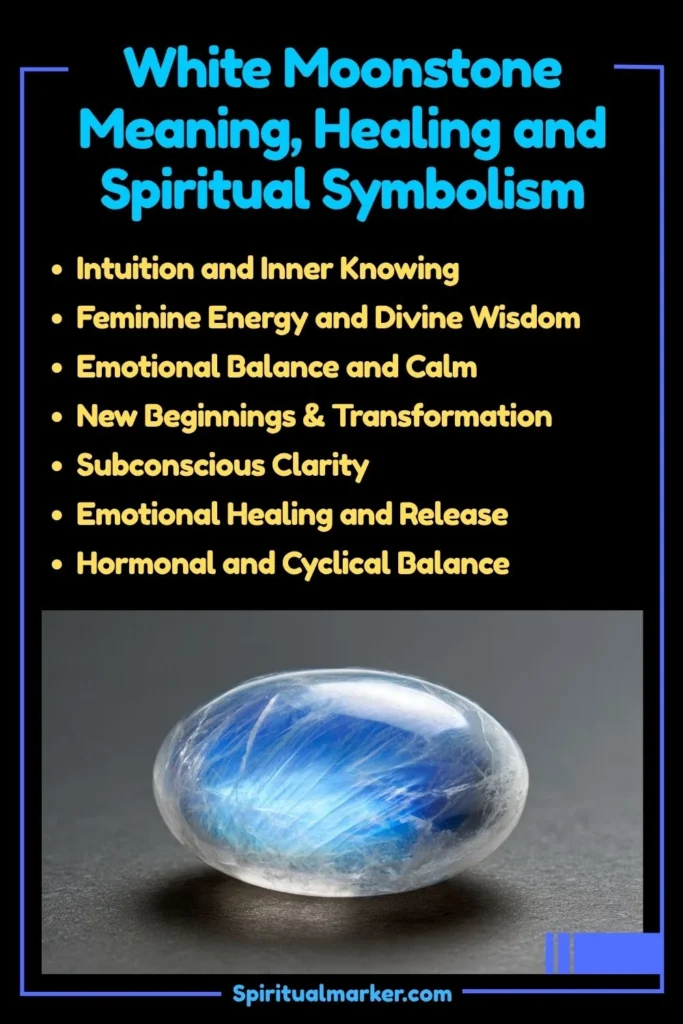
White moonstone is a naturally occurring gemstone celebrated for its soft, milky white appearance and the ethereal inner glow it displays when light moves across its surface. That optical phenomenon, called adularescence, creates a floating blue or silver sheen that shifts and rolls as the stone moves. No two moonstones display exactly the same light pattern, which makes each stone genuinely unique.
Mineralogically, moonstone belongs to the feldspar group, specifically a variety called orthoclase or adularia. Its inner glow results from the layering of two feldspar minerals, orthoclase and albite, that form alternating internal layers. When light enters the stone, it scatters between those layers and produces the characteristic luminous shimmer moonstone is known for.
White moonstone differs from other moonstone varieties such as rainbow moonstone, peach moonstone, or gray moonstone primarily through its pale, almost translucent white color and its softer, more introspective energy. While rainbow moonstone displays stronger iridescence across multiple colors, white moonstone carries a gentler, more specifically emotional and spiritual quality that practitioners frequently describe as soothing and deeply feminine.
Origins and Formation of White Moonstone
White moonstone forms through geological processes involving slow cooling of magma over millions of years. As magma cools, two different feldspar minerals separate into thin alternating layers within the stone. That internal layered structure is what creates the adularescence people find so visually compelling. The slower the cooling process, the more pronounced the inner glow tends to become.
Sri Lanka remains the world’s most historically significant source of high-quality white moonstone. The country has produced fine specimens for thousands of years and continues to supply the global gemstone market with some of the most luminous examples available. Other significant sources include India, Madagascar, Myanmar, Tanzania, Brazil, and the United States.
Indian moonstone, particularly from the state of Rajasthan, holds a distinct cultural significance. Hindu tradition regards moonstone as a sacred gemstone connected to the moon deity Chandra. Travelers and merchants have historically carried moonstone for protection during journeys, believing the stone’s connection to lunar cycles offered spiritual guidance in unfamiliar territory.
White moonstone rates approximately 6 to 6.5 on the Mohs hardness scale, making it moderately soft compared to gemstones like sapphire or diamond. Its relative softness means it requires more careful handling than harder stones, particularly when worn daily in rings or bracelets that receive frequent physical contact.
Key Properties of White Moonstone
| Property | Details |
|---|---|
| Color | White, cream, pale silver, translucent |
| Optical Phenomenon | Adularescence (floating inner glow) |
| Mineral Group | Feldspar (orthoclase or adularia) |
| Hardness | 6 to 6.5 on the Mohs scale |
| Chakra Association | Crown chakra, Third Eye chakra |
| Primary Symbolism | Intuition, feminine energy, emotional clarity, inner truth |
| Main Sources | Sri Lanka, India, Madagascar, Myanmar, Brazil |
| Energy Style | Receptive, calming, spiritually attuned, emotionally nurturing |
| Common Jewelry Types | Rings, pendants, earrings, bracelets |
| Spiritual Uses | Meditation, dream work, moon rituals, intuitive development |
Historical Significance of White Moonstone
White moonstone carries one of the richest historical records of any gemstone connected with spiritual practice. Ancient Rome believed that moonstone was literally formed from moonlight frozen into physical form. Roman natural philosopher Pliny the Elder wrote about the stone’s connection to the lunar cycle in the first century AD, noting that its inner appearance seemed to shift with the moon’s phases. That association persisted across centuries and continents.
In Hindu mythology, moonstone was considered a sacred stone born from moonbeams. The stone carried associations with the god Chandra, deity of the moon, and was believed to bring good fortune, clarity, and divine blessing to those who possessed it. Gemstones set in gold were given as spiritual gifts, particularly during ceremonies marking new beginnings, marriages, or periods of personal transformation.
The Art Nouveau period of the late 19th and early 20th centuries brought white moonstone into significant Western artistic prominence. Jewelry designers like René Lalique celebrated the stone’s ethereal quality, incorporating it into elaborate pieces designed to reflect femininity, mystery, and natural beauty. That cultural moment helped introduce moonstone to broader Western audiences as a gemstone of deep aesthetic and symbolic value.
In Ancient Greece, moonstone was linked with Selene, goddess of the moon, and Hecate, goddess of magic and the crossroads. Both deities were associated with feminine power, intuition, cycles of transformation, and the mysterious aspects of inner life that resist rational explanation. White moonstone became a physical symbol of those hidden but deeply felt forces.
5 Spiritual Meanings of White Moonstone
1. Intuition and Inner Knowing
The most enduring spiritual meaning of white moonstone centers on intuition and the kind of inner knowing that exists beyond rational thought. People are drawn to this stone when they feel disconnected from their own instincts, when external noise has grown so loud that their own inner voice becomes difficult to hear. White moonstone spiritually represents the process of returning to that quiet inner clarity.
Intuition works differently from logical reasoning. It does not announce itself with explanations or evidence. It arrives as a quiet sense of knowing that feels emotionally true even before intellectual understanding catches up. Many people describe white moonstone’s energy as similar to that quality. It does not push or demand. It creates a kind of internal stillness where deeper awareness becomes more accessible.
In many spiritual traditions, the moon itself represents the intuitive mind, the reflective, receptive aspect of consciousness that perceives what the analytical mind tends to overlook. White moonstone carries this symbolism directly into physical form. Its shifting adularescent glow mirrors the way intuition operates, fluid, changing, impossible to pin down completely, but unmistakably real when directly experienced.
Many practitioners specifically use white moonstone during periods when important decisions loom but clarity feels absent. Rather than forcing an answer through mental analysis, white moonstone symbolizes the value of pausing, listening inward, and trusting what already knows the answer. That stillness before action forms one of the stone’s central spiritual messages.
2. Feminine Energy and Divine Wisdom
White moonstone holds one of the strongest connections to feminine energy in the entire world of crystal symbolism. This does not refer exclusively to gender. Feminine energy, in spiritual traditions, describes a universal quality that includes receptivity, nurturing, creativity, emotional depth, cyclical change, and connection to the rhythms of the natural world. Every person contains both feminine and masculine energies, and white moonstone is believed to strengthen, balance, and honor the feminine aspect within anyone who works with it.
The moon has carried feminine symbolism across virtually every human civilization in recorded history. Ancient Egyptian culture associated the moon with Isis, goddess of magic and healing. Greek tradition honored Selene and Artemis as lunar deities. Many indigenous traditions worldwide observe the moon as a feminine spiritual presence governing emotional tides, cycles of growth, and inner life. White moonstone absorbs and reflects this centuries-deep symbolism.
Many people working through feelings of emotional disconnection, creative stagnation, or loss of personal nurturing find white moonstone especially meaningful. When life demands constant outward productivity, analytical thinking, and emotional hardness, the stone symbolically calls attention back to the equally important inner qualities. Receptivity, patience, emotional honesty, and creative flow all fall within its spiritual territory.
White moonstone also connects with the divine feminine in its broader spiritual sense, the aspect of the sacred that is experienced through emotional feeling, relational awareness, and embodied wisdom rather than purely through doctrine or intellectual belief. Many people who feel spiritually alive in nature, in creative expression, in relationships, or in quiet contemplation find deep resonance with what white moonstone represents.
3. Emotional Balance and Calm
White moonstone carries strong associations with emotional balance because its spiritual energy is consistently described as calming, stabilizing, and emotionally cooling. Many people experience emotional turbulence that arrives without obvious cause, sudden waves of anxiety, irritability, sadness, or emotional overwhelm that feel disproportionate to external circumstances. White moonstone symbolizes the restoration of emotional equilibrium during these unpredictable periods.
Part of this symbolism connects to the moon’s influence on natural cycles. The ocean’s tides respond to the moon’s gravitational pull. Many traditional cultures observed that human emotions also follow cyclical patterns, rising and falling in ways that mirror the lunar cycle. White moonstone spiritually represents a deep attunement to those natural emotional rhythms rather than resistance to them.
Modern life frequently discourages emotional flow. People are expected to maintain consistent emotional output regardless of their internal state. That suppression of natural emotional rhythm often creates emotional buildup, moodiness, emotional exhaustion, or chronic stress. White moonstone symbolically encourages a different relationship with emotional experience. Rather than fighting emotional waves, it represents riding them with awareness and patience.
Many practitioners use white moonstone during emotional regulation practices such as journaling, meditation, breathwork, or quiet nature walks. They describe its energy as helping soften emotional reactivity without suppressing emotional honesty. The stone symbolizes the space between stimulus and response, that brief internal pause where emotional intelligence operates most clearly.
4. New Beginnings and Personal Transformation
White moonstone is deeply associated with new beginnings across virtually every culture that has historically prized it. The moon begins each cycle in darkness, gradually building toward fullness before returning to darkness again. Every new moon represents a fresh start, a blank slate, a moment of quiet potential before something new grows. White moonstone carries that symbolism into personal and spiritual life, representing the threshold moments when one chapter ends and another has not yet fully begun.
People navigating major life transitions often feel an instinctive pull toward white moonstone. Career changes, the ending of relationships, relocation, spiritual shifts, or periods of grief and rebuilding all qualify as threshold experiences. In each case, white moonstone symbolically holds space for what is changing. It does not rush transformation. It does not force premature certainty. Its energy reflects the value of the in-between space, the liminal phase where old identity has dissolved and new identity has not fully formed.
That symbolism takes on particular power because modern culture rarely makes space for genuine transition. People are encouraged to move quickly from one phase to the next, to have answers, to project confidence, to perform stability even during genuine instability. White moonstone spiritually pushes back against that pressure. It represents the sacred pause before growth, the moment of honest not-knowing that authentic transformation requires.
Many practitioners use white moonstone specifically during new moon ceremonies, setting intentions for the lunar cycle ahead and asking for clarity about emerging directions in their lives. The stone’s connection to cyclical lunar energy reinforces the idea that every ending contains the seed of a new beginning, and that personal transformation follows natural rhythms rather than arbitrary timelines.
5. Dream Awareness and Subconscious Clarity
White moonstone holds a long-standing connection to dreams, subconscious awareness, and the hidden dimensions of inner life. Many spiritual traditions worldwide regard the dream state as a space where the deeper mind communicates what waking consciousness tends to overlook. White moonstone is believed to heighten awareness of that internal communication, making dreams more vivid, more memorable, and more emotionally meaningful.
Dreams have carried spiritual significance across human history. The Old Testament records numerous instances of divine communication occurring through dreams. Joseph’s ability to interpret dreams saved Egypt from famine according to Genesis 41. The book of Job speaks of God speaking through dreams to reveal hidden truths. Ancient Greek and Egyptian cultures maintained dedicated dream temples where people slept in sacred spaces seeking healing visions. White moonstone resonates with this ancient understanding that inner life during sleep carries genuine spiritual significance.
Beyond literal dreams, white moonstone also connects to subconscious clarity during waking life. The subconscious mind processes enormous amounts of emotional, relational, and experiential information beneath the surface of conscious awareness. Sometimes that subconscious processing produces feelings, creative impulses, or unexplained emotional reactions that carry important personal information. White moonstone spiritually represents a stronger, more conscious relationship with those deeper layers of self-knowledge.
Many people who work with white moonstone during dream practices place the stone near their sleeping area or hold it briefly before sleep while setting an intention for clarity, guidance, or insight. Others use it during hypnagogic meditation, the transitional state between waking and sleep where imagery and symbolic understanding often emerge more freely. The stone symbolizes the courage required to look honestly at what lives beneath the surface.
6 Healing Properties of White Moonstone
1. Emotional Healing and Release
White moonstone is widely recognized within crystal healing traditions for its connection to emotional healing. People often carry unprocessed grief, suppressed sadness, old heartbreak, or accumulated emotional tension that never found full expression. Over time, that emotional buildup contributes to numbness, chronic fatigue, emotional reactivity, or a vague sense of being internally stuck. White moonstone symbolically creates space for those buried emotions to surface gently and move through.
What distinguishes white moonstone’s healing energy from more intense healing stones is its quality of emotional gentleness. Some crystals associated with emotional work carry intense or activating energy. White moonstone tends to feel softer, slower, and more patient. Many people describe its emotional healing presence as similar to moonlight itself: present, subtle, illuminating without blinding, and consistently available throughout the night.
This healing symbolism matters because emotional wounds rarely heal through force or urgency. Grief moves at its own pace. Trauma recovery unfolds in layers over time. The emotional healing associated with white moonstone honors that natural timeline. It does not promise rapid emotional transformation. Instead, it represents steady emotional support during the slow, honest work of genuinely feeling and releasing what has been held too long.
Many practitioners combine white moonstone with journaling, contemplative prayer, therapy, or somatic healing practices. They find that its calming energy helps them access emotional truth without becoming emotionally overwhelmed in the process. That balance between emotional honesty and emotional safety forms a core part of what white moonstone represents in healing traditions.
2. Hormonal and Cyclical Balance
Within traditional and metaphysical healing systems, white moonstone has historically been associated with hormonal balance and the natural rhythms of the female body. Its strong connection to the moon, and by extension to cyclical biological processes, explains why many women have worn moonstone during menstruation, pregnancy, childbirth, and menopause for centuries. While crystal healing operates in the realm of symbolic and energetic support rather than medical treatment, the tradition reflects a meaningful cultural recognition of the body’s cyclical wisdom.
Many women report that their emotional and physical experience shifts significantly throughout the monthly cycle. Ancient healing traditions observed these shifts and treated them as spiritually significant rather than medically inconvenient. White moonstone symbolically honors the body’s natural cycles rather than pathologizing them. It represents attunement to biological rhythm as a form of self-knowledge and spiritual awareness.
Beyond biological cycles, white moonstone also connects to the broader idea of cyclical time in human experience. Seasons change. Life moves through periods of expansion and contraction, fullness and emptiness, activity and rest. White moonstone spiritually encourages trust in those natural rhythms rather than constant resistance to phases of apparent stillness or inner withdrawal. That trust itself can function as a form of deep emotional healing.
3. Stress Relief and Mental Calm
White moonstone carries consistent associations with stress relief and mental calm within crystal healing communities. Its visual quality contributes directly to this reputation. The soft, luminous appearance of high-quality white moonstone has an inherently calming effect on the visual system. Many people report feeling their breathing slow and their shoulders drop slightly simply from looking at the stone closely.
Beyond its visual quality, white moonstone symbolically represents the opposite of mental overload. Stress usually involves the mind racing forward into future fears or backward into past regrets. White moonstone’s energy centers on the present moment, the quiet space of current awareness rather than the mental noise of what was or what might be. Practitioners who use it during meditation report that it helps anchor attention to immediate experience rather than anxious mental projection.
Many people place white moonstone in their sleeping environments, meditation spaces, or workplaces specifically because they associate its presence with a calmer mental atmosphere. It does not carry an energizing or stimulating quality. Its healing symbolism runs in the opposite direction, toward softness, stillness, and emotional decompression. That makes it particularly relevant for people whose lives demand constant outward mental performance.
4. Strengthening Psychic Sensitivity and Intuitive Perception
White moonstone holds a strong traditional association with psychic sensitivity, clairvoyant perception, and heightened spiritual awareness. Many metaphysical traditions view intuitive and psychic capacities not as supernatural abilities limited to certain individuals but as natural dimensions of human consciousness that most people have allowed to remain undeveloped through cultural conditioning that prioritizes exclusively rational modes of knowing.
Crystal healers and spiritual practitioners frequently use white moonstone during practices designed to strengthen these capacities. Tarot reading, oracle work, meditation, channeling, energy healing, and pendulum work all represent areas where practitioners reach for white moonstone to heighten receptivity and perceptual clarity. Many describe it as helping them access a quieter, deeper level of awareness where intuitive information feels clearer and more trustworthy.
Whether or not one holds metaphysical beliefs about psychic perception, white moonstone’s healing symbolism in this area reflects something universally valuable: the cultivation of attention, listening, and receptivity. In a world that prizes speaking over hearing, acting over waiting, and certainty over openness, white moonstone represents the healing power of learning to receive rather than constantly project.
5. Supporting Fertility and New Life
Across cultures and centuries, white moonstone has carried consistent associations with fertility, pregnancy, and the beginning of new life. Ancient Roman, Greek, Indian, and Chinese traditions all connected the stone to lunar energy and its perceived influence over conception, gestation, and birth. Women hoping to conceive or navigating pregnancy frequently wore moonstone as a protective and energetically supportive talisman in many traditional cultures.
The stone’s connection to fertility extends beyond biological reproduction in spiritual symbolism. Creative fertility, the kind that produces art, innovation, spiritual insight, meaningful relationships, and new ways of living, also falls within the stone’s healing territory. Many artists, writers, musicians, and spiritual creators work with white moonstone during periods when creative energy feels blocked, dormant, or exhausted.
In both senses, white moonstone’s healing role involves nurturing potential before it becomes visible. Seeds grow in darkness before they break through the surface. New creative work lives in imagination before it takes physical form. New life develops in protected internal space before entering the world. White moonstone reflects the healing wisdom of honoring that invisible, preparatory phase as genuinely sacred rather than merely preliminary.
6. Deepening Spiritual Connection
White moonstone is one of the most consistently recommended stones for people seeking to deepen their spiritual life. Its connection to the crown chakra and third eye chakra means it is often associated with spiritual perception, connection to higher awareness, and the opening of consciousness beyond ordinary everyday experience. Many spiritual practitioners treat it as a stone that helps bridge the personal and the transcendent.
This healing quality feels especially relevant for people who describe feeling spiritually dry, disconnected, or unable to access the sense of meaning and presence they once experienced more easily. White moonstone symbolically encourages a return to receptive spiritual awareness. Rather than striving harder in spiritual practice, it represents allowing, trusting, and creating inner space where spiritual experience can arise naturally.
Many contemplative traditions across multiple spiritual paths emphasize the importance of exactly this kind of receptive stillness. The Christian contemplative tradition speaks of centering prayer and silent waiting before God. Buddhist practice cultivates the quality of open, non-grasping awareness. Sufi mysticism honors the heart’s receptivity to divine presence. White moonstone spiritually reflects the healing dimension of all these traditions: the practice of becoming inwardly quiet enough to perceive what is always already present.
White Moonstone and Chakra Connections
White moonstone primarily connects with two chakras: the crown chakra (Sahasrara) and the third eye chakra (Ajna). Both energy centers relate to spiritual perception, higher consciousness, and the dimensions of experience that transcend ordinary material awareness.
The crown chakra sits at the top of the head and governs connection to universal consciousness, spiritual insight, and the sense of transcendent meaning that gives life depth beyond immediate personal experience. When this chakra feels open and balanced, people often report a sense of spiritual presence, clarity of purpose, and the feeling of being connected to something larger than individual identity. When blocked, people may feel spiritually empty, mentally rigid, or cut off from any sense of higher meaning.
The third eye chakra sits between the eyebrows and governs intuition, inner vision, perceptual clarity, and the ability to see beyond surface appearances into deeper truths. When this chakra feels aligned, people experience clearer intuition, richer inner visual experience, stronger dream awareness, and a greater ability to perceive patterns and meaning that others miss. White moonstone’s connection to this chakra explains its long association with heightened psychic sensitivity and inner knowing.
Some practitioners also connect white moonstone secondarily to the sacral chakra, particularly in relation to its associations with feminine energy, creativity, emotional flow, and the cyclical rhythms of the body and natural world. This secondary connection reinforces the stone’s broad role in emotional and creative healing alongside its primary spiritual associations.
How to Use White Moonstone for Spiritual Growth
People work with white moonstone in many different ways depending on their spiritual intentions, personal beliefs, and daily practices. Meditation remains one of the most common applications. Holding a piece of white moonstone in the hand or placing it on the forehead or crown during seated meditation helps many practitioners access deeper stillness and more receptive inner states. Some people report that the stone’s cool surface serves as a physical anchor for awareness, helping the mind settle rather than wander.
New moon ceremonies represent another deeply traditional use. Because white moonstone carries such strong lunar symbolism, many spiritual practitioners use it during new moon rituals to set intentions, release what no longer serves, and open themselves to the emerging cycle ahead. The stone is sometimes placed on an altar beside candles, written intentions, or other symbolic objects during these ceremonies.
Many people work with white moonstone during dream practices, placing the stone beneath their pillow or on a bedside surface before sleep while holding the intention of receiving clearer inner guidance through dreams. Keeping a dedicated dream journal alongside this practice helps people track and interpret what arises during the night. Consistent practice over several weeks often produces noticeable shifts in dream vividness and emotional resonance.
White moonstone also pairs beautifully with journaling, breathwork, and contemplative prayer. Holding the stone while writing can help people access emotional honesty more readily. Its calming energy may reduce the internal resistance that sometimes makes emotional writing difficult, allowing deeper self-expression to emerge naturally.
How to Wear White Moonstone Jewelry
White moonstone appears in virtually every form of jewelry, from delicate rings and earrings to bold pendant necklaces and stacked bracelets. The choice of jewelry form influences both the aesthetic experience and the spiritual symbolism many people associate with wearing it.
Pendant necklaces allow white moonstone to rest near the heart and throat, areas associated in spiritual traditions with emotional truth and authentic self-expression. Many people who wear white moonstone pendants describe a sense of emotional centering throughout the day, a subtle but consistent reminder of their intention toward inner clarity and spiritual openness.
Rings keep the stone in constant contact with the hands, which many traditions consider energetically significant because hands both give and receive in everyday life. Wearing white moonstone on the non-dominant hand is sometimes associated with receptivity, specifically the intention to receive guidance, clarity, or insight. The dominant hand is associated with active projection of energy outward.
Many spiritual practitioners combine white moonstone with complementary stones to create layered energetic intentions. Labradorite amplifies intuition and magical awareness. Amethyst deepens spiritual perception and calm. Rose quartz pairs beautifully with moonstone’s emotional healing qualities, adding warmth and heart-centered compassion to moonstone’s more reflective energy. Clear quartz can amplify moonstone’s effects when used together during meditation.
Caring for White Moonstone Jewelry
White moonstone requires thoughtful care because its relatively soft structure makes it more vulnerable to scratches and damage than harder gemstones. Store white moonstone separately from harder stones such as diamonds, sapphires, or rubies. Even brief contact with harder materials can create surface scratches that dull the stone’s luminosity over time.
Clean white moonstone using lukewarm water, a small amount of mild soap, and a soft cloth. Rinse thoroughly and pat dry rather than air drying, since mineral deposits in water can leave dull residue on the surface. Avoid ultrasonic cleaners, steam cleaning, harsh chemical solutions, or abrasive cleaning materials. These methods may damage the stone’s surface or loosen it from its setting.
Remove white moonstone jewelry before intense physical activity, swimming, gardening, or household cleaning. Chlorine, salt water, and cleaning chemicals can affect both the stone and its metal setting over time. Physical impact during sports or labor-intensive activities risks chipping the stone’s surface or fracturing it internally.
Many people who value white moonstone energetically also practice spiritual cleansing of the stone alongside physical cleaning. Moonlight exposure during the full or new moon remains the most symbolically resonant cleansing method, given the stone’s deep lunar associations. Other approaches include sound cleansing with singing bowls, smudging with herbs, or briefly placing the stone on a piece of selenite or clear quartz. Avoid prolonged direct sunlight, as strong UV exposure can affect the clarity of some moonstone specimens over time.
White Moonstone Meaning at a Glance
| Aspect | Details |
|---|---|
| Primary Meaning | Intuition, inner knowing, feminine wisdom |
| Chakra Association | Crown chakra, Third Eye chakra |
| Main Spiritual Symbolism | New beginnings, emotional balance, lunar cycles |
| Common Colors | White, pale silver, cream, translucent |
| Optical Phenomenon | Adularescence (inner floating glow) |
| Hardness | 6 to 6.5 Mohs |
| Main Sources | Sri Lanka, India, Madagascar, Myanmar |
| Emotional Associations | Calm, receptivity, emotional honesty, self-awareness |
| Popular Jewelry Types | Pendants, rings, earrings, bracelets |
| Spiritual Uses | Meditation, dream work, moon rituals, intuitive development |
| Care Needs | Gentle cleaning, soft storage, avoid heat and harsh chemicals |
A Final Note
White moonstone holds a quality that few gemstones match. Its visual beauty alone would make it worth noticing. But the centuries of spiritual tradition, cultural symbolism, and personal meaning that people have woven around it give it genuine depth that a beautiful appearance alone cannot fully explain.
Its meaning centers on intuition, emotional balance, feminine wisdom, and the quiet courage required to begin again. Whether that resonates through a spiritual or metaphysical lens, through an appreciation of natural history and cultural tradition, or simply through an unexplained personal pull toward the stone’s luminous presence, white moonstone continues to speak to something real in human experience.
If white moonstone draws your attention, you might consider wearing it during moments of personal transition or uncertainty, using it to support meditation and dream practices, or simply keeping it close as a physical reminder of the inner wisdom that is always available beneath the surface of daily noise. Some people find that placing it on a windowsill during the full moon and setting a clear intention for the month ahead creates a meaningful ritual of renewal that feels both grounding and spiritually alive. However you choose to work with it, white moonstone rewards patience, receptivity, and honest inner attention.