
Nail biting is a common habit that many people hide. It often appears during stress or deep thought. Beyond anxiety, some people sense a spiritual or symbolic meaning in the behavior.
The spiritual meaning of nail biting often involves anxiety, self-criticism, or a need for control. Nails are protective, so biting them may signal a feeling of vulnerability. A spiritual meaning of nail biting personality traits shares that focus, though personality adds another layer.
Personality traits linked to nail biting include perfectionism, nervousness, and a tendency to internalize stress. At its best, the habit may signal sensitivity and awareness. At its worst, it can point to unresolved tension.
If nail biting feels compulsive, it may be a call to address underlying anxiety. A spiritual meaning of yawning also deals with involuntary habits, though yawning relates to energy release.
Psychological Reason Why People Bite Their Nails
Psychologically, nail biting is classified as a body-focused repetitive behavior. It usually develops during childhood and continues into adulthood when emotional regulation feels difficult.
The most common triggers include anxiety, boredom, perfectionism, suppressed anger, and fear of failure. The act of biting creates temporary relief. The brain releases small amounts of dopamine, which calms the nervous system for a moment. That short relief conditions the brain to repeat the behavior again and again.
On a deeper level, nail biting reflects a need for control during emotional discomfort. When life feels uncertain, the body looks for something predictable. The hands become the outlet. The person may not even realize they are doing it.
Spiritually, this shows a disconnect between emotional awareness and expression. The feelings exist, but they are not being consciously processed.
What Does Nail Biting Symbolize?
Symbolically, nails represent protection, boundaries, and personal strength. They are tools for defense and grip. Biting them away suggests weakening one’s own boundaries.
At a spiritual level, nail biting symbolizes internalized stress and self-consumption. The person is literally turning their energy inward and feeding on themselves emotionally. It often reflects:
• Fear of making mistakes
• Suppressed emotions
• Self-criticism
• Inner restlessness
• Difficulty trusting life
The habit also points to unresolved inner tension. Something wants attention. Something wants expression. Instead of flowing outward through communication or action, it circulates inside the body.
In spiritual psychology, this is linked to the throat chakra and solar plexus chakra. When these energy centers are blocked, emotional expression becomes restricted, and physical habits emerge.
12 Spiritual Meanings of Nail Biting Behavior
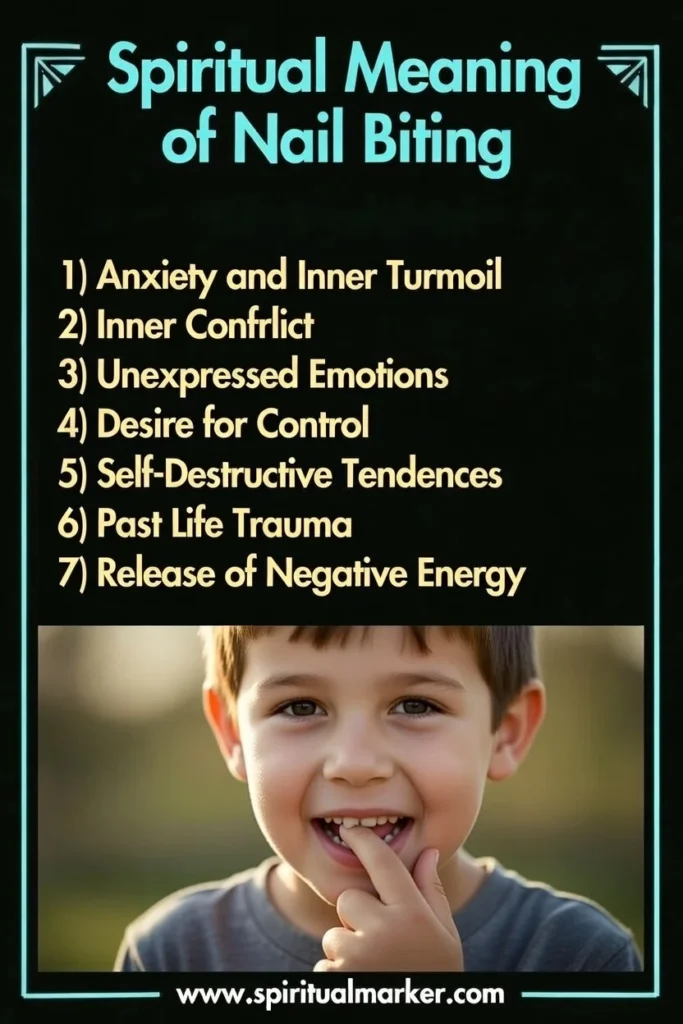
1) Anxiety and Inner Turmoil
Nail biting often surfaces during moments of stress, but spiritually, it reflects more than just nervous energy. It can indicate an inner world in disarray, where the mind struggles to find calm and the spirit feels fragmented.
The act of biting nails becomes a physical outlet for mental chaos, a way the body attempts to release tension it cannot process on a higher level. This behavior may point to unresolved worries, pervasive self-doubt, or an ongoing battle with uncertainty.
When observed over time, nail biting can reveal patterns of suppressed anxiety, highlighting the need for emotional realignment and inner peace. Addressing it spiritually may involve practices that restore energetic balance, such as meditation, grounding exercises, or mindful awareness.
2) Inner Conflict
From a spiritual perspective, nail biting can symbolize a tug-of-war within the self. It represents opposing forces at play in one’s soul—often the tension between fear and desire, resistance and growth, or comfort and progress.
This inner conflict creates subtle stress that the body expresses through habitual actions. The nails, small yet visible, become symbolic battlegrounds where the subconscious acts out struggles the conscious mind may not fully acknowledge.
Recognizing this pattern invites introspection, prompting a deeper understanding of personal motivations, fears, and ambitions. Spiritual guidance in this context encourages alignment of thought and action, resolving the dualities that drive these behaviors.
3) Unexpressed Emotions
Nail biting can act as a physical manifestation of suppressed emotions. When feelings such as anger, sadness, or frustration remain unacknowledged, they often create energetic blockages that seek release through repetitive behaviors.
Spiritually, this habit signals a call to acknowledge what has been buried within the psyche. The body expresses what the mind resists, and each bite becomes a subtle reminder to confront and process emotions rather than ignore them.
Healing may involve journaling, counseling, or energy practices that allow emotions to flow naturally, transforming stagnant energy into conscious self-expression and restoring emotional equilibrium.
4) Desire for Control
A seemingly small action like biting one’s nails can reveal a subconscious need to assert control in an unpredictable world. Spiritually, it reflects a sense of powerlessness, where the individual attempts to master a tiny, tangible element of life—the nails—as a way to regain some agency.
This desire often emerges during times of uncertainty, transition, or overwhelm, signaling the need to reconnect with inner strength. Awareness of this pattern encourages reflection on areas where control is genuinely possible versus areas that require surrender.
Spiritual practices that cultivate inner autonomy, such as mindful breathing or intention-setting, can help redirect the need for control into healthier channels.
5) Deep Insecurity
Nail biting is also linked to feelings of vulnerability and self-doubt. On a spiritual level, it mirrors a fear of judgment and a sense of inadequacy that manifests physically.
The habit becomes a coping mechanism, a protective response to perceived threats to self-worth. This behavior points toward deeper layers of insecurity that may be tied to childhood experiences, societal expectations, or personal comparisons.
Understanding the spiritual roots of insecurity allows the individual to confront these fears, cultivate self-compassion, and rebuild confidence from within. Practices that reinforce self-love and acceptance can gradually reduce the compulsive urge, replacing it with empowered self-expression.
6) Self-Destructive Tendencies
For some, nail biting emerges as a subtle form of self-punishment, stemming from feelings of guilt, shame, or low self-esteem. Spiritually, it represents a pattern of self-sabotage, where the individual unconsciously enacts harm on their own body to reflect inner criticism or unresolved emotional wounds.
The act of chewing nails becomes a tangible manifestation of internalized negativity, revealing a need for self-forgiveness and personal nurturing. Recognizing this tendency is the first step toward healing, allowing the individual to redirect energy toward constructive habits and compassionate self-care practices.
Transforming this behavior involves integrating mindfulness, affirmations, and spiritual awareness to replace self-destructive impulses with nurturing rituals.
7) Past Life Trauma
In spiritual traditions that consider karmic influences, nail biting can sometimes be seen as an echo of unresolved issues from past lives. This behavior may reflect fears, losses, or anxieties carried forward into the present, manifesting subtly in the body when the soul has not fully healed old wounds.
Each bite becomes a symbolic attempt to manage unresolved tension or protect oneself from repeating patterns of vulnerability. Recognizing this link encourages introspection into recurring emotional struggles, inviting practices such as past-life regression, meditation, or energetic healing to release karmic residue.
Spiritually, addressing past life trauma allows the soul to move toward wholeness and resilience in this lifetime.
8) Release of Negative Energy
Nail biting can also serve as a conduit for purging absorbed negativity. From a spiritual standpoint, the habit may emerge in individuals who are highly sensitive to the emotional or energetic climate around them.
Daily interactions, stressful environments, or exposure to unresolved tension in others can accumulate as subtle blocks within the body. Chewing nails then functions as a physical release, a subconscious method of discharging unwanted energy.
This process signals the need for protective and cleansing practices such as grounding, smudging, or visualizations to maintain energetic clarity. Awareness of this function can help transform nail biting from a reactive habit into a conscious ritual for managing and releasing negativity safely.
9) Lack of Grounding
A persistent nail-biting habit may also point to spiritual disconnection. Individuals experiencing restlessness, scattered thoughts, or feeling “ungrounded” often display habits that seek physical stability or comfort, even unconsciously.
Nails become a tactile focus, giving the body something tangible to anchor itself while the spirit navigates uncertainty. This habit signals the importance of reconnecting with the present moment and cultivating a sense of inner security.
Practices such as walking barefoot on natural surfaces, meditation, or mindful breathing help strengthen the connection to the body and earth, reducing the compulsion to seek grounding through self-soothing behaviors like nail biting.
10) Planetary Imbalance (Rahu Influence)
In Vedic astrology, planetary energies are believed to influence mental, emotional, and physical habits. Nail biting can be associated with Rahu, a shadow planet that governs illusion, restlessness, and karmic confusion.
Under Rahu’s influence, the mind may experience turbulent energy, leading to anxiety, impulsivity, or obsessive behaviors. Nail biting then becomes an expression of inner chaos and the struggle to find clarity.
Understanding this astrological influence can guide spiritual remedies such as mantras, meditation, or chakra balancing to harmonize Rahu’s energy, promoting calm, mental focus, and healthier coping mechanisms.
11) Perfectionism
Spiritually, nail biting can reveal a deep-seated intolerance for imperfection. Individuals who demand flawlessness from themselves or their surroundings may unconsciously act out this tension through habits like nail biting.
Each bite becomes a reflection of dissatisfaction or frustration with perceived shortcomings, illustrating a misalignment between spiritual ideals and self-acceptance. Awareness of this tendency invites practices that nurture self-compassion and embrace human imperfection.
Meditation, affirmations, and reflective journaling can help reduce the inner pressure for perfection, transforming nail-biting impulses into mindful attention to personal growth rather than self-criticism.
12) Chakra Imbalance
Finally, nail biting may indicate blockages or imbalance in the body’s energy centers, particularly the root or sacral chakras. The root chakra governs stability, security, and grounding, while the sacral chakra relates to creativity, emotions, and healthy expression.
When these chakras are blocked, individuals may manifest habits like nail biting as a physical outlet for pent-up tension, insecurity, or resistance to change. Spiritually, addressing chakra imbalance through energy healing, meditation, or yoga can help release stagnant energy, restore flow, and foster emotional resilience.
Awareness of these imbalances allows the habit to transform from a compulsive act into a signal for deeper personal and spiritual work.
Personality Traits of Individuals with a Habit of Biting Nails
People who bite their nails often share certain personality patterns. Some of these traits are strengths. Others create emotional challenges.
- They are highly sensitive. These individuals feel deeply. They pick up subtle emotional shifts in people and environments. This makes them empathetic and intuitive, but also emotionally overloaded.
- They are self-critical. Many nail biters set high standards for themselves. When they fall short, even slightly, the inner voice becomes harsh. The habit becomes a physical response to mental pressure.
- They are mentally active. Their minds rarely slow down. Overthinking, analyzing, replaying conversations, and anticipating outcomes becomes a daily loop. Nail biting acts as a grounding mechanism for mental excess.
- They seek control. When life feels unpredictable, they try to manage what they can. The body becomes the object of control. This can reflect underlying fear of uncertainty.
- They are emotionally restrained. Instead of expressing frustration, sadness, or anger openly, they internalize it. The habit becomes a silent emotional release.
- They are resilient. Despite inner tension, these individuals often function well in external life. They carry emotional weight quietly and keep going. This shows strong adaptability, even when emotional needs remain unmet.
Myths and Superstitions
Across folklore, nail biting has carried symbolic warnings.
In some traditions, it is believed that biting nails attracts negative energy or bad luck. The idea comes from the belief that nails hold personal energy, and damaging them weakens spiritual protection.
Other superstitions suggest that nail biting shortens life, invites poverty, or blocks prosperity. These beliefs were often used to discourage the habit in children, but they reflect a deeper spiritual fear of self-destruction and energy leakage.
Spiritually speaking, these myths point to one message: self-harming habits disrupt energetic balance.
Cultural and Religious Interpretations of Biting Nails
In Hindu philosophy, nail biting is associated with restless mental energy or rajasic tendencies. It suggests a mind dominated by agitation, worry, and unfulfilled desire.
In Islamic teachings, while nail biting is not considered sinful, it is discouraged as it reflects poor self-discipline and lack of awareness of bodily actions.
In Buddhist thought, repetitive habits like nail biting represent attachment to mental discomfort. The behavior becomes a loop of craving and relief, reinforcing suffering.
Christian interpretations often associate nail biting with anxiety and lack of surrender to divine trust. The habit becomes a physical manifestation of inner fear.
Across cultures, one theme repeats: nail biting reflects unresolved inner tension and lack of emotional grounding.
Spiritual Approaches to Stop the Habit of Biting Nails
Breaking this habit requires more than willpower. It requires emotional awareness.
The first step is conscious observation. Each time the urge arises, pause and ask what emotion is present. Anxiety, boredom, frustration, or fear often sit beneath the surface.
Meditation helps slow the nervous system and reduce impulsive behavior. Even five minutes a day increases awareness of body habits.
Breathwork is powerful. Slow breathing activates the parasympathetic nervous system, reducing the need for physical coping mechanisms.
Energy healing practices like chakra balancing, Reiki, or grounding exercises help release stored emotional tension.
Affirmations can reprogram subconscious patterns. Statements like “I release stress through awareness, not self-harm” slowly shift behavior.
Journaling also works well. Writing down emotional triggers creates a bridge between inner experience and conscious expression.
The goal is not to fight the habit, but to understand it.
Final Thoughts
Nail biting is not random. It is a message from within.
It speaks of emotional overload, internal pressure, and unexpressed feelings. Spiritually, it reflects a soul trying to cope quietly with mental noise and emotional tension.
This habit does not mean weakness. It often appears in sensitive, intelligent, and emotionally complex individuals. People who feel deeply and think intensely.
When addressed with awareness instead of shame, nail biting becomes a gateway to emotional healing. A signal to slow down, listen inward, and release what has been held too long.
Your body never acts without reason. It always speaks the language of the soul.
You Might Also Like
1) Thigh Twitching Superstition & Spiritual Meaning (Right, Left)
2) Single Long White Hair Superstition and Spiritual Meaning
3) Spiritual Meaning of Eggs and Their Symbolism
4) Spiritual Meaning of Mushrooms and Their Symbolism
5) What Does a Queen Bee Symbolize Spiritually?
FAQs
1. What is the spiritual meaning of nail biting?
Nail biting carries spiritual meaning related to anxiety, control, and self-protection. The habit often indicates that you are holding onto stress or nervous energy. Your nails represent boundaries and protection in spiritual symbolism. Biting them might suggest that you feel vulnerable or unprotected. It could be a physical expression of trying to break down your own defenses. Some spiritual traditions view nail biting as a sign of inner conflict or unresolved emotions. The habit might also indicate that you are trying to feel more grounded or in control. Understanding these symbolic meanings can help you approach the habit with greater self-awareness.
2. What personality traits are linked with nail biting?
Certain personality traits are often associated with nail biting in psychological and spiritual interpretations. People who bite their nails are often seen as perfectionists or overachievers. They might have high standards for themselves and struggle with anxiety. Many nail biters are sensitive individuals who feel things deeply. The habit can indicate a tendency toward nervousness or worry. Some interpretations suggest nail biters have difficulty expressing anger or frustration. They might internalize their emotions rather than expressing them openly. The habit can also indicate that someone is a deep thinker who processes things internally. These traits combine to create a complex personality profile.
3. Is nail biting related to anxiety spiritually?
Yes, nail biting is strongly related to anxiety from both psychological and spiritual perspectives. The physical act of biting nails can be a way of releasing nervous energy. It provides a temporary outlet for anxious feelings. Spiritually, this might indicate that you are holding onto fear or worry. The habit could be a sign that you need to address the root causes of your anxiety. Some spiritual traditions view nail biting as a message to trust more in the universe. It might encourage you to release control and accept what you cannot change. Addressing the spiritual aspects of anxiety can help reduce the urge to bite your nails. Practices like meditation and breathwork can be particularly helpful.
4. How can I address nail biting from a spiritual perspective?
Addressing nail biting from a spiritual perspective involves awareness and self-compassion. Start by noticing when and why you bite your nails. This awareness helps you understand the triggers for the habit. Consider what emotions you are feeling when you bite your nails. Are you stressed, anxious, or bored? Replace the habit with a spiritual practice when you feel the urge. This might include deep breathing, prayer, or meditation. Some people find that carrying a smooth stone or prayer beads helps redirect the energy. Practice self-compassion rather than judgment about the habit. Recognize that it is a coping mechanism and show yourself kindness. Over time, you can develop healthier ways to handle the underlying emotions.