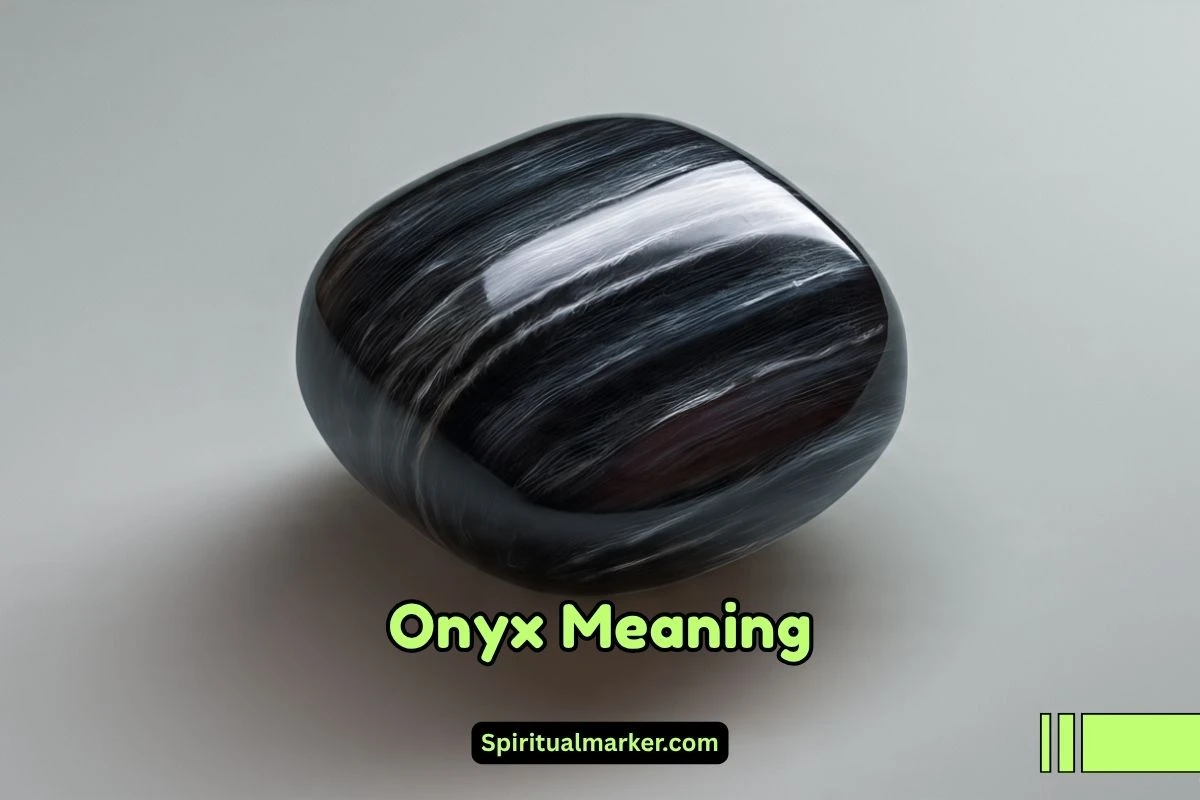
Have you ever picked up a piece of onyx and felt something shift inside you? Many people describe holding it as grounding. The stone feels solid, smooth, and quietly commanding in a way that few gemstones match.
Onyx has carried spiritual weight for thousands of years. Ancient warriors carried it into battle. Healers placed it on the body to draw out illness. Priests carved it into sacred objects. Across dramatically different cultures and centuries, onyx consistently appeared wherever strength, protection, and spiritual seriousness mattered most.
Today, people still reach for onyx during difficult seasons. Some wear it for protection. Others use it for focus, emotional steadiness, or personal transformation. Its deep black color and dense, grounding energy give it a presence unlike softer, more emotionally delicate stones.
This article covers the full meaning of onyx, its healing properties, spiritual symbolism, historical background, and practical ways to use it in everyday life. You will also find guidance on wearing and caring for onyx jewelry while honoring both its physical beauty and energetic depth.
5 Key Takeaways
- Onyx primarily symbolizes protection, inner strength, emotional resilience, and personal power.
- Most spiritual traditions connect onyx with the root chakra and grounding energy.
- People commonly use onyx during grief, stress, emotional recovery, shadow work, and major life transitions.
- Onyx rates 6.5 to 7 on the Mohs hardness scale, making it durable enough for everyday jewelry.
- Wearing or carrying onyx may strengthen feelings of emotional stability, mental clarity, and quiet confidence.
What Is Onyx?
Onyx is a banded variety of chalcedony, which belongs to the quartz family. It forms in parallel layers, creating a distinct banded appearance. Pure black onyx is the most widely known variety, though the stone also appears in white, brown, red, and multi-banded forms.
The version most people recognize is black onyx. Its color comes from the way carbon-based inclusions settle into the silica structure during formation. This gives it a smooth, opaque finish and a deep, almost absorptive quality that draws the eye inward.
Many people confuse onyx with other black stones like obsidian, black tourmaline, or jet. However, onyx has a distinct mineral structure and a more even, silky texture compared to volcanic obsidian. Spiritually, onyx also carries a noticeably different energy. Where obsidian feels sharp and cleansing, onyx feels structured and deeply stabilizing.
Its hardness makes it practical for carving. Artisans have shaped onyx into cameos, seals, amulets, goblets, and decorative tiles throughout history. That combination of physical durability and deep symbolic meaning explains why onyx has endured as a culturally significant stone across so many civilizations.
Origins and Formation
Onyx forms through the deposition of silica within volcanic rock cavities. Hot silica-rich water circulates through these spaces and slowly deposits mineral layers. Over time, alternating bands of different minerals create the layered structure characteristic of banded onyx.
The word “onyx” comes from the ancient Greek word meaning “claw” or “fingernail.” According to one mythology, the stone originated when Cupid trimmed the fingernails of the sleeping goddess Venus. The clippings fell into a river and transformed into onyx. This origin story, however poetic, reflects how deeply the ancient world connected the stone with divine energy.
Major onyx sources include India, Brazil, Mexico, Madagascar, the United States, and Pakistan. India has historically produced some of the finest black onyx specimens. Brazilian deposits often yield the banded variety used in decorative arts and cameo carving.
The stone’s formation process reinforces many of its symbolic qualities. Onyx builds itself layer by layer through consistent geological pressure over massive timescales. This mirrors its spiritual associations with patience, resilience, and gradual personal development.
Key Properties
| Property | Details |
|---|---|
| Primary Color | Deep black, also white, brown, red, banded |
| Composition | Banded chalcedony (quartz family) |
| Hardness | 6.5 to 7 on the Mohs scale |
| Chakra Association | Root chakra (primarily), solar plexus |
| Primary Symbolism | Protection, strength, grounding, resilience |
| Common Sources | India, Brazil, Mexico, Madagascar, USA |
| Transparency | Opaque |
| Energy Style | Grounding, stabilizing, empowering |
Historical Use of Onyx
Few gemstones carry as long or as geographically widespread a history as onyx. Archaeological evidence places it in ancient Egyptian tombs, Greek temples, Roman military regalia, and early Christian artwork. That reach across civilizations speaks to something universally resonant about the stone.
Ancient Egyptians used onyx extensively. They carved it into vessels, jewelry, and sacred amulets. Egyptian priests believed onyx could absorb and neutralize negative energy. They placed it strategically in tombs to protect the dead from harmful forces during the journey into the afterlife.
In ancient Rome, onyx became closely associated with military strength. Soldiers wore onyx amulets engraved with the face of Mars, the god of war, believing the stone would activate courage in battle. Roman craftsmen also prized onyx for creating cameo portraits, a practice that later spread through Renaissance Europe.
Greek philosophers and healers referenced onyx in early medicinal texts. They believed black onyx strengthened the heart, sharpened mental clarity, and improved physical endurance. Some texts connected it with dream work, suggesting the stone influenced the quality and meaning of sleep.
In Islamic tradition, onyx carried significant spiritual value. The Prophet Muhammad reportedly wore an onyx ring engraved with sacred scripture, a practice that influenced the widespread use of engraved onyx seals throughout the Islamic world for centuries.
Biblical references to onyx appear in the Book of Exodus, where the stone is listed among those set into the priestly breastplate of Aaron. This religious context elevated onyx far beyond decorative use, placing it within sacred ceremonial tradition.
5 Spiritual Meanings of Onyx
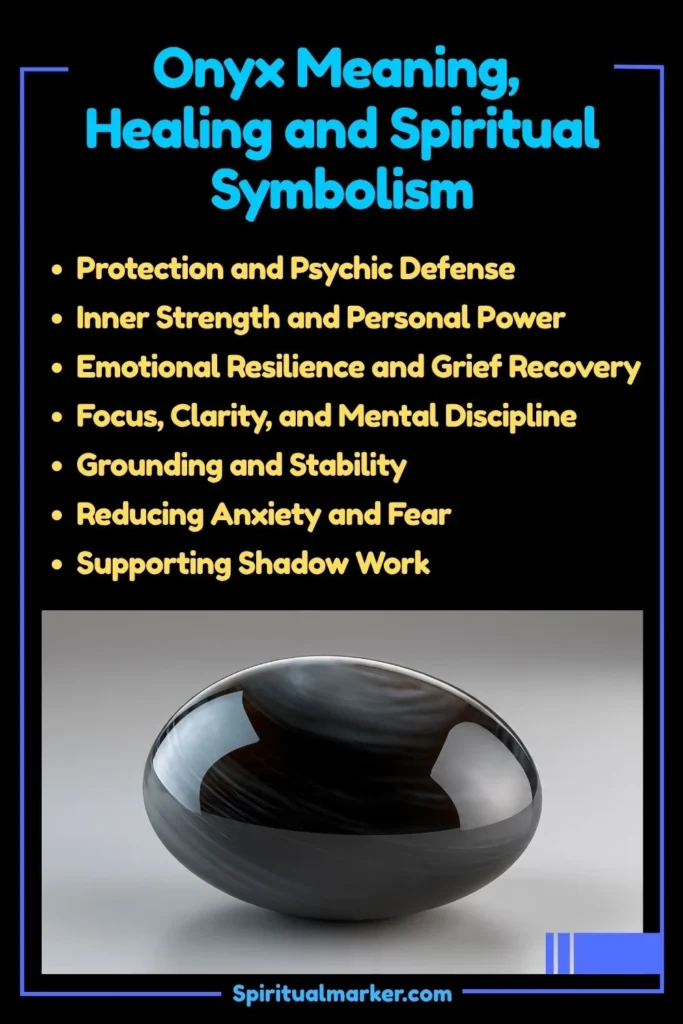
1. Protection and Psychic Defense
Protection stands as the most universally recognized spiritual meaning of onyx across nearly every culture that has worked with the stone. From ancient Egyptian priests to medieval European nobles, people have consistently viewed onyx as a shield against harmful energy, negative influence, and psychic interference.
This protective symbolism feels especially relevant today. Many people live in emotionally and energetically demanding environments. Social stress, difficult relationships, emotional manipulation, and constant overstimulation can quietly drain personal energy without obvious warning signs. Spiritually, onyx is believed to create a protective boundary between a person’s inner energy and external pressures.
Many crystal healers describe onyx as an “energetic absorber.” Rather than simply deflecting negative energy outward, the stone is believed to absorb it and neutralize it before it settles into the person carrying the stone. This absorption quality connects directly to onyx’s dense, opaque appearance. Nothing passes through it visually, and many practitioners believe nothing harmful passes through it energetically.
Protection in the onyx tradition is not passive. It does not symbolize hiding or avoidance. Instead, it represents active energetic defense. Warriors carried it. Priests used it. Leaders wore it. Its protective meaning has always been associated with people who face real challenges, make difficult decisions, and need steady inner fortification rather than spiritual escape.
This symbolism also extends to psychic and spiritual protection. Many metaphysical traditions teach that certain environments, relationships, or spiritual practices can leave a person feeling energetically depleted or vulnerable. Onyx is often recommended during spiritual development work, energy healing, or situations where a person may feel unusually drained by others. Its grounding energy is believed to anchor personal energy securely during those exposures.
For people who identify as empaths or highly sensitive individuals, onyx holds particular protective significance. Empaths frequently absorb the emotional states of those around them, sometimes without recognizing the source of their own emotional shifts. Spiritually, onyx is thought to help establish clearer energetic boundaries without requiring emotional withdrawal or relational disconnection.
2. Inner Strength and Personal Power
Onyx consistently symbolizes inner strength because its energy is deeply associated with resilience, discipline, self-mastery, and personal empowerment. Unlike gentler healing stones focused primarily on softness and emotional release, onyx carries a more grounded, fortifying quality. Its meaning centers on building internal resources rather than simply soothing emotional discomfort.
People frequently describe feeling more mentally firm when carrying or wearing onyx regularly. This quality is not about aggression or dominance. It refers to a quieter form of strength that develops through emotional steadiness, mental clarity, and a stable sense of self even during turbulent external circumstances.
The stone’s connection to inner strength becomes particularly meaningful during prolonged hardship. Grief, illness, financial instability, relationship breakdown, and career upheaval all create sustained emotional pressure. Short-term emotional support matters, but onyx spiritually represents the deeper resilience required to remain functional, focused, and emotionally intact across longer periods of difficulty.
Many practitioners connect onyx with self-discipline because the stone’s grounding energy naturally supports structured thinking and intentional behavior. Where emotional instability scatters attention and weakens follow-through, onyx symbolizes the internal steadiness that allows people to commit to goals, maintain habits, and exercise personal agency even when emotions feel chaotic.
Personal power, in the onyx tradition, means something specific. It refers to sovereignty over one’s own emotional and mental responses rather than power over external people or situations. This makes onyx particularly valuable for individuals who tend toward emotional reactivity, impulsive decision-making, or emotional patterns driven by fear, anxiety, or insecurity.
Some traditions also associate onyx with confronting personal shadow material. Shadow work involves examining the parts of yourself that feel uncomfortable, suppressed, or socially unacceptable. This kind of internal work requires significant inner strength because it often surfaces shame, unresolved grief, or deeply conditioned emotional patterns. Onyx spiritually represents the courage required to engage that process with honesty and stability.
3. Emotional Resilience and Grief Recovery
Emotional resilience forms one of onyx’s most personally meaningful spiritual associations. The stone has been connected with grief, mourning, and emotional endurance across several ancient traditions. In some cultures, mourners wore black onyx jewelry as a symbol of carrying loss with dignity. This practice embedded the stone deeply in the emotional vocabulary of grief and recovery.
Resilience differs from toughness. Toughness often means emotional suppression. Resilience means feeling difficult emotions fully while maintaining the internal stability to continue functioning, healing, and growing. Onyx spiritually represents this distinction clearly. Its meaning does not center on avoiding pain but on developing the emotional depth to move through pain without breaking down entirely.
People experiencing grief often describe feeling unmoored from their own sense of self. Loss disrupts identity, routine, purpose, and emotional security in ways that smaller stresses rarely do. The weight of onyx and its grounding energy symbolize emotional anchoring during that disorientation. Many mourners throughout history found comfort in carrying something physically solid and symbolically powerful during periods when their inner world felt unstable.
Onyx also symbolizes processing grief with dignity. Many people feel pressured to recover from loss faster than their emotional system allows. Social pressure, professional expectations, and personal self-judgment can transform grief into an additional source of shame. Onyx spiritually encourages a different relationship with loss, one that honors emotional reality without demanding premature emotional closure.
Beyond grief, onyx’s connection to emotional resilience applies to recovery from emotional trauma, prolonged anxiety, relationship wounds, and burnout. These experiences share a common thread. They quietly erode emotional stability and the sense of personal strength over time. Onyx symbolizes the rebuilding of that internal foundation through patience, groundedness, and emotional honesty rather than forced positivity.
Many practitioners place onyx near the root chakra during healing work because root chakra imbalances often manifest as emotional instability, fear, insecurity, and disconnection from personal identity. Strengthening root chakra energy through grounding practices and supportive stones like onyx is believed to gradually restore the emotional steadiness that trauma and grief weaken.
4. Focus, Clarity, and Mental Discipline
Onyx carries a well-established reputation for supporting mental focus and cognitive clarity within spiritual and metaphysical traditions. While many healing stones emphasize emotional or spiritual qualities, onyx holds particular significance for people who struggle with mental scatter, chronic distraction, decision fatigue, or difficulty maintaining concentration during stressful periods.
This quality connects directly to the stone’s grounding energy. Grounding is often understood primarily as a physical or emotional state, but it also has significant implications for mental clarity. When people feel ungrounded, the mind tends toward scattered thinking, impulsive decision-making, heightened anxiety, and difficulty prioritizing effectively. Onyx spiritually symbolizes the mental steadiness that returns when inner energy feels rooted and stable.
Many students, professionals, creative workers, and spiritual practitioners use onyx during intellectually demanding tasks because they believe it strengthens sustained attention. Its dense, absorptive energy is thought to quiet mental noise rather than amplify thought, which differs meaningfully from more stimulating stones like citrine or carnelian.
Decision-making becomes particularly difficult during emotionally turbulent periods. Fear, grief, stress, and emotional confusion cloud judgment in ways that can lead to impulsive choices or prolonged indecision. Onyx spiritually represents mental clarity that persists even under emotional pressure. This makes it meaningful for people navigating major life decisions during uncertain or emotionally charged circumstances.
The stone’s historical use by rulers, military leaders, and scholars reflects this association. People who held serious responsibility and needed reliable judgment under pressure consistently chose onyx as a symbolic and spiritual companion. That pattern across unrelated cultures suggests something genuine in how people experience the stone’s influence on mental focus.
Onyx is also frequently connected with overcoming mental habits rooted in fear or negative thought patterns. Anxious thinking, catastrophizing, and self-defeating internal narratives all interfere with clear perception and effective action. Spiritually, onyx is believed to help interrupt these patterns by strengthening the part of the self that can observe thoughts without becoming entirely controlled by them.
5. Grounding and Stability
Grounding represents the foundation of onyx’s spiritual identity. While many crystals reach upward toward spiritual expansion, intuitive development, or emotional opening, onyx points consistently downward toward earth, body, stability, and physical presence. This downward orientation is not a limitation. It is a strength that makes onyx uniquely valuable across an enormous range of healing and spiritual contexts.
Grounding in spiritual traditions refers to maintaining a stable connection with physical reality, present-moment awareness, and the body’s own rhythms while engaging with emotional, mental, or spiritual processes. Without grounding, spiritual development can create emotional disorientation, heightened anxiety, detachment from daily life, or an unsettling sense of floating without anchor.
Onyx’s connection to the root chakra reinforces this grounding symbolism. The root chakra governs fundamental needs including physical safety, financial security, personal identity, and a sense of belonging. When this energy center feels blocked or depleted, anxiety, instability, survival fear, and existential insecurity tend to surface. Onyx spiritually supports root chakra health by providing an energetically stabilizing influence that reinforces the body’s relationship with the earth.
Many people describe feeling more present in their bodies after carrying or meditating with onyx. This embodied awareness matters greatly for people who experience dissociation, anxiety-driven mental overthinking, or emotional numbing as responses to stress. Grounding does not eliminate emotional difficulty, but it creates a stable platform from which those difficulties become more manageable.
Stability, as symbolized by onyx, also reflects consistency over time. Many gemstones are associated with dramatic shifts, intuitive flashes, or transformative breakthroughs. Onyx represents the steadier work of building lasting inner stability through consistent grounding practices, emotional honesty, and patient personal development. This slower, more structural energy makes onyx especially meaningful for long-term personal transformation.
Physically, onyx was historically placed beneath the feet or held during meditation as a direct grounding practice. Some traditions recommended standing on onyx tiles during prayer or ceremony because practitioners believed the stone connected human energy with earth energy more effectively than most other materials. That physical grounding practice reflects how seriously ancient cultures took the stone’s stabilizing properties.
6 Healing Properties of Onyx
1. Strengthening the Root Chakra
Onyx is one of the most frequently recommended stones for root chakra work because its grounding energy aligns so directly with that energy center’s core functions. The root chakra, located at the base of the spine, governs physical security, personal identity, basic survival instincts, and the sense of being safely rooted in the world. When this chakra functions well, people tend to feel calm, confident, physically stable, and emotionally secure.
Root chakra imbalances often appear as chronic anxiety, existential fear, difficulty trusting others, financial insecurity worries, emotional volatility, and a persistent sense of not belonging. These experiences may stem from childhood instability, trauma, prolonged stress, or significant life disruptions that shook a person’s sense of safety at a foundational level.
Many practitioners place black onyx directly on the base of the spine or at the feet during chakra balancing sessions. The stone’s dense, absorptive energy is believed to draw excess anxiety downward and out of the system while simultaneously reinforcing a stronger connection with stabilizing earth energy. This dual action of releasing and grounding forms the heart of onyx’s root chakra healing reputation.
Regular root chakra work with onyx is also believed to gradually improve emotional regulation. When the root feels secure, the entire emotional and energetic system tends to function more smoothly. Emotional responses become less extreme, anxiety decreases in intensity, and the capacity to tolerate uncertainty improves significantly over time.
2. Reducing Anxiety and Fear
Anxiety often lives in the body before it reaches conscious awareness. Tension, shallow breathing, a contracted chest, tight shoulders, and an overactive mind all reflect the physical dimension of fear that anxiety creates. Onyx’s grounding influence is believed to work partly through the body’s nervous system, encouraging physical relaxation that then supports calmer mental states.
Many crystal practitioners keep onyx nearby during situations that typically trigger anxiety. Job interviews, difficult conversations, medical appointments, financial decisions, and social situations all carry anxiety-producing potential. Onyx is thought to provide a stabilizing energetic presence during those exposures, helping a person remain more grounded and less overwhelmed by fear.
Its symbolism of protection reinforces this anxiety-reducing quality. Fear of the unknown, fear of judgment, fear of failure, and fear of abandonment all have a quality of psychological exposure at their core. Onyx spiritually represents a kind of inner armor that does not eliminate fear but reduces the sense of total vulnerability that fear often creates.
Some traditions specifically associated onyx with overcoming fear of death. Ancient Egyptians placed it in tombs not only to protect the deceased but also to comfort the living by symbolizing that even the most profound human fear could be met with grounded spiritual strength. That historical context gives onyx a depth of meaning in anxiety work that extends far beyond everyday stress.
3. Supporting Shadow Work and Self-Awareness
Shadow work has gained increasing recognition in psychological and spiritual communities because of its role in genuine emotional healing. The concept, originally developed by psychiatrist Carl Jung, refers to engaging with the unconscious parts of the self that have been suppressed, denied, or disowned through social conditioning, trauma, or shame.
Onyx’s deep black color has long been associated with darkness and depth, not in a threatening sense but in a symbolic one. Darkness represents what lies beneath conscious awareness. Working with onyx during shadow integration is believed to support the courage and emotional stability required to examine suppressed material honestly.
Many practitioners use onyx during journaling, dreamwork, therapy, or reflective meditation focused on shadow exploration. The stone’s grounding energy is thought to prevent the emotional overwhelm that shadow material can sometimes trigger. It provides stability while difficult truths surface. Onyx does not soften the truth, but it steadies the person receiving it.
Shadow work ultimately builds self-awareness in ways that surface-level self-reflection rarely achieves. Recognizing unconscious patterns, emotional triggers, defense mechanisms, and conditioned beliefs requires both courage and stability. Onyx spiritually provides that stable foundation from which honest self-examination becomes possible and productive rather than destabilizing.
4. Improving Concentration and Memory
Ancient Greek texts mentioned onyx as a stone that sharpened the mind. Modern crystal practitioners continue this association, often recommending onyx for people who struggle with attention, memory, mental fatigue, or cognitive distraction.
The stone’s grounding quality is central to this property. Scattered mental energy and poor concentration frequently stem from ungrounded states. When attention constantly leaps between worries about the future and regrets from the past, focus becomes impossible. Onyx symbolically anchors attention to the present moment and the task at hand.
Many students place onyx on their desks during study sessions. Writers keep it near their workspaces. Professionals carry it during periods of high cognitive demand. The stone’s steadying presence is believed to slow mental fragmentation and support the kind of sustained attention that learning and creative work require.
Memory in spiritual traditions is also connected with groundedness. Trauma, anxiety, and emotional dissociation all interfere with memory encoding and recall. By supporting a more grounded and present mental state, onyx may indirectly support clearer memory function as well.
5. Physical Vitality and Endurance
Historical healing traditions across multiple cultures associated onyx with physical strength and endurance. Ancient Romans believed it improved stamina in battle. Medieval physicians referenced it in texts about strengthening the heart. Some traditions connected it with improving kidney and bone health, though these claims reflect historical belief systems rather than clinical medicine.
In modern crystal healing, onyx is still associated with physical grounding and vitality. Practitioners sometimes use it during recovery from illness, physical exhaustion, or prolonged fatigue. The stone’s root chakra connection links it with the body’s foundational physical energy, the kind that supports basic biological function rather than heightened stimulation.
Athletes, laborers, and people engaged in intensive physical training have historically reached for onyx as a symbolic support for endurance and physical discipline. This reflects the stone’s broader identity as a stone of sustained effort rather than quick bursts of energy.
Some practitioners place onyx on the soles of the feet during energy healing sessions because the feet connect most directly with earth energy. Grounding through the feet is believed to restore physical vitality that stress, illness, or emotional depletion has quietly drained over time.
6. Building Confidence and Overcoming Self-Doubt
Self-doubt quietly undermines personal power in ways that external obstacles rarely can. A person may possess genuine talent, emotional intelligence, and valuable skills while remaining paralyzed by the internal belief that those qualities are insufficient. Onyx’s spiritual association with personal power and inner strength directly addresses this pattern.
Many people who struggle with confidence describe a pervasive internal instability. They second-guess decisions. They minimize their accomplishments. They shrink from conflict even when they recognize they deserve better treatment. This emotional pattern often traces back to unresolved root chakra energy, early experiences of instability, or prolonged exposure to emotionally demeaning environments.
Onyx symbolically interrupts this pattern by reinforcing the energetic experience of being grounded in one’s own identity. When you feel internally stable and rooted, external criticism, social comparison, and the fear of failure lose some of their destabilizing power. You begin operating from a place of genuine personal authority rather than constant emotional reactivity to perceived threats.
Many practitioners recommend wearing onyx as a daily reminder of personal strength. Its physical weight and cool solidity can serve as a tactile anchor during moments of self-doubt. When anxiety or insecurity rises, simply holding onyx or feeling it against the skin can reactivate awareness of inner stability.
How to Wear Onyx Jewelry for Spiritual Growth
People wear onyx jewelry in several different ways depending on their intentions and personal energy needs. Because onyx connects primarily with the root chakra and grounding energy, bracelets and rings that maintain regular skin contact are especially popular choices.
Onyx bracelets worn on the left wrist are commonly associated with receiving the stone’s energy inward. Many practitioners believe the left side of the body is more receptive to incoming energy, making it a natural placement for stones intended to support personal healing, grounding, or emotional stability.
Onyx rings carry historical significance dating back thousands of years. Ancient cultures engraved onyx rings with protective symbols, names, and sacred imagery. Wearing an onyx ring today continues this tradition of carrying the stone’s protective and empowering energy into daily interactions.
Onyx pendants and necklaces sit close to the solar plexus when worn at mid-chest length. Many practitioners choose this placement for its connection with personal power, self-confidence, and emotional courage. Longer pendants that rest near the lower abdomen bring the stone even closer to root chakra territory.
Some people carry loose onyx stones in pockets or bags during the day. This allows for intentional physical contact during stressful moments without the permanence of wearing jewelry throughout an entire day.
Pairing onyx with complementary stones can deepen specific intentions. Clear quartz amplifies onyx’s grounding and protective qualities. Amethyst adds intuitive clarity to onyx’s mental focus energy. Labradorite combines onyx’s protection with heightened spiritual awareness. Red jasper reinforces root chakra work alongside onyx.
Caring for Onyx Jewelry
Onyx is relatively durable with a Mohs hardness of 6.5 to 7, which makes it more resistant to everyday wear than softer stones. However, it still benefits from thoughtful care to preserve its polish, depth of color, and overall structural integrity over years of use.
Store onyx separately from harder stones such as diamonds, sapphires, or topaz that could scratch its surface. Soft-lined jewelry pouches or individual compartments in a jewelry box work well for long-term storage.
Cleaning onyx works best with lukewarm water, mild soap, and a soft cloth. Rinse thoroughly and dry completely before storing. Avoid ultrasonic cleaners, steam cleaners, and harsh chemical solutions because these methods can affect the stone’s surface or internal structure over time.
Avoid prolonged exposure to direct sunlight because extended UV exposure may gradually lighten onyx’s rich black color. Remove onyx jewelry before swimming in chlorinated pools or natural bodies of water, before heavy exercise, and before applying lotions, perfumes, or cleaning products.
Many people who work with onyx spiritually also practice energetic cleansing. Common methods include placing the stone in moonlight overnight, using sound cleansing with singing bowls or bells, smudging near cleansing herbs such as sage, or burying the stone briefly in clean soil. Energetic cleansing intentions vary across different spiritual traditions and personal practices.
Table: Onyx Meaning at a Glance
| Aspect | Details |
|---|---|
| Primary Meaning | Protection, inner strength, grounding |
| Chakra Association | Root chakra (primary), solar plexus |
| Main Spiritual Symbolism | Resilience, personal power, psychic defense |
| Common Colors | Deep black, white, brown, banded |
| Hardness | 6.5 to 7 Mohs |
| Main Sources | India, Brazil, Mexico, Madagascar |
| Emotional Associations | Confidence, steadiness, courage, resilience |
| Popular Jewelry Types | Bracelets, rings, pendants, carvings |
| Spiritual Uses | Grounding, shadow work, protection, focus |
| Historical Connection | Egyptian, Roman, Greek, Islamic, Biblical |
A Final Note
Onyx stands apart from most gemstones because its energy asks something of you. It does not comfort through softness or enchant through sparkle. It grounds, stabilizes, and quietly demands that you meet yourself honestly.
Its spiritual meaning centers on protection, strength, emotional resilience, and personal power. Across thousands of years and dramatically different cultures, onyx earned its reputation through consistent use by people who faced real challenges and needed genuine inner fortification.
Whether you are drawn to onyx for its protective properties, its grounding energy, or its deep historical significance, the stone offers a kind of presence that feels different from more emotionally expressive crystals. It works beneath the surface. It builds slowly. It holds steady.
If onyx keeps appearing in your awareness, that connection may reflect something your current season requires. Strength during difficulty. Stability during uncertainty. Honest self-awareness during a period of personal transformation. You might wear it daily, hold it during reflection, or simply keep it nearby as a grounding presence during demanding periods.
The stone has been meeting people exactly where they are for millennia. It continues doing so today.