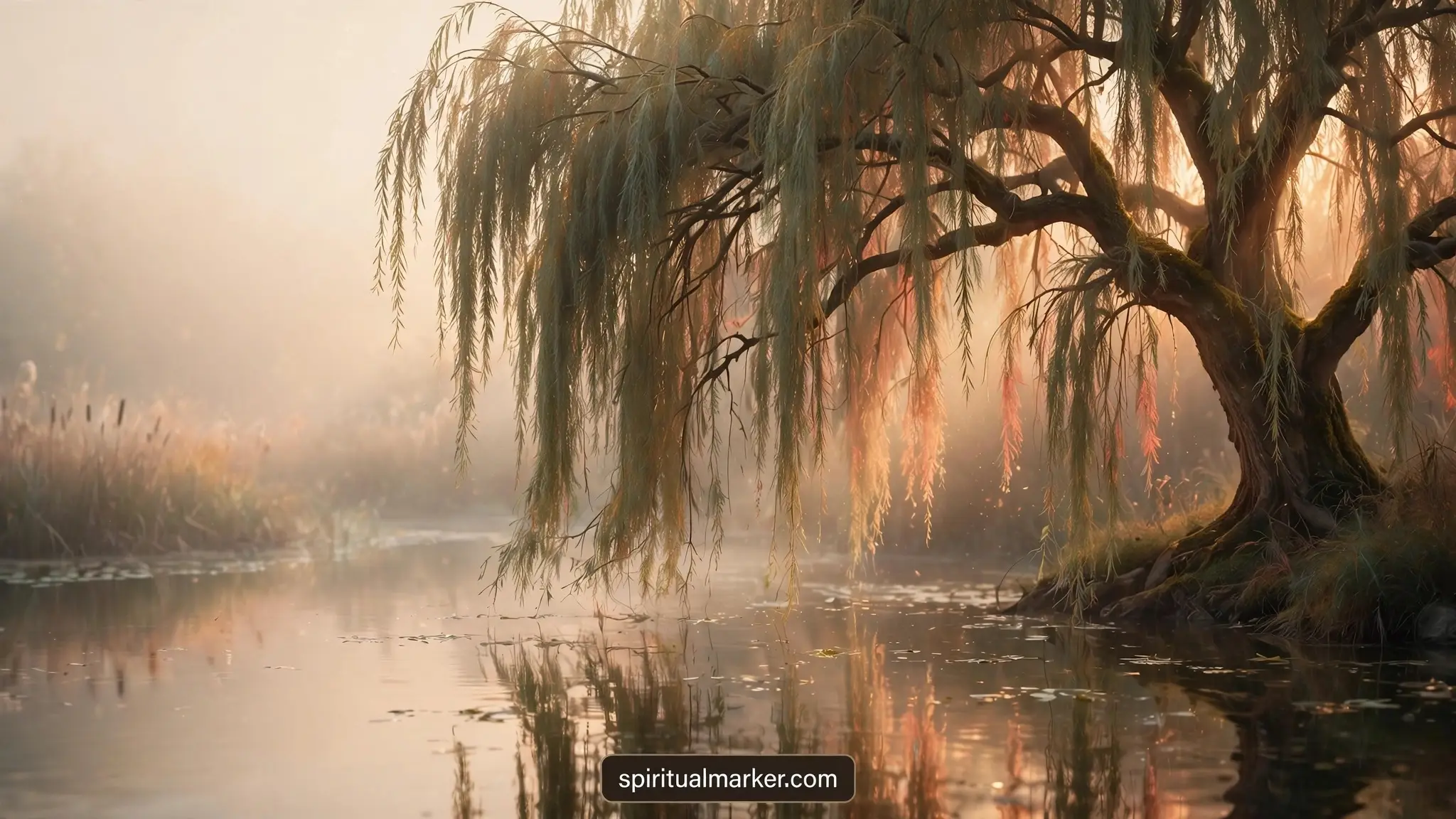
You have probably stood near a willow tree and felt something shift inside you. Something quiet. Something ancient. The long, sweeping branches that brush the earth, the way the whole tree seems to bow in perpetual reverence — it speaks a language older than words. People have sensed this for thousands of years. Across every continent and culture, the willow tree spiritual meaning has stirred the hearts of healers, poets, mystics, and grieving souls alike.
The willow tree symbolism is not simple. It carries contradictions within its bark. It stands for grief and for healing, for flexibility and for endurance, for the depths of intuition and the heights of spiritual vision. Few trees in the natural world hold so many layers of sacred meaning. This is precisely why the spiritual significance of the willow tree continues to captivate spiritual seekers, nature lovers, and those walking through seasons of personal transformation.
Whether you encountered a willow tree in a dream, feel drawn to plant one in your garden, or simply noticed one during a walk near water, your instinct to pause and pay attention is worth trusting. The willow is speaking. This post will help you hear exactly what it says — through mythology, scripture, cultural traditions, dream symbolism, and deep spiritual reflection.
Key Takeaways
- The willow tree represents resilience through surrender. Its branches bend dramatically in the storm but never break. This teaches a powerful spiritual lesson — true strength comes from flexibility, not rigidity.
- The willow is deeply connected to water and emotional healing. It grows near rivers, lakes, and streams. Spiritually, water governs emotion, intuition, and the subconscious. The willow bridges the physical and emotional worlds.
- Across cultures, the willow symbolizes both death and rebirth. Ancient Chinese, Celtic, and Egyptian traditions all recognized the willow as a guardian of the cycle of life — a tree that stands at the threshold between worlds.
- The willow tree holds strong ties to feminine energy and the moon. Many traditions link the willow to lunar cycles, the goddess, and the divine feminine — making it a powerful symbol for intuition, creativity, and inner wisdom.
- Dreaming of a willow tree carries its own layered spiritual message. Whether the tree in your dream appears weeping, standing tall, or near water, each variation brings a specific spiritual insight about your current emotional and spiritual state.
What Is the Willow Tree and Why Does It Hold Spiritual Power?
The willow tree belongs to the genus Salix, which includes over 400 species. Most grow near water — beside rivers, along lake shores, and in marshlands. The weeping willow (Salix babylonica) is the most recognizable, with its cascading branches that seem to pour downward like a waterfall frozen in time. People plant willows in graveyards, gardens, and alongside meditation paths — often without knowing why. The pull is instinctive.
The spiritual power of the willow tree comes from several unique qualities. First, it regenerates with extraordinary force. Cut a willow branch and place it in water — it will root and grow a new tree. This biological trait carries enormous symbolic weight. Death becomes a doorway. Loss becomes the beginning of something new. Second, the willow bends under pressure without breaking. In a windstorm, the oak may stand rigid until it cracks; the willow sways, flows, and survives. Third, the willow’s deep connection to water places it firmly within the spiritual domain of emotion, healing, and the unconscious mind.
Ancient healers understood the physical power of the willow, too. The bark of the white willow (Salix alba) contains salicin, the natural compound from which aspirin was derived. Long before modern medicine, Indigenous peoples, Greek physicians, and Egyptian healers used willow bark to reduce fever and pain. This history deepens the willow’s identity as a tree of healing — one that mends both the body and the spirit. When something holds physical and spiritual healing properties simultaneously, the spiritual traditions of the world take notice.
What Does the Willow Tree Symbolize and Represent Spiritually?
At its spiritual core, the willow tree symbolizes the courage to feel deeply. It does not stand apart from its emotions. It bends into them. It grows beside the water, not away from it. In this way, the willow teaches you that emotional depth is not weakness — it is wisdom. You feel grief, longing, love, and transformation more fully when you stop resisting them. The willow shows you how.
The weeping willow spiritual meaning specifically connects to grief, mourning, and the dignity of sorrow. Its drooping branches have long reminded people of bowed heads and tearful eyes. Yet the willow does not stay broken. After every storm, it rises again. This is the central spiritual paradox of the willow: it is the tree of sorrow and the tree of resilience living inside the same bark. Many people plant willows on the graves of loved ones precisely because of this dual meaning.
Beyond grief, the willow tree represents intuition and psychic sensitivity. Its close bond with water links it to the moon, to dreams, and to the unseen world. Many witches, shamans, and intuitive healers throughout history have used willow wood in their practices — carving wands, weaving branches into ritual circles, and burning willow in sacred fires. The willow is considered a tree that thins the veil between this world and the next, making it a powerful tool for those who seek deeper spiritual sight.
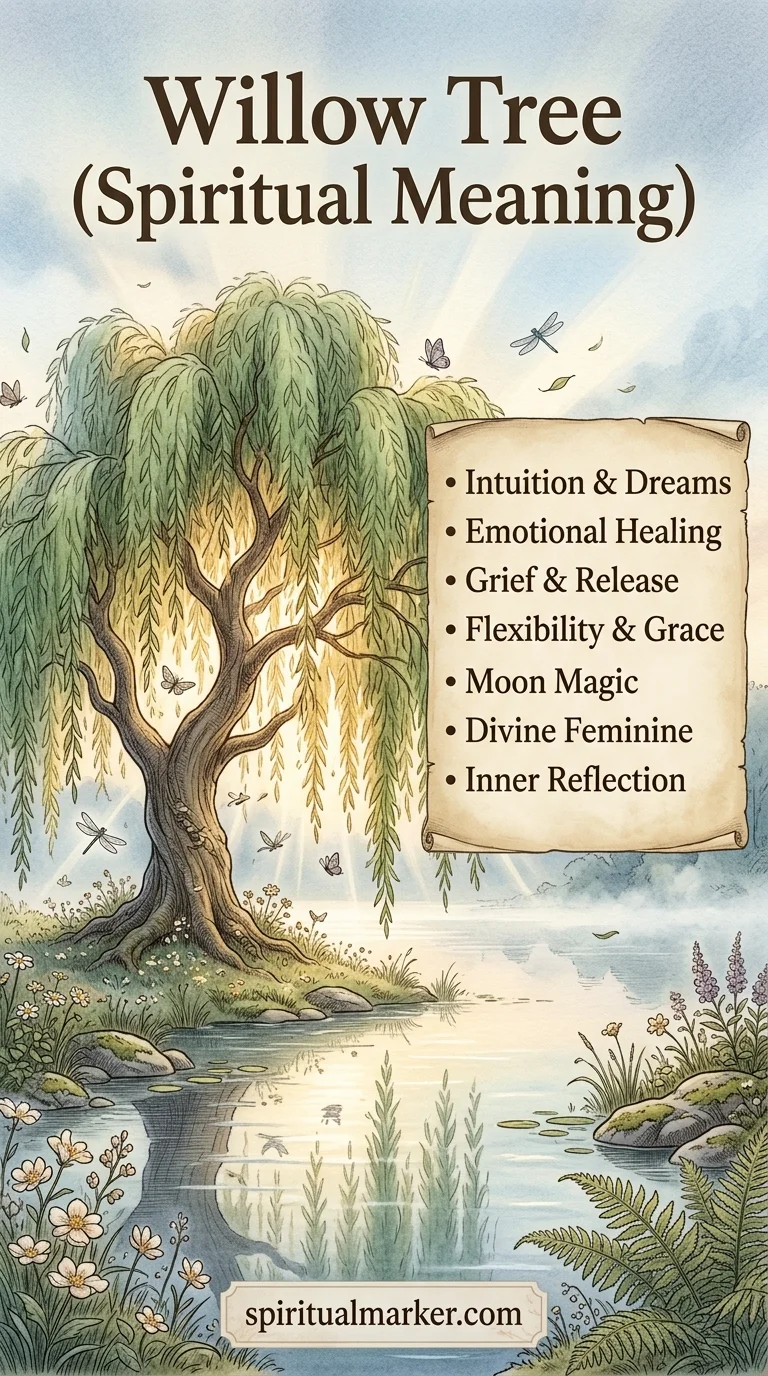
7 Spiritual Meanings of the Willow Tree
1. Resilience and Adaptability
The first and most celebrated spiritual meaning of the willow tree is resilience. Watch a willow in a storm and you will never forget what you see. The branches whip violently in every direction. The whole canopy becomes a blur of motion. Yet when the storm passes, the willow stands whole. Not a single branch breaks. This is not weakness — it is mastery. The willow has learned what rigid trees never will: that bending is how you survive.
Spiritually, this quality speaks directly to your inner life. Life will bring storms — loss, failure, illness, heartbreak, and seasons of profound uncertainty. The willow asks you to develop the same quality of flexible strength. Do not become brittle in your beliefs, your relationships, or your sense of self. Stay rooted in your core values while remaining open to movement, change, and redirection. This is the spiritual art of adaptability.
Many spiritual teachers across Buddhism, Taoism, and Indigenous traditions point to the willow as a model for what the Tao calls “wu wei” — effortless action, flowing with life rather than against it. The willow does not fight the wind. It dances with it. When you align with life’s natural current rather than resisting it, you conserve enormous spiritual energy. That energy then becomes available for healing, creativity, and deeper connection with the divine.
On a personal level, the willow tree teaches you that your seasons of bending are not failures. They are training. Every time life brings you to your knees and you rise again, you are becoming more willow-like. Your roots deepen. Your capacity for endurance grows. The willow honors every storm you have survived and reminds you that you are stronger than you know.
2. Emotional Healing and the Power of Grief
The weeping willow spiritual meaning is perhaps the most emotionally resonant of all its symbolic layers. For centuries, people have placed willow branches on graves, woven them into mourning wreaths, and planted willow trees in memorial gardens. The tree’s drooping silhouette mirrors the posture of a person in grief — head bowed, shoulders curved, tears falling. The willow does not pretend grief is not real. It gives grief a shape, a home, and a witness.
Yet the willow also teaches that grief is not permanent. The same branches that weep in winter bud with fresh green life in spring. The same tree that stands beside the grave also shelters new nests, blooms with catkins, and breathes oxygen into the world. The willow holds both realities at once — the depth of loss and the certainty of renewal. This is a profoundly spiritual message for anyone navigating bereavement, endings, or profound sadness.
Emotionally, the willow reminds you that feeling grief fully is part of healing. Modern culture often urges people to move on quickly, to stay positive, to push through pain. The willow disagrees. It says: let your branches fall. Let the tears come. Honor the weight of what you have lost. Spiritual traditions from the Celtic world to Native American culture affirm this truth — grief is sacred. It is the price of love, and the willow holds that truth without flinching.
Willow bark tea and willow flower essences have been used in herbal and energetic medicine specifically to help people process emotional wounds. The Bach Flower Remedy “Willow” addresses feelings of resentment, bitterness, and self-pity. Dr. Edward Bach identified the willow as the remedy for those who feel life has treated them unfairly. Taking the remedy, or simply meditating near a willow tree, can help release these stuck emotional patterns and restore a sense of faith in life’s larger unfolding.
3. Intuition and Psychic Awareness
The willow tree’s connection to water makes it one of nature’s most powerful symbols of intuition. Water governs the emotional and psychic realms in nearly every spiritual tradition. The moon pulls the tides, and the moon also governs dreams, cycles, and the subconscious mind. Because the willow grows where water flows, it sits precisely at the intersection of the visible and invisible worlds. Many traditions treat it as a tree that opens spiritual sight.
In the practice of dowsing, willow branches have been used for centuries to locate underground water sources. The dowser holds a forked willow branch loosely and walks slowly across land. When the branch dips toward the ground, water is believed to lie beneath. Whether one accepts the science or not, the spiritual symbolism is unmistakable — the willow is used to find what is hidden. It reveals the invisible. It points toward what cannot be seen with the naked eye.
Celtic druids considered the willow tree one of the seven sacred trees of their tradition. They placed it under the governance of the moon and linked it to heightened psychic perception, prophetic dreams, and the ability to receive messages from the spirit world. Willow wands were carved for magical and divinatory use. Sleeping under a willow or placing willow leaves beneath your pillow was believed to invite vivid, meaningful dreams — windows into spiritual truth that the waking mind cannot access.
If you feel drawn to the willow tree, pay attention to your own intuition. The willow’s appearance in your life — whether physically, in a dream, or simply as a recurring image — may signal that your psychic and intuitive gifts are awakening. Trust your inner knowing more. Spend time near water. Create space for silence, for dreams, for the quiet inner voice that speaks beneath the noise of daily life. The willow is your spiritual invitation to go deeper.
4. Death, Rebirth, and the Cycle of Life
Few trees in human spiritual history have stood so consistently at the threshold between life and death as the willow. Ancient Egyptians planted willows near tombs. Greeks associated the willow with Persephone, goddess of the underworld, and with Hecate, the goddess of magic and crossroads. The Celts saw it as a tree that grew between worlds. Japanese spiritual traditions placed the willow at the boundary of the living and the dead. This is not coincidence — it is convergent spiritual wisdom.
The willow earns this association through its biology. A cut willow branch placed in soil or water will root itself and grow an entirely new tree. This is one of the most dramatic examples of vegetative regeneration in the plant kingdom. The old tree dies, yet from its body, new life springs forward. This biological miracle maps perfectly onto the spiritual concept of rebirth — the soul that passes through death and emerges transformed, renewed, and reborn into a higher form of existence.
For those walking through major life transitions — the end of a relationship, the death of a loved one, a career collapse, a spiritual crisis — the willow offers a radical message of hope. What feels like death may be the beginning of your most profound renewal. The willow does not mourn the branch that falls. It grows three more in its place. Your losses, your endings, and your seasons of grief may be the very soil in which your next chapter is already taking root.
In the language of nature’s spiritual symbolism, the willow asks you to trust the cycle. Autumn must come before spring. The seed must break open before the shoot can emerge. Death is woven into the fabric of growth, and the willow guards that truth with breathtaking grace. Meditating near a willow tree during times of personal loss or transition can help you align with this ancient cycle and find peace within what feels like dissolution.
5. Feminine Energy and Lunar Connection
The willow tree holds one of the strongest spiritual connections to feminine energy and the divine feminine of any tree in the natural world. Its fluid form, its connection to water, its monthly relationship with the lunar cycle through the timing of catkin production, and its historical association with goddesses across cultures all mark it as a deeply feminine symbol. This does not make it exclusive to women — it speaks to the feminine principle within all beings: the capacity for deep feeling, nurturing, receptivity, and creative flow.
In Celtic mythology, the willow was sacred to the goddess Brigid in her aspect as healer and keeper of sacred wells. Water sources surrounded by willows were considered especially holy — places where prayers could be heard and healing could happen. The Greek goddess Artemis, ruler of the moon and the natural world, was also associated with willow groves. In ancient Sumerian texts, the goddess Inanna rested in the shade of a great willow tree — connecting the tree to divine feminine sovereignty and spiritual power.
The willow tree follows lunar cycles in its growth patterns, with peak sap flow and activity aligning with the full moon. Many practitioners of earth-based spirituality time their willow rituals, herb gathering, and willow wand carving with the full and new moon phases for this reason. The tree responds to lunar energy in its very biology, making it a natural altar for those who honor the moon and the rhythms of the natural world.
For anyone seeking to reconnect with their own inner feminine wisdom — regardless of gender — the willow tree is a powerful spiritual ally. Sit beneath a willow at dusk. Breathe slowly. Let your thoughts flow like water rather than marching like soldiers. Notice what arises — impressions, feelings, images, sudden knowing. This is the willow teaching you to receive, to sense, to trust what cannot yet be proven. That is the gift of the feminine principle, and the willow offers it freely.
6. Protection and Spiritual Warding
The willow tree has served as a spiritual protector in numerous traditions around the world. In China, willow branches are hung above doorways during the Qingming Festival and on the day before the Ghost Festival to ward off wandering spirits. The belief holds that willow wood and branches repel malevolent entities while allowing benevolent ones to pass freely. This places the willow in the role of spiritual gatekeeper — a tree that discerns what should and should not enter a sacred space.
In European folk magic, willow was used to bind spells of protection. Willow twigs were woven into protective talismans and placed at windows and thresholds. Witches and wise women in Britain used willow in protective charms for mothers during childbirth and for children during illness. The flexible nature of willow made it ideal for weaving — and weaving was itself a magical act, binding intention into physical form. A willow weaving carried protective spiritual intent in its very structure.
Shamanic traditions from Siberia to the Americas used willow in sacred healing ceremonies. Willow branches formed the frames of sweat lodges in some Native American traditions, literally building a sacred, protective container for the healing ritual within. The willow’s strength and flexibility made it the perfect material — a structure that yields under pressure but never collapses. This physical quality mirrors the spiritual protection the willow offers: yielding, adaptive, and ultimately unbreakable.
If you feel spiritually unprotected, energetically drained, or in need of a cleansing boundary, the willow tree may be calling to you. Carrying a small piece of willow wood, wearing willow flower essence, or meditating beneath a willow tree while setting clear spiritual intentions can help you reestablish energetic boundaries. The willow does not build walls — it weaves shields. That distinction matters. You remain open and connected to life while protected from what diminishes you.
7. Wisdom, Inner Growth, and Spiritual Maturity
The seventh spiritual meaning of the willow tree is one that reveals itself slowly, like the tree itself. Willows grow fast by tree standards, but they live long — some varieties for hundreds of years. They age into enormous, gnarled presences draped in flowing curtains of branches. An old willow carries a gravity and a majesty that younger trees simply have not earned yet. This aging into wisdom is itself a spiritual teaching about the value of deep inner growth over time.
Wisdom, the willow teaches, is not the same as knowledge. Knowledge collects facts. Wisdom integrates experience. Every storm the willow has survived, every flood it has stood in, every drought it has endured — all of it becomes part of its deep root system. The willow knows the land beneath it intimately because it has drawn water from every layer. Spiritually, this mirrors the kind of wisdom that only comes from living fully, feeling deeply, and allowing your experiences to root you rather than uproot you.
In the Ogham alphabet — the sacred tree alphabet used by Celtic druids — the willow is called Saille and is associated with the fifth lunar month. Its meaning in the Ogham tradition is specifically linked to inner knowing, the receptive mind, and the development of spiritual vision through emotional experience. The druids understood that the most penetrating spiritual wisdom comes not from the intellect alone but from the heart’s long encounter with life in all its beauty and pain.
The willow’s wisdom invites you to honor your own journey. Your experiences — especially the difficult ones — have not broken you. They have rooted you. Every year you have lived, every loss you have processed, every season of grief and renewal has deepened your root system. You know things now that cannot be found in any book. The willow recognizes that knowing and bows its branches in respect. You are wiser than you realize.
Willow Tree Meaning and Symbolism Across Cultures and Religions
The willow tree spiritual meaning appears with striking consistency across vastly different cultures and time periods, suggesting that the willow speaks a universal spiritual language. Each tradition brings its own nuance, but the core themes — healing, grief, the afterlife, water, and feminine power — recur with remarkable frequency around the globe.
In ancient China, the willow was one of the most beloved spiritual trees. It represented immortality and regeneration, largely because of its remarkable ability to regrow from a single cutting. Willow branches decorated homes during the Qingming (“Clear and Bright”) Festival, a celebration honoring ancestors and the renewal of spring. The Guanyin, the Buddhist bodhisattva of compassion, is often depicted holding a willow branch in one hand and a vase of pure water in the other — the willow channeling compassion and the water purifying all sorrow. This image powerfully combines the willow’s healing and emotional depth symbolism into a single sacred icon.
In ancient Egypt, the willow was sacred to Osiris, the god of death and resurrection. Egyptian myth tells that the body of Osiris, slain by his brother Set, was hidden within a great tree often identified as a willow. The tree grew so large and beautiful that it was made into a pillar of a king’s palace. When Isis, Osiris’s devoted wife, finally recovered his body, the willow became permanently associated with death, divine love, and resurrection. Willows were commonly planted near tombs, and willow garlands have been found in ancient Egyptian burial sites, confirming the tree’s sacred role in ushering souls to the afterlife.
In Japan, the willow appears throughout spiritual folklore as a tree that marks the boundary between the living and the dead. Japanese ghost stories frequently feature willows at crossroads and riverbeds — places where spirits linger between worlds. The yanagi (willow) is associated with the spirit world and with yurei (ghosts), particularly the spirits of those who died in grief or longing. Rather than viewing this as sinister, Japanese spiritual culture treats the willow as a compassionate witness to unresolved human emotion — a tree that holds space for spirits who have not yet found peace.
In ancient Greece and Rome, the willow was connected to several powerful goddesses. Hecate, goddess of magic, crossroads, and the moon, had sacred willow groves. Persephone, queen of the underworld, was associated with willows growing along the banks of the river Styx. Even Circe, the powerful sorceress of Homer’s Odyssey, was said to live in a grove that included willows. These associations placed the willow firmly in the realm of feminine divine power, magic, and the navigation of life’s deepest transitions.
Willow Tree Symbolism in World Mythologies
Beyond individual cultures, the willow tree mythology spans the entire globe with a consistency that points to something deeply encoded in human spiritual experience. The tree appears in creation stories, heroic journeys, and tales of love and loss with equal frequency.
In Celtic mythology, the willow is one of the most powerful of the nine sacred trees used in the ritual Beltane fire. The druids regarded the willow as the tree of enchantment and the keeper of deep mysteries. Its wood was used to make the cauldron — the symbol of rebirth, transformation, and feminine wisdom in Celtic spiritual life. The White Goddess, as described by the poet Robert Graves in his study of Celtic mythology, presides over the willow month (April to May), connecting it to poetry, inspiration, and the trance-like states through which druids received spiritual vision.
In Slavic mythology, the weeping willow was believed to grow from the tears of grieving mothers and widows. The tree absorbed human sorrow and transformed it into beauty. Touching a weeping willow was thought to transfer some of the tree’s capacity for endurance to the person in grief — a living exchange of spiritual strength between the human and the natural world. Slavic folk healers would collect willow bark and leaves specifically for those suffering from broken hearts or prolonged mourning, using the tree’s physical properties to mirror and magnify its spiritual ones.
In Mesopotamian mythology, the world’s first garden — the sacred garden of the gods in Sumerian cosmology — contained a great willow called the huluppu tree. In the myth of Inanna, this tree was planted by the Euphrates River. Inanna tended the huluppu tree with hopes of making a throne and a bed from its wood. The tree attracted a serpent, a storm bird, and a dark spirit — all symbols of challenges to sovereignty and spiritual power. Only after Gilgamesh helped Inanna clear the tree did she claim her full divine authority. The willow in this myth represents the growth process of the soul — the challenges and the clearing that must happen before full spiritual maturity is reached.
Willow Tree Biblical Meaning and Significance
The willow tree in the Bible carries potent symbolic meaning tied to exile, longing, worship, and spiritual faithfulness. The most famous biblical reference to the willow comes from Psalm 137, the heartbreaking psalm of the Babylonian exile. The psalm opens with the Israelites sitting beside the rivers of Babylon, their harps hung on willow trees. They cannot sing the songs of Zion in a foreign land. The willows in this passage become symbols of silenced worship, suspended joy, and the grief of spiritual displacement.
This passage has resonated with countless people across centuries and continents who have experienced spiritual exile — the feeling of being far from God, far from home, far from the life they were meant to live. The willows of Babylon became a universal image of sacred grief. Yet even here, the willow does not signal hopelessness. The Israelites did return. The harps were taken down from the trees. The songs were sung again. The willow witnessed both the grief and the restoration.
In the book of Leviticus (23:40), the willow appears in a joyful context. God commands the Israelites to take branches of willows of the brook as part of the Feast of Tabernacles (Sukkot) celebration. The willow branch is combined with palm, myrtle, and citron in the lulav bundle, waved during prayers of thanksgiving and blessing. In rabbinic interpretation, the willow represents those who have neither Torah knowledge nor good deeds — yet are still included in the community, still waved before God, still part of the whole. No one is excluded. Every soul has a place in the holy bundle.
In the book of Isaiah (44:4), the promise of spiritual renewal is described using the willow as a metaphor: “They shall spring up among the grass, as willows by the watercourses.” Here, the willow represents abundant spiritual life nourished by living water. The image speaks of people growing in righteousness and faith the way willows grow near rivers — naturally, powerfully, and with great vitality. The biblical willow is ultimately a tree of both sorrow and flourishing, exile and return, grief and grace.
The Willow Tree in Native American Spiritual Traditions
Many Native American tribes hold deep spiritual reverence for the willow tree, integrating it into ceremony, medicine, and daily spiritual life in meaningful ways. The willow’s presence near water, its medicinal bark, and its exceptional flexibility made it practically and spiritually indispensable to numerous nations across North America.
Among the Lakota people, the willow holds a particularly sacred role. The frame of the inipi (sweat lodge), used in one of the most important purification ceremonies, is traditionally built from willow branches. The willow’s flexibility allows it to be bent into the dome shape of the lodge without breaking. Spiritually, the willow frame represents the ribs of Grandmother Earth — the sacred container that holds the ceremony and protects those within. Participants emerge from the inipi spiritually cleansed and renewed, and the willow’s presence is central to that transformation.
The Ojibwe people used willow extensively in healing practices. Willow bark tea treated pain and fever, but the plant was also used in spiritual healing ceremonies addressing emotional and spiritual wounds. Willow was considered a plant ally that helped individuals release anger and resentment stored in the body and spirit — a perspective that aligns strikingly with Edward Bach’s later identification of willow as the remedy for bitterness. Different wisdom traditions, separated by continents and centuries, arrived at the same truth about the willow’s spiritual medicine.
For many nations, the willow also marked sacred water sites. Where willows grew, water was present — and water was sacred. Willows guided people to sources of physical and spiritual sustenance. Their presence near rivers and springs identified those places as worthy of reverence, protection, and gratitude. The willow acted as both a practical sign and a spiritual beacon, pointing toward the life-giving force that all nations recognized as holy.
Willow Tree Symbolism in Love, Relationships, and Loss
The willow tree has long been a symbol of love — particularly love that aches, love that endures absence, and love that must learn to release. In Renaissance poetry and Elizabethan literature, the willow was the tree of unrequited love and heartbreak. Shakespeare uses the willow repeatedly in this context. In Othello, Desdemona sings the haunting “Willow Song” as she prepares for bed on the night of her death — a song about a woman abandoned by her lover, a woman whose grief the willow witnesses. In A Midsummer Night’s Dream, Dido is described as standing on the wild sea banks waving her love away “with a willow in her hand.”
These literary associations reflect a deeper spiritual truth. The willow holds the grief of love without judgment. It does not tell you to hurry up and heal. It does not minimize the magnitude of what you have lost. It simply stands beside you, branches weeping alongside your own tears, offering the wordless companionship of a witness who has seen this sorrow before and survived it. The willow validates love’s wounds and, by its very existence, promises that beauty and new growth lie on the other side.
In traditional Victorian flower language, the Language of Flowers (floriography), the weeping willow signified mourning and forsaken love. Giving someone willow meant: “I know your grief. I stand with you in it.” This gesture carried enormous emotional weight in a culture that expressed what could not easily be spoken. Today, the willow continues to serve this role — as a symbol of compassionate witness for anyone navigating the complex, sacred terrain of love, loss, and the courage to love again.
Dreaming About a Willow Tree: Spiritual and Psychological Meanings
Dreams speak in symbols, and the willow tree in dreams carries specific spiritual messages depending on the context in which it appears. Your subconscious mind uses familiar spiritual archetypes to communicate truths your waking mind has not yet fully processed. A willow in your dream is rarely accidental — it is an invitation to pay close attention to your emotional and spiritual state.
Dreaming of a healthy, full weeping willow near water is widely interpreted as a positive sign. It suggests that your emotional healing is progressing, even if you do not consciously feel it yet. Your roots are deepening. The water near the willow signals that your subconscious is actively processing grief, longing, or transition. This dream type often appears during periods of spiritual awakening or major life change, affirming that you are growing through the difficulty rather than being destroyed by it.
Dreaming of a willow tree with broken or fallen branches may signal unresolved emotional wounds that need attention. The broken branches represent parts of yourself that have bent too far under pressure — areas of your psyche or spirit that require healing and restoration. This dream type is a compassionate nudge from your inner wisdom to slow down, seek support, or create space for deep emotional processing. A spiritual director, therapist, trusted mentor, or time alone in nature may be what this dream is pointing toward.
Seeing a willow tree in bloom with catkins or new leaves in a dream is a powerful symbol of renewal and spiritual new beginnings. After a period of grief or dormancy, something in you is waking up. New growth is breaking through old wood. This dream carries the message that your season of mourning is shifting toward morning — that creative, spiritual, and emotional energy is returning to you. Pay attention to what specific actions or desires feel newly alive within you following this dream type.
Dreaming of sitting under a willow tree suggests a deep need for shelter, introspection, and spiritual rest. The willow’s branches create a natural sanctuary — a private world enclosed by hanging green curtains. If you dream of resting beneath one, your spirit is asking for a retreat from external noise and demands. This is not avoidance. It is the soul’s legitimate need for a sacred, protected space in which to hear its own voice clearly. Honoring that need in waking life — even briefly — can shift the course of your spiritual journey significantly.
Willow Tree as a Spirit Animal and Totem
While trees are not traditionally classified as spirit animals in the strictest sense, many earth-based spiritual traditions recognize tree totems — trees that serve as spiritual guides, teachers, and allies for specific individuals. If the willow tree appears repeatedly in your life — in dreams, in places you are drawn to, on objects that seem to find you — it may be functioning as your personal tree totem.
People who carry the willow tree as their totem tend to be highly empathic and emotionally sensitive. They feel things deeply — sometimes too deeply. They often absorb the emotions of people around them and may struggle with establishing clear emotional boundaries. They are drawn to water, to moonlit nights, to the quiet hours of dusk and dawn when the veil between worlds feels thin. They possess strong intuitive gifts that may not yet be fully developed or trusted.
The willow totem teaches its people to honor their sensitivity as a gift, not a burden. Your capacity to feel deeply makes you an extraordinary healer, artist, or spiritual guide. The willow asks you to stop apologizing for the depth of your emotions and start channeling them into creative and spiritual work. Plant your roots in practices that ground and nourish you. Return to water often — the ocean, a river, a lake, even a long bath. Let your emotional nature flow rather than backing up into stagnation.
How to Connect With the Spiritual Energy of the Willow Tree
Connecting with the spiritual energy of the willow tree does not require elaborate ritual or deep esoteric knowledge. The willow meets you where you are. Simple, intentional practices open the door to its wisdom and healing presence.
Spend time beneath a willow tree. Find a willow near water if possible. Sit quietly beneath its curtain of branches and breathe slowly. Allow the enclosed, sheltered feeling to calm your nervous system. Notice the sounds — water if it is nearby, wind through the leaves, birds nesting above. This sensory immersion attunes your awareness to the willow’s frequency. Stay for at least twenty minutes without a phone or agenda. Let your mind wander where it needs to go.
Journal near a willow. Bring a notebook to a willow tree and write without editing. Ask the willow: “What do I need to hear right now?” Then write whatever comes — even if it feels irrational, even if it surprises you. The willow’s presence near water activates intuitive and subconscious processing. What emerges in writing beneath a willow tree may carry insights that months of regular journaling have not yet surfaced.
Use willow in meditation. Hold a piece of willow bark or a small willow branch during meditation. Set an intention around one of the willow’s core spiritual themes — healing grief, developing intuition, releasing rigidity, or honoring a life transition. Breathe the intention into the wood. Carry it with you as a reminder throughout your day. In many traditions, wood holds the energy of the tree’s spiritual character and acts as a physical anchor for spiritual intention.
Try willow flower essence. Bach Flower Remedy Willow is widely available in health food stores and online. Place four drops under your tongue or in a glass of water. Use it during periods of bitterness, resentment, self-pity, or feeling that life has been unfair. The essence works gently on the emotional and spiritual body, helping shift patterns that keep you stuck in old wounds. Many people report a gradual but profound softening of hardened emotional positions after consistent use.
A Final Note
The willow tree spiritual meaning is not a single note. It is a chord — rich, layered, resonant, and slightly melancholic in the most beautiful way. It holds grief and renewal in the same breath. It points toward intuition and psychic depth while also grounding you in the living, breathing, rooted earth. It has comforted the grieving, guided the mystical, sheltered the sacred, and blessed the dead across every civilization that has been wise enough to sit in its shade.
If the willow has found its way into your awareness, take that seriously. Trees do not wander into human consciousness by accident. The willow is asking something of you — perhaps to grieve more honestly, to trust your intuition more fully, to bend without breaking in a situation that has felt impossible, or to honor the sacred cycle of endings and beginnings in your own life.
You can deepen this connection by spending regular time in nature near water. You can plant a willow if you have the space — and watch your own resilience grow alongside it. You can read more about the spiritual traditions mentioned here and let the wisdom of ancient cultures inform your modern journey. Above all, you can return to the willow’s central teaching whenever life feels heavy: bend, root, and rise. The storm will pass. New growth is already forming beneath the surface. The willow has always known this, and now — so do you.