
Most people notice morganite for its color first. That warm, blush-pink tone feels immediately soft and inviting. But many who wear it or carry it close report something else entirely. They feel a quieting of emotional noise. A settling. A return to something tender inside themselves that stress had buried.
That experience is not accidental. For centuries, morganite has earned a reputation as one of the most heart-centered gemstones in the crystal world. Spiritual traditions across cultures associate it with unconditional love, emotional courage, deep compassion, and the kind of healing that begins in the heart and slowly works outward into every area of life.
Unlike gemstones tied to power, ambition, or protection, morganite speaks a softer language. Its energy is frequently described as tender but transformative. People drawn to it often carry emotional weight they have not yet named. Heartbreak. Grief. Years of self-abandonment. A love they gave fully that was not returned. Morganite’s symbolism meets people in those places without force or urgency.
This article covers the full morganite meaning, its spiritual symbolism, historical roots, healing properties, and the ways people use it for emotional and spiritual growth. You will also learn how to wear morganite jewelry intentionally and care for it properly over time.
5 Key Takeaways
- Morganite symbolizes unconditional love, emotional healing, compassion, and heart-centered spiritual energy.
- Many spiritual traditions link morganite with the heart chakra and the activation of divine love.
- People often use morganite during grief recovery, relationship healing, self-worth rebuilding, and emotional transformation.
- Morganite belongs to the beryl family, sharing its mineral group with emerald and aquamarine.
- Wearing morganite close to the heart or skin may deepen feelings of emotional safety, self-compassion, and spiritual openness.
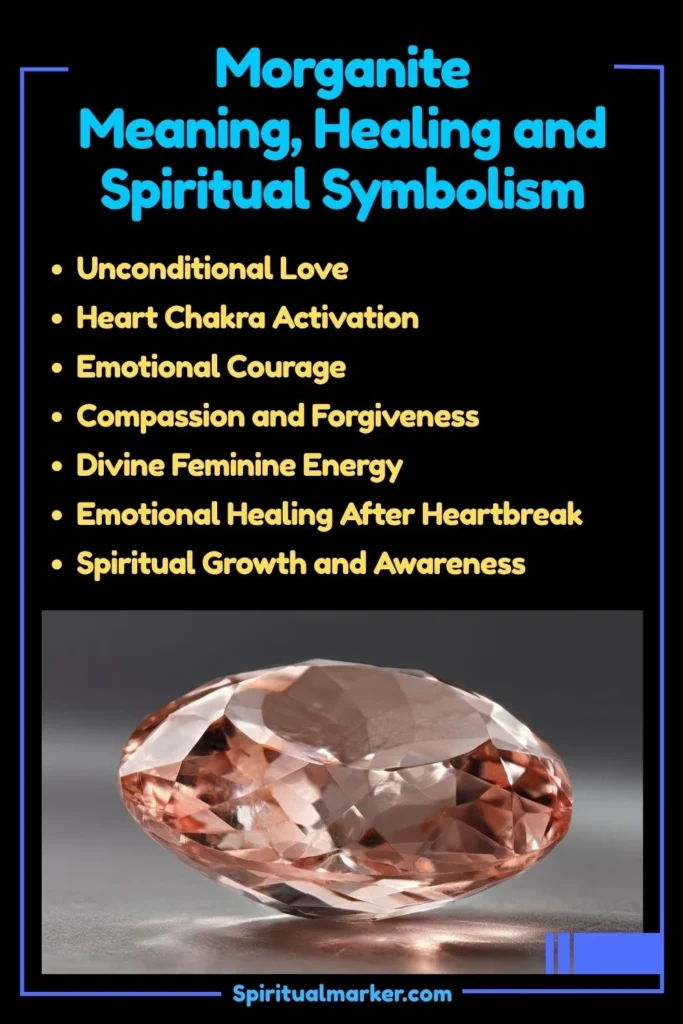
What is Morganite?
Morganite is a pink to peach-pink variety of beryl, the same mineral family that produces emerald and aquamarine. Its color ranges from very pale blush and soft salmon to deeper rose and warm peachy-pink tones. The stone’s appearance feels simultaneously delicate and radiant, which is part of why it has become so beloved in both fine jewelry and spiritual practice.
The pink color comes from trace amounts of manganese within the crystal’s structure. As beryl grows in pegmatite rock formations, manganese becomes incorporated during the crystallization process. The concentration of manganese determines how deep or soft the final color appears. Stones with higher saturation carry a richer rose tone, while lower concentrations produce that signature pale blush morganite is famous for.
Morganite was officially named in 1910 after J.P. Morgan, the American financier and notable gem collector. George Kunz, the famous gemologist at Tiffany & Co., proposed the name in Morgan’s honor. That connection to one of history’s most powerful collectors adds an interesting layer of irony. A stone named after a man known for ambition and wealth carries spiritual symbolism centered almost entirely on softness, love, and emotional vulnerability.
People sometimes confuse morganite with rose quartz because both share pink tones and heart-centered symbolism. However, morganite feels noticeably different in texture and energy. Rose quartz tends to carry a milkier, more opaque appearance and a broadly nurturing energy. Morganite often appears more transparent and carries a quality many describe as more emotionally precise, particularly around themes of romantic love, self-worth, and heart chakra activation.
Origins and Formation of Morganite
Morganite forms in granite pegmatites, which are coarse-grained igneous rock formations known for producing large crystals. These geological environments provide the heat, pressure, and mineral richness that beryl crystals need to grow. Morganite’s formation requires the specific presence of manganese alongside the standard beryl components of beryllium, aluminum, silicon, and oxygen.
The stone appears in several regions worldwide. Brazil remains one of the most significant sources, particularly the state of Minas Gerais, which has long been famous for producing gem-quality beryl. Madagascar produces some of the finest large morganite crystals available today. Afghanistan, Mozambique, Namibia, and the United States, particularly California and Maine, also yield notable deposits.
California holds a special place in morganite’s history. The original discovery of the stone in 1910 occurred at the Pala Chief Mine in San Diego County. This makes California’s contribution to morganite’s story both geological and historical. The warm, dry landscape of Southern California produced a stone that would go on to carry some of the most emotionally resonant symbolism in the crystal world.
Morganite is sometimes heat-treated to improve or stabilize its color. Peach and salmon tones sometimes shift toward a purer pink after heating. Reputable gem dealers typically disclose this treatment. From a spiritual perspective, many practitioners prefer untreated natural morganite because they believe the stone’s unaltered energetic properties remain more intact.
Key Properties of Morganite
| Color | Pale pink, blush, peach, salmon, rose |
| Composition | Beryllium aluminum silicate (Beryl family) |
| Hardness | 7.5 to 8 on the Mohs scale |
| Chakra Association | Primarily the heart chakra |
| Symbolism | Unconditional love, compassion, emotional healing |
| Common Sources | Brazil, Madagascar, Afghanistan, Mozambique, USA |
| Transparency | Transparent to translucent |
| Energy Style | Gentle, loving, emotionally expansive |
Historical Use of Morganite
Morganite’s formal history began in the early twentieth century, but pink beryl likely appeared in ornamental and personal use long before gemologists gave it a distinct name. Ancient and medieval jewelers worked with beryl broadly, valuing the mineral family for its clarity, durability, and range of colors. Pink beryl stones found in older jewelry collections may well represent early morganite specimens.
In the decades following its naming, morganite attracted attention from collectors and designers who appreciated its unusual combination of gem-quality hardness and romantic coloring. Tiffany & Co. played a major role in elevating the stone’s status during the early twentieth century. Their promotion of morganite introduced it to audiences who associated pink gemstones almost exclusively with pink sapphire or tourmaline.
Within metaphysical and crystal healing traditions, morganite gained significant attention during the late twentieth century as spiritual practitioners began working more intentionally with beryl family stones. Its pink color and transparent quality made it a natural candidate for heart chakra work. Healers began recommending it specifically for grief, emotional trauma, romantic wounds, and rebuilding love after loss.
Today morganite remains one of the most valued gemstones in both engagement ring design and spiritual crystal practice. Its dual reputation as a luxury jewelry stone and a deeply emotionally resonant healing crystal reflects its unusual breadth of appeal. Few gemstones carry meaning so easily across both the aesthetic and the spiritual dimensions of human experience.
5 Spiritual Meanings of Morganite
1. Unconditional Love
The most widely recognized spiritual meaning of morganite centers on unconditional love. This is not the romantic love tied to expectations, conditions, or emotional transaction. Morganite symbolizes the kind of love that persists regardless of outcome. It represents love offered freely without requiring reciprocation as payment for emotional safety.
Many spiritual traditions describe unconditional love as the highest expression of the heart. In Christian mysticism, this concept appears in what the ancient Greeks called agape, a love that flows without boundary or condition. Many Buddhist traditions speak of metta, or loving-kindness, as a practice of extending compassion to all beings equally. Morganite spiritually reflects both of these ideas. Its energy is frequently described as expansive and non-selective, moving outward toward others while simultaneously turning inward toward the self.
This symbolism holds particular weight for people who have learned to love conditionally as a form of self-protection. After repeated emotional disappointment, many people unconsciously begin withholding emotional openness until certain conditions feel met. Morganite spiritually represents the courage to love without armor. It does not suggest recklessness or ignoring emotional boundaries. Rather, its meaning centers on choosing openness even when the past has made openness feel dangerous.
Its connection to unconditional love also extends into self-directed love. People who find loving others relatively natural often struggle enormously to extend that same warmth toward themselves. Morganite symbolizes the dissolving of that double standard. Its spiritual energy encourages the same quality of love you offer the people you care most about to be turned toward your own emotional wounds and perceived failures.
2. Heart Chakra Activation
In crystal healing traditions, morganite’s connection to the heart chakra is among the strongest associated with any pink gemstone. The heart chakra, known in Sanskrit as Anahata, sits at the center of the energetic body and governs love, compassion, emotional trust, forgiveness, and the capacity for genuine human connection. When this energy center functions with balance, people tend to experience emotional openness, healthy relationship patterns, and a grounded sense of inner worthiness.
When the heart chakra feels blocked or contracted, the signs appear across multiple dimensions of life. Emotional guardedness, difficulty receiving love, patterns of emotional withdrawal, or chronic feelings of unworthiness often reflect restricted heart chakra energy. Crystal healers frequently turn to morganite specifically because its vibration is believed to activate and expand the heart chakra without overwhelming the emotional system in the process.
What makes morganite spiritually distinctive within heart chakra work is its perceived quality of gentleness during activation. Some healing stones associated with the heart chakra produce emotionally intense experiences. People report unexpected emotional releases, sudden clarity, or even temporarily heightened emotional sensitivity. Morganite tends to work differently. Many practitioners describe its heart chakra activation as gradual and warm, more like sunlight slowly warming a cold room than a sudden shift in temperature.
Some crystal traditions also associate morganite with what they call divine love frequency, a vibration they believe connects human emotional experience to something larger than individual feeling. In this context, morganite is not simply about romantic or interpersonal love. Its heart chakra symbolism reaches toward a spiritual dimension of love that transcends personal relationships entirely, linking emotional healing with broader spiritual awakening and connection to divine compassion.
3. Emotional Courage
Morganite carries a spiritual meaning that many people overlook at first. Beneath its soft coloring and gentle energy lies a symbolism deeply connected to emotional courage. True emotional courage is not the absence of fear or pain. It is the willingness to remain emotionally present and honest even when emotional self-protection feels far more comfortable.
Many people reach a point where emotional pain has become so familiar that numbness begins to feel like strength. Staying closed feels safer than risking more hurt. Building emotional walls seems practical after enough disappointment. Morganite spiritually challenges that logic. Its symbolism suggests that healing requires a different kind of bravery. Not the bravery of force or dominance, but the quieter courage of choosing to feel, to open, and to remain emotionally present despite past wounds.
This dimension of morganite’s meaning becomes especially relevant during emotionally avoidant periods. People sometimes stay in states of emotional numbness for years without recognizing them as avoidance. Life functions on the surface while deeper emotional processing remains frozen. Spiritually, morganite represents the warmth needed to begin thawing that frozen emotional landscape. Its energy encourages movement, not forced catharsis but a gradual willingness to soften toward one’s own emotional reality.
Emotional courage in morganite’s symbolism also includes the courage of vulnerability in relationships. Letting someone see your actual emotional state, your fears, your needs, your insecurities, requires a form of bravery that our culture rarely celebrates. Morganite spiritually represents the internal shift that makes that kind of relational vulnerability feel less like a threat and more like a meaningful choice.
4. Compassion and Forgiveness
Morganite holds strong spiritual associations with both compassion and forgiveness. These two qualities appear together often in spiritual traditions because they share a common root. Both require the willingness to hold another person’s pain or failure with some degree of emotional generosity, even when that feels deeply difficult.
Forgiveness within morganite’s spiritual symbolism does not mean approving of harmful behavior. This distinction matters enormously. Many people resist the concept of forgiveness because they interpret it as a statement that what happened was acceptable, or that the person who caused harm deserves a restored relationship. Morganite’s symbolism points in a different direction. It frames forgiveness as an act performed primarily for the person doing the forgiving. Carrying unforgiven resentment over long periods creates emotional weight that affects the person holding it far more than the one it is directed toward.
Research in psychology supports this perspective. Studies on forgiveness, including work published in the Journal of Behavioral Medicine, have found that people who actively practice forgiveness report lower levels of stress hormones, reduced anxiety, and better cardiovascular health than those who hold chronic resentment. Morganite spiritually embodies this liberating dimension of forgiveness, treating it as emotional medicine rather than moral duty.
Its compassion symbolism extends into how people treat themselves during failure, disappointment, or perceived inadequacy. Many individuals hold themselves to standards of emotional perfection that they would never apply to someone they love. Morganite spiritually challenges that habit. It represents the same quality of tender compassion directed inward. Its energy is often described as creating emotional space where self-criticism can soften into something more honest and more gentle.
5. Divine Feminine Energy
Many spiritual traditions associate morganite with divine feminine energy. This concept does not belong exclusively to women. Divine feminine energy refers to a set of qualities, including receptivity, intuition, emotional depth, nurturing, creativity, and the capacity to hold space for vulnerability, that exist as part of every human being’s spiritual makeup regardless of gender.
Modern life frequently rewards masculine energy patterns like action, achievement, output, and emotional containment. People of all genders often learn to suppress or undervalue the receptive, emotionally intelligent qualities associated with divine feminine energy because those qualities feel less socially rewarded. Morganite spiritually represents a return to those undervalued dimensions of human experience. Its symbolism honors emotional depth, relational sensitivity, and the spiritual power of receiving as much as giving.
Within certain goddess traditions, morganite is associated with Venus, Aphrodite, and other love deities whose domains cover not just romantic love but all forms of beauty, creative expression, emotional truth, and sacred sensuality. These associations reinforce morganite’s reputation as a stone that honors the full range of emotional and spiritual experience rather than only the parts that feel productive or purposeful.
Divine feminine energy in morganite’s symbolism also connects to the concept of receptive healing. Many forms of emotional healing require not just active effort but the ability to receive care, love, and support without deflecting or minimizing it. People who struggle with worthiness often find receiving deeply uncomfortable. Morganite’s spiritual energy is frequently associated with developing the capacity to receive fully, whether that means receiving love, receiving help, or receiving one’s own compassion without guilt.
6 Healing Properties of Morganite
1. Emotional Healing After Heartbreak
Morganite has one of the strongest reputations in crystal healing for supporting emotional recovery after heartbreak. Whether the heartbreak comes from romantic loss, the end of a deep friendship, family estrangement, or the death of someone significant, morganite’s energy is consistently described as stabilizing during those raw and disorienting periods.
Heartbreak does not always follow a logical timeline. People often feel confused by their own emotional responses, experiencing grief intensely at unexpected moments or feeling disconnected from the pain in ways that seem strange. Within crystal healing traditions, morganite is valued specifically because its energy does not force emotional processing at a pace faster than a person can manage. Its gentle heart chakra vibration creates what many describe as a safe emotional container where feelings can surface gradually without becoming destabilizing.
Many practitioners also associate morganite with helping people release emotional attachments that have outlived their natural course. After significant relationships end, people sometimes remain energetically bound to the connection long after the relationship itself has concluded. This kind of emotional attachment can quietly prevent new emotional openness from developing. Morganite spiritually supports the gentle release of those lingering bonds while preserving the genuine warmth and meaning the connection once held.
Its healing symbolism for heartbreak also includes emotional recovery from unrequited love. Loving someone deeply who cannot or does not love you in return creates a specific kind of emotional wound that can feel profoundly isolating. Morganite’s energy is associated with honoring the love that existed without shame, while gradually releasing the grief attached to its unfulfillment.
2. Reducing Anxiety and Emotional Overwhelm
Morganite’s calming energy has made it a popular choice for people dealing with anxiety, emotional overwhelm, and chronic stress. Its symbolism and vibrational reputation center on emotional steadiness, which is the opposite of what anxiety creates. Anxiety keeps the emotional system in a state of heightened alert. Morganite’s energy is frequently described as creating a counterbalancing effect, gently slowing the emotional system toward a more regulated state.
People dealing with relationship anxiety specifically often report feeling drawn to morganite. Relationship anxiety involves persistent fear of abandonment, rejection, or emotional loss that can make even stable connections feel precarious. Morganite’s symbolism of unconditional love and emotional safety speaks directly to those fears. Its spiritual energy is believed to help shift the emotional baseline from fear-based relating toward a slightly more secure internal foundation.
In meditation practice, many people place morganite over the heart or hold it in their hands during breathing exercises. The physical presence of the stone often provides a grounding focal point during anxiety responses, giving the nervous system something tangible and calming to anchor attention. Even practitioners who approach crystals skeptically sometimes report that the deliberate ritual of sitting quietly with morganite creates conditions for emotional regulation simply through the focused attention the practice requires.
Its anxiety-reducing properties also reflect its symbolism around emotional permission. Many anxious people carry an internal pressure to feel differently than they actually feel. They want to stop being anxious, stop being sad, or stop caring so much. Morganite’s energy is associated with a softer approach. Rather than fighting emotional experience, its symbolism encourages acknowledging feelings without amplifying them, which is one of the most effective principles in evidence-based emotional regulation practices.
3. Strengthening Self-Worth
Self-worth sits at the center of nearly every emotional struggle. When self-worth feels fragile, people tend to tolerate mistreatment, minimize their own needs, seek constant external validation, and interpret ordinary setbacks as evidence of their fundamental inadequacy. Morganite’s healing properties include a strong association with rebuilding self-worth from the inside rather than constructing it from external achievements or relationships.
The distinction between self-esteem and self-worth matters here. Self-esteem often fluctuates with performance, success, and comparison. Self-worth, in contrast, refers to a more stable internal sense that one deserves love, care, and respect as a baseline condition of existing rather than as a reward earned through specific behavior. Morganite’s spiritual symbolism centers on this deeper, more unconditional form of self-regard.
Many people develop wounds to their self-worth early in life through childhood experiences of criticism, emotional neglect, conditional love, or repeated messages that their natural emotional expression was unwelcome or excessive. Those wounds often operate invisibly for decades, shaping relationship choices, emotional thresholds, and internal dialogue in ways a person may not consciously recognize. Morganite spiritually represents the healing of those foundational emotional wounds rather than simply managing their surface symptoms.
Crystal healers often pair morganite with personal affirmation practices, journaling, or therapeutic work because they believe the stone’s energy creates a more receptive emotional state for self-worth rebuilding work. The combination of intentional inner work and morganite’s symbolic support for self-compassion can create conditions where people begin hearing their own positive affirmations differently. Rather than bouncing off an internal wall of disbelief, they find the words landing somewhere softer.
4. Deepening Romantic Love and Partnerships
Morganite is perhaps most widely known in popular culture as the stone of divine love and romance. Its use in engagement rings has grown dramatically over the past decade partly because couples are drawn to its symbolism. Choosing morganite as a center stone carries an implicit statement about the kind of relationship being committed to. One built on emotional openness, compassionate communication, and love that runs deeper than performance or expectation.
Within spiritual practice, morganite’s healing properties for romantic partnerships focus on deepening emotional intimacy. Long-term relationships sometimes develop a layer of emotional distance that builds gradually and quietly. Busyness, unresolved conflict, accumulated small disappointments, and the general pressure of adult life can slowly reduce the emotional closeness that once felt effortless. Morganite’s energy is associated with reopening channels of emotional warmth between partners.
It is also frequently connected with improving emotional communication in relationships. Couples who struggle to express needs, fears, or feelings without conflict sometimes find that working with morganite as part of a broader relationship healing intention creates subtle shifts in emotional tone. The stone’s symbolism around compassion and emotional patience seems to anchor the intention to approach each other with greater generosity, particularly during emotionally charged conversations.
Morganite’s healing properties extend to attracting love for those who seek it. In manifestation traditions, wearing or carrying morganite is believed to align a person’s energetic state with the frequency of love, making them more emotionally open, more recognizable to compatible partners, and more willing to act on genuine romantic connection when it presents itself. This is not about magical outcomes. It reflects the practical reality that when people feel more emotionally open and self-accepting, they tend to show up differently in social and romantic contexts.
5. Supporting Grief and Loss
Grief carries a weight unlike any other emotional experience. It does not follow predictable patterns. It does not respect timelines. It can arrive without warning months or years after a loss and feel as fresh and disorienting as the original moment of impact. Morganite’s healing properties include a specific and long-standing reputation for supporting people through grief.
What makes morganite particularly meaningful in grief work is its symbolism of love that continues beyond loss. Grief and love are inseparable. You do not grieve something you did not love. Morganite spiritually honors that connection. Rather than framing grief as something to overcome or move past as quickly as possible, its energy reflects the understanding that grief is love with nowhere to go. The stone’s symbolism creates room for that love to continue existing even when its object is no longer present.
In practical terms, many people who work with morganite during grief report that it helps them feel less emotionally isolated during a process that can feel profoundly lonely. Even when surrounded by supportive people, grief carries an interior quality that feels impossible to fully share. Morganite’s energy is described as companionable. Not intrusive. Not cheerful. Simply present in a way that feels quietly supportive without demanding that the person feel anything other than what they actually feel.
Crystal healers sometimes recommend morganite for complicated grief, grief that involves ambivalence, estrangement, trauma, or unresolved conflict with the person who died. These forms of grief are particularly difficult because they contain emotional contradictions. Love and anger existing together. Relief and guilt arriving simultaneously. Morganite’s energy around compassion and emotional honesty may help people hold those contradictions without forcing resolution before they are genuinely ready.
6. Spiritual Growth and Awareness
Beyond its emotional healing properties, morganite carries a reputation in spiritual traditions for supporting genuine spiritual growth. This distinction matters. Spiritual growth is not the same as spiritual experience. Many people accumulate spiritual experiences without actually changing internally. Morganite’s symbolism centers on the quieter and more demanding kind of growth, the kind that requires honest self-examination, emotional accountability, and the willingness to see oneself clearly without defensiveness.
Its connection to the heart chakra means that morganite’s spiritual growth symbolism begins in the emotional body rather than the intellectual or spiritual mind. Many people approach spirituality primarily through thought, study, or practice while keeping their emotional lives relatively unexamined. Morganite challenges that pattern. Its energy invites emotional honesty as the foundation of authentic spiritual development. You cannot genuinely grow toward love as a spiritual value while remaining cut off from your own emotional reality.
Morganite also supports the spiritual practice of presence. Many people spend enormous amounts of mental and emotional energy living in either the past or the future. Regret and nostalgia pull attention backward. Anxiety and planning project attention forward. The present moment, where actual spiritual contact becomes possible, often goes largely unoccupied. Morganite’s gentle grounding quality helps anchor attention in the present emotional experience, which is the only place real spiritual work can happen.
Some practitioners associate morganite with deepening intuitive awareness, particularly emotional intuition. Emotional intuition refers to the capacity to sense the emotional truth of a situation before the analytical mind has assembled enough information to reach a conclusion. This form of knowing is frequently undervalued in rational-dominant cultures but represents a genuine and sophisticated form of intelligence. Morganite’s energy is believed to strengthen trust in that internal sensing, making its guidance more accessible during periods of uncertainty or decision-making.
How to Wear Morganite Jewelry for Spiritual Growth
Wearing morganite jewelry represents one of the most natural ways to maintain ongoing contact with the stone’s energy throughout daily life. Because morganite’s primary association lies with the heart chakra, pendants and necklaces that rest near the chest carry particular symbolic resonance. Wearing a morganite pendant directly over the heart area creates a continuous energetic reminder of the qualities the stone represents. Love. Compassion. Emotional openness. Presence.
Morganite rings have become enormously popular, particularly as engagement and commitment rings. Wearing morganite on the ring finger of the left hand follows a tradition rooted in the ancient belief that a vein, the vena amoris, runs directly from that finger to the heart. Whether or not that anatomy holds up to modern medical scrutiny, the symbolism remains meaningful. Carrying morganite on that particular finger represents a constant physical connection between the stone’s loving energy and the heart it symbolically reaches.
Morganite bracelets allow regular physical contact during everyday tasks and interactions. Many people find that the tactile reminder of the stone against their skin helps them pause during emotionally reactive moments. Reaching to touch the bracelet during a stressful conversation becomes a physical anchor that creates a brief moment of emotional regulation before responding.
Some practitioners combine morganite with stones that complement its energy. Rose quartz amplifies the themes of self-love and compassion. Aquamarine, another beryl family member, may support emotional clarity and honest communication. Rhodonite can strengthen the forgiveness and emotional balance work that morganite initiates. The combination of complementary stones reflects a layered approach to crystal healing that many practitioners find more nuanced and effective than working with a single stone alone.
Caring for Morganite Jewelry
Morganite’s hardness of 7.5 to 8 on the Mohs scale makes it significantly more durable than many popular gemstones. It holds up well to daily wear, which is one practical reason it has become so popular in fine jewelry. However, proper care still matters for preserving both its physical beauty and, for those who value it spiritually, its energetic clarity.
Clean morganite regularly using lukewarm water, mild soap, and a soft brush. Gentle scrubbing removes the skin oils and cosmetic residue that accumulate with regular wear and gradually dull the stone’s brilliance. Rinse thoroughly and dry with a soft cloth. This simple routine keeps the stone looking its best without risking damage.
Avoid exposing morganite to harsh chemicals. Chlorine bleach, household cleaning products, and even some perfumes can affect the surface of the stone over time. Remove morganite jewelry before swimming in chlorinated pools, using cleaning products, or applying cosmetics and fragrance directly to the skin near the stone.
Store morganite separately from harder gemstones like diamonds, sapphires, and rubies. Although morganite is relatively hard, diamonds rank at 10 on the Mohs scale and can scratch it. A soft fabric pouch or individual compartment in a jewelry box provides adequate protection during storage.
For those who value morganite spiritually, energetic cleansing practices vary widely based on personal belief and tradition. Moonlight cleansing remains one of the gentlest and most popular methods, placing the stone under full moonlight overnight to refresh its energy. Sound cleansing with singing bowls or bells, placing the stone near selenite, or simply holding it with conscious intention during meditation represent other common approaches. Avoid submerging morganite in salt water for extended periods, as salt can potentially affect the stone’s surface over time.
Morganite Meaning at a Glance
| Aspect | Details |
| Primary Meaning | Unconditional love and heart-centered healing |
| Chakra Association | Heart chakra (Anahata) |
| Main Spiritual Symbolism | Divine love, compassion, emotional courage, forgiveness |
| Common Colors | Blush pink, peach, salmon, rose |
| Hardness | 7.5 to 8 Mohs |
| Main Sources | Brazil, Madagascar, Afghanistan, Mozambique, USA |
| Emotional Associations | Self-worth, grief support, vulnerability, emotional safety |
| Popular Jewelry Types | Engagement rings, pendants, bracelets |
| Spiritual Uses | Meditation, heart healing, grief work, romantic intention |
| Care Needs | Mild soap, soft cloth, keep from harsh chemicals |
A Final Note
Morganite occupies a rare space in the world of gemstones. It earns admiration as a luxury jewelry stone and deep respect as a healing crystal, not because those two reputations contradict each other but because they reflect the same truth from different angles. Beauty and meaning are not opposites. In morganite, they arrive together.
Its spiritual meaning centers on the most fundamental human need. To love and be loved. To feel emotionally safe enough to be fully known by another person, and by oneself. To find the courage to remain open after loss, disappointment, and pain have made openness feel like a risk rather than a natural state of being.
If morganite draws your attention, that pull likely reflects something real about where you are emotionally right now. You might consider wearing it during periods of emotional healing, keeping it in your meditation space as an anchor for heart-centered intention, or simply letting its soft color serve as a daily reminder that emotional tenderness is not weakness. It has always been one of the most honest forms of strength.