Energy, vibration, and frequency are more than scientific terms. They are the hidden language of the universe. Across spiritual traditions, these concepts explain how thoughts, emotions, and matter interact.
The energy vibration and frequency in spirituality often involve the idea that everything is connected. Your thoughts emit a frequency that attracts similar experiences. A spiritual meaning of the law of attraction shares that vibrational focus, though the article covers the topic in depth.
Some traditions view energy as the foundation of all life. Others see frequency as a tool for healing and manifestation. The context of your practice can add detail.
If you feel drawn to energy work, it may signal a need for alignment. A spiritual meaning of aura colors also deals with energy fields, though auras carry a more visual element.
Key Takeaways
- Energy, vibration, and frequency form the spiritual framework behind how thoughts, emotions, and intentions affect your reality.
- Every emotional state carries a measurable frequency, and lower states like fear vibrate differently than higher states like gratitude.
- Ancient traditions, from Hinduism to Ancient Egypt, built spiritual systems around sound, resonance, and subtle energy centers.
- Raising your vibration is a practical spiritual process involving mindset, environment, sound, and conscious intention.
- Recognizing shifts in your personal frequency helps you understand emotional patterns, relationships, and spiritual growth more clearly.
What Are Energy, Vibration, and Frequency in Spirituality?
In spiritual terms, energy refers to the invisible life force that animates all living things. Many traditions call this force prana, chi, or ruach, depending on the culture. This force never sits still. It moves, pulses, and oscillates, and that movement is what spiritual teachers call vibration. Frequency then describes the rate at which this vibration occurs, essentially how fast or slow that energy moves through a person, object, or space.
Physics confirms that everything in the observable universe vibrates at some rate, including solid matter that appears motionless. Atoms constantly move, and that constant motion creates a frequency unique to each form. Spiritual practitioners apply this same principle to emotions, thoughts, and intentions. A person who holds fear, anger, or shame carries what many traditions describe as a dense or heavy vibration. A person who holds love, gratitude, or peace carries what many call a light or high vibration.
This framework gained mainstream attention through researcher David R. Hawkins, whose work Power vs. Force mapped emotional states on a calibrated scale of consciousness. Hawkins placed shame and guilt near the bottom of the scale, while love, joy, and peace sat near the top. Although his methodology remains debated among scientists, his framework resonates deeply with spiritual seekers because it matches lived experience. You already know that anger feels heavy and joy feels light. Spiritual teachings simply give that feeling a structured name.
Spiritually, frequency is not abstract theory. It shapes how you attract relationships, opportunities, and experiences. Many spiritual traditions teach that like attracts like, meaning your internal frequency draws external circumstances that match it. Understanding this principle gives you agency rather than leaving you at the mercy of random events.
What Does Feeling a Shift in Energy Symbolize or Represent?
When you suddenly feel lighter, heavier, calmer, or more agitated without an obvious cause, spiritual traditions interpret this as a shift in vibrational frequency. This shift often symbolizes transition, signaling that your inner state or surrounding environment has changed in ways your conscious mind has not yet processed. A sudden wave of peace might represent alignment with your purpose. A sudden wave of unease might represent misalignment with a person, decision, or place.
Many spiritual teachers describe these shifts as the body acting as an energetic instrument, picking up signals long before the rational mind catches up. A feeling of heaviness around a particular person may represent unresolved tension or misaligned intentions. A feeling of expansion in a quiet forest may represent connection with a higher, more harmonious frequency found in nature. These sensations rarely lie, even when logic struggles to explain them.
Vibrational shifts also represent spiritual growth. As you release old patterns, traumas, or limiting beliefs, your baseline frequency naturally rises. This explains why people who commit to meditation, gratitude, or energy healing often report feeling lighter within weeks. Their vibrational signature has genuinely changed, and the world around them begins to reflect that shift.
7 Spiritual Meanings of Energy, Vibration, and Frequency
1. Energy as the Universal Connector
One of the oldest spiritual ideas shared across cultures is the belief that an invisible life force connects everything that exists. Although different traditions use different names for it, the underlying concept remains remarkably similar. In Hindu philosophy, this force is known as prana. In Traditional Chinese thought, it appears as qi or chi. Many Indigenous traditions describe a living network that binds people, animals, plants, and the land itself into a single interconnected whole.
From this perspective, energy is far more than personal vitality. It acts as a bridge between all forms of life. Every thought, action, and emotion becomes part of a larger exchange occurring within this interconnected field. When people speak about feeling connected to nature, sensing another person’s emotions, or experiencing profound unity during prayer or meditation, they often describe moments when this deeper connection feels especially visible.
This spiritual meaning challenges the common belief that we exist as isolated individuals. Instead, it suggests that our lives constantly influence one another in ways we may never fully see. A kind word can change someone’s entire day. A harmful action can create consequences that ripple outward through families, communities, and even future generations. Within this framework, energy serves as the unseen thread weaving every experience into a larger tapestry of life.
Many spiritual teachers view this awareness of connection as the foundation of compassion. When people recognize that their energy affects others and that others affect them in return, relationships often become less transactional and more meaningful. The idea reminds us that separation may be an illusion, while connection remains a fundamental spiritual reality.
2. Vibration as Emotional Truth
Spiritually, vibration often refers to the emotional and energetic quality that a person carries beneath their words and actions. Most people have experienced situations where something felt “off” despite no obvious reason. Someone may speak politely, smile warmly, and appear trustworthy, yet an uncomfortable feeling remains. Spiritual traditions frequently attribute this phenomenon to vibration.
Unlike spoken language, vibration cannot easily hide. Emotions such as anger, fear, resentment, joy, or peace tend to express themselves through body language, tone, presence, and subtle energetic cues that people perceive unconsciously. This is why individuals often describe instantly feeling comfortable around some people while feeling uneasy around others.
Many spiritual systems teach that intuition functions as a natural ability to read these vibrations. Before the analytical mind begins evaluating facts and evidence, the intuitive mind may already sense the emotional reality beneath the surface. While intuition is not infallible, countless traditions regard it as an important guide because it often detects inconsistencies that logic may overlook initially.
This meaning also encourages authenticity. When vibration reflects emotional truth, pretending to feel something we do not genuinely feel becomes increasingly difficult to sustain. Genuine kindness, sincere compassion, and authentic love tend to create a noticeably different atmosphere than behaviors performed solely for approval or appearance. As a result, vibration becomes a spiritual language that communicates what words alone cannot fully express.
3. Frequency as a Mirror of Inner State
The idea that frequency mirrors inner reality appears in many modern spiritual teachings as well as older philosophical traditions. According to this perspective, the quality of a person’s inner world influences how they perceive, respond to, and interact with external circumstances.
This concept does not suggest that every hardship results directly from personal thoughts or emotions. Life contains countless factors beyond individual control. However, spiritual teachings often emphasize that our internal state shapes the lens through which we experience those circumstances. Two people can encounter the same challenge and respond in completely different ways because their underlying frequencies differ.
A frequency rooted in confidence, resilience, and self-worth may encourage constructive action during difficult periods. Conversely, a frequency dominated by fear, helplessness, or chronic self-doubt can make obstacles appear larger and opportunities harder to recognize. Over time, these patterns influence decisions, relationships, habits, and outcomes.
Many spiritual practitioners view frequency as a mirror because it reflects beliefs that may otherwise remain hidden. Persistent emotional patterns often reveal deeper assumptions about safety, abundance, love, or personal value. When people begin examining those assumptions honestly, they frequently notice corresponding changes in their experiences and relationships.
For this reason, frequency is often associated with personal responsibility rather than blame. The focus remains on recognizing the inner patterns that influence life and understanding that meaningful transformation usually begins within before becoming visible externally.
4. High Vibration as Spiritual Alignment
High vibration is commonly associated with emotional and spiritual states that promote expansion, connection, and clarity. Feelings such as gratitude, compassion, forgiveness, hope, and joy are often described as high-frequency emotions because they encourage openness rather than contraction.
Many spiritual traditions view these states as indicators of alignment. Alignment occurs when a person’s thoughts, values, actions, and deeper purpose begin working together instead of pulling in different directions. When this happens, people often report experiencing greater peace, confidence, and fulfillment even when life remains imperfect.
Importantly, high vibration does not mean constant happiness. Spiritual teachings rarely portray enlightened individuals as people who never experience sadness, frustration, or grief. Rather, high vibration reflects an overall state of harmony in which difficult emotions can arise without completely dominating one’s inner world.
Historical spiritual figures across cultures frequently demonstrated this principle. They faced hardship, opposition, and loss, yet maintained compassion, courage, and inner stability. Their lives suggest that spiritual alignment involves responding to challenges from a grounded place rather than avoiding challenges altogether.
Many people describe high-vibrational living as feeling more authentic. Instead of constantly adapting to external expectations, they begin making choices that reflect their genuine values and spiritual convictions. This sense of congruence often creates a feeling of inner freedom that many traditions regard as an important sign of spiritual growth.
5. Low Vibration as a Call for Healing
The term “low vibration” is sometimes misunderstood as a judgment or criticism. Spiritually, however, many traditions interpret it very differently. Rather than indicating failure, low-vibrational states often signal that something within requires healing, attention, or compassion.
Emotions such as grief, shame, guilt, resentment, loneliness, and fear frequently emerge after painful experiences. These emotions carry significant energetic weight because they often remain connected to unresolved wounds. When ignored or suppressed, they can influence thoughts, behaviors, and relationships for years.
Many spiritual teachings caution against forcing positivity in response to these feelings. Pretending pain does not exist rarely resolves it. Instead, unresolved emotions often continue operating beneath the surface, quietly shaping perceptions and reactions. Because of this, spiritual healing frequently begins with honest acknowledgment rather than avoidance.
Across cultures, rituals of mourning, confession, prayer, storytelling, and emotional expression have long served as methods for processing difficult experiences. These practices recognize that healing requires engagement with pain rather than escape from it.
Viewed through this lens, low vibration becomes a messenger. It points toward areas where growth remains unfinished and where deeper self-awareness may be needed. Rather than seeing difficult emotions as obstacles to spirituality, many traditions regard them as essential parts of the spiritual journey itself.
6. Sound and Vibration as Sacred Tools
The connection between sound and spirituality appears throughout human history. Long before modern technology measured frequencies and vibrations, ancient cultures recognized that certain sounds could influence consciousness, emotion, and communal experience.
Sacred chanting provides one of the clearest examples. Hindu mantras, Buddhist chants, Gregorian hymns, Sufi devotional songs, and Indigenous ceremonial music all use rhythmic sound to create shifts in awareness. Although these traditions differ significantly in beliefs and practices, they share a common recognition that sound can alter inner states.
From a spiritual perspective, sound affects both the individual and the collective environment. Repeated rhythms often help quiet mental chatter, improve focus, and create a sense of presence. This explains why chanting and drumming frequently accompany prayer, meditation, healing ceremonies, and sacred gatherings.
Many traditions also believe that certain sounds carry symbolic or spiritual significance beyond their audible qualities. Sacred words, names of deities, and ritual chants are often treated as vehicles that connect practitioners with deeper spiritual realities. The sound itself becomes part of the practice rather than merely accompanying it.
This widespread use of sound across cultures highlights a profound spiritual insight: vibration is not only something we experience internally. It can also be intentionally shaped through voice, music, rhythm, and sacred expression to support transformation, reflection, and connection.
7. Frequency as Connection to the Divine
Perhaps the deepest spiritual interpretation of frequency is the belief that it represents humanity’s relationship with the divine. Many traditions describe the divine as an infinite source of love, wisdom, truth, and unity that exists beyond ordinary human perception.
Within this framework, spiritual practices aim to help individuals attune themselves to that higher reality. Prayer, meditation, contemplation, silence, fasting, and sacred rituals all serve a similar purpose. They reduce distractions and create conditions that allow a person to become more receptive to spiritual awareness.
Many mystics throughout history have described encounters with the divine using language associated with light, harmony, peace, and profound unity. Although their cultural backgrounds varied widely, their descriptions often shared remarkable similarities. They spoke of feeling connected to something greater than themselves while simultaneously feeling more fully themselves than ever before.
The metaphor of tuning a radio helps explain this concept. The signal already exists, but interference can make it difficult to hear clearly. Spiritual practice, according to many traditions, helps reduce that interference. Fear, ego, constant distraction, and emotional turmoil may obscure the connection, while stillness and spiritual devotion help bring it into focus.
This meaning presents frequency not merely as a personal characteristic but as a bridge between the human and the sacred. It suggests that spiritual growth involves deepening awareness of a divine presence that has always existed, waiting to be recognized beneath the noise of everyday life.
Energy and Vibration Across Cultures and Religions
Hinduism offers one of the oldest frameworks for understanding vibration through the concept of nada brahma, meaning the world is sound. The sacred syllable Om is considered the primal vibration from which all existence emerged. Hindu yogic traditions also describe chakras, seven energy centers running along the spine, each vibrating at a distinct frequency tied to specific emotional and physical functions.
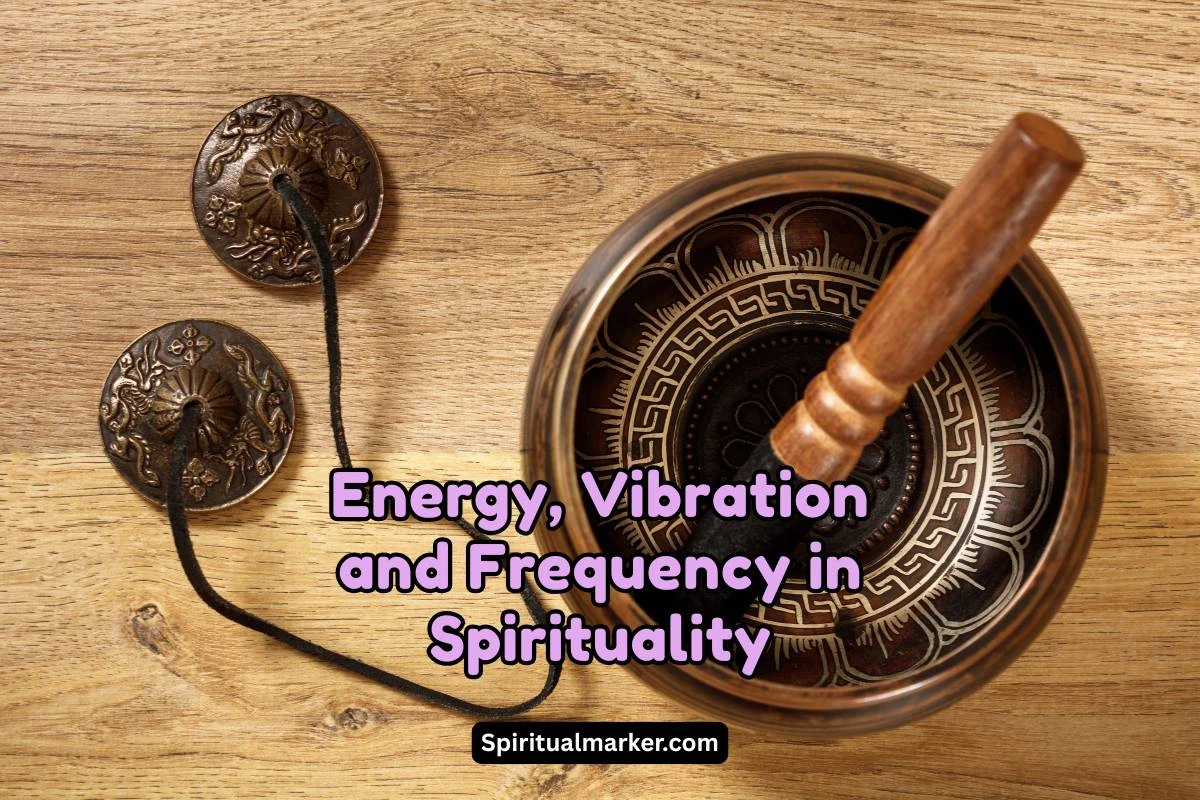
Buddhism approaches vibration through mindfulness and the cultivation of metta, or loving-kindness, which practitioners believe radiates outward and influences surrounding energy. Tibetan Buddhist monks famously use singing bowls and chanting to alter consciousness and induce deep meditative states, treating sound as a direct gateway to higher awareness.
Ancient Egyptian spirituality linked vibration to the concept of Ma’at, a cosmic order maintained through balance and harmony. Temples were reportedly constructed with acoustic properties designed to amplify chanting and ceremonial sound, suggesting an early understanding of how frequency could shape sacred spaces.
Christianity references vibration indirectly through scripture describing creation through spoken word. Genesis describes God speaking light into existence, implying that sound and vibration held creative power from the very beginning of existence. The Christian tradition of hymn singing and communal worship also reflects an intuitive understanding that shared sound shifts collective emotional states.
Indigenous traditions across the Americas, Africa, and Australia frequently use drumming, chanting, and dance as ceremonial tools to shift communal energy, mark life transitions, or connect with ancestral spirits. These practices treat rhythm and vibration as living technologies passed down through generations rather than symbolic gestures alone.
Vibration and Frequency in Mythology and Ancient Wisdom
Greek mythology offers the story of Orpheus, whose music could calm wild animals, move stones, and even soften the heart of the underworld itself. This myth encodes an ancient belief that sound and vibration hold power beyond ordinary physical force, capable of bending reality through resonance alone.
Pythagoras, often remembered for mathematics, devoted significant study to what he called the music of the spheres, a theory suggesting celestial bodies produce harmonic vibrations as they move through the cosmos. Though not strictly mythology, this idea blurred the line between ancient science and spiritual wisdom, proposing that the universe itself operates as a vast musical instrument.
Norse mythology speaks of Heimdall, whose hearing was so refined he could detect sound across realms, symbolizing a heightened sensitivity to vibration that mythic figures often possess. Many cultures associate gods and spiritual messengers with extraordinary sensory perception, hinting at an ancient intuition that higher beings operate on subtler frequencies than ordinary humans.
Aboriginal Australian traditions describe the Dreaming, a foundational mythology in which ancestral beings sang the world into existence through journeys later known as songlines. This belief treats vibration and sound as literally generative, shaping landscapes, animals, and laws through voice alone, reinforcing how deeply ancient wisdom intertwines creation with frequency.
Types of Spiritual Energy and Their Frequencies
Personal energy refers to your own internal frequency shaped by thoughts, emotions, and physical health. This type fluctuates daily depending on sleep, stress, and emotional triggers, making daily practices like meditation essential for maintaining balance.
Environmental energy describes the frequency held by physical spaces. A cluttered, dimly lit room often carries a heavier frequency, while a clean space filled with natural light tends to feel lighter and more spacious. Many spiritual practices, including feng shui and smudging rituals, exist specifically to clear and balance environmental frequency.
Collective energy emerges when groups of people gather with shared intention, such as during concerts, protests, or religious ceremonies. This combined frequency often feels far more powerful than any single person’s energy alone, which explains why communal worship and group meditation produce such strong emotional effects.
Earth energy, sometimes called telluric energy or ley lines, describes the frequency believed to flow through the planet itself. Sacred sites like Stonehenge or Sedona are often associated with heightened earth energy, drawing spiritual seekers searching for amplified frequency and clarity.
Cosmic energy refers to frequency believed to originate beyond Earth, including solar and lunar cycles. Many spiritual practitioners track moon phases closely, believing the moon’s gravitational and energetic pull directly influences emotional tides and personal frequency throughout each month.
Biblical and Scriptural References to Vibration and Frequency
The Bible opens with an act of vibration. Genesis 1:3 describes God speaking, “Let there be light,” demonstrating creation through spoken sound rather than physical construction. This passage suggests that voice and vibration carried generative power from the very first moment of recorded existence.
John 1:1 reinforces this idea, stating, “In the beginning was the Word,” positioning sound and frequency as foundational to divine creation rather than incidental. Spiritual scholars often interpret this verse as evidence that ancient writers intuitively understood vibration as a creative force long before modern physics confirmed that all matter oscillates.
The story of Joshua and the walls of Jericho describes trumpets and shouting bringing down massive city walls, a narrative many interpret symbolically as sound vibration overcoming physical solidity. While historians debate the literal events, the spiritual symbolism remains consistent with the broader biblical theme connecting sound to power.
The Psalms repeatedly emphasize singing and praise as spiritual practice, with verses like Psalm 100:1 urging believers to “make a joyful noise.” This consistent emphasis on vocal expression throughout scripture reflects an understanding that sound carries spiritual weight beyond simple communication.
Raising Your Vibration: Spiritual and Psychological Meanings
Spiritually, raising your vibration means consciously shifting your internal state toward emotions like gratitude, compassion, and peace. Psychologically, this process mirrors what researchers call emotional regulation, the ability to manage and shift emotional states rather than remaining trapped in reactive patterns. Both frameworks describe the same underlying truth, that your inner state is not fixed and can be intentionally influenced.
Practices like gratitude journaling, mindfulness meditation, and time spent in nature consistently appear across both spiritual teaching and psychological research as effective methods for shifting emotional baseline. Spiritually, these practices are described as attuning yourself to higher frequencies. Psychologically, they are described as strengthening neural pathways associated with positive affect and reduced stress response.
Sound-based practices, including binaural beats and singing bowl meditation, have gained psychological interest because they appear to influence brainwave patterns, encouraging states associated with relaxation and focus. Spiritually, this confirms ancient claims about sound’s transformative power. Scientifically, it points toward measurable changes in brain activity following sustained exposure to specific frequencies.
Community and connection also play a significant psychological role in vibration. Isolation tends to lower mood and increase rumination, while meaningful social connection tends to elevate emotional states. Spiritually, this aligns with teachings that emphasize collective energy as more powerful than isolated effort, reinforcing why spiritual communities, prayer groups, and shared ritual remain central to nearly every tradition worldwide.
Signs You Are Experiencing a Vibrational Shift
Many people notice subtle signs when their frequency begins shifting in a meaningful way. Sudden changes in sleep patterns, including vivid dreams or difficulty staying asleep, often accompany internal shifts as the subconscious mind processes new emotional material. A growing sense of impatience with toxic relationships or environments frequently emerges as well, since a rising frequency naturally clashes with lower, denser energy that previously felt tolerable.
Increased sensitivity to noise, crowds, or chaotic environments is another common sign, as a refined frequency becomes less compatible with overstimulation. Many people also report heightened intuition during these shifts, noticing patterns, synchronicities, or gut feelings with greater clarity than before. These signs are not random. They reflect a genuine internal recalibration that spiritual traditions have documented for centuries.
A Final Note
Energy, vibration, and frequency in spirituality are not abstract concepts reserved for mystics and physicists alone. They describe a living reality you experience every single day, in every room you enter and every emotion you carry. Recognizing this language gives you a powerful tool for understanding yourself and your relationships with far greater clarity. You can begin small, perhaps with five minutes of quiet breathing each morning or a moment of gratitude before bed.
Pay attention to how spaces, people, and sounds affect your internal state, and trust what you sense even when logic struggles to keep up. Over time, these small shifts compound into a noticeably lighter, more aligned way of moving through the world.