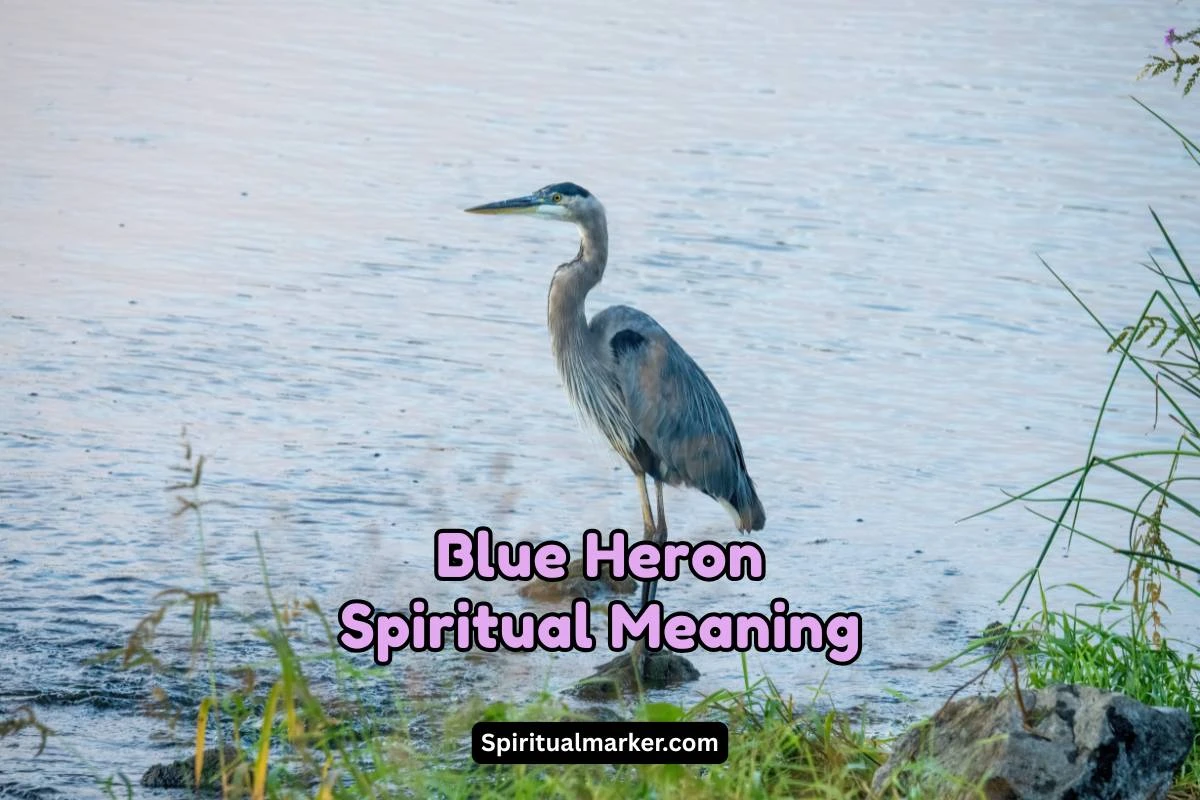
The blue heron is a majestic bird of the wetlands. Its long legs, graceful neck, and sharp beak make it unforgettable. Across cultures, blue herons carry deep spiritual meaning and symbolism.
The blue heron spiritual meaning often involves patience, self-reliance, and spiritual balance. Herons are solitary hunters, so they can signal a need for independence. A spiritual meaning of a crane shares that wading-bird focus, though cranes carry a more social energy.
Some traditions view blue herons as symbols of wisdom, longevity, and spiritual insight. Others see them as a reminder to trust your own path. The heron's behavior can add detail.
If a blue heron appears in your life, it may be a call to be patient. A spiritual meaning of a seagull also deals with water birds, though seagulls carry a more opportunistic energy.
Key Takeaways
- The blue heron symbolizes patience, self-reliance, and stillness in the face of life’s chaos.
- Seeing a blue heron is often interpreted as a divine sign to trust your own path and move at your own pace.
- Across Native American, Celtic, Egyptian, and Eastern traditions, the heron is a sacred bird connected to wisdom and the spirit world.
- In dreams, the blue heron often represents emotional clarity, transformation, and a call to solitude.
- The blue heron is a powerful spirit animal for those who are introspective, independent, and deeply intuitive.
What Is the Blue Heron and Why Does It Carry Spiritual Significance?
The great blue heron (Ardea herodias) is the largest heron in North America. It stands up to four feet tall, with a wingspan stretching nearly six feet. Its slate-blue feathers, long elegant neck, and slow, deliberate movements make it one of the most visually striking birds in nature.
But the blue heron is not just beautiful. It is deeply unusual in its behavior. Unlike most birds, the heron does not travel in flocks. It hunts alone, stands alone, and navigates life on its own terms. It moves between land, water, and air with effortless grace. These qualities are precisely what make it such a powerful spiritual symbol.
Water birds in general have long held sacred significance. Water represents the unconscious mind, emotion, depth, and the mysteries of the soul. A bird that lives between the sky and the water, standing at the threshold of two worlds, naturally becomes a symbol of spiritual in-between states. The heron occupies the liminal space between the conscious and unconscious, the physical and spiritual, the surface and the deep.
Many people report feeling an almost electric stillness when they encounter a blue heron. That feeling is not accidental. The bird’s presence seems to create a field of calm around it. Spiritually, that stillness is the message. The heron invites you to pause, look inward, and listen.
What Does Seeing a Blue Heron Symbolize?
Seeing a blue heron is rarely a neutral experience. Most people who encounter one feel it. There is a sense of being watched, or being seen. The heron usually makes direct eye contact. It holds its ground with total confidence. Then, when it is ready, it lifts itself into the air with those massive wings and disappears.
Seeing a blue heron symbolizes:
- A call to slow down and trust the timing of your life
- A reminder to stand in your own power without needing external validation
- A message to dive deep into your emotions and examine what lies beneath the surface
- A sign that spiritual guidance is near, especially during transitions or difficult decisions
- An invitation to embrace solitude as strength, not weakness
The heron’s behavior models a spiritual truth that many traditions teach: wisdom comes from stillness, not speed. The heron does not rush its hunt. It does not scatter into panic when conditions are imperfect. It simply waits for the right moment with absolute confidence that the moment will come.
If you saw a blue heron during a period of confusion or uncertainty, the bird may be signaling that your answers are already present. You simply need to get quiet enough to see them.
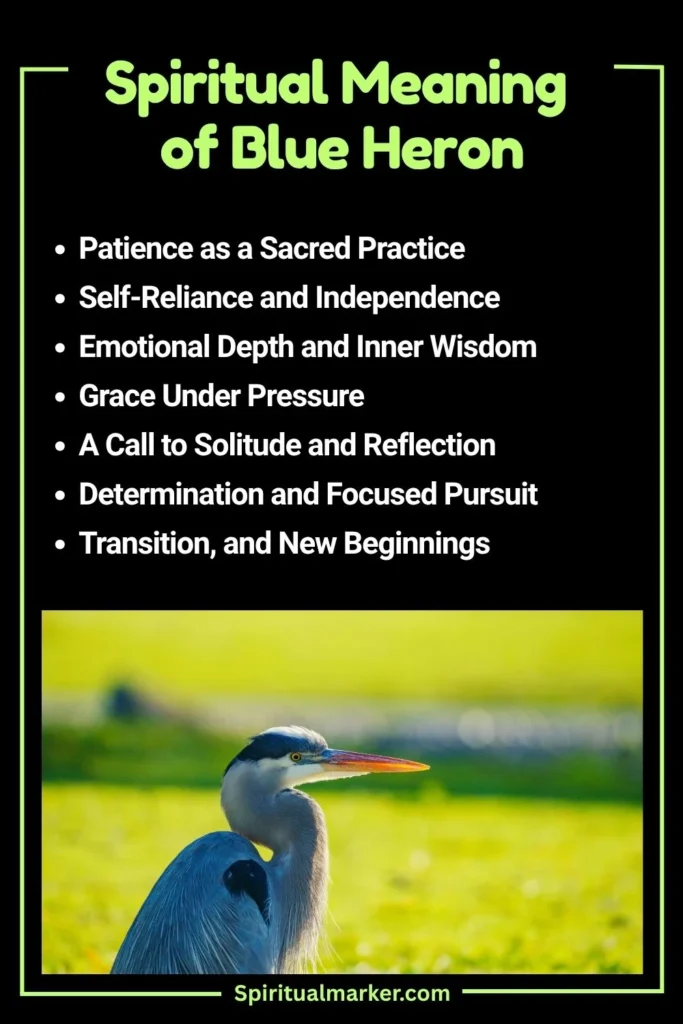
7 Spiritual Meanings of the Blue Heron
1. Patience as a Sacred Practice
The blue heron is perhaps the most powerful symbol of patience in the natural world. Watching a heron hunt is watching patience in physical form. It can stand motionless for thirty minutes or more, waiting for a fish to swim within reach. It does not give up. It does not switch strategies every few minutes. It trusts the process completely.
Spiritually, the blue heron arrives in your life when you are tempted to force outcomes. You may be rushing a relationship, a career move, or a personal transformation. The heron reminds you that divine timing is real. The right moment is coming. Your job is to stay present and remain ready, not to manufacture urgency.
Many spiritual teachers across traditions emphasize that patience is not passive. It is an active form of trust. The heron demonstrates this beautifully. It is fully alert, fully engaged, and fully ready. It is simply not rushing what cannot be rushed. That is a lesson most people spend a lifetime trying to learn.
The next time you feel frustrated by waiting, remember the heron at the water’s edge. Stillness is not inaction. It is the highest form of readiness.
2. Self-Reliance and Independence
The blue heron is a solitary creature by nature. It does not need a flock to feel safe. It does not require constant companionship or external reassurance. It knows its own capabilities, and it trusts them completely. This makes it one of the most powerful symbols of self-reliance and independence in spiritual traditions worldwide.
When the blue heron appears as a spiritual messenger, it often comes to people who are overly dependent on the approval of others. You may be seeking validation from people who cannot give it. You may be waiting for someone else to tell you that your path is correct. The heron challenges you to trust your own instincts.
This message is not about isolation or cutting people off. The heron is not antisocial out of fear. It is self-sufficient out of confidence. There is a meaningful difference. The heron teaches healthy independence, the kind that allows deep connection with others because you are not desperate for it.
If the blue heron is your spirit animal, you likely work best in solitude. You think deeply, move at your own pace, and resist being herded by group pressure. These are gifts, not flaws. The heron honors them as strengths.
3. Emotional Depth and Inner Wisdom
The heron lives at the boundary of water and land. In spiritual symbolism, water represents the unconscious mind, emotional depth, and the hidden currents of feeling that run beneath daily life. The heron stands in that water without fear. It looks into the murky depths and sees clearly what others cannot.
This symbolism speaks directly to emotional intelligence and inner wisdom. The blue heron’s appearance often signals that you are being called to look more deeply at your own emotional life. Something beneath the surface needs your attention. An old wound, a buried feeling, or an unexamined pattern may be affecting your current reality.
The heron does not flinch at what it sees in the water. It looks directly at it and acts with precision. That is the spiritual invitation here. You are being encouraged to face your inner world with the same clear-eyed courage. Emotional avoidance, the heron suggests, keeps you hungry. Emotional honesty leads to nourishment.
Many healers and spiritual counselors who work with animal symbolism note that people going through deep inner work often encounter herons repeatedly. The bird seems to show up at transition points, when old identities are dissolving and new ones are forming. It is a guardian of the threshold between the old self and the emerging self.
4. Grace Under Pressure
Few birds move with the elegance of a blue heron in flight. Those enormous wings lift slowly, powerfully, with a quiet grace that seems almost impossible given the bird’s size. The heron does not flap frantically. It moves with deliberate, measured power. Every wingbeat is intentional. Nothing is wasted.
Spiritually, this quality speaks to grace under pressure. The heron is not reckless. It does not crash into situations. It navigates with poise, even when carrying significant weight. This is a powerful message for people facing heavy burdens, difficult relationships, or overwhelming circumstances.
Grace under pressure is not the same as pretending everything is fine. The heron carries its full weight honestly. It simply does not collapse under it. The bird teaches that strength and elegance are not opposites. You can move through hard things with dignity. You can carry grief, uncertainty, or challenge without losing your sense of self.
This meaning is especially relevant for people in caregiving roles, leadership positions, or anyone currently holding space for others while managing their own inner storms. The heron says: you have the wingspan. Trust it.
5. A Call to Solitude and Reflection
The blue heron is famously solitary. Outside of breeding season, it prefers its own company. It is not lonely. It is simply deeply comfortable with itself. In many spiritual frameworks, this is seen as a mark of a mature and awakened soul. Spiritual maturity often involves learning to be at peace in your own presence.
When the blue heron appears repeatedly in your life, it may be calling you to spend more time in intentional solitude. Not isolation, but deliberate quietude. Time away from noise, screens, demands, and the constant pull of social engagement. Time with your own thoughts, feelings, and inner voice.
Many spiritual traditions emphasize that wisdom does not shout. It whispers. You can only hear it when the noise drops away. The heron models this by retreating to quiet waters, standing alone, and listening to a frequency most people never tune into.
If you have been feeling spiritually dry, scattered, or disconnected, the heron’s appearance may be a gentle push toward intentional solitude. Even a few hours of quiet reflection each week can dramatically shift your inner landscape. The heron knows this. Now it is passing the knowledge to you.
6. Determination and Focused Pursuit
The heron does not give up. If a fish escapes, the heron resets. It recalibrates its position and waits again with the same level of focused attention. It does not sulk. It does not abandon the hunt. This quality reflects a spiritual message about unwavering determination and focused pursuit of your goals.
Many people start strong and fade when results do not come quickly. The heron models a different approach. It commits completely to the moment of now, not to some imagined future reward. Because of that complete presence, it almost always succeeds. Presence and patience together create results that rushing never can.
Spiritually, the heron appears to people who need to recommit to something they have been neglecting or abandoning prematurely. A creative project, a spiritual practice, a healing journey, or a relationship may need you to show up with that heron-like steadiness. The bird is not asking you to work harder. It is asking you to stay longer.
This message pairs naturally with trust in divine timing. Determination without trust becomes exhausting. But determination anchored in trust becomes sustainable. The heron holds both simultaneously, and it thrives.
7. Transition, Transformation, and New Beginnings
The blue heron moves between three worlds: land, water, and sky. In many spiritual traditions, the ability to navigate multiple realms marks a being as a guide between states of existence. The heron is a classic symbol of transition and transformation precisely because it belongs to all three elements without being limited to any one of them.
When a blue heron appears during a major life transition, many people interpret it as confirmation that the change they are facing is spiritually supported. A career shift, a move, the end of a relationship, a health challenge, a spiritual awakening: all of these are threshold crossings. The heron stands at the threshold and says, the crossing is safe.
Transformation, by its nature, requires leaving something behind. The heron understands this. It does not try to stay on land when the fish are in the water. It enters fully into whatever environment the moment requires. That is the invitation for you. Transformation asks for full entry, not tentative half-steps taken with one foot still in the past.
If you are standing at a crossroads and a blue heron crosses your path, many spiritual traditions would say you have received your answer. Move forward. The timing is right. The guide is present.
Blue Heron Symbolism Across Cultures and Religions
The spiritual significance of the blue heron stretches across continents and centuries. Different cultures arrived at remarkably similar conclusions about this bird’s sacred nature, which suggests the symbolism runs deeper than cultural conditioning alone.
Native American Traditions
In many Native American traditions, the great blue heron holds a revered place. For the coastal and Pacific Northwest tribes, the heron is seen as a symbol of patience, good luck, and self-determination. Some nations consider the heron a totemic guardian of rivers and coastal waters, a spiritual protector of the boundary between the human world and the spirit world.
The Cherokee associate the heron with the crane in certain teachings, and both birds represent good judgment, wisdom, and the ability to see clearly through murky situations. The heron’s ability to stand still in moving water while spotting fish beneath the surface was seen as a metaphor for spiritual discernment, the ability to see truth in confusing circumstances.
The Iroquois and several Plains nations viewed birds that navigated water and sky as messengers from higher realms. The heron, standing between worlds, was seen as a carrier of prayers and a receiver of divine guidance. Seeing one was considered a blessing and an omen of good fortune, particularly for hunters and those embarking on journeys.
Celtic Symbolism
In Celtic mythology, the heron appears as the crane in many older texts, and the two birds share symbolism in this tradition. Both are associated with secret knowledge, longevity, and the mysteries of the otherworld. The Celts saw these birds as guardians of esoteric wisdom, the keepers of things that cannot be spoken aloud.
The heron’s ability to stand at the edge of water made it a natural symbol of the Celtic concept of liminality, the sacred space between one state and another. Twilight, water’s edge, the crossing of seasons: these were sacred times and places in Celtic cosmology. The heron, belonging permanently to this liminal space, was seen as inherently sacred.
In some Irish traditions, the heron was associated with the goddess Morrigan, who presided over fate, prophecy, and transformation. The bird was sometimes seen as her messenger, appearing to signal that a significant change in fate was approaching.
Egyptian Mythology
The ancient Egyptians held the heron in particularly high regard. The Bennu bird, which many scholars consider the origin of the phoenix legend, was depicted as a large heron, specifically modeled on the gray or purple heron found along the Nile. The Bennu represented creation, resurrection, and the cycle of death and rebirth.
According to Egyptian mythology, the Bennu/heron was the first creature to land on the primordial mound that rose from the chaos of waters at the beginning of creation. Its cry was the first sound to shatter the silence of the universe. This origin story elevated the heron to a position of cosmic significance, a bird present at the very moment of creation.
The Bennu was also closely associated with Ra, the sun god, and with Osiris, the god of resurrection. This connection tied the heron symbolism to themes of eternal life, spiritual continuity, and the soul’s journey beyond physical death.
Eastern Traditions
In Chinese symbolism, the heron is associated with strength, patience, and long life. It is also connected to purity and the ability to ascend to higher spiritual realms. The white heron in particular is seen as a messenger of the gods in Shinto traditions, where herons are considered sacred birds that carry prayers between humans and divine beings.
In Japanese culture, the heron appears in poetry, art, and spiritual narrative as a symbol of grace, solitude, and meditative wisdom. It embodies the Zen principle of mushin (no-mind), a state of pure presence without mental interference. The heron does not overthink. It simply is.
Blue Heron Symbolism in World Mythologies
Beyond organized religious traditions, the blue heron appears across world mythologies as a figure of power and mystery.
In Greek mythology, the heron was considered a sacred bird of Athena, the goddess of wisdom, strategy, and craft. Its appearance was seen as an omen of divine favor, particularly in matters requiring careful judgment and strategic thinking. Soldiers and sailors considered the sighting of a heron before a journey or battle as a positive sign from Athena herself.
The Greek poet Hesiod mentioned herons as prophetic birds in his writings. The heron’s tendency to appear at dusk and dawn, those liminal hours between day and night, reinforced its reputation as a creature that existed between the human and divine realms.
In Maori tradition from New Zealand, the kotuku, a species of white heron, holds deep spiritual and cultural significance. The kotuku is so rare that seeing one became associated with extraordinary or once-in-a-lifetime blessings. The phrase “he kotuku rerenga tahi” (a kotuku seen but once) became a Maori proverb describing something exceptionally precious and rare.
In some West African mythologies, long-legged water birds including herons are associated with ancestral spirits who return to observe and guide the living. Their appearance near family homes or sacred water sources is interpreted as a visitation from beloved ancestors, bringing messages of protection and continuity.
The Blue Heron as a Spirit Animal and Totem
If the blue heron is your spirit animal, you likely recognize yourself in its qualities. You are probably deeply introspective. You think before you speak. You prefer depth over breadth in relationships. You do not follow the crowd instinctively. You trust your own inner compass even when it takes you in an unusual direction.
People with the blue heron as their spirit animal tend to be natural observers. They watch situations carefully before entering. They are not passive. They are strategic, reading the landscape before committing to action. This quality makes them excellent problem-solvers, counselors, artists, and healers.
The shadow side of the heron totem involves the risk of over-isolation. The heron’s independence can tip into avoidance if it is not conscious. People with this spirit animal sometimes use solitude as a shield rather than a sanctuary. The heron’s message is not to lock yourself away. It is to know yourself so deeply that your solitude becomes generative rather than protective.
If the heron is calling to you as a totem animal, it may be asking you to step into your authentic nature more boldly. Stop apologizing for needing quiet. Stop forcing yourself to operate at other people’s pace. Stop hunting in herds when you are designed to hunt alone. Your singular path is valid. The heron validates it with every still, solitary stance at the water’s edge.
Blue Heron Biblical Meaning and Significance
The Bible does not specifically mention the blue heron by name, but the heron does appear in scripture. In Leviticus 11:19 and Deuteronomy 14:18, the Hebrew word “anaphah” is translated as “heron” in most versions. In these passages, the heron is listed among the birds considered unclean under Mosaic law.
This designation does not diminish the bird’s spiritual significance in a broader biblical context. Many animals listed as ceremonially unclean still carry profound symbolic meaning in Christian and Jewish theology. Ceremonial law and symbolic meaning are separate categories in biblical scholarship.
More broadly, the qualities the heron embodies align with deep biblical themes. Patience, for example, is one of the most consistently praised virtues in scripture. Psalm 27:14 commands, “Wait for the Lord; be strong and take heart and wait for the Lord.” The heron models this divine instruction more vividly than almost any other creature.
Proverbs 8 speaks of wisdom as something found in stillness and reflection. The heron’s contemplative nature echoes this scriptural wisdom perfectly. Isaiah 40:31 promises that “those who wait upon the Lord will renew their strength; they will soar on wings like eagles.” The heron’s patient waiting followed by powerful flight mirrors this spiritual promise.
In Christian symbolism, the heron’s three-world navigation (land, water, sky) has been interpreted by some theologians as a symbol of the Trinity. Its habit of hunting at dawn and dusk connects it symbolically to Christ as the Light of the World, the one who stands at the threshold between darkness and light.
Contemplative Christian traditions, particularly among monastics, have long drawn on the imagery of solitary birds standing in silent waters as metaphors for the contemplative soul. The heron’s posture of watchful stillness before the divine is spiritually resonant within these traditions.
Dreaming About a Blue Heron: Spiritual and Psychological Meanings
Dreams involving blue herons are considered highly significant across both spiritual and psychological frameworks. Because the heron carries such dense symbolism, its appearance in dreams almost never lacks meaning.
Seeing a Blue Heron Standing Still in a Dream
Dreaming of a heron standing motionless at the water’s edge typically signals that your unconscious is urging patience. You may be facing a decision in waking life that feels urgent. The heron in your dream is slowing you down deliberately. The answer you need is coming. Forcing it will cause you to miss it.
Psychologically, this image reflects the Jungian concept of the Self counseling the ego to slow down. The heron at the water represents the unconscious (water) and the conscious mind (the shore), with the heron as the wise intermediary between them.
Dreaming of a Blue Heron in Flight
A heron taking flight in your dream often signals imminent change or a breakthrough. Something that has been building quietly beneath the surface is about to rise into your conscious awareness or your outer life. This is typically a positive dream symbol, especially if the heron’s flight is graceful and unimpeded.
In spiritual dream interpretation, a heron flying toward you carries a message of approaching blessings or guidance. A heron flying away from you may suggest that an opportunity is passing, encouraging you to act before the window closes.
A Blue Heron Speaking or Making Eye Contact in a Dream
When a heron makes direct eye contact with you in a dream, or if the dream includes a sense of direct communication, it is widely interpreted as a message from a spirit guide or ancestral presence. Pay careful attention to the feeling tone of the dream. What emotions did you feel? Those feelings carry the message more reliably than specific images.
If the heron spoke words in your dream, those words deserve serious reflection upon waking. Write them down immediately. Spiritual dreams fade fast if not recorded.
A Wounded or Dead Heron in a Dream
Dreaming of an injured or dead blue heron can feel disturbing, but it does not necessarily carry a negative meaning. A wounded heron often represents a part of you that has been suppressed. Your patience, your wisdom, your independence, or your inner knowing may have taken damage through external pressure or self-betrayal.
The dream is not a punishment. It is a diagnosis. Your psyche and your spirit are showing you where healing is needed. A dead heron in a dream sometimes signals the death of an old identity, which, while painful, is necessary for transformation.
When the Blue Heron Keeps Appearing: Recognizing a Spiritual Pattern
When you see a blue heron once, it may be coincidence. When you see one repeatedly, or when the heron begins appearing in multiple forms, such as in dreams, in art, in conversations, and in nature, it is worth paying attention.
Spiritual traditions across cultures agree that recurring animal appearances are rarely accidental. They represent a message that has not yet been fully received. The repetition is not random. It is persistence. Something is trying to get your attention.
Ask yourself what is currently unresolved in your life. Where are you forcing outcomes instead of trusting timing? Where are you seeking external validation instead of trusting your inner voice? Where have you abandoned the practice of stillness? The answers to those questions are likely the answers the heron is carrying.
Keeping a journal of your heron encounters, including where you were, what you were thinking, and what was happening in your life at the time, can reveal patterns that bring the message into sharp focus. Many people who do this report a clear theme emerging within just a few weeks.
Blue Heron Color Symbolism: Why “Blue” Matters
The color blue in spiritual symbolism carries its own rich layer of meaning. Blue is universally associated with truth, clarity, calm, communication, and spiritual depth. It is the color of the sky and the sea, both of which represent vast, open, limitless spaces.
The great blue heron’s slate-blue coloring is not merely aesthetic. In color psychology and spiritual frameworks, blue is the color of the throat chakra, the energy center governing communication, authentic expression, and the ability to speak your truth. A bird that embodies this color at the level of its entire body carries a powerful message about authentic self-expression.
If you have been suppressing your voice, shrinking from honest communication, or struggling to articulate your true feelings, the blue heron’s appearance may specifically address that wound. The bird’s blue is not the blue of sadness. It is the blue of depth, dignity, and clear sight.
The combination of blue coloring with the heron’s water-and-sky symbolism creates a triple emphasis on depth, clarity, and communication. This bird is not asking you to be louder. It is asking you to be truer.
A Final Note
The blue heron spiritual meaning is not a simple, single message. It is a layered, multidimensional teaching that shifts depending on where you are in your life. At its core, however, the heron always brings the same underlying truth: you are enough, your pace is valid, and your depth is your strength.
Whether you encountered this bird by a riverbank, in a dream, or through a growing pull toward its symbolism, the message is personal. The heron does not speak in generalities. It speaks directly to you, in the specific language of your current circumstances.
If you want to work more deeply with the blue heron’s energy, consider spending regular time near water in quiet reflection. Notice where you are rushing what cannot be rushed. Sit with the discomfort of patience. Practice trusting your own instincts without seeking external confirmation.
The heron has been standing at the water’s edge for a very long time. It knows exactly how long to wait. Perhaps it is time you trusted your own version of that knowing.