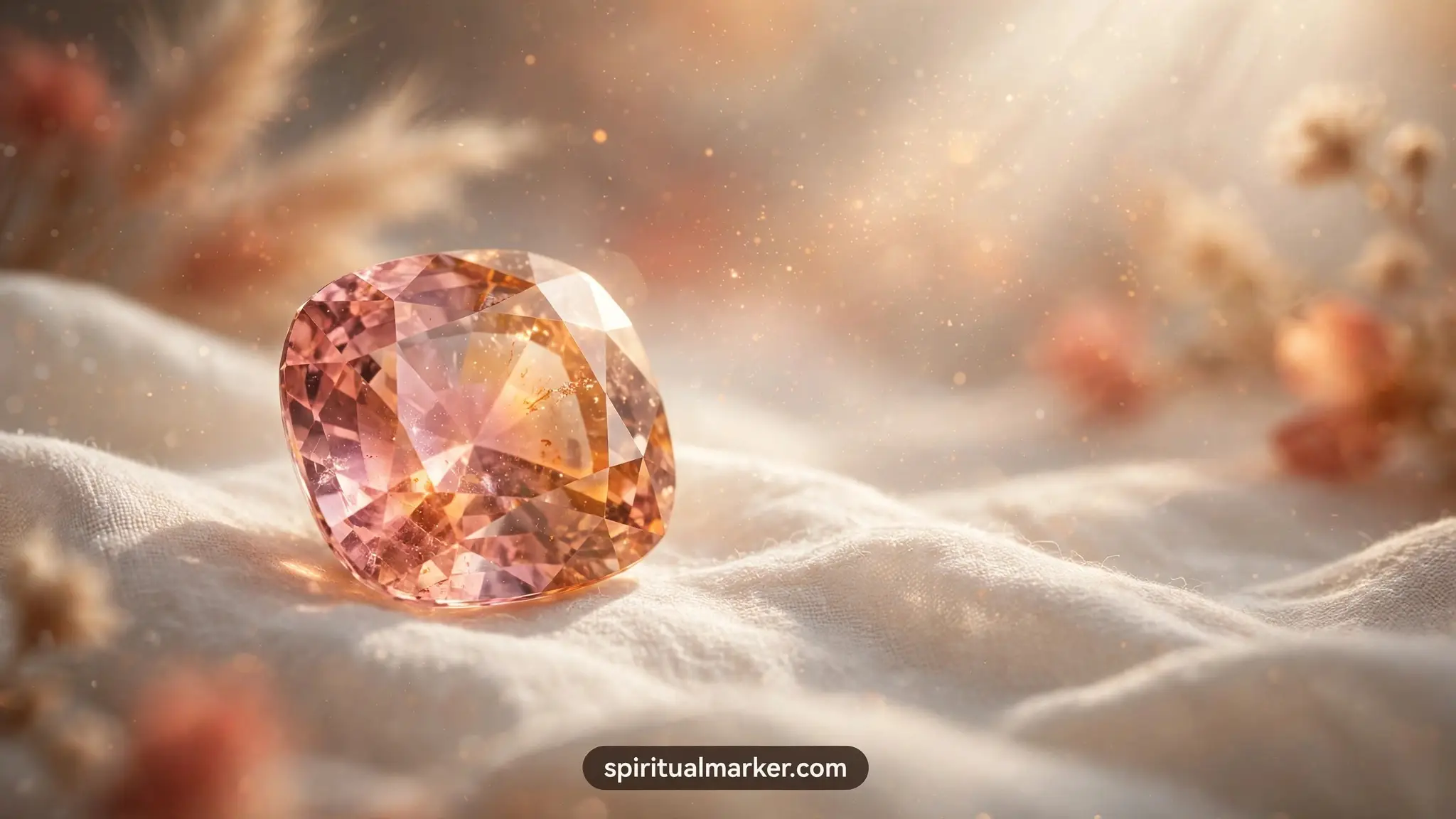
Few gemstones in the world stop people completely in their tracks. Padparadscha sapphire is one of them. Its color sits somewhere between a blushing coral, a ripe peach, and a glowing pink sunset. No photograph fully captures what you see in person. That warm, living quality in its tone feels almost like the stone holds light differently from every other sapphire on earth.
People across cultures have long felt a deep pull toward this stone. Sri Lankan gem traders gave it a name derived from the Sanskrit word for lotus blossom, and that name has carried enormous spiritual weight for centuries. The lotus rises from murky water into open light. It symbolizes spiritual awakening, purity born from difficulty, and the quiet power of transformation. Padparadscha sapphire carries all of that within its layered color.
Its rarity adds another layer to its significance. Authentic padparadscha sapphires are among the rarest colored gemstones in the world. Gem laboratories and experts still debate the precise color boundaries that define a true padparadscha versus an ordinary pink or orange sapphire. That very ambiguity has become part of its spiritual identity. It belongs to no single category. It bridges two worlds simultaneously, which mirrors many of the spiritual themes people associate with it.
This article covers the padparadscha sapphire meaning, its spiritual symbolism, healing properties, historical significance, and how people incorporate it into spiritual and personal growth practices. You will also learn how to wear and care for padparadscha sapphire jewelry while honoring both its physical beauty and its energetic depth.
5 Key Takeaways
- Padparadscha sapphire takes its name from the Sanskrit word for lotus blossom, carrying centuries of spiritual symbolism around awakening and sacred transformation.
- Many traditions connect this stone with the heart chakra and sacral chakra, linking it to love, creative energy, emotional warmth, and divine wisdom.
- People often use padparadscha sapphire during meditation, spiritual reflection, and emotional healing work focused on love, clarity, and personal courage.
- Authentic padparadscha sapphires come primarily from Sri Lanka, with additional sources in Madagascar and Tanzania, and their rarity makes them highly prized in gem communities.
- Wearing padparadscha sapphire close to the skin or heart may deepen feelings of emotional warmth, spiritual clarity, and inner confidence.
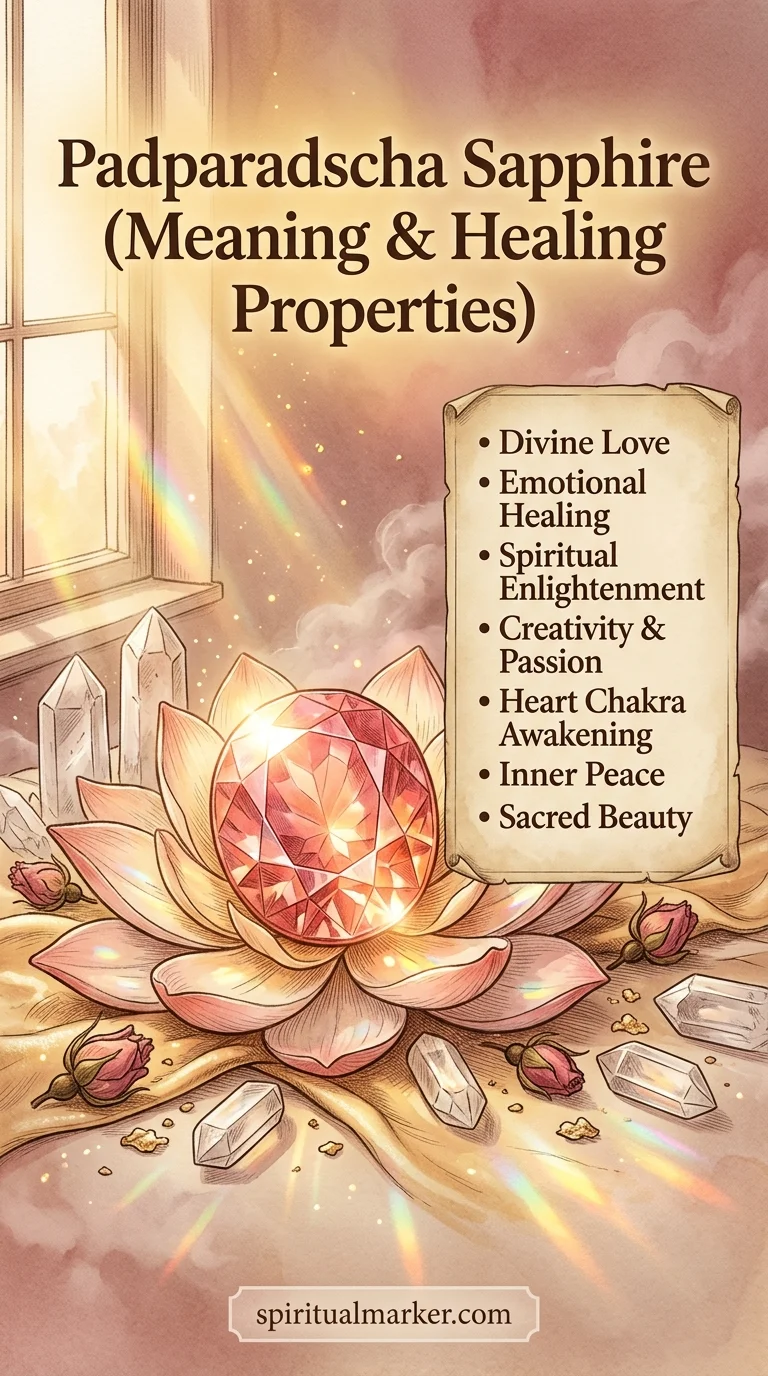
What is Padparadscha Sapphire?
Padparadscha sapphire is a variety of corundum, the same mineral family as rubies and all other sapphires. Its defining characteristic is its uniquely blended color, a delicate marriage of pink and orange that resembles a lotus flower or a tropical sunset. No other gemstone in the world occupies quite the same visual space. That specific color combination is what makes it both scientifically rare and spiritually compelling.
The color comes from the presence of both chromium and iron within the crystal structure. Chromium produces pink hues. Iron shifts color toward orange and yellow. When both elements are present in precise proportions, the result is padparadscha’s extraordinary warm pinkish-orange tone. Even slight shifts in element concentration produce stones that fall outside the accepted color range, which is why truly qualifying padparadscha sapphires represent only a tiny fraction of sapphire production globally.
Many people initially confuse padparadscha sapphire with pink sapphire, orange sapphire, or even certain shades of spinel or morganite. However, padparadscha has a warmth and luminosity that sets it distinctly apart. It does not read as purely pink. It does not read as purely orange. Instead, it feels alive with a dual warmth that most gemstones cannot replicate, which contributes strongly to its spiritual reputation as a stone that bridges energies.
Origins and Formation of Padparadscha Sapphire
Corundum forms deep within the earth under intense heat and pressure. Over millions of years, geological forces push these crystals toward the surface through processes involving metamorphic and igneous rock formations. What makes padparadscha sapphire special is not just the geological conditions that create corundum, but the highly specific trace element combination required to produce its signature color.
Sri Lanka remains the most historically significant source of padparadscha sapphire. The gem-rich gravels of the Ratnapura region, whose name literally means “City of Gems” in Sinhalese, have produced padparadscha sapphires for over two thousand years. Sri Lankan stones are widely considered the most prized because they tend to display a particularly soft, luminous quality in their pink-orange hue.
Madagascar has emerged as another significant source since the late 1990s. Madagascan padparadscha sapphires sometimes display a slightly more vivid color range than Sri Lankan stones. Tanzania also yields padparadscha sapphires, though these stones may carry subtle color differences depending on their specific deposit origin. Gem laboratories routinely analyze these stones to determine geographic origin, which affects both their market value and, for some collectors, their spiritual significance.
The long geological journey of padparadscha sapphire adds to its symbolic meaning in spiritual traditions. Forming under extreme pressure and heat over millions of years before reaching human hands connects it powerfully with themes of patience, perseverance, and earned transformation.
Key Properties of Padparadscha Sapphire
| Property | Details |
|---|---|
| Color | Pink-orange, salmon, peach-coral, lotus pink |
| Composition | Aluminum oxide (corundum) with chromium and iron |
| Hardness | 9 on the Mohs scale |
| Chakra Association | Heart chakra, sacral chakra |
| Symbolism | Love, wisdom, spiritual awakening, transformation |
| Common Sources | Sri Lanka, Madagascar, Tanzania |
| Transparency | Transparent to translucent |
| Energy Style | Warm, uplifting, heart-centered, spiritually clarifying |
Historical Use of Padparadscha Sapphire
Sri Lanka’s ancient gem trade gave padparadscha sapphire its name and much of its foundational mythology. The lotus flower already carried profound spiritual meaning across Hindu, Buddhist, and broader South Asian traditions long before gemstones received its name. Lotus symbolism appears throughout the Rigveda, the Bhagavad Gita, and countless Buddhist sutras. The padme in the sacred mantra “Om Mani Padme Hum” literally translates to lotus. Associating this gem with the lotus was not accidental. It was a deliberate spiritual designation.
In ancient Sri Lanka and India, sapphires of all kinds were considered stones of divine protection, royal wisdom, and celestial power. Blue sapphires were associated with Saturn in Vedic astrology, while the rare padparadscha occupied a more nuanced position. Its dual-toned color connected it with both solar warmth and lunar softness, making it symbolically potent for practitioners who worked with planetary energies.
European royalty and nobility began acquiring padparadscha sapphires as gem trade routes expanded during the medieval and Renaissance periods. The stones became treasured for their unusual beauty rather than their spiritual properties in Western contexts initially. However, as gemstone metaphysics developed through the 19th and 20th centuries, Western spiritual practitioners began recognizing the same warm, heart-awakening energy that Eastern traditions had long associated with the stone.
Today padparadscha sapphire continues to hold dual significance. Collectors value it for extreme rarity and beauty. Spiritual practitioners value it for its perceived ability to activate love, creative wisdom, and emotional courage. Both perspectives acknowledge that this is not an ordinary stone.
5 Spiritual Meanings of Padparadscha Sapphire
1. Sacred Love and Emotional Warmth
Padparadscha sapphire carries one of the most distinctive spiritual meanings in the gemstone world because its color occupies the visual space between passionate pink and warm orange. Both of those colors carry deep associations with love in their own right. Pink connects with gentle, tender, heart-centered love. Orange connects with warmth, vitality, creative energy, and emotional openness. Together in padparadscha, they create a symbolism of love that feels whole rather than one-dimensional.
Many spiritual traditions distinguish between different qualities of love. Romantic love, familial love, compassionate love, and divine love each carry their own energetic character. Padparadscha sapphire is often associated with love in its most complete and spiritually elevated form. Its symbolism does not reduce love to mere sentiment or passion. Instead, it points toward love as a state of being, a spiritual orientation that combines emotional warmth with wisdom and clarity.
This makes padparadscha sapphire particularly meaningful for people navigating complex emotional terrain. After heartbreak, grief, emotional withdrawal, or relationship difficulties, love can feel threatening rather than healing. The stone’s symbolic connection with love that carries both warmth and strength suggests a path back to emotional openness that does not require vulnerability without discernment. Many practitioners describe its energy as encouraging brave love, the kind that remains open even after pain.
Its lotus flower namesake reinforces this meaning powerfully. The lotus grows through muddy, difficult conditions before blooming beautifully above the water’s surface. Spiritually, padparadscha sapphire represents love that grows through difficulty rather than despite it. That quality makes its symbolism feel genuinely earned rather than idealized. It reflects the real human experience of learning to love again after loss, fear, or disappointment.
2. Spiritual Awakening and Enlightenment
The lotus flower has represented spiritual awakening and enlightenment across Asian spiritual traditions for thousands of years. When Sri Lankan gem traders named this sapphire after the lotus, they encoded a spiritual message directly into the stone’s identity. Padparadscha sapphire does not merely resemble a lotus in color. Within these traditions, it carries the lotus’s deepest symbolic weight.
In Buddhist philosophy, the lotus rising from murky water toward sunlight represents the individual soul moving from ignorance toward awakening. The Buddha is frequently depicted seated upon an open lotus, symbolizing consciousness that has transcended ordinary suffering and reached a state of clear awareness. Padparadscha sapphire symbolically participates in this imagery because its color mirrors the warm, luminous quality of a sunrise lotus bloom.
Spiritual awakening is rarely a single dramatic moment. Most people who pursue deeper spiritual awareness experience it as a gradual unfolding. Old assumptions dissolve slowly. New awareness emerges in layers. Certainties that once felt solid begin revealing their fragility. Padparadscha sapphire symbolically supports this process because its own identity resists simple categorization. It is neither purely pink nor purely orange. It exists between definitions, which spiritually mirrors the experience of consciousness that is actively expanding beyond its previous boundaries.
Many meditation practitioners use padparadscha sapphire during contemplative practice because they feel it helps quieten mental restlessness while encouraging deeper levels of awareness. Its warm color provides a visually grounding focal point while its spiritual symbolism creates a meaningful context for inner work focused on growth, clarity, and expanded consciousness.
3. Creative Wisdom and Inner Clarity
Sapphires have long carried associations with wisdom, mental clarity, and truth across both Eastern and Western spiritual traditions. Ancient Persians believed the earth rested upon a giant sapphire whose reflection gave the sky its blue color. Medieval European clergy wore blue sapphires as symbols of divine wisdom and purity of thought. While padparadscha sapphire carries a warmer hue than the classic blue sapphire, it inherits this deep connection with clarity of mind and discernment.
What distinguishes padparadscha’s relationship with wisdom is how its orange-pink warmth modifies the stone’s intellectual symbolism. Pure blue sapphire symbolism tends toward cool, rational clarity. Padparadscha sapphire brings warmth into that equation. Its wisdom is not detached or cerebral. It is creative, intuitive, and emotionally intelligent. Many practitioners describe it as a stone that helps people think clearly while also feeling clearly, bridging the gap between head and heart.
This quality makes padparadscha sapphire especially meaningful for artists, writers, healers, teachers, and anyone whose work requires both creative openness and clear judgment. Creative work often suffers when self-doubt, fear, or emotional confusion blocks the natural flow of ideas. Padparadscha sapphire symbolically represents the state where creativity flows from a grounded, clear, emotionally open center rather than from anxiety or compulsion.
Inner clarity also involves honest self-knowledge. People who carry unresolved emotional confusion about their own desires, values, or direction often feel creatively and spiritually blocked. The stone’s symbolism encourages gentle, honest self-awareness that does not demand harsh self-examination but rather allows truth to surface naturally through warmth and patience.
4. Courage and Emotional Resilience
Corundum itself is one of the hardest natural substances on earth, ranking 9 out of 10 on the Mohs hardness scale. Only diamond surpasses it. This physical durability has always contributed to sapphire’s spiritual association with strength, endurance, and resilience. Padparadscha sapphire carries this quality while translating it into an emotionally specific symbolism.
Emotional resilience is not the same as emotional toughness or emotional suppression. True resilience involves the ability to feel deeply without being destroyed by feeling. It requires enough inner stability to process pain, fear, disappointment, and uncertainty without collapsing permanently under their weight. Padparadscha sapphire symbolically embodies this quality because its lotus imagery carries both softness and persistence simultaneously.
The lotus does not force its way through the water aggressively. It grows steadily, persistently, without forcing anything. That patient strength is exactly what emotional resilience looks like in practice. People who carry padparadscha sapphire during difficult emotional periods often report that it reminds them to keep moving forward without requiring themselves to feel invincible. The stone spiritually represents courage that coexists with vulnerability rather than eliminating it.
This symbolism becomes particularly important during major life transitions. Career changes, relationship endings, grief, illness, financial difficulty, and identity shifts all demand emotional courage that many people feel unprepared for. Padparadscha sapphire does not symbolize artificial cheerfulness or false confidence. Instead, it represents the genuine courage that develops through choosing to remain open and moving even when the path ahead feels genuinely uncertain.
5. Divine Feminine Energy and Sacred Balance
Padparadscha sapphire’s color sits at the intersection of pink and orange, two colors with strong associations with feminine energy, nurturing warmth, and creative life force across many spiritual traditions. Pink connects broadly with love, care, and emotional sensitivity. Orange connects with the sacral energy center, which governs creativity, sensuality, emotional expression, and the life-sustaining warmth of embodied existence.
The concept of divine feminine energy does not refer exclusively to gender. It describes a quality of consciousness that emphasizes receptivity, intuition, compassion, creative flow, and emotional intelligence. Many spiritual systems describe reality as requiring balance between active and receptive principles, between solar and lunar energies, between outward action and inward awareness. Padparadscha sapphire symbolically represents the receptive, nurturing, creatively generative aspect of this balance.
This quality makes it meaningful for people of any gender who feel called to develop greater emotional intelligence, creative openness, or intuitive awareness. Modern life tends to reward constant productivity, decisive action, and measurable results. Padparadscha sapphire’s symbolism points in the opposite direction. It honors the value of inner receptivity, patient wisdom, and emotionally grounded creativity that produces genuine depth rather than surface-level output.
Many spiritual practitioners also connect padparadscha sapphire with sacred relationships because its dual-color nature symbolizes complementary energies in harmonious union. The meeting of warmth and softness within a single stone reflects the spiritual ideal of relationships where different energies meet and create something more complete than either could achieve alone.
6 Healing Properties of Padparadscha Sapphire
1. Emotional Healing and Heart Opening
Padparadscha sapphire holds a strong reputation within crystal healing traditions for its ability to support emotional healing, particularly in areas related to love, vulnerability, and emotional courage. People often turn to this stone after periods of significant emotional pain, including romantic heartbreak, grief, abandonment, betrayal, or sustained emotional loneliness. Its warm pink-orange energy is widely described as emotionally nurturing without being overwhelmingly intense.
What sets padparadscha sapphire apart from purely pink heart-healing stones like rose quartz is the presence of orange within its energy signature. Orange relates to the sacral chakra, the energy center associated with emotional fluidity, creative vitality, and the ability to experience pleasure and joy. When emotional wounds are deep, people often experience not just sadness but also a loss of vitality, creativity, and the capacity to feel genuinely good. Padparadscha sapphire symbolically addresses both the heart wound and the deeper energetic depletion that often accompanies it.
Many practitioners describe its healing energy as gently activating rather than passively soothing. It does not simply calm emotional pain. It encourages the gradual rebuilding of emotional aliveness that sometimes disappears after significant loss. This makes it particularly meaningful during recovery periods when people begin moving from emotional survival mode back toward genuine emotional engagement with life.
Emotional healing with padparadscha sapphire is also connected with forgiveness work. Forgiveness in spiritual contexts does not require pretending harm did not occur. Rather, it involves releasing the emotional charge that keeps a person tethered to a painful experience. The stone’s lotus symbolism reinforces this beautifully. Releasing what muddied the water does not erase the past. It allows the lotus, and the person, to rise toward light anyway.
2. Mental Clarity and Decision-Making
Sapphires across all colors have long been associated with mental clarity, focus, and sound judgment. Padparadscha sapphire inherits this reputation while infusing it with the warmer, more intuitive qualities of its distinctive color. Many people experience periods of significant mental fog, particularly during times of emotional stress, major life decisions, spiritual transition, or creative blocks. Padparadscha sapphire is often used during these periods as a tool for reconnecting with clear, grounded thinking.
One of the most common challenges people face in decision-making is the interference of fear, excessive caution, or emotional confusion. The right path forward may be intellectually clear, but emotional noise makes it difficult to trust that clarity. Padparadscha sapphire’s symbolism bridges heart and mind, encouraging people to make decisions from a place that honors both logical assessment and emotional truth without sacrificing one for the other.
Many creative professionals who work with padparadscha sapphire describe it as helping them cut through creative paralysis. Creative blocks frequently stem not from lack of ideas but from an accumulation of self-doubt, fear of judgment, and emotional uncertainty about the value of one’s work. The stone’s association with creative wisdom and warm mental clarity creates a spiritually supportive environment for creative work that feels both inspired and purposeful.
Its connection with mental clarity also extends to spiritual discernment. Spiritual seekers sometimes experience phases of genuine confusion about beliefs, practices, teachers, or directions. Padparadscha sapphire symbolically supports the process of distinguishing genuine inner truth from external pressure or spiritual confusion, helping people return to a clear sense of their own authentic spiritual understanding.
3. Activating the Heart and Sacral Chakras
In crystal healing traditions, padparadscha sapphire is unique because its dual color connects it meaningfully with two chakra centers simultaneously. Its pink component resonates with the heart chakra, the fourth energy center associated with love, empathy, compassion, emotional balance, and connection. Its orange component resonates with the sacral chakra, the second energy center associated with creativity, emotional vitality, sensual awareness, and the joy of embodied life.
When the heart chakra is balanced, people experience genuine emotional openness, healthy relational boundaries, and the ability to give and receive love without excessive fear or guardedness. When blocked, they may experience emotional numbness, relational fear, excessive self-protection, or difficulty forming meaningful connections. Padparadscha sapphire is often used in heart chakra healing work to encourage the gradual reopening of emotional receptivity.
The sacral chakra governs a different but equally important dimension of well-being. When this center is balanced, people feel creative, emotionally fluid, pleasurable, and vitally alive. When blocked or depleted, they may experience creative stagnation, emotional flatness, difficulty experiencing joy, or disconnection from their own desires and passions. Padparadscha sapphire symbolically nourishes both of these centers simultaneously, which makes its healing application unusually comprehensive.
Many practitioners place padparadscha sapphire during meditation either at the heart center or the sacral center depending on which area feels most in need of attention. Some use it at both points in sequence during longer healing sessions. The stone’s warmth and luminosity make it an emotionally responsive focal point during chakra balancing work, energy healing, and contemplative meditation.
4. Strengthening Relationships and Deepening Love
Padparadscha sapphire has earned a strong reputation as a stone of love and relationship deepening in many crystal healing traditions. Its association with sacred love, emotional warmth, and heart-centered wisdom makes it particularly meaningful for couples, individuals seeking meaningful connection, and those working to heal relational wounds. People wear it as engagement rings, gifts between partners, and love talismans in cultures where gemstone symbolism is taken seriously.
In relationship healing contexts, padparadscha sapphire is often associated with emotional honesty and vulnerable communication. Relationships frequently suffer most not from dramatic conflicts but from the slow accumulation of unexpressed feelings, unspoken needs, and emotional distance that develops when people feel unsafe sharing their authentic inner experience. The stone symbolically encourages the warmth and courage required to speak truthfully and receive truth with openness.
Its symbolism is not limited to romantic relationships. Family bonds, deep friendships, mentor relationships, and the relationship a person has with their own emotional self all benefit from the same qualities padparadscha sapphire represents. Warmth, honesty, courage, creative vitality, and the patient willingness to remain present through difficulty are qualities that strengthen every significant relationship when practiced consistently.
Many spiritual practitioners also use padparadscha sapphire to support the practice of loving-kindness meditation, known in Buddhist traditions as metta. This practice involves cultivating genuine feelings of goodwill toward oneself and others, beginning with those closest and gradually extending outward. The stone’s warm, heart-activating symbolism aligns naturally with the emotional intention of this practice.
5. Supporting Inner Transformation
Few spiritual symbols capture the experience of inner transformation as powerfully as the lotus flower, and padparadscha sapphire carries that symbol in its very name. Transformation is one of the most recurring themes in human spiritual experience. Every major wisdom tradition acknowledges that genuine personal growth requires moving through difficulty, releasing outdated identities, and allowing something new to emerge through that process.
Padparadscha sapphire’s symbolism speaks directly to people in the middle of that process. Transformation rarely feels graceful while it is happening. The period between releasing an old way of being and fully inhabiting a new one often feels disorienting, uncomfortable, and emotionally raw. The stone’s lotus imagery provides a meaningful spiritual anchor during this in-between space, reminding people that growth is genuinely occurring even when it cannot yet be seen clearly.
The stone’s physical hardness reinforces this symbolism. Sapphire withstands enormous geological pressure to emerge as one of the most brilliant and durable substances in nature. The same principle applies to the people who carry it during difficult transformative periods. Difficulty does not prevent emergence. When approached with patience, warmth, and spiritual awareness, it often accelerates it.
Many people use padparadscha sapphire during major life transitions such as career reinvention, recovery from significant illness, spiritual awakening processes, moving through grief, ending long relationships, or beginning entirely new chapters. Its warm, encouraging energy combined with its association with clarity and perseverance makes it symbolically well-suited for accompanying people through change rather than simply representing a static ideal.
6. Boosting Confidence and Personal Power
Padparadscha sapphire’s orange component connects it meaningfully with themes of personal power, self-confidence, and the courage to show up fully in one’s own life. Orange is energetically associated with the sacral chakra and, in many traditions, with the solar plexus chakra as well, both centers governing personal vitality, self-expression, and the courage to pursue one’s authentic path without excessive self-doubt or external validation.
Low confidence often develops through years of emotional wounding, criticism, comparison, or environments that did not support genuine self-expression. People carry those wounds quietly while continuing to function outwardly. Padparadscha sapphire symbolically addresses this by combining heart warmth with energizing vitality, encouraging people to reconnect with their own worth from the inside rather than seeking it from external achievements or approval.
Confidence rooted in spiritual practice looks different from confidence built purely through achievement. Achievement-based confidence tends to fluctuate with outcomes. Spiritually grounded confidence develops from a deeper sense of inherent worth that remains stable regardless of external results. Padparadscha sapphire symbolically represents this more stable form of self-assurance, one that coexists with humility, warmth, and emotional honesty rather than requiring performance or perfection.
Many people notice that their ability to pursue meaningful goals, express themselves creatively, and engage authentically in relationships improves during periods when they work spiritually with this stone. Whether that reflects energetic properties or simply the focusing effect of meaningful symbolic intention, the practical outcome of renewed personal confidence remains the experience many report.
How to Wear Padparadscha Sapphire Jewelry for Spiritual Growth
Padparadscha sapphire’s rarity makes it one of the more exclusive choices in spiritual gemstone jewelry. However, even smaller stones carry the same symbolism as larger ones. Many practitioners believe that intention and consistent contact matter more than stone size when working with any gemstone for spiritual purposes.
Because of its strong connection with the heart chakra, pendants and necklaces position padparadscha sapphire close to the heart, which many feel strengthens its emotional healing and love-related symbolism. Rings are also extremely popular, particularly for those drawn to the stone’s love symbolism. Padparadscha sapphire engagement rings have grown in popularity among couples who appreciate the stone’s association with sacred love, emotional warmth, and spiritual depth alongside its extraordinary beauty.
Bracelets allow consistent physical contact throughout the day, which many practitioners believe helps maintain a steady connection with the stone’s energy during daily activities. Earrings position the stone near the head and throat, which some associate with enhanced mental clarity and honest communication, both qualities strongly linked with padparadscha sapphire’s symbolism.
Some people combine padparadscha sapphire with complementary stones. Rose quartz may amplify gentle love energy. Moonstone may deepen intuitive and feminine symbolic resonance. Citrine may reinforce the creative vitality and confidence themes. Clear quartz is often paired as an amplifying stone that strengthens the intention behind any gemstone it accompanies.
Caring for Padparadscha Sapphire Jewelry
One of padparadscha sapphire’s practical advantages is its exceptional physical durability. At 9 on the Mohs scale, it ranks just below diamond. This makes it highly resistant to scratching and suitable for everyday wear in rings, bracelets, pendants, and earrings without the fragility concerns that affect softer stones like opal or moonstone.
Clean padparadscha sapphire with warm water, mild soap, and a soft brush. Ultrasonic cleaners are generally safe for untreated natural padparadscha sapphires, but treated stones should be cleaned more gently. Always check with your jeweler whether your specific stone has been heat-treated or clarity-enhanced, as treatment affects appropriate cleaning methods.
Store padparadscha sapphire jewelry separately from diamonds, which can scratch even other sapphires at close contact points. Soft fabric pouches or individual jewelry compartments work well. Prolonged exposure to harsh chemicals, including perfumes, hairspray, and cleaning products, may dull the stone’s surface over time.
Many spiritually-oriented owners also practice energetic cleansing of padparadscha sapphire alongside physical care. Common methods include moonlight charging, sound cleansing with singing bowls or bells, sage or palo santo smoke, and intention-setting meditation. Padparadscha sapphire is generally considered safe near water, unlike porous or water-sensitive stones, making gentle water cleansing a practical option as well.
Padparadscha Sapphire Meaning at a Glance
| Aspect | Details |
|---|---|
| Primary Meaning | Sacred love, spiritual awakening, inner transformation |
| Chakra Association | Heart chakra, sacral chakra |
| Main Spiritual Symbolism | Lotus blossom, wisdom, emotional courage, divine feminine |
| Common Colors | Pink-orange, salmon, peach-coral, lotus pink |
| Hardness | 9 Mohs |
| Main Sources | Sri Lanka, Madagascar, Tanzania |
| Emotional Associations | Warmth, love, resilience, creative confidence |
| Popular Jewelry Types | Rings, pendants, earrings, bracelets |
| Spiritual Uses | Meditation, love healing, chakra balancing, transformation work |
| Care Needs | Mild soap, soft brush, separate storage from diamonds |
A Final Note
Padparadscha sapphire stands apart from nearly every other gemstone because its identity itself resists ordinary definition. It is not quite pink. It is not quite orange. It blooms somewhere between the two in a space that feels both rare and deeply personal. That quality mirrors what many people find when they sit with this stone long enough. It meets them where their own complexity lives, at the intersection of strength and tenderness, clarity and warmth, earthly beauty and spiritual depth.
Its connection with the lotus flower roots it in one of humanity’s most enduring spiritual images. Growth through difficulty. Light from murky beginnings. A beauty that earns its brilliance. These are not abstract ideals. They describe real human experience, the kind that leaves people changed in ways that matter.
If padparadscha sapphire has caught your attention, you might consider keeping it close during meditation to deepen your experience with its lotus-like clarity. You could wear it as jewelry when navigating emotionally important moments or decisions. You might place it at your heart or sacral center during quiet reflection when you feel creatively or emotionally blocked. Many people also choose it as a meaningful gift for someone moving through a significant personal transformation, because its symbolism honors both the difficulty and the beauty of that journey.
Whether you value it for its extraordinary rarity, its warm beauty, or the depth of its spiritual symbolism, padparadscha sapphire continues to call to people who sense that some gemstones carry more than color within them. It carries a story. And that story, rooted in lotus blossoms and ancient wisdom, still resonates today.