
Some materials carry a presence that feels older than words. Mother of pearl is one of them. The moment light touches its surface, something shifts. That soft, layered shimmer pulls your attention inward. People have worn it, revered it, and built rituals around it for thousands of years across nearly every corner of the world.
What makes this material so enduring is not just its beauty. It carries a reputation for emotional protection, intuitive clarity, and deep inner calm. Ancient coastal cultures believed the ocean itself passed its wisdom into this shell lining. For them, wearing mother of pearl was not decoration. It was spiritual armor. It was connection to water, the moon, and the rhythms of life that move beneath the surface of ordinary days.
People who feel emotionally overwhelmed often find themselves drawn to mother of pearl without fully knowing why. Its energy tends to meet people in soft, quiet moments rather than dramatic ones. It does not announce itself. It settles. And that settling quality is precisely what makes it so meaningful to those navigating stress, emotional transitions, grief, or a deepening spiritual path.
This article covers the meaning of mother of pearl, its spiritual symbolism, healing properties, historical background, chakra associations, and practical ways to use it for emotional and spiritual growth. You will also find guidance on caring for mother of pearl jewelry and preserving its natural beauty over time.
5 Key Takeaways
- Mother of pearl symbolizes protection, intuition, emotional calm, and feminine energy.
- Many spiritual traditions connect it with the water element, the moon, and the third eye and sacral chakras.
- People often use mother of pearl during meditation, emotional healing, grief recovery, and spiritual grounding.
- Scientifically known as nacre, it forms inside mollusks as a natural defense mechanism over years of slow biological layering.
- Wearing mother of pearl close to the skin is believed to strengthen emotional resilience, calm anxious energy, and support spiritual sensitivity.
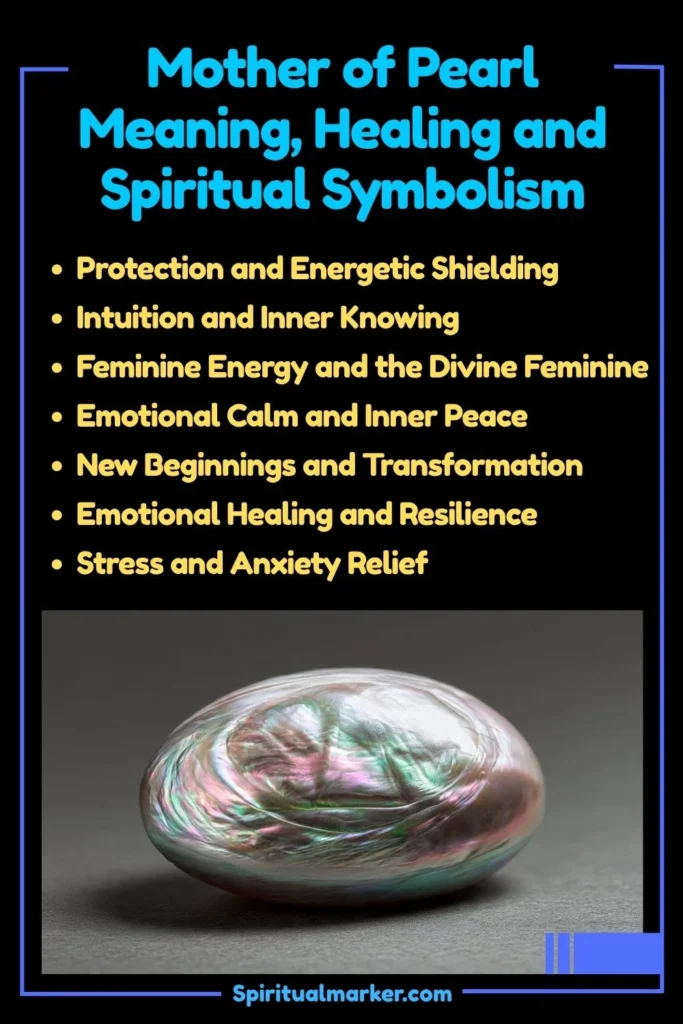
What Is Mother of Pearl?
Mother of pearl, scientifically called nacre, is the iridescent inner lining found inside certain mollusk shells. Oysters, abalones, mussels, and nautiluses all produce it as a biological response to irritants. The mollusk secretes layers of aragonite crystals and an organic protein called conchiolin over the irritant. Over time, those microscopic layers stack together and create the signature iridescent sheen people recognize immediately.
Unlike gemstones that form deep underground through geological pressure, mother of pearl forms in living organisms through a slow, patient biological process. That origin story matters spiritually. Many traditions see mother of pearl as carrying the energy of water, the ocean, and the slow wisdom of life unfolding in its own time.
Its appearance shifts depending on the angle of light. Creamy whites, soft pinks, silver blues, and golden greens all emerge from the same surface. This optical phenomenon is called iridescence, and it results from light diffracting through those ultra-thin nacre layers. That visual depth is one reason people have always associated mother of pearl with mystery, the subconscious, and hidden emotional truths.
Many people confuse mother of pearl with pearl itself. They are related but different. Pearls form when nacre fully coats a foreign particle inside the mollusk. Mother of pearl refers to the shell lining itself. Both carry similar spiritual energy, but mother of pearl tends to feel broader and more protective, while pearl often symbolizes purity and personal refinement.
Origins and Formation of Mother of Pearl
Mother of pearl forms in ocean and freshwater mollusks across the globe. The most prized nacre historically came from the Persian Gulf, the Red Sea, the coasts of Polynesia, and the Gulf of Mexico. Indigenous communities in these regions built entire economies, spiritual practices, and artistic traditions around shell materials for thousands of years.
In Polynesia, mother of pearl held sacred significance in navigation, ceremony, and ancestor veneration. Hawaiian traditions used it in lei-making and ceremonial ornamentation, viewing it as a gift from the ocean deities. In ancient China, mother of pearl appeared in imperial jewelry and lacquerware as a symbol of wealth, protection, and spiritual grace. Indigenous peoples of the American Southwest inlaid it into ceremonial objects, jewelry, and sacred tools.
The mollusk’s layering process can take years. Each layer of nacre is only a few hundred nanometers thick. Thousands of layers stack invisibly upon one another before the iridescent effect fully develops. Spiritually, this slow accumulation makes mother of pearl a powerful symbol of patience, gradual growth, and the beauty that develops only through sustained effort over time.
Today, mother of pearl is harvested sustainably from both wild and farmed sources. Australia, Indonesia, Japan, the Philippines, and Tahiti remain major sources. Each region’s nacre carries slightly different color tones, from the silver-white of Australian abalone to the warm golden tones of Philippine oyster shells.
Key Properties of Mother of Pearl
| Property | Details |
|---|---|
| Scientific Name | Nacre (aragonite + conchiolin) |
| Source | Inner lining of mollusks |
| Primary Colors | White, cream, silver, pink, blue-green, gold |
| Hardness | 2.5 to 4.5 on the Mohs scale |
| Chakra Association | Third Eye, Sacral, Crown (secondary) |
| Element | Water |
| Symbolism | Protection, intuition, emotional calm, feminine energy |
| Common Sources | Australia, Tahiti, Philippines, Japan, Indonesia |
| Energy Style | Gentle, protective, intuitive, emotionally grounding |
| Popular Uses | Jewelry, meditation, spiritual rituals, home decor |
Historical Use of Mother of Pearl
The human relationship with mother of pearl stretches back at least 100,000 years. Archaeological sites in South Africa have yielded shell beads made from mollusk shells dating to this period. Ancient Mesopotamian civilizations used nacre in decorative inlay work on royal furniture, musical instruments, and ceremonial objects as early as 3000 BCE. The Standard of Ur, a remarkable artifact from ancient Sumer, features mother of pearl mosaic pieces alongside lapis lazuli.
In ancient Egypt, mother of pearl appeared in amulets worn for divine protection. Egyptian healers believed shells held a connection to the goddess Isis, associating them with feminine power, regeneration, and sacred water. Shells and nacre objects frequently appeared in burial contexts, suggesting a belief that mother of pearl could ease the journey between worlds.
Across Asian spiritual traditions, mother of pearl appeared in Buddhist art and temple decoration. In China, nacre symbolized good fortune, prosperity, and divine protection. Traditional Chinese medicine occasionally included ground shell in formulas intended to calm the spirit, clear heat, and ease emotional restlessness, a use rooted in centuries of accumulated healing knowledge.
In Native American traditions, particularly among the Zuni and Navajo peoples, mother of pearl held deep ceremonial significance. It represented the element of water and often appeared alongside turquoise, jet, and coral in sacred jewelry and ritual objects. Many tribes used shells as currency and offering items, recognizing their intrinsic spiritual value.
During the Victorian era, mother of pearl became extremely fashionable in European jewelry, buttons, fans, and decorative objects. While its use became more ornamental during this period, spiritual practitioners continued to value it for protection, emotional stability, and connection to lunar and oceanic energies.
5 Spiritual Meanings of Mother of Pearl
1. Protection and Energetic Shielding
Among all the spiritual meanings attached to mother of pearl, protection stands as one of the most universal. This symbolism flows directly from the material’s biological origin. A mollusk creates nacre specifically to shield itself from harm. It wraps something foreign and potentially damaging in layer after protective layer until that threat becomes something beautiful. Spiritually, that process mirrors the idea of transforming adversity into strength through patient, consistent inner work.
Many spiritual traditions associate mother of pearl with a kind of energetic armor. It does not create walls or emotional numbness. Instead, its protective quality feels more like a filter. Negative energy, harsh emotional environments, and psychic overstimulation are believed to slide off rather than penetrate. People who feel emotionally sensitive or easily affected by others’ moods often find this symbolism deeply resonant.
Ancient sailors frequently carried mother of pearl as a talisman for protection at sea. The ocean, in many world traditions, represents both life-giving power and unpredictable danger. Carrying a piece of the ocean itself, in the form of nacre, was believed to invoke the water’s protective blessing. Polynesian navigators in particular wove shell materials into spiritual practices tied to safe passage across vast stretches of open water.
This protective symbolism extends into emotional life as well. Mother of pearl is often associated with shielding the emotional body during periods of grief, conflict, or significant life change. It does not suppress emotional experience. Rather, its energy is believed to create a soft emotional boundary that allows people to process difficulty without becoming overwhelmed. Many crystal practitioners describe this as feeling held rather than numbed during painful emotional periods.
2. Intuition and Inner Knowing
Mother of pearl has long been associated with intuition, inner knowing, and the quieter forms of spiritual awareness that resist logical explanation. Its iridescent surface, shifting subtly with every movement of light, visually represents the idea that truth is layered and multi-dimensional. What you see depends on the angle from which you look. This quality makes mother of pearl a natural symbol for the kind of perception that moves beyond surface-level observation.
Many spiritual systems connect mother of pearl with the third eye chakra, the energy center associated with insight, psychic sensitivity, and spiritual vision. When this energy center feels active and balanced, people often report stronger gut feelings, more vivid and meaningful dreams, and a greater sense of clarity about personal direction. Mother of pearl is believed by many practitioners to gently encourage this sensitivity without forcing it open unnaturally.
Its connection to water deepens this intuitive symbolism. Water in most spiritual traditions represents the emotional body, the subconscious mind, and the flow of hidden truths. Water does not resist its environment. It moves around obstacles, finds pathways, and settles into available space. Mother of pearl spiritually reflects that same quality of receptive, fluid awareness that allows intuition to surface naturally rather than being forced.
People who feel disconnected from their instincts often turn toward mother of pearl during periods of spiritual rebuilding. Life stress, emotional suppression, and prolonged periods of overanalysis can quiet intuitive awareness. Mother of pearl symbolizes the gentle process of reawakening that inner voice after it has been silenced by noise, fear, or emotional overload.
3. Feminine Energy and the Divine Feminine
Few materials carry as strong an association with feminine energy as mother of pearl. This connection runs through nearly every culture that has valued nacre throughout history. It links to water, the moon, fertility, creation, emotional depth, and the nurturing forces that sustain life quietly behind the scenes. In Hinduism, the goddess Lakshmi, associated with abundance, grace, and beauty, is sometimes depicted with shell imagery. In ancient Greece, the goddess Aphrodite rose from the sea on a shell, placing nacre at the very heart of divine feminine mythology.
The moon connection reinforces this symbolism powerfully. Tidal rhythms respond to the moon’s gravitational pull. Shells live inside those rhythms. Many spiritual traditions view the moon as a symbol of feminine cycles, emotional intelligence, intuitive wisdom, and the power of darkness and mystery. Mother of pearl, born from a creature that lives within tidal rhythms, naturally carries that lunar energy within its symbolism.
In crystal healing traditions, mother of pearl is often recommended during periods when people need to reconnect with receptivity, softness, and emotional intelligence. Modern culture frequently rewards aggression, speed, and external achievement while undervaluing patience, emotional awareness, and inner knowing. Mother of pearl symbolically restores balance by honoring the quieter, more intuitive dimensions of human experience that tend to get overlooked.
This symbolism does not exclude any gender. Feminine energy in spiritual traditions refers to qualities available to all people regardless of gender identity. Receptivity, compassion, emotional courage, and creative nurturing are universal human capacities. Mother of pearl invites everyone to reconnect with those dimensions of themselves, especially when external pressure pushes relentlessly toward action, control, and productivity.
4. Emotional Calm and Inner Peace
The most immediate feeling many people associate with mother of pearl is calm. That quality permeates its spiritual symbolism across traditions and time periods. Its muted iridescence does not demand attention. It invites it gently, slowly, without pressure. That visual character reflects the kind of inner stillness it has long been believed to support in the people who work with it.
Emotional calm in spiritual traditions is not the same as emotional flatness. True inner peace coexists with full emotional awareness. It means feeling emotions without being destabilized by them, processing difficulty without drowning in it, and returning to steadiness after disruption rather than remaining in chaos. Mother of pearl symbolizes this balanced relationship with emotional experience rather than the suppression of it.
Many people feel emotionally scattered during high-stress periods. Anxiety, overthinking, relational conflict, and chronic fatigue all fragment attention and create internal noise that makes it difficult to access clear feeling or clear thought. Mother of pearl’s calming symbolism specifically addresses this fragmented state. It represents the return to emotional coherence, the moment when scattered internal experience begins to settle back into recognizable form.
Traditional Chinese medicine’s use of ground shell in formulas for calming the spirit reflects a practical, centuries-old understanding of this quality. The herbal category that includes shell materials in TCM is called Shen-calming herbs, with Shen referring to the spirit or mind. This tradition validates what many modern crystal practitioners sense intuitively. Something in mother of pearl resonates with the nervous system and the emotional body in a way that encourages settling rather than stimulation.
5. New Beginnings and Transformation
Mother of pearl carries deep symbolism around new beginnings, renewal, and personal transformation. This meaning emerges partly from its biological origin and partly from the cultures that have used it through history. A mollusk does not produce nacre all at once. It builds it layer by patient layer over years, slowly turning something irritating into something luminous. That process mirrors the way meaningful personal change actually works.
Many people are drawn to mother of pearl during major life transitions. Career changes, relationship endings, geographical moves, recovery from illness, and spiritual awakening periods all create emotional upheaval that simultaneously opens the door to profound personal growth. Mother of pearl spiritually represents the patient, layered process of building something beautiful from what was difficult. Its energy does not rush transformation. It honors the time that genuine change requires.
Water symbolism deepens this theme. In many world traditions, water represents cleansing, release, and regeneration. Baptism rituals use water to mark spiritual rebirth. Hindu pilgrims bathe in sacred rivers to release karma and begin again. The ocean in particular symbolizes the vast, limitless potential from which new life continuously emerges. Mother of pearl, born from the ocean, carries that regenerative water energy within its spiritual symbolism.
Many practitioners believe mother of pearl is especially powerful during periods when the past feels heavier than the future. Grief, regret, and emotional attachment to what no longer serves a person can make movement forward feel impossible. Mother of pearl symbolically represents the willingness to release and begin again, not by forgetting what came before, but by allowing it to become part of the foundation from which something new can grow.
6 Healing Properties of Mother of Pearl
1. Emotional Healing and Resilience
Mother of pearl holds a strong reputation in crystal healing traditions for supporting emotional healing. Its symbolism centers on emotional resilience rather than emotional avoidance. Many people who carry unresolved emotional pain experience a slow accumulation of grief, resentment, or anxiety that builds quietly beneath daily functioning. Over time, that unprocessed emotional weight affects sleep, relationships, physical health, and overall sense of wellbeing.
Crystal practitioners often use mother of pearl during grief work, trauma recovery, and emotional integration practices. Its energy is described as patient and holding rather than forceful or intense. It does not rip emotional wounds open dramatically. Instead, many people describe its presence as creating an emotional softness that allows difficult feelings to surface gently and be acknowledged rather than pushed back down.
Its connection to water reinforces this healing quality. Water heals through movement. Emotional healing similarly requires movement through feeling rather than around it. Mother of pearl spiritually supports that willingness to feel, process, and eventually release what no longer needs to be carried. For people who have spent years in emotional suppression, even subtle permission to feel more openly can represent significant healing progress.
The biological metaphor is worth returning to here. The mollusk that creates nacre does not eliminate the irritant. It transforms it. That is precisely what emotional resilience looks like in practice. Not the absence of difficulty, but the capacity to metabolize it, layer by layer, until what once caused pain becomes something that contributes depth and character to a person’s emotional life.
2. Stress and Anxiety Relief
Mother of pearl has earned a consistent reputation as a calming stone in crystal healing traditions. People dealing with chronic stress, anxiety, or emotional overwhelm often report a noticeable sense of soothing when working with or wearing it. Its visual quality plays a role in this. That soft, shifting iridescence tends to slow visual attention in the same way a candle flame or moving water captures focus and slows racing thoughts.
Stress operates by keeping the nervous system in a sustained state of alert. The body reads ongoing pressure, whether from work, relationships, financial strain, or emotional conflict, as a threat that requires a continuous response. Mother of pearl’s calming symbolism addresses this pattern by inviting the nervous system toward a different baseline. Its energy is frequently described as regulating rather than sedating.
Many practitioners place mother of pearl near the body during meditation or hold it during moments of acute stress or emotional overwhelm. The physical sensation of cool, smooth nacre against the skin is itself calming. Touch affects the nervous system directly. The parasympathetic nervous system, responsible for rest and emotional regulation, responds to gentle tactile sensation. Smooth natural materials like mother of pearl engage this response naturally.
Its association with water and ocean energy amplifies this effect symbolically. Research consistently shows that proximity to water reduces cortisol levels and lowers subjective stress. Marine environments produce a measurable psychological calming effect that many people intuitively seek during emotionally difficult periods. Mother of pearl carries a resonance with that oceanic calm even when the actual ocean is not within reach.
3. Enhanced Intuition and Spiritual Sensitivity
One of the more widely discussed healing properties of mother of pearl involves its believed ability to sharpen intuitive awareness and deepen spiritual sensitivity. Many people feel disconnected from their gut instincts during prolonged periods of stress, intellectual overactivity, or emotional suppression. Mother of pearl is associated with the gradual reopening of that intuitive channel when it has been quieted by external pressure or internal noise.
This quality connects to its association with the third eye chakra, the energy center linked to spiritual sight, inner knowing, and the perception of subtle patterns that escape ordinary conscious awareness. Many meditation practitioners incorporate mother of pearl into sessions specifically focused on developing clarity, sharpening discernment, or deepening spiritual receptivity. Its gentle energy is believed to encourage openness without overstimulation.
Dreams often become more vivid and symbolically meaningful for people who work with mother of pearl regularly. The subconscious communicates through imagery, emotion, and metaphor, and many spiritual traditions view dreams as important vehicles for inner guidance. Mother of pearl’s lunar and water associations connect it naturally with the dreamworld, where the boundaries between conscious awareness and deeper knowing become more fluid.
Journaling, creative expression, and reflective spiritual practices also appear to deepen for people who use mother of pearl as a supportive material during these activities. The stone’s calming influence on mental chatter may create more internal space for genuine intuitive signals to surface. Many people report clearer emotional guidance, stronger sense of personal direction, and a deeper trust in their own perception during periods of consistent engagement with mother of pearl.
4. Strengthening Relationships and Communication
Mother of pearl carries healing symbolism connected to relationships, emotional honesty, and compassionate communication. Because its energy centers on emotional calm and intuitive receptivity, many practitioners associate it with improved interpersonal dynamics. Relationships often suffer most when people are emotionally reactive, emotionally withdrawn, or communicating from a place of unresolved inner pain rather than genuine present awareness.
Its protective energy plays an important role in relational healing. Many communication difficulties arise not from lack of care but from emotional vulnerability that feels too exposed. When people fear being hurt, misunderstood, or dismissed, they often communicate defensively. Mother of pearl symbolically supports the kind of protection that makes vulnerability feel safer without requiring emotional walls that block genuine connection.
Many practitioners use mother of pearl during relationship-focused meditations, couples rituals, or personal reflection work centered on forgiveness and emotional repair. Its symbolism honors the patience that genuine relational healing requires. Damaged trust, old wounds, and patterns of misunderstanding do not resolve overnight. Mother of pearl reflects the layered, steady work of rebuilding connection over time through consistent emotional honesty and compassionate presence.
Its lunar associations also connect it to emotional cycles. Relationships naturally move through periods of closeness and distance, harmony and friction. Understanding these cycles rather than resisting them forms the foundation of emotionally intelligent relating. Mother of pearl symbolically supports that cyclical awareness, encouraging patience during difficult relational phases rather than panic or premature withdrawal.
5. Physical Calming and Bodily Harmony
Within crystal healing traditions, mother of pearl is sometimes associated with physical calming and the reduction of tension held in the body. Emotional stress does not remain purely psychological. It accumulates in muscles, affects digestion, disrupts sleep, and can lower immune resilience over time. The body and emotional body are not separate systems, which is why materials associated with emotional calm often carry perceived physical benefits as well.
Practitioners sometimes associate mother of pearl with the softening of physical tension, particularly tension held around the shoulders, chest, and stomach, areas that commonly accumulate emotional stress in the body. This is not a medical claim. Rather, it reflects the holistic view that emotional calm and physical relaxation tend to support one another naturally when emotional healing progresses.
Traditional Chinese medicine’s historical use of shell materials for calming the spirit reflects an ancient understanding of this mind-body relationship. The Shen-calming category in TCM includes materials used to quiet mental restlessness, support sleep, and ease emotional agitation that manifests physically. While modern crystal healing and traditional medicine are distinct practices, they share a foundational understanding that emotional regulation and physical wellness are deeply interconnected.
Many people who struggle with stress-related physical symptoms like tension headaches, interrupted sleep, or digestive discomfort report that regular calming practices, whether meditation, breathwork, gentle movement, or crystal work with materials like mother of pearl, contribute to overall physical comfort over time. The mechanism may be as simple as the consistent activation of the parasympathetic nervous system during calming rituals that include grounding materials.
6. Spiritual Grounding and Centering
While mother of pearl carries strong associations with water, the moon, and intuitive openness, it also symbolizes spiritual grounding in many traditions. This might initially seem contradictory. Grounding is often associated with earth energy, heaviness, and rootedness. But water has its own form of grounding. Oceanic depth, tidal regularity, and the constant rhythm of waves all create a form of stability that differs from earth’s solidity but functions in a similarly centering way.
Spiritual grounding refers to maintaining emotional and mental stability while engaging in deeper spiritual work or navigating heightened emotional states. Without grounding, people can feel emotionally scattered, spiritually unmoored, or overwhelmed during meditation, grief processing, or intuitive development. Mother of pearl’s calming water energy provides a different kind of anchor, one that steadies through fluidity rather than rigid resistance.
Many practitioners hold or wear mother of pearl during extended meditation sessions for precisely this reason. Its energy is believed to keep the spiritual experience emotionally manageable. It supports receptivity without encouraging emotional flooding. For people whose spiritual practices have sometimes felt destabilizing, mother of pearl offers a gentler, more protected form of spiritual engagement.
Its centering quality also supports daily spiritual practice. Not every meditation produces dramatic insights. Many moments of genuine spiritual growth happen in the quiet return to ordinary awareness after a period of inner stillness. Mother of pearl symbolizes this quality of returning to center, returning to breath, returning to the present moment with greater clarity and emotional steadiness than existed before the practice began.
Mother of Pearl Chakra Connections
Mother of pearl connects most strongly with the third eye chakra, located between the eyebrows, and the sacral chakra, located below the navel. The third eye governs intuition, spiritual insight, inner vision, and the ability to perceive subtle emotional and energetic patterns. Mother of pearl’s iridescent, layered quality mirrors the multi-dimensional perception associated with a balanced third eye.
The sacral chakra governs emotional intelligence, creative energy, sensual awareness, and the capacity for emotional flow. Its element is water, which aligns perfectly with mother of pearl’s origin and symbolism. When the sacral chakra feels balanced, emotions move freely without becoming stagnant or overwhelming. Mother of pearl is believed to support this emotional fluency, helping people feel their emotional lives more fully without emotional flooding or suppression.
Some practitioners also associate mother of pearl with the crown chakra, the energy center at the top of the head associated with higher consciousness, spiritual connection, and the sense of unity with something larger than the individual self. Its lunar symbolism and deep historical connection to sacred practices across many cultures support this secondary crown chakra association for those whose spiritual framework includes higher-dimensional energy work.
How to Use Mother of Pearl for Spiritual Growth
People use mother of pearl in many different ways depending on their spiritual intentions and personal practices. Wearing it as jewelry remains one of the most common and practical approaches. Because mother of pearl connects with both intuition and emotional calm, wearing it near the face, throat, or heart in the form of earrings, necklaces, or brooches keeps its symbolism close to the energy centers most relevant to its meaning.
During meditation, holding a piece of mother of pearl in the palm or placing it on the forehead near the third eye can deepen the quality of inward focus. Many practitioners pair mother of pearl with moonstone, aquamarine, or labradorite during intuition-focused sessions. These combinations amplify water element symbolism and strengthen the receptive, intuitive quality that mother of pearl brings.
Placing mother of pearl near water features, altars, or windowsills where moonlight reaches it can strengthen its energetic presence in a space. Many people place nacre shells or polished mother of pearl pieces in bathrooms, near garden water features, or in meditation corners where its calming presence can work gently over time. Creating a dedicated spiritual space around water-element materials can support ongoing emotional and spiritual grounding throughout daily life.
Some people keep a small piece of mother of pearl near their bed to support vivid dreaming and intuitive sleep. Because of its lunar associations, many practitioners charge their mother of pearl under full moonlight by leaving it on a windowsill overnight. This practice holds symbolic value in many spiritual traditions connected to lunar cycles, renewal, and the amplification of intuitive energy.
Journaling with mother of pearl nearby can also support emotional clarity and creative insight. Writing with emotional honesty becomes easier when the emotional environment feels safe and calm, and that is precisely the energetic quality mother of pearl is believed to cultivate. Many people report that their most honest and illuminating journal entries happen during or after quiet time spent with calming spiritual materials.
Caring for Mother of Pearl Jewelry
Mother of pearl requires gentle, consistent care because of its relatively soft structure and organic composition. With a Mohs hardness of approximately 2.5 to 4.5, nacre scratches more easily than harder gemstones like sapphire or topaz. Store mother of pearl jewelry separately from harder pieces to prevent surface damage. Soft fabric pouches or individual compartments in padded jewelry boxes work best.
Avoid exposing mother of pearl to harsh chemicals, perfume, hairspray, chlorine, or acidic substances. These can erode the delicate surface layers that create its iridescent appearance. Always apply perfume and cosmetics before putting on mother of pearl jewelry, and remove pieces before swimming, bathing, or housecleaning.
Clean mother of pearl with a soft, slightly damp cloth and allow it to air dry completely before storing. Avoid ultrasonic cleaners, steam cleaning, or abrasive polishing cloths. Its organic structure makes it more sensitive to mechanical cleaning methods than mineral gemstones. Mild soap diluted in lukewarm water is safe for occasional cleaning when needed.
Keep mother of pearl away from prolonged direct sunlight and extreme heat. Extended UV exposure can cause the surface to dull or develop fine surface cracking over time. Consistent moderate humidity suits nacre better than very dry environments, which can cause the organic layers to shrink and crack. Many people who value their mother of pearl spiritually also practice energetic cleansing by placing it under full moonlight overnight, which is gentle on the material while carrying symbolic significance within lunar spiritual practices.
Table: Mother of Pearl Meaning at a Glance
| Aspect | Details |
|---|---|
| Primary Meaning | Protection, intuition, emotional calm |
| Chakra Association | Third Eye, Sacral, Crown (secondary) |
| Main Spiritual Symbolism | Feminine energy, new beginnings, inner peace |
| Common Colors | White, cream, silver, pink, blue-green, gold |
| Hardness | 2.5 to 4.5 Mohs |
| Main Sources | Australia, Tahiti, Japan, Philippines, Indonesia |
| Emotional Associations | Calm, resilience, emotional fluency, compassion |
| Popular Jewelry Types | Earrings, necklaces, rings, bracelets, brooches |
| Spiritual Uses | Meditation, dream work, intuition development, grief healing |
| Care Needs | Gentle cleaning, avoid chemicals, store separately |
A Final Note
Mother of pearl stands apart because its meaning feels both ancient and immediately personal. You do not need to know its history to feel its pull. Something in its layered shimmer speaks directly to the part of a person that recognizes beauty built through patience, protection earned through vulnerability, and calm developed through the honest experience of difficulty.
Its spiritual symbolism centers on protection, intuition, emotional calm, feminine energy, and gradual transformation. Whether you approach it through a crystal healing framework, a historical and cultural lens, or simple aesthetic appreciation, mother of pearl continues to resonate across every context it enters.
If mother of pearl draws your attention right now, that pull may reflect something meaningful about your current emotional or spiritual chapter. You might consider wearing it as a reminder of your own resilience and quiet inner depth. You might keep it near water or moonlight as part of a calming daily ritual. Or you might simply appreciate the way its surface reminds you that the most luminous things in life often form slowly, layer by layer, from experiences that were never easy.