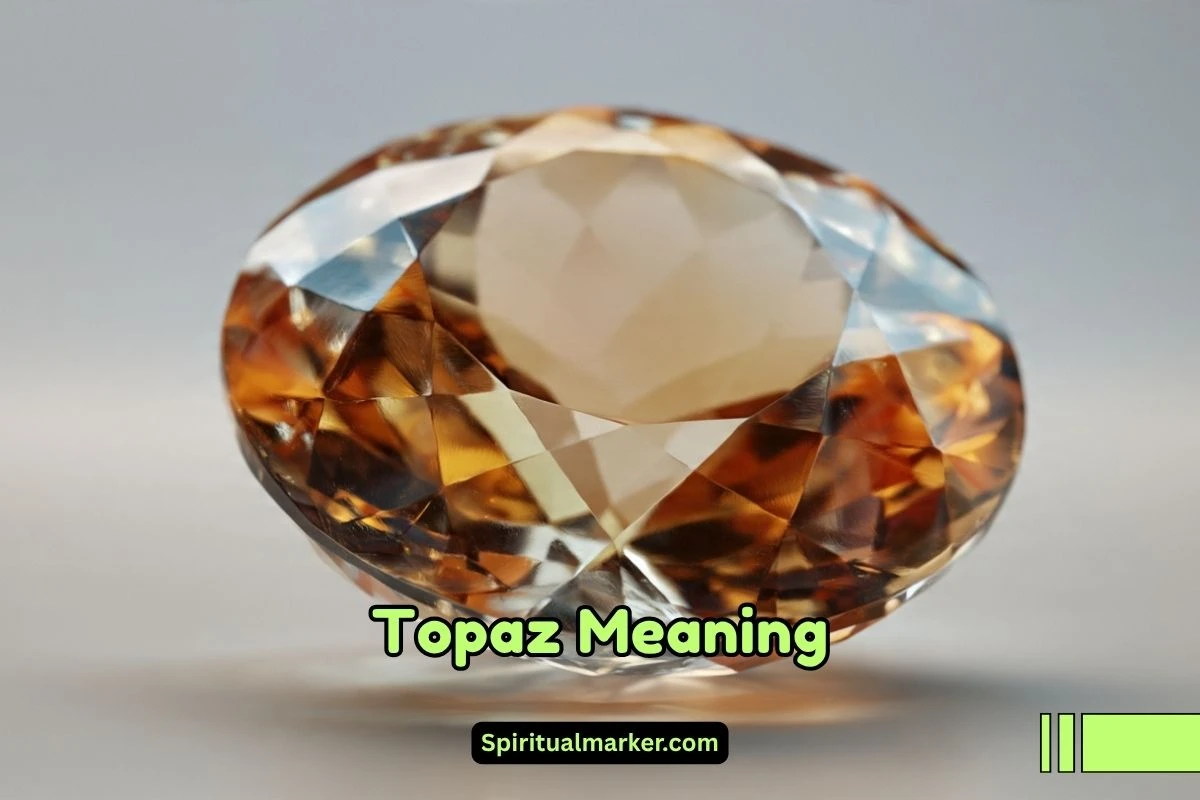
Have you ever looked at a piece of topaz and felt something stir inside you? Many people do. Its warm golden glow or cool blue clarity seems to speak directly to something deep within the human spirit. That feeling is not accidental.
For thousands of years, people across vastly different cultures treated topaz as a sacred stone. Ancient Egyptians believed it channeled the energy of the sun god Ra. Greek warriors carried it into battle for strength and protection. Medieval Europeans placed it inside churches and royal crowns as a symbol of divine favor and personal power.
Today, topaz continues to hold tremendous significance. People wear it for emotional clarity, spiritual strength, abundance, and inner confidence. Crystal healers associate it with mental focus, positive energy flow, and deepened self-awareness. Some traditions link specific topaz colors with unique healing frequencies, each one addressing a different area of emotional or spiritual life.
What makes topaz remarkable is its range. It appears in rich golden amber, vivid blue, soft pink, and the prized imperial orange-gold. Each color carries its own symbolic weight. Yet across all these varieties, topaz shares a central spiritual identity rooted in truth, light, and personal empowerment.
This article covers the complete meaning of topaz, its spiritual symbolism, healing properties, historical background, chakra connections, and the ways people use it for spiritual growth. You will also learn how to care for topaz jewelry and maintain both its physical beauty and energetic significance.
5 Key Takeaways
- Topaz symbolizes truth, clarity, confidence, abundance, and spiritual alignment across many traditions.
- Different topaz colors carry distinct spiritual meanings, from golden topaz’s connection with solar energy to blue topaz’s link with clear communication.
- Many spiritual practitioners associate topaz with the solar plexus, throat, and crown chakras, depending on the stone’s color.
- Topaz has a long historical reputation as a stone of protection, healing, and royal power across ancient Egypt, Greece, Rome, and medieval Europe.
- Wearing or meditating with topaz is believed to support mental clarity, emotional balance, self-expression, and personal transformation.
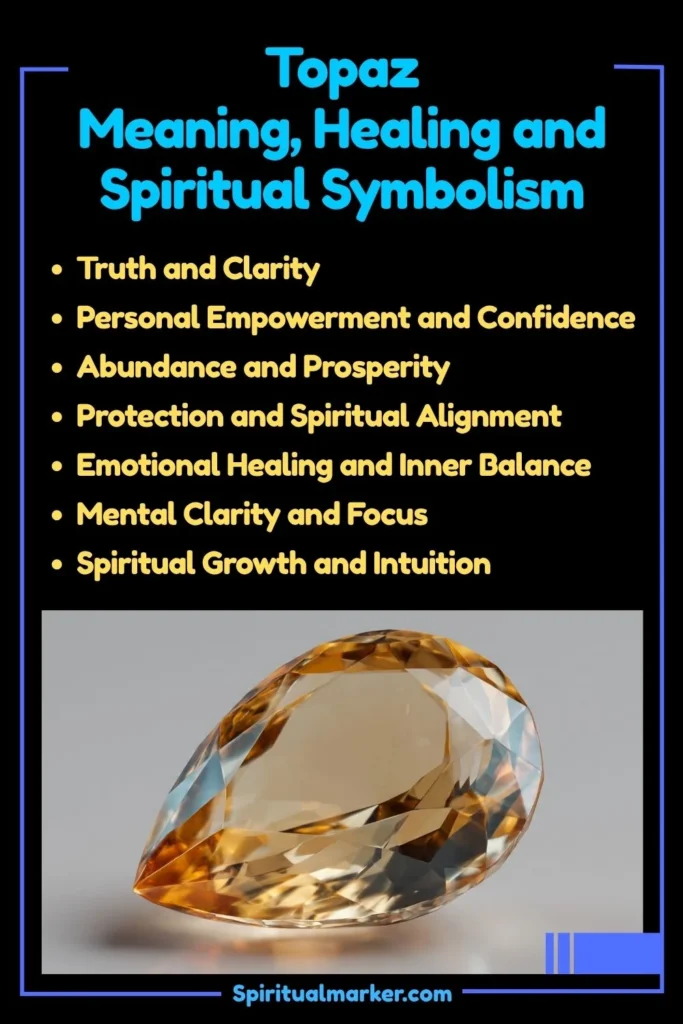
What Is Topaz?
Topaz is a silicate mineral composed of aluminum, silicon, oxygen, and fluorine. It forms in igneous rocks, particularly in pegmatites and rhyolite lava flows, where fluorine-rich vapors interact with cooling magma over long geological periods. Its crystal structure creates a naturally prismatic form, which contributes to its exceptional transparency and brilliance.
Pure topaz is actually colorless. The wide range of colors you see in jewelry comes from trace impurities or from structural irregularities within the crystal lattice. Iron and chromium create golden and orange tones. Chromium alone produces rare pink and red varieties. Blue topaz, the most commercially popular form today, is often natural topaz treated with irradiation and heat to enhance or develop its color.
On the Mohs hardness scale, topaz scores an 8 out of 10. This makes it significantly harder and more durable than most common gemstones. Only corundum (ruby and sapphire) and diamond sit above it. That durability is part of why topaz has been prized for jewelry across centuries.
Many people confuse topaz with citrine or smoky quartz because of similar golden hues. However, topaz has a noticeably higher clarity, denser weight, and distinct crystal formation. Spiritually, each stone also carries a completely different energetic identity.
Origins and Formation
Topaz forms deep within the earth under intense geological conditions. It develops in granite pegmatites, which are coarse-grained igneous rocks formed during the late stages of magma cooling. As fluorine-rich fluids move through rock cavities and fractures, they leave behind silicate minerals that slowly crystallize into topaz over millions of years.
This slow, pressurized formation process contributes to topaz’s symbolic reputation for strength, resilience, and clarity under pressure. Many spiritual traditions see the stone’s geological origin as metaphorically meaningful. Just as topaz forms from intense conditions deep within the earth, personal strength and clarity often develop through difficult human experiences.
Major topaz deposits exist in Brazil, which produces some of the world’s finest imperial topaz. Other significant sources include Russia, Pakistan, Sri Lanka, Nigeria, Mexico, Australia, and the United States. The famed imperial topaz from Ouro Preto, Brazil, carries deep historical prestige and remains among the most valuable topaz varieties on the market.
Russia’s Ural Mountains also hold historical significance. The golden topaz mined there during the 18th and 19th centuries became known as “Siberian” topaz and was highly prized by Russian royalty and European gem traders alike.
Key Properties at a Glance
| Property | Details |
|---|---|
| Composition | Aluminum silicate fluoride |
| Hardness | 8 on the Mohs scale |
| Colors | Colorless, blue, golden, orange, pink, red, imperial |
| Chakra Association | Solar plexus, throat, crown (varies by color) |
| Primary Symbolism | Truth, clarity, abundance, confidence, protection |
| Main Sources | Brazil, Russia, Pakistan, Sri Lanka, Nigeria |
| Transparency | Transparent to translucent |
| Energy Style | Warming, clarifying, empowering |
| Birthstone | November (golden/yellow) and December (blue) |
| Anniversary Gemstone | 4th and 19th wedding anniversaries |
Historical Use and Cultural Significance
The history of topaz stretches back at least four thousand years. Its name is believed to derive either from the Sanskrit word tapas, meaning “fire” or “heat,” or from the ancient Greek name Topazios, referring to a small island in the Red Sea where yellow stones were once mined.
Ancient Egyptians held topaz in extraordinary reverence. They believed the stone received its golden color directly from Ra, the sun god. They wore it as protective amulets, believing it shielded them from harm and channeled solar power into the body. Yellow and golden gems were closely associated with divine energy in Egyptian sacred culture.
Ancient Greeks and Romans prized topaz for its perceived ability to increase strength and grant its wearer invisibility during times of danger. Roman soldiers and nobles wore topaz as protective talismans. Pliny the Elder, the Roman naturalist, mentioned topaz extensively in his writings as one of the most powerful healing stones known to his civilization.
During the Middle Ages, European royalty embedded topaz in crowns, scepters, and ecclesiastical objects. Pope Clement VI used a large topaz in his ceremonial ring. The stone appeared frequently in cathedral art and religious jewelry, partly because of a widespread belief that it could detect poisons. Rulers placed topaz in chalices and cups, believing it would change color or lose its brilliance if the contents were poisoned.
Hebrew tradition also intersected with topaz. The stone is commonly associated with one of the twelve gems listed in the Bible as part of the High Priest’s breastplate (Exodus 28:17-20), representing one of the twelve tribes of Israel. Scholars debate which exact stones appear on the breastplate, but topaz appears in most translations.
In Indian Vedic astrology, topaz is connected with Jupiter, the planet of wisdom, abundance, and spiritual expansion. Wearing topaz is believed to attract the blessings of Jupiter, bringing prosperity, knowledge, and spiritual merit to the wearer.
5 Spiritual Meanings of Topaz
1. Truth and Clarity
Truth sits at the very heart of topaz’s spiritual identity. Across multiple ancient and modern traditions, the stone consistently carries the symbolism of seeing clearly, speaking honestly, and living in alignment with one’s deepest values.
This meaning feels especially powerful in a world where people regularly suppress their real thoughts and feelings. Social pressure, fear of rejection, and habitual self-doubt can create significant distance between who a person truly is and the face they present to the world. Topaz spiritually represents the courage to close that gap.
Many crystal practitioners believe topaz resonates with mental clarity by helping reduce the emotional static that clouds honest self-perception. You may find it easier to recognize where you have been compromising your values or where personal honesty has been quietly slipping away. The stone’s brilliant, transparent nature directly mirrors this symbolism. Light passes cleanly through topaz. Very little is hidden.
This connection with truth also extends outward into communication. People who struggle to speak their needs, enforce boundaries, or express themselves authentically often feel drawn to topaz. Its spiritual energy is believed to strengthen the voice and support truthful expression without aggression or fear.
Many spiritual texts link truth with liberation. When people stop suppressing genuine feelings, something lifts. Emotional heaviness associated with pretense, people-pleasing, and self-abandonment begins to fade. Topaz spiritually symbolizes that liberation. It reflects the profound emotional and spiritual relief that comes from living and speaking honestly.
The Romans understood this instinctively. They associated topaz with clarity of mind and justice, values they connected with their highest ideals of governance and personal virtue. That ancient association between topaz and truthful living has carried forward across centuries into modern spiritual traditions.
2. Personal Empowerment and Confidence
Confidence is another of topaz’s most enduring spiritual associations. The stone has a long historical reputation as a talisman carried by leaders, warriors, and visionaries seeking to strengthen their resolve and trust their own judgment.
This symbolism matters deeply today. Many people live with persistent self-doubt that operates below conscious awareness. They may second-guess decisions constantly, minimize their abilities, or feel fundamentally unworthy of success and recognition. Over time, that internal narrative becomes a powerful limitation.
Golden and imperial topaz carry particularly strong associations with personal power. Their solar energy connects with willpower, self-assurance, and the ability to act decisively even during uncertainty. Many healers link these varieties with the solar plexus chakra, the energy center governing personal authority and self-trust.
Topaz spiritually symbolizes the shift from self-doubt to self-ownership. It represents trusting your own perception, honoring your own worth, and moving forward with genuine conviction. That shift rarely happens instantly. It develops through consistent emotional honesty, self-awareness, and the gradual dismantling of limiting beliefs built up over years.
Ancient Hindu texts reference golden topaz as a stone capable of increasing mental strength, wisdom, and personal fortune. The connection between spiritual clarity and outer confidence appears repeatedly across traditions because they are not truly separate. When a person knows who they are and what they value, confidence tends to follow naturally.
Many people wear topaz during job interviews, public speaking, creative presentations, or other situations requiring visible confidence. The stone symbolizes inner strength made visible, the kind of self-assurance that does not require external approval because it comes from genuine self-knowledge.
3. Abundance and Prosperity
Topaz holds a deep and consistent association with abundance across multiple cultural traditions. This connection reaches beyond simple financial prosperity. In its fullest spiritual meaning, topaz represents abundance as a way of living: richness in relationships, creativity, purpose, health, joy, and spiritual depth.
The stone’s historical connection with Jupiter in Vedic astrology reinforces this symbolism powerfully. Jupiter governs expansion, generosity, wisdom, and good fortune. Wearing topaz was traditionally believed to align the wearer with Jupiter’s benefic influence, attracting opportunities and blessings across multiple life areas.
Golden topaz in particular reflects the warmth and generosity of the sun. Solar symbolism has always been connected with abundance in ancient cultures. The sun grows crops, provides warmth, drives the seasons, and sustains all life. Golden topaz carries this same life-giving, expansive energy symbolically.
Spiritually, topaz encourages an abundance mindset by helping dissolve fear, scarcity thinking, and emotional contraction. Many people unconsciously limit their own potential through beliefs about unworthiness or lack. They hesitate to pursue opportunities, ask for what they need, or invest in their own growth because fear of loss feels stronger than hope for gain. Topaz’s symbolism challenges this pattern directly.
The stone also represents generous giving as part of the abundance cycle. True prosperity in most spiritual traditions flows in both directions. Receiving blessings and sharing them creates a living energetic cycle that continues to grow. Topaz spiritually reflects this generous spirit, encouraging both gratitude for present blessings and openness to greater expansion.
4. Protection and Spiritual Alignment
Topaz has carried protective symbolism since antiquity. Ancient Egyptians, Greeks, Romans, and medieval Europeans all believed the stone created a spiritual shield around its wearer. While protection meant different things across each culture, the core belief remained consistent: topaz was not a passive stone. It was believed to actively defend the spirit against harm.
In medieval Europe, topaz was thought to neutralize poisons, cool fevers, and break the power of dark enchantments. Royal households kept topaz close for this reason. The stone’s brilliant clarity was seen as symbolic of divine light that could cut through darkness, deception, and negative influence.
In modern spiritual practice, protective symbolism takes a more nuanced form. Topaz is believed to help its wearer maintain energetic boundaries. People who regularly absorb others’ emotional energy, struggle with emotional manipulation in relationships, or feel spiritually drained after social interaction often turn to topaz for energetic reinforcement.
Spiritual alignment is another dimension of this symbolism. Topaz is associated with helping people reconnect with their authentic spiritual path, especially after periods of confusion, misdirection, or spiritual doubt. Many practitioners believe the stone helps clarify spiritual purpose by cutting through emotional noise and mental distraction.
This alignment aspect connects topaz with higher consciousness and spiritual truth. Blue topaz, in particular, is often linked with the throat and crown chakras, which govern communication with higher wisdom and spiritual awareness. Clear topaz is sometimes used during meditation and prayer as a tool for spiritual receptivity and divine connection.
5. Emotional Healing and Inner Balance
While topaz is often celebrated for its empowering and clarifying qualities, it also carries significant meaning as an emotional healing stone. This dimension of topaz symbolism focuses on restoring inner balance, processing emotional pain, and cultivating emotional resilience.
Topaz’s connection with emotional healing feels especially meaningful for people who have experienced loss, betrayal, long-term stress, or emotional exhaustion. The stone is not associated with dramatically intense emotional catharsis. Instead, its healing symbolism centers on a more measured, clarifying form of emotional recovery.
Many spiritual traditions suggest that emotional wounds often begin in the mind as much as in the heart. Distorted beliefs about worthiness, belonging, safety, and love shape emotional experience profoundly. Topaz symbolically addresses this mental-emotional intersection by encouraging honest self-reflection alongside emotional gentleness.
In some traditions, the stone is associated with the ability to release resentment and emotional rigidity. People who have been deeply hurt sometimes build extensive emotional armor to prevent future pain. While that protection can feel necessary initially, it often eventually creates isolation, numbness, or chronic emotional contraction. Topaz spiritually represents the gradual, courageous process of softening that armor without becoming recklessly vulnerable.
Blue topaz carries particularly strong associations with emotional communication, helping people articulate feelings they have kept hidden or struggle to express. Golden topaz tends to address emotional courage and the strength to face difficult truths honestly. Together, they reflect topaz’s complete emotional healing identity.
6 Healing Properties of Topaz
1. Mental Clarity and Focus
Topaz has a strong reputation as a stone for sharpening the mind. Many crystal practitioners use it when they need to make important decisions, solve complex problems, or cut through mental fog that has been affecting their thinking.
Mental fog is a genuine human experience. Emotional stress, chronic fatigue, information overload, and anxiety can all reduce mental sharpness. Tasks that once felt effortless begin to feel laborious. Decisions that should be straightforward become paralyzing. Topaz symbolically addresses this scattered mental state by encouraging clarity, focus, and intellectual precision.
Its connection with truth reinforces this healing property. Clear thinking requires honest self-assessment. When people avoid looking directly at difficult realities, mental energy gets consumed by that avoidance. Topaz is believed to help dissolve that internal resistance, freeing mental energy for sharper, more focused thought.
Many students, writers, researchers, and professionals who work with complex material wear or keep topaz nearby for this reason. The stone symbolizes the kind of mental clarity that comes from genuine engagement with truth rather than from avoidance or wishful thinking.
2. Emotional Courage
Courage is one of topaz’s most distinctive healing associations. This is not the reckless courage of impulsivity. It is the quieter, more sustainable courage required to live honestly, speak truthfully, and make decisions aligned with genuine values even when fear is present.
Emotional courage shows up in many forms. It appears when someone finally leaves an unhealthy situation after years of hesitation. It shows up when a person speaks an uncomfortable truth instead of saying what others want to hear. It is present when someone commits to healing rather than continuing to avoid emotional pain.
Golden and imperial topaz are especially connected with this healing quality. Their warm, solar energy resonates with the willpower required to act despite fear. Many practitioners believe working with these stones during meditation or reflection can gradually strengthen emotional resolve.
This healing property also applies to creative courage. Artists, writers, musicians, and entrepreneurs often experience profound self-doubt that prevents them from fully expressing their creative vision. Topaz is associated with pushing through that hesitation and committing to authentic creative expression despite vulnerability and uncertainty.
3. Stress Relief and Nervous System Support
Topaz’s calming, clarifying energy gives it a meaningful role in stress relief. Unlike deeply grounding stones such as black tourmaline or calming emotional stones such as green opal, topaz works on stress differently. It tends to address the mental component of stress by reducing rumination, scattered thinking, and decision fatigue.
When the mind is clearer, the nervous system often follows. Many people find that mental overstimulation contributes significantly to physical tension, restless sleep, and emotional irritability. Topaz symbolically helps interrupt the cycle of mental overactivity that keeps people locked in chronic low-grade stress.
Blue topaz in particular carries strong associations with calm communication and nervous system ease. Its cool, flowing color reflects emotional quietude. Many people place blue topaz near their workspace or wear it during demanding professional situations as a reminder to respond thoughtfully rather than reactively.
Some ancient traditions also connected topaz with cooling fevers and reducing inflammation. While modern healing does not rely on crystals for medical treatment, this historical association reflects topaz’s longstanding reputation as a stone that addresses excessive heat in the body, whether literal or metaphorical.
4. Confidence in Communication
Communication is one of the most consistently mentioned areas of topaz healing. Blue topaz carries a particularly strong association with the throat chakra, which governs self-expression, verbal honesty, listening, and the ability to speak with clarity and purpose.
Many people experience deep communication anxiety. They may struggle to articulate their needs clearly, fear being misunderstood, hold back important thoughts to avoid conflict, or find themselves unable to speak up in high-stakes situations. Over time, chronic communication suppression can contribute to emotional frustration and strained relationships.
Blue topaz symbolically addresses all of these patterns. It is associated with helping people find the right words, speak from a place of inner calm rather than reactivity, and communicate with greater authenticity. Practitioners often use it before difficult conversations, public presentations, or negotiations where clear and confident communication matters.
This healing property extends to creative writing and artistic expression as well. Many creatives who work with blue topaz describe feeling a clearer connection between their internal experience and their external creative output. The stone’s symbolism of truthful self-expression translates naturally into any medium that requires authentic voice.
5. Spiritual Growth and Intuition
For those engaged in active spiritual practice, topaz offers meaningful support for deepened awareness and intuitive development. Clear and blue topaz varieties are especially associated with the crown chakra, which governs higher consciousness, spiritual receptivity, and connection with wisdom beyond ordinary thinking.
Spiritual growth often requires moving past the noise of habitual thought patterns, emotional reactivity, and unconscious conditioning. Topaz symbolically helps create the mental and emotional space needed for deeper spiritual insight. Its clarifying energy is thought to help practitioners enter meditative states more easily and remain present during extended spiritual reflection.
The stone’s historical connection with divine light across Egyptian, Greek, and Hindu traditions reinforces this spiritual dimension. Ancient peoples consistently associated topaz with a quality of clarity that transcended ordinary human perception. Whether understood literally or symbolically, that association carries meaningful resonance in modern spiritual practice.
Many meditation practitioners place topaz near the crown of the head during practice, believing it facilitates receptivity to higher guidance. Others hold the stone during prayer or contemplation, using it as a tangible focal point for spiritual intention. These practices vary widely by tradition and personal preference.
6. Manifestation and Goal Setting
Topaz carries a strong association with manifestation, particularly in relation to purposeful goal-setting and the disciplined pursuit of meaningful objectives. This healing property emerges from topaz’s combined qualities of mental clarity, personal confidence, and energetic alignment with abundance.
Manifestation in spiritual traditions is rarely about passive wishing. More accurately, it involves aligning thought, belief, emotion, and action around a clear intention. Topaz symbolically supports each dimension of that process. Its clarity helps articulate what you truly want. Its confidence-building energy supports belief in your ability to achieve it. Its connection with abundance creates emotional openness to receiving positive outcomes.
Many practitioners use topaz during vision setting rituals, goal-planning sessions, or new moon ceremonies focused on attracting desired outcomes. The stone is believed to help anchor intentions into the physical world through mental precision and energetic focus.
Golden topaz is particularly popular for this purpose because of its strong connection with solar energy, willpower, and the active pursuit of goals. Imperial topaz amplifies this effect, adding qualities of nobility, leadership, and expansive ambition to the manifestation process.
Topaz and the Chakras
Understanding topaz through the lens of chakra healing reveals how powerfully the stone’s different colors map onto the human energy system.
Golden and yellow topaz resonate most strongly with the solar plexus chakra, located in the upper abdomen. This chakra governs personal power, self-confidence, decision-making, and emotional resilience. When the solar plexus is balanced, you feel purposeful, self-assured, and capable of healthy boundaries. Golden topaz’s warm solar energy directly supports this center.
Blue topaz aligns with the throat chakra, located at the base of the throat. This chakra governs communication, authentic self-expression, active listening, and speaking one’s truth. Blue topaz’s clarifying, communicative energy makes it one of the most popular stones for throat chakra work.
Clear or colorless topaz connects with the crown chakra, at the top of the head, which governs higher consciousness, spiritual awareness, and divine connection. Its transparent, light-filled nature resonates with the crown chakra’s association with pure spiritual awareness.
Pink topaz resonates with the heart chakra, offering gentle emotional healing, compassion, and loving openness similar to rose quartz but with topaz’s additional quality of emotional courage and clarity.
Imperial topaz, with its rich orange-gold hues, bridges the sacral and solar plexus chakras, connecting creative passion, emotional warmth, personal power, and inspired action into a single energetic frequency.
How to Wear Topaz Jewelry for Spiritual Growth
Wearing topaz jewelry is one of the most accessible ways to maintain regular contact with the stone’s energy throughout your day. The placement matters. Golden topaz pendants worn near the solar plexus support confidence, personal power, and emotional clarity. Blue topaz necklaces positioned near the throat reinforce authentic communication and self-expression.
Topaz rings carry significance in many spiritual traditions. Wearing topaz on the index or middle finger of your dominant hand is associated with decision-making strength, leadership, and purposeful action. On the receptive hand, topaz rings are sometimes associated with drawing positive energy, abundance, and spiritual insights toward you.
Topaz bracelets allow regular physical contact with the stone during interactions and daily activity. Many people find that feeling the stone against their wrist serves as a gentle reminder to stay grounded, speak honestly, and trust their own judgment throughout demanding situations.
Some practitioners combine topaz with complementary stones to create layered energetic support. Citrine alongside golden topaz amplifies abundance and positive energy. Aquamarine paired with blue topaz deepens the throat chakra’s communicative clarity. Clear quartz combined with any topaz variety is believed to amplify the stone’s primary qualities significantly.
Many people also incorporate topaz into their meditation practice by holding it during quiet reflection, placing it on relevant chakra points, or positioning it within their meditation space. Its clarifying energy can help quiet mental noise and sharpen spiritual focus during contemplative practice.
Caring for Topaz Jewelry
Topaz’s hardness of 8 on the Mohs scale makes it considerably more durable than softer gemstones. However, it still requires mindful care to maintain both its physical beauty and its energetic clarity.
Store topaz separately from diamonds, corundum gems, and other very hard materials that could scratch its surface, and away from softer stones that topaz itself could scratch. A soft fabric pouch or padded compartment in a jewelry box works best.
Clean topaz gently using lukewarm water, a mild soap, and a very soft brush or cloth. Avoid ultrasonic cleaners for topaz with inclusions, as the vibration can cause fracturing along internal stress planes. Steam cleaning is generally safe for clean, inclusion-free topaz but should be avoided for treated or color-enhanced varieties.
Avoid prolonged direct sunlight with some topaz varieties, particularly pink and certain orange stones. Extended UV exposure can gradually fade their color over time. Store colored topaz away from bright windows when not in use.
Remove topaz jewelry before heavy physical activity, gardening, or cleaning with harsh chemicals. While topaz is hard, it has a perfect cleavage in one direction, meaning a sharp impact from the right angle could cause it to split. Gentle daily wear is typically safe, but rough activity increases risk.
For energetic cleansing, many practitioners use moonlight, sound bowls, clear quartz clusters, or brief burial in dry earth. Topaz generally responds well to moonlight cleansing because the moon’s reflective, clarifying symbolism harmonizes naturally with topaz’s associations with truth and inner light. Avoid submerging topaz for long periods during energetic cleansing, as some treatment processes on enhanced stones can be affected by extended water exposure.
Table: Topaz Meaning at a Glance
| Aspect | Details |
|---|---|
| Primary Meaning | Truth, clarity, confidence, and abundance |
| Chakra Association | Solar plexus (golden), throat (blue), crown (clear) |
| Main Spiritual Symbolism | Protection, empowerment, spiritual alignment |
| Common Colors | Blue, golden, imperial, pink, clear, orange |
| Hardness | 8 Mohs |
| Main Sources | Brazil, Russia, Pakistan, Sri Lanka, Nigeria |
| Emotional Associations | Courage, clarity, confidence, emotional healing |
| Popular Jewelry Types | Pendants, rings, bracelets, earrings |
| Spiritual Uses | Meditation, manifestation, chakra work, protection |
| Care Needs | Gentle cleaning, protected storage, away from prolonged sunlight |
A Final Note
Topaz is a gemstone with genuine depth. Its long history of human reverence spans continents, centuries, and spiritual traditions because it touches something real in human experience: the desire for clarity, truth, strength, and spiritual alignment.
Whether you are drawn to the warm golden fire of imperial topaz, the serene calm of blue topaz, or the pure transparent brilliance of colorless topaz, the stone consistently reflects the same core message. Know yourself clearly. Speak your truth. Trust your strength. Stay open to abundance.
If topaz has caught your attention, that connection is worth honoring. You might wear it as jewelry, keep it in your workspace, use it during meditation, or simply appreciate its natural beauty as a reminder of the qualities it represents. Some people carry it through periods of personal transition. Others use it when preparing for important conversations or decisions. Many simply find comfort in its steady, clarifying presence.
The stone’s historical resonance across so many cultures is not coincidental. It reflects a widely shared human recognition that some things in the natural world carry symbolic power worth paying attention to. Topaz has earned its place among the most spiritually significant gemstones not through marketing but through four thousand years of genuine human experience.