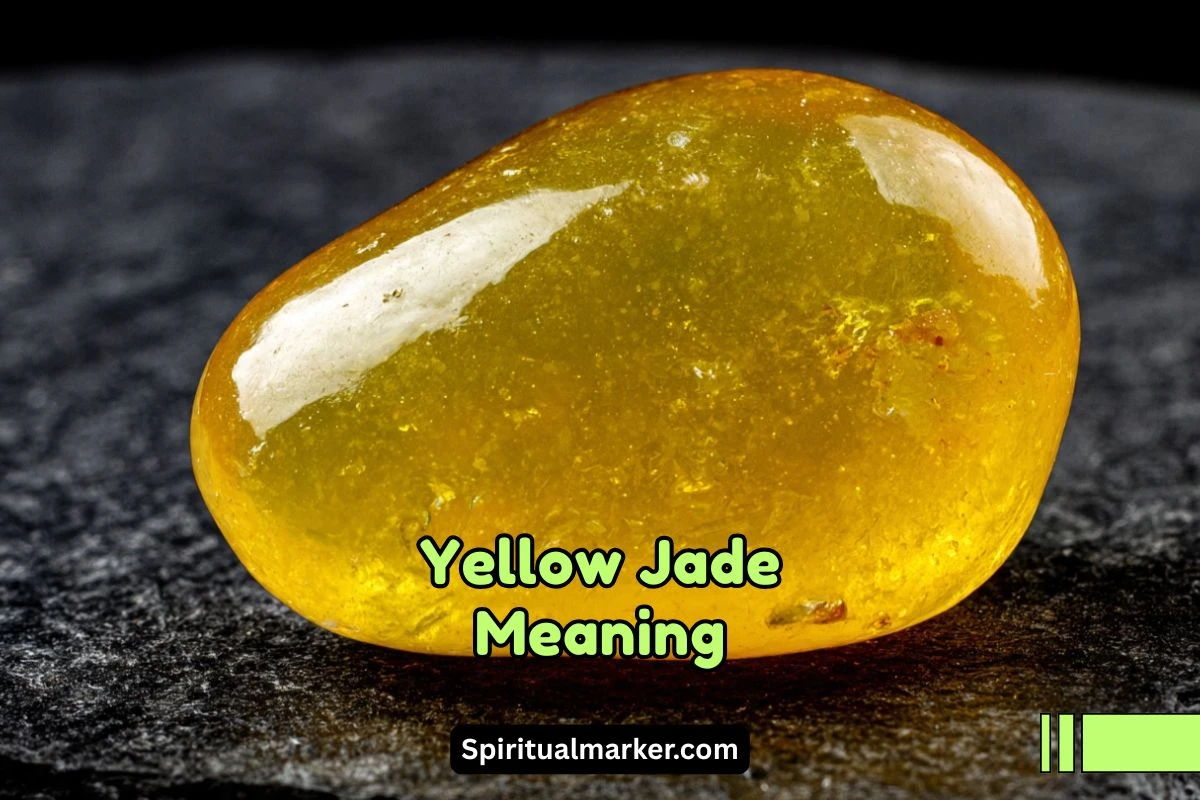
Yellow jade glows with a warm, golden hue. Its sunny color evokes joy, optimism, and abundance. In spiritual practice, this stone carries uplifting and prosperous energy.
The yellow jade meaning often involves joy, luck, and personal power. It is a stone of the solar plexus chakra, helping to boost confidence and attract good fortune. A spiritual meaning of white jade shares that jade focus, though white carries a more purifying energy.
Yellow jade is used in crystal healing to lift mood, attract wealth, and support decision-making. It can also symbolize friendship and good luck. The stone's energy is bright and encouraging.
If you feel drawn to yellow jade, it may signal a need for optimism. A spiritual meaning of yellow calcite also deals with yellow stones, though calcite carries a more mental energy.
5 Key Takeaways
- Yellow jade symbolizes confidence, wisdom, abundance, and emotional clarity.
- It connects strongly with the solar plexus chakra, which governs personal power and self-worth.
- Many spiritual traditions link yellow jade with mental focus, positive energy, and inner strength.
- Yellow jade has a long history in Chinese, Mesoamerican, and Maori spiritual traditions.
- Wearing or carrying yellow jade may support emotional balance, optimism, and a stronger sense of purpose.
What Is Yellow Jade?
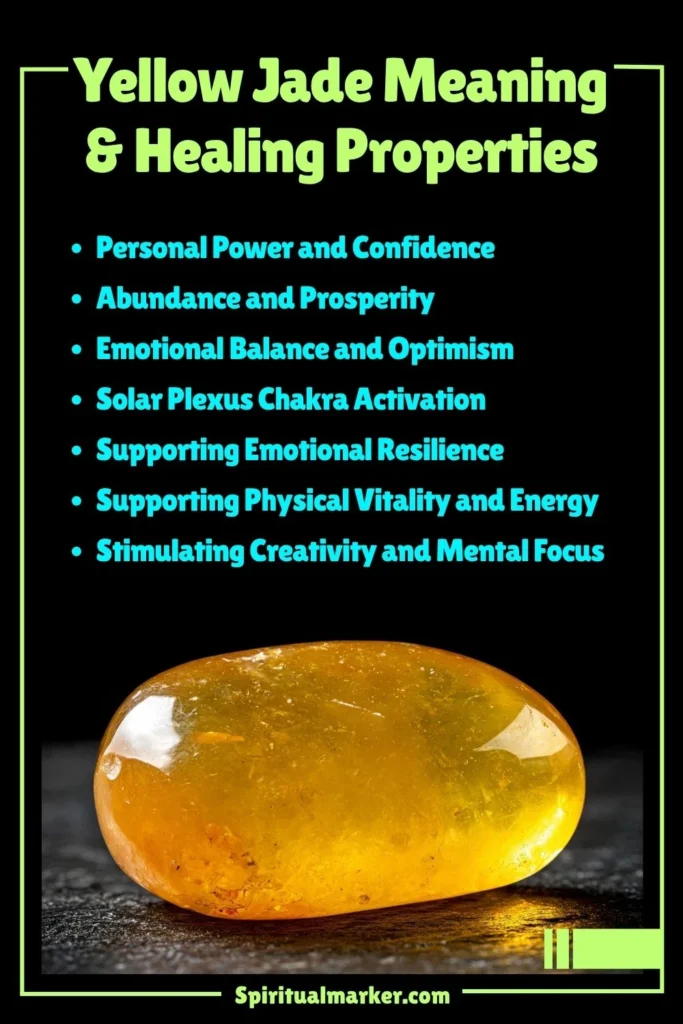
Yellow jade is a naturally occurring gemstone prized for its warm, golden-yellow tones. Its color ranges from soft butter yellow to deep amber gold. Some pieces carry a smooth, creamy appearance. Others show a slightly translucent quality that allows light to pass through partially.
Jade itself comes in two mineral forms: nephrite and jadeite. Both are considered true jade, but they differ in composition, density, and geographic origin. Most yellow jade found in commercial and spiritual markets is nephrite jade. Nephrite forms from calcium, magnesium, and iron-rich minerals. It has a slightly fibrous internal structure, which gives it exceptional toughness.
Yellow jade gets its color from iron and other mineral impurities present during formation. The specific concentration of these minerals determines the exact shade of yellow. Paler tones suggest lower iron content. Deeper golden hues reflect a higher mineral concentration.
Many people confuse yellow jade with yellow aventurine or citrine. However, jade feels denser and heavier than both. It also carries a smoother, waxy luster. Energetically, jade holds a more grounding and emotionally stable quality compared to the brighter, more stimulating energy of citrine.
Origins and Formation
Jade forms deep within the earth under high pressure and relatively low temperature conditions. This geological process takes millions of years. The stone’s association with patience, endurance, and timeless wisdom directly reflects its slow, deliberate formation.
Nephrite jade deposits appear across several countries. China has produced jade for over 5,000 years and remains one of the world’s most historically significant sources. New Zealand, Canada, Russia, Australia, and South Korea also produce notable nephrite deposits.
Jadeite jade, the rarer and more vibrant variety, comes primarily from Myanmar. Some jadeite deposits also exist in Guatemala, Japan, and Kazakhstan. Yellow jadeite is rarer than yellow nephrite, which makes high-quality yellow jadeite pieces particularly valuable.
Yellow jade specifically appears in Chinese and Taiwanese markets with regularity. Many yellow jade carvings, beads, and jewelry pieces trace their origin to Henan or Liaoning provinces in China, both of which have produced jade for ancient imperial use.
The stone’s long journey from deep earth pressure to polished gemstone adds to its spiritual narrative. Many healing traditions view geological hardship as symbolic of personal resilience. Yellow jade’s formation itself tells a story of strength, patience, and lasting value.
Key Properties
| Property | Details |
|---|---|
| Color | Pale yellow, golden yellow, amber, honey |
| Composition | Nephrite or Jadeite |
| Hardness | 6 to 7 on the Mohs scale |
| Chakra Association | Solar Plexus Chakra |
| Symbolism | Confidence, wisdom, abundance, clarity |
| Common Sources | China, Taiwan, New Zealand, Canada, Myanmar |
| Transparency | Opaque to slightly translucent |
| Energy Style | Warm, stabilizing, uplifting, grounding |
Historical Use of Yellow Jade
Few gemstones carry a historical record as rich as jade. In ancient China, jade held cultural and spiritual importance that surpassed nearly every other material, including precious metals. The Chinese phrase “gold is valuable, jade is priceless” reflects this deeply rooted reverence.
Yellow jade specifically carried associations with imperial authority, divine wisdom, and noble virtue. The color yellow held profound significance in Chinese culture. It was the exclusive color of emperors. It represented the center of the universe, the earth element, and sovereign power. Yellow jade naturally absorbed all of these associations.
Chinese philosophers and Confucian scholars often compared jade’s qualities to human virtue. They associated jade’s hardness with moral strength, its smoothness with gentleness, its translucence with wisdom, and its durability with integrity. Yellow jade was believed to carry the energy of heaven and earth together.
Across the Pacific, Mesoamerican civilizations including the Maya and Aztec also revered jade deeply. They associated jade with life, fertility, rain, and royal authority. While green jade dominated their traditions, yellow and golden tones were linked with the sun god and solar power.
In Maori culture of New Zealand, greenstone jade called pounamu held sacred status. It represented strength, protection, and spiritual connection. While not yellow specifically, this tradition reflects how broadly jade has carried spiritual significance across unconnected cultures worldwide.
Modern crystal healing traditions draw from all of these historical threads. Yellow jade today stands as a symbol of ancient wisdom meeting personal empowerment. Its history adds weight and depth to its contemporary spiritual use.
5 Spiritual Meanings of Yellow Jade
1. Personal Power and Confidence
Yellow jade is most strongly associated with personal power. This connection runs through both its historical symbolism and its chakra alignment. The solar plexus chakra governs self-confidence, willpower, personal authority, and the ability to act decisively. Yellow jade resonates directly with this energy center.
Many people feel drawn to yellow jade during periods of self-doubt or emotional uncertainty. After repeated disappointment, harsh criticism, or prolonged stress, confidence can quietly erode beneath the surface. A person may continue appearing capable outwardly while internally questioning their worth, their decisions, or their direction.
Spiritually, yellow jade symbolizes the reclamation of personal authority. It does not represent arrogance or aggressive dominance. Instead, it reflects the quieter confidence that comes from knowing your own value. Many traditions describe this as inner authority rooted in self-awareness rather than external validation.
The stone’s golden color reinforces this meaning visually. Gold and yellow tones have symbolized power, vitality, and solar energy across cultures for millennia. The sun gives life, direction, and warmth. Yellow jade carries a similar symbolism in spiritual traditions, representing the life-giving force of personal courage and inner strength.
For many individuals, yellow jade serves as a daily reminder that confidence is not a fixed trait. It grows through consistent emotional care, honest self-reflection, and willingness to act despite uncertainty. Spiritually, the stone symbolizes that slow, steady rebuilding of inner strength.
Some practitioners believe that holding or wearing yellow jade during difficult decisions helps anchor emotional clarity. Whether through metaphysical energy or simple psychological association, many people report feeling calmer and more decisive when carrying the stone. Its grounding energy feels less about forcing confidence and more about remembering it was always there.
2. Abundance and Prosperity
Yellow jade carries powerful associations with abundance, prosperity, and the free flow of positive energy. These associations have deep roots in Chinese spiritual and philosophical traditions. Jade in general was considered an attractor of good fortune. Yellow jade, colored like gold itself, amplified those associations considerably.
Abundance in this spiritual context does not refer exclusively to financial wealth. Yellow jade symbolizes abundance across multiple areas of life, including emotional richness, meaningful relationships, creative energy, physical vitality, and mental clarity. Many practitioners believe that when energy flows freely and without blockage, abundance naturally follows in various forms.
The solar plexus chakra connection reinforces this symbolism. A balanced solar plexus supports motivation, purpose, and confident action. When people feel purposeful and emotionally clear, they tend to make better decisions, maintain healthier habits, and pursue opportunities with greater consistency. Yellow jade spiritually represents removing the internal barriers that slow this natural flow.
Many Chinese households and businesses traditionally placed jade objects near entrances or in prosperity corners based on feng shui principles. Yellow jade was sometimes selected specifically for its solar energy and its connection with the earth element, which in Chinese cosmology governs stability, nourishment, and groundedness.
The abundance symbolism of yellow jade also connects with gratitude and perspective. Many spiritual traditions suggest that abundance begins with recognizing what already exists rather than focusing exclusively on what is missing. Yellow jade is sometimes described as a stone that helps shift attention toward present gifts, existing strengths, and available opportunities. This shift in perspective alone can produce meaningful changes in emotional experience.
3. Wisdom and Mental Clarity
Yellow jade has long symbolized wisdom. This meaning appears in Confucian philosophy, Chinese imperial traditions, and modern crystal healing practice. The stone’s association with wisdom feels natural because jade itself was compared to the qualities of a wise and virtuous person for thousands of years.
Mental clarity and wisdom are not identical, but they are deeply connected. Clarity involves seeing situations as they actually are, without excessive emotional distortion, fear-based thinking, or defensive rationalization. Wisdom builds on that clarity by integrating experience, empathy, and sound judgment. Yellow jade spiritually represents both qualities working together.
Many people struggle with mental clarity during emotionally difficult periods. Stress creates cognitive overload. Fear narrows thinking. Prolonged pressure makes it harder to separate relevant concerns from background noise. In crystal healing traditions, yellow jade is believed to support clearer thinking by stabilizing emotional turbulence that interferes with mental focus.
The solar plexus chakra connection matters here too. When this energy center functions well, people often experience stronger mental focus, better decision-making, and a clearer sense of direction. When it becomes blocked, confusion, indecision, and scattered thinking frequently follow. Yellow jade spiritually supports the clarity needed to move forward with confidence.
Many students, writers, creative professionals, and decision-makers have historically kept jade nearby during mentally demanding work. Whether this reflects metaphysical influence or simply the psychological effect of meaningful objects, the association between yellow jade and sharp, focused thinking runs deep across multiple cultures and traditions.
Wisdom also involves knowing what to release. Many people hold onto outdated beliefs, unhelpful emotional patterns, or fear-based perspectives long after those patterns have stopped serving them. Yellow jade symbolizes wisdom-guided release, the willingness to let go of what clouds thinking and limits emotional growth.
4. Emotional Balance and Optimism
While many people associate yellow jade primarily with mental energy, it also carries significant emotional symbolism. Yellow jade is strongly connected with optimism, emotional stability, and positive perspective. Its warm golden color naturally evokes feelings of sunshine, warmth, and vitality. These visual associations translate directly into its spiritual identity.
Optimism in a spiritual context is not about denying reality or forcing false positivity. True optimism involves maintaining emotional resilience even when circumstances feel difficult. It means continuing to act with courage and hope without suppressing honest emotional experience. Yellow jade symbolizes this grounded form of optimism rather than naive cheerfulness.
Many people experience prolonged periods of emotional heaviness. Chronic stress, disappointment, grief, or emotional exhaustion can flatten a person’s emotional landscape over time. The warmth and brightness once felt in daily life begins to feel distant or inaccessible. Yellow jade spiritually represents the gradual return of emotional warmth after difficult periods.
Its connection with the solar plexus also involves emotional empowerment. When people feel emotionally disempowered, they often struggle to maintain positive perspectives consistently. Small difficulties feel overwhelming. Setbacks trigger disproportionate emotional responses. Yellow jade symbolizes restoring the emotional foundation that makes resilience sustainable rather than forcing positivity without roots.
Many crystal practitioners describe yellow jade’s energy as emotionally uplifting without being stimulating to the point of agitation. Unlike crystals associated with intense, high-frequency energy, yellow jade feels warm and steady. It lifts emotional heaviness gradually. It encourages a gentler form of joy that builds over time rather than flashing brightly and fading quickly.
5. Protection and Energetic Shielding
Yellow jade has deep protective symbolism rooted in both historical use and contemporary spiritual practice. Jade in general has been worn as a protective talisman across Chinese, Mesoamerican, and Maori cultures. Warriors carried it. Travelers wore it. Children were given jade amulets to protect their health and spirit.
In Chinese tradition, jade was believed to protect both the physical body and the spiritual essence of the person wearing it. Some ancient burial practices placed jade pieces on the bodies of the deceased to preserve the spirit during its passage to the afterlife. This reflects how deeply protective power was attributed to the stone.
Yellow jade specifically carries solar protective energy. The sun has represented divine protection across countless ancient cultures. Solar deities guarded against darkness, danger, and spiritual harm. Yellow jade, colored like the sun itself, absorbed these protective associations naturally over centuries of use.
In contemporary crystal healing, yellow jade protection focuses primarily on energetic boundaries. Many practitioners believe certain people absorb negative energy from their environment or from other people without realizing it. This energetic sensitivity can manifest as emotional exhaustion, irritability, or a vague sense of heaviness after social interaction or stressful environments.
Yellow jade is believed to support stronger energetic boundaries that allow positive energy to flow while reducing the absorption of external emotional negativity. This symbolism feels especially meaningful for empathetic individuals, caregivers, teachers, healers, and people who regularly work in high-stress emotional environments.
Protection in spiritual traditions also extends to protecting intention. When people set clear goals, make meaningful changes, or pursue personal growth, external pressures and internal doubts can undermine those efforts. Yellow jade symbolizes holding steadfast to positive intention even when obstacles appear.
6 Healing Properties of Yellow Jade
1. Solar Plexus Chakra Activation
The solar plexus chakra, located in the upper abdomen, governs personal identity, willpower, self-esteem, and the ability to act with purpose. When this chakra functions well, people feel emotionally grounded, mentally focused, and personally empowered. When it becomes blocked or underactive, confusion, low confidence, and emotional passivity often follow.
Yellow jade resonates powerfully with the solar plexus chakra because of its yellow color, warm energy, and historical association with personal authority. In chakra healing systems, color correspondence plays an important role. Yellow stones align naturally with yellow energy centers, creating a symbolic and energetic harmony.
Many practitioners place yellow jade directly on the solar plexus area during meditation or energy work. They believe this strengthens the chakra’s natural function, supporting clearer decision-making, healthier boundaries, and a stronger sense of personal direction. Whether understood metaphysically or symbolically, this practice creates a meaningful focus point during reflection and self-awareness exercises.
Solar plexus healing also involves emotional empowerment. People who chronically struggle with confidence, boundaries, or personal authority often benefit from intentional practices that reconnect them with their inner strength. Yellow jade serves as a physical and symbolic anchor for this process, reminding practitioners that confidence is an internal resource rather than something that must be earned externally.
2. Boosting Self-Confidence and Inner Strength
Self-confidence is not a personality trait people either have or lack. It is a dynamic emotional state that fluctuates based on experience, environment, internal dialogue, and emotional health. Many people who appear outwardly confident privately wrestle with significant self-doubt. Yellow jade healing traditions address this inner experience directly.
The stone symbolizes building self-trust through consistent self-awareness. Many people doubt themselves not because they lack capability, but because they have not yet learned to trust their own instincts, recognize their own patterns, or acknowledge their own progress honestly. Yellow jade spiritually encourages that deeper form of self-recognition.
Many practitioners carry or wear yellow jade during situations that trigger anxiety or self-doubt. Job interviews, difficult conversations, public speaking, creative performance, and major life decisions all create conditions where self-confidence becomes emotionally vulnerable. The stone serves as a tangible reminder of inner strength during moments when external pressure makes that strength harder to feel.
Its warm energy is also associated with recovering confidence after setbacks. Failure, rejection, criticism, or public embarrassment can leave lasting emotional marks. People may begin avoiding challenges, suppressing ambition, or shrinking emotionally long after the original event has passed. Yellow jade healing symbolizes the patient rebuilding of courage after difficult emotional experiences.
3. Supporting Emotional Resilience
Emotional resilience refers to the capacity to navigate difficulty, recover from setbacks, and adapt to change without losing emotional stability. It does not mean avoiding pain or feeling invulnerable. It means maintaining enough inner stability to keep moving forward even through difficult emotional experiences.
Yellow jade is associated with emotional resilience because its energy feels steady and enduring rather than volatile or fragile. Jade itself is remarkably tough for its hardness rating. It resists breaking even under significant pressure because of its interlocking fibrous internal structure. This physical characteristic mirrors its spiritual symbolism of emotional durability.
Many people working through grief, loss, life transitions, or chronic stress find yellow jade useful as a grounding emotional anchor. Its warm presence during meditation or quiet reflection encourages emotional stability without forcing emotional suppression. People can acknowledge pain while simultaneously connecting with a sense of inner steadiness that supports continued movement forward.
Emotional resilience also involves perspective. People who maintain broader perspectives during difficult periods tend to recover more effectively than those who become emotionally trapped in immediate pain. Yellow jade’s symbolism of wisdom and clarity connects directly with this capacity for perspective. Its energy encourages people to see present difficulty within a larger context of personal growth and ongoing life experience.
4. Encouraging Optimism and Positive Thinking
Yellow jade’s warm color carries natural psychological associations with positivity. Color psychology research consistently shows that yellow tones promote feelings of optimism, mental energy, and emotional warmth in many individuals. This scientific observation aligns with what spiritual traditions have attributed to yellow jade for centuries.
The healing property of encouraging positive thinking is not about forcing cheerfulness. True positive thinking involves actively choosing constructive perspectives while still acknowledging honest emotional experience. Yellow jade symbolizes this healthier form of optimism. It encourages looking for real opportunities within challenging circumstances rather than simply denying difficulty.
Many practitioners use yellow jade during journaling, affirmation work, or morning intention-setting rituals. Its presence helps create a mentally positive starting point for the day. Over time, these consistent practices may genuinely shift internal emotional patterns. Psychology research supports the idea that deliberate attention to positive experiences strengthens neural pathways associated with optimism and emotional resilience.
Yellow jade also connects healing optimism with purpose. People tend to feel most genuinely optimistic when they feel purposeful and directionally clear. The stone’s solar plexus connection supports this by encouraging stronger personal clarity and motivated action, both of which naturally feed a more optimistic emotional orientation.
5. Supporting Physical Vitality and Energy
Some crystal healing traditions associate yellow jade with physical vitality, immune strength, and energetic endurance. While these beliefs fall outside mainstream medical understanding and should never replace professional medical care, they reflect a longstanding holistic view that emotional and energetic health influence physical well-being.
The solar plexus connection is relevant here too. In many energy healing systems, the solar plexus governs digestive health, metabolic function, and physical energy levels. A balanced solar plexus is believed to support better physical stamina and bodily functioning. Yellow jade, as a solar plexus stone, inherits these physical associations.
Historically, jade was used in traditional Chinese medicine both symbolically and practically. Ground jade was incorporated into certain preparations. Jade tools and massage rollers were used in traditional wellness practices. The stone was believed to support kidney function, cleanse toxins, and promote overall physical harmony.
Modern jade rollers and gua sha tools, which have gained significant popularity in recent years, continue this tradition. Many jade rollers use yellow or green jade to gently massage facial tissue, stimulate circulation, and support lymphatic drainage. While scientific evidence for metaphysical claims remains limited, jade rolling has demonstrable benefits for circulation and tissue relaxation.
6. Stimulating Creativity and Mental Focus
Yellow jade is associated with creative energy and mental sharpness. Its solar energy links to the generative power of the sun, which many ancient cultures viewed as the ultimate creative force. For artists, writers, musicians, entrepreneurs, and problem-solvers, this creative symbolism holds practical spiritual meaning.
Many creative people experience periods of mental stagnation or creative blockage. Ideas feel elusive. Motivation feels flat. The natural flow of creative thinking seems to temporarily dry up. Yellow jade is often used during these periods as a symbolic catalyst for renewed creative energy.
Its wisdom symbolism reinforces this healing property. Creativity requires both open exploration and focused discernment. Too much scattered thinking produces chaos without substance. Too much rigid focus suppresses creative generation. Yellow jade’s dual association with mental clarity and warm expansive energy reflects this creative balance between openness and direction.
Students preparing for exams, professionals working through complex problems, and creative practitioners seeking renewed inspiration often keep yellow jade at their desks or work areas. Whether through metaphysical influence or simple psychological anchoring, the stone serves as a meaningful focal point for mental intention and creative purpose.
How to Use Yellow Jade for Spiritual Growth
Wearing Yellow Jade Jewelry
Wearing yellow jade jewelry keeps the stone’s energy in consistent contact with your body throughout the day. Bracelets remain especially popular because they allow direct skin contact during daily activity. Many practitioners believe consistent physical contact strengthens the stone’s influence over time.
Pendants worn near the solar plexus area align the stone directly with its primary chakra connection. This placement feels particularly meaningful during periods when personal confidence, emotional balance, or clarity of purpose feels unstable.
Yellow jade rings carry significance in traditions where hand energy reflects personal intention and active engagement with the world. Wearing yellow jade on the dominant hand may symbolize bringing its qualities of wisdom and confidence into your daily actions.
Using Yellow Jade in Meditation
During meditation, hold yellow jade in both hands or place it on your solar plexus area while lying down. Before beginning, set a clear intention. You might focus on releasing self-doubt, cultivating confidence, inviting mental clarity, or anchoring optimism.
Many practitioners begin with several slow, deep breaths while holding yellow jade. They visualize the stone’s golden warmth spreading through the solar plexus area, releasing tension and restoring clarity. This visualization practice creates a focused meditative state aligned with the stone’s core symbolism.
Regular meditation with yellow jade, even for ten to fifteen minutes daily, can gradually deepen your intentional relationship with the stone’s symbolic qualities. Consistency matters far more than duration in establishing meaningful spiritual practices.
Placing Yellow Jade in Your Environment
Feng shui traditions recommend placing jade in specific areas of the home to support abundance, harmony, and positive energy flow. Yellow jade works particularly well in home offices, study spaces, or creative work areas because of its association with mental clarity, focus, and productive energy.
Placing yellow jade near the entrance of a home or business may symbolically invite abundance and positive energy. Some practitioners position yellow jade in the southeast corner of a room, which corresponds to the wealth and abundance area in traditional feng shui systems.
Living spaces benefit from jade’s warm, stabilizing presence. Unlike some crystals associated with high-frequency or intense energies, yellow jade feels comfortable and grounding in everyday environments.
Combining Yellow Jade With Other Crystals
Yellow jade pairs well with several complementary stones depending on your intention.
Citrine and yellow jade together amplify abundance energy and optimistic thinking. Both stones carry solar associations and support the solar plexus chakra.
Clear quartz combined with yellow jade may amplify clarity and intention. Many practitioners use clear quartz as an energetic amplifier alongside stones like yellow jade.
Tiger’s eye and yellow jade create a powerful pairing for personal power, grounded confidence, and mental focus.
Rose quartz paired with yellow jade balances the energetically assertive solar plexus qualities with the compassionate, heart-centered energy of the heart chakra.
Caring for Yellow Jade
Jade is relatively durable at 6 to 7 on the Mohs hardness scale, but it still requires mindful care to maintain its beauty and structural integrity over time.
Store yellow jade separately from harder gemstones such as sapphire, ruby, or diamond to prevent surface scratching. Soft fabric pouches or padded compartments work best for storage.
Clean yellow jade gently with lukewarm water, a few drops of mild soap, and a soft cloth. Dry it thoroughly after cleaning. Avoid ultrasonic cleaners, steam cleaning, harsh chemical solutions, or abrasive materials. These may damage the stone’s surface or compromise its internal structure.
Remove yellow jade jewelry before swimming, intense physical activity, gardening, or household cleaning involving chemical products. Prolonged chemical exposure or physical impact can dull the stone’s luster over time.
Energetic cleansing is a regular practice among spiritually oriented jade users. Common methods include placing the stone in moonlight overnight, burying it briefly in clean earth, using sound vibration from singing bowls, or setting it near cleansing herbs such as sage or palo santo. These practices are purely symbolic but carry meaningful ritual value for many practitioners.
Avoid exposing yellow jade to prolonged direct sunlight, as sustained UV exposure may gradually affect its color in some specimens.
Yellow Jade at a Glance
| Aspect | Details |
|---|---|
| Primary Meaning | Personal power, confidence, wisdom |
| Chakra Association | Solar Plexus Chakra |
| Main Spiritual Symbolism | Abundance, clarity, optimism, protection |
| Common Colors | Pale yellow, golden yellow, amber, honey |
| Hardness | 6 to 7 Mohs |
| Main Sources | China, Taiwan, New Zealand, Canada, Myanmar |
| Emotional Associations | Resilience, confidence, optimism, emotional balance |
| Popular Jewelry Types | Bracelets, pendants, rings, beads |
| Spiritual Uses | Meditation, abundance rituals, solar plexus healing, feng shui |
| Care Needs | Gentle cleaning, separate storage, avoid chemicals |
A Final Note
Yellow jade is more than a beautiful gemstone. It carries thousands of years of cultural reverence, spiritual symbolism, and healing tradition from some of humanity’s oldest civilizations. That weight of meaning does not disappear simply because centuries have passed. If anything, it deepens as more people reconnect with these ancient traditions in contemporary life.
Its meaning centers on things people need profoundly. Confidence. Clarity. Resilience. Abundance. Wisdom. These qualities are not abstract ideals. They are the emotional and spiritual foundations that allow people to navigate life with greater purpose and less fear.
If yellow jade has caught your attention, trust that response. Whether you are drawn to it for its warm beauty, its rich history, or its spiritual symbolism, bringing yellow jade into your daily life connects you with a tradition of human experience that stretches across continents and millennia.
Consider starting simply. Wear a yellow jade bracelet, place a small piece on your desk, or hold it briefly during morning reflection. Notice what shifts, however subtly, in your sense of clarity, confidence, or inner warmth over time.
Some of the most meaningful changes begin with the smallest intentional steps.