
Lava stone is a stone of fire and earth. It forms from cooling magma, creating a porous, grounding material. In spiritual practice, lava stone carries powerful and stabilizing energy.
The lava stone meaning often involves grounding, strength, and the ability to weather change. It is a stone of the root chakra, helping to calm anxiety. A spiritual meaning of black tourmaline shares that protective-stone focus, though tourmaline carries a more electric energy.
Lava stone is used in crystal healing to ground energy, support courage, and provide stability during change. It can also symbolize resilience and transformation. The stone's energy is earthy and dependable.
If you feel drawn to lava stone, it may signal a need for grounding. A spiritual meaning of black obsidian also deals with volcanic stones, though obsidian carries a more reflective energy.
5 Key Takeaways
- Lava stone symbolizes strength, grounding, courage, and transformation rooted in volcanic creation.
- Many spiritual traditions connect lava stone with the root chakra and deep energetic stability.
- People often use lava stone during meditation, emotional recovery, aromatherapy, and personal transformation periods.
- Lava stone is porous, making it one of the few crystals capable of absorbing and diffusing essential oils.
- Wearing or carrying lava stone is believed to help people feel emotionally anchored, mentally steady, and spiritually connected to earth energy.
What is Lava Stone?
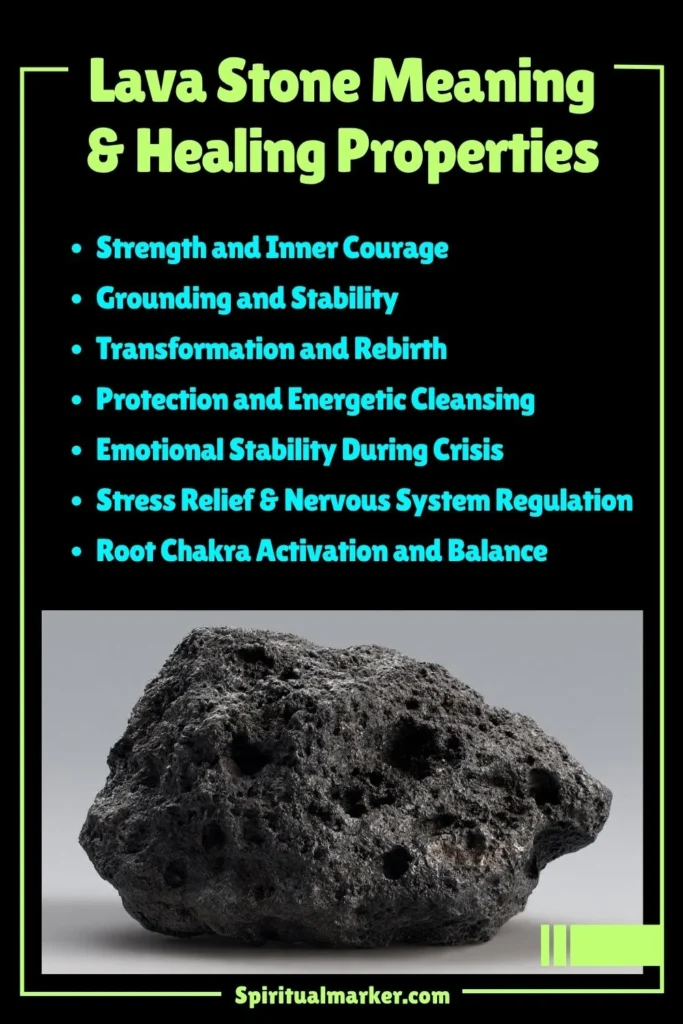
Lava stone, also called basalt or lava rock, is an igneous rock formed when molten magma from volcanic eruptions reaches the earth’s surface and cools rapidly. As the magma cools and solidifies, it traps gas bubbles within its structure, creating the characteristic porous, rough texture that makes lava stone immediately recognizable. Its color ranges from dark charcoal gray to deep black, though reddish-brown variations also exist depending on the mineral composition and oxidation during cooling.
Unlike gemstones that form slowly beneath the earth over millions of years, lava stone is born through intense heat and explosive force. That distinction matters symbolically. Most healing crystals represent patience, slow formation, and gradual energetic development. Lava stone represents something different entirely. It is the product of dramatic geological activity, shaped by extremes, and carries a raw, elemental energy that many people describe as immediately noticeable when held in the hand.
Chemically, basalt is rich in minerals including iron, magnesium, calcium, and silica. Its high iron content contributes to its dark color and its spiritual association with grounding, stability, and magnetic earth energy. Many crystal practitioners believe that stones rich in iron carry particularly strong protective and stabilizing properties, and lava stone fits naturally within that tradition.
Origins and Formation
Lava stone forms wherever volcanic activity occurs, which means deposits exist across nearly every continent. Hawaii remains one of the most spiritually significant sources because of its deep cultural and mythological connection to volcanic energy. Iceland, Indonesia, Mexico, Italy, and various parts of Africa also produce high volumes of basalt used in jewelry and spiritual practice.
The formation process itself adds layers of symbolic meaning. Magma originates in the earth’s mantle, sometimes hundreds of kilometers below the surface. It rises through the crust under immense pressure, eventually breaking through in volcanic eruptions. When lava meets open air or ocean water, it cools almost instantly, locking its mineral composition permanently into stone. That journey from deep underground to the surface mirrors the spiritual journey of bringing hidden inner truths into conscious awareness.
Lava fields that form after eruptions appear barren and lifeless at first. Over decades, they transform into some of the most fertile land on earth. Many indigenous cultures recognized this cycle long before modern geology formalized it. They built spiritual practices around volcanic rock because they saw it as a physical reminder that destruction and creation are not opposites. They are part of the same continuous cycle.
Key Properties
- Color: Black, dark gray, reddish-brown
- Composition: Igneous basalt rock, rich in iron, magnesium, and silica
- Hardness: Approximately 3 to 3.5 on the Mohs scale
- Chakra Association: Primarily the root chakra; secondary connection to sacral chakra
- Symbolism: Strength, grounding, courage, transformation, protection
- Common Sources: Hawaii, Iceland, Indonesia, Mexico, Italy, Africa
- Texture: Porous and rough
- Energy Style: Grounding, stabilizing, protective, deeply centering
Historical Use of Lava Stone
Volcanic rock has played a role in human spiritual and cultural life for thousands of years. Ancient Aztec and Mayan civilizations used obsidian, a volcanic glass closely related to lava stone, for ceremonial blades, mirrors used in divination, and ritualistic carvings. The volcanic rock itself featured in temple construction, altar design, and ceremonial tools throughout Mesoamerica.
In Hawaiian culture, the volcanic landscape held profound spiritual meaning. Pele, the goddess of fire, lightning, wind, and volcanoes, was believed to inhabit the active volcanic regions of the Big Island. Lava fields were considered sacred ground. Removing volcanic rock from the islands was viewed as a serious spiritual offense capable of inviting misfortune, a belief that persists culturally even today.
Ancient Romans used basalt extensively in construction, but also recognized its durability as symbolically significant. Warriors in various cultures carried volcanic stone as protective amulets, believing its fiery origin gave it the power to deflect harm and strengthen resolve in battle. The Roman military association with lava stone connected it to courage, martial strength, and physical endurance.
In more recent metaphysical traditions, lava stone gained popularity in the 20th and 21st centuries as crystal healing expanded globally. Its accessibility, affordability, and deeply grounding energy made it a staple in healing collections. The discovery that its porous texture absorbs essential oils transformed lava stone beads into natural aromatherapy diffusers, adding another layer of practical spiritual utility that no other stone can replicate as effectively.
5 Spiritual Meanings of Lava Stone
1. Strength and Inner Courage
The most immediate spiritual meaning associated with lava stone is strength. This is not merely physical strength, though ancient warriors certainly connected volcanic rock with physical power. The deeper meaning centers on emotional and psychological strength. The kind of strength required to face difficult truths, endure prolonged hardship, and keep moving forward when everything inside you wants to stop.
Lava stone earns this symbolism through its own violent origins. It formed under conditions of extreme heat and pressure, was expelled from deep within the earth, and survived rapid cooling to become something solid and enduring. That process naturally mirrors the human experience of being tested by life’s most difficult circumstances. Many people feel a quiet resonance with lava stone during periods when they need to summon reserves of emotional courage they are not sure they still possess.
Within spiritual traditions, courage is rarely described as the absence of fear. It is more accurately described as the willingness to act despite fear. Lava stone spiritually represents that distinction. It does not promise that difficulty will disappear. Instead, it symbolizes the internal steadiness needed to face difficulty without collapsing. Many practitioners describe this as the stone’s most emotionally important quality.
This symbolism becomes especially meaningful during major life transitions. Career upheaval, relationship endings, health challenges, grief, and personal identity shifts all require a form of courage that is not dramatic or performative. It is quiet, persistent, and deeply personal. Lava stone represents exactly that quality of internal strength. It reflects courage that does not announce itself loudly but holds steady beneath the surface throughout the entire ordeal.
2. Grounding and Stability
Grounding is one of the most frequently referenced concepts in crystal healing, and lava stone is considered among the most powerful grounding stones available. The concept of grounding refers to maintaining a stable emotional and energetic connection to the present moment, to physical reality, and to the earth itself. People who feel chronically anxious, mentally scattered, emotionally detached, or spiritually unmoored often benefit most from grounding practices.
Lava stone’s connection to grounding runs deeper than most other dark stones commonly associated with this property. Obsidian, black tourmaline, and smoky quartz all carry grounding energy, but lava stone adds a layer of elemental earth energy rooted in the planet’s own geological core. It did not form on the surface. It came from within the earth, from its deepest, most pressurized interior. That origin gives its grounding symbolism a particular intensity.
Many people experience disconnection from the present moment during periods of high stress, anxiety, grief, or emotional overwhelm. The mind races forward into worst-case scenarios or retreats backward into regret and rumination. Physical grounding practices such as walking barefoot outdoors, sitting against a tree, or holding heavy stones help interrupt those mental loops by reestablishing sensory connection with physical reality. Lava stone serves this purpose particularly well because of its weight, rough texture, and dense elemental energy.
In meditation, many practitioners hold lava stone in both hands or place it at the base of the spine to activate root chakra energy and encourage a deeply grounded meditative state. This approach helps prevent the mental drift or emotional overwhelm that can occur during deep introspection. The stone’s grounding presence creates an energetic anchor that allows deeper exploration without losing emotional stability.
3. Transformation and Rebirth
Few symbols in the natural world represent transformation as powerfully as a volcanic eruption. The earth breaks open, releases enormous destructive energy, and then slowly rebuilds something entirely new from the remains. That cycle of destruction and regeneration forms the core of lava stone’s transformative symbolism, and it resonates with people at nearly every stage of major personal change.
Transformation rarely arrives gently. Most meaningful personal change is preceded by a breakdown of some kind. A relationship ends, an identity collapses, a belief system gets shattered, or a period of prolonged suffering eventually reaches a breaking point. What comes after that breaking point determines everything. Lava stone spiritually represents the phase between breakdown and rebuilding. It holds the energy of the transitional space where the old has ended but the new has not yet fully formed.
Ancient alchemical traditions often used fire as a symbol of purification and transformation. The idea that heating a raw material breaks down impurities and reveals something purer beneath appears across numerous spiritual and philosophical traditions. Lava stone carries this same fire symbolism in physical form. It is the product of the earth’s most purifying process, and many spiritual practitioners believe it brings similar purifying energy to emotional and personal transformation.
This meaning also connects with the concept of rebirth found across many spiritual frameworks. In numerous indigenous traditions, volcanic activity is associated with divine creation rather than mere destruction. New land emerges from the ocean as volcanic islands rise from the sea floor. Fertile soil forms from cooled lava over time. Lava stone symbolically carries that promise of renewal, reminding people that what feels like an ending may actually be the beginning of something stronger and more aligned with their authentic nature.
4. Protection and Energetic Cleansing
Lava stone has a long historical association with protection. Warriors carried it. Shamans used it in protective rituals. Cultures living near active volcanoes treated volcanic rock with deep reverence, believing it held divine protective power connected to the forces that shaped the land around them. In modern spiritual practice, that protective symbolism remains strong.
Many crystal practitioners describe lava stone as creating an energetic shield around its wearer. This shield is not conceived as passive. Unlike stones that simply deflect negative energy, lava stone is often described as actively burning away energetic negativity through its inherent fire element. People who feel energetically drained, emotionally invaded, or spiritually depleted after spending time in certain environments or with certain people often turn to lava stone as a protective and cleansing tool.
The concept of energetic cleansing associated with lava stone also extends to internal emotional states. Old anger, fear, resentment, and emotional heaviness are sometimes described within healing traditions as stagnant energies that accumulate over time and begin interfering with emotional and spiritual flow. Lava stone’s fire symbolism represents the burning away of those stagnant patterns, clearing space for more balanced and productive emotional energy to emerge.
Many people also find that lava stone helps them maintain energetic boundaries in environments that feel emotionally draining. Crowded places, emotionally intense social situations, and work environments with high levels of stress or conflict can feel exhausting for people who are energetically sensitive. Wearing a lava stone bracelet or carrying the stone during these situations helps many people maintain a greater sense of internal calm and protection.
5. Passion, Motivation, and Fire Energy
Unlike most grounding stones, which carry purely calming and settling energy, lava stone also holds a motivating, activating quality connected to its fire element. Many practitioners describe its energy as simultaneously grounding and stimulating. It anchors you to the present while simultaneously encouraging forward movement, renewed purpose, and a rekindling of passion that may have dimmed during difficult periods.
This dual quality makes lava stone particularly valuable for people experiencing emotional flatness or motivational stagnation. Depression, burnout, prolonged grief, and chronic stress can all reduce a person’s sense of passion, purpose, and engagement with life. The fire symbolism within lava stone represents the reigniting of that internal flame. Not through forced positivity or denial of difficulty, but through the natural rekindling of life force energy that was temporarily suppressed.
Many spiritual traditions describe the relationship between earth and fire as fundamentally generative. Earth provides stability and substance. Fire provides activation and transformation. Lava stone contains both elements in a single physical form, which explains why it often feels more dynamically energizing than purely earthy grounding stones like black tourmaline or hematite. That combination of stability and activation makes it especially appealing to people who need both emotional steadiness and renewed motivation simultaneously.
The sacral chakra connection associated with lava stone relates directly to this passion and motivation symbolism. The sacral chakra governs creativity, sensual energy, emotional expression, and the desire to engage meaningfully with life. When this energy center feels blocked or depleted, people often experience creative stagnation, emotional numbness, and loss of enthusiasm. Lava stone’s fire energy is believed by many practitioners to gently reactivate sacral energy alongside its stronger root chakra grounding effects.
6 Healing Properties of Lava Stone
1. Emotional Stability During Crisis
Lava stone is perhaps most widely valued in crystal healing circles for its ability to support emotional stability during periods of acute crisis or prolonged difficulty. When external circumstances feel chaotic or uncontrollable, the need for an internal anchor becomes critical. Many people reach for lava stone instinctively during these periods because its weight, texture, and dense energy create an immediate sense of being physically and emotionally held.
The emotional stabilizing effect associated with lava stone relates closely to its root chakra connection. The root chakra governs the sense of safety, belonging, and physical security. When this energy center feels destabilized by threat, loss, sudden change, or prolonged uncertainty, emotional regulation becomes significantly more difficult. Lava stone’s grounding energy is believed to help reestablish root chakra stability, creating a more solid energetic foundation from which emotional processing can occur.
Many practitioners working in grief support, trauma recovery, and emotional healing use lava stone as a tactile grounding tool during sessions. Holding a rough, heavy stone while processing difficult emotions provides a physical anchor that prevents the emotional overwhelm commonly experienced when intense feelings surface. The stone’s grounding presence helps people remain emotionally present with their experience without being completely overtaken by it.
2. Stress Relief and Nervous System Regulation
The combination of lava stone with essential oils creates one of the most practically useful healing applications in crystal therapy. Because lava stone is porous, it absorbs liquid essential oils and then diffuses them slowly as the stone warms against skin. This allows wearers to benefit from both the energetic properties of the stone and the therapeutic aromatherapy benefits of the oil throughout the day.
Lavender oil applied to a lava stone bracelet combines the stone’s grounding energy with lavender’s extensively researched calming effects. A 2019 study published in the journal Frontiers in Behavioral Neuroscience found that lavender aromatherapy significantly reduced anxiety symptoms and improved sleep quality in participants. Frankincense oil paired with lava stone enhances meditative focus and deepens the spiritual grounding experience many practitioners seek. Bergamot, chamomile, and sandalwood oils all complement lava stone’s grounding energy in different ways, depending on the emotional needs of the individual.
Beyond the aromatherapy combination, lava stone’s grounding properties themselves support nervous system regulation. Chronic stress keeps the nervous system locked in a state of sympathetic activation, commonly called the fight-or-flight response. Grounding practices of all kinds help shift the nervous system toward parasympathetic activation, the rest-and-digest state where healing, emotional processing, and cognitive clarity become possible. Holding or wearing lava stone during grounding exercises, breathwork, or mindfulness practice may support this physiological shift.
3. Courage During Major Life Transitions
One of the most practically meaningful healing properties of lava stone involves its capacity to support courage during major life transitions. Divorce, career change, relocation, identity shifts, recovery from addiction, beginning therapy, or confronting long-avoided truths all require a form of sustained courage that most people find extremely difficult to maintain consistently. Lava stone’s symbolism of volcanic strength and transformative resilience makes it a particularly fitting companion during these chapters.
The psychological concept of behavioral activation describes how taking small, consistent actions during difficult emotional periods can gradually rebuild motivation and emotional engagement over time. Lava stone serves as a physical symbol of that commitment to forward movement. Wearing it or carrying it as a reminder of personal strength can help reinforce the intention to keep moving even when fear, doubt, or exhaustion make stopping feel more appealing.
Many people find that having a physical object connected to their healing journey or personal transformation adds a meaningful layer of intentionality to the process. Lava stone works particularly well in this role because its appearance itself tells a story of transformation. You can hold a piece of black volcanic rock and genuinely reflect on the geological drama that created it, then apply that narrative to your own experience of change and emergence.
4. Releasing Anger and Emotional Heaviness
Anger is one of the most misunderstood emotions in spiritual communities. Many healing traditions either encourage its aggressive expression or urge its complete suppression, both of which can create problems over time. Healthy emotional healing generally requires a middle path, acknowledging anger honestly while channeling its energy constructively rather than either unleashing it destructively or burying it beneath forced calm.
Lava stone holds a unique position in this emotional territory because fire and anger share significant symbolic overlap. Many people instinctively reach for lava stone when carrying emotional heaviness linked to anger, injustice, resentment, or frustration. The stone’s fire symbolism creates a sense of permission to acknowledge the intensity of those emotions without shame, while its grounding earth energy provides the stability needed to avoid being consumed by them.
Some practitioners use lava stone specifically during emotional release practices such as journaling, somatic movement, breathwork, or therapeutic dialogue because they believe the stone helps create a contained, safe energetic space for processing intense emotions. The image of volcanic fire burning away what no longer serves creates a powerful psychological framework for the emotional release process. People can channel the metaphor of volcanic release into their own experience of letting go of emotional weight that has accumulated over months or years.
5. Root Chakra Activation and Balance
The root chakra, located at the base of the spine, governs humanity’s most fundamental energetic needs. Safety, physical security, survival instincts, belonging, and the basic sense of being able to trust that life is manageable all flow through this energy center. When the root chakra feels balanced, people generally experience greater emotional stability, practical effectiveness, and a grounded sense of confidence in navigating daily life. When it feels blocked or depleted, anxiety, fear, insecurity, financial worry, and existential uncertainty tend to amplify significantly.
Lava stone is considered one of the most powerful root chakra stones available, primarily because of its direct origin from the earth’s interior. Its elemental connection to the planet’s geological foundations creates a resonance with the root chakra’s earth element that many practitioners find deeply stabilizing. Placing lava stone at the base of the spine during meditation, wearing it as a bracelet on the left wrist to receive its energy, or carrying it in a pocket throughout the day are all common methods for supporting root chakra activation.
Root chakra healing with lava stone also addresses the physical body’s relationship with the earth. Many people who spend long hours indoors, engaged with digital devices, working high-stress corporate environments, or living in urban settings become chronically disconnected from the physical grounding that natural environments provide automatically. Lava stone offers a tangible, portable connection to earth energy that many people find genuinely restorative during these periods of environmental disconnection.
6. Physical Endurance and Vitality
Some crystal healing traditions associate lava stone with physical vitality, endurance, and stamina. Athletes, physical laborers, and people engaged in demanding physical disciplines sometimes carry or wear lava stone believing it supports both physical strength and mental toughness during demanding training or performance situations. While these claims exist within spiritual rather than scientific frameworks, the psychological benefit of having a meaningful symbol of strength during challenging physical endeavors is itself well-documented in sports psychology research.
The connection between lava stone and physical endurance draws from its geological narrative. Basalt is one of the most durable and structurally stable rock types on earth. Roads, buildings, and tools made from basalt resist weathering and pressure over extraordinarily long timescales. Spiritually, that durability translates into symbolic physical resilience. The stone that survived volcanic expulsion, rapid cooling, and geological time carries an implicit message about endurance that many people find genuinely motivating.
Many hot stone massage therapists use smooth basalt lava stones heated to therapeutic temperatures because basalt retains heat exceptionally well and releases it slowly into muscle tissue. This application bridges the stone’s spiritual symbolism with measurable physical benefit. The heat from basalt stones reduces muscle tension, improves circulation, and promotes deep physical relaxation, demonstrating that lava stone’s healing associations are not purely metaphorical in every context.
Lava Stone and Chakra Connections
While lava stone connects primarily with the root chakra, its fire element creates secondary associations with the sacral chakra and solar plexus chakra as well. This combination of chakra connections gives lava stone a broader energetic range than many single-chakra grounding stones, making it useful across a wider variety of healing intentions.
The root chakra association provides lava stone’s foundational grounding, safety, and stability energy. The sacral chakra connection relates to its fire symbolism, passion, creativity, and emotional expression properties. The solar plexus chakra secondary connection speaks to lava stone’s association with courage, personal power, and the kind of assertive self-confidence needed to pursue meaningful transformation. Together, these three lower chakra connections give lava stone a strong emphasis on the physical, emotional, and personal power dimensions of spiritual well-being.
Practitioners working with lava stone for chakra healing often combine it with complementary crystals to address additional energy centers. Pairing lava stone with carnelian may amplify sacral chakra activation and creative energy. Combining it with citrine may strengthen solar plexus confidence and clarity. Adding rose quartz to a lava stone practice may help bridge the grounding lower chakra energy with heart chakra openness and compassion. These combinations allow practitioners to customize their healing approach based on specific emotional or spiritual needs.
How to Wear Lava Stone Jewelry for Spiritual Growth
Lava stone bracelets are the most popular form of lava stone jewelry, and for good reason. Worn on the wrist, the stone maintains consistent contact with pulse points, which many practitioners believe enhances the energetic connection between the stone and the wearer’s circulatory and nervous systems. The left wrist is traditionally associated with receiving energy, making it the preferred wrist for stones used in healing and spiritual support. The right wrist is associated with projecting energy outward, making it useful when the intention involves sharing strength or protection with one’s environment.
Lava stone bracelets also serve as the most effective aromatherapy diffuser jewelry available because the porous beads absorb essential oils so efficiently. Apply one to two drops of your chosen oil directly onto the lava beads, allow a moment for the oil to absorb, and then wear the bracelet as normal. The heat from your skin will gently warm the stone throughout the day, slowly releasing the oil’s aroma in a subtle, continuous manner. Most lava stone beads can hold an oil application for one to three days before reapplication becomes necessary.
Lava stone necklaces and pendants are another popular choice, particularly for those seeking protection or transformation energy throughout the day. Wearing the stone near the heart or sternum keeps it centrally located on the body, close to multiple significant energy centers. Lava stone rings and earrings also exist, though bracelets and necklaces remain the most common choices for spiritual practice.
Many people combine lava stone with complementary crystals in beaded bracelets or necklaces. Common pairings include lava stone with tiger’s eye for combined grounding and confidence, lava stone with amethyst for a balance of grounding and spiritual clarity, and lava stone with turquoise for grounding combined with emotional communication and protection. These combinations allow wearers to layer healing intentions within a single piece of jewelry.
Caring for Lava Stone Jewelry
Lava stone is relatively durable compared to softer healing crystals, but its porous structure requires specific care practices to maintain its appearance and function over time. The same porosity that makes it an excellent essential oil diffuser also makes it susceptible to absorbing water, chemicals, and residue from skin care products. Regular cleaning helps prevent buildup within the stone’s pores, which can dull its appearance and reduce its ability to absorb oils effectively.
Clean lava stone jewelry using a dry or slightly damp soft cloth after regular wear. For deeper cleaning, rinse the stone briefly under lukewarm water and allow it to dry completely before wearing it again or applying new oils. Avoid soaking lava stone in water for extended periods because moisture trapped within the pores can weaken the stone’s structural integrity over time. Never use ultrasonic cleaners, chemical jewelry cleaners, or abrasive materials on lava stone.
Store lava stone separately from harder gemstones to prevent surface scratching. Despite its volcanic origin story of extraordinary heat, lava stone should be kept away from prolonged direct sunlight and excessive heat exposure after formation, as these conditions can affect the oils absorbed within the stone’s pores. A soft fabric pouch or individual jewelry compartment provides adequate storage protection.
Many practitioners energetically cleanse their lava stone regularly using moonlight, sound cleansing with singing bowls or bells, or smudging with sage or palo santo. Because lava stone is associated with fire energy, some practitioners prefer to pass it briefly near candlelight as an energetic cleansing method that aligns with the stone’s elemental nature. Spiritual cleansing frequency depends entirely on how often and intensively you use the stone and what personal belief system guides your practice.
Table: Lava Stone Meaning at a Glance
| Aspect | Details |
|---|---|
| Primary Meaning | Strength, grounding, and transformation |
| Chakra Association | Root chakra (primary), sacral and solar plexus (secondary) |
| Main Spiritual Symbolism | Courage, protection, rebirth, fire energy |
| Common Colors | Black, dark gray, reddish-brown |
| Hardness | 3 to 3.5 Mohs |
| Main Sources | Hawaii, Iceland, Indonesia, Mexico, Italy |
| Emotional Associations | Stability, courage, passion, emotional release |
| Popular Jewelry Types | Bracelets, necklaces, pendants |
| Spiritual Uses | Meditation, aromatherapy, chakra healing, grounding |
| Special Property | Porous texture absorbs essential oils for aromatherapy |
A Final Note
Lava stone occupies a distinct place among healing stones because its symbolism is rooted in something genuinely extreme. Most gemstones form quietly, slowly, and invisibly beneath the earth’s surface. Lava stone formed through eruption, through the most dramatic geological process the planet produces. That origin gives its symbolism a raw credibility that more delicate crystals cannot quite replicate.
Its meaning centers on strength, grounding, transformation, and the deep human capacity for resilience. Whether you are navigating personal crisis, searching for emotional stability during uncertainty, looking for a grounding anchor during meditation, or simply drawn to the primal beauty of volcanic stone, lava stone meets you with an energy that feels both ancient and immediately present.
If you feel called to work with lava stone, consider wearing it as a bracelet and experimenting with essential oils that match your current emotional intentions. Try pairing it with complementary grounding crystals like black tourmaline or smoky quartz to deepen its stabilizing effects. Keep it on your person during periods of significant personal transition, and use it as a physical reminder that some of the most enduring and beautiful things in existence were forged under the most intense conditions imaginable.