You knock the shaker. Salt scatters across the counter in a fine white spray, and before you even grab a cloth, something in your chest tightens. Maybe you reach for a pinch and toss it over your shoulder without thinking twice. That small, almost automatic reaction is not random. It is the echo of a belief that has traveled through thousands of years of human history. The spilling salt spiritual meaning reaches back to ancient temples, biblical covenants, royal courts, and kitchen folklore passed down through generations.
Salt was never just a seasoning. It preserved food, sealed friendships, and sat at the center of sacred rituals across nearly every civilization. Losing even a pinch felt like losing something precious. That anxiety hardened into superstition, and the superstition hardened into a spiritual language that still speaks to us today. This piece walks through the spilling salt superstition, its roots in scripture, its place in world mythology, and what your own reaction to a spill might be quietly telling you.
Key Takeaways
Here are five important points to carry with you before exploring the deeper meaning:
- The belief that spilling salt brings bad luck traces back to ancient Rome, where salt was treated as a precious, almost sacred commodity.
- Leonardo da Vinci’s The Last Supper shows Judas knocking over a salt cellar, a detail many believe cemented the superstition in Christian Europe.
- Throwing a pinch of spilled salt over your left shoulder is meant to blind evil spirits believed to linger behind you.
- In the Bible, salt represents covenant, preservation, and purity, appearing in Leviticus, Numbers, and the words of Jesus himself.
- Cultures from Japan to West Africa to Italy all treat spilled salt as spiritually significant, though the exact meaning shifts from place to place.
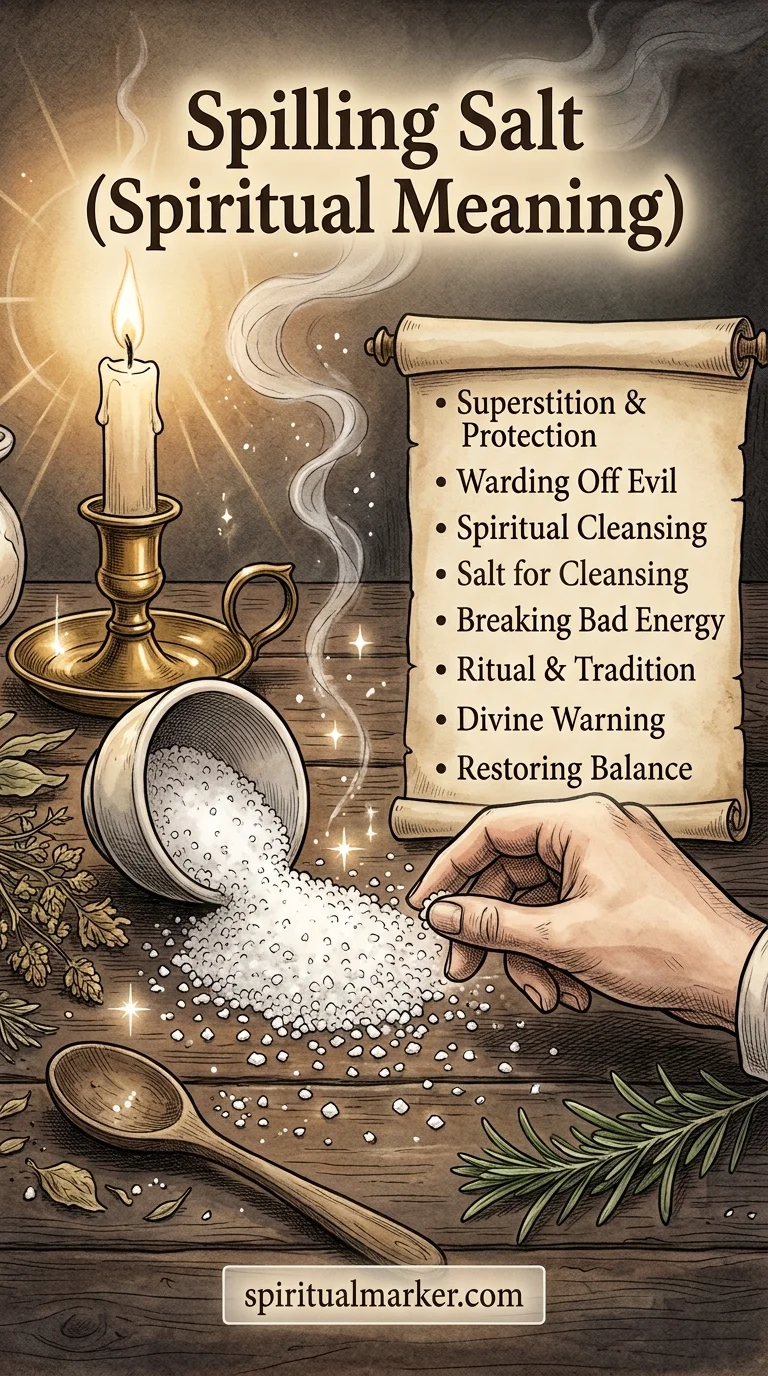
What Does Spilling Salt Mean Spiritually?
At its core, the spiritual meaning of spilling salt centers on disruption. Salt has long symbolized stability, preservation, and unbroken bonds. When it spills, that symbol of steadiness suddenly breaks apart on the floor or table in front of you. Many traditions read this as a small rupture in the energy around you, a signal that something protective has slipped, even if only for a moment.
This is why so many cultures pair the spill with an immediate corrective action. You do not simply clean it up and move on. You toss a pinch over your shoulder, you whisper a small phrase, or you pause to notice the moment. These responses are not really about the salt itself. They are about restoring a sense of order after an unexpected break in your routine. Spiritually minded people often describe this as resetting the energy of a space rather than ignoring what just happened.
Salt also holds a long association with protection against negative forces. Ancient Romans, Egyptians, and Greeks all used salt in religious offerings and purification rites. In many religions, salt is still placed on the altar to represent purity, and it is mixed into holy water for the same reason. When salt spills, the protective barrier it represents feels momentarily compromised. That is the emotional root beneath an otherwise ordinary kitchen accident.
Where Did the Spilling Salt Superstition Come From?
The spilling salt superstition did not appear overnight. It grew out of salt’s extraordinary value in the ancient world. Long before refrigeration existed, salt preserved meat, fish, and vegetables through harsh winters and long voyages. A household without enough salt faced real hardship. Wasting it on the floor was not a minor inconvenience. It represented a tangible financial and survival loss.
This value shaped language itself. The word salary comes directly from the Latin term for salt money, a connection that still surprises most people today. Author Maguelonne Toussaint-Samat traces these superstitious habits back to salt’s original purposes, noting that salt purifies and protects food from decay since it comes from the sea, the primordial source of life. That practical power eventually took on a spiritual weight far beyond the kitchen.
European folklore added emotional texture to this ancient anxiety. An old English belief holds that every grain of spilled salt represents a future tear, while German tradition warns that spilling salt stirs up enmity, treating the act as a disturbance caused by the devil himself. French households developed their own version of the ritual, tossing spilled salt behind them to strike the devil directly in the eye. Each culture built its own explanation, yet all of them agreed on one point. Spilled salt demanded a response, not indifference.
The Last Supper and the Birth of a Lasting Omen
No single image shaped this superstition more powerfully than Leonardo da Vinci’s The Last Supper. Painted in the late fifteenth century, the mural depicts Judas Iscariot with his elbow resting near an overturned salt cellar. Whether da Vinci intended this detail as deliberate symbolism remains debated among art historians, yet the connection stuck firmly in the cultural imagination.
The timing could not have felt more loaded. Judas would soon betray Jesus, and the spilled salt sat right beside him in one of the most reproduced paintings in human history. Whether the association was intentional or later overread by viewers, it was already embedded in European Christian culture that spilled salt signals treachery and misfortune, a connection that remains one of the most enduring biblical references woven into everyday superstition. For centuries afterward, ordinary people glancing at copies, engravings, and descriptions of the painting absorbed the same lesson without ever opening a theology book.
This painting did something rare. It took a folk belief that already existed in scattered form across Europe and gave it one unforgettable visual anchor. Betrayal, loss, and spilled salt became permanently linked in the Western imagination, reinforcing a superstition that practical necessity had already planted centuries earlier.
7 Spiritual Meanings of Spilling Salt
Spilling salt carries layered meaning depending on the tradition you draw from. Here are seven interpretations that appear consistently across spiritual and folk practices worldwide.
1. A Warning to Slow Down
Many practitioners interpret a sudden salt spill as a nudge to pause. You may be rushing through tasks, distracted, or moving faster than your attention can keep up with. The spill becomes a small physical interruption that asks you to slow your pace and notice what you are doing in the present moment. Rather than treating the accident as bad luck waiting to strike, this view frames it as a gentle correction.
This interpretation fits neatly with mindfulness traditions that treat everyday interruptions as invitations rather than punishments. A spilled shaker forces you to stop, clean, and reset before continuing. Spiritually minded people often use this short pause to check in with their thoughts and emotional state, treating the mess as an unplanned moment of reflection rather than a curse.
Some go further and view repeated spills as a pattern worth examining. If salt keeps spilling around you during a particular week or season, it may point toward a broader sense of scattered energy in your life. Addressing the root cause, whether that is stress, distraction, or overcommitment, often matters more than the ritual cleanup itself.
2. A Disruption in Protective Energy
Because salt has symbolized protection across so many cultures, its spill often reads as a momentary gap in your spiritual defenses. This does not necessarily mean something harmful is imminent. It more often signals that your usual sense of groundedness has wobbled slightly, perhaps due to stress, conflict, or an unsettled environment.
Practitioners in Wicca and related earth based traditions treat salt as a representation of the element Earth, used specifically to cleanse a space of negative energy. In Wicca, salt is symbolic of the element Earth, and it also cleanses an area of harmful, negative energy. When that protective substance spills unexpectedly, some practitioners choose to immediately re-cleanse the space rather than wait for a buildup of unwanted energy.
This belief explains why so many people instinctively reach for a pinch to throw rather than simply sweeping the mess away. The gesture restores a felt sense of protection. Whether or not you believe in literal spiritual defenses, the act of consciously reclaiming a small piece of the spill carries genuine psychological comfort.
3. A Call to Repair a Strained Relationship
Salt has represented friendship and loyalty since antiquity. Sharing salt at a table sealed bonds between hosts and guests, and breaking that bond, even accidentally, carried weight. Salt was formerly a symbol of friendship because of its lasting quality, and many considered it ominous to spill salt on the table while seeing it as fortunate to spill wine. This connection still shapes how some people interpret a spill today.
If you spill salt during a meal with someone, certain folk traditions suggest examining the relationship for unspoken tension. Perhaps a conversation has been avoided, or a small disagreement has gone unresolved. The spill becomes a prompt rather than a punishment, encouraging you to reach out and mend what feels frayed before distance grows wider.
This meaning carries particular weight in cultures where hospitality holds sacred status. Arabic tradition still uses the phrase that there is salt between two people to describe an unbreakable bond formed through shared meals. A spill at the table, in this lens, becomes a small but meaningful invitation to tend to your closest connections.
4. A Reminder of Life’s Fragility
Salt dissolves easily, scatters quickly, and cannot be perfectly gathered back once spread across a surface. Many spiritual interpretations lean on this physical reality as a metaphor for how quickly stability can shift in daily life. One careless movement, and something orderly becomes scattered.
This reading invites reflection rather than fear. You cannot control every variable in your environment, and small accidents will always happen. Treating a salt spill as a gentle reminder of impermanence can soften your reaction to it. Instead of irritation, some people choose to view the moment as an opportunity to practice acceptance.
This perspective also appears in Buddhist influenced thought, where attachment to control often creates more suffering than the disruption itself. A spilled shaker becomes a tiny lesson in letting go, a quick exercise in releasing frustration over something that, in the end, costs very little to clean up.
5. An Omen Tied to Financial Energy
Given salt’s historical role as currency and trade goods, many folk beliefs connect spilled salt directly to financial loss. Roman soldiers were long rumored to receive salt as part of their pay, giving rise to the enduring word salary even though historians note no solid evidence supports literal payment in salt. The association between salt and money still runs deep in cultural memory.
Some practitioners treat a salt spill as a nudge to review their finances. Have you been careless with spending lately? Is an unexpected expense on the horizon? Rather than predicting doom, this interpretation works more like a prompt for financial mindfulness, encouraging you to check your budget or savings before small leaks become larger losses.
In Hoodoo and related folk magic traditions, salt frequently appears in money drawing rituals and prosperity charms. A spill within this context sometimes gets reframed not as loss but as released stagnant energy, clearing space for new financial opportunity to enter once the mess is properly addressed.
6. A Sign to Cleanse Your Space
Salt’s purifying reputation spans continents. In Japanese culture, salt removes spiritual dirt during the misogi purification rituals, where participants are washed and then sprinkled with salt to clear away dead energy. A spill in this light becomes less of an accident and more of an automatic cleansing act, even if unplanned.
Some people interpret an unexpected spill as their environment signaling a need for deeper cleaning, both physically and energetically. Cluttered rooms, lingering tension after an argument, or simply a long stretch without tidying can all build up a heaviness that salt traditionally helps clear. The spill arrives almost like a prompt your space sends to itself.
Following this logic, many people choose to do a more intentional cleanse right after a spill rather than simply wiping it away. Opening a window, lighting a candle, or sweeping with extra care turns an ordinary chore into a small ritual that restores a sense of lightness to the room.
7. A Test of Your Reaction and Mindset
The final spiritual meaning circles back to you rather than the salt itself. How you respond to small disruptions often reveals more than the disruption does. Do you panic, get frustrated, or laugh it off? Spilled salt offers a low stakes moment to observe your own patterns of reaction under minor stress.
Researchers have actually studied this exact behavior. Professor Jane Risen of the University of Chicago has published research showing that jinx avoidance behavior, such as tossing salt after a spill, can have a positive effect on people’s actions following a perceived bad luck event. Her findings suggest the ritual itself, separate from any literal belief in curses, helps people regain a sense of control and move forward with steadier focus.
This meaning bridges ancient superstition with modern psychology in a satisfying way. You do not need to believe in devils lurking over your shoulder to recognize the value of a small grounding ritual. The spill becomes a mirror, showing you whether you can meet a tiny disruption with calm rather than spiraling thought.
Spilling Salt Superstitions Across Cultures and Religions
Western Europe is not alone in treating spilled salt as spiritually charged. Italy holds some of the strongest beliefs in this area, with many households treating spilled salt and even spilled olive oil as serious bad omens requiring immediate correction. The shared logic across Mediterranean cultures often points back to the ancient value placed on preserved food and trade goods.
In the American South, the superstition took on regional flavor as European settlers blended their inherited beliefs with local folklore. Spilled salt in this tradition can mean either a friend is coming or an enemy is thinking of you, depending on the specific regional variation, though the brief flash of unease the moment produces remains nearly universal. This regional split shows how a single superstition can branch into very different predictions while keeping the same emotional core.
Asian traditions add their own layer of meaning. In Buddhist practice, salt is believed to repel evil spirits, which is part of the reason many people in Asian cultures throw salt over their shoulder before entering their home after attending a funeral, scaring off any spirits that may be clinging to them. Hawaii and Samoa carry related customs, using sea salt placed in the corners of a home or poured along door thresholds to keep unwanted spirits from crossing inside. Hindu tradition incorporates salt into rituals meant to ward off the evil eye, waving a small portion around a person believed to be affected by an unlucky gaze.
Feng shui practitioners take a more practical approach, using salt as an absorbent tool for clearing negative energy rather than framing it strictly as an omen. Salt jars placed in specific corners of a home are believed to soak up stagnant or harmful chi, offering a modern application of an ancient material that has rarely lost its spiritual relevance no matter where it travels.
Why Toss Salt Over Your Left Shoulder?
The specific instruction to throw spilled salt over your left shoulder rather than your right one is not random. Christian folklore long held that the devil lingers behind a person’s left side, waiting for moments of weakness or distraction to cause mischief. The right side, by contrast, was traditionally associated with guardian angels and protective forces.
This left and right symbolism runs deep in language itself. The Latin word sinister simply meant left, yet it slowly absorbed connotations of evil and misfortune over centuries of use. Throwing salt toward that side was meant to strike directly at the source of potential trouble, blinding it before any harm could take root. This practice is commonly held to be a superstition, stemming from the notion that spilling salt is unlucky and that the devil or other evil spirits reside on the left shoulder, and individuals who follow it believe tossing salt there blinds these spirits and prevents the misfortune associated with the spill.
Some regional variations add extra steps to intensify the ritual. Certain American folk practices call for tossing the salt and then crawling under the table before emerging on the opposite side, a more elaborate gesture meant to fully reverse the bad luck. Whether you follow the simple toss or the more theatrical version, the underlying intention stays the same. You are reclaiming a small piece of control after an unsettling accident.
Biblical Meaning of Salt and Spilled Offerings
Scripture treats salt as far more than a flavoring agent. The Old Testament establishes what is called a covenant of salt, a binding agreement meant to last forever. This phrase appears in the Book of Numbers, where God’s priestly covenant with the Aaronic priesthood is described as a covenant of salt, and again in the second book of Chronicles, where God’s covenant with the Davidic kings of Israel receives the same description. Salt, in these passages, becomes the very symbol of an unbreakable promise.
Leviticus reinforces this connection directly within temple worship. The text instructs that every grain offering must be seasoned with salt, with the explicit command that the salt of the covenant with God should never be missing from any offering, and that salt should accompany all sacrifices brought before the Lord. This requirement was not a minor culinary detail. It tied every single sacrifice back to the larger, enduring promise between God and his people.
Jesus drew on this same symbolism centuries later when addressing his followers directly. His call for believers to become the salt of the earth carried deep resonance for an audience already steeped in the tradition of salt covenants. Because Levitical priests did not own land of their own, God promised to provide for them through the offerings of the people, and he called this promise of provision a salt covenant. Salt represented permanence, provision, and a bond that could not be casually broken.
Given this rich symbolic weight, spilling salt within a biblical worldview naturally took on heavier meaning than a simple kitchen mishap. A spilled offering, or even spilled table salt within a culture shaped by these teachings, echoed the idea of a broken or threatened covenant. This scriptural backdrop helped the superstition take such firm root across centuries of Christian Europe, long before da Vinci ever picked up a paintbrush.
Salt Symbolism in World Mythology
Beyond formal religion, salt occupies a powerful place in myth and legend across continents. Ancient Sumerians, often credited as among the earliest civilizations to prize salt heavily, passed their reverence for the mineral to the Egyptians, Assyrians, and eventually the Greeks. Each culture layered new stories and meanings onto salt as it traveled along trade routes that shaped the ancient world.
Australian Aboriginal mythology connects salt directly to feared spiritual beings tied to specific landscapes. Vast salt lakes across the continent’s interior carry ancestral stories warning people away from their crusted surfaces. These tales describe spirits believed to dwell beneath the salt, powerful enough in local legend to threaten anyone who dares trespass, including aircraft flying overhead in more modern retellings of the old warnings.
Greek mythology offers its own salt centered figure through Mintha, a water nymph whose story later evolved into the herb mint, itself associated with hospitality and fresh beginnings in folk magic. Roman mythology, meanwhile, tied salt closely to religious offerings made to multiple gods, with the substance considered powerful enough to carry prayers and intentions directly into the divine realm during festival sacrifices.
These scattered mythological threads share a common pattern. Across wildly different cultures with no direct historical contact, salt repeatedly earns a reputation as something sacred, dangerous, and capable of bridging the human and spiritual worlds. That consistency across isolated mythologies suggests something deeper than coincidence, pointing instead toward salt’s genuinely unique role in human survival and ritual life.
How to Respond When You Spill Salt
Most traditions agree on a simple sequence of steps once salt hits the table or floor. First, take a small pinch directly from the spilled pile rather than grabbing fresh salt from the container. This detail matters to many practitioners, who believe the ritual only works using the exact salt that fell, since that salt is symbolically tied to the moment of disruption itself.
Next comes the toss over your left shoulder, ideally performed without overthinking the motion. Some traditions recommend three small tosses rather than one large pinch, layering extra symbolic weight onto the gesture. Throughout this short ritual, many people quietly state an intention, even something as simple as wishing away bad luck or affirming a sense of calm before continuing with their day.
Finally, clean the remaining spill thoroughly rather than leaving residue scattered about. This practical step often gets framed spiritually as well, with some viewing a full cleanup as confirmation that the disruption has been fully addressed rather than left lingering. Whether you follow every step precisely or simply toss a pinch and move on with a smile, the act itself offers a moment of intentional pause within an otherwise ordinary day.
A Final Note
Spilled salt carries far more history than its tiny white grains suggest. From Roman trade routes to biblical covenants, from da Vinci’s brushstrokes to Japanese purification rites, this small accident has gathered meaning across nearly every corner of human civilization. The spiritual meaning behind spilling salt ultimately reflects something universal about how people respond to disruption, loss, and the fragile order we try to maintain in daily life.
If you find yourself reaching for a pinch the next time the shaker tips over, there is no need to feel embarrassed about it. You are taking part in a tradition stretching back thousands of years, one shared by Roman priests, medieval villagers, and modern psychologists studying the comfort of ritual. Consider treating the moment as a brief, grounding pause rather than a cause for worry, and if you want to go further, try learning the specific salt traditions tied to your own cultural background. You may discover a thread connecting you to ancestors who once felt that exact same flicker of unease over a few scattered grains.