
You wake up with a warmth in your chest. A faint smile lingers on your face. Someone tells you that you were laughing in your sleep. You do not remember what the dream was. Yet, something about that moment feels deeply meaningful. It feels like more than just a random body function. It feels like a message.
Millions of people across the world experience this. Some wake up mid-laugh. Others are told by their partners that they were smiling in their sleep all night. Scientifically, this phenomenon is connected to REM sleep and emotional processing. But across cultures, spiritual traditions, and ancient belief systems, this experience carries a far deeper significance.
The spiritual meaning of laughing and smiling in sleep has fascinated mystics, theologians, and dream interpreters for centuries. In many traditions, a sleeping laugh is seen as a sign from the divine realm. It signals inner peace, angelic connection, spiritual growth, or even a visitation from a loved one who has passed. The experience is rarely “just a dream.”
This blog post breaks down every layer of this experience. You will learn what it means spiritually, what different religions and cultures say about it, what it means when you are the one smiling in someone else’s dream, and what the Bible has to say about joy expressed during sleep. Whether you are a spiritual seeker or just someone curious about the deeper meaning of your sleep experiences, this post has answers.
Key Takeaways
1. Laughing and smiling in sleep is widely regarded as a positive spiritual sign. Most traditions interpret it as a signal of divine favor, inner alignment, and spiritual peace. It is rarely seen as something negative or alarming.
2. It may indicate an angelic or spiritual visitation. Many belief systems teach that angels, ancestors, or spirit guides communicate during the vulnerable state of sleep. A joyful response during sleep often signals such contact.
3. It reflects the state of your soul. Spiritually, the body reacts to what the soul experiences. When your soul encounters healing, love, or divine presence during a dream, the physical body responds with a smile or laughter.
4. The Bible connects sleep-time joy to God’s blessings and restoration. Several scriptures link dreams, restoration, and laughter together, presenting sleep-laughter as a symbol of God’s restorative work in a person’s life.
5. The context and frequency of this experience matter. A one-time event carries a different weight than recurring smiling or laughing in sleep. Repeated occurrences may indicate an active spiritual process unfolding in your life.
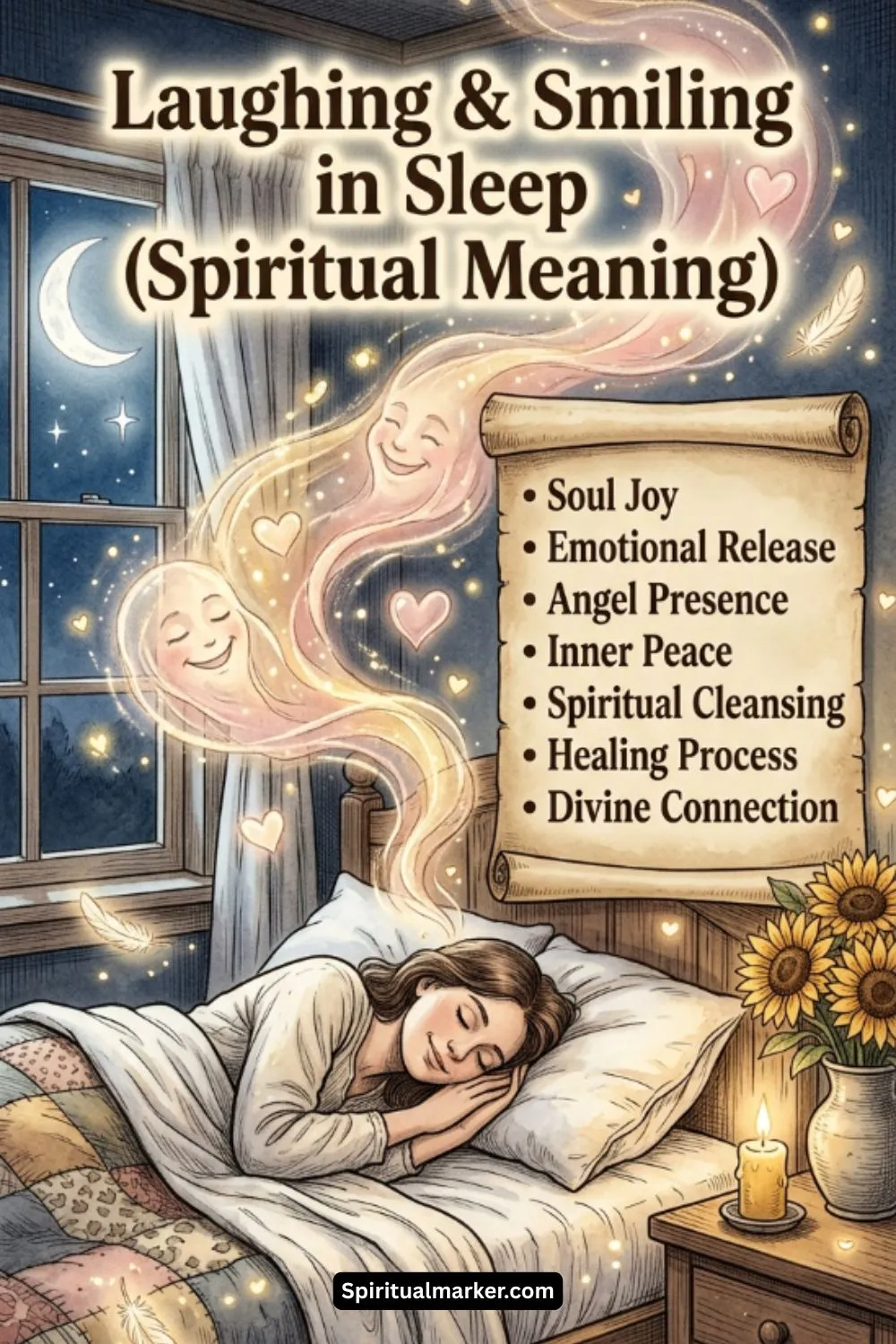
What Does It Mean to Laugh or Smile in Your Sleep?
Before diving into the spiritual side, it helps to understand what actually happens when you laugh or smile during sleep. Sleep researchers have documented this phenomenon across all age groups. Infants smile in their sleep within the first few weeks of life. Adults experience it during both REM (Rapid Eye Movement) sleep and non-REM stages. During REM sleep, the brain processes emotions, consolidates memories, and often creates vivid dream scenarios.
When a dream triggers a joyful emotional response, the facial muscles respond physically. The brain does not fully suppress motor activity during emotional dream sequences. This is why people sometimes cry, flinch, or laugh out loud while asleep. Science explains the how. Spirituality addresses the why.
Spiritually speaking, sleep is considered a liminal state. It is a threshold between the physical world and the spiritual realm. Ancient cultures treated sleep as sacred time. The Greek word for sleep, “hypnos,” was even personified as a deity. Many shamanic traditions view the sleeping state as a time when the soul travels, receives messages, and encounters spiritual beings. In this context, laughing or smiling during sleep is the physical body’s reaction to something joyful the soul is experiencing in that spiritual space.
7 Spiritual Meanings of Laughing and Smiling in Sleep
1. A Sign of Divine Joy and Inner Peace
The most commonly cited spiritual meaning of smiling in sleep is that it signals deep inner peace. This is not surface-level happiness. This is the kind of peace that comes when your soul is aligned with something greater than yourself. Spiritual teachers across many traditions describe this state as the soul resting in the presence of the divine. When the body is relaxed enough to let that peace surface physically, a smile or laugh emerges naturally.
In many Eastern spiritual philosophies, this state is called “Ananda”, a Sanskrit word meaning pure bliss. It is believed that during deep sleep, the ego dissolves and the soul reconnects with its true nature. That reconnection produces an unbounded sense of joy. The smile you express in sleep is your physical self echoing what the soul is already experiencing on a higher plane.
This meaning becomes even more significant when the person experiencing it is going through a difficult season in waking life. If you are in the middle of a painful transition, a loss, or an overwhelming challenge, laughing joyfully in your sleep may be a spiritual signal that healing is happening beneath the surface. Your soul is being restored even when your waking mind cannot see it yet. The body is confirming a deeper truth.
This is not a coincidence. Many spiritual traditions teach that the healing process begins in the spirit before it manifests in the physical. The smile in sleep may be the first visible evidence of that invisible restoration. Pay attention to this. Do not dismiss it as random. It carries a message of hope directly from your inner world.
2. Angelic Presence and Spiritual Visitation
Across numerous spiritual traditions, angels are believed to visit humans during sleep. The sleeping state lowers the defenses of the conscious mind. This makes the individual more spiritually receptive. In Islamic tradition, angels are said to hover over sleeping believers, and a righteous dream is considered a form of divine communication. In Christianity, angels appear repeatedly in dreams throughout both the Old and New Testaments.
When a person laughs or smiles in their sleep, many spiritual teachers interpret this as a direct response to an angelic encounter. The soul, recognizing the presence of a celestial being, responds with joy. The physical body mirrors that response. This is why the experience often leaves a person feeling unusually peaceful or uplifted upon waking, even when they cannot recall a specific dream.
Ancient Jewish mystical texts, particularly the Zohar, describe the soul as partially leaving the body during sleep to receive spiritual nourishment. If the soul encounters an angelic messenger or a divine light source during this journey, it returns to the body with joy. This joy then expresses itself through the sleeping body as a smile or a laugh. The tradition is clear: joy during sleep is spiritually significant and should not be ignored.
Many people who have experienced this describe waking up with an inexplicable sense of being loved, watched over, and protected. This is consistent with what spiritual traditions say about angelic presence. Angels bring peace. They bring assurance. And sometimes, they bring a joy so pure that your body smiles in its sleep without any conscious effort from you.
3. Connection With a Deceased Loved One
One of the most emotionally powerful spiritual meanings of laughing in sleep is the belief that a departed loved one has visited. Many grief counselors and spiritual teachers note that dreams involving deceased loved ones often feel more vivid, more real, and more emotionally charged than ordinary dreams. When a person laughs or smiles during such a dream, it typically means the encounter was one of warmth, reunion, and comfort.
In many African and Indigenous American spiritual traditions, the ancestors are believed to remain active in the lives of the living. They communicate through dreams, signs, and symbols. A dream in which you hear the laugh of a deceased parent, or share a joyful moment with a lost friend, is considered a sacred visitation. Your sleeping laughter is your soul’s response to that meeting. It is real on a spiritual level, even if the physical body cannot verify it.
This type of experience often brings a profound sense of closure. People who have been carrying grief report waking from these dreams feeling lighter, more at peace, and even grateful. They describe a sense that their loved one is okay and that the relationship did not end at death. The spiritual meaning of smiling while sleeping in this context is one of continued love that transcends the physical world.
If you recently lost someone and you experience laughing or smiling in your sleep, many spiritual traditions would say your loved one visited you. They brought you joy. They wanted you to know they are at peace. The smile on your sleeping face was your soul’s way of saying, “I know. I feel it.”
4. Spiritual Growth and Awakening
Spiritual awakening is rarely a single dramatic moment. It is a process. It happens in layers. Sleep is one of the primary arenas in which this growth takes place. The subconscious mind processes deep truths during sleep that the waking ego often resists. When a breakthrough occurs at that subconscious level, when a spiritual truth finally lands in the soul, the response is sometimes joy expressed through smiling or laughing in sleep.
Many people going through an active spiritual awakening report unusual sleep experiences. They have more vivid dreams. They wake up at specific times, like 3 AM or 4 AM. They experience a sense of being watched or guided. And some experience unexplained joy during sleep. This joy is a symptom of the soul expanding. Old beliefs are being released. New spiritual understanding is taking root.
In Buddhist teachings, joy (called “piti”) is one of the five factors of absorption, or jhana. It arises naturally when the mind settles into a state of deep stillness and clarity. During sleep, if the mind dips into a jhana-like state, piti can arise spontaneously. The sleeping body smiles or laughs as a result of this deep meditative joy. It is the same joy experienced by long-time meditators, but accessed through the doorway of sleep.
Pay attention to what is happening in your spiritual life around the time you begin experiencing laughing in sleep. Are you reading new spiritual material? Are you praying more consistently? Have you recently let go of something that was holding you back? The sleeping joy often correlates with a real shift happening in your inner landscape. It is the soul celebrating its own growth.
5. Good Fortune and Blessings on the Way
In many folk traditions and spiritual belief systems around the world, laughing or smiling in sleep is considered a powerful omen of good fortune. This belief is especially prevalent in Asian cultures, where dreams are treated as windows into future events. A joyful sleep experience is seen as a preview of blessings that are already moving toward you in the physical world.
Chinese dream interpretation, rooted in Taoist and Confucian spiritual frameworks, often links sleep-laughter with incoming prosperity, positive relationships, and favorable life outcomes. It is believed that the subconscious or spiritual self can perceive blessings before the conscious mind is aware of them. The smile in sleep is the soul’s preview reaction to something good that has already been set in motion.
West African spiritual traditions share a similar view. Elder women in Yoruba culture, for instance, often observe young children who smile in their sleep and declare that “the ancestors are blessing them.” The sleeping smile is treated as a confirmation that the child carries spiritual favor. This perspective extends to adults as well. A grown person who laughs in their sleep is said to be walking in alignment with the blessings of their lineage.
If you are in a period of waiting, praying, or believing for a breakthrough, smiling in your sleep may be the spiritual signal you needed. Traditions across the world agree: it is rarely a coincidence. Good things are coming. Your soul already knows it. The smile is the proof.
6. Release of Emotional Burdens and Healing
The human soul carries weight. It carries grief, fear, trauma, and unresolved pain. Much of this emotional weight is processed during sleep. Psychologists refer to this as emotional memory consolidation, a process by which the brain replays and reframes difficult experiences during REM sleep. On a spiritual level, this same process is seen as the soul releasing what no longer serves it.
When this release occurs, when a burden that the soul has carried for months or years finally lifts during the vulnerable state of sleep, the physical response is often a smile or a laugh. It is not a mocking laugh. It is not a nervous laugh. It is the laugh of liberation. It is the kind of laughter that comes when something heavy is finally put down. The body celebrates the release.
Energy healers and spiritual therapists often interpret sleeping laughter as evidence that deep healing is occurring below the level of conscious awareness. Reiki practitioners, shamanic healers, and energy workers describe seeing clients smile or laugh during healing sessions as a sign that blocked energy is moving. The same principle applies during sleep. The body is a vessel for spiritual energy. When that energy flows freely, joy is the natural result.
If you have been through a long season of emotional pain and you begin to laugh or smile in your sleep, take it as a deeply positive sign. Your spiritual body is doing the healing work your conscious mind could not do alone. The weight is lifting. The smile on your sleeping face is not a random muscle twitch. It is the visible proof of invisible healing taking place in the depths of your soul.
7. A Confirmation That You Are on the Right Path
Many people experience a season of doubt during major life transitions. They question their choices, their purpose, and their direction. In those moments, the universe often sends confirmation signs. One of the most subtle and overlooked signs is unexplained joy during sleep. When your soul is aligned with the right path, with your true purpose and calling, it experiences a peace that transcends logic.
Spiritual teachers from multiple traditions describe this as the “witness” state of the soul. In this state, the deeper self observes and affirms what is happening in a person’s life. If you have recently made a major decision, taken a leap of faith, or stepped into a new chapter, and you begin experiencing smiling or laughing in your sleep, the spiritual interpretation is clear. Your soul is saying yes. The universe is affirming your direction.
In Sufi mysticism, there is a concept called “hal”, a spiritual state or condition that descends upon the heart. When a person is in alignment with divine will, the hal of joy and contentment settles into the soul. This inner state does not leave when the person falls asleep. The sleeping person continues to carry this hal, and it expresses itself through peaceful smiling and contented laughter during sleep.
Trust what your sleeping body is telling you. The soul speaks when the conscious mind is quiet. A laugh or a smile in the deepest part of sleep is one of the clearest ways the soul expresses alignment, affirmation, and approval. You are on the right path. Keep moving forward.
Laughing and Smiling in Sleep Across Cultures and Religions
The spiritual meaning of smiling in sleep shows up across virtually every major culture and religious tradition. The specific interpretations differ. Yet the underlying message is remarkably consistent: joy during sleep is sacred.
In Hindu tradition, smiling or laughing in sleep is often linked to Sanchita Karma, the stored good deeds of past lives. It is believed that when the soul accesses this reservoir of positive karma during sleep, it experiences joy. The physical body then reflects that joy through expressions of happiness during sleep. This is one reason why in Indian households, a sleeping child who smiles is considered deeply auspicious. Parents often say, “The gods are playing with them.”
In Islamic tradition, the Prophet Muhammad (peace be upon him) distinguished between three types of dreams: those from Allah, those from the self, and those from Shaytan (the devil). A dream that produces genuine joy, peace, and contentment is classified as a “ru’ya”, a true and good dream from Allah. When a person laughs or smiles in sleep as a result of such a dream, it is seen as a spiritual gift and a mercy from God. Islamic scholars generally view sleep-laughter with a positive lens, as long as it follows a righteous dream experience.
In Native American traditions, specifically among the Lakota and Cherokee peoples, dreams are treated as direct communications from the spirit world. Laughter and joy within dreams are associated with the Heyoka spirit, a sacred contrarian energy that brings unexpected healing through humor and joy. A person who laughs in their sleep is sometimes seen as someone being touched by this sacred energy. It is a sign of spiritual activity and favor, not a cause for alarm.
Celtic spiritual traditions viewed sleep as a journey to the “Otherworld,” a parallel spiritual realm. In this realm, departed ancestors, fairy beings, and divine guides could interact with the sleeping traveler. When someone returned from this journey laughing or smiling, it was understood that they had experienced a joyful meeting with benevolent beings. The sleeping smile was proof of a successful spiritual journey. Celtic druids took such experiences very seriously as signs of spiritual health and connection.
Laughing and Smiling in Sleep in World Mythologies
Mythology provides rich context for understanding why laughter and smiling in sleep carry such deep spiritual weight. Ancient stories about gods, heroes, and divine encounters during sleep point to a universal human belief: the sleeping state is where the divine and the human meet.
In Greek mythology, the god Morpheus was the god of dreams. He was the son of Hypnos (Sleep) and Nyx (Night). Morpheus could take on any human form and appear to sleeping mortals. The gods communicated their will through Morpheus. When a mortal received a joyful dream from Morpheus, it was understood as a message of divine blessing. The Greeks believed that smiling in sleep was evidence of a divine dream, a direct message from Olympus.
In Egyptian mythology, the god Bes was a protector of households, mothers, and children. Bes was depicted as a dwarf god with a lion-like face, and he was known for making babies laugh. Ancient Egyptians believed that infants who smiled in their sleep were being visited by Bes. This belief extended to adults as well. A smile during sleep meant a protective deity was nearby, watching and blessing the sleeper. Temples dedicated to sleep and dream interpretation, called “incubation temples,” were common in ancient Egypt, where people would sleep inside to receive divine messages.
Norse mythology contains the concept of the “Hamingja”, a personal spirit or luck-force attached to each individual. This spirit was believed to travel and engage in activity while the person slept. A joyful sleeping experience, including laughter, was attributed to a healthy and active Hamingja. It signaled that the person’s spiritual luck and power were strong and working on their behalf. A sleeping laugh, in this context, meant your spiritual force was winning battles you could not even see.
Sumerian texts, among the oldest written records of human civilization, contain references to divine dreams in which the sleeping individual encountered gods and received blessings. The emotional responses to these divine encounters, including expressions of joy, were taken as proof of divine contact. Laughter and smiling during sleep were recorded as signs of a favorable encounter with a deity. The Sumerians saw no separation between the spiritual and the physical. A joyful body during sleep meant a joyful soul in the presence of the divine.
What Does It Mean When Someone Else Sees You Smiling in Sleep?
There is another dimension to this experience that rarely gets discussed. What does it mean when someone else observes you smiling or laughing in your sleep? This is a common experience for partners, parents, and caregivers who watch over sleeping loved ones. The spiritual meaning of witnessing another person’s sleep-joy carries its own significance.
In many African spiritual traditions, observing a loved one smile or laugh in their sleep is considered a privilege. It means you have been granted a glimpse of that person’s soul in a moment of divine connection. You are not simply watching a sleeping body. You are witnessing the soul in its most transparent state. The tradition teaches that this experience is meant to build love, deepen trust, and affirm the bond between the observer and the sleeper.
In a relationship context, watching your partner smile or laugh in their sleep is often interpreted as a sign of spiritual alignment between the two of you. Many couples report that periods in which one partner frequently smiles in sleep correspond with particularly harmonious and positive seasons in the relationship. The spiritual interpretation is that the sleeping partner’s soul is at peace. That peace extends to the relationship itself.
For parents watching over infants who smile in sleep, the spiritual meaning is especially tender. Many traditions worldwide, from Indian to West African to Celtic, teach that newborns have an especially close connection to the spirit world. They have recently arrived from it. Their smiling in sleep is seen as a sign that they are still in active communication with the divine. Parents who witness this are encouraged to take it as a blessing on the child and an affirmation of the child’s spiritual wholeness.
Biblical Meaning of Laughing and Smiling in Sleep
The Bible does not address laughing in sleep directly. However, it contains rich themes about joy, laughter, dreams, and divine communication during sleep that provide a powerful biblical framework for interpreting this experience.
The most striking biblical connection is found in Psalm 126:1-2: “When the Lord restored the fortunes of Zion, we were like those who dreamed. Our mouths were filled with laughter, our tongues with songs of joy.” This passage directly links dreaming with laughter and divine restoration. The image is powerful: people experiencing such an overwhelming reversal of circumstances that their dreaming is filled with joy and their waking mouths break into laughter. Laughing in sleep, in the biblical framework, is connected to divine restoration.
Proverbs 17:22 states: “A joyful heart is good medicine, but a crushed spirit dries up the bones.” The Bible consistently presents joy as a spiritual force, not merely an emotion. When joy is experienced during sleep, it carries the same spiritual potency. God is described throughout scripture as the source of all true joy. If a person is experiencing genuine, unexplained joy during sleep, the biblical perspective would point to God as the origin of that joy.
In Genesis 37 and 40-41, Joseph receives and interprets significant divine dreams. In Matthew 1:20, an angel appears to Joseph (Mary’s husband) in a dream and gives him life-changing direction. The Book of Job (33:14-16) says: “For God speaks in one way, and in two, though man does not perceive it. In a dream, in a vision of the night, when deep sleep falls on men, while they slumber on their beds, then he opens the ears of men.” This scripture alone confirms that God communicates actively through sleep. A joyful response during sleep, including smiling and laughing, may be the soul’s reaction to receiving a divine message or experiencing God’s presence.
In Nehemiah 8:10, the scripture declares: “The joy of the Lord is your strength.” Biblical joy is not passive. It is a spiritual force and a source of power. When that joy visits a believer during sleep, it aligns with the biblical principle that God strengthens His people even during rest. Isaiah 26:3 adds: “You will keep in perfect peace those whose minds are steadfast, because they trust in you.” A smile in sleep may be the outward evidence of that perfect peace resting on a trusting soul.
Dreaming of Someone Laughing or Smiling: Spiritual Interpretations
The experience shifts slightly when you are the one dreaming about someone else laughing or smiling. This also carries significant spiritual meaning. The identity of the person in the dream, the nature of their laughter, and the emotional tone of the encounter all shape the interpretation.
When you dream of a deceased loved one smiling at you, most spiritual traditions interpret this as a visitation dream. The smiling face of the departed person is their way of communicating peace. They are okay. They are happy. They want you to release grief and carry forward with joy. This type of dream is one of the most comforting spiritual experiences a grieving person can have. The smile in the dream is a message of love from beyond the physical realm.
Dreaming of a stranger laughing joyfully at you or with you can symbolize the arrival of a new presence in your life. This could be a new friend, a mentor, or even an angelic guide taking on human form in the dream. The laughter signals that this incoming connection is positive, spirit-led, and life-giving. Pay attention to how the laughter made you feel in the dream. Joy in response to a stranger’s laugh suggests the new connection will bring genuine happiness and growth.
If you dream of a spiritual figure smiling at you, whether that is Jesus, a saint, a guru, or a divine being from your own tradition, the spiritual meaning is profound. This is widely regarded as a direct spiritual blessing. The figure’s smile is an affirmation, a sign of approval, and an expression of divine love directed specifically at you. Many people describe such dreams as among the most powerful experiences of their spiritual lives. The impression they leave is often permanent.
Is Laughing in Sleep Always a Positive Spiritual Sign?
Most of the time, the spiritual meaning of laughing in sleep is overwhelmingly positive. However, it is worth addressing the question directly: is it always a good sign? The honest answer is that context matters.
In some folk traditions, mocking laughter during sleep, laughter that feels cruel or derisive even within the dream, can be interpreted as a signal of spiritual attack or negative spiritual influence. The key is the emotional quality of the laughter. Joyful, warm, loving laughter is virtually always interpreted as a positive spiritual sign across traditions. Cold, hollow, or fearful laughter carries a different energy entirely.
In some West African spiritual practices, if a person consistently laughs in their sleep in a way that frightens or disturbs those around them, a spiritual elder may be consulted. This is not because the laughter itself is evil, but because any strong spiritual phenomenon during sleep is worth examining carefully. The quality, tone, and emotional residue of the experience are the most important factors in discernment.
For the vast majority of people who experience gentle smiling or joyful laughing in sleep, the spiritual interpretation remains positive. The soul is experiencing something beautiful. The body is responding authentically. There is no need for fear or alarm. The experience is a gift, and receiving it with gratitude is the spiritually appropriate response.
How to Honor and Respond to This Spiritual Experience
When you or someone close to you experiences laughing or smiling in sleep, there are meaningful ways to honor that experience. These responses help you stay spiritually aware and connected to the message being communicated.
Keeping a dream journal is one of the most effective practices. Write down anything you remember upon waking, even fragments. Over time, patterns emerge. You may notice that you smile in sleep during specific seasons of your life. Tracking those patterns gives you valuable spiritual insight into your own inner world and your relationship with the divine.
Practicing gratitude upon waking is another powerful response. If you wake up feeling unusually peaceful, joyful, or light, even without remembering a specific dream, acknowledge it. Say thank you. Whether you direct that gratitude toward God, the universe, your ancestors, or simply your own spirit, the act of acknowledgment deepens the spiritual connection and invites more of these experiences into your life.
Some spiritual practitioners recommend meditation or quiet reflection immediately after waking from a joy-filled sleep experience. The residual energy of the spiritual encounter lingers for a short time after waking. Sitting in stillness during those first few minutes allows you to receive more of what was communicated. You may receive an insight, a memory of the dream, or simply a deep sense of peace that carries you through the day.
A Final Note
The spiritual meaning of laughing and smiling in sleep is one of the most universally affirming experiences the human soul can have. Across every major religion, culture, mythology, and spiritual tradition, this experience points in the same direction: toward divine favor, healing, connection, and joy.
Science explains the mechanism. Spirituality reveals the meaning. And when both converge, what you get is a richer, more complete picture of what it means to be a spiritual being having a human experience. Your soul does not rest when your body rests. It continues its journey. It meets beings of light. It receives healing. It experiences the presence of God. And sometimes, the body cannot help but smile.
If you have been experiencing this, take it as an encouragement. Something beautiful is happening in the deepest parts of your spiritual life. You may want to begin keeping a dream journal to track what surfaces over time. You may also want to set an intention before sleep, inviting spiritual clarity, healing, or guidance. Pay attention to what shifts in your waking life after nights of joyful sleep experiences. You may find that the two are more connected than you realized.
The soul speaks in the language of joy. Your sleeping smile is one of its most honest and beautiful sentences.