The lamb is a symbol of innocence and sacrifice. Its gentle nature and soft wool evoke purity and vulnerability. Across cultures, lambs carry deep spiritual meaning and reveal powerful truths.
The lamb spiritual meaning often involves innocence, sacrifice, and spiritual purity. In Christianity, the lamb represents Jesus Christ. A spiritual meaning of a dog shares that animal-symbol focus, though dogs carry a more loyal energy.
Some traditions view lambs as symbols of peace, meekness, and renewal. Others see them as a reminder to trust in a higher power. The lamb's behavior can add detail.
If a lamb appears in your life, it may signal a need for gentleness. A spiritual meaning of a horse also deals with animal symbolism, though horses carry a more powerful energy.
Key Takeaways
- The lamb is a universal spiritual symbol of purity, innocence, and divine sacrifice found across Christianity, Judaism, Islam, and ancient pagan traditions.
- In biblical symbolism, the lamb most powerfully represents Jesus Christ as both the sacrificial offering for sin and the victorious Lamb of Revelation.
- The lamb symbolizes more than gentleness. It also carries meanings of humility, obedience, spiritual rebirth, and divine protection.
- Across world mythologies and cultures, from ancient Egypt to Greek tradition, the lamb was consistently linked to gods, fertility, and sacred rituals.
- Dreaming of a lamb often signals a period of spiritual renewal, emotional healing, or a call to trust in a higher power during a difficult season of life.
What Is the Lamb and Why Does It Hold Spiritual Significance?
A lamb is simply a young sheep, typically less than one year old. But calling it “simply” anything misses the point entirely. Throughout history, the lamb occupied a central place in the spiritual and social lives of ancient peoples. Shepherding was one of the oldest human professions. Communities lived and died by the health of their flocks. The lamb was both an economic lifeline and a sacred object of devotion.
Its spiritual significance grew naturally from its qualities. A lamb is gentle by nature. It does not fight. It does not overpower. It follows, trusts, and depends entirely on its shepherd. These traits made it the perfect metaphor for the human relationship with the divine. Ancient priests and prophets recognized that the lamb embodied virtues humanity was meant to cultivate: meekness, trust, purity, and surrender.
The lamb was also the animal of choice for sacrifice across many traditions precisely because of its flawlessness. Ancient law required a lamb “without blemish” for sacred offerings. That requirement was never accidental. The unblemished lamb represented the ideal standard of purity. Offering a perfect lamb was an act of giving your best to the divine, not your leftover. That theology of wholeness and dedication runs through every culture that has ever honored this animal.
What Does Seeing a Lamb Symbolize or Represent?
When you see a lamb, whether in a field, in art, or in a vision, it carries a specific spiritual charge. The most immediate meaning is innocence and purity. The lamb has not been corrupted. It has not carried the weight of the world. Seeing one is often interpreted as a sign that innocence is present, or that you are being called back to a more innocent, trusting state of being.
A lamb also signals divine protection. The image of a shepherd tending a lamb is one of the most comforting spiritual metaphors across traditions. It speaks to the idea that a higher power watches over the vulnerable. If you see a lamb in a spiritually significant moment, many traditions interpret it as reassurance. You are not alone. Someone greater is watching over your path.
Seeing a lamb can also represent a call to gentleness. This is especially true during seasons of conflict, anger, or hardship. The lamb asks you to choose the softer response. It reminds you that strength does not always look like aggression. Sometimes, the most powerful thing you can do is remain calm, trusting, and open, just like the lamb in its field.
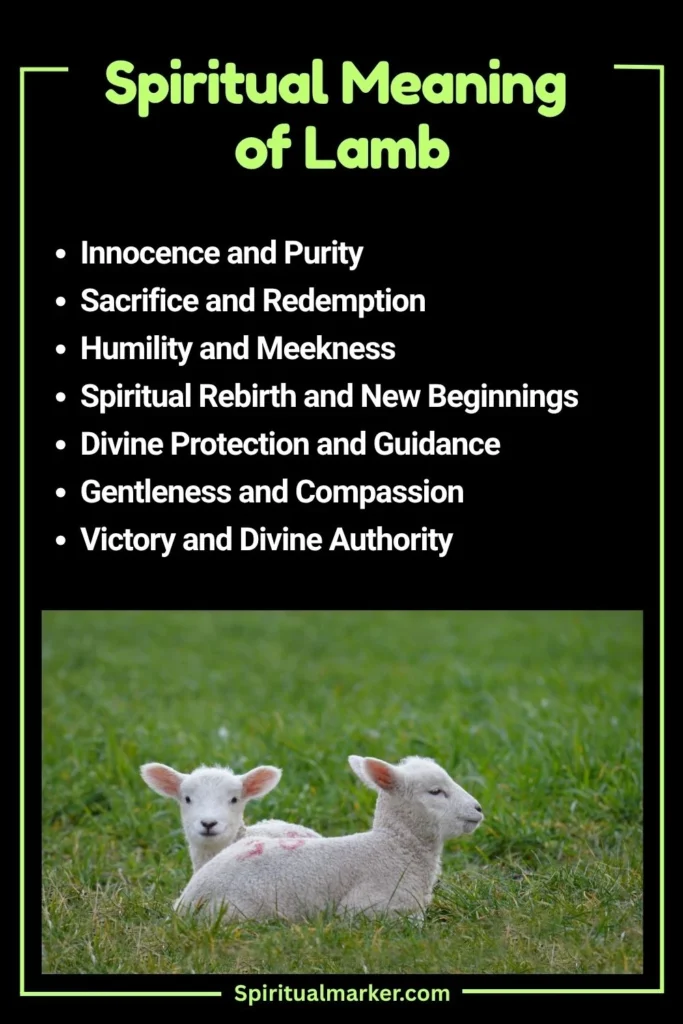
7 Spiritual Meanings of the Lamb
1. Innocence and Purity
The lamb’s most foundational spiritual meaning is innocence. Across every tradition that has ever honored this animal, the lamb represents a state of being untouched by sin, corruption, or moral compromise. This is why ancient sacrificial law demanded an unblemished lamb. The blemish was not just a physical flaw. It represented moral impurity, and only the pure could approach the sacred.
In Christian theology, this innocence is most fully expressed in the figure of Jesus Christ as the Lamb of God. The Gospel of John records John the Baptist declaring, “Behold, the Lamb of God, who takes away the sin of the world” (John 1:29). Christ’s innocence was not passive. It was active and purposeful. His purity became the vehicle for humanity’s redemption, showing that true innocence carries enormous spiritual power.
On a personal level, the lamb as a symbol of purity invites you to examine your own inner life. Where have you allowed corruption, bitterness, or compromise to settle in? The lamb does not carry grudges. It does not hold on to wounds. Connecting with this spiritual meaning is an invitation to return to a cleaner, clearer version of yourself, one that is spiritually open and free from the weight of unresolved sin or pain.
2. Sacrifice and Redemption
No spiritual meaning of the lamb runs deeper than sacrifice. In nearly every ancient religious tradition, the lamb was the animal most commonly offered to the divine. The Hebrew Passover required a spotless lamb, slaughtered and its blood applied to doorposts as a sign of protection. The annual Day of Atonement included the sacrifice of lambs as part of the ritual cleansing of the community’s sins. Sacrifice was not cruelty. It was theology in action.
The idea behind sacred sacrifice was always substitution. The lamb died so that the people could live. It took on the weight that the community could not carry alone. This is the same theological logic that runs through the Christian understanding of Jesus as the sacrificial Lamb. As 1 Peter 1:18-19 states, believers were redeemed “with the precious blood of Christ, a lamb without blemish or defect.” The sacrifice was complete. The redemption was total.
This meaning of sacrifice and redemption also carries a personal application. Sometimes the lamb symbolism appears in your life during seasons where you are being called to give something up. It might be a habit, a relationship, a version of yourself that no longer serves your growth. The lamb reminds you that giving something over to a higher purpose, even when it is painful, leads to transformation. Sacrifice, spiritually understood, is always the path to something greater.
3. Humility and Meekness
The lamb does not demand attention. It does not assert dominance. It grazes quietly, follows its shepherd, and exists without pretension. This behavioral reality made the lamb one of the oldest symbols of humility and meekness in spiritual traditions worldwide. Humility, in this context, is not weakness. It is a chosen posture of openness toward something greater than yourself.
Jesus leaned into this symbolism directly. In Matthew 5:5, he declared, “Blessed are the meek, for they will inherit the earth.” The word translated “meek” in Greek is praus, which refers to controlled strength, not absence of strength. The meek lamb is not a pushover. It is an animal that has the power to flee or resist but chooses to trust instead. That trust is the heart of true spiritual humility.
When the lamb appears as a spiritual symbol in your life, it often comes as a corrective. Perhaps you have been striving too hard, grasping too tightly, or pushing your own agenda with too much force. The spiritual meaning of humility embedded in the lamb calls you to release your grip. It asks you to trust the process, trust your spiritual path, and trust that you do not have to control every outcome. The lamb’s entire existence is an act of surrender, and surrender, done right, is one of the most spiritually courageous things you can do.
4. Spiritual Rebirth and New Beginnings
Lambs are born in spring, which is no coincidence when you consider how deeply spring symbolism runs in spiritual traditions. Spring is the season of new life, resurrection, and renewal. The lamb arrives at the same time as the thawing earth, the returning green, and the longer days. This timing made the lamb a powerful symbol of new beginnings across cultures that observed the agricultural calendar as sacred time.
In Christian tradition, the connection between the lamb, Easter, and resurrection is direct and intentional. Jesus was crucified during Passover, when lambs were being sacrificed across Jerusalem. His resurrection on the third day permanently fused the imagery of the lamb with the idea of new life after death. The lamb did not just represent sacrifice; it represented what comes after sacrifice: transformation and rebirth.
Personally, lamb symbolism connected to rebirth often appears when you are at a significant turning point. You may be ending one chapter of life and beginning another. You may be recovering from grief, illness, or loss. The lamb speaks to that tender, vulnerable season of beginning again. It says that new life is not just possible. It is already underway, even when you cannot yet see it fully.
5. Divine Protection and Guidance
The relationship between a lamb and its shepherd is one of complete dependence and complete protection. The lamb does not navigate predators alone. It does not find its own food or water. It trusts entirely in the shepherd’s knowledge and care. This dependence, far from being a flaw, became one of the most beloved spiritual metaphors for the divine-human relationship across religious history.
Psalm 23 opens with “The Lord is my shepherd, I shall not want,” immediately casting the believer in the role of the lamb, fully provided for and guided by a loving God. The image recurs in Isaiah 40:11, where God is depicted as carrying his people “like a shepherd who carries lambs in his arms.” These are not poetic flourishes. They are theological declarations about the character of divine protection.
When the lamb appears as a spiritual symbol of protection, it speaks to your current need for guidance. You may be in a season of uncertainty, walking through unfamiliar territory, or making decisions you are not confident about. The lamb reminds you that you were never meant to navigate life entirely on your own. Divine guidance is available. The question the lamb poses is whether you are willing to follow.
6. Gentleness and Compassion
The lamb is an inherently gentle creature. It does not bite, scratch, or intimidate. It approaches the world with openness rather than aggression. This quality made the lamb a natural symbol of compassion across spiritual traditions, representing the idea that true spiritual maturity produces gentleness, not harshness.
In early Christianity, the lamb became a symbol of Christ’s tenderness toward the broken and outcast. Jesus described himself as “gentle and humble in heart” in Matthew 11:29, and his ministry consistently reflected that gentleness. He touched lepers, dined with tax collectors, and wept at the tomb of his friend Lazarus. His lamb-like compassion was not sentimentality. It was a revolutionary form of spiritual power that treated the vulnerable as worthy of full dignity and care.
The spiritual meaning of gentleness embedded in the lamb has a direct personal application. Gentleness toward others is a spiritual discipline. It requires you to override your instinct to react harshly, to protect yourself at all costs, or to respond with force when you feel threatened. The lamb calls you to a higher standard, one where your first response to difficulty is compassion, and where your treatment of others reflects the tenderness you yourself long to receive.
7. Victory and Divine Authority
This is the meaning that surprises most people. The lamb is not only a symbol of gentleness and sacrifice. In the book of Revelation, the lamb appears as a figure of cosmic victory and supreme authority. Revelation 5:12 declares, “Worthy is the Lamb, who was slain, to receive power and wealth and wisdom and strength and honor and glory and praise.” The same lamb that was sacrificed is now worshiped at the throne of God.
This theological reversal is one of the most powerful ideas in all of religious literature. The slaughtered lamb becomes the conquering king. The one who appeared weakest turns out to hold ultimate authority. Revelation depicts the Lamb opening the seven seals that determine human history, leading armies, and receiving the worship of every creature in heaven and earth. The Lamb of God in Revelation is simultaneously the most humble and the most powerful figure in the cosmos.
For you personally, this meaning of lamb symbolism speaks to the power hidden in what looks like weakness. When you choose vulnerability over armor, surrender over control, or faithfulness over ambition, you are operating in the spiritual logic of the lamb. What appears defeated from the outside is actually participating in the deepest form of spiritual power. The lamb reminds you that true victory comes through surrender, not domination, and that the path down is often the way up.
Lamb Meaning and Symbolism Across Cultures and Religions
The lamb holds sacred status in nearly every major world religion, though the specific meanings shift according to each tradition’s theology. In Judaism, the lamb is central to Passover, the most important annual festival. The Passover Seder still includes symbolic reference to the lamb sacrificed in Egypt, whose blood protected Israelite families from the final plague. The lamb in this context is a symbol of deliverance and divine covenant.
In Islam, the lamb is honored through the feast of Eid al-Adha, which commemorates Ibrahim’s willingness to sacrifice his son and God’s merciful provision of a lamb in his place. This story, parallel to the Genesis account of Abraham and Isaac, established the lamb as a symbol of faith, obedience, and divine mercy in Islamic tradition. Families who can afford to do so sacrifice a lamb during Eid, distributing the meat to the poor as an act of charity and worship.
In Hinduism, while the cow holds the most prominent sacred status, lambs and sheep appear in Vedic sacrificial contexts. The ashvamedha and other Vedic yajnas sometimes included smaller animals as offerings, representing the human desire to give the divine something precious. The underlying principle is the same across traditions: the lamb represents what is pure and valuable, worthy of offering to the highest powers.
Celtic spirituality also held the lamb in high regard. Sheep were central to Celtic agricultural life, and the lamb represented the abundance of spring and the renewal of the earth after winter. Early Celtic Christians quickly merged this existing reverence with Christian symbolism, creating a rich tradition of lamb imagery in Celtic art, including the famous Chi-Rho symbols decorated with lambs found on early Irish manuscripts and stone crosses.
Lamb Symbolism in World Mythologies
Long before the great monotheistic religions took shape, lamb symbolism was already embedded in the mythological systems of the ancient world. In ancient Egypt, the ram god Khnum was depicted with a ram’s head and believed to be the creator of human bodies and souls, shaping them on a divine potter’s wheel. Lambs born in his sacred flocks were considered especially holy, and harming them was treated as a serious religious offense.
In ancient Greece, lambs were the preferred sacrifice for many of the Olympian gods. Zeus, Hera, and Apollo all received lamb offerings at their temples. The Pythian Games at Delphi began with the sacrifice of a lamb, offered to Apollo before the athletic and artistic competitions began. Greek myth also includes the famous Golden Fleece, sought by Jason and the Argonauts, which represents divine favor, kingship, and the ultimate prize worth risking everything to obtain.
Roman religion similarly honored the lamb through the Lupercalia festival and other agricultural rites. The flamen, Rome’s priestly class, conducted sacrifices that regularly included lambs, offered to gods like Mars and Jupiter. The underlying mythology held that the gods required the best of the flock as evidence of human devotion and gratitude. Lambs, being young and spotless, were considered the finest available offering.
In Mesopotamian mythology, the lamb appears in some of the oldest written religious texts on earth. The Sumerian myth of Dumuzi, the shepherd god, features lambs prominently as symbols of divine abundance and cosmic order. The shepherd-lamb relationship in Mesopotamian myth directly influenced later Hebrew and ultimately Christian theological language about God as shepherd and humanity as his flock. The symbolism did not arise in isolation. It built on thousands of years of accumulated meaning.
Lamb Biblical Meanings and Significance
The biblical meaning of the lamb is the most developed and theologically rich of any tradition. The word “lamb” appears over 90 times in the Bible, from Genesis through Revelation, and every appearance carries significant weight. The lamb is not a background detail in Scripture. It is a central theological thread woven through the entire narrative arc of the Bible.
The lamb first appears in Genesis 4, when Abel offers “the firstborn of his flock” to God and receives divine favor. The first animal sacrifice in Scripture involves a lamb, establishing from the very beginning the connection between lambs and access to God. This pattern continues through Abraham’s near-sacrifice of Isaac, where God provides a ram as a substitute at the last moment, a narrative that theologians have long recognized as a foreshadowing of Christ’s own sacrifice.
The Passover narrative in Exodus 12 establishes the lamb’s most prominent Old Testament role. God commanded each Israelite family to select a year-old male lamb without defect, slaughter it at twilight, and apply its blood to their doorposts. When the angel of death passed through Egypt, every home marked with lamb’s blood was spared. This event, the foundational liberation story of the Hebrew people, permanently linked the lamb’s blood with salvation and protection.
The prophet Isaiah provided the most striking prophetic use of lamb imagery. In Isaiah 53:7, describing the coming suffering servant, he wrote: “He was oppressed and afflicted, yet he did not open his mouth; he was led like a lamb to the slaughter.” This passage, written roughly 700 years before Christ, became one of the most cited Old Testament prophecies by New Testament writers to explain the significance of Jesus’ death. The lamb was not just a religious symbol. It was a prophecy wearing wool.
In the New Testament, John the Apostle uses the image of the Lamb more than any other writer. In the book of Revelation, the Lamb appears 28 times and is explicitly identified with the risen Christ. The Lamb opens the seals of history, stands on Mount Zion with 144,000 faithful followers, defeats the beast, and ultimately reigns from the throne of God. The final chapters of Revelation describe the eternal city of New Jerusalem illuminated not by the sun, but by the glory of the Lamb. The biblical symbolism of the lamb ends not with sacrifice but with eternal kingship.
The Lamb of God: Deep Theological Significance
The title “Lamb of God” is one of the most theologically loaded titles given to Jesus in the New Testament. When John the Baptist applied it in John 1:29, his Jewish audience would have immediately understood its multiple layers. The phrase connected Jesus simultaneously to the Passover lamb, the daily temple sacrifices, and the suffering servant of Isaiah 53. One title carried the weight of centuries of sacrificial theology.
Early Christian theologians spent significant energy unpacking the Lamb of God theology. Justin Martyr, writing in the second century, argued that every lamb sacrificed in the Old Testament was a deliberate foreshadowing of Christ. Origen described Christ as the true Passover lamb, whose sacrifice ended the need for all further animal offerings. The sacrificial system itself was, in this reading, a centuries-long visual sermon preparing the world to recognize Jesus when he arrived.
The Agnus Dei, Latin for “Lamb of God,” became one of the most enduring phrases in Christian liturgy. It is sung in Catholic and many Protestant worship services to this day. The image of the lamb carrying a banner of victory, the Agnus Dei icon, appears in churches worldwide, on stained glass, mosaics, and altarpieces. Few symbols in Christian art have shown more staying power, because few theological truths cut deeper than the idea that ultimate power chooses to look like a lamb.
Lamb Symbolism in Christian Art and Iconography
The lamb became one of the most frequently depicted symbols in early Christian art, particularly during the first three centuries when representing Christ in human form was considered too bold or potentially idolatrous. The lamb served as a safe and scripturally grounded substitute for the human figure of Jesus. Catacombs in Rome, dating to the second and third centuries, are filled with lamb imagery carved into the stone walls where early Christians buried their dead.
The sixth-century mosaic in the apse of the Basilica of Saints Cosmas and Damian in Rome depicts twelve lambs representing the twelve apostles, approaching the central Lamb of God from both sides. This artistic convention, called the Agnello tradition, communicated the entire structure of the Church in a single visual: the apostles as lambs, Christ as the supreme Lamb, all moving toward the divine throne. Medieval artists expanded this language into elaborate altarpiece cycles, the most famous being Jan van Eyck’s Ghent Altarpiece, where the Lamb of God stands on an altar bleeding into a chalice as angels and saints approach in procession.
The Good Shepherd iconography, which shows Jesus carrying a lamb on his shoulders, is one of the oldest representations of Christ in existence. This image, based on Luke 15’s parable of the lost sheep, communicated to ordinary people, many of whom were shepherds themselves, that Christ’s love was personal, searching, and unwilling to leave the vulnerable behind. The lamb in the shepherd’s arms was not just a theological idea. It was an emotional promise.
Dreaming About a Lamb: Spiritual and Psychological Meanings
Dreaming of a lamb is considered a highly significant spiritual experience in many traditions, and psychology adds a complementary layer of meaning to what the imagery communicates. The lamb in dreams almost always carries a positive charge, though the specific meaning depends on what the lamb is doing and how you feel during the dream.
A white lamb in a dream is widely interpreted as a sign of spiritual purity, peace, and divine blessing. Many people report dreaming of a white lamb during periods of transition, recovery, or spiritual awakening. The white lamb in this context often signals that you are being spiritually renewed, that old patterns are falling away, and that something cleaner and truer is emerging in your life. Pay attention to the emotional tone of the dream. Peace in the dream amplifies the positive meaning significantly.
Dreaming of a lamb being led or following a shepherd carries specific guidance. This dream often appears when you are at a crossroads and feeling uncertain about which direction to take. The imagery invites you to trust. It suggests that guidance is available, but you must choose to follow rather than strike out entirely on your own. This kind of dream frequently comes during seasons of major life decision, career change, relationship transition, or spiritual reassessment.
A distressed or lost lamb in a dream carries a different message. This imagery often reflects your own inner state. You may feel vulnerable, unprotected, or separated from something or someone important. Psychologically, the lost lamb dream taps into deep feelings of abandonment or disorientation. Spiritually, it may be a call to reconnect with your faith, your community, or the inner resources that keep you grounded. The important thing about a lost lamb dream is that in every tradition, the lost lamb is found. Its lostness is not its final state.
Dreaming of holding a lamb is one of the most tender and personally significant dream images. It often signals a need to nurture something new in your life, whether a relationship, a creative project, a spiritual practice, or a fragile part of your own inner world that needs protection and care. If the lamb in your arms feels warm and calm, the dream is likely a confirmation that you are already caring well for what matters most. If it feels agitated or scared, consider what in your waking life needs more attentive, gentle care.
The Lamb as a Spirit Animal or Totem
In shamanic and totem traditions, each animal carries specific medicine, meaning the spiritual gifts and lessons it offers to those who feel drawn to it. If the lamb appears as your spirit animal or totem, it is bringing you a very particular set of teachings that are worth taking seriously.
The lamb spirit animal calls you to cultivate gentleness as a spiritual practice. This does not mean becoming passive or allowing others to take advantage of you. It means consciously choosing a softer approach in situations where your instinct might be to harden. The lamb totem asks you to lead with vulnerability, to let your tenderness be visible, and to trust that your openness is not a liability. In a culture that often rewards aggression and ambition, the lamb’s medicine is countercultural and deeply needed.
The lamb as a totem also brings the gift of trust and surrender. People with this spirit animal often struggle with control, finding it difficult to release outcomes and trust in a larger process. The lamb totem arrives specifically to address this struggle. Its lesson is that the most peaceful and productive life is lived in alignment with something greater than your own will. Surrender, the lamb teaches, is not giving up. It is an act of profound spiritual intelligence.
A Final Note
The lamb spiritual meaning is far richer and more layered than most people expect. From the sacrificial altars of ancient Egypt to the gleaming throne room of Revelation, from the dreams that wake you at 3 a.m. to the stained glass windows of medieval cathedrals, the lamb has carried the same essential truths across every era and tradition: purity matters, sacrifice transforms, gentleness is strength, and trust in something greater than yourself is the wisest thing you can do.
Whether you are drawn to this symbolism through Christian faith, spiritual curiosity, a meaningful dream, or simply a sense that this gentle creature carries a message meant for you right now, you are not wrong. The lamb symbolism has endured for thousands of years because it speaks to something permanent in the human experience: the longing for innocence, the need for redemption, and the deep comfort of knowing that a good shepherd is watching over the path ahead.
If you want to go deeper, consider meditating on the lamb imagery most resonant for you, whether that is the Passover lamb, the Lamb of God in Revelation, or the Good Shepherd carrying the lost lamb home. Journaling about what each image evokes in you can open surprising spiritual insights. You might also explore the lamb’s presence in your own cultural heritage, since nearly every tradition on earth has placed this animal at the center of its most sacred stories. The lamb is waiting to tell you something. Give it your full attention.