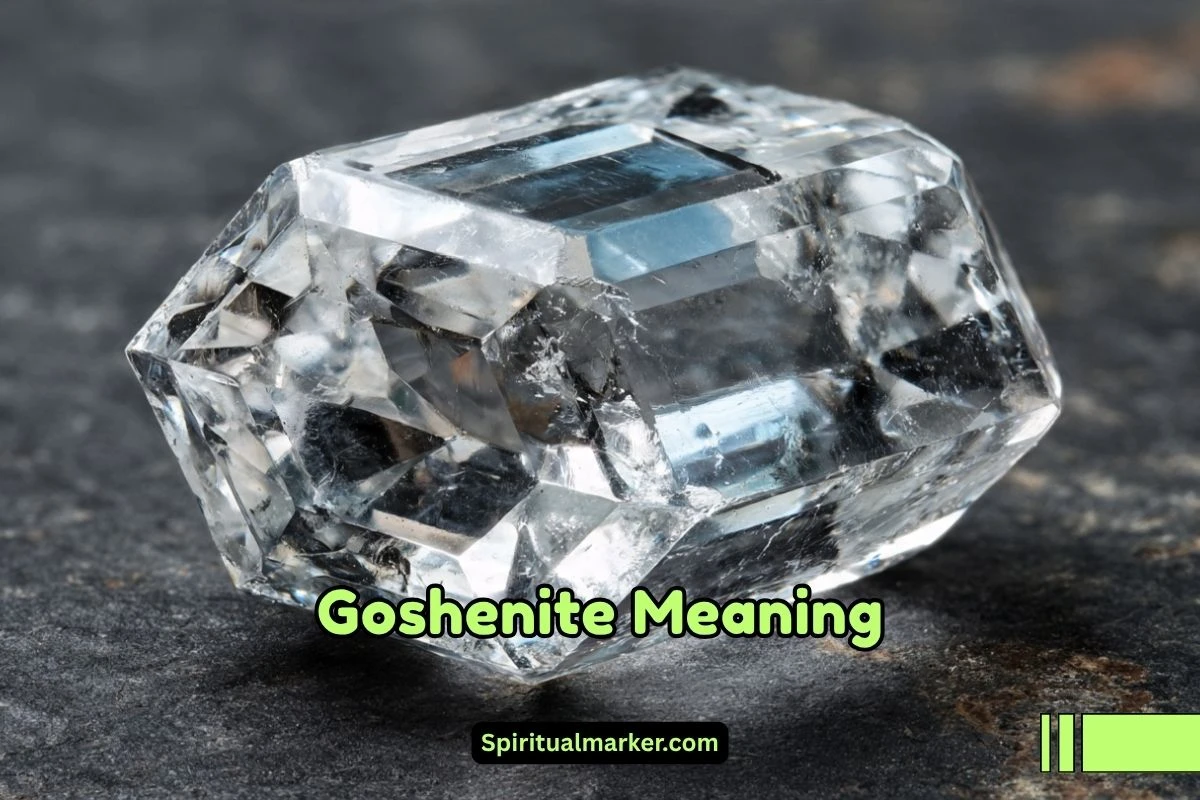
Most people walk past goshenite without a second glance. It has no rich color to stop them. No electric flash of light. No deep saturation to demand attention. It sits quietly in its transparent, colorless form, and many people simply move on. But those who pause long enough to hold one often describe something unexpected. A strange mental stillness. A sense of clarity that arrives without warning.
Goshenite is the purest form of beryl, the same mineral family that produces emerald, aquamarine, and morganite. While its colorful cousins receive most of the attention, goshenite holds a distinct place in crystal and spiritual traditions. Its very lack of color is the point. That transparency has made it a symbol of truth, mental clarity, emotional purification, and spiritual honesty for centuries. People who study gemstones spiritually often call it the “mother of crystals” because of its pure, unfiltered energy.
Historically, goshenite served as a lens material before modern glass manufacturing existed. Ancient Romans and Greeks used thin slices of beryl to correct vision. That connection between goshenite and clearer sight runs deeper than its physical applications. Spiritually, the stone became associated with seeing things as they truly are, stripping away illusion, and confronting truth with patience and courage.
This article covers the goshenite meaning, its healing properties, spiritual symbolism, historical background, and the ways people work with it during personal growth and emotional healing. You will also learn how to wear goshenite jewelry and care for it properly over time.
5 Key Takeaways
- Goshenite symbolizes clarity, truth, emotional purification, and mental transparency.
- Many spiritual traditions associate goshenite with the crown chakra and higher awareness.
- People often use goshenite during meditation, decision-making, emotional detox, and spiritual alignment work.
- Goshenite ranks 7.5 to 8 on the Mohs hardness scale, making it more durable than many gemstones.
- Wearing goshenite close to the head or body may support mental focus, emotional honesty, and spiritual grounding.
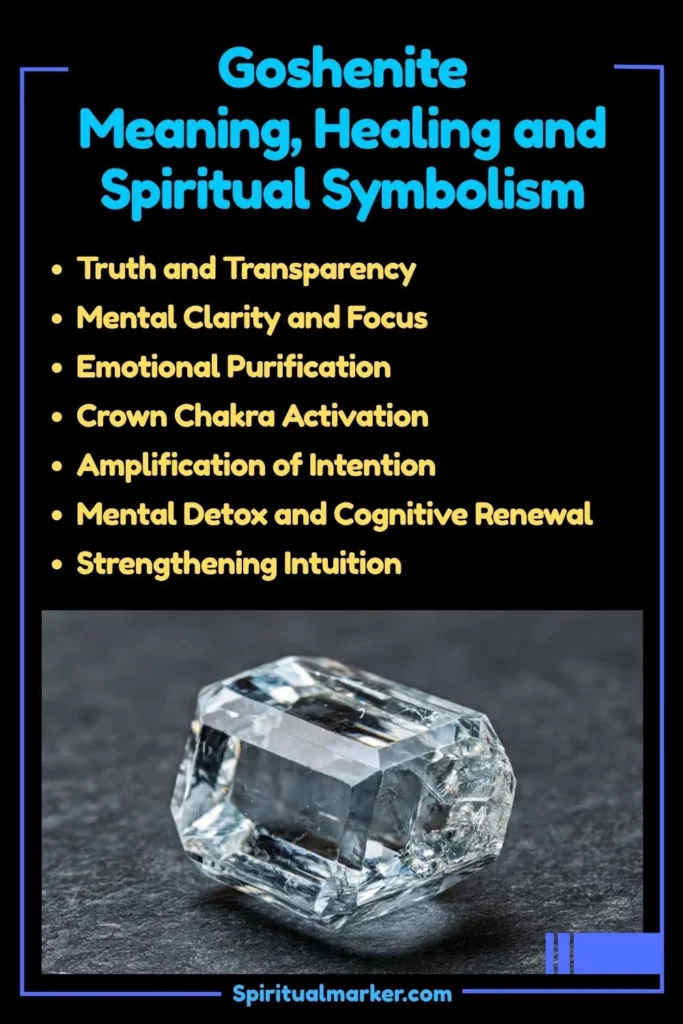
What is Goshenite?
Goshenite is a naturally occurring colorless variety of beryl, a mineral composed of beryllium aluminum cyclosilicate. Its name comes from Goshen, Massachusetts, where significant deposits were first discovered and documented. Unlike other beryl varieties that owe their color to trace metal impurities such as chromium or iron, goshenite contains no chromophores. The absence of those impurities produces its signature colorless, glass-like transparency.
At first, goshenite can resemble clear quartz or even diamond to an untrained eye. However, its structure, weight, and light behavior differ meaningfully. Goshenite has a vitreous luster and a refractive index between 1.57 and 1.60. It has a hexagonal crystal system, which gives it a clean, geometric internal structure. Its hardness of 7.5 to 8 on the Mohs scale makes it suitable for everyday wear without excessive concern about surface damage.
Spiritually, goshenite occupies a unique position among crystals. Many colorful stones carry energy tied to their specific color frequency. Goshenite, being without color, is often described as holding neutral, receptive, and highly amplifying energy. Some practitioners believe it strengthens the properties of other crystals placed nearby, acting as an energetic magnifier. Others work with goshenite specifically for its direct connection to mental clarity and emotional transparency.
Origins and Formation of Goshenite
Goshenite forms deep within granite pegmatites, which are coarse-grained igneous rocks that develop during the late stages of magma cooling. As magma cools slowly underground, rare elements including beryllium concentrate into pockets where they crystallize into beryl. The complete absence of metal impurities during this crystallization process is what creates goshenite rather than emerald, aquamarine, or another colored beryl variety. That purity of formation mirrors its spiritual symbolism closely.
Goshenite deposits appear in several countries worldwide. Notable sources include Brazil, Canada, China, Pakistan, Namibia, Mexico, and of course the United States. Brazilian goshenite is particularly well-regarded in the gem trade for its large, clean crystals. Pakistani specimens often display exceptional transparency and strong natural brilliance.
Because beryl forms under extreme geological pressure over vast timescales, goshenite carries an inherent symbolism of patience and endurance. It does not form quickly or easily. Its clarity is earned through a long, pressurized process, which makes it a meaningful symbol for those who have worked hard to develop inner honesty, emotional resilience, or mental discipline over time.
Key Properties of Goshenite
| Property | Details |
|---|---|
| Color | Colorless, transparent |
| Composition | Beryllium aluminum cyclosilicate |
| Hardness | 7.5 to 8 on the Mohs scale |
| Chakra Association | Crown chakra, Third Eye chakra |
| Symbolism | Truth, clarity, purification, spiritual alignment |
| Common Sources | Brazil, Canada, Pakistan, China, Namibia, USA |
| Transparency | Fully transparent to translucent |
| Energy Style | Neutral, amplifying, mentally clarifying |
Historical Use of Goshenite
Goshenite has a remarkably practical history. Long before modern optical glass existed, craftspeople in ancient civilizations used thin, polished beryl sheets as corrective lenses and magnifying tools. Pliny the Elder, the Roman natural historian, referenced beryl as a material used to improve vision. That practical application of goshenite as a lens for seeing more clearly became the foundation of its spiritual reputation as a stone of mental and perceptual clarity.
Medieval European traditions connected colorless beryl with divination, scrying, and truthful communication. Crystal balls used by seers were sometimes carved from beryl rather than quartz, specifically because practitioners believed beryl’s transparency helped reveal hidden truths. Goshenite, as the purest form of beryl, carried the strongest association with truthful perception in many of these traditions.
In alchemical and early metaphysical writings, white or colorless stones often symbolized spiritual purity and divine light. Goshenite fit naturally within this symbolic framework. Its complete absence of color was read not as emptiness but as fullness. A stone holding all light rather than filtering it through one color frequency. That interpretation persists strongly in modern crystal healing traditions today.
5 Spiritual Meanings of Goshenite
1. Truth and Transparency
The most consistent spiritual meaning attached to goshenite across different traditions is its connection to truth and transparency. Its colorless nature makes this symbolism almost impossible to separate from its physical appearance. Where other crystals filter light through color, goshenite allows light to pass through completely unchanged. That visual quality directly reflects its spiritual reputation as a stone that strips away distortion and reveals what is actually present.
Many people carry subtle layers of self-deception without fully realizing it. They may minimize emotional pain, rationalize harmful patterns, avoid difficult conversations, or construct internal narratives that protect them from uncomfortable truths. These protective layers can feel necessary, but they often prevent real growth and emotional clarity. Spiritually, goshenite is believed to gently challenge those layers. It does not force confrontation. Instead, it creates a mental environment where honesty feels more natural and avoidance feels less appealing.
This meaning becomes particularly significant in relationships. Communication built on selective honesty or emotional avoidance often creates long-term misunderstanding and distance. Many practitioners associate goshenite with clearer, more courageous communication. Its energy is believed to support truthful expression without cruelty or harshness. The stone symbolizes speaking honestly from a place of emotional clarity rather than emotional reactivity.
Goshenite’s connection to truth also extends inward. Self-honesty requires a particular kind of courage. Looking at personal fears, motivations, and emotional patterns clearly is not easy. It requires both bravery and emotional steadiness. Goshenite is often described as supporting both. Its energy encourages honest self-reflection without tipping into harsh self-criticism or shame. That balance makes it meaningful for people engaged in deep personal or spiritual growth work.
2. Mental Clarity and Focus
Goshenite carries a strong reputation as a stone of mental clarity and cognitive focus. Many practitioners and crystal enthusiasts reach for it during periods when thinking feels foggy, decisions feel overwhelming, or mental overload begins affecting daily function. Its transparent appearance reinforces this symbolism. A mind influenced by goshenite’s energy is often described as clear, ordered, and capable of precise thinking.
Modern life creates constant mental input. Notifications, responsibilities, emotional pressures, and information overload can leave the mind feeling scattered and overstimulated. This mental noise makes it difficult to think clearly, prioritize effectively, or make decisions from a grounded place. Within crystal traditions, goshenite represents a quieting of that mental static. Its energy is commonly described as organizing rather than stimulating. It does not energize the mind with intensity. Instead, it appears to help the mind settle into greater order and precision.
Students, writers, researchers, and professionals who work with complex intellectual tasks sometimes use goshenite during focused work periods. They believe the stone supports sustained concentration and reduces the tendency for the mind to wander or become overwhelmed. While individual experiences vary widely, the consistent theme across crystal traditions is that goshenite symbolizes mental sharpness without mental tension.
Its connection to mental clarity also links it with better decision-making. Many poor decisions happen when emotions overwhelm rational thinking or when mental fatigue clouds judgment. Goshenite spiritually represents the state of mind where both emotional awareness and logical clarity coexist without one dominating the other. That balanced mental state creates space for decisions that feel both emotionally honest and intellectually sound.
3. Emotional Purification
Beyond mental clarity, goshenite carries deep symbolism related to emotional purification. Emotional purification in spiritual traditions does not mean eliminating emotions or becoming emotionally neutral. It refers to releasing the accumulated emotional residue that builds over time through unprocessed experiences, suppressed feelings, long-held resentments, or emotional patterns that no longer serve a person’s growth.
People often carry emotional weight they have not consciously identified. Grief from years past, anger that never fully expressed itself, guilt that became deeply embedded in daily thinking, or fear patterns formed during painful experiences. These emotional layers accumulate quietly beneath the surface. Over time, they can color how a person perceives new situations, responds to relationships, or interprets their own worth. Goshenite spiritually symbolizes the gentle clearing of that accumulated weight.
The purification symbolism of goshenite feels appropriate precisely because of its colorless nature. Color in crystal traditions often represents a specific emotional or energetic frequency. Goshenite’s lack of color is interpreted as the removal of all accumulated emotional coloring. Returning to a baseline of emotional clarity. A state where reactions come from the present moment rather than from layers of past emotional conditioning.
This meaning is particularly meaningful during major life transitions. After the end of a relationship, a significant loss, a career change, or a period of prolonged stress, many people carry emotional residue from those experiences into their next chapter. Goshenite symbolizes the intentional clearing of that residue before moving forward. It represents emotional freshness, not through forced positivity, but through honest release and emotional transparency.
4. Crown Chakra Activation
In chakra traditions, goshenite connects most strongly with the crown chakra, the energy center located at the top of the head associated with higher consciousness, spiritual connection, universal awareness, and divine understanding. A balanced crown chakra is often described as a state where personal awareness expands beyond individual identity. A person feels connected to something larger than themselves, whether that is described as divine wisdom, universal energy, or spiritual truth.
When the crown chakra feels blocked or underactive, people may experience a sense of spiritual disconnection, meaninglessness, mental rigidity, or an inability to access intuitive wisdom. They may feel intellectually active but spiritually flat. Goshenite is associated with gently opening and activating this energy center. Its pure, colorless energy aligns naturally with the crown chakra’s association with white light and total energetic clarity.
Many meditation practitioners place goshenite at the top of the head during lying-down meditation practices, specifically to work with crown chakra energy. The intention behind this placement is to open receptivity to higher awareness while maintaining mental clarity. Goshenite’s grounding transparency helps prevent the spacey, overly detached feeling that can sometimes accompany intense crown chakra work with other high-vibration stones.
Its crown chakra connection also links goshenite to spiritual integrity. Living in alignment with genuine spiritual values rather than performing spirituality for external approval is a central theme. Goshenite symbolizes the kind of spirituality that begins in inner honesty and radiates outward naturally. It represents devotion to truth as a spiritual practice rather than spiritual performance as a social identity.
5. Amplification of Intention
One of goshenite’s most distinctive spiritual qualities is its reputation as an energetic amplifier. Because it carries no color frequency of its own, many practitioners believe goshenite does not impose a specific energy on its user. Instead, it magnifies and clarifies the energies already present, including intentions, emotions, and the properties of other crystals nearby.
This amplifying quality makes goshenite particularly useful during intentional spiritual work. When you set a clear intention during meditation, journaling, or prayer, goshenite is believed to strengthen that intention’s clarity and focus. The purer the intention, the more powerfully goshenite is said to support it. This creates a natural incentive for emotional and mental honesty during spiritual practice. Vague or conflicted intentions may feel more obvious in goshenite’s presence because the stone reflects rather than filters.
Crystal practitioners often combine goshenite with other stones in grids or layouts specifically because of this amplifying reputation. Paired with rose quartz, it may strengthen compassion and emotional openness. Combined with black tourmaline, it may amplify protective and grounding energy. Alongside amethyst, it may deepen spiritual awareness and intuitive clarity. Goshenite acts as a neutral energetic conductor rather than a dominant stone.
The amplification symbolism also carries a personal challenge. Goshenite does not discriminate between positive and negative intentions. It magnifies what is truly present rather than what a person wishes were present. Spiritually, this makes it a stone for those who are genuinely committed to honesty, growth, and clarity rather than those seeking comfort through spiritual bypassing.
6 Healing Properties of Goshenite
1. Mental Detox and Cognitive Renewal
Goshenite is widely associated with what crystal traditions call mental detox. This refers to the clearing of persistent negative thought patterns, mental loops, cognitive distortions, and accumulated mental noise that affects how a person thinks and feels on a daily basis. Just as emotional purification addresses the residue of past emotional experiences, mental detox addresses the habitual thinking patterns that develop over time through repetition, stress, or negative conditioning.
Many people develop deeply ingrained thought habits without recognizing them as patterns. Automatic negative thoughts, persistent self-criticism, catastrophic thinking, or a constant tendency to overthink can become so familiar that they feel like personality traits rather than learned mental habits. Goshenite symbolizes the process of stepping back from those patterns and seeing them clearly for what they are. That recognition is the first step toward genuine mental renewal.
Research in cognitive psychology consistently supports the idea that awareness of negative thought patterns precedes the ability to shift them. Dr. Aaron Beck’s foundational work on cognitive behavioral therapy showed that identifying distorted thinking patterns reduces their hold significantly over time. Goshenite spiritually mirrors this same principle. Clarity precedes change. Seeing accurately enables healing.
Many practitioners use goshenite during journaling sessions specifically because they believe it supports more honest and clear self-reflection. The act of writing combined with the stone’s symbolic energy of mental clarity creates a practice that encourages truthful internal observation rather than habitual self-narration. This combination can surface insights that remain buried during ordinary reflection.
2. Emotional Honesty
Goshenite holds a meaningful reputation for supporting emotional honesty, particularly in people who have developed strong tendencies toward emotional suppression, avoidance, or intellectualization. These patterns often develop as protective responses to painful emotional experiences. A child who learned that expressing emotions led to ridicule or punishment may grow into an adult who struggles to identify or express feelings clearly. Goshenite spiritually represents the safe space of emotional transparency.
Emotional honesty requires two distinct skills. The first is recognizing what you actually feel beneath the layers of what you think you should feel or what feels acceptable to express. The second is finding a way to communicate that feeling truthfully without either suppressing it or allowing it to overwhelm the interaction. Goshenite is associated with both aspects of this process. It symbolizes clarity about one’s actual emotional state and the courage to express it with appropriate openness.
Many spiritual traditions across different cultures emphasize the importance of emotional truth. Proverbs 23:23 states, “Buy the truth and do not sell it.” While the context differs, the principle of treating truth as something worth protecting and pursuing appears consistently in wisdom traditions worldwide. Goshenite resonates with this value at an emotional level, representing the inner commitment to not trading away emotional honesty for the comfort of avoidance.
Its healing property of emotional honesty also benefits relationships deeply. Partnerships, friendships, and family connections that lack emotional transparency often develop chronic misunderstandings, unspoken resentments, and emotional distance. Goshenite symbolizes the willingness to speak truthfully and listen openly within those connections, creating conditions for more genuine emotional intimacy over time.
3. Strengthening Intuition
Although goshenite is primarily associated with mental clarity and rational transparency, it also carries a meaningful connection to intuitive development. This might seem contradictory at first. Intuition often feels mysterious and non-rational. Mental clarity feels logical and ordered. Goshenite bridges these two qualities by creating the mental quietness within which intuition becomes audible.
Intuition frequently struggles to surface when the mind is overloaded with noise, competing thoughts, anxiety, or constant mental chatter. Many people who describe losing touch with their intuitive sense later realize they simply could not hear it beneath the volume of daily mental activity. Goshenite’s symbolism of mental clarity directly serves intuitive development by reducing that internal noise. When the mind quiets, intuitive awareness tends to surface more readily.
Its connection to the third eye chakra also supports this intuition-strengthening reputation. The third eye is the energy center associated with inner vision, perception beyond the physical senses, and access to deeper knowing. When mental clarity and third eye activation combine, intuitive insights become easier to recognize, trust, and act upon. Goshenite symbolically supports this combination.
Many people who work with goshenite during meditation describe a gradual increase in dream clarity, synchronistic awareness, and gut-level confidence in their perceptions over time. These experiences are subjective and individual. However, they consistently point toward the same theme. Goshenite creates conditions where inner knowing becomes more accessible by clearing the mental interference that typically obscures it.
4. Supporting Honest Communication
Goshenite’s reputation extends naturally into the domain of communication and honest expression. Because the stone symbolizes truth-telling and mental clarity together, many practitioners associate it with the ability to communicate with greater precision, honesty, and emotional intelligence. This combination addresses one of the most common human challenges. Saying what you mean clearly while remaining emotionally aware of how your words land on others.
Difficult conversations are among the most emotionally demanding human experiences. Telling a friend something they do not want to hear. Setting a boundary with someone whose approval matters deeply. Admitting a mistake to a colleague or partner. Each of these situations requires both emotional courage and mental clarity. Goshenite spiritually represents the internal state that makes those conversations possible. Not easy, but genuinely possible with greater grace and precision.
Some practitioners keep a piece of goshenite nearby during important conversations or hold it during moments of emotional vulnerability as a tactile reminder of their commitment to honest expression. Whether or not the stone influences the conversation energetically, the intentional use of a symbolic object can reinforce psychological commitment to a chosen value. In this case, that value is truthful, clear, and compassionate communication.
Its use in communication contexts also connects goshenite to conflict resolution. Many conflicts intensify not because people feel different things but because they fail to communicate those differences clearly and honestly. Goshenite symbolizes the clarity of expression that allows both parties in a conflict to actually understand each other rather than simply reacting to misread emotional signals. That shift from reaction to understanding forms the foundation of genuine resolution.
5. Spiritual Alignment
Goshenite carries a significant healing reputation connected to spiritual alignment. Spiritual alignment in this context refers to the state of living and acting in genuine accordance with one’s deepest values, spiritual understanding, and authentic self rather than performing spirituality or following external spiritual expectations without inner conviction. Many people find that genuine spiritual alignment is much harder to maintain than spiritual performance. Goshenite symbolizes the quiet internal work required for true alignment.
Religious and spiritual traditions across history have consistently emphasized the importance of inner sincerity over outward religious behavior. Jesus emphasized this principle in Matthew 6:1, warning against performing righteous acts publicly for the approval of others rather than from genuine devotion. Goshenite spiritually reflects this same principle in crystal tradition. Its energy is associated with authentic spiritual practice rather than spiritual identity crafted for social consumption.
For people navigating periods of spiritual questioning or transition, goshenite often serves as a meaningful anchor. When inherited beliefs no longer resonate and a person has not yet found a new spiritual framework that feels genuinely true, the disorientation can feel significant. Goshenite symbolizes commitment to truth even in the absence of certainty. It encourages sitting with honest uncertainty rather than rushing toward comfortable but unconvincing answers.
Its spiritual alignment symbolism also connects it with integrity in daily life. Living with integrity means behaving consistently with one’s stated values not just during formal spiritual practice but in ordinary daily interactions, decisions, and responses. Goshenite represents that consistent alignment. The same clarity present during meditation and prayer extending into workplace conversations, family dynamics, and personal choices.
6. Releasing Illusion
One of goshenite’s most spiritually potent associations involves the dissolution of illusion. Illusion in spiritual traditions does not only refer to obviously false beliefs. It also encompasses the subtler stories people tell themselves about their identity, their relationships, their worth, their capabilities, and their place in the world. These stories often feel like reality because they have been repeated so consistently and for so long that questioning them requires significant courage.
Goshenite is associated with the willingness to look at those stories clearly. Not with harsh judgment, but with the steady gaze of honest observation. Many people discover that stories they have held about themselves as not intelligent enough, not worthy of love, not capable of change, or any number of other limiting narratives, are not reflections of truth. They are accumulated illusions formed through past pain, criticism, or misunderstanding.
The process of releasing illusion is rarely comfortable. Seeing clearly often means acknowledging that choices made from false premises caused real harm, either to oneself or others. Goshenite symbolizes the compassionate courage required to face that recognition without collapsing into shame. The stone’s transparency reflects the possibility of clear seeing that does not destroy but instead liberates.
Many practitioners use goshenite during shadow work, a psychological and spiritual practice that involves examining the aspects of the self that are typically hidden, denied, or unconscious. Shadow work requires exactly the qualities goshenite symbolizes. Honest observation, mental clarity, emotional courage, and the willingness to see what has been kept in the dark. The stone’s pure transparency makes it a fitting companion for this kind of deep inner work.
How to Wear Goshenite Jewelry for Spiritual Growth
People wear goshenite in different forms depending on their spiritual goals and personal preferences. Because the stone connects primarily with the crown chakra and third eye chakra, wearing it near the head carries particular symbolic significance. Goshenite earrings and head-worn jewelry place the stone in proximity to these energy centers, which many practitioners believe strengthens its connection to mental clarity, intuitive development, and spiritual alignment.
Goshenite pendants are another popular choice. Worn at different lengths, a pendant can rest near the throat or heart depending on chain length. Proximity to the throat chakra may reinforce goshenite’s association with honest communication and truthful expression. Many people choose pendant placement consciously based on which healing intention they are currently working with.
Rings and bracelets keep goshenite in direct physical contact throughout the day. Some practitioners believe this consistent contact strengthens the stone’s influence on daily awareness and mindfulness. Wearing goshenite on the dominant hand is sometimes associated with expressing truth outwardly through actions and words. Wearing it on the non-dominant hand is associated with receiving clarity and insight more openly.
Goshenite pairs beautifully with stones that complement its energy. Clear quartz amplifies its clarity-enhancing qualities. Amethyst deepens its intuitive and crown chakra connections. Black tourmaline grounds its high-vibration energy into practical daily awareness. Selenite reinforces its association with spiritual alignment and energetic purification. These combinations can be worn as layered jewelry or used together during meditation practices.
Caring for Goshenite Jewelry
Goshenite is relatively durable compared to many gemstones, ranking 7.5 to 8 on the Mohs hardness scale. This makes it resistant to everyday surface scratching. However, beryl can contain natural inclusions or growth planes that make certain specimens more susceptible to fracturing under sharp impact. Handle goshenite pieces with care, particularly when engaging in heavy physical activity.
Store goshenite separately from harder gemstones such as topaz, sapphire, or diamond. Even though goshenite ranks fairly high on the hardness scale, harder stones may still scratch its surface if they contact it repeatedly. Soft cloth pouches or individual compartments in a padded jewelry box provide ideal storage conditions.
Clean goshenite using lukewarm water and a mild soap, wiping gently with a soft cloth. Rinse thoroughly to remove any soap residue. Avoid ultrasonic cleaners because vibration can worsen existing inclusions. Steam cleaning is not recommended for the same reason. Harsh chemical cleaners, bleach, or abrasive cloths can damage the stone’s surface polish and should be avoided entirely.
Many people who use goshenite spiritually also cleanse it energetically at regular intervals. Common methods include moonlight exposure overnight, placing it beside selenite for several hours, using sound vibration from singing bowls, or smudging with white sage or palo santo. Because goshenite’s spiritual reputation centers on clarity and purification, regular energetic cleansing feels particularly fitting. It symbolically returns the stone to its naturally transparent, unfiltered state.
Table: Goshenite Meaning at a Glance
| Aspect | Details |
|---|---|
| Primary Meaning | Truth, clarity, emotional purification |
| Chakra Association | Crown chakra, Third Eye chakra |
| Main Spiritual Symbolism | Transparency, mental clarity, spiritual alignment |
| Color | Colorless, fully transparent |
| Hardness | 7.5 to 8 Mohs |
| Main Sources | Brazil, Canada, Pakistan, China, USA |
| Emotional Associations | Honesty, mental focus, emotional freedom |
| Popular Jewelry Types | Pendants, earrings, rings, bracelets |
| Spiritual Uses | Meditation, shadow work, crown chakra activation |
| Care Needs | Gentle cleaning, protect from sharp impact |
A Final Note
Goshenite does not seduce with color or dazzle with obvious beauty. Its power lies in its clarity. That transparency is both its most striking physical feature and its deepest spiritual quality. In a world that often rewards complexity, noise, and surface performance, a stone whose entire identity rests on complete transparency carries a quietly radical message.
Its spiritual meaning centers on truth, mental clarity, emotional purification, and alignment with what is genuinely real rather than what is comfortable or convenient. People drawn to goshenite often find themselves at moments of personal transition. Standing at the threshold between who they have been and who they are becoming. The stone reflects back a simple but demanding invitation. See clearly. Live honestly. Act in alignment.
If goshenite calls your attention, consider keeping it nearby during journaling, meditation, or important conversations. Some people place it on their desk during focused work. Others hold it during prayer or reflection. Pairing it with a complementary stone such as amethyst or selenite can also deepen its spiritual work over time. However you choose to work with it, goshenite consistently rewards those willing to meet its energy with equal honesty and genuine intention.