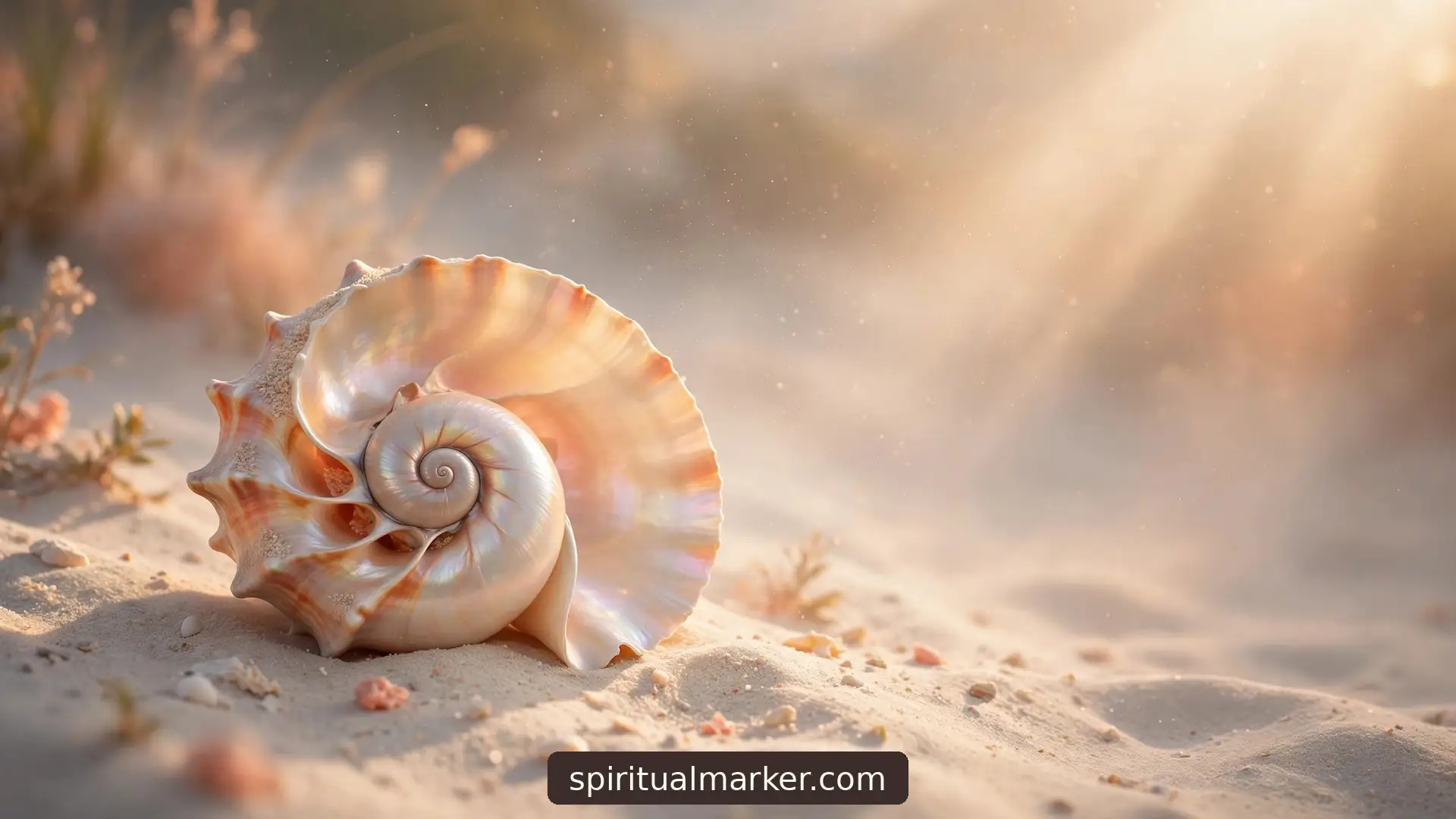
You bend down on a quiet shoreline and pick up a seashell. It feels weightless in your palm, yet something about it stops you. Maybe it is the spiral curve, or the way light catches its ridges, or simply the silence it carries from somewhere far beneath the waves. That small pause you feel is not random. Across centuries and continents, people have felt that exact same pull toward seashells and their spiritual meaning.
The seashell spiritual meaning runs far deeper than beach decor or vacation souvenirs. Ancient cultures linked shells to rebirth, protection, divine femininity, and the eternal rhythm of the tides. Pilgrims wore them as badges of faith. Priestesses used them to read the will of the gods. Sailors carried them for safe passage across dangerous waters. Even today, you will find seashells resting on meditation altars, tucked into wedding bouquets, and placed quietly on windowsills to invite peace into a home.
This piece walks through the full spiritual symbolism of seashells, from their biblical roots to their presence in world mythology, from specific shell types and their hidden meanings to what it means when a seashell appears in your dreams. You will also find practical context drawn from scripture, folklore, and cultural history, so the symbolism feels grounded rather than vague. By the time you finish reading, that shell sitting on your shelf or buried in a drawer somewhere will mean something entirely different to you.
Key Takeaways
- Seashells symbolize rebirth, protection, and spiritual awakening across nearly every culture that has lived near an ocean.
- The scallop shell carries deep Christian symbolism, tied to baptism, pilgrimage, and Saint James the Greater.
- Spiral shells like the conch and nautilus represent growth, inner journeying, and the unfolding of consciousness.
- Dreaming about seashells often signals emotional clarity, intuition, or a message trying to reach you from your subconscious.
- Different shell colors and types hold distinct meanings, from purity and peace in white shells to grounding and protection in darker ones.
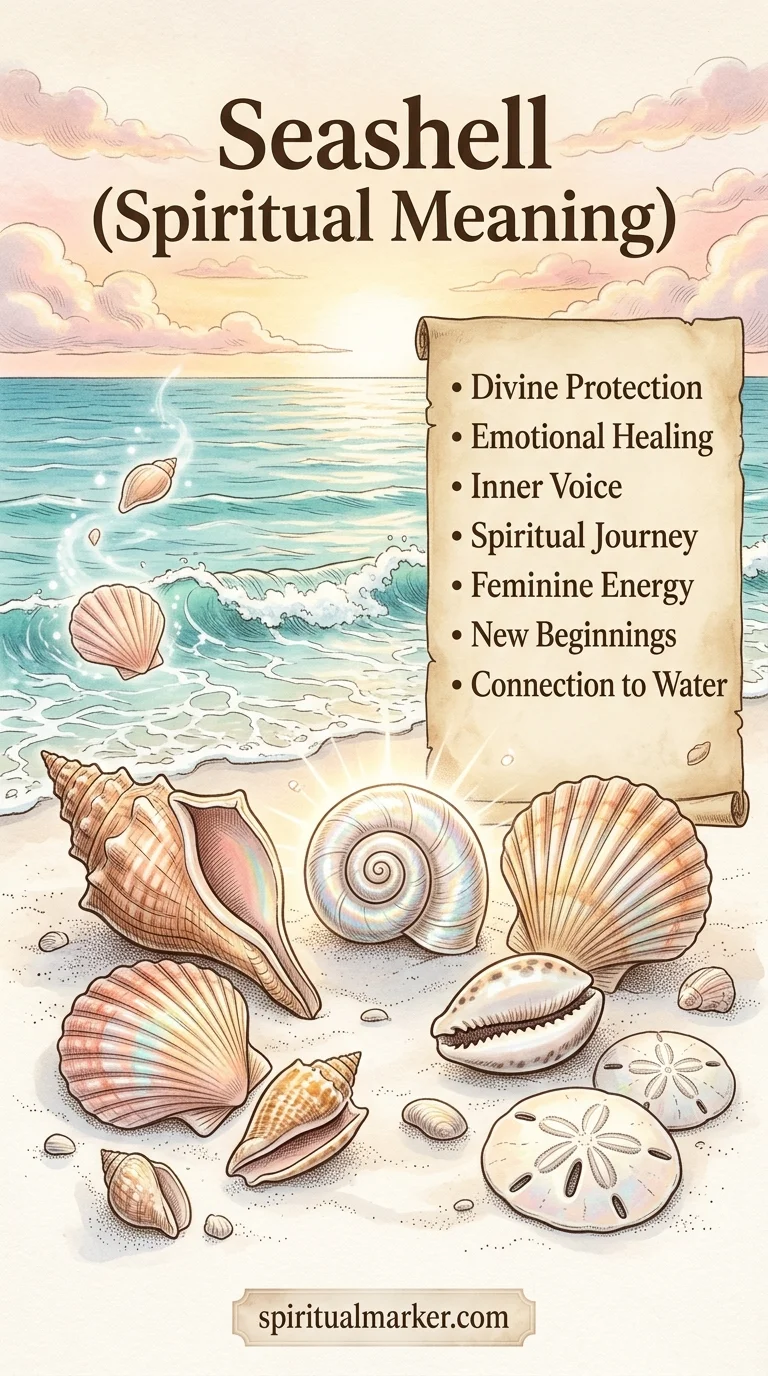
What Are Seashells and Do They Hold Spiritual Power?
A seashell is the hardened exoskeleton left behind by a marine mollusk such as a snail, clam, oyster, or conch. Once the creature inside dies or outgrows its home, the shell remains, washed ashore by tides that have carried it for miles, sometimes for years. On a purely physical level, a shell is calcium carbonate shaped by biology and ocean currents. Spiritually, though, people have rarely treated shells as ordinary debris.
Shells form through sacred geometry. Many spiral outward in a logarithmic pattern, the same mathematical sequence found in galaxies, hurricanes, and the human ear. Researchers studying marine biology have long noted that mollusks build their shells in time with the moon’s gravitational pull on the tides. That lunar connection alone explains why so many cultures linked seashells to the divine feminine, to cycles, and to the moon goddess archetypes found in Greek, Hawaiian, and Yoruba traditions.
Marine biologist Chris Meyer, who has studied shells extensively, suggested that human attraction to shells may be hardwired rather than culturally taught. He proposed that the human brain is so naturally drawn to the beauty of shells that cultures across the globe assigned them spiritual meaning independently of one another. That theory matters because it shifts the conversation. Shell symbolism is not simply inherited superstition passed down through scattered legends. It may reflect something instinctive in how humans process beauty, mystery, and the unknown.
Spiritually speaking, a shell holds power because it represents a threshold. It exists in the space between sea and land, between the visible world and a hidden one beneath the waves. Seashells are considered a powerful symbol of the Pagan Great Mother Goddess precisely because of this connection to water, the moon, and sacred geometry working together. Holding a shell, then, means holding far more than a pretty object. You are holding a fragment of a much larger natural order.
What Does Finding or Seeing a Seashell Symbolize?
Finding a seashell on the beach often feels like more than luck. Many spiritual practitioners interpret an unexpected shell discovery as a small but meaningful sign from the universe, a nudge to pay closer attention to your inner world. The ocean has long represented emotion, intuition, and the subconscious mind, so anything that emerges from it tends to carry messages tied to those same themes.
When you spot a shell glinting in the sand, it often symbolizes that your emotional clarity is returning after a period of confusion or stress. The shell traveled through rough currents and crashing waves before reaching the shore intact, and many people see that journey as a mirror of their own resilience. You survived turbulence too, and you came out the other side still whole.
Seeing a shell can also represent an invitation toward stillness. Beaches are naturally meditative spaces, and the shells scattered along them seem to call you to slow down, breathe, and listen. Shells serve as powerful symbols of protection, resilience, and the interconnectedness of all living things, and their presence in our lives, whether in waking life or in dreams, can offer valuable insights and guidance. That guidance rarely arrives loudly. It tends to surface quietly, the way a shell simply appears at your feet without warning.
Some spiritual traditions treat finding a shell as confirmation that you are protected on your current path. Sailors once carried shells for exactly this reason, trusting them as small talismans against danger at sea. Carrying that same logic into modern life, finding a shell during a difficult season can feel like reassurance that you are not navigating it alone.
7 Spiritual Meanings of Seashells
1. Rebirth and New Beginnings
Few symbols carry the weight of renewal quite like a seashell does. A mollusk builds, outgrows, and eventually leaves its shell behind, and that natural process became a spiritual metaphor for human transformation. In Christianity, this meaning became formalized through baptism. Christianity frequently uses shells as symbols, and a scallop shell represents baptism, symbolizing purity and rebirth. Many baptismal fonts across Europe were even shaped like scallop shells to reflect this exact symbolism. When you encounter a shell during a transitional period in your life, it often points toward closing one chapter and stepping cleanly into another.
2. Protection From Negative Energy
Shells are hard, dense, and built to withstand crushing pressure underwater, so it makes sense that protection became one of their core spiritual meanings. Many people believe shells offer protection against evil spirits, since their hard texture is thought to make one’s mind stronger and more resilient. Across African and Caribbean spiritual traditions, cowrie shells in particular took on this protective role. In Vodun, Candomblé, and Santería, cowrie shells carry a significant divinatory role and are often used in divination practices, symbolizing wealth, prosperity, and protection. Keeping a shell near your front door, your desk, or your bed is a common modern practice rooted in this older belief.
3. Fertility and Feminine Energy
Few images in art history capture this meaning better than Botticelli’s depiction of Venus rising from a scallop shell. The shell’s shape, often likened to the female form, gives it a powerful symbol of the divine feminine and the regenerative power of fertility. This association runs through Roman mythology, where Venus herself is frequently painted emerging from the sea atop a shell. Shells are smooth, curved, and protective on the outside while soft on the inside, a physical structure that mirrors the way many cultures have visualized womanhood, creation, and the womb itself.
4. Spiritual Awakening and Inner Growth
Spiral shells hold a particularly strong connection to personal growth. The nautilus, for example, never abandons its shell the way other mollusks do. Instead, it builds new, larger chambers as it grows, expanding outward in the same spiral pattern its entire life. The Nautilus shell is thus a symbol of growth and renewal, and its outward spiral shape suggests that it can keep growing indefinitely. Spiritually, a spiral shell encourages you to trust your own expansion, even when it feels slow or invisible from the outside.
5. Connection Between the Physical and Spiritual Worlds
Shells exist at the meeting point of land and sea, which has made them powerful symbols of crossing between worlds. Some believe shells are a bridge between the physical and the supernatural realm, a belief rooted in the shell’s close relationship with water and water spirits. This is part of why shells appear so often in divination practices, from West African Ifá readings to Caribbean spiritual traditions, where practitioners interpret the patterns formed when cowrie shells are cast onto a surface.
6. Resilience and Inner Strength
A shell endures crashing waves, shifting sand, and years of tumbling against rock before it ever reaches your hand. That history gives it a natural symbolism tied to endurance. Seashells have become a popular symbol of life, hope, strength, and protection, reminding people to be defiant against all obstacles of life. When life feels overwhelming, a shell on your desk or in your pocket can serve as a quiet physical reminder that pressure does not have to break you. It can shape you instead.
7. Eternity and the Continuation of Life
Because shells often outlive the creatures that built them, many traditions connect them to the idea of life continuing beyond physical death. It is believed that shells are for eternity, and that is why people believe they symbolize immortality, with the idea that living life after death makes you spiritually conscious. This meaning shows up clearly in funeral customs along coastal regions of the American South and West Africa, where shells were placed on graves as offerings meant to give the spirit something familiar to rest beside.
Seashell Meaning and Symbolism Across Cultures and Religions
Seashell symbolism rarely stays confined to a single belief system. It travels across continents and centuries, picking up new layers of meaning while keeping its core themes intact. In Christianity, the scallop shell holds perhaps the most recognizable spiritual role. The symbolism may have stemmed from a story involving the apostle James the Greater, who used a scallop shell as a bowl while he begged for food and spread the gospel of Jesus Christ. Starting in the Middle Ages, pilgrims walking the Camino de Santiago in Spain carried scallop shells in his honor, and the shell eventually became the universal symbol of pilgrimage itself.
In Hinduism, the conch shell takes center stage. The Hindu god Vishnu, the creator, is shown holding a conch in his right hand, and the instrument is blown during temple rituals to mark sacred moments and ward off negative forces. In Buddhism, the conch carries a related but distinct meaning. The conch symbolizes freedom from ignorance and victory over suffering in Buddhism, while in Chinese Buddhism specifically, it represents a successful voyage. It remains one of the eight auspicious symbols recognized throughout Tibetan Buddhist practice, often used as a ceremonial trumpet during monastic gatherings.
In Islam, the symbolism shifts slightly toward voice and revelation. The conch shell is understood as a symbol of the voice of the divine realm, connecting sound and breath to spiritual communication. In Roman mythology, the shell becomes a vessel for beauty and love itself, with Venus, the goddess of love and fertility, frequently depicted rising from the sea inside a clamshell.
In African and Afro-Caribbean religions such as Vodun, Candomblé, and Santería, shells play an active role rather than a purely symbolic one. Cowrie shells are often used in divination practices and are symbolic of wealth, prosperity, and protection, with practitioners reading the patterns shells form when scattered to interpret messages from spirits and deities. Among Pagan and earth-based traditions, the scallop shell appears on altars dedicated to sea goddesses. The Scallop appears on Pagan altars as a symbol of the sea goddess and the element of Water, and it may be adopted as a badge by anyone who has undergone a spiritual quest.
What stands out across all of these traditions is the repetition of the same core ideas: purity, protection, voyage, and the voice of something greater than ourselves. Different religions reach for the same object to express remarkably similar spiritual truths, which says something powerful about how deeply embedded shell symbolism is in human consciousness.
Seashell Symbolism in World Mythology
Mythology gives shells some of their most vivid spiritual imagery. In Greek and Roman storytelling, the shell becomes inseparable from the birth of love itself. Botticelli’s famous painting of Aphrodite, known as Venus in Roman mythology, captures this myth visually, showing the goddess emerging fully formed from sea foam while standing on a scallop shell. In Greek mythology, Aphrodite, the goddess of love, was born from the sea and emerged from a seashell, emphasizing her connection to beauty and birth. The shell here is not decorative. It is the literal vessel of creation.
Poseidon and Amphitrite, rulers of the sea in Greek myth, are also closely tied to shell imagery, often depicted being carried or accompanied by massive scallop or conch forms. Ancient art shows Poseidon riding upon one, while Aphrodite floats to shore in a scallop shell, reinforcing the shell’s role as a throne or chariot fit for sea deities.
Hawaiian mythology adds its own layer to this story. In Hawaiian folklore, Leimomi, a goddess of creation, created seashells to beautify the islands, framing shells as deliberate gifts rather than incidental ocean debris. This belief still echoes in Hawaiian and Tahitian cultures today. Tahitians and Hawaiians consider seashells sacred, and shell leis remain a meaningful, ceremonial gift rather than a simple tourist souvenir.
Yoruba mythology, practiced widely across West Africa and the African diaspora, treats cowrie shells as instruments of divine communication. Priestesses traditionally read cast cowries to interpret the will of the Orishas, the spirits and deities at the center of Yoruba spiritual practice. Practitioners of voodoo and Santeria read cowries to illuminate the will of gods and spirits, much like Yoruba priestesses. Across every one of these myths, the pattern repeats. Shells are never treated as background scenery. They are the objects through which gods speak, create, and reveal themselves to humanity.
Types of Seashells and Their Spiritual Meanings
Not every shell carries the same spiritual weight. Shape, color, and structure all shift the meaning slightly, which is part of why spiritual practitioners often choose specific shells for specific intentions.
The conch shell stands among the most sacred shapes across world religion. Its spiral form and powerful sound have made it central to Hindu, Buddhist, and Polynesian ceremonial life. The conch shell serves as a wind instrument in Polynesian and South American traditions, where blowing into the conch is believed to summon spiritual powers. Holding or displaying a conch is often associated with awakening, divine voice, and the breaking of ignorance.
The scallop shell carries the strongest Christian symbolism of any shell type, tied directly to pilgrimage, baptism, and Saint James. Its fan shape, radiating outward from a single point, mirrors the spiritual idea of a single act of faith expanding outward into a much larger journey.
The nautilus shell speaks to growth above almost any other meaning. Unlike some other shell creatures, the Nautilus does not shed or exchange its shell, but creates a large chamber for its body as it grows. Spiritually, it represents continued expansion without abandoning your foundation, a meaningful symbol for anyone navigating long-term personal development.
The abalone shell holds particular weight in Native American and Polynesian spiritual practice, most visibly as the vessel used to hold sage during smudging ceremonies. Abalone shells have an especially sacred meaning in Native American and Polynesian religion, and the shells represent the giving power of the Mother Ocean. Its iridescent interior is often associated with compassion, abundance, and emotional healing.
The cowrie shell, small and unassuming compared to a conch or scallop, carries some of the most significant spiritual power of any shell type, particularly across African and Caribbean traditions. In African traditions, cowrie shells are used in divination and as currency, signifying wealth and fertility, while their distinct shape is linked to protection and luck.
Color also matters. White shells lean toward purity, peace, and fresh starts, making them popular choices for meditation spaces and new beginnings. Darker shells, by contrast, are more often associated with grounding energy and protection against unwanted influences, absorbing rather than reflecting outside disturbances. Spiral shells in general tend to carry meanings tied to inward journeying, self-discovery, and the unfolding of consciousness over time, regardless of their specific species or origin.
Seashell Biblical Meanings and Significance
While seashells are not mentioned extensively by name throughout scripture, their symbolism became deeply woven into Christian tradition through the life of Saint James the Greater, one of Jesus’s twelve apostles. According to tradition, James used a scallop shell as a simple bowl while traveling, begging for food and water as he spread the gospel across what is now Spain. James asked for food and water using a scallop shell while traveling around the globe, meaning even the most impoverished people could fill his shell. Over time, the shell became inseparable from his legacy.
After James’s death, his remains were said to rest in Santiago de Compostela, and pilgrims began traveling there from across Europe. Pilgrims visiting James’s tomb began carrying scallop shells in his honor, and the route to Santiago de Compostela was marked with scallop shells, with people wearing them as badges to ensure safe passage. The shell became a passport of sorts, a visible sign that the wearer had undertaken a sacred journey of faith.
This pilgrimage symbolism naturally connected to one of Christianity’s central rites: baptism. Water represents spiritual cleansing throughout the Bible, from the flood narrative in Genesis to John baptizing Jesus in the Jordan River, and the shell’s close relationship with water made it a fitting visual companion to this theology. In Christianity, seashells symbolize baptism, representing the washing away of sins and the rebirth of the soul. Many baptismal fonts built across medieval Europe took the literal shape of a scallop shell to reflect this connection directly in church architecture.
The biblical meaning of the seashell, then, is less about a specific verse and more about an entire theological theme it came to represent: faith expressed through physical sacrifice, the willingness to wander far from comfort in service of something greater, and the promise of spiritual rebirth through water. This sacred meaning took root across Christian Europe, dating back to the earliest pilgrims, many of whom would have been illiterate, who were guided to pilgrimage sites by the scallop emblem alone. Even centuries later, that same shell appears on church facades, gravestones, and pilgrim badges throughout Europe, a quiet but persistent reminder of how deeply this small ocean object became tied to the Christian journey of faith.
Dreaming About Seashells: Spiritual and Psychological Meanings
Dreams involving seashells tend to leave a distinct emotional residue, often more vivid and memorable than other dream imagery. Spiritually, this is rarely treated as coincidence. If you ever dreamed of a seashell, it is considered a sign that you are connected spiritually, meaning the world is trying to connect with you. Many traditions interpret shell dreams as a form of communication arriving through the subconscious, often during a period when your waking mind is too busy or distracted to receive the message directly.
Holding a seashell in a dream often points toward a desire for spiritual connection that you may not be acting on while awake. Dreaming that you hold a seashell indicates your spirit is trying to communicate with the universe, suggesting an inner readiness for guidance even if your conscious mind has not caught up yet. Finding a shell in a dream, particularly an intact and beautiful one, frequently signals approaching clarity after a confusing or emotionally heavy period in your life.
Dreaming of a broken or cracked shell carries a heavier emotional tone. Some interpretations link this image to grief or instability. Others go further, suggesting that broken seashells symbolize impending melancholy brought on by crumbling foundations, damaged homes, and unfulfilled dreams, serving as a visual reminder of how wounded we feel when we lose something. Yet this meaning is not without hope. If two people have two equally sized pieces of a shattered shell, it represents continued love for one another, a popular ritual among couples or dear friends who split a shell in halves and wear each half. Even brokenness, in shell symbolism, can carry a thread of connection running through it.
From a psychological lens, dream researchers often point to the ocean itself as a near universal symbol of the unconscious mind. A shell surfacing from that water in a dream can represent something hidden finally becoming visible, whether that is a buried emotion, an unresolved memory, or a piece of self-knowledge you have been circling without fully grasping. The shell’s hard exterior and soft, hidden interior make it a fitting psychological metaphor for protection wrapped around vulnerability, a dynamic many people unconsciously recognize in their own emotional patterns.
Whether you lean toward the spiritual interpretation or the psychological one, the underlying message tends to overlap. A seashell appearing in your dream usually points you back toward your own intuition, asking you to slow down and listen to whatever your inner world has been trying to say.
Seashells as Symbols of Healing and Self-Reflection
Beyond mythology and dream symbolism, seashells have carved out a quieter but equally meaningful role in everyday spiritual practice: emotional healing. Many people instinctively reach for a shell during stressful moments, turning it over in their hands the same way someone might hold a smooth stone or worry beads. Shells have regularly been used since recorded time by many ancient and modern-day tribes for ceremonial purposes including healing, protection, self-love practice, and spiritual and psychic awareness.
This healing association is not purely symbolic folklore either. Scientists describe shells as mnemoactive objects, physical triggers of rich sensory memories, meaning the simple act of touching a shell can transport you back to a specific moment, a particular beach, a particular feeling of freedom. That sensory pull is part of why shells show up so often in meditation practices and personal altars. Touching a shell becomes a grounding ritual, a small physical anchor pulling your attention away from anxious thoughts and back into your body.
Abalone shells in particular carry this healing reputation strongly, largely due to their long history as smudging vessels in Native American spiritual practice. Their use spans communication, peace, self-love, and healing, with an iridescent surface often associated with emotional softness and compassion toward oneself. Many people find that simply running a thumb along the smooth inner curve of an abalone shell calms a racing mind faster than words ever could. Keeping a shell nearby during a difficult emotional season is less about superstition and more about ritual, giving your mind a tangible object to focus on while it processes something larger than words can easily hold.
A Final Note
Seashells carry far more history and meaning than most people realize when they slip one into a pocket on a quiet beach walk. They have marked pilgrimages, decorated altars, guided sailors, and shown up uninvited in dreams that linger long after waking. Whether you see them through a Christian lens, a mythological one, or simply as a quiet personal reminder of resilience, the symbolism rarely strays far from a few core truths: protection, renewal, and connection to something larger than yourself.
If you already have a few shells lying around your home, consider giving them an actual place rather than letting them collect dust in a drawer. A small dish on your windowsill, a single shell on your desk, or one tucked into a pocket during a hard week can serve as a small but steady anchor. You might also try choosing a shell that matches what you need most right now, a scallop for new beginnings, an abalone for healing, or a spiral shell for growth you cannot quite see yet. And the next time the ocean hands you one, take a moment before you pocket it. Notice the shape, the color, the wear on its surface. That brief pause is often where the real meaning of a seashell quietly reveals itself, long before you ever set it down on a shelf.