
You look up at the sky on a clear night and stop walking. Something pulls you. The full moon hangs luminous and full, commanding attention in a way no other celestial body does. You feel something shift inside you. That feeling is not a coincidence. Cultures across every continent and every era have looked at that same glowing orb and felt the same pull. The full moon spiritual meaning stretches back thousands of years, woven into religion, mythology, ritual, and the deepest recesses of the human psyche.
People often ask what the full moon symbolizes spiritually. The answer is layered and rich. The full moon represents completion, illumination, heightened energy, emotional release, and divine feminine power. It marks the peak of the lunar cycle. It is the moment when the moon reflects the maximum light of the sun, and in spiritual traditions, that light carries meaning far beyond simple astronomy.
Whether you follow a spiritual path or simply feel curious about the cosmos, this guide brings you every essential truth about full moon symbolism, its sacred role in world cultures, its appearance in sacred texts, and what it means when the full moon appears in your dreams. Read every section carefully. The full moon has something to say to you specifically.
Key Takeaways
Before diving deep, here are five essential points to hold onto as you read.
1. The full moon marks spiritual completion. It sits at the peak of the lunar cycle, representing the fullness of energy, effort, and manifestation. What you planted at the new moon now reaches its highest point.
2. The full moon amplifies emotions and intuition. Across spiritual traditions, the full moon heightens sensitivity, psychic awareness, and emotional intensity. Many healers and mystics treat this phase as a time for deep inner work.
3. Full moon symbolism appears in nearly every major religion. Christianity, Islam, Hinduism, and Buddhism all assign sacred or spiritually significant meaning to the full moon. It is a universal celestial symbol.
4. Dreaming of a full moon carries powerful spiritual messages. A full moon in a dream often signals clarity, spiritual awakening, hidden truths coming to light, or an important turning point in your waking life.
5. Different cultural traditions assign unique meanings to the full moon. From Native American moon ceremonies to Chinese Mid-Autumn celebrations and Hindu Purnima rituals, the full moon holds a sacred place in human civilization worldwide.
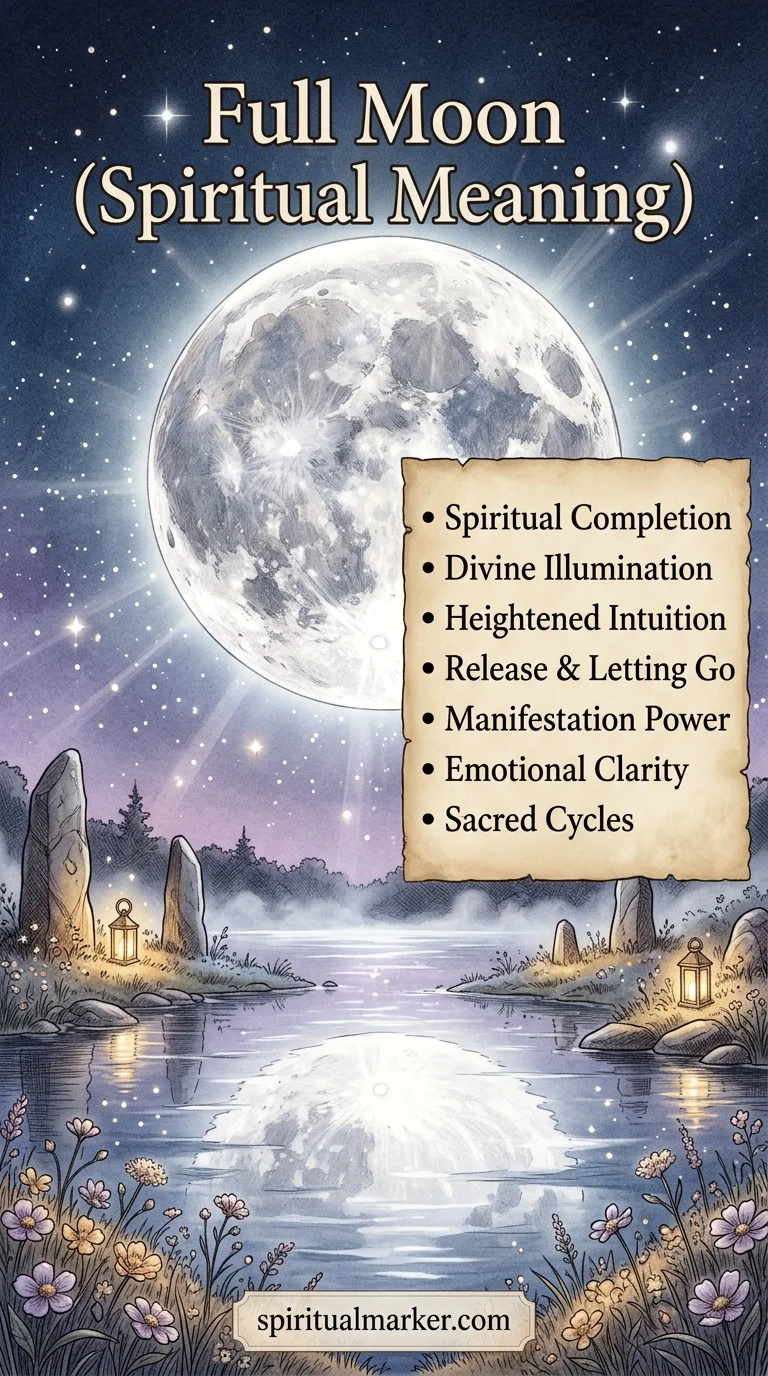
What Is the Full Moon and Does It Hold Spiritual Power?
The full moon occurs when the Earth sits directly between the sun and the moon. The moon receives maximum sunlight at this point and appears as a perfect glowing circle in the night sky. Astronomically, this happens roughly once every 29.5 days as the moon completes its orbit around the Earth. From a purely scientific lens, the full moon is a phase. From a spiritual lens, it is an event.
Ancient peoples did not separate the physical from the spiritual. They understood the natural world as alive with meaning. The moon governed tides, agriculture, animal behavior, and female fertility cycles. These practical realities gave the moon enormous authority. That authority naturally translated into spiritual and symbolic power. When they observed that the full moon coincided with heightened animal activity, stronger ocean tides, and intense human emotions, they concluded that the moon operated as a force, not merely a light.
Modern science has confirmed several of these observations. Research published in the journal Current Biology found that human sleep patterns change around the full moon, with people falling asleep later and sleeping less deeply. Studies in emergency medicine have noted correlations between the full moon and increased hospital admissions. These physical effects form the scientific foundation beneath the spiritual beliefs. The moon genuinely influences living systems. That influence gives its spiritual symbolism a grounded, real-world basis rather than pure superstition.
The spiritual power of the full moon also connects to light itself. In most wisdom traditions, light symbolizes divine presence, truth, and consciousness. The full moon radiates reflected light at its maximum. Many spiritual teachers describe this as a metaphor for the soul at its most awakened state, when the individual self reflects the divine light most completely. You, at your most spiritually open, are like a full moon. This is why so many spiritual practices peak during the full moon phase.
What Does Seeing a Full Moon Symbolize or Represent?
When you see a full moon, you experience one of nature’s most ancient spiritual symbols. Different spiritual traditions interpret its appearance in slightly different ways, but several core themes remain consistent across thousands of years of human wisdom.
The most immediate symbolism of the full moon is wholeness. The circle is a universal symbol of completeness. No beginning, no end. The full moon in its perfect circular form tells you that something in your life has reached completion. This can apply to a project, a relationship, a personal growth cycle, or a spiritual lesson. Seeing the full moon often arrives as a cosmic confirmation that you have arrived somewhere important.
Illumination and revelation represent another key meaning. The full moon lights up the darkness. What was hidden becomes visible. In spiritual terms, this means that truths previously concealed come forward under full moon energy. This applies to personal truths about yourself, hidden dynamics in relationships, or spiritual insights that finally click into place. Many people report sudden realizations or “aha moments” during full moon periods.
Seeing a full moon also symbolizes heightened intuitive power. The moon governs the water element and the emotional body in most esoteric traditions. At its full phase, these energies peak. You may find that your gut feelings are sharper, your empathy more acute, and your dreams more vivid around this time. This is not accidental. The full moon actively amplifies the parts of you that operate beyond logic.
Finally, the full moon represents release and surrender. Because it marks the peak of the lunar cycle, what comes after is decrease. Many spiritual traditions use the full moon as a moment to let go of what no longer serves. Old habits, resentments, fear, or outdated beliefs all become candidates for release under the full moon. You acknowledge what you have completed, and you release what you no longer need to carry.
7 Spiritual Meanings of the Full Moon
1. Completion and the Peak of Manifestation
The full moon spiritual meaning of completion runs deeper than simple endings. The lunar cycle begins in darkness at the new moon, when seeds of intention are planted. As the moon grows, those intentions gather momentum. At the full moon, they reach their maximum expression. This is the harvest moment. Whatever you set in motion two weeks prior now shows its full form.
In manifestation practices, the full moon holds the energy of arrival. Practitioners who follow lunar cycles treat the new moon as a time for setting intentions and the full moon as a time for receiving. The spiritual lesson here teaches you that growth follows natural rhythms. You cannot force the flower to bloom before its time. The full moon reminds you to honor the pace of your own unfolding.
This energy of completion also carries a symbolic death and rebirth. The cycle that peaks at the full moon must then begin to wane. Ancient civilizations saw this as a sacred truth about all of life. Nothing stays at its peak forever. The full moon teaches you to celebrate the moment of fullness while remaining unattached to its permanence. That balance defines spiritual maturity.
Many spiritual teachers describe the full moon as a cosmic report card. It shows you clearly where your energy has gone and what results your actions have produced. You see the truth of your efforts during this phase. This clarity, though sometimes uncomfortable, serves your growth in powerful ways.
2. Divine Feminine Energy and Sacred Power
The moon has represented divine feminine energy across virtually every ancient culture. Goddesses from Artemis in Greek mythology to Isis in Egyptian tradition to Selene and Hecate all embodied lunar power. The full moon in particular links to the Mother archetype within the divine feminine. It symbolizes nurturing, abundance, fertility, and the full expression of creative power.
The triple goddess tradition, observed in many Pagan and Wiccan paths, divides the lunar cycle into three phases. The waxing moon represents the Maiden, the full moon represents the Mother, and the waning moon represents the Crone. Each phase carries its own wisdom, but the Mother phase at the full moon speaks to the peak of life-giving force. It is the energy of creation made visible, of love made tangible.
This feminine symbolism also connects to intuition and emotional intelligence. Feminine spiritual energy in most traditions governs the interior world, the realm of feeling, instinct, and deep knowing. The full moon amplifies these qualities. Both men and women carry feminine energy within them. The full moon invites all people, regardless of gender, to honor their inner wisdom during this phase.
Ancient farmers noticed that crops planted according to the lunar calendar grew more robustly. Biodynamic agriculture still follows these principles today. This practical observation reinforced the spiritual view of the moon as a life-giving mother force. The full moon’s connection to fertility extended from crops to women’s cycles, animal reproduction, and the broader abundance of life on Earth.
3. Spiritual Illumination and Inner Truth
Light has always represented spiritual truth. The full moon delivers light into darkness, and spiritually this translates to clarity arriving where confusion once lived. Many people experience sudden understanding during full moon periods. Situations they could not read clearly suddenly make sense. Relationships they misunderstood become transparent. Spiritual blocks that felt impenetrable begin to dissolve.
In Buddhist tradition, the full moon holds special significance as a day of heightened awareness. Many Buddhist holidays fall on the full moon, including Wesak, which celebrates the birth, enlightenment, and death of the Buddha. This timing is intentional. The full moon in Buddhism represents the light of awakened consciousness shining in the world. Meditating during a full moon is considered especially powerful for deepening insight.
The spiritual illumination of the full moon also reveals what you have been avoiding. Shadow work, the practice of confronting the hidden or denied parts of yourself, becomes more urgent under full moon energy. The light that the moon casts does not allow easy hiding. It shines on the parts of your life, your personality, and your choices that you might prefer to leave in the dark. This is uncomfortable but deeply necessary for genuine spiritual growth.
Teachers in many traditions specifically advise practitioners to sit in full moon light during meditation. The practice involves allowing the moon’s light to physically touch you while you remain still and open. This ritual aims to invite the moon’s illuminating energy into your consciousness directly. Many who practice this report a profound sense of clarity and peace in the days that follow.
4. Emotional Release and Healing
The full moon’s connection to water gives it direct authority over the emotional realm. Water governs feeling in most esoteric traditions. The tides respond visibly to the moon’s pull, and the human body, composed mostly of water, responds as well. The emotional intensity that many people feel around the full moon is not imaginary. It represents the lunar pull on your inner waters.
This intensity creates a powerful opportunity for emotional release and healing. Feelings that have been suppressed or carried quietly for weeks often surface around the full moon. Old grief, unresolved anger, buried sadness, or unexpressed joy can all emerge during this phase. Rather than resisting these emotions, spiritual teachers advise receiving them. The full moon creates a natural window for emotional catharsis.
Ritual practices centered on full moon emotional release take many forms. Some practitioners write down everything they wish to release, then burn the paper under the full moon. Others immerse themselves in water, such as a bath or natural body of water, while setting the intention to release emotional weight. Still others use breath work, sound healing, or prayer to move stagnant emotions during this potent phase.
The healing potential of the full moon also extends to interpersonal relationships. Difficult conversations that have been postponed often find their moment under full moon energy. The heightened emotional clarity of this phase makes honest communication more accessible. Many people report resolving long-standing conflicts or finally expressing important truths to loved ones during full moon periods. The moon facilitates the kind of vulnerability that leads to genuine healing.
5. Heightened Psychic Awareness and Intuition
Across every mystical tradition, the full moon links directly to psychic ability and intuitive power. Seers, oracles, shamans, and mystics across history have favored the full moon for divination, prophecy, and spiritual communication. The veil between the physical and spiritual worlds is considered especially thin during this phase. Energies that normally remain imperceptible become more accessible.
Clairvoyance, clairsentience, and clairaudience, the abilities to see, feel, and hear beyond ordinary perception, are believed to sharpen considerably during the full moon. Even those who do not identify as naturally intuitive report stronger gut feelings, more accurate first impressions, and more vivid coincidences or synchronicities during this phase. The full moon essentially turns up the volume on your sixth sense.
Tarot readers, astrologers, and energy healers often schedule their most important readings or sessions around the full moon. The belief holds that the heightened energy of this phase makes spiritual information more accessible and interpretations more accurate. Crystal practitioners cleanse and charge their crystals under the full moon to refresh their energetic properties. This practice treats the full moon as a powerful energetic resource.
For those walking a spiritual path, the full moon offers a natural checkpoint for intuitive development. Paying close attention to your inner signals during this phase, tracking what you sense, feel, or know without logical explanation, and then watching how those intuitions unfold can significantly accelerate your spiritual growth. The full moon provides regular, reliable opportunities to practice and refine your inner knowing.
6. Transformation and the Death-Rebirth Cycle
The full moon presides over one of spirituality’s deepest themes: transformation through endings. Every full moon signals the beginning of the moon’s journey back into darkness. In this way, it embodies both fullness and the approach of death. Ancient peoples understood this as a sacred pattern. Life does not move in straight lines. It moves in circles, and the full moon marks the turning point in each cycle.
Many initiatory traditions place their most significant rites of passage under the full moon. The peak energy of the full moon was believed to amplify the power of these transitions. What you release under the full moon does not merely end. It transforms. The energy of what you let go gets recycled into new potential for the next cycle. This is the spiritual ecology of the lunar calendar.
The mythology surrounding werewolves and full moon transformations in Western folklore actually reflects this ancient spiritual understanding. The werewolf story encodes the truth that the full moon activates primal, instinctual energy and forces transformation. The idea that humans become more animal under the full moon speaks to the awakening of deeper, wilder aspects of the self. Spiritually, this points to the value of integrating your untamed nature rather than suppressing it.
Personal transformation rituals during the full moon often involve symbolic death and rebirth. You might shed an old identity, end a chapter of life that no longer fits, or physically transform your space by clearing out possessions tied to your old self. Each of these acts participates in the moon’s own transformation cycle. You align yourself with one of the universe’s most fundamental rhythms when you honor the full moon as a time of conscious change.
7. Connection to the Divine and Cosmic Order
The full moon has served as a symbol of divine order in countless spiritual and religious traditions. Its perfect regularity, appearing like clockwork every month in its full glory, communicated to ancient peoples that the universe operates according to intelligent, reliable principles. The moon’s faithfulness became evidence of a divine intelligence underlying creation. Trusting the full moon became synonymous with trusting the cosmos itself.
In many traditions, the full moon marks a moment of direct connection between the human and the divine. Prayer, ritual, and meditation performed under the full moon were believed to travel more directly to spiritual realms. The heightened light of the full moon was seen as evidence of the divine spotlight shining more brightly on Earth. Sacred ceremonies timed to the full moon aimed to take advantage of this perceived increase in divine proximity.
The full moon also represents cosmic harmony in astrological traditions. When the moon reaches its full phase, the sun and moon sit in exact opposition across the zodiac. This celestial alignment creates a tension and a balance simultaneously. Astrologically, this opposition can surface conflicts that need resolution, but it also creates the conditions for profound integration. The full moon invites you to find balance between opposing forces within yourself and in your life.
Feeling small but connected under a full moon is one of the most commonly reported spiritual experiences. That feeling contains wisdom. You are a tiny part of an enormous, beautifully ordered universe, and the full moon makes that truth undeniable. That feeling is not desolation. It is the precise sensation of belonging to something much larger than yourself, which is one of the deepest needs of the human spirit.
Full Moon Meaning and Symbolism Across Cultures and Religions
No single culture holds exclusive rights to full moon symbolism. Every civilization that has looked up at the night sky has developed its own sacred relationship with the moon. What is remarkable is how often the same core themes appear across traditions with no historical contact with each other. This convergence suggests that the full moon’s spiritual significance reflects something universal in human consciousness.
In Hindu tradition, the full moon is called Purnima and holds extraordinary religious importance. Purnima occurs every month and is considered the most auspicious day of the lunar calendar. Devotees fast, visit temples, and perform elaborate rituals on this day. Specific full moons carry even greater significance. Guru Purnima, which falls in July, honors all spiritual teachers and the transmission of sacred knowledge. Sharad Purnima in October celebrates the full moon as the night when the moon is closest to Earth and believed to rain down divine nectar, called amrit, onto the world below.
Chinese culture celebrates the full moon with the Mid-Autumn Festival, known as the Moon Festival. This celebration falls on the fifteenth day of the eighth lunar month, when the full moon is at its most beautiful of the year. Families gather to eat mooncakes, burn incense, and give thanks under the full moon. The festival honors family unity, abundance, and gratitude. The full moon in Chinese symbolism represents reunion, wholeness, and the blessing of heaven upon the Earth.
In Native American traditions, each full moon of the year carries a specific name that reflects the natural world’s activity during that month. The January full moon is called the Wolf Moon. February brings the Snow Moon. The harvest Moon of September signals the time to gather crops. These names demonstrate the Native American understanding of the full moon as a calendar of nature’s wisdom. Each full moon delivered specific guidance about how to live in harmony with the Earth.
Islamic culture holds the full moon in high regard, particularly during Ramadan. The crescent moon signals the start of the holy month, and the full moon marks its midpoint. The full moon of Sha’ban, the month before Ramadan, is called Laylat al-Bara’ah, the Night of Forgiveness. Muslims observe this night with prayer, seeking divine forgiveness and interceding for departed souls. The full moon serves as a spiritual milestone within the Islamic lunar calendar.
Full Moon Symbolism in World Mythologies
Mythology provides the most direct window into how ancient peoples experienced the spiritual meaning of the full moon. These stories were not mere entertainment. They were sacred teachings about the nature of reality, human experience, and the relationship between mortals and the divine. The full moon appears as a central character in mythologies worldwide.
In Greek mythology, the full moon belonged to several powerful goddesses. Selene was the Titan goddess of the moon itself. She drove her silver chariot across the night sky, illuminating the world below. Her full moon represented beauty, power, and the feminine divine in its most complete expression. Artemis, goddess of the hunt and the wilderness, also governed the moon. She carried the full moon’s energy of independence, clarity of purpose, and fierce protection. Hecate, goddess of magic, crossroads, and the underworld, ruled the dark moon but was invoked during the full moon for her heightened power to reveal hidden truths and grant supernatural insight.
Egyptian mythology connected the full moon to the god Thoth, divine scribe and keeper of wisdom. Thoth governed writing, science, judgment, and the recording of souls’ deeds. The full moon in Egyptian belief was a moment when divine accounting occurred. This connected the full moon to themes of truth, justice, and cosmic record-keeping. The moon’s clarity at its full phase represented the clarity required for honest self-examination before the divine.
In Japanese mythology, the full moon connects to the legend of Tsukimi, or moon viewing. The moon deity Tsukuyomi-no-Mikoto governed the night and the moon. Japanese tradition holds that the moon’s surface contains a rabbit pounding mochi, the moon rabbit of lunar folklore. This gentle, domestic image contrasts with more dramatic lunar myths and reveals the Japanese full moon’s associations with peace, craftsmanship, and the quiet beauty of impermanence. Tsukimi festivals still take place annually across Japan to honor the full moon’s beauty.
Celtic mythology revered the moon as a keeper of time and memory. The Celts used a lunar calendar, and the full moon marked important moments in the agricultural and spiritual year. The Celtic moon goddess appeared in triple form, echoing the waxing, full, and waning phases. Druidic ceremonies held under the full moon were considered especially potent. The Celts believed that the full moon opened a portal between the worlds of the living and the dead, making spiritual communication more accessible.
Mesopotamian mythology, one of humanity’s oldest recorded traditions, worshipped Sin or Nanna as the moon god. Unlike many later traditions that feminized the moon, Sin was male and held the highest position in the Mesopotamian pantheon for a period. The full moon in Mesopotamia represented the moment when Sin appeared in his greatest glory. Temples were built to honor him. Monthly full moon festivals involved feasting, prayer, and elaborate ritual. This tradition reveals the full moon’s earliest known role as a sacred focal point for organized religious life.
Types of Full Moons and Their Unique Spiritual Meanings
Not all full moons carry the same energy. Several specific types of full moons carry unique spiritual significance that amplifies or modifies the baseline full moon symbolism. Knowing these distinctions allows you to work more specifically with each lunar event.
The Blood Moon occurs during a total lunar eclipse, when Earth’s shadow covers the moon completely. The moon turns a deep red or orange color due to sunlight refracting through Earth’s atmosphere. Spiritually, the Blood Moon represents radical transformation, endings of major life cycles, and powerful karmic clearing. Ancient peoples viewed blood moons with awe and reverence. Many saw them as divine signs of significant change. Modern spiritual practitioners treat Blood Moons as some of the most potent full moons for releasing deep-seated patterns and initiating major life transitions.
The Supermoon occurs when the full moon coincides with the moon’s closest approach to Earth in its elliptical orbit. The moon appears significantly larger and brighter than average. Spiritually, the Supermoon is understood to amplify all full moon qualities. Emotions run higher, intuition sharpens further, and manifestation energy strengthens considerably during a Supermoon. Practitioners who work with lunar energy treat Supermoons as especially potent opportunities for healing, ritual, and spiritual acceleration.
A Blue Moon refers to either the second full moon in a single calendar month or, in older tradition, the third full moon in a season that contains four full moons. The phrase “once in a blue moon” reflects its relative rarity. Spiritually, the Blue Moon carries the energy of rare opportunities, unexpected blessings, and once-in-a-cycle gifts. It invites you to reach for what you usually consider out of reach. Blue Moon energy supports bold intentions and extraordinary manifestation.
The Harvest Moon, the full moon closest to the autumn equinox, has been celebrated by agricultural societies worldwide for millennia. Its name comes from the way its light extended working hours for farmers gathering crops. Spiritually, the Harvest Moon represents gratitude, abundance, and the reward of sustained effort. It is a time to count your blessings with genuine appreciation, to acknowledge what the year’s work has produced, and to prepare for the quieter, more inward season ahead.
The Cold Moon of December, also called the Long Night Moon, carries the spiritual energy of stillness, inner warmth, and the light in deep darkness. It is the full moon of the winter solstice season, when nights are longest and darkness most complete. The Cold Moon reminds you that light persists even in the deepest winter. Spiritually, it supports reflection, gratitude for warmth and shelter, and the cultivation of inner light during external darkness.
Full Moon Biblical Meanings and Significance
The Bible references the moon more than fifty times, and many of these references carry significant spiritual weight. The full moon, while not always specified by that name, appears in several important biblical contexts that reveal the moon’s sacred role in Judeo-Christian spiritual life.
In Genesis 1:14-16, God specifically creates the moon to govern the night and to serve as a marker for “signs and seasons and days and years.” This establishes the moon as a divine timekeeper from the very beginning of biblical history. The full moon governed the timing of major Jewish festivals, all of which are tied to the lunar calendar. Passover falls on the fourteenth of Nisan, the night of a full moon. The festival of Sukkot begins on the fifteenth of Tishrei, also a full moon. These were not coincidences. The full moon’s completeness and illumination were divinely appointed for these moments of sacred remembrance.
Psalm 81:3 commands the blowing of the ram’s horn “at the new moon, at the full moon, on our feast day.” This verse directly mandates full moon celebration as part of Hebrew worship. The full moon in this context signals a moment of communal gathering, worship, and divine encounter. The Israelites did not view the full moon as a pagan symbol. They incorporated it as a sacred marker within their covenant relationship with God.
In the New Testament, Jesus was crucified during the Passover full moon. The timing was not accidental. The Passover full moon carried powerful symbolism of liberation, sacrifice, and divine intervention. Early Christians who understood the lunar calendar recognized that the death and resurrection of Jesus occurred at the moment of maximum lunar light, when the spiritual and physical worlds aligned most completely. This connection gave the full moon an additional layer of redemptive symbolism within Christian theology.
Revelation 12:1 describes a vision of “a woman clothed with the sun, with the moon under her feet, and on her head a crown of twelve stars.” This powerful prophetic image places the moon at the feet of a heavenly figure, suggesting that the full moon’s power operates in submission to divine authority while still carrying immense cosmic significance. Many Christian scholars interpret this figure as representing the Church, Israel, or Mary, but all interpretations agree that the moon in this vision represents divine order, cyclical time, and the transition between earthly and heavenly realms.
Full Moon and Astrology: The Spiritual Connection
In astrology, the full moon holds a position of major significance in every monthly cycle. Each full moon occurs in a specific zodiac sign, and that sign colors the energy and themes that the full moon activates. A full moon in Aries carries warrior energy and themes of self-assertion. A full moon in Pisces activates intuition, compassion, and spiritual sensitivity. A full moon in Capricorn brings themes of achievement, responsibility, and long-term vision.
The full moon represents the opposition between the sun and moon in astrological terms. The sun governs your conscious self, your ego, and your outward expression. The moon governs your subconscious, your emotions, and your inner life. When they sit in opposition at the full moon, tensions between your outer life and inner needs surface for examination. This is why full moons often coincide with emotional flashpoints, relationship friction, or sudden realizations about misalignment between your authentic self and your external circumstances.
Astrologers pay close attention to what planets the full moon aspects in a given month. A full moon that makes a tense angle to Saturn may bring restrictions, delays, or hard truths that demand confrontation. A full moon that harmonizes with Jupiter may amplify abundance, optimism, and expansion. Each month’s full moon carries a specific astrological signature that seasoned practitioners use to navigate their personal and spiritual lives with greater intentionality.
Your natal moon sign, the zodiac position of the moon at the exact moment of your birth, determines how you personally experience and express lunar energy. When a full moon falls in your natal moon sign, you enter a period of heightened emotional intensity, clarity about your inner needs, and acceleration of your personal growth. These personal full moons, occurring roughly once a year, are considered especially significant turning points in your spiritual and emotional development.
Dreaming About the Full Moon: Spiritual and Psychological Meanings
Dreams of the full moon carry some of the most powerful spiritual messages you can receive in the dream state. The full moon appears in dreams as a symbol that requires attention. Your subconscious and spiritual guidance systems use full moon imagery specifically because of its universal resonance with completion, illumination, and transformation.
Dreaming of a bright, clear full moon is consistently associated with positive spiritual meaning. This dream signals clarity, spiritual awakening, and the arrival of truth in your life. Something you have been confused or uncertain about in your waking life is about to become clear. The full moon in this context acts as your dream mind’s way of telling you that the period of waiting or confusion is ending. Light is coming. From a Jungian psychological perspective, the bright full moon represents the illuminated unconscious, the moment when hidden psychic material rises to conscious awareness for integration.
A full moon partially obscured by clouds in a dream suggests that clarity exists but something blocks your full access to it. This dream often points to a truth you sense but cannot quite articulate, a situation where you know something is off but cannot identify exactly what. Psychologically, this image indicates partial awareness on the edge of conscious understanding. The spiritual message encourages patience. The clouds will move. The revelation will come when you are truly ready to receive it.
Dreams of multiple full moons appearing simultaneously carry themes of overwhelming abundance, multiple opportunities arriving at once, or a sense of spiritual inflation. This dream can be awe-inspiring or unsettling, depending on your emotional response within the dream. The spiritual interpretation centers on the concept of multiplicity and choice. You may be standing at a moment where several paths, relationships, or possibilities call to you simultaneously, and this dream prompts you to choose wisely rather than grasping for everything at once.
A red or blood-colored full moon in a dream tends to signal powerful transformation ahead. This dream often precedes major life changes. It may relate to an ending that feels dramatic or emotionally intense. The red color carries associations with passion, urgency, warning, and primal energy. Spiritually, a red full moon in a dream asks you to pay close attention to the changes arriving in your life and to approach them with courage rather than resistance. Psychologically, red lunar dreams often coincide with periods of heightened emotional processing or significant personal transition.
When you howl at the moon or feel irresistibly drawn to it in a dream, your dream self expresses the desire to connect with your instinctual nature. This dream type speaks to the part of you that exists beyond social conditioning and rational control. The pull toward the full moon in your dream is the pull toward your authentic, untamed self. The spiritual message here is clear: stop suppressing your instincts. Your deeper nature is calling for expression, and the full moon in your dream is amplifying that call to a level you can no longer ignore.
How to Harness Full Moon Energy in Your Spiritual Practice
The full moon offers tangible, practical opportunities for deepening your spiritual life. You do not need elaborate rituals or special equipment. What you need is intentionality, presence, and willingness to work with the natural cycle the moon provides.
Full moon journaling is one of the simplest and most effective practices you can adopt. Sit outside under the full moon, or near a window where you can see it, and write freely. Write about what you have accomplished since the last new moon. Write about what emotions feel ready to surface. Write about what you are ready to release. The full moon creates a natural container for this kind of honest self-examination. Many people find that they write with unusual depth and clarity during this practice.
Charging your intentions and sacred objects under the full moon is a practice used across multiple traditions. You can place crystals, written intentions, photographs, or meaningful objects in a spot where the full moon’s light reaches them overnight. The belief is that the moon’s energy cleanses and amplifies whatever it touches. You retrieve these objects the next morning carrying them with renewed spiritual charge. This practice works beautifully even if you approach it symbolically rather than literally.
Full moon bathing, sitting or walking in direct moonlight, is an ancient practice found in Ayurvedic, Chinese, and indigenous traditions worldwide. The belief holds that moonlight carries subtle nourishing energy, particularly beneficial for calming the nervous system, balancing female hormones, and opening psychic sensitivity. Whether or not you accept these specific claims, the practice of sitting quietly in the open air under a beautiful full moon is undeniably restorative for mind, body, and spirit.
Full moon meditation focuses on receiving rather than seeking. Rather than asking questions or setting intentions, you simply open and receive. You breathe deeply, relax completely, and allow whatever insights, emotions, or energies the full moon carries to move through you without resistance. This receptive practice honors the full moon’s nature as a moment of arrival rather than striving. It teaches you the spiritual art of receiving gracefully what the universe offers.
A Final Note
The full moon spiritual meaning is not a relic of superstition. It is a living wisdom that billions of human beings across thousands of years have found genuinely useful for navigating their inner and outer lives. The full moon teaches completion. It teaches illumination. It teaches the courage to release what no longer serves and to receive what the universe has been preparing to deliver.
You do not have to belong to any particular religion or spiritual tradition to benefit from the full moon’s energy. All you need is awareness. Notice how you feel during the days surrounding the full moon. Track your emotions, your energy levels, your intuitive hits, and your dreams. You may begin to recognize patterns that reveal the moon’s genuine influence on your inner life.
Consider starting a simple practice of stepping outside on the night of each full moon and looking up. Take a breath. Let yourself feel the quiet power of that light. Over time, you may find that this small act of conscious attention transforms your relationship with time, with your own cycles, and with the deeper rhythms of the universe that hold you.
The full moon has been watching over humanity since before the first word was ever spoken. It watched over your ancestors as they gathered around fires, planted their seeds, named their children, and gave thanks for the abundance of life. That same light reaches you now. What you do with it is entirely up to you.