You have probably looked up at the night sky and noticed a thin sliver of glowing light. That slim, curved shape is the crescent moon, and it is one of the most spiritually charged symbols in human history. Whether it appears in its waxing phase, curving toward fullness, or its waning phase, retreating back into darkness, the crescent moon speaks a silent language. It speaks directly to your soul.
Many spiritual traditions treat the moon as a living mirror of the human experience. The moon does not stay the same. It grows, it shrinks, it disappears, and it returns. Your life follows the same rhythm. You grow through seasons of expansion and you release during seasons of letting go. The waxing and waning crescent moon spiritual meaning reflects exactly this pattern in your personal journey.
Ancient astrologers, shamans, mystics, and modern spiritual practitioners all assign specific energy to each lunar phase. The waxing crescent moon carries the energy of new beginnings, intentional action, and planting seeds. The waning crescent moon, also called the balsamic moon, carries the energy of surrender, healing, and sacred rest. Together, these two phases bookend the full lunar cycle with profound spiritual purpose.This blog post takes a deep look at both phases. You will learn the spiritual symbolism of each crescent, what these phases mean across different cultures and religions, how they appear in mythology, and what it means when you dream about a crescent moon. By the end, you will see the crescent moon not just as a pretty shape in the sky, but as a powerful spiritual guide for your everyday life.
Key Takeaways
Before diving deeper, here are five important truths about the waxing and waning crescent moon spiritual meaning that you should carry with you throughout this read.
- The waxing crescent moon signals a time of intention-setting, new beginnings, and forward momentum. It is the universe inviting you to take the first brave step toward something you want to build or become.
- The waning crescent moon, or balsamic moon, is a sacred phase of release, rest, and deep inner reflection. Spiritually, it asks you to let go of what no longer serves your highest good before a new cycle begins.
- Both crescent phases hold strong connections to feminine energy, intuition, and the subconscious mind. Many spiritual practitioners use these phases to align their rituals, meditations, and prayers with natural cosmic energy.
- Across ancient cultures, including Egyptian, Greek, Islamic, and Celtic traditions, the crescent moon was a divine symbol tied to goddesses, prophecy, and the cycles of time. This symbolism runs deep in human spiritual DNA.
- The crescent moon in dreams carries specific spiritual messages. A waxing crescent in a dream often points to new opportunities and awakening potential. A waning crescent in a dream often signals the need for closure, healing, or spiritual preparation.
What Is the Crescent Moon and Why Does It Hold Spiritual Power?
The crescent moon appears at two specific points in the lunar cycle. It shows up right after a new moon, when a thin sliver begins to grow on the right side. This is the waxing crescent. It also appears right before the next new moon, when only a thin sliver remains glowing on the left side. This is the waning crescent. Both phases last approximately three days each, making them brief but deeply impactful windows of spiritual energy.
Astronomically, a crescent moon occurs when less than half of the moon’s surface is illuminated by the sun as seen from Earth. But spiritual traditions have never been satisfied with only the physical explanation. From ancient Mesopotamia to modern witchcraft, people across every era have recognized the crescent as a portal of sacred energy. The moon governs tides, animal behavior, and biological cycles in women. It is no stretch of the imagination to accept that the moon also influences your spiritual and emotional rhythms.
The crescent moon specifically holds power because it represents transition. It is neither full nor dark. It sits at the threshold between one state and another. Spiritually, thresholds are always significant. They are the liminal spaces where transformation happens. The crescent moon is a cosmic reminder that you are always either moving toward something or releasing something, and both movements are sacred.
Many spiritual teachers connect the crescent moon directly to the divine feminine. The moon is seen as feminine in most spiritual traditions because it reflects rather than generates light, it moves in cycles, and it governs the inner waters of emotion and intuition. The crescent phase, in particular, amplifies these qualities. Whether waxing or waning, the crescent moon speaks to the part of you that is sensitive, intuitive, and deeply connected to the rhythms of life.
What Does Seeing a Crescent Moon Symbolize or Represent?
Seeing a crescent moon in the sky is never spiritually neutral. Many people feel a quiet pull when they look up and spot that delicate silver curve. That feeling is not random. Your soul recognizes a symbol that has spoken to humanity for thousands of years. The crescent moon represents hope, potential, timing, and trust in natural cycles.
When you see a waxing crescent moon, the universe is often sending you a message about momentum. Something in your life is just beginning to take shape. A new relationship, a creative project, a spiritual path, or a personal intention is starting to grow. The waxing crescent says: “Keep going. The light is building.” It is an invitation to move forward with faith and focused intention, even when the outcome is not yet fully visible.
When you see a waning crescent moon, the message shifts. The waning crescent whispers about completion and surrender. It tells you that a cycle is coming to a close. Something in your life needs to be released before a new chapter can begin. Seeing this moon phase is often a spiritual nudge to rest, reflect, and let go of old patterns, toxic relationships, limiting beliefs, or emotional wounds that have been weighing you down.
Some spiritual traditions also link the sight of a crescent moon to protection and divine guidance. In Islamic tradition, the crescent moon holds enormous religious significance as a symbol of faith. In ancient Egypt, seeing the crescent was considered a blessing from the moon god Khonsu. Across many cultures, the crescent moon appearing at a significant moment in your life was seen as a spiritual sign of alignment, a signal that the universe is watching over your path.
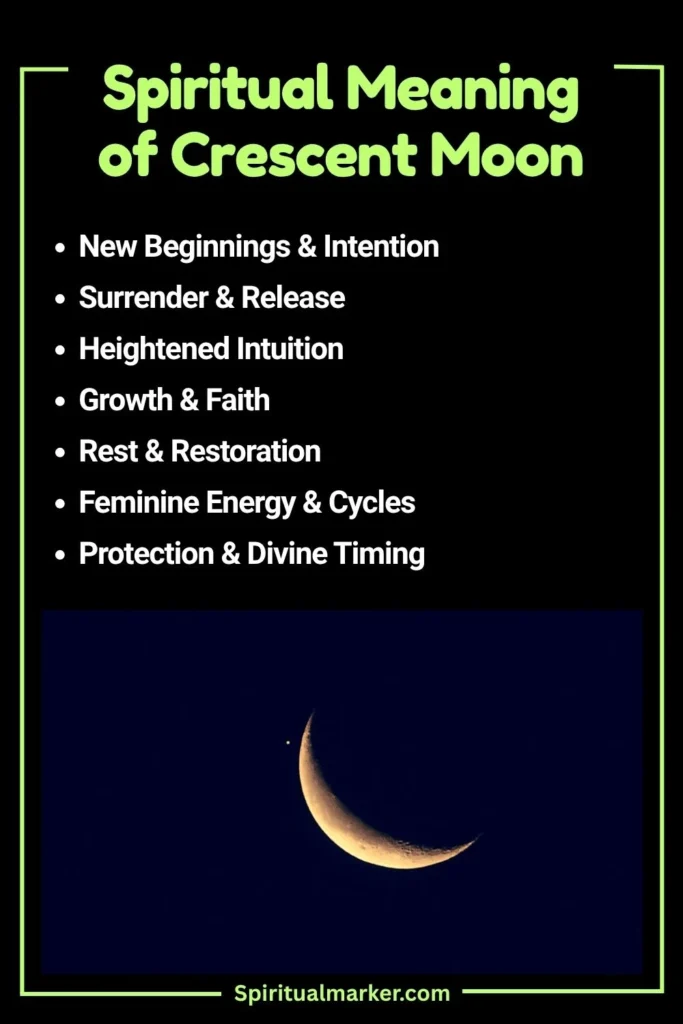
7 Spiritual Meanings of the Waxing and Waning Crescent Moon
1. New Beginnings and the Power of Intention (Waxing Crescent)
The waxing crescent moon spiritual meaning begins with the energy of new starts. Right after the new moon, when the first sliver of light appears, it marks the universe’s green light for action. This phase is considered one of the most powerful times for setting intentions. Spiritual practitioners across Wiccan, pagan, and New Age traditions use the waxing crescent to plant the seeds of what they want to manifest in the coming lunar cycle.
The energy of this phase is hopeful, eager, and forward-facing. You are not yet seeing results, but the spark has been lit. This is the moment to write down your goals, speak your prayers aloud, or begin a new spiritual practice. The waxing crescent asks you to act on faith. The light is small, but it is growing. Every great journey begins with a single, courageous step taken in incomplete light.
Psychologically, this phase also awakens your creative energy and motivation. Many people feel a surge of inspiration during the waxing crescent period. New ideas flow more easily. You feel driven to start things you have been putting off. This is not coincidence. The building lunar energy pulls your own inner reserves upward. Trust that pull. The waxing crescent moon is spiritually asking you to believe in the seeds you plant before you can see them sprout.
2. Surrender, Release, and Letting Go (Waning Crescent)
The waning crescent moon carries an entirely different spiritual frequency. As the lunar light retreats toward total darkness, this phase calls you into the sacred art of letting go. Spiritually, this is one of the most powerful but most overlooked phases of the entire lunar cycle. Most people celebrate the full moon and honor the new moon, but the waning crescent quietly holds the energy of deep spiritual cleansing.
This phase is sometimes called the balsamic moon, from the word “balm,” suggesting healing and soothing. It is the moon’s way of asking you to release everything that did not serve you during the cycle. Old grudges, fears, self-doubt, unhealthy habits, and toxic emotional patterns are all spiritually ripe for release during this window. Many spiritual traditions use this time for cleansing rituals, banishing ceremonies, or deep forgiveness work.
The waning crescent moon spiritual meaning also touches on the concept of divine trust. Letting go requires tremendous faith. It means believing that the universe will provide something better once you release your grip on what is old. This moon phase teaches you that endings are not failures. They are completions. Every waning crescent that disappears into darkness is followed by a new moon and then a brand new waxing crescent. The cycle always continues.
3. Heightened Intuition and Inner Knowing
Both the waxing and waning crescent moon phases are deeply connected to intuition. The crescent, with its threshold energy, sits at the boundary between light and dark. Spiritually, that boundary is the very space where your intuition lives. It is neither fully rational nor fully emotional. It is the quiet inner voice that knows without explaining, that feels without logic, that guides without maps.
During the waxing crescent phase, your intuition tends to spark with ideas and nudges. You may receive flashes of insight about which direction to take. Pay close attention to your dreams, gut feelings, and unexpected coincidences during this time. These are often messages from your higher self or from spiritual guides pointing you toward your next right step.
During the waning crescent phase, intuition deepens into a quieter but more penetrating knowing. This is when your soul whispers truths that your conscious mind has been avoiding. Many psychics, spiritual readers, and intuitive healers report heightened sensitivity during the waning crescent. Meditative practices feel richer, prophetic dreams become more vivid, and the inner voice grows stronger. This phase supports deep spiritual discernment and clarity.
4. Growth, Faith, and Spiritual Momentum
The waxing crescent moon is spiritually synonymous with growth that requires faith. The moon is growing, but you cannot yet see the fullness of what is coming. This mirrors many spiritual journeys, where you step forward in obedience or trust before the full picture reveals itself. Every major spiritual tradition honors this kind of faith-in-the-dark. In Christianity, this is the essence of faith itself. In Buddhism, this reflects the beginner’s mind. In indigenous traditions, this is the wisdom of the planting season.
The spiritual invitation during the waxing crescent is to stay committed to your growth even when progress feels invisible. A seed underground does not look like a tree. The work happening beneath the surface is real, even when it cannot be seen. The waxing crescent moon affirms that your spiritual development is always happening, even in periods when outward results seem absent.
This phase also supports momentum in spiritual practices. Starting a new prayer habit, beginning a meditation routine, committing to a gratitude journal, or initiating a fast are all practices well-supported by waxing crescent energy. The building light fuels your discipline and enthusiasm. Many people who begin spiritual practices during the waxing crescent find it easier to maintain them as the moon grows toward fullness.
5. Rest, Restoration, and Sacred Stillness
The waning crescent moon holds a spiritual teaching that modern culture desperately needs: the profound power of rest. In a world that celebrates constant productivity, the waning crescent stands as a sacred counter-current. It honors the necessity of stillness. It insists that you cannot pour from an empty vessel. Before you can plant new seeds in the next waxing crescent phase, you must allow the soil of your spirit to rest and restore.
Spiritually, this phase aligns with the concept of Sabbath found across many religious traditions. In Judaism and Christianity, the Sabbath is a commanded rest, a recognition that even the divine rested after creation. The waning crescent echoes this principle at the cosmic level. The moon rests in darkness before it rises again. You are invited to do the same. Spiritual restoration is not laziness. It is preparation.
During the waning crescent, your body, mind, and spirit benefit enormously from practices like yin yoga, silent prayer, fasting, journaling, and sleep hygiene rituals. These activities honor the moon’s energy and allow you to arrive at the new moon phase feeling genuinely renewed. Many spiritual traditions teach that the quality of your new beginnings depends entirely on the quality of your endings. The waning crescent is your sacred time to end well.
6. Feminine Energy, Cycles, and the Divine Goddess
Across nearly every ancient spiritual tradition, the crescent moon is inextricably linked to feminine divine energy. Goddesses from Artemis to Isis to Diana to Selene all carry the crescent as their symbol. This is not coincidental. The crescent moon represents the cyclical nature of the feminine, which mirrors the cycles of nature, creation, and life itself. All things that create, nurture, and transform operate in cycles.
The waxing crescent corresponds to the Maiden archetype of the divine feminine: young, bright, full of possibility, reaching toward her fullest expression. The waning crescent corresponds to the Crone archetype: wise, inward, deeply knowing, preparing for transformation. Together, these phases honor the full spectrum of feminine power. Both the reaching and the resting are divine. Both the growing and the releasing are sacred.
For both men and women on a spiritual path, the crescent moon invites a relationship with feminine energy within. This means honoring your emotional intelligence, trusting your intuition, respecting your natural cycles of energy, and understanding that your worth is not tied to your productivity. The crescent moon teaches that being is as powerful as doing. The moon does not apologize for its phases. Neither should you.
7. Protection, Hope, and Divine Timing
One of the most universal crescent moon spiritual meanings across all traditions is protection. The crescent moon has been used as a protective symbol for thousands of years. In ancient Mesopotamia, crescent amulets were worn to ward off evil. Ottoman soldiers carried the crescent into battle as a symbol of divine protection. Even today, spiritual practitioners place crescent symbols in their homes and sacred spaces as energetic shields.
The waxing crescent carries protective energy that is active and forward-moving. As the light builds, it pushes back darkness. Spiritually, this phase is a powerful time to set energetic boundaries, cleanse your space, and call in protective guides or angels. The growing light of the waxing crescent is a natural ally for any spiritual protection practice.
The waning crescent carries protective energy of a different quality. It protects through wisdom and discernment. As the cycle prepares to begin again, the waning crescent helps you see clearly what needs to be left behind. It guards you against carrying old wounds, old patterns, and old energies into your new beginning. Perhaps the deepest form of spiritual protection is the ability to recognize what you need to release. The waning crescent offers exactly that kind of protective clarity.
Crescent Moon Meaning and Symbolism Across Cultures and Religions
The crescent moon symbolism cuts across nearly every culture on earth. Its appearance in the spiritual and religious traditions of vastly different peoples separated by oceans and centuries speaks to its universal power. No matter where human beings looked up at the sky, they saw in the crescent moon a reflection of something profound about existence.
In ancient Egypt, the crescent moon was associated with Khonsu, the god of the moon and time, and with Thoth, the god of wisdom and writing. The Egyptians saw the lunar cycle, including the crescent phases, as a divine clock governing not just time but spiritual judgment and the journey of the soul. The waxing crescent was linked to the growth of divine power, while the waning crescent represented the soul’s preparation for transition into the afterlife.
In Islamic tradition, the crescent moon holds its most recognized modern meaning. The crescent and star symbol is one of the most widely known religious symbols in the world. The crescent moon marks the beginning of the Islamic lunar calendar and signals the start of Ramadan, the holy month of fasting and prayer. Its appearance in the night sky is a sacred moment for Muslim communities globally. The crescent in Islam is fundamentally about divine timing, faith, and community.
In Hindu tradition, the crescent moon adorns the head of Lord Shiva, one of the most revered deities. Shiva wears the crescent on his matted hair as a symbol of his mastery over time and his role as the lord of creation and destruction. The crescent on Shiva’s head also represents the control of the mind, since in Hindu cosmology the moon governs the mental realm. This association connects the crescent moon’s spiritual meaning directly to mental clarity and mastery over one’s inner world.
In Celtic and pagan European traditions, the crescent moon was associated with the Triple Goddess, a divine feminine archetype embodying the Maiden, Mother, and Crone. The waxing crescent represented the Maiden. The full moon represented the Mother. The waning crescent represented the Crone. Celtic spiritual practice honored all three phases as equally sacred and recognized the power in every stage of the lunar cycle.
Crescent Moon Symbolism in World Mythologies
World mythologies are rich with crescent moon imagery. The stories told about the moon in ancient traditions reveal the deep spiritual intelligence these cultures possessed about lunar cycles and their meaning for human life.
In Greek mythology, the crescent moon was the symbol of Artemis, the goddess of the hunt, the wilderness, and the moon. Artemis was depicted wearing a crescent diadem on her head or holding a crescent bow. She was a protector of young women, a guardian of the natural world, and a powerful embodiment of independent feminine strength. The crescent in her myth represents both the power of the hunt (waxing energy, forward movement) and the power of solitude and deep knowing (waning energy, sacred withdrawal).
Selene, another Greek goddess, was the actual personification of the moon. She drove her silver chariot across the sky each night. The crescent moon was her crown. Her mythological story includes her great love for the mortal Endymion, who she placed into an eternal sleep to preserve his youth. This myth captures beautifully the waning crescent spiritual theme: the choice to hold something in sacred stillness rather than allow it to be consumed by time.
In Mesopotamian mythology, the moon god Sin (also called Nanna in Sumerian tradition) was one of the most powerful deities in the pantheon. Sin was depicted as a wise old man with a crescent-shaped beard, traveling across the sky in a boat. His crescent symbol governed fertility, time, and the fate of kings. Ancient Mesopotamian priests studied the phases of the crescent moon to determine divine will and forecast the fates of nations. The crescent was not merely a natural phenomenon. It was a direct communication from the divine.
In Aztec and Mesoamerican mythology, the moon goddess Coyolxauhqui was depicted with crescent moon imagery. Her mythological dismemberment by her brother Huitzilopochtli (the sun god) was seen as a cosmic allegory for the moon’s relationship with the sun and its cyclical journey through phases. This myth encodes the waning crescent’s spiritual truth: that breaking apart, losing light, and descending into darkness are not permanent defeats but sacred transformations that lead to rebirth.
Waxing Crescent Moon: Spiritual Practices and Rituals
The waxing crescent moon is a powerful time for spiritual action. Because this phase carries the energy of growth, initiation, and forward movement, it supports practices that set things in motion. Many spiritual traditions have developed specific rituals that align with this lunar energy to amplify their power.
Intention-setting ceremonies are among the most widely practiced waxing crescent rituals. You write your intentions on paper, speak them aloud, or inscribe them on candles. The act of naming what you want under the waxing crescent is considered spiritually potent. The growing light carries your intentions forward as the moon moves toward fullness. Many practitioners revisit these intentions at the full moon to assess their growth and give gratitude for their unfolding.
Crystal charging and activation is another powerful waxing crescent practice. Crystals associated with new beginnings and growth, such as green aventurine, citrine, clear quartz, and moonstone, are placed under the waxing crescent’s light to absorb its energy. The building lunar frequency is believed to amplify the crystal’s own vibrational properties. Carrying these charged crystals during the waxing crescent phase keeps you aligned with growth energy throughout your day.
Affirmation practices also receive a strong spiritual boost during the waxing crescent. Affirmations spoken with conviction during this phase are believed to carry extra momentum because they align with the natural forward energy of the building moon. Statements like “I am open to new beginnings,” “My intentions are taking root and growing,” and “I move forward with faith and clarity” resonate particularly well with the waxing crescent’s spiritual frequency.
Waning Crescent Moon: Spiritual Practices and Rituals
The waning crescent moon calls for a completely different set of spiritual practices. This phase favors depth over action, release over acquisition, and stillness over momentum. Its spiritual practices are among the most transformative in any lunar-based tradition because they deal with the hardest human work: letting go.
Releasing ceremonies are the hallmark of waning crescent spiritual practice. These involve writing down what you want to release, including old fears, limiting beliefs, toxic patterns, or unresolved emotions, and then safely burning, burying, or tearing up the paper. The act of physically destroying the written words is a symbolic and energetically powerful way to signal to your subconscious that you are truly ready to let go. The retreating lunar light supports this release at an energetic level.
Forgiveness meditation finds its most fertile ground during the waning crescent phase. Many spiritual teachers recommend using this phase specifically to practice Ho’oponopono (the Hawaiian forgiveness prayer), Tonglen meditation from the Tibetan Buddhist tradition, or simple silent prayer for those who have hurt you. The waning crescent’s energy of dissolution supports the dissolving of old resentments in a way that other lunar phases do not as readily facilitate.
Dream journaling and spiritual review are also highly aligned with the waning crescent moon. As the lunar cycle prepares to close, this is a natural time for retrospection. Looking back over the past month to identify lessons learned, growth achieved, and patterns noticed allows you to enter the new moon with wisdom rather than simply starting over unconsciously. Many spiritual traditions teach that conscious closure is the foundation of genuine new beginnings.
Crescent Moon Biblical Meanings and Significance
The crescent moon in the Bible is addressed both directly and symbolically. While the Bible does not use the term “crescent moon” in the same ritualistic way that pagan traditions do, the moon’s phases carry significant theological weight throughout scripture.
In Genesis 1:16, God creates “the lesser light to govern the night.” The moon is established as a divine appointment from the very beginning of creation. Psalm 104:19 specifically states: “He made the moon to mark the seasons.” This verse places the moon’s phases, including the crescent phases, within the framework of divine order and sacred timing. The crescent moon, in a biblical context, is part of God’s design for marking time and governing creation.
The Hebrew calendar is a lunar calendar, and the new moon (Rosh Chodesh) is a monthly sacred observance in Jewish tradition. The waxing crescent that appears after Rosh Chodesh is a signal that the new month has truly begun. This observance connects the crescent moon directly to divine renewal and consecrated time. Ancient Israelites would light fires on hilltops to signal the sighting of the new crescent to distant communities, indicating the start of a fresh spiritual cycle.
In Revelation 12:1, a “woman clothed with the sun, with the moon under her feet, and a crown of twelve stars on her head” appears as a powerful apocalyptic symbol. Many theologians interpret this woman as representing both Mary and the Church. The moon beneath her feet can be read as dominion over time and cyclical earthly power. The crescent shape most often associated with this vision reinforces the idea of the divine feminine standing above the cycles of the world, spiritually transcendent yet deeply connected to them.
The Bible also contains warnings against worshipping celestial bodies (Deuteronomy 4:19), which reflects the reality that crescent moon worship was prevalent in the ancient Near East. This warning does not negate the moon’s spiritual significance. Rather, it repositions the moon from an object of worship to a created sign pointing toward the Creator. For Christians, the crescent moon’s spiritual meaning is found not in the moon itself but in what it reveals about God’s order, timing, and faithfulness.
The Crescent Moon and the Chakra System
In Hindu and yogic traditions, the crescent moon is closely tied to specific chakras in the body’s energy system. Understanding these connections deepens your ability to work with crescent moon energy intentionally and effectively in your spiritual practice.
The Third Eye Chakra (Ajna) holds the strongest connection to the crescent moon. This energy center, located between your eyebrows, governs intuition, inner vision, and spiritual perception. The crescent moon’s consistent association with heightened intuition aligns perfectly with this chakra’s domain. Working with the crescent moon through meditation while focusing on the third eye chakra can significantly amplify your intuitive abilities and spiritual clarity.
The Crown Chakra (Sahasrara) also receives activation during crescent moon phases. This chakra at the top of your head governs your connection to divine wisdom, higher consciousness, and spiritual enlightenment. The crescent moon’s liminal energy, standing at the boundary between light and dark, resonates with the crown chakra’s role as the bridge between individual consciousness and universal awareness.
The Sacral Chakra (Svadhisthana) connects to the crescent moon through its governance of cycles, creativity, and the flow of emotions. Because the moon is energetically tied to water and emotional flow, and because the sacral chakra governs these same qualities, crescent moon periods can either amplify emotional creativity during the waxing phase or stir deep emotional release during the waning phase. Working with sacral chakra practices during crescent moon phases, such as creative movement, expressive journaling, or water rituals, can be spiritually very productive.
Dreaming About the Crescent Moon: Spiritual and Psychological Meanings
Dreams featuring the crescent moon carry layered spiritual and psychological significance. The moon in dreams is widely recognized across Jungian psychology and spiritual traditions as a symbol of the unconscious mind, feminine energy, intuition, and the hidden aspects of the self. When the crescent moon appears specifically in your dreams, the message is often more nuanced and personal than a full moon dream.
Dreaming of a waxing crescent moon most commonly signals that something new is trying to emerge in your life. This could be a new relationship, a creative idea, a spiritual awakening, or a shift in your identity. The dream is your subconscious showing you that growth is imminent. Pay close attention to the emotions you feel in the dream. Feeling excited or hopeful suggests you are ready to welcome this new beginning. Feeling anxious may indicate that you need to address fears before you can fully move forward.
Dreaming of a waning crescent moon often speaks to the need for closure, rest, or release. Something in your waking life is coming to an end, and your soul is processing this transition during sleep. These dreams can sometimes feel melancholy but are not negative omens. They are signs of your deep spiritual intelligence at work. Your subconscious is preparing you to let go gracefully. The waning crescent in a dream may also appear when you are on the verge of a major spiritual breakthrough, because such breakthroughs always require releasing something old first.
From a Jungian psychological perspective, the crescent moon in dreams represents the anima (the feminine principle within every person, regardless of gender). A waxing crescent appearing in a dream may indicate that your anima energy is awakening and seeking expression. A waning crescent may suggest that old, outdated expressions of this energy are being retired to make way for a more evolved, authentic version. Carl Jung believed that integrating the anima was central to the journey toward psychological and spiritual wholeness.
If you dream of holding a crescent moon in your hands, the spiritual meaning is particularly significant. This dream suggests that you are in direct contact with divine feminine power and intuitive wisdom. Your soul is communicating that you carry within you the ability to navigate cycles, to begin and to end, to grow and to release. This is a deeply affirming dream. It tells you that you are more spiritually capable and cosmically supported than your waking mind may currently believe.
The Crescent Moon in Astrology and Its Spiritual Implications
In Western astrology, the Moon is one of the most important planetary influences in a birth chart. It governs your emotional nature, instincts, subconscious patterns, and your relationship with the feminine principle in your life. The lunar phase present at the time of your birth, including whether you were born under a waxing or waning crescent moon, is believed to shape your spiritual temperament and life lessons.
People born under a waxing crescent moon are believed to carry a natural orientation toward growth, initiation, and forward momentum. They often feel a persistent drive to build, create, and begin new ventures. Their spiritual lesson typically involves learning to trust the process without demanding immediate results. They are natural planters of seeds and must develop the patience to allow things to unfold in divine timing rather than human timing.
People born under a waning crescent moon (balsamic moon) are often considered old souls in astrological terms. They frequently feel a deep pull toward spiritual matters, solitude, and reflection. These individuals carry within them the wisdom accumulated across many cycles and past lives. Their spiritual lesson often involves learning to share their wisdom with the world rather than retreating entirely from it. They are natural healers, spiritual teachers, and keepers of ancient knowledge.
Beyond birth charts, astrological moon transits through the crescent phases each month affect everyone. When the transiting moon moves through its waxing crescent phase in a particular zodiac sign, the energy of that sign amplifies the intentions and actions of that period. A waxing crescent in Aries carries fiery, bold initiation energy. A waxing crescent in Taurus carries steady, material-world building energy. Similarly, the waning crescent takes on the qualities of whichever sign it transits, shaping the flavor of release and reflection that the phase offers.
A Final Note
The waxing and waning crescent moon spiritual meaning is not a relic of primitive superstition. It is a sophisticated, time-tested wisdom system that millions of people across every era and every culture have found deeply true and practically useful. The moon cycles are real. Their influence on tides, biology, and natural rhythms is scientifically measurable. Their influence on human consciousness and spiritual life is experientially verifiable by anyone willing to pay attention.
You do not need to subscribe to any specific religion or spiritual tradition to benefit from lunar awareness. You only need to cultivate the willingness to look up, to notice, and to listen. The waxing crescent moon will always remind you that beginnings are possible, that intentions matter, and that growth is always underway even when it is invisible. The waning crescent moon will always remind you that endings are sacred, that rest is necessary, and that letting go is the bravest and most powerful spiritual act you can perform.
Consider keeping a lunar journal for one complete moon cycle. Note how you feel during the waxing crescent. Observe what ideas and energies arise. Then note how you feel during the waning crescent. Notice what feels complete, tired, or ready to be released. After even one full cycle of conscious lunar awareness, many people report feeling more in tune with themselves, more aligned with natural rhythms, and more intentional in their spiritual lives. The crescent moon has been guiding human souls since the beginning of time. It is ready to guide yours too.