You light a small bundle of dried leaves. Smoke curls upward, thick and fragrant. It fills the room within seconds. Something in your chest loosens. This is burning sage, one of the oldest spiritual rituals still practiced today. Its meaning runs far deeper than a pleasant smell.
The burning sage spiritual meaning centers on purification, protection, and connection. People have carried this practice across continents for centuries. They use smoke to clear stagnant energy. They use it to invite blessings and mark sacred space. Whether you grew up watching a parent wave a smudge stick, or you found this practice through social media, the pull is not random. Smoke has always meant something to human beings.
This piece walks through the spiritual meaning of burning sage. You will learn its symbolism across cultures. You will see its place in biblical text. You will explore what it means when sage shows up in your dreams. Seven core spiritual meanings get explained in depth. By the end, you will understand why this practice has mattered for so long.
Key Takeaways
- Burning sage symbolizes purification. It removes negative energy from a person, object, or space through smoke.
- The ritual, often called smudging, began with Indigenous peoples of the Americas. It carries deep cultural and ceremonial weight.
- Seven spiritual meanings define the practice. They include cleansing, protection, intention, connection, release, ancestry, and gratitude.
- The Bible never names sage directly. It describes incense burning extensively as a symbol of prayer.
- Dreaming about burning sage often points to emotional cleansing. It can also signal fresh starts or rising spiritual awareness.
What Is Burning Sage and Does It Hold Spiritual Power?
Sage belongs to the Salvia family. This group of aromatic plants includes white sage, garden sage, and black sage. The Latin root of its name, salvere, means “to heal” or “to save.” That single word says almost everything. Ancient cultures never saw sage as a simple kitchen herb. It was medicine. It was ceremony. It was a bridge to the spiritual realm.
Burning sage, often called smudging, involves lighting a bundle of dried leaves. The smoke drifts through a space, over an object, or around a person. The smoke does more than smell good. Research shows white sage contains compounds that activate certain brain receptors. These receptors can elevate mood and reduce stress. They may even ease physical pain. So when people say burning sage feels calming, real chemistry backs that sensation up.
But does the ritual hold actual spiritual power? That answer depends on who you ask. This is part of what makes the topic so layered. Many Native cultures view plants as more than living things. Plants carry a soul. Plants carry a spirit. Sage is no exception. In this worldview, burning sage becomes communion. You connect directly to the spirit of the plant and the earth. The fire releases the plant’s essence. The rising smoke becomes a carrier. It moves prayers and intentions from the physical world into the unseen one.
You do not need to believe in spirits to notice a shift. Smoke fills a room, and attention sharpens. Breathing slows. The space feels different almost instantly. That shift explains why this ritual has survived for thousands of years. It appears across cultures that never had contact with each other. Smoke rises. It disappears upward, out of sight. That direction matches where humans have long imagined heaven to be. That visual fact, smoke ascending and vanishing, may be the oldest reason humans link smoke to prayer.
What Does Burning Sage Symbolize and Represent?
Burning sage represents transformation. A solid leaf becomes invisible smoke. That smoke is believed to carry something away with it. It might carry bad energy. It might carry stagnant emotion. It might carry unwanted spiritual residue. The act of burning changes the plant completely. A static object becomes an active force. That force can move, spread, and clear a space.
At its core, the symbolism breaks into a few central ideas. Sage represents cleansing. Water washes a body. Smoke washes a space or a spirit in much the same way. Sage also represents protection. Many traditions treat the smoke as a barrier. That barrier keeps harmful energy from settling back in. There is also a strong thread of connection running through the symbolism. Smoke from burning sacred herbs is believed to carry prayers upward. The smoke produced from these burning herbs is considered to carry prayers to the spirit world, and it is used to cleanse and purify the energy of a space, object, or individual. That single idea, smoke as a messenger, appears again and again across unrelated belief systems.
Fire, smoke, the plant, and the vessel each carry their own symbolic weight. Many traditions connect smudging to the four classical elements. The abalone represents water, the unlit sage represents earth. The smoke represents air, and the lit sage represents fire. Bringing all four elements together is meant to create balance. The ritual invites a fifth element, spirit, to move freely through the space. This is why smudging rarely feels rushed. People treat it as a small, deliberate ceremony. Even a few minutes deserve that care.
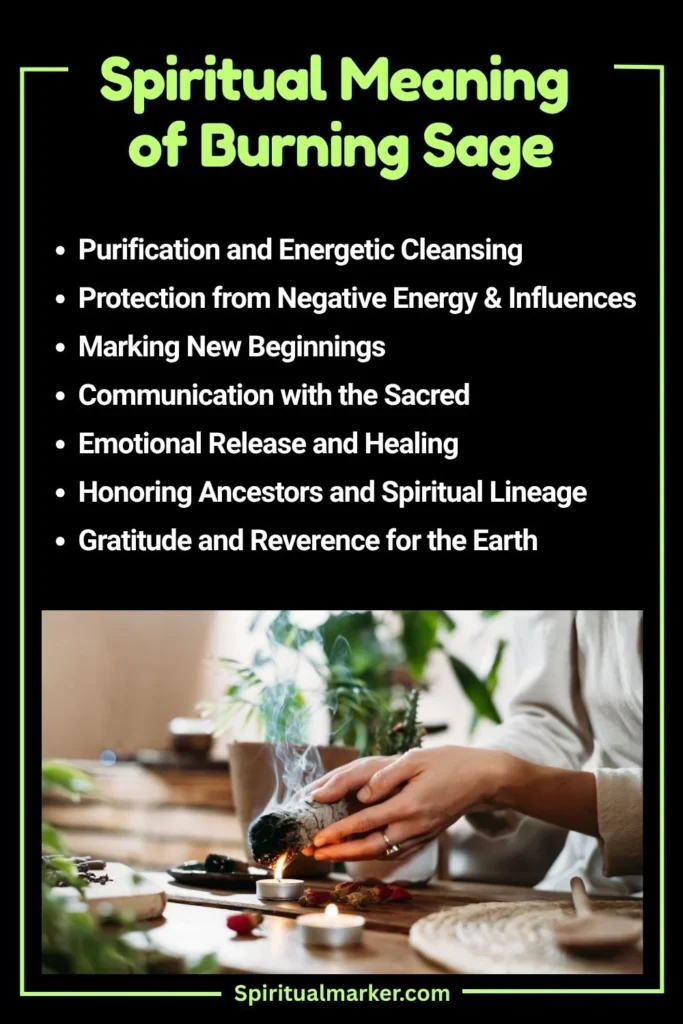
7 Spiritual Meanings of Burning Sage
1. Purification and Energetic Cleansing
The most widely recognized spiritual meaning of burning sage is purification. People burn sage to clear heavy or stuck energy. This might follow an argument or an illness. It might follow a difficult visitor or daily stress. The smoke acts like an energetic broom. It sweeps through corners and lingers in the air. It touches everything it passes along the way.
This meaning extends beyond physical spaces. People smudge themselves, their tools, and their crystals. They even smudge their pets sometimes. The belief holds that anything can absorb stagnant energy over time. Smudging is often the first step in any ceremony. It helps bring participants into the present. They leave behind daily stress and outside distractions. The cleansing here is not symbolic alone. Many treat it as a functional reset. It returns a space or a person to a neutral state before something important begins.
2. Protection from Negative Energy and Influences
Sage smoke is widely believed to build a barrier. This barrier guards against harmful or draining energy. Once a space has been cleared, many traditions hold something stays behind. That residue is believed to discourage negativity from returning. This is one reason people smudge homes after stressful events. They see the ritual as both removal and defense at once.
This protective layer is never treated as permanent. It requires renewal. Locking a door does not stop you from checking it again tomorrow. People who smudge regularly often describe it as routine spiritual maintenance. It works much like cleaning your home. It works much like checking in on your health.
3. Setting Intentions and Marking New Beginnings
Burning sage frequently accompanies a deliberate intention. People smudge before starting a new home. They smudge before a relationship or a business. They smudge to release an old pattern. The smoke becomes a visual marker of change. It tells you, and the space around you, that something is shifting.
This meaning explains why people often smudge before something rather than after. A new apartment gets smudged before boxes are unpacked. A new journal passes through smoke before the first entry. The ritual draws a clear line. It separates what came before from what is about to begin. That act of separation carries real psychological weight. It helps a person commit to a fresh start.
4. Spiritual Connection and Communication with the Sacred
Smoke has a strange, almost hypnotic quality. It rises in unpredictable patterns. It catches light and drifts like something alive. Across many traditions, this quality made smoke a natural symbol for prayer. For thousands of years, incense and smoke have connected people to the spirit realm. Burning sage fits neatly into that long lineage.
People who use sage this way often describe opening a channel. They are not creating one from nothing. The belief holds that the spiritual realm stays present at all times. Daily distraction simply makes it hard to sense. Burning sage, in this meaning, quiets the static. It helps a person feel more present and more open. It prepares them for whatever guidance they are seeking.
5. Emotional Release and Healing
Beyond the unseen world, burning sage carries a deeply emotional meaning for many people. Lighting the bundle and watching it smoke mirrors an internal process. That process is letting go. Grief, anger, and anxiety are common targets of this kind of ritual. Old resentment often gets named too.
This meaning often surfaces after a breakup or a loss. It surfaces after any major life disruption. The smoke becomes a stand-in for the emotion itself. It is visible and tangible. You can watch it disperse and fade away. Psychologically, this gives a person a concrete action to take. Feelings are often shapeless and overwhelming on their own. You cannot always control grief, but you can light a match.
6. Honoring Ancestors and Spiritual Lineage
In many Indigenous traditions, sage connects the living to those who came before them. Smudging ceremonies often open with prayers or songs. These honor ancestors, elders, and spiritual lineage. The rising, dispersing smoke is sometimes described as reaching backward and forward at once. It touches both the past and whatever comes next.
This meaning carries serious cultural weight. It deserves respect rather than casual borrowing. Smudging has been well established as a Native American cultural or tribal practice. The ancestral dimension is not interchangeable with vague ideas about good vibes. For those who carry this lineage, burning sage links directly to identity and survival. That weight matters, especially given how long the practice faced suppression.
7. Gratitude and Reverence for the Earth
The final core meaning ties back to the plant itself. Sage does not grow everywhere. Traditional harvesting treats it as a gift, not a resource. Traditional gatherers take great care over timing. They consider the time of day, month, or year before collecting herbs, a practice rooted in reverence rather than convenience.
Burning sage, approached this way, becomes an act of gratitude toward the earth. The plant is believed to carry real spiritual potency. This meaning asks you to slow down. It asks you to acknowledge where the plant came from. Treat the smoke as something earned, not a household product. Skipping this layer is exactly what critics point to. Casual, commercialized smudging often misses this respect entirely.
How to Approach Burning Sage with Intention
The ritual itself matters as much as the belief behind it. Most traditional teaching treats smudging as a sequence. It rarely works as a single rushed action. Practitioners often center themselves before striking a match. They take a few slow breaths first. They name what they hope to release before lighting the bundle. Skipping this step turns the ritual into a chore. Including it turns five minutes into something closer to meditation with smoke as the anchor.
Once the sage is lit, traditions recommend letting it smolder. An open flame is rarely the goal here. A small orange ember should glow at the tip. Steady smoke should follow, not fire. Many people guide the smoke with a feather or their hand. Blowing on the smudge stick is discouraged in several Native teachings. Native teaching holds that blowing releases negative energy. It is believed to send that energy from the person back into the smoke meant to carry it away. The motion should feel deliberate, almost like sweeping. You guide smoke into corners and behind doors. You guide it around objects that collect stagnant energy.
A heatproof vessel underneath the bundle is considered essential. This matters for safety and for symbolism alike. Traditionally, an abalone shell served this purpose. It represents water beneath the burning earth, fire, and rising air. Today, a ceramic bowl works just as well. The order of movement carries meaning too. Some teachings recommend a counter-clockwise path through a room. Others favor moving from the back toward the front door. This symbolically pushes anything unwanted out and away.
Timing carries its own significance as well. Sage burning after dark feels atmospheric to many people. Still, several traditional teachers recommend smudging during daylight hours. Sunlight is believed to add its own cleansing power to the ritual. Pairing the practice with open windows helps too. It gives the smoke, and whatever it gathered, a real exit. Otherwise it simply settles back into the room once it cools.
Burning Sage Meaning and Symbolism Across Cultures and Religions
Smudging did not begin as a universal practice, even though people often treat it that way. Several Native American, First Nations, Inuit, and Métis cultures use forms of sage local to their region. Even so, the use of sage is neither universal nor as widespread as many people believe. Its use in regions with no traditional sage practice largely traces back to the Pan-Indian movement. It rarely traces back to older tribal tradition. In some cases, the borrowed practice directly conflicts with what is traditional for a specific nation.
Among many Native American, First Nations, Inuit, and Métis communities, sage holds a sacred status. This status goes beyond casual spiritual practice. Native elders teach that the smoke of dried sage clears negative energy and restores harmony. Sage sits alongside cedar and sweetgrass as a commonly used ceremonial plant. Sage is used to dispel negative energy. Cedar is used for an overall blessing or to cleanse where there has been illness. Sweetgrass draws in positive energy. Each plant carries its own job. Traditional teaching often discourages mixing them carelessly. Burning only one herb at a time avoids giving mixed messages, according to guidance passed down through Native elders.
This history carries serious weight and real pain. It was illegal for Native Americans to practice their religion until 1978 in the U.S. Many were jailed and even killed for keeping these traditions alive. Smudging sage sat among those banned religious practices. This history matters enormously today. The casual commercialization of smudging sits on top of a long fight to practice it at all.
Outside Indigenous American traditions, other cultures built parallel relationships with smoke. They never called the practice smudging. Ancient cultures such as the ancient Egyptians, Romans, and Greeks used sage as medicinal plants. They believed the plant and its smoke could heal sore throats. They also believed it could cure infertility and ease stomach trouble. There are descriptions of burning sage that trace back to shamans of the Siberian region. This suggests the instinct to burn aromatic plants emerged independently in multiple places. It did not spread from one single source.
In Eastern Orthodox, Roman Catholic, and some Lutheran traditions, incense burning remains active in worship today. This continues a practice stretching back thousands of years. This is technically distinct from sage smudging. Both rituals share the same underlying logic. Smoke rising symbolizes something sacred moving upward, whether that something is a prayer, a blessing, or a cleansed spirit.
The commercialization of smudging has created real tension in recent decades. Major retailers like Anthropologie, Sephora, World Market, and Walmart now sell smudging “kits.” This happens despite traditional rules against selling sacred medicine like white sage. These kits often bundle herbs that traditionally never appear together. Some products contain herbs not native to North America, as well as substances that are toxic when burnt. In some Native American cultures the burning of these herbs is prohibited entirely. Treating sacred medicine as a casual product conflicts directly with that teaching. Wild sage populations have also faced over-harvesting pressure. Commercial demand keeps climbing, even as traditional harvesters follow strict seasonal limits.
None of this closes the practice off to outsiders completely. It does mean approaching the ritual with awareness, not indifference. Learn where your sage came from. Understand which traditions you are drawing from. Treat the herb as something earned, not purchased casually. These small steps honor a long and difficult history. That history almost disappeared under religious persecution entirely.
Types of Sage and Their Distinct Spiritual Meanings
Not all sage carries the same symbolic weight. The differences matter more than most casual users realize. White sage, known scientifically as Salvia apiana, stands as the most recognized smudging variety. White sage tends to grow longer, narrower leaves than other varieties. These leaves densely populate the stem, which makes bundling easier. Within many Indigenous traditions, white sage carries the title “Sacred Sage.” That title gets reserved specifically for ceremonial use.
Black sage, often called mugwort, brings a different energy entirely. This thick, dark variety feels intrinsically linked to the mountains. People use it specifically for removing unwanted energy. It also works well for those looking to deepen intuition. It can help someone find their way to clarity. Many practitioners reach for black sage specifically for that purpose. They want clarity rather than pure cleansing alone.
Sweetgrass, while technically not a sage, often gets bundled alongside it. Rich, sweet, and full of fragrance, this combo brings sweetness and wilderness to a space. It helps anchor a person back to the earth. It balances the sharper, clearing energy of sage itself. Common garden sage, the kind found in most kitchens, holds a gentler reputation. People use it more for tea and light cleansing.
Choosing between these varieties is not just about scent. Each type carries its own symbolic job. Traditional practitioners choose based on what the moment requires. Sometimes a space needs something heavy removed. Sometimes it needs something gentle invited in. Sometimes it just needs grounding.
Burning Sage and Incense in the Bible
Here is something that surprises many people. The Bible never mentions sage by name. The specific practice of burning sage appears nowhere in Scripture. The Bible does not explicitly mention burning sage. It does, however, talk about burning other herbs and creating scented offerings to God. The broader practice of burning fragrant plants shows up constantly across both Testaments.
God gave Moses extremely specific instructions about incense. The level of detail shows how seriously the practice was treated. Aaron was to burn fragrant incense every morning when he trims the lamps. When Aaron trims the lamps at twilight, he shall burn incense. There shall be perpetual incense before the LORD throughout your generations. This was never a casual ritual. The LORD warned Aaron that he was never to offer any strange incense on this altar. A blend that strayed from God’s exact formula carried severe consequences. Two of Aaron’s sons would go on to burn “strange incense” at the altar. The consequence of their violation of this prohibition was that fire from the LORD consumed them. Intention and obedience clearly mattered in this form of worship.
The symbolism behind biblical incense centers almost entirely on prayer. Burning incense on the altar was symbolic for intercessory prayer, a connection made explicit across the Psalms. On the Day of Atonement, the high priest carried burning incense into the Most Holy Place. The high priest entered the Holy of Holies with a censer burning incense. This created a protective cloud over the mercy seat, shielding him from God’s full presence. The smoke was never decorative. It served a protective and deeply symbolic function. That function tied directly to the gap between a holy God and imperfect people.
So where does this leave burning sage for Christians today? The Bible does not expressly forbid or encourage burning sage, nor does Scripture explicitly mention it. For Christians, sage burning is a matter of conscience, church guidance, and personal conviction. Some denominations link smudging to pagan ritual and the pursuit of warding off evil through means other than prayer. Some denominations link any form of incense or smudging to pagan rituals, auras, and evil spirits. They view it as conflicting with biblical teaching. Others note there is nothing inherently wrong with burning sage for non-spiritual reasons, such as simply enjoying the aroma. If we choose to burn sage, we should treat it like any other freedom in Christ. We should be careful it never becomes a stumbling block for a weaker believer.
What stays consistent across thousands of years is striking. From the golden altar in the Tabernacle to a smudge stick in a modern apartment, smoke carries something beyond itself. That something might be a formal prayer under strict divine instruction. It might be a personal intention whispered into the air. Either way, rising smoke as a bridge to the sacred shows up again and again. It appears across traditions that otherwise share very little in common.
Dreaming About Burning Sage: Spiritual and Psychological Meanings
Dreams involving burning sage or smudging tend to surface during transition. The dreamer often cannot name what is shifting right away. From a spiritual lens, this dream signals something specific. Your subconscious is already working through a cleansing process. Your waking mind simply has not caught up yet. The dream becomes a kind of preview. It shows you, symbolically, what your spirit prepares to release.
Smoke in dreams almost always points toward transformation. Something solid is changing into something else. It drifts. It disperses. It becomes harder to hold onto. If you dream of smudging a specific person, pay attention. The dream may highlight a relationship that needs clearing. That could mean resolving tension. It could mean creating healthier emotional distance instead. Dreaming of smudging your own home often reflects something else. It points to a desire for safety and order in waking life. This shows up especially after chaotic or emotionally heavy weeks.
From a psychological standpoint, these dreams appear during active release. You might be letting go of guilt, resentment, or anxiety. You may not have named those emotions consciously yet. The mind often reaches for ritual imagery during this process. Candles, water, fire, and smoke all serve this purpose. A sage dream, in this light, is less mystical and more practical. Your brain borrows a familiar cleansing symbol. It represents an emotional process already underway inside you.
If the smoke in your dream feels overwhelming or choking, that detail matters. This version of the dream suggests something specific. Whatever you are trying to release feels bigger than you currently know how to handle. It may help to slow down and address that feeling directly. Waiting for it to dissipate on its own rarely works. On the other hand, some dreams clear easily. The space feels lighter once the smoke lifts. This often reflects genuine relief and real progress. Something heavy in your waking life is finally beginning to lift.
A Final Note
Burning sage carries meaning that stretches across thousands of years. It spans dozens of unrelated cultures, from Indigenous ceremonies in the Americas to incense rituals described in Scripture itself. At its center sits one consistent idea. Smoke rises, and something travels with it. That something might be negative energy. It might be an unspoken prayer. It might be an intention you are not ready to say aloud yet.
If you choose to bring this practice into your own life, take time to learn where it came from. Treat it with the respect that history demands, especially given how deeply rooted smudging is in Native American spiritual survival. Consider sourcing sage ethically. Learn the specific traditions tied to the herb you use. Approach the ritual with intention rather than habit. You might also try journaling about what you hope to release before lighting anything at all. The clearest results often come when inner work matches the outer ritual. However you move forward, let the practice mean something real to you. Do not let it become one more empty trend.