The whale is a majestic creature of the deep. Its immense size and gentle nature inspire awe. Across cultures, whales carry deep spiritual meaning and symbolism.
The whale spiritual meaning often involves wisdom, emotional depth, and spiritual connection. Whales are ancient beings, so they can signal a need to trust your inner voice. A spiritual meaning of a dolphin shares that ocean-creature focus, though dolphins carry a more playful energy.
Some traditions view whales as record-keepers of the planet or messengers of the divine. Others see them as a sign of emotional healing. The whale's behavior can add detail.
If a whale appears in your life, it may be a call to go deeper. A spiritual meaning of a seahorse also deals with sea creatures, though seahorses carry a more gentle energy.
Key Takeaways
- Whales symbolize deep wisdom, intuition, and emotional intelligence across nearly every spiritual tradition on Earth.
- The whale is a powerful spirit animal and totem, guiding those who feel called to live authentically and dive into their inner truth.
- In Biblical and Christian symbolism, the whale represents transformation, divine testing, and miraculous rescue from darkness.
- Dreaming of whales carries significant spiritual weight, often signaling emotional healing, subconscious awakening, or a major life transition.
- Across world mythologies and indigenous cultures, whales are revered as world-creators, ancestral spirits, and cosmic guardians of the sea.
What Are Whales and Why Do They Hold Such Spiritual Power?
Whales are the largest animals ever to have lived on Earth. They are ancient beyond measure, with fossil records stretching back over 50 million years. They communicate through complex songs that travel hundreds of miles underwater. They care for their young with striking tenderness. They grieve their dead. Scientists have documented self-awareness, empathy, and culture within whale communities, traits once thought exclusively human.
This combination of size, intelligence, depth, and mystery has made whales spiritually magnetic across human history. Ancient peoples did not need neuroscience to recognize the whale’s sacred nature. They simply watched, listened, and felt it. Indigenous coastal communities built entire cosmologies around whales. Ocean-faring civilizations mapped their spiritual lives onto whale behaviors. Even landlocked cultures inherited whale myths through trade, scripture, and oral tradition.
The whale’s natural environment adds another layer of spiritual meaning. Water, in nearly every spiritual system, represents the subconscious mind, emotion, and the hidden forces beneath the surface of life. A whale navigates this world with authority. It breathes air, just like a human, yet thrives in the deepest, darkest depths. Spiritually, this makes the whale a symbol of the soul’s ability to move between worlds, to hold both the conscious and unconscious in perfect balance.
When a creature this ancient, this large, and this emotionally complex enters your awareness, whether in waking life, in dreams, or in repeated symbolic encounters, spiritual traditions across the globe agree on one thing: pay attention. The whale has something to say.
What Does Seeing a Whale Symbolize or Represent?
Seeing a whale in real life is a rare and striking experience. In spiritual terms, it is rarely considered coincidence. Most traditions interpret a whale sighting as a significant sign, a message from the universe, your higher self, or the spirit world.
At its core, seeing a whale symbolizes emotional depth and the call to dive inward. Just as the whale plunges into the ocean’s darkest zones, you may be receiving an invitation to explore what lies beneath your surface. This could mean confronting buried emotions, reconnecting with your intuition, or beginning a journey of deep inner healing.
A whale sighting can also represent communication and the power of your voice. Whales are known for their songs, complex vocalizations that serve as navigation, bonding, and expression. Seeing a whale may be a spiritual nudge to speak your truth, to share your wisdom, or to listen more carefully to the messages around you. Some traditions interpret a breaching whale specifically as a sign of breakthrough energy, something long submerged is finally rising to the surface.
Additionally, whales appearing in your life can signal protection and guidance. In many indigenous traditions, the whale is a guardian spirit. Its appearance assures you that you are not alone on your journey. You are being watched over by something vast and wise. If you are going through a difficult period, a whale sighting carries the message: you have the depth and the strength to endure this.
9 Spiritual Meanings of Whales
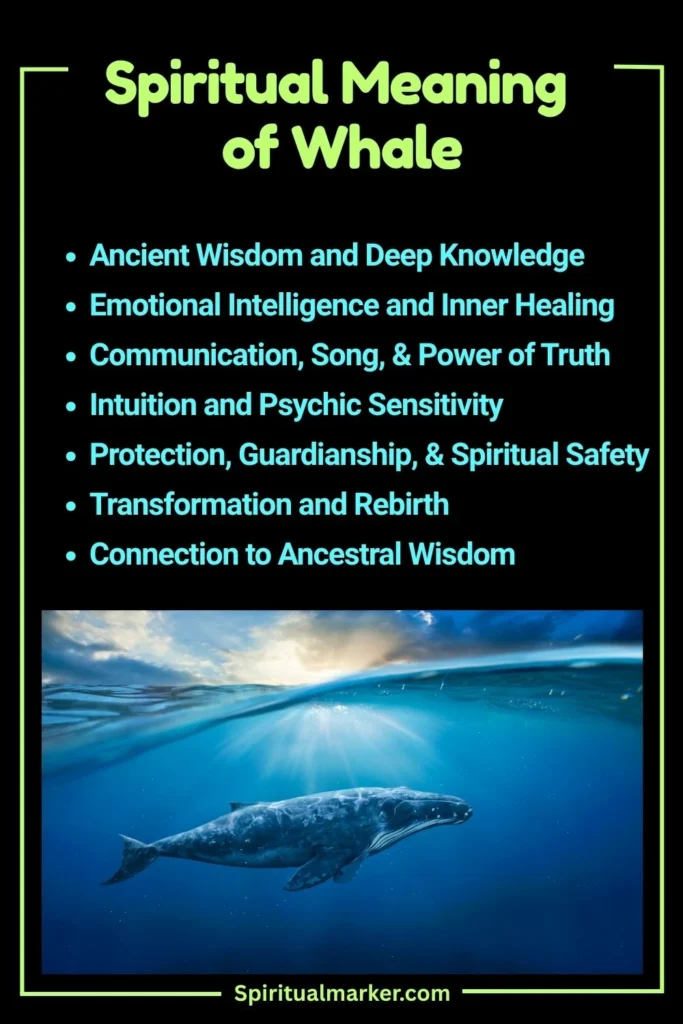
1. Ancient Wisdom and Deep Knowledge
The whale is one of the oldest living creatures on Earth, and its spiritual symbolism reflects this ancient lineage. Whales carry primordial wisdom, a kind of knowledge that predates human civilization. Many shamanic traditions believe that whales hold the records of Earth’s history within their consciousness, like living libraries of the planet’s memory.
When the whale appears as a spiritual symbol in your life, it often signals a time to honor old wisdom over trendy answers. You may be in a season that demands depth over speed, patience over urgency. The whale teaches that true knowledge is not acquired quickly. It is gathered through years of moving through deep, often dark waters.
This meaning speaks particularly to those in roles of mentorship, healing, or creative work. If you feel the whale calling to you, it may be affirming that you carry more wisdom than you currently acknowledge. Trust what you have lived through. Your experience is a form of sacred knowledge, and this is your time to use it.
2. Emotional Intelligence and Inner Healing
Whales are deeply emotional beings. Research has confirmed that they form lasting social bonds, mourn their dead, and care for injured members of their pods. Spiritually, the whale represents the full spectrum of emotional experience, and the courage it takes to feel all of it without running away.
The whale’s spiritual meaning here is not just about feeling emotions. It is about moving through them with grace and intention. The whale does not resist the current. It navigates it. In the same way, whale symbolism encourages you to stop fighting your emotional landscape and start learning to swim within it.
This meaning often arises for people who have suppressed grief, trauma, or vulnerability for too long. The whale’s appearance in your life may be a direct invitation to begin inner healing work. Whether through therapy, journaling, meditation, or simply giving yourself permission to feel, the whale says: emotional depth is not weakness. It is one of your greatest spiritual gifts.
3. Communication, Song, and the Power of Truth
Whale song is one of the most haunting and beautiful sounds in the natural world. Male humpback whales, for example, sing complex, evolving songs that can last for hours. These songs are not random. They carry information, emotion, and social meaning across vast distances of ocean.
Spiritually, the whale’s gift of song represents the sacred power of authentic communication. This is not just about speaking loudly or often. It is about speaking with depth, with feeling, and with truth. The whale teaches that your words have weight. They travel further than you realize. They reach people in ways you may never fully see.
If the whale appears in your spiritual path, you may be receiving a message to use your voice more fully. Perhaps you have been silent when you needed to speak. Perhaps you have been speaking without truly expressing what is inside you. The whale’s symbolism calls you to align your words with your soul’s truth, and to trust that this truth will resonate with those who are meant to hear it.
4. Intuition and Psychic Sensitivity
Whales navigate the deep ocean using echolocation and magnetic sensitivity, perceiving the world through channels that human senses cannot access. This remarkable ability translates spiritually into a symbol of heightened intuition, psychic awareness, and sensitivity to unseen energies.
The whale as a spiritual symbol often appears in the lives of highly intuitive or empathically sensitive people, those who sense things beneath the surface of situations, who feel what others feel, and who receive information through channels they cannot always explain. Rather than treating this sensitivity as a burden, the whale teaches you to treat it as a navigational gift.
This meaning also extends to spiritual seekers who are developing their intuitive abilities. The whale’s presence may affirm that you are on the right path. Your inner knowing is not imagination. Your gut feelings are not paranoia. You are attuned to deeper frequencies, and the whale is your confirmation that this attunement is real and worth trusting.
5. Protection, Guardianship, and Spiritual Safety
In nearly every culture with a significant relationship to the ocean, whales are revered as protectors. Pacific Islander traditions describe whales as guardians who guided canoes safely through treacherous waters. Indigenous Alaskan peoples honored the whale as a protector of their communities. Even in modern metaphysical thought, the whale is considered a powerful spiritual guardian.
The whale’s sheer size alone carries protective symbolism. Nothing in the ocean threatens the adult whale. It moves without fear. Spiritually, the whale teaches you that true protection comes from inner power, not external armor. You do not need to harden yourself against the world. You need to go deeper into your own strength.
If you feel called to whale symbolism during a period of danger, transition, or vulnerability, this meaning is particularly relevant. The whale is telling you that you are protected. Something larger than your current fears is holding you. You can move through the unknown waters ahead with the confidence of a creature that knows its own power.
6. Transformation and Rebirth
The story of Jonah being swallowed by a great whale and emerging three days later is one of the most recognized transformation narratives in human spiritual history. This story is not unique to the Bible. Similar whale-swallowing-and-rebirth myths appear in Polynesian, Greek, and Indigenous American traditions. The pattern is unmistakable: the whale’s belly is a place of darkness, dissolution, and ultimately, profound rebirth.
Spiritually, the whale represents the transformative power of going through darkness rather than around it. When you encounter the whale as a symbol during a difficult passage in life, it often signals that you are in the belly of your own transformation. Something old is dying. Something new is forming. The darkness you feel is not a dead end. It is a gestation period.
This meaning is especially powerful for those experiencing grief, major life change, loss of identity, or spiritual crisis. The whale does not promise a quick exit from the darkness. Instead, it promises that the darkness has a purpose. What emerges from this process will be unrecognizable from what entered it, and that is exactly the point.
7. Connection to Ancestral Wisdom and Collective Memory
Whales live in pods and maintain extraordinarily complex social structures. They pass knowledge across generations, teaching their young not just to survive, but to navigate specific ocean routes, hunting techniques, and social behaviors unique to their pod. Scientists call this cultural transmission, and it mirrors the way human ancestors passed sacred knowledge through oral tradition, ritual, and story.
Spiritually, the whale represents our connection to ancestral memory and the wisdom of those who came before us. When the whale enters your spiritual awareness, it may be pointing you toward your lineage. There is something in your family history, your cultural heritage, or your ancestral line that holds the medicine you need right now.
This meaning also extends to the idea of the collective unconscious, the shared pool of human wisdom, symbol, and experience that Carl Jung described. The whale, as a symbol that appears across every human culture without direct contact between them, is itself a testament to this shared knowing. When you connect to whale energy, you connect to something that belongs to all of humanity. You tap into a wisdom that stretches far beyond your individual lifetime.
Whale Symbolism Across Cultures and Religions
Indigenous and Native Traditions
Among the Indigenous peoples of the Pacific Northwest, including the Haida, Tlingit, and Nootka nations, the whale holds one of the highest spiritual positions in the natural world. The orca, or killer whale, appears on totem poles as a symbol of strength, family, and long life. These traditions teach that whales are reincarnated humans who chose to return to the sea, carrying with them the wisdom of their human lives.
The Maori people of New Zealand hold a deeply sacred relationship with whales, particularly the sperm whale. According to Maori tradition, the great navigator Paikea rode a whale from the homeland of Hawaiki to the shores of Aotearoa. Whales are thus seen as navigators, ancestors, and divine escorts in Maori spiritual life. The story of Paikea is not merely legend. It encodes the whale’s role as a spiritual guide through the unknown.
Indigenous Alaskan and Arctic peoples, including the Inuit and Yupik communities, have maintained whale ceremonies for thousands of years. The bowhead whale is especially sacred. Its arrival signals not just physical sustenance but spiritual renewal for the entire community. Whalers undergo spiritual preparation before a hunt, acknowledging the whale as a conscious being that chooses to give itself. This relationship is built on mutual respect, gratitude, and spiritual reciprocity.
East Asian Symbolism
In Chinese spiritual tradition, the whale is associated with wisdom, longevity, and the ocean’s cosmic power. Ancient Chinese texts describe a mythical whale-like creature called the Kun, an enormous being that transforms into a bird called the Peng and flies to the highest heavens. This creature represents the capacity for radical transformation and the movement between earthly and divine realms.
In Japanese coastal culture, whales hold a complex spiritual position. They are both sacred and central to subsistence. Traditional whaling communities in Japan held elaborate memorial ceremonies for whales, known as kujira kuyo, honoring the whale’s spirit and asking forgiveness for its death. This practice reflects a spiritual worldview in which every living being possesses a spirit worthy of reverence, and the taking of life must always be balanced with gratitude and ceremony.
African and Indigenous South American Traditions
Among several West African spiritual traditions, the ocean itself is considered a divine realm, home to powerful water spirits. Whales, as the ocean’s largest inhabitants, are treated as emissaries of the water deities, carrying divine messages between the spirit world and the living. Their presence in coastal waters is taken as a direct form of divine communication.
In parts of South America, particularly among coastal Indigenous communities in Chile and Peru, the whale appears in petroglyphs and oral traditions as a cosmic guardian of the sea. The whale’s beaching, historically, was not seen as tragedy but as a sacred gift from the ocean, a moment of profound spiritual and physical abundance.
Whale Symbolism in World Mythologies
The Leviathan of Ancient Near Eastern Myth
Long before the Bible codified it, the Leviathan was a fearsome sea creature in ancient Near Eastern mythology. In Canaanite texts from Ugarit, the Leviathan appears as Lotan, a multi-headed sea serpent representing primal chaos and the untamed forces of the deep. When God subdues the Leviathan in Biblical scripture (Job 41, Psalm 74), it mirrors this older mythological pattern: divine order conquering primordial chaos.
Whether the Leviathan represents a whale, a sea serpent, or a composite mythological creature, its spiritual symbolism is consistent. It represents the raw, uncontrollable power of nature, the part of existence that resists human dominance. To encounter Leviathan energy spiritually is to be confronted with something greater than yourself, something that demands humility, awe, and surrender rather than control.
Greek and Roman Sea Mythology
In Greek mythology, the whale appears through the story of Andromeda and Perseus. A sea monster, described in some sources as a massive whale-like creature called the Ketos, was sent by Poseidon to terrorize the Ethiopian coast. Perseus rescued Andromeda from the creature, turning it to stone with Medusa’s head. Spiritually, this myth represents the hero’s confrontation with the monstrous unconscious, the terrifying depths that must be faced, not avoided, on the journey to wholeness.
The Greek Ketos gave its name to the scientific order Cetacea, which includes all whales, dolphins, and porpoises. This linguistic lineage connects modern science directly to an ancient spiritual symbol. The Greeks embedded reverence and terror into their understanding of these creatures, acknowledging that what lives in the deep is simultaneously dangerous and worthy of sacred attention.
Norse and Scandinavian Mythology
Norse seafaring culture produced rich whale mythology. The Hafgufa was a legendary sea creature in Norse texts, sometimes described as enormous enough to be mistaken for an island. Sailors who anchored on its back were swallowed when it dove. This myth, like the Jonah story, carries the spiritual theme of unknowing descent and miraculous survival.
Norse traditions also include protective whale spirits called Landdísir, who could inhabit ocean creatures. Iceland’s protective spirits, or landvettir, include a whale among the four guardian beings of the island. The whale of Iceland’s west was considered a cosmic protector, a being of extraordinary power that sheltered the land and its people from spiritual harm.
Whale as a Spirit Animal and Totem
If the whale is your spirit animal, you likely possess a rare combination of emotional depth, creative power, and quiet authority. You do not need to be the loudest person in the room. Your presence carries weight. People feel something when you speak. You have access to an inner wisdom that others often come to you for, even when you underestimate yourself.
The whale spirit animal calls you to trust your instincts implicitly. Just as the whale navigates the ocean without GPS or maps, you are equipped with an internal guidance system that exceeds logic. Your intuition is your compass. The challenge is learning to trust it even when the water around you is dark and the surface seems very far away.
Those with the whale as a totem animal are often gifted communicators, healers, therapists, artists, or spiritual leaders. They feel most alive near water. They process life deeply and sometimes struggle with the shallowness they perceive in everyday social interaction. If this sounds familiar, the whale totem is affirming your nature. You are not too much. You are precisely calibrated for the depth of work you are here to do. Lean into it rather than apologizing for it.
The whale totem also carries a generational mission. Those who carry it are often here to heal ancestral wounds, to break cycles, and to transmit new patterns of wisdom to those who come after them. This is not small work. It requires the endurance, the patience, and the sheer spiritual magnitude of the whale itself.
Whale Biblical Meanings and Significance
The most famous whale story in the Bible is undoubtedly the Book of Jonah. God commands Jonah to go to Nineveh and prophecy. Jonah flees by sea. A great storm arises, and Jonah is thrown overboard and swallowed by a “great fish,” translated in many traditions as a whale. He spends three days and three nights in the whale’s belly before being delivered to shore.
This story carries enormous spiritual and theological weight. The whale’s belly represents a place of reckoning, a forced encounter with one’s own resistance, fear, and ultimate need for surrender to a higher will. Jonah cannot run from his divine assignment. The whale becomes the instrument of God’s relentless mercy, catching Jonah before he sinks, holding him in darkness until he prays, then delivering him exactly where he needs to go.
In the New Testament, Jesus references the story of Jonah in Matthew 12:40, connecting Jonah’s three days in the whale to his own three days in the tomb. This comparison elevates whale symbolism to the highest level of Christian theological significance. The whale becomes a type, a prefiguration of death, burial, and resurrection. It is no longer merely a sea creature. It is a vessel of divine transformation.
The Bible also references the Leviathan, a fearsome sea creature in Job 41 and Psalm 74. God’s dominion over the Leviathan demonstrates divine power over the deepest, most terrifying forces of creation. In this context, the whale symbolizes both the limits of human power and the boundlessness of divine authority. The whale reminds the believer: there are depths in creation that only God commands.
Dreaming About Whales: Spiritual and Psychological Meanings
What It Means to Dream of a Whale
Dreams involving whales are among the most spiritually significant dreams a person can have. Across cultures and spiritual traditions, the whale in a dream is considered a major symbol. It rarely appears as background imagery. When a whale enters your dream, it tends to be the central, commanding presence, and your emotional response to it holds critical meaning.
Psychologically, from a Jungian perspective, the whale often represents the Self, the totality of the psyche including the unconscious parts we have not yet integrated. Dreaming of a whale may signal that something huge and powerful is rising from your unconscious into awareness. This is not something to fear. It is the psyche’s way of bringing you into greater wholeness.
Common Whale Dream Scenarios and Their Meanings
Dreaming of a whale swimming peacefully typically signals emotional harmony, spiritual alignment, and a period of deep inner peace. You are in a flow state. Your conscious life and unconscious life are moving in the same direction. This dream often appears after a period of emotional struggle, confirming that you have emerged into calmer waters.
Dreaming of a whale breaching, leaping out of the ocean, is one of the most powerful whale dreams. It represents a major breakthrough, something long hidden or suppressed is now coming to the surface with force. This could be a creative project, an emotional truth, a repressed memory, or a calling you have been ignoring. The whale is erupting into your conscious awareness with urgency. Do not dismiss what arises in the days following this dream.
Dreaming of being swallowed by a whale mirrors the Jonah archetype directly. This dream signals that you are in or about to enter a profound period of transformation. Something about your current identity, circumstances, or beliefs must dissolve before the next chapter can begin. This is not a nightmare. It is a initiatory dream, one of the most sacred in the spiritual dream lexicon. Stay with what it evokes. The darkness is part of the process.
Dreaming of a dead whale can carry a sobering message. It may indicate that something important is being neglected, your intuition, your emotional needs, your creative life, or a spiritual practice that once sustained you. It can also represent the end of a significant life chapter. While this dream can feel heavy, it carries the energy of necessary endings that make room for new beginnings.
Dreaming of a whale singing or speaking is extraordinarily rare and deeply meaningful. This dream carries a direct spiritual message. You may not remember the exact words or sounds, but the feeling it leaves is the message. Pay attention to what you feel upon waking. Write it down immediately. The whale in this dream is functioning as a direct messenger from the deeper realms of your psyche or the spiritual world.
The Whale as a Symbol of Creativity and the Unconscious
Many artists, writers, and creative thinkers have been drawn to whale symbolism precisely because it mirrors the creative process itself. Herman Melville’s Moby-Dick is perhaps the most famous literary example, but the whale as a metaphor for the vast, uncontrollable creative unconscious appears across literature, poetry, and visual art throughout history.
The ocean in Jungian psychology represents the unconscious mind, the enormous, largely unexplored reservoir of imagery, emotion, instinct, and potential that lies beneath conscious awareness. The whale, as the ocean’s sovereign creature, symbolizes the creative force that dwells in the depths of the psyche. It cannot be tamed or fully known. It can only be approached with humility, patience, and a willingness to go where the surface dweller dare not.
Creatives who feel a deep connection to whale symbolism are often channeling work that comes from a place much deeper than the intellect. The whale asks you to stop forcing and start listening. Your greatest creative work does not come from your thinking mind. It surfaces from the depths, in its own time, in ways you did not plan. Trust the depths. Trust the process. Trust the whale.
Whale Symbolism in Dreams Versus Waking Life
There is a meaningful distinction between encountering whale symbolism in dreams versus in waking life. A waking whale encounter, whether a sighting in the ocean, a whale appearing repeatedly in media, artwork, or conversation, speaks to your external spiritual environment. The universe is using the waking world to send you a message. This message is typically about direction, protection, or a call to deepen your spiritual practice.
A dream encounter, by contrast, speaks to your internal spiritual landscape. It arises from within. It reflects the state of your soul, your unconscious, and your relationship with the deeper parts of yourself. Both forms of whale encounter are equally valid and important. Together, they create a complete spiritual picture.
If you are experiencing both waking and dream encounters with whale symbolism simultaneously, this is a rare and significant alignment. The external and internal worlds are speaking the same language to you at the same time. This level of synchronicity deserves serious spiritual attention. Something significant is either already happening or about to happen in your life, and the whale is your signal to show up for it with full awareness and open hands.
A Final Note
The whale spiritual meaning is not one thing. It is many things, woven together across thousands of years of human reverence, story, dream, and sacred encounter. Whales represent wisdom, emotional depth, transformation, communication, ancestral memory, intuition, protection, and the raw creative power of the unconscious. They carry Biblical resonance, mythological gravity, and the quiet authority of the oldest beings on Earth.
If the whale has found its way into your life, whether through a dream, a sighting, a recurring image, or a sudden unexplainable fascination, trust that this arrival is meaningful. Nothing in the spiritual world is random. The whale has shown up because you are ready to go deeper, to listen more carefully, and to move through the waters of your life with greater courage and greater grace.
Take time to sit quietly and ask: what is the whale asking me to face? What depth am I avoiding? What truth is ready to surface? Then stay with the silence long enough to hear the answer. The whale does not sing in loud places. It sings in the deep. You will only hear it when you are willing to go there.
The whale’s medicine is for those who are not afraid of the ocean within themselves. You are one of them. Go deep.