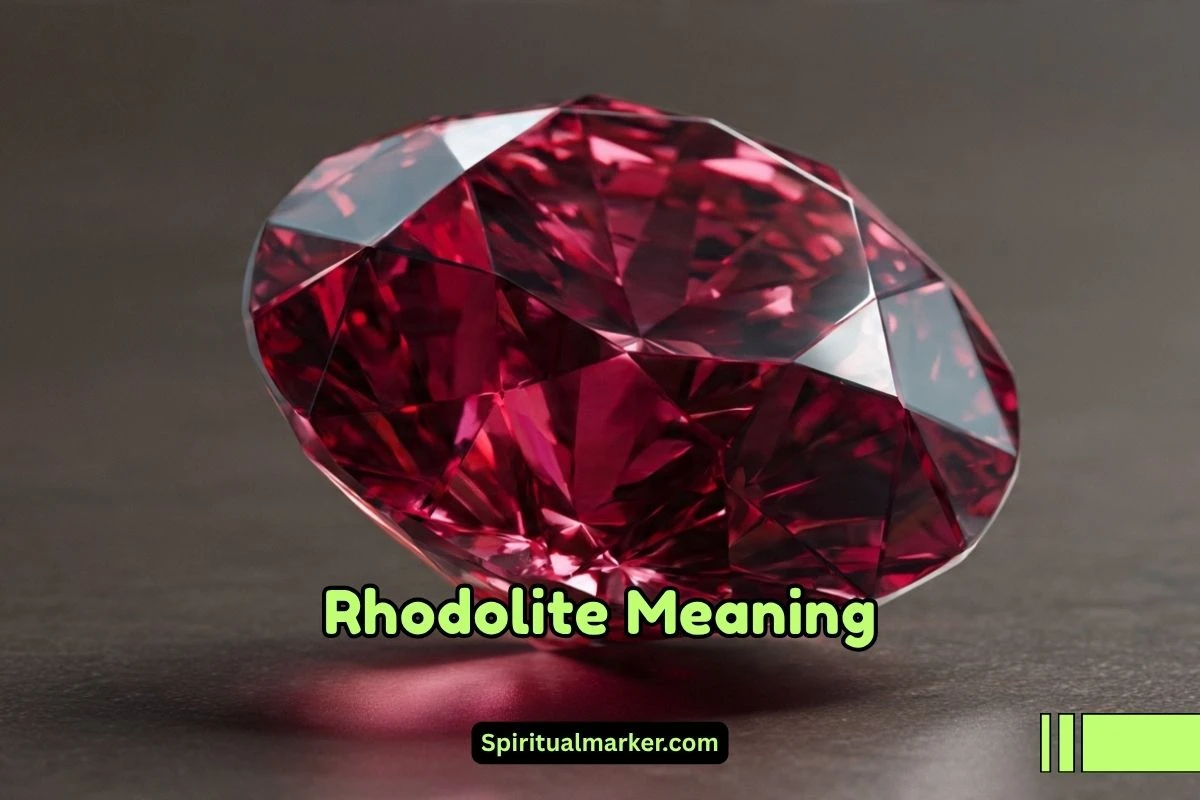
Some gemstones earn attention through dazzling brilliance. Rhodolite earns something deeper. People who encounter this rose-red gemstone for the first time often feel an unexplainable pull toward it, as if the stone mirrors something already alive within them. Its warm, velvety color sits somewhere between raspberry red and violet, and that visual warmth tends to resonate emotionally long before any spiritual context is introduced.
Rhodolite belongs to the garnet family, but it carries its own distinct identity. While red garnets often evoke themes of passion and physical vitality, rhodolite leans toward something more emotionally refined. Across crystal healing traditions, it has long been associated with emotional courage, self-worth, love, and spiritual awakening. Many practitioners describe its energy as warm but not aggressive, motivating but not overwhelming, and deeply heart-centered without being sentimental.
People often gravitate toward rhodolite during emotionally significant periods of life. Some carry it through heartbreak. Others turn to it while rebuilding confidence after long seasons of self-doubt or emotional suppression. Its reputation as a stone of emotional healing and spiritual clarity has grown steadily across various metaphysical traditions because it seems to meet people at the exact emotional threshold where they need support most.
This article covers the full meaning of rhodolite, its healing properties, spiritual symbolism, historical roots, chakra associations, and the ways people incorporate it into daily life and spiritual practice. You will also find practical guidance on wearing and caring for rhodolite jewelry while honoring its energetic significance.
5 Key Takeaways
- Rhodolite symbolizes emotional courage, self-love, compassion, and spiritual awakening.
- Many crystal traditions connect rhodolite with the heart chakra and the root chakra.
- People frequently use rhodolite during emotional recovery, confidence rebuilding, and spiritual reflection.
- Rhodolite scores between 7 and 7.5 on the Mohs hardness scale, making it more durable than many healing crystals.
- Wearing rhodolite as jewelry, especially near the heart, may strengthen feelings of self-worth, emotional openness, and spiritual grounding.
What Is Rhodolite?
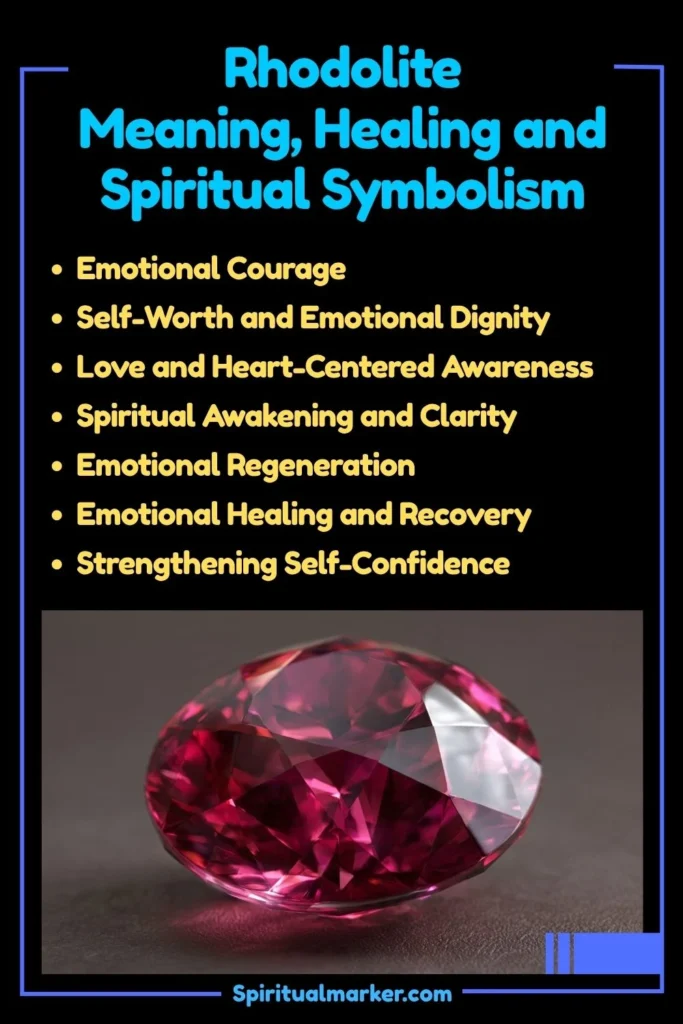
Rhodolite is a variety of garnet, specifically a blend of pyrope and almandine garnet. Its name comes from the Greek word rhodon, meaning rose, which accurately describes its signature color range. Most rhodolite specimens appear in shades of rose red, raspberry, violet red, and pale purplish pink. Unlike deeper red garnets that carry heavier visual intensity, rhodolite’s color feels warmer and more luminous, almost as if light passes through it from within.
Chemically, rhodolite falls within the silicate mineral family. Its specific composition of magnesium and iron creates the particular mix of red and violet tones that distinguish it from other garnet varieties. The stone typically forms in metamorphic rocks under intense heat and pressure over geological timescales. That formation process carries symbolic resonance in spiritual traditions, where pressure and heat metaphorically reflect emotional trials that eventually produce beauty and strength.
Gemologically, rhodolite holds strong appeal not only in crystal healing but also in fine jewelry. Its excellent clarity, good hardness, and attractive color make it a valued gemstone across multiple markets. However, its spiritual reputation continues to grow alongside its commercial appeal, attracting people who feel drawn to both its appearance and its energetic character.
Origins and Formation of Rhodolite
Rhodolite forms deep within the earth under significant geological pressure. Metamorphic environments, where extreme heat and compression transform existing rock structures over millions of years, produce the conditions necessary for rhodolite crystals to develop. This slow, pressurized formation process creates a stone with remarkable internal clarity and structural integrity.
The primary sources of rhodolite include Tanzania, Zimbabwe, Sri Lanka, India, Brazil, and the United States. Tanzania’s Umba Valley has produced some of the most highly regarded rhodolite specimens in the world. These stones often display a particularly rich violet-rose color that crystal healers and collectors prize equally.
Indian rhodolite, particularly from Rajasthan, tends to lean more toward raspberry red tones and has played a role in traditional Vedic gemstone practices for centuries. In Vedic astrology, red garnets including rhodolite are sometimes associated with Rahu, one of the lunar nodes, and used as protective and spiritually clarifying stones. This historical connection adds cultural depth to rhodolite’s modern spiritual reputation.
Rhodolite’s formation entirely beneath the surface of the earth reinforces spiritual symbolism around hidden strength, internal transformation, and the idea that profound beauty often develops in difficult, unseen circumstances before it surfaces into the world.
Key Properties of Rhodolite
| Property | Details |
|---|---|
| Color | Rose red, raspberry, violet red, pale purplish pink |
| Composition | Pyrope-almandine garnet (silicate mineral) |
| Hardness | 7 to 7.5 on the Mohs scale |
| Chakra Association | Heart chakra, root chakra |
| Symbolism | Emotional courage, love, self-worth, spiritual awakening |
| Common Sources | Tanzania, Zimbabwe, Sri Lanka, India, Brazil, USA |
| Transparency | Transparent to translucent |
| Energy Style | Warm, heart-centered, emotionally motivating |
Historical Use of Rhodolite
Garnets as a family carry one of the oldest recorded histories in gemstone use. Archaeological evidence shows garnet beads dating back more than 5,000 years across Egyptian, Sumerian, and ancient Roman civilizations. While records specific to rhodolite as a distinct variety appear later in history, the broader garnet family’s cultural footprint deeply shapes the spiritual context rhodolite inhabits today.
Ancient Romans used red garnets extensively as signet rings, traveling amulets, and decorative stones. They believed garnets offered protective energy to travelers and warriors. The stone was thought to light the way through darkness, both literally and metaphorically. This association with inner light and spiritual protection carried forward through medieval European traditions, where garnets appeared in ecclesiastical jewelry and royal ornamentation as symbols of faith and vitality.
In Vedic traditions, red garnets including rhodolite-adjacent stones appear in texts related to planetary gemstone therapy. Ancient Indian healers and astrologers assigned garnet to specific planetary energies and used it in rituals meant to strengthen emotional resilience, clarity, and spiritual protection. These traditions continue influencing modern crystal healing practices across South Asia and globally.
As a named variety, rhodolite gained formal recognition in the 19th century when gemologists began distinguishing its particular pyrope-almandine composition from other garnet types. Its spiritual reputation grew organically through the 20th century crystal healing movement, drawing from the broader garnet legacy while establishing its own identity centered on love, emotional healing, and personal transformation.
5 Spiritual Meanings of Rhodolite
1. Emotional Courage
Rhodolite’s most recognized spiritual meaning centers on emotional courage. Many people confuse courage with the absence of fear. In emotional terms, courage more accurately describes the willingness to face fear honestly rather than avoid it. Rhodolite is widely associated with that particular kind of bravery, the type that allows someone to stay emotionally present during painful, uncertain, or vulnerable moments instead of retreating into numbness or detachment.
Many individuals carry deep emotional wounds that have quietly shaped their behavior for years. Fear of rejection, fear of vulnerability, fear of emotional failure, or fear of loving again after loss all create invisible barriers that limit emotional freedom. Within crystal healing traditions, rhodolite symbolizes the gradual dissolution of those emotional barriers. Its warm energy is believed to encourage emotional presence without forcing a level of exposure the person is not ready to handle.
This symbolism feels particularly relevant during moments of major emotional decision-making. Choosing to forgive someone who caused significant pain requires emotional courage. Allowing yourself to love again after betrayal requires it. Expressing emotional needs clearly in relationships where vulnerability has historically led to disappointment also requires it. Rhodolite spiritually represents the internal energy needed to make those emotionally courageous choices.
The stone’s deep rose-red color reinforces this symbolism visually. Red across many cultural traditions represents vitality, life force, and inner strength. Rhodolite’s softer violet undertones moderate that intensity into something more emotionally nuanced. It symbolizes strength that feels warm rather than aggressive, and courage that comes from emotional honesty rather than emotional suppression.
2. Self-Worth and Emotional Dignity
Rhodolite carries strong spiritual associations with self-worth because many of the emotional struggles it addresses ultimately trace back to how people value themselves. Long periods of emotional neglect, critical relationships, unprocessed grief, or repeated experiences of rejection can quietly erode a person’s internal sense of value. Over time, this erosion affects choices, relationships, communication, and emotional boundaries in ways that often go unnoticed until the damage becomes significant.
Within spiritual traditions, self-worth differs from self-esteem in an important way. Self-esteem often fluctuates based on external achievements, social validation, or performance. Self-worth in metaphysical philosophy refers to something more fundamental, the intrinsic sense that one deserves love, respect, emotional safety, and care regardless of external circumstances. Rhodolite symbolizes this deeper form of self-valuation. Its energy is associated with reconnecting people with their inherent emotional dignity rather than helping them seek external proof of their value.
Many crystal practitioners recommend rhodolite during recovery from emotionally damaging relationships. People who have experienced chronic criticism, emotional manipulation, neglect, or emotional abuse often internalize harmful beliefs about their own worth. Rhodolite symbolically represents the process of unlearning those internalized beliefs. Its energy is described as gently confrontational, encouraging people to examine where their self-perception became distorted and what emotional truth lies beneath that distortion.
This meaning also applies to people recovering from professional failure, social rejection, or public criticism. The emotional aftermath of these experiences often challenges how people see themselves. Rhodolite spiritually reflects the possibility of returning to emotional self-respect without requiring external validation or achievement to justify that return.
3. Love and Heart-Centered Awareness
Among all of rhodolite’s spiritual meanings, its connection to love remains one of the most consistently recognized across healing traditions. However, this connection extends well beyond romantic love. Rhodolite symbolizes love as a broader emotional and spiritual orientation, encompassing self-love, compassionate love for others, forgiveness, and the kind of unconditional emotional care that many spiritual traditions place at the center of meaningful human experience.
The stone’s association with the heart chakra creates a natural alignment with love-centered spiritual practice. Many people intellectually understand the importance of love and compassion but find genuine emotional openness difficult in practice. Emotional walls built after past hurt, disappointment, or betrayal can make vulnerability feel dangerous rather than meaningful. Rhodolite is believed to help soften those emotional walls by encouraging emotional safety from within rather than relying on external circumstances to feel safe enough to open up.
Romantically, many practitioners associate rhodolite with attracting and deepening emotionally authentic connections. Rather than representing superficial attraction or short-term passion, its symbolism focuses on love that develops through emotional honesty, mutual respect, and genuine vulnerability. This makes it particularly meaningful for people seeking emotionally mature relationships rather than emotionally charged but unstable connections.
Its heart-centered symbolism also carries implications for self-love. Many spiritual traditions position self-love not as indulgence or narcissism but as the emotional foundation from which healthy relationships with others can develop. People who have never been taught to value their own emotional needs often give in relationships from a place of emotional depletion rather than emotional fullness. Rhodolite spiritually represents the cultivation of internal emotional resources that make loving others sustainably genuinely possible.
4. Spiritual Awakening and Clarity
Rhodolite holds a notable reputation within spiritual traditions as a stone that supports awakening and spiritual clarity. Spiritual awakening in this context does not necessarily refer to dramatic mystical experiences. More often, it describes a gradual shift in perception where a person begins seeing themselves, their relationships, and their life circumstances with greater emotional honesty and deeper awareness.
Many people move through long periods of emotional autopilot. External responsibilities, emotional suppression, habitual patterns, and social conditioning can create a kind of spiritual numbness where deeper questions about meaning, purpose, identity, and authentic living remain unaddressed. Crystal practitioners often associate rhodolite with the beginning of that inner re-examination process. Its energy is described as activating emotional sensitivity in a way that makes previously ignored internal truths harder to dismiss.
This spiritual clarity function is closely connected to rhodolite’s association with both the heart chakra and the root chakra. Heart chakra energy encourages emotional honesty and openness. Root chakra energy supports grounded, stable awareness. Together, these two energetic influences create a spiritual foundation where awakening feels emotionally safe rather than destabilizing. Rhodolite symbolizes awakening that is grounded in emotional reality rather than disconnected from it.
Many spiritual practitioners use rhodolite during meditation, reflective journaling, or prayer specifically because they believe it encourages honest self-examination. Rather than amplifying spiritual ego or fueling emotionally disconnected intellectual spirituality, its energy supports genuine introspection. This makes rhodolite particularly meaningful for people who feel drawn to spiritual growth but want that growth to remain emotionally authentic and practically applicable in daily life.
5. Emotional Regeneration and New Beginnings
Rhodolite carries strong symbolism around emotional regeneration, the process of rebuilding emotional health after significant damage. Loss, trauma, grief, betrayal, and prolonged emotional stress all leave marks on a person’s emotional landscape. While those marks may eventually become less visible to others, they often continue influencing emotional responses, relationship patterns, and personal decision-making long after the original source of pain has passed.
Spiritual traditions frequently use the metaphor of fire and renewal in relation to garnet stones, and rhodolite fits naturally within that imagery. Fire destroys but it also clears space. After significant emotional experiences, people often find themselves standing in a kind of emotional clearing where familiar patterns, relationships, or ways of being no longer feel relevant. Rhodolite spiritually represents the energy needed to begin rebuilding in that cleared space rather than retreating into familiar emotional patterns out of fear or habit.
New beginnings in this sense rarely feel dramatic or exciting at their actual starting points. They often feel uncertain, fragile, and emotionally exposing. Someone leaving a long-term relationship, starting over after professional failure, relocating to a new place, or recovering from illness may intellectually understand that a new chapter is beginning while emotionally feeling disoriented and unsure. Rhodolite symbolically supports the emotional bravery required to take genuine steps forward rather than remaining emotionally stagnant.
This meaning connects deeply with the stone’s garnet lineage. Historically, garnet was carried by travelers as a protective stone during uncertain journeys. Rhodolite extends that symbolism into the emotional realm, representing protection and strength during internal journeys into unfamiliar emotional territory. It symbolizes the courage to begin again with greater self-awareness than before.
6 Healing Properties of Rhodolite
1. Emotional Healing and Recovery
Rhodolite’s most celebrated healing property involves its capacity to support emotional healing during and after difficult life experiences. Crystal healing traditions consistently position rhodolite as a stone that creates emotional space for recovery, recognizing that healing from significant emotional pain rarely follows a linear path. People experience setbacks, emotional regression, and periods of numbness before genuine restoration becomes possible, and rhodolite’s symbolism reflects that non-linear reality.
Many people carry emotional wounds from experiences they have never fully processed. Childhood emotional neglect, relationship trauma, grief from loss, or sustained emotional pressure from work or social environments can create deep emotional imprints. Over time, these imprints often become invisible but continue influencing emotional reactions in subtle ways. Practitioners believe rhodolite creates a kind of internal emotional permission to acknowledge those wounds without immediately collapsing beneath their weight.
The stone’s connection with emotional recovery also reflects its association with patience. Real emotional healing requires time. Many people feel frustrated by how long recovery takes, particularly in cultures that celebrate rapid emotional “bouncing back” and discourage visible signs of emotional struggle. Rhodolite spiritually represents the opposite value, the understanding that meaningful healing cannot be forced and that emotional recovery deserves the time and gentleness it actually requires.
Rhodolite is sometimes compared to rose quartz in its heart-centered healing focus, but practitioners often distinguish the two. Rose quartz is frequently described as unconditional and soft, while rhodolite is seen as more activating, adding an element of emotional courage and momentum to the healing process rather than simply offering emotional comfort.
2. Strengthening Self-Confidence
Rhodolite connects strongly with self-confidence because confidence in a genuine sense grows directly from emotional self-awareness and self-acceptance rather than from external achievements or social performance. Many people pursue confidence through accomplishment, hoping that achieving certain goals will finally create the internal sense of security they seek. That approach often produces temporary confidence spikes followed by further depletion when the next challenge arises.
Spiritually, rhodolite represents confidence that develops from within. Its root chakra connection provides emotional grounding and stability, while its heart chakra connection encourages self-compassion. Together, these influences support a form of confidence that feels steady rather than performance-dependent. Practitioners often describe this as quiet confidence, the kind that remains functional even during setbacks rather than collapsing when things go wrong.
People who have experienced long periods of emotional suppression, social comparison, or relentless self-criticism often find their confidence severely depleted even in areas where they are genuinely capable. Rhodolite’s healing symbolism centers on rebuilding that depleted internal confidence by addressing the emotional root causes of insecurity rather than simply encouraging positive thinking or behavioral changes.
Many practitioners suggest rhodolite particularly benefits people preparing for emotionally significant challenges such as difficult conversations, career transitions, creative vulnerability, or re-entering social environments after periods of emotional withdrawal. Its energy is believed to provide emotional steadiness during moments when internal confidence matters most.
3. Releasing Guilt and Shame
Guilt and shame represent two of the most emotionally heavy internal experiences a person can carry. While guilt often relates to specific actions or choices a person regrets, shame cuts deeper, attaching itself to identity rather than behavior. A person experiencing guilt thinks “I did something wrong.” A person experiencing shame thinks “I am wrong.” That distinction matters enormously in healing contexts, and rhodolite’s spiritual tradition addresses both.
Research by vulnerability scholar Brené Brown, whose work spans more than two decades of qualitative studies, consistently shows that shame corrodes the very parts of us that believe we are capable of change. Rhodolite’s healing tradition aligns symbolically with this understanding. Many practitioners believe the stone helps people identify where shame-based beliefs have taken root in their emotional self-perception and begin gently challenging those beliefs from a place of increasing self-compassion.
Guilt, when processed honestly, can actually support personal growth by encouraging accountability and behavioral change. Unprocessed guilt, however, often hardens into shame over time. Rhodolite spiritually represents the process of moving from unprocessed guilt and shame toward emotional accountability without self-destruction. It encourages people to acknowledge past mistakes or painful experiences without allowing those experiences to permanently define their emotional identity or limit their future possibilities.
This healing property makes rhodolite particularly meaningful for people carrying long-standing regret, those emerging from situations involving moral failure, or individuals working through the emotional aftermath of relationships where they both caused and experienced harm. Its energy is associated with the kind of deep emotional honesty that makes genuine release possible without requiring emotional self-punishment as a prerequisite.
4. Enhancing Emotional Intuition
Rhodolite is frequently associated with emotional intuition, the subtle internal awareness that senses emotional truth beneath surface appearances. Many people have learned to distrust their emotional instincts through repeated experiences of emotional gaslighting, critical relationships, cultural messages that dismiss emotional intelligence, or personal histories where emotional honesty led to negative consequences. Over time, that distrust creates a kind of internal emotional static where genuine intuitive signals become difficult to distinguish from anxiety, projection, or habitual fear.
Spiritual traditions connect rhodolite with emotional intuition because of its dual chakra relationship. Heart chakra energy naturally generates emotional sensitivity, the ability to sense emotional undercurrents in relationships and situations. Root chakra energy provides the grounding necessary to interpret those sensations accurately rather than reactively. Together, these influences are believed to create a more reliable connection between a person’s emotional perception and their practical decision-making.
People often describe emotional intuition as “knowing without knowing why.” In relationships, this might appear as a persistent feeling that something is emotionally misaligned despite outwardly positive surface communication. In professional situations, it might show as a quiet internal signal about whether a particular direction genuinely aligns with a person’s deeper values. Rhodolite symbolically supports trusting and refining those internal signals rather than constantly overriding them with intellectual rationalization.
This healing property also benefits people in caregiving roles, therapeutic relationships, or leadership positions where reading emotional dynamics accurately forms a central part of effective functioning. Rhodolite’s energy is described as sharpening emotional awareness while simultaneously providing enough grounding to prevent emotional overwhelm from that heightened sensitivity.
5. Physical Vitality and Energy
Beyond its emotional and spiritual associations, rhodolite’s connection with the root chakra gives it a physical dimension within crystal healing traditions. The root chakra governs foundational physical energy, stability, and the body’s basic sense of safety and vitality. When root chakra energy feels depleted, people often experience physical fatigue, chronic low energy, difficulty motivating for physical movement, or a general sense of physical disconnection from their environment.
Crystal practitioners often position rhodolite as an energizing stone in a physically grounding sense. Unlike stones associated with nervous stimulation or heightened mental activity, rhodolite’s physical energy symbolism focuses on sustainable physical vitality that comes from emotional stability and internal balance rather than from external stimulation. Many people find that emotional healing and physical energy levels are closely connected, and rhodolite’s tradition acknowledges that relationship directly.
Historically, garnet’s association with physical vitality was well established in ancient medical traditions. Medieval physicians sometimes incorporated garnet into healing preparations because they believed it stimulated circulation and physical life force. While modern crystal healing does not rely on these historical medical applications as literal treatments, the symbolic tradition of garnet as a physically vitalizing stone continues influencing how practitioners work with rhodolite today.
People recovering from periods of prolonged physical exhaustion, illness, emotional burnout, or sustained high stress often report that rhodolite feels physically as well as emotionally supportive. Its combined root and heart chakra symbolism reflects the understanding that true physical vitality requires both emotional health and physical grounding working together rather than separately.
6. Supporting Spiritual Growth and Purpose
Rhodolite occupies a meaningful position in spiritual traditions because its energy is believed to support not only emotional healing but also the broader process of spiritual growth and purposeful living. Many people feel a persistent sense that something important remains unexpressed or unlived within them. That feeling often reflects the distance between a person’s current life and their genuine values, authentic emotional needs, and deepest sense of purpose.
Spiritual growth in this context refers to the ongoing process of becoming more emotionally honest, more self-aware, more compassionate, and more aligned with the values and purposes that give life genuine meaning. Rhodolite symbolizes the emotional courage this process demands because authentic spiritual growth nearly always requires confronting areas of emotional avoidance, releasing patterns that once served as protection but now limit genuine living, and choosing vulnerability over comfortable emotional numbness.
The stone’s association with the heart chakra anchors this spiritual symbolism in love-centered practice. Many spiritual traditions across different cultures and belief systems position love, compassion, and genuine human connection as central to meaningful spiritual development. Christianity frames love as the greatest commandment. Buddhist philosophy centers on compassion as the foundation of awakened living. Indigenous wisdom traditions frequently connect spiritual health with relational and communal love. Rhodolite’s heart-centered energy resonates with this cross-cultural spiritual emphasis on love as a spiritual practice rather than merely an emotion.
Many practitioners use rhodolite during periods of vocational discernment, life purpose reflection, or spiritual direction work because they believe it helps clarify what genuinely matters beneath the noise of social expectation, fear-based decision-making, and habitual emotional patterns. Its energy is associated with purposeful clarity that comes from emotional honesty rather than from intellectual analysis alone.
Rhodolite and Chakra Healing
Rhodolite works primarily with two energy centers: the heart chakra and the root chakra. This dual chakra association gives it a distinctive energetic range that fewer healing crystals fully occupy. Most heart-centered stones lack strong grounding properties, and most root chakra stones carry limited emotional or relational energy. Rhodolite bridges this gap, offering both emotional warmth and physical stability within a single stone.
The heart chakra, located at the center of the chest, governs love, compassion, forgiveness, emotional openness, and meaningful human connection. When heart chakra energy flows freely, people typically experience emotional generosity, healthy emotional boundaries, and the ability to give and receive love without excessive fear or emotional guardedness. When it feels blocked, emotional withdrawal, difficulty trusting others, chronic resentment, or fear of vulnerability often follow. Rhodolite’s primary heart chakra connection makes it deeply relevant for anyone navigating emotional healing, relationship challenges, grief, or self-love work.
The root chakra, located at the base of the spine, governs physical security, survival instincts, grounding, and the body’s fundamental sense of safety in the world. When root chakra energy feels balanced, people experience physical groundedness, emotional stability, and the capacity to remain present during challenging circumstances. When depleted, anxiety, chronic restlessness, physical fatigue, or emotional instability often emerge. Rhodolite’s root chakra connection provides the energetic grounding that prevents heart-centered healing work from becoming emotionally unmoored or disconnected from daily reality.
Together, these two chakra associations create rhodolite’s particular spiritual character: emotionally warm but physically grounded, love-centered but not emotionally naive, and spiritually expansive while remaining practically anchored in the present.
How to Wear Rhodolite Jewelry for Spiritual Growth
Wearing rhodolite as jewelry remains one of the most accessible and consistent ways to maintain contact with its energy throughout daily life. Because the stone connects strongly with the heart chakra, pendants and necklaces worn at chest level hold particular symbolic relevance. Keeping rhodolite near the heart creates physical proximity between the stone’s energy and the chakra it most directly serves.
Rhodolite rings carry meaning related to conscious choice and commitment. Many people wear rhodolite on their dominant hand to symbolize making choices that reflect emotional courage and self-worth. Others wear it on the non-dominant hand as a symbol of receiving emotional healing and remaining open to growth. Both approaches carry meaningful intention depending on what emotional work feels most relevant at a given time.
Bracelets allow consistent physical contact with rhodolite throughout the day. During emotionally stressful moments, physically touching the stone while breathing slowly can serve as a mindfulness anchor, drawing attention back to the present moment and the emotional intentions represented by the stone. This simple tactile practice requires no special belief system and can benefit anyone who values mindful emotional awareness.
Some practitioners pair rhodolite with complementary stones to create energetically balanced combinations. Rose quartz deepens the heart-centered softness. Black tourmaline or hematite enhances the grounding influence. Amethyst supports spiritual clarity. Citrine adds warmth and gentle motivation. These combinations allow people to customize their energetic support based on what their current emotional or spiritual situation requires.
Caring for Rhodolite Jewelry
Rhodolite’s hardness of 7 to 7.5 on the Mohs scale makes it more durable than many healing crystals, but it still benefits from careful handling and thoughtful storage. Harder gemstones such as sapphire, diamond, or topaz can scratch rhodolite if the two stones rub against each other in the same jewelry box or bag. Store rhodolite pieces individually in soft fabric pouches or padded compartments to prevent surface damage.
Clean rhodolite using lukewarm water, a very mild soap, and a soft brush or cloth. Rinse thoroughly and dry gently before storing. Avoid ultrasonic cleaners and steam cleaning because these methods can damage certain garnet varieties. Harsh chemical cleaners, household bleach, and abrasive cleaning materials should also be avoided to protect the stone’s surface polish and overall structural integrity.
Extended exposure to direct sunlight can gradually affect the color saturation of some garnets over long periods. While rhodolite is generally more color-stable than lighter gems, avoiding prolonged sun exposure remains a reasonable precaution for maintaining the stone’s visual appearance. Similarly, removing rhodolite jewelry before intense physical activity, sports, or manual work reduces the risk of impact damage.
For energetic cleansing, many practitioners use moonlight exposure, placing the stone near a window during a full moon. Sound cleansing with singing bowls or chimes also serves as a gentle and physically safe cleansing method. Some people use smoke cleansing with sage, palo santo, or other cleansing herbs. Running water cleansing works for rhodolite given its hardness, though brief contact is sufficient and the stone should be dried promptly. Each method carries its own symbolic resonance depending on personal spiritual practice.
Table: Rhodolite Meaning at a Glance
| Aspect | Details |
|---|---|
| Primary Meaning | Emotional courage and self-worth |
| Chakra Association | Heart chakra and root chakra |
| Main Spiritual Symbolism | Love, self-worth, spiritual awakening, new beginnings |
| Common Colors | Rose red, raspberry, violet red, pale purplish pink |
| Hardness | 7 to 7.5 Mohs |
| Main Sources | Tanzania, Zimbabwe, Sri Lanka, India, Brazil, USA |
| Emotional Associations | Courage, self-love, healing, intuition, purpose |
| Popular Jewelry Types | Pendants, rings, bracelets |
| Spiritual Uses | Meditation, chakra work, emotional healing, spiritual reflection |
| Care Needs | Mild cleaning, separate storage, avoid harsh chemicals |
A Final Note
Rhodolite stands apart because its energy feels genuinely purposeful rather than decorative. Its spiritual tradition centers on emotional experiences most people navigate privately: the slow rebuilding of self-worth, the courage it takes to love honestly, the patience required for genuine healing, and the clarity that comes from finally examining what has long been avoided. These themes make rhodolite meaningful in a personal rather than theoretical way.
Whether you approach rhodolite through a metaphysical framework or simply appreciate its natural beauty, the emotional themes it represents carry real weight. Emotional courage, self-worth, love, and spiritual clarity are not abstract concepts. They are daily realities that shape how you navigate relationships, make decisions, and understand yourself.
If rhodolite has drawn your attention, consider what emotional or spiritual area of your life is asking for more honesty, more courage, or more compassionate attention. You might wear rhodolite as jewelry to keep its symbolism close. You might meditate with it during periods of emotional uncertainty. You might keep it in a meaningful space as a visual reminder of your commitment to emotional and spiritual growth. You might also simply let its warm rose-red color remind you that beauty and strength often develop together, quietly, in the most pressurized places.