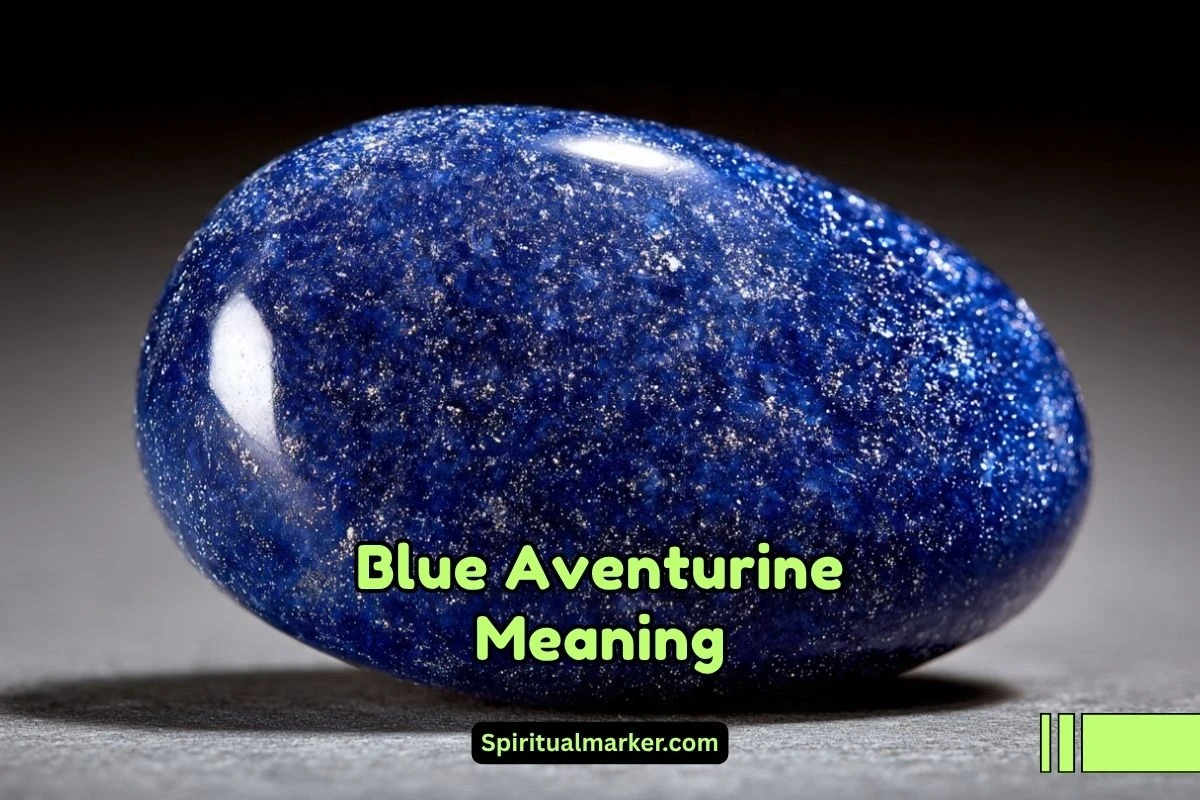
Have you ever picked up a blue stone and felt a quiet sense of mental clarity settle over you? Many people experience that feeling with Blue Aventurine. There is something about its cool, shimmering blue color that draws people in before they even know its name. That pull is rarely accidental in crystal traditions.
Blue Aventurine has been connected with calm minds, honest communication, and spiritual self-awareness for centuries. People across different cultures and healing traditions have reached for this stone during periods of confusion, emotional overwhelm, or creative stagnation. Its reputation is not built on drama or intensity. It is built on steady, reliable inner clarity.
Unlike stones associated with fiery transformation or emotional intensity, Blue Aventurine works in a quieter register. Its energy feels like a deep breath on a difficult day. It does not force change. It creates the internal conditions where meaningful change becomes possible.
Crystal healers, spiritual practitioners, and gemstone enthusiasts consistently value Blue Aventurine for its connection to honest self-expression, mental focus, and emotional regulation. Whether worn as jewelry, used during meditation, or placed in a workspace, this stone symbolizes the courage to speak truthfully and the patience to think clearly.
This article covers the meaning of Blue Aventurine, its historical significance, spiritual symbolism, healing properties, and practical ways to use it in daily life. You will also learn how to care for Blue Aventurine jewelry and what makes this stone unique among blue crystals.
5 Key Takeaways
- Blue Aventurine symbolizes mental clarity, honest communication, emotional calm, and spiritual self-awareness.
- It is strongly connected with the throat chakra and the third eye chakra in crystal healing traditions.
- People often use Blue Aventurine during meditation, public speaking, creative work, and emotional recovery.
- Blue Aventurine belongs to the quartz family and gets its shimmering appearance from reflective mineral inclusions.
- Wearing or carrying Blue Aventurine may strengthen focus, reduce anxiety, and encourage honest self-expression over time.
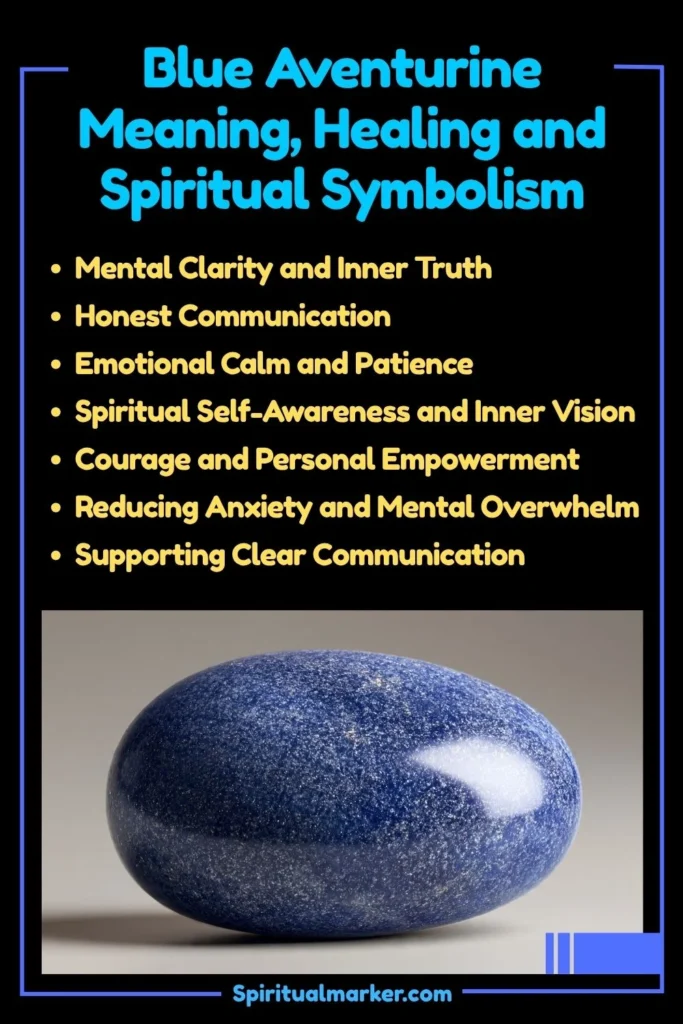
What Is Blue Aventurine?
Blue Aventurine is a member of the quartz family, recognized for its translucent to opaque blue color and its characteristic sparkle. That distinctive shimmer comes from tiny reflective mineral platelets, typically fuchsite, muscovite, or blue dumortierite, embedded within the quartz structure. This optical phenomenon is called aventurescence, and it gives Blue Aventurine its signature glittery quality under light.
Its color ranges from pale sky blue to deep navy, and the intensity of its shimmer varies depending on the concentration of mineral inclusions. Some pieces show a subtle glitter. Others catch the light dramatically. Either way, the visual effect is unmistakable.
Many people initially confuse Blue Aventurine with blue quartz or sodalite because they share similar color families. However, Blue Aventurine is distinguished by its aventurescence and its softer, more luminous appearance. Spiritually, it also carries a very different energetic reputation, one centered on mental focus, clear communication, and emotional steadiness rather than intuition alone.
The name “aventurine” comes from the Italian word “a ventura,” meaning “by chance.” According to popular accounts, a glassmaker accidentally dropped copper filings into molten glass in 18th-century Venice, creating a sparkling material called goldstone or aventurine glass. When the natural stone was later found with a similar appearance, it inherited the name.
Origins and Formation of Blue Aventurine
Blue Aventurine forms within metamorphic and sedimentary rock environments where silica-rich fluids interact with mineral-bearing rock over long geological periods. As quartz crystallizes, it traps microscopic platelets of blue minerals such as dumortierite or fuchsite, which are responsible for both its color and its optical shimmer.
The stone is found in several parts of the world. India produces some of the most widely recognized deposits and remains the most significant commercial source. Other notable origins include Brazil, Russia, China, Austria, Chile, and Tanzania. Indian Blue Aventurine often displays a deep, richly saturated blue tone, while Brazilian specimens may lean toward lighter shades.
Dumortierite inclusions are particularly significant in Blue Aventurine. Dumortierite itself carries spiritual associations with mental discipline, patience, and cognitive clarity. Many crystal practitioners believe that when dumortierite occurs within the aventurine matrix, it amplifies the stone’s connection to focused thought and honest communication.
The geological patience required to form Blue Aventurine mirrors many of its spiritual themes. Growth happens slowly, layer by layer, under persistent conditions. The stone does not rush into existence. That natural process echoes the kind of personal development Blue Aventurine is said to support.
Key Properties of Blue Aventurine
| Property | Details |
|---|---|
| Color | Pale blue, sky blue, deep navy blue |
| Composition | Silicon dioxide (quartz) with mineral inclusions |
| Hardness | 6.5 to 7 on the Mohs scale |
| Chakra Association | Throat chakra and third eye chakra |
| Primary Symbolism | Clarity, communication, calm, self-awareness |
| Common Sources | India, Brazil, Russia, China, Chile |
| Transparency | Translucent to opaque |
| Special Feature | Aventurescence (shimmering optical effect) |
| Energy Style | Steady, focusing, mentally clarifying |
Historical Use of Blue Aventurine
Ancient civilizations valued aventurine stones long before modern crystal healing traditions gave them specific metaphysical frameworks. In ancient Tibet, aventurine was commonly used to improve eyesight and was believed to support mental clarity. Tibetan artisans reportedly set it into statues to represent the visionary power of divine sight.
Native American traditions in certain regions used aventurine in medicine wheel rituals and ceremonial objects. The stone’s association with vision, inner truth, and grounded spiritual awareness fit naturally within these frameworks of healing and spiritual guidance.
In ancient China, green aventurine was widely revered, but blue stones in general held strong connections to heaven, clear thought, and spiritual authority. Blue was considered the color of intellectual virtue and divine wisdom in many Chinese philosophical traditions. Blue Aventurine, with its celestial appearance, naturally carried these associations.
During the European Renaissance, physicians and philosophers often classified blue stones as beneficial for the mind and nervous system. While scientific understanding was different then, the intuitive association between blue tones and mental calm appears consistently across unconnected cultures and historical periods.
In more recent metaphysical traditions, Blue Aventurine gained a distinct spiritual identity. Crystal healers began associating it specifically with throat and third eye activation, making it a preferred tool for anyone seeking to improve communication, deepen meditation, or develop greater emotional honesty.
5 Spiritual Meanings of Blue Aventurine
1. Mental Clarity and Inner Truth
Blue Aventurine carries one of its strongest spiritual associations with mental clarity and inner truth. Many people are drawn to this stone during periods of mental fog, decision fatigue, confusion, or emotional overload. Its reputation is built on the idea that clarity is not always the absence of information. Sometimes it is the ability to cut through excessive mental noise and recognize what actually matters.
Modern life generates enormous cognitive pressure. People process hundreds of decisions daily. They manage competing obligations, absorb digital information constantly, and rarely give their minds uninterrupted quiet. Over time, this mental overstimulation can create a sense of internal cloudiness. Thoughts become tangled. Priorities become blurred. Even simple decisions can feel disproportionately heavy.
Spiritually, Blue Aventurine represents the process of mental decluttering. Many practitioners describe its energy as mentally “cooling,” similar to the clarity that follows a period of deep rest or time spent quietly in nature. The stone does not promise instant answers. Instead, its symbolism focuses on creating the internal stillness where genuine insight becomes possible.
Inner truth is another significant dimension of this symbolism. Many people carry beliefs about themselves that formed during painful experiences rather than through honest self-reflection. Negative self-perception, limiting beliefs, and emotional stories built around past failures can quietly shape a person’s choices and self-concept for years. Blue Aventurine spiritually represents the gentle willingness to examine those stories more honestly. It encourages self-awareness without self-criticism, which is a delicate but meaningful balance in personal healing.
This meaning is especially relevant for people navigating major life crossroads. Career decisions, relationship evaluations, personal identity questions, or spiritual reinvention all require a kind of honest inner listening that mental busyness makes difficult. Blue Aventurine symbolically creates space for that deeper listening to occur.
2. Honest Communication and Self-Expression
Communication is one of the most consistently challenging aspects of human experience. Many people carry unexpressed thoughts, emotional truths, creative ideas, and important personal needs that never reach spoken language. Fear of judgment, conflict avoidance, low self-confidence, or simply not knowing how to begin can keep important things permanently unspoken. Blue Aventurine is deeply connected in crystal traditions with breaking through exactly these communication barriers.
Its strong relationship with the throat chakra forms the foundation of this symbolism. The throat chakra governs all forms of self-expression, including spoken words, written communication, creative output, and personal truth-telling. When this chakra feels energetically balanced, people often experience greater ease in articulating their thoughts and feelings. When blocked, emotional tension may manifest as speaking too little, speaking without authenticity, or feeling chronically misunderstood.
Blue Aventurine is often associated with finding the courage to speak honestly in situations that feel emotionally risky. This might mean a difficult conversation with a partner, expressing a professional disagreement, or simply admitting something vulnerable to a trusted friend. The stone’s symbolism does not focus on aggressive confrontation. It focuses on calm, grounded honesty that comes from a place of emotional steadiness rather than emotional reactivity.
This spiritual meaning also extends into creative communication. Writers, artists, musicians, teachers, and speakers frequently work with Blue Aventurine because they associate it with overcoming creative blocks and expressing their authentic creative voice. The stone symbolizes the confidence to share your perspective without constantly second-guessing its value. That kind of expressive freedom can be both personally fulfilling and professionally significant.
Many people also find Blue Aventurine meaningful during public speaking situations. Stage fright and performance anxiety often stem from excessive self-focus and fear of external judgment. Spiritually, the stone is said to shift attention from fear of judgment toward genuine engagement with the message being shared.
3. Emotional Calm and Patience
Blue Aventurine frequently symbolizes emotional calm and patience, two qualities that become increasingly important during emotionally difficult periods. While some crystals are associated with emotional intensity or dramatic cathartic release, Blue Aventurine takes a quieter approach. Its spiritual energy is consistently described as steady, soothing, and emotionally stabilizing rather than exciting or emotionally amplifying.
Patience is often undervalued in contemporary healing discussions. Many people want emotional resolution quickly. They want grief to lift faster, anxiety to disappear sooner, and personal growth to happen more rapidly than it naturally does. This understandable impatience can actually slow emotional healing by creating additional frustration and self-criticism on top of the original emotional difficulty.
Spiritually, Blue Aventurine represents the wisdom of emotional patience. It symbolizes trust in gradual processes. Just as its own formation required immense geological time, the stone reflects the understanding that meaningful emotional healing rarely happens instantly. Its energy encourages people to stop fighting their own timeline and instead support their emotional recovery with consistency and gentleness.
This meaning also addresses the emotional pattern of impulsive reactions. When people feel emotionally triggered, they often speak or act from that triggered state rather than from a more grounded emotional center. Blue Aventurine spiritually represents the pause between emotional stimulus and emotional response. Many crystal practitioners believe working with this stone strengthens the ability to respond thoughtfully rather than react impulsively.
Emotional calm in this spiritual tradition is not passive or emotionally avoidant. It is an active, conscious choice to remain emotionally centered even when circumstances feel destabilizing. Blue Aventurine symbolizes that centered emotional presence as a form of personal strength rather than emotional suppression.
4. Spiritual Self-Awareness and Inner Vision
Beyond its throat chakra associations, Blue Aventurine carries strong spiritual connections to the third eye chakra, the energy center associated with intuition, inner vision, self-knowledge, and deeper spiritual perception. This dual chakra relationship makes Blue Aventurine uniquely positioned among blue crystals because it bridges the worlds of authentic self-expression and deeper inner awareness.
Spiritual self-awareness involves more than intellectual understanding of your personality. It includes recognizing your emotional patterns, understanding your core values, identifying what genuinely aligns with your soul, and developing honest awareness of both your strengths and your growing edges. This kind of deeper self-knowledge is not comfortable or easy. It requires stillness, honesty, and a willingness to see yourself more clearly than social roles and daily busyness typically allow.
Blue Aventurine is often used during meditation and reflective spiritual practices because many practitioners believe it supports this deeper inner looking. Unlike stones associated with psychic ability or visionary experiences, Blue Aventurine is more practically oriented. Its spiritual vision connects with everyday self-understanding, helping people make decisions that genuinely reflect their inner truth rather than external pressure.
Many people live with significant gaps between their inner experience and their outward life. They pursue careers that do not align with their values, maintain relationships that do not reflect their authentic self, or follow belief systems inherited from others rather than consciously chosen. Blue Aventurine spiritually represents the process of closing those gaps by developing honest self-awareness one layer at a time.
Its shimmer is often interpreted symbolically as inner light becoming visible. Just as light reflects differently off the mineral inclusions within the stone, Blue Aventurine is said to help people see their own inner landscape more clearly, including dimensions of themselves that may have remained unexamined for long periods.
5. Courage and Personal Empowerment
Courage might not be the first word that comes to mind when looking at a soft, shimmering blue stone. But Blue Aventurine has carried symbolism connected with personal courage and quiet empowerment across multiple spiritual traditions. This courage is not the loud, aggressive variety. It is the steady, inner courage required to live authentically in a world that frequently pressures people to conform, silence themselves, or choose safety over truth.
Personal empowerment in the context of Blue Aventurine begins with self-ownership. Many people gradually surrender ownership of their thoughts, feelings, creative visions, and life direction through repeated experiences of criticism, rejection, or emotional invalidation. Over time, this erosion of self-ownership can feel so normal that people stop noticing it. They simply accept limitation as a permanent fact about themselves.
Blue Aventurine spiritually represents the beginning of reclaiming that self-ownership. Its energy is associated with the quiet but transformative moment when someone decides to trust their own perceptions, honor their own needs, and pursue directions that genuinely resonate with who they are rather than what others expect of them. This form of personal empowerment is deeply connected to the stone’s communication symbolism. Authentic self-expression requires believing that your truth has value.
The stone’s aventurescence, that inner shimmer, often serves as a symbolic reminder that personal brilliance does not always announce itself loudly. It reveals itself when conditions allow light to reach it. Many spiritual practitioners interpret this as a metaphor for human potential. Your inner strengths, gifts, and authentic character are always present, even during periods when circumstances prevent them from being fully visible.
6 Healing Properties of Blue Aventurine
1. Reducing Anxiety and Mental Overwhelm
Blue Aventurine has developed a strong reputation as a calming stone, particularly for anxiety and mental overwhelm. Within crystal healing traditions, many people turn to this stone specifically when they feel mentally saturated, emotionally reactive, or perpetually on edge. Its association with both the throat and third eye chakras positions it as a stabilizing presence that works across emotional and cognitive levels simultaneously.
Anxiety often manifests as a relentless loop of catastrophic thinking. The mind races through worst-case scenarios, past regrets, and future uncertainties without pause. This mental pattern is exhausting and can gradually affect sleep quality, physical health, emotional relationships, and daily functioning. Blue Aventurine symbolically represents an interruption in that mental loop.
Many practitioners believe the stone encourages a shift in internal focus, from anxious anticipation toward present-moment awareness. This is why Blue Aventurine frequently appears in meditation kits, anxiety relief crystal sets, and mindfulness-oriented spiritual practices. Its cool, steady energy is thought to support a calmer nervous system state during moments of heightened emotional tension.
Unlike stimulating or energetically intense crystals, Blue Aventurine’s calming property is widely described as gentle and non-intrusive. It does not suppress emotions or create emotional detachment. Instead, it is believed to create a subtle emotional buffer that prevents emotional overwhelm from escalating unnecessarily. Many people find this quality particularly valuable during periods of chronic stress, high-pressure work environments, or life transitions that carry significant emotional weight.
Its relatively hard mineral structure (6.5 to 7 on the Mohs scale) also makes it durable enough for daily wear, which is practically significant. People who benefit from its calming symbolism can keep it close throughout demanding days without worrying about fragility or frequent damage.
2. Supporting Clear Communication
Perhaps the most widely recognized healing property of Blue Aventurine is its supportive role in communication. Crystal healers and spiritual practitioners consistently reference this stone when discussing throat chakra healing because of how strongly its symbolism aligns with expressive clarity and authentic self-expression.
Many people struggle with communication not because they lack words but because they struggle to organize their thoughts coherently under pressure, express emotion without losing composure, or assert their perspective without feeling excessive guilt. These are fundamentally emotional challenges wrapped in communicative situations. Blue Aventurine addresses this intersection between emotional experience and spoken expression.
People who work with this stone during communication challenges often describe using it before important conversations, interviews, presentations, or moments when they need to express something personally significant. The stone’s symbolism is not about making someone eloquent or verbally perfect. It is about reducing the internal interference, the self-doubt, the fear, and the emotional tension, that often distorts natural communication.
Written communication falls within this healing property as well. Writers, content creators, academic researchers, and anyone who expresses themselves through text may find Blue Aventurine’s clarifying energy meaningful during periods of creative block or writing difficulty. The stone symbolically supports the same authentic, organized self-expression whether it manifests verbally or in written form.
3. Improving Focus and Mental Discipline
Blue Aventurine is frequently associated with improved mental focus, cognitive discipline, and organized thinking. This healing property is especially relevant in modern environments where digital distractions, information overload, and constant multitasking fragment sustained concentration. Many students, professionals, creative workers, and spiritual practitioners use Blue Aventurine during periods when they need sharper mental engagement.
The presence of dumortierite inclusions in many Blue Aventurine specimens is spiritually significant here. Dumortierite has its own strong associations with mental organization, intellectual patience, and cognitive endurance. When this mineral occurs within an aventurine matrix, many crystal practitioners believe it amplifies the stone’s capacity to support focused thinking.
Mental focus in crystal traditions is not treated as a purely intellectual phenomenon. Emotional turbulence frequently disrupts concentration even when the intellectual willingness to focus is fully present. Grief, anxiety, unresolved conflict, or emotional restlessness can make sustained mental attention nearly impossible. Blue Aventurine is believed to address focus from this dual angle, calming the emotional interference while simultaneously encouraging mental organization and clarity.
Many people place Blue Aventurine on their desks, in study spaces, or in creative environments specifically to support this focusing property. Its cool visual appearance also functions as a natural anchor point during meditation or concentration exercises. The act of briefly holding or visually focusing on the stone can serve as a grounding reset during mentally scattered moments.
4. Emotional Balance and Mood Stability
Emotional balance is a central healing theme connected with Blue Aventurine, particularly for people whose emotional experience tends toward extremes. Emotional volatility, mood swings, excessive emotional reactivity, and the feeling of being emotionally “all over the place” are experiences many people recognize but find difficult to regulate without consistent support.
Crystal healing traditions position Blue Aventurine as a stabilizing emotional influence. Its energy is believed to reduce the peaks and valleys of emotional reactivity rather than eliminating emotional experience altogether. This distinction matters because emotional health is not emotional numbness. The goal is not to feel nothing but to feel without being entirely overwhelmed or controlled by feeling.
Blue Aventurine is particularly associated with emotional balance in social contexts. Many people who struggle with emotional regulation find that social environments amplify their emotional reactivity. They absorb others’ emotional states easily, become overwhelmed in emotionally charged conversations, or feel drained after sustained social interaction. The stone’s calming energy is believed to provide emotional insulation, helping people engage socially without losing their emotional center.
For people managing conditions like anxiety, emotional sensitivity, or stress-related mood disruption, Blue Aventurine represents an accessible complementary tool within a broader self-care practice. It does not replace professional mental health support but may serve as a meaningful symbolic anchor during emotional recovery or emotional regulation work.
5. Strengthening Intuition and Self-Knowledge
While Blue Aventurine is primarily associated with the throat chakra, its third eye connection gives it a meaningful relationship with intuition and self-knowledge. These two qualities often develop together. As people become more honest with themselves through genuine self-reflection, their intuitive sense of what is right for them tends to strengthen accordingly.
Intuition in this context is not mystical prediction. It is a deep, bodily knowing that integrates experience, values, and emotional intelligence into a clear sense of direction without requiring exhaustive rational analysis. Many people report that Blue Aventurine supports access to this kind of knowing during meditation, journaling, or quiet reflection.
Self-knowledge is a lifelong process. People contain multitudes. Motivations are complex. Patterns form beneath conscious awareness. Blue Aventurine’s healing energy is associated with patient, honest self-examination rather than surface-level self-assessment. Many practitioners believe regular work with this stone gradually increases emotional literacy, the ability to accurately name and understand your own internal experience.
Research in psychology consistently shows that higher emotional literacy correlates with better relationship quality, more effective decision-making, reduced anxiety, and greater overall life satisfaction. While crystal healing traditions approach this connection from a spiritual perspective, the practical outcomes align meaningfully with these psychological findings.
6. Supporting Personal Leadership and Confidence
Blue Aventurine carries a quieter version of confidence symbolism compared to bolder stones like citrine or tiger’s eye, but its connection to personal leadership is genuine and consistently referenced in crystal traditions. This form of confidence centers on the courage to lead yourself honestly, to make decisions aligned with your values, to speak your truth even when it is uncomfortable, and to trust your own judgment.
Many people in leadership positions, whether leading teams, families, creative projects, or their own personal development, struggle with an internal confidence gap. They project competence externally while managing persistent self-doubt internally. Blue Aventurine is specifically associated with closing that gap between outward presentation and inward self-trust.
This healing property is closely tied to the stone’s throat chakra symbolism. Authentic leadership requires authentic communication. Leaders who cannot speak honestly, who suppress important perspectives, who avoid necessary but difficult conversations, eventually compromise both their effectiveness and their integrity. Blue Aventurine spiritually represents the communication courage that genuine leadership requires.
The stone is also associated with decisiveness. Confident decision-making requires mental clarity, emotional regulation, honest self-knowledge, and trust in one’s own judgment. These are exactly the qualities Blue Aventurine is believed to support collectively. When these properties work together, they create an internal foundation for making confident, grounded decisions even under uncertain or complex conditions.
How to Wear Blue Aventurine Jewelry for Spiritual Growth
Wearing Blue Aventurine jewelry is one of the most accessible ways to maintain consistent energetic contact with the stone throughout daily life. Because Blue Aventurine connects strongly with both the throat and third eye chakras, the way and location you wear it carries symbolic significance.
Necklaces and pendants are particularly meaningful when working with Blue Aventurine for communication and self-expression. Wearing the stone near your throat aligns it directly with the throat chakra. Many people choose Blue Aventurine pendants before important presentations, honest conversations, or creative work sessions. The physical presence of the stone near the throat serves as a grounding reminder of intentional, authentic communication.
Bracelets keep Blue Aventurine in consistent contact with the skin, which many practitioners believe strengthens its energetic influence throughout the day. A bracelet is also practical during work or study sessions because it stays close without requiring conscious attention.
Earrings with Blue Aventurine position the stone near the head, which resonates meaningfully with the stone’s third eye associations. People who work with Blue Aventurine for mental clarity, focus, or intuitive development sometimes prefer earrings for this reason.
Some practitioners combine Blue Aventurine with complementary crystals. Sodalite reinforces mental clarity and logical thinking. Lapis lazuli deepens communication symbolism and spiritual awareness. Amethyst adds calm introspection and spiritual depth. Clear quartz is often paired with Blue Aventurine to amplify its overall energy and intention.
Wearing Blue Aventurine consistently during activities such as meditation, journaling, focused work, creative practice, or emotionally significant conversations may strengthen your personal relationship with the stone’s symbolic energy over time.
Caring for Blue Aventurine Jewelry
Blue Aventurine is a relatively durable stone thanks to its quartz base and Mohs hardness of 6.5 to 7. However, proper care helps preserve its polish, shimmer, and structural integrity over years of regular use.
Store Blue Aventurine separately from harder stones like diamonds, sapphires, or topaz, which can scratch its surface. A soft cloth pouch or padded jewelry compartment works well for individual storage.
Clean Blue Aventurine using lukewarm water, a small amount of mild soap, and a soft cloth or brush. Rinse thoroughly and dry gently. Avoid ultrasonic cleaners and steam cleaning machines, as vibration and intense heat can affect the mineral inclusions within the stone.
Remove Blue Aventurine jewelry before intense exercise, swimming in chlorinated pools, or using harsh household cleaning products. Prolonged chemical exposure can dull the stone’s surface over time.
Many spiritual practitioners also energetically cleanse their Blue Aventurine regularly. Common methods include moonlight exposure, particularly during full or new moons. Some practitioners use sound cleansing through singing bowls or bells. Others prefer placing the stone near selenite or clear quartz, which are believed to cleanse and recharge other crystals. Smoke cleansing with herbs like sage, cedar, or palo santo is another traditional method.
The cleansing method you choose is a matter of personal belief and preference. What matters most is that the practice feels meaningful and consistent within your spiritual framework.
Table: Blue Aventurine at a Glance
| Aspect | Details |
|---|---|
| Primary Meaning | Mental clarity and honest communication |
| Chakra Association | Throat chakra and third eye chakra |
| Main Spiritual Symbolism | Clarity, courage, patience, self-awareness |
| Common Colors | Sky blue, pale blue, deep navy |
| Hardness | 6.5 to 7 Mohs |
| Main Sources | India, Brazil, Russia, China, Chile |
| Emotional Associations | Calm, focus, emotional balance, confidence |
| Popular Jewelry Types | Necklaces, bracelets, earrings |
| Spiritual Uses | Meditation, communication work, focus |
| Key Mineral Inclusions | Dumortierite, fuchsite, muscovite |
| Care Needs | Gentle cleaning, separate storage |
A Final Note
Blue Aventurine occupies a unique place among healing crystals because its energy is both practical and deeply spiritual. It does not promise dramatic mystical experiences. Instead, it quietly supports the qualities that make daily life more authentic and internally aligned, clearer thinking, braver communication, steadier emotions, and honest self-knowledge.
Its shimmer feels like an honest metaphor. The best version of yourself does not always announce its presence loudly. Sometimes it reveals itself gradually, in moments of genuine honesty, mental stillness, and courageous self-expression. Blue Aventurine symbolically holds space for exactly those moments.
If this stone draws your attention, that response may be telling you something worth listening to. Some people work with it as a spiritual tool, others wear it for its calming beauty, and many simply keep it close as a daily reminder to think clearly, speak honestly, and trust themselves more fully.
You might consider placing it on your desk, wearing it during a conversation that matters, or simply holding it during a quiet moment of reflection. Sometimes the most meaningful step is simply beginning.