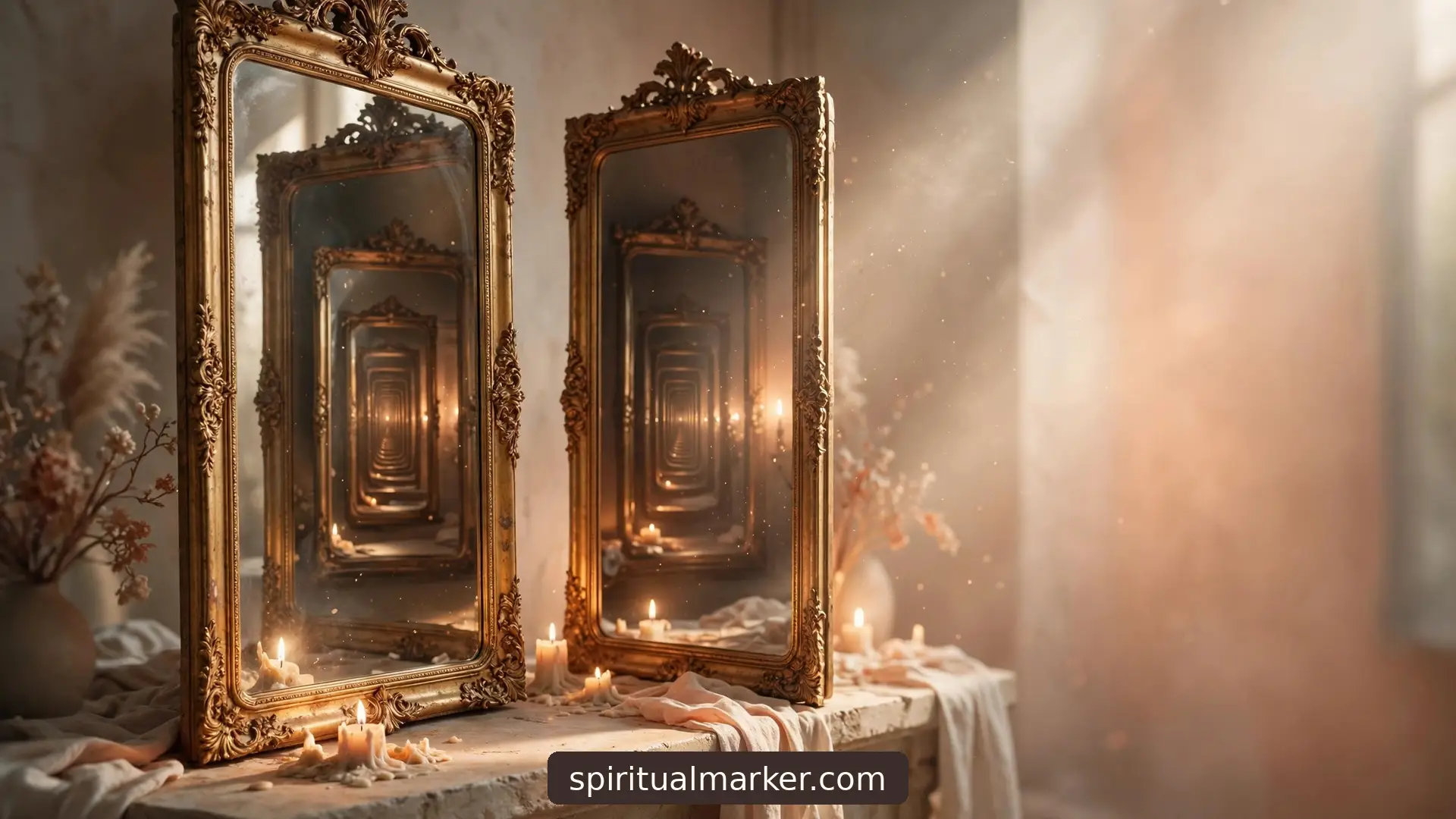
You have probably seen it before. Two mirrors placed directly across from each other, creating a tunnel of reflections that stretches into apparent infinity. Most people walk past this sight without a second thought. But for centuries, spiritual traditions, metaphysical practitioners, and ancient mystics have treated this image as one of the most powerful and unsettling symbols in the visible world. The two mirrors facing each other spiritual meaning runs far deeper than physics or optics. It touches something fundamental about the nature of the soul, the structure of reality, and the invisible dimensions that sit just beyond ordinary perception.
What happens when two mirrors face each other is technically called an infinite regression or a mirror tunnel. Each mirror reflects the other’s reflection, and that reflection contains another reflection, creating a corridor of images that appears to go on without end. Science explains this as a consequence of parallel reflecting surfaces. But spiritual traditions across the globe read something far more significant into that corridor. They see a portal. A warning. A meditation on eternity. A glimpse behind the curtain of the physical world.
Whether you are approaching this topic from a place of curiosity, spiritual practice, or a genuine concern after setting up mirrors in your home, this post covers everything you need to know. You will find the symbolism of two mirrors facing each other, what various religions say about it, how different world cultures have interpreted the infinite reflection, and what it might mean for your own spiritual life right now.
Key Takeaways
Before going deeper, here are five essential points that anchor everything in this post:
- Two mirrors facing each other symbolize infinity, the eternal soul, and the cyclical nature of existence across nearly every major spiritual tradition on Earth.
- Many cultures and feng shui traditions warn against placing two mirrors directly opposite each other in the home, citing concerns about energy disturbance, spiritual unrest, and negative feedback loops.
- The infinite corridor of reflections created by opposing mirrors is widely interpreted as a metaphor for the human soul’s capacity for endless self-examination and inner depth.
- In several mystical traditions, including Kabbalah, Sufism, and certain Hindu schools of thought, the image of two facing mirrors represents the relationship between God and the human soul, each reflecting the other endlessly.
- Dreaming of two mirrors facing each other carries specific spiritual messages related to self-deception, karmic loops, and the need for honest inner reflection.
What Are Mirrors and Why Do They Carry Spiritual Weight?
Mirrors are among the oldest tools humanity has ever used for spiritual purposes. Long before polished glass existed, ancient peoples used still water, obsidian stone, and polished metal to see their own reflections. The spiritual significance of mirrors is ancient and universal. Across traditions, the mirror has been treated as a threshold object, something that sits precisely on the boundary between the visible and invisible worlds. Many cultures believed that a mirror did not simply show your face. They believed it captured something of your essence, your soul, your true self that the conscious mind often works hard to hide.
In ancient Greece, the mirror was associated with the goddess Aphrodite and with the concept of self-knowledge. The Delphic maxim “know thyself” was not simply a philosophical instruction. It was a spiritual directive, and the mirror was one of the tools through which that knowledge could be pursued. In ancient China, bronze mirrors were buried with the dead as protective talismans. In medieval Europe, mirrors were thought to capture the soul of anyone who gazed too long into them. The phrase “breaking a mirror brings seven years of bad luck” comes directly from this tradition, the belief that shattering a mirror meant shattering a fragment of the soul housed within it.
When you place two mirrors facing each other, you amplify all of this energy dramatically. You are not simply doubling the spiritual weight of a single mirror. You are creating a feedback loop, a system in which spiritual energy, reflection, and symbolism multiply upon themselves endlessly. That is why this specific configuration has fascinated and alarmed spiritual practitioners for as long as mirrors have existed. The mirror facing mirror spiritual meaning is not a simple matter. It layers concepts of infinity, the soul, karmic cycles, and cosmic order into a single visual phenomenon.
What Does the Infinite Reflection of Two Facing Mirrors Symbolize?
The most immediate and striking quality of two mirrors facing each other is the infinite regression they produce. Each image within the tunnel is slightly smaller, slightly darker, slightly more distant than the one before it. The corridor seems to stretch forever, growing dimmer and narrower until it disappears into darkness. This image is not neutral. Spiritually, it carries a weight that most people feel instinctively, even if they cannot name it. That faint sense of unease, of vertigo, of awe that you get when you look into a mirror tunnel is not imaginary. It is the soul responding to a symbol that speaks directly to its deepest nature.
At its most fundamental level, two mirrors facing each other represent infinity. The reflections never truly end. They simply move beyond the reach of human perception. This is one of the most potent visual metaphors for the concept of eternity that the physical world can produce. Many traditions interpret this as a representation of the eternal nature of the soul itself. The body is finite. The physical world is finite. But the soul, like those reflections, continues beyond the point where the eye can follow.
The symbolism of two mirrors facing each other also speaks to the concept of duality and its transcendence. Two mirrors represent two opposing forces, two poles of existence, the self and the other, the divine and the human, the visible and the invisible. When they face each other, neither dominates. Neither wins. They simply reflect each other endlessly in a relationship that has no beginning and no end. Many mystical traditions see this as the perfect visual symbol for the relationship between opposites in a spiritually balanced universe.
Beyond infinity and duality, the facing mirror symbol also represents the depth of the human psyche. Carl Jung, the Swiss psychologist whose work drew heavily on spiritual and mythological traditions, wrote extensively about the concept of infinite inner depth. He taught that the unconscious mind extends far beyond what any individual can fully perceive or know. The mirror tunnel is a powerful visual echo of this idea. You see reflections of reflections, images within images, layers within layers. This is exactly how the unconscious mind operates, with meanings nested inside meanings, and truths hidden beneath layers of perception.
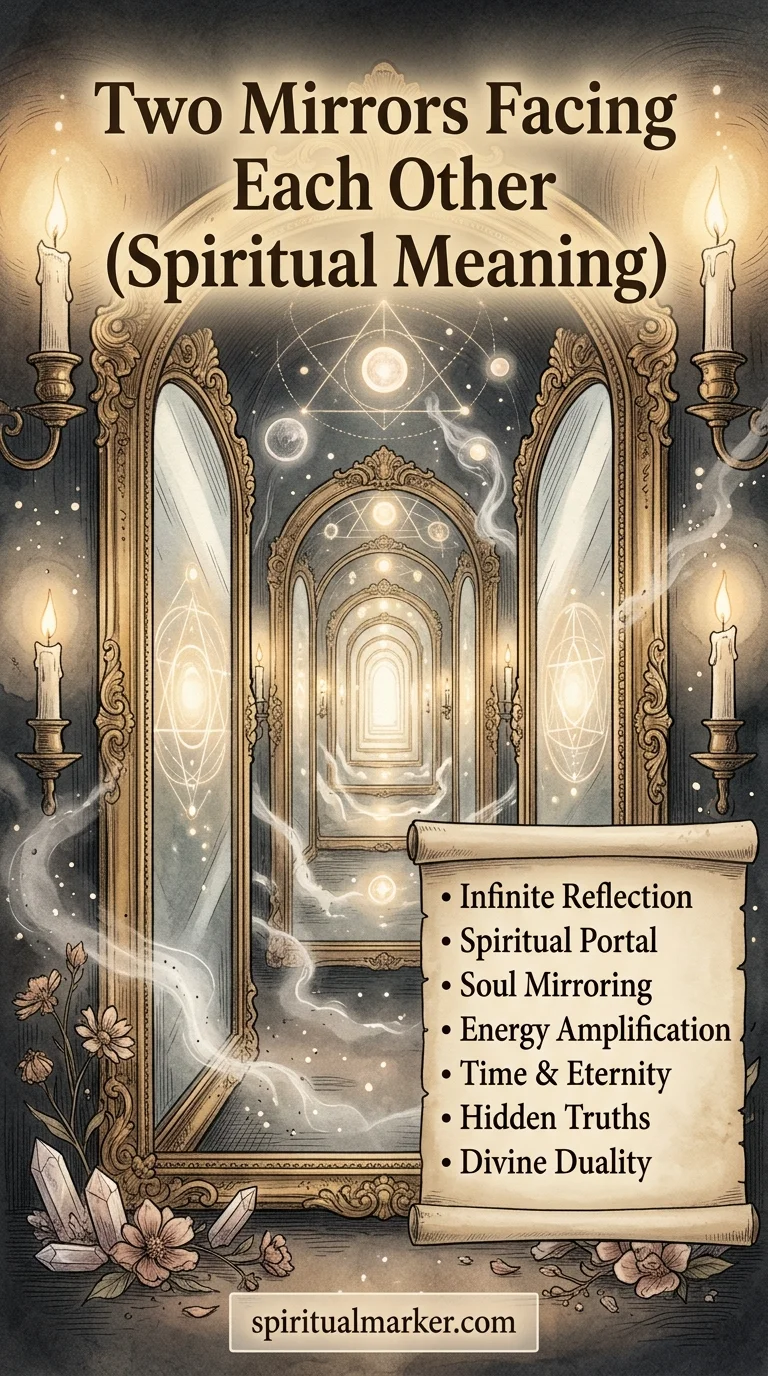
7 Spiritual Meanings of Two Mirrors Facing Each Other
1. A Gateway to Infinity and the Eternal Soul
The most widely recognized spiritual meaning of two mirrors facing each other is their representation of infinity. The tunnel of reflections stretches beyond the visible horizon in a way that no other natural phenomenon can replicate so cleanly. Across Hindu philosophy, Buddhist cosmology, and Sufi mysticism, eternity is not simply a long stretch of time. It is a fundamentally different category of existence, one that the finite human mind cannot fully hold. The infinite mirror reflection gives that abstract concept a visible, tangible form. You can literally look at eternity in a mirror tunnel.
In Hindu tradition, the concept of Ananta, meaning the infinite or endless, is one of the core attributes of Brahman, the ultimate divine reality. The Upanishads describe Brahman as that which is beyond all limits, all edges, all endings. The mirror tunnel, with its regression into apparent endlessness, visually captures this quality with remarkable precision. When you stand between two facing mirrors, you are literally surrounded by a symbol of the divine infinite nature.
The eternal soul, or Atman in Hindu teaching, shares this infinite quality. It was never born and will never die. It exists beyond the cycles of physical life and death. The image in the mirror tunnel, which fades but never truly disappears, reflects this teaching with quiet power. The reflections grow smaller and dimmer, but they do not actually cease. They simply move beyond what the eye can reach. Many teachers use this image as a meditation aid, asking students to contemplate the mirror tunnel as a way of connecting with their own eternal nature.
In Western mystical traditions, particularly in Neoplatonism and later in Christian mysticism, the soul’s origin in the divine was described as a kind of reflection. The human soul was understood as a reflection of the divine light, and the divine held a reflection of the soul in return. Two facing mirrors, each reflecting the other endlessly, serve as a perfect icon for this mutual, eternal relationship between the human and the divine.
2. The Karmic Loop and Cycles of Repetition
Not every spiritual meaning of two facing mirrors is transcendent and beautiful. One of the most sobering interpretations relates to karmic loops, the spiritual idea that unresolved patterns, wounds, and behaviors repeat themselves across lifetimes until they are consciously addressed and healed. The mirror tunnel is a precise visual metaphor for this experience. You see the same image repeated again and again, each time slightly more distant, slightly more distorted, but recognizably the same. This is exactly how karma operates in many Eastern spiritual frameworks.
In Buddhist teaching, samsara refers to the cycle of death and rebirth driven by attachment, ignorance, and craving. Beings caught in samsara repeat similar experiences across many lifetimes, not as punishment, but because the underlying causes of suffering have not been resolved. The two mirrors facing each other visually represent this cycle with startling accuracy. The reflections repeat. They do not evolve or change. They simply reproduce themselves, each one spawning another, until the pattern finally disappears into darkness.
Hindu philosophy offers a parallel concept in the idea of vasanas, which are deep-seated mental impressions or tendencies carried across lifetimes. These impressions drive behavior in predictable, repeated patterns until spiritual practice and self-awareness dissolve them. Seeing two mirrors facing each other in this light becomes a powerful prompt for self-examination. What patterns in your life keep repeating? What situations show up in different forms but with the same emotional core? The mirror tunnel asks you to look honestly at those cycles.
This meaning also carries a practical message. The karmic symbolism of facing mirrors suggests that the first step toward breaking a repetitive cycle is to see it clearly for what it is. The mirror forces you to look at yourself. Two mirrors force you to look at your patterns from multiple angles, including angles you would rather avoid. This is spiritually demanding work, but the two-mirror image insists on it.
3. A Portal Between Worlds
In folklore, shamanic traditions, and many occult systems, mirrors are understood as thresholds between the physical and spirit worlds. A single mirror was already considered a portal in many traditions, a surface through which spirits could pass or through which a sensitive individual could perceive other dimensions. When two mirrors face each other, creating a tunnel that appears to stretch infinitely, the portal quality is magnified dramatically. Many practitioners describe the two mirrors facing each other spirit portal as one of the most powerful and potentially dangerous configurations in the physical environment.
Slavic folklore, for instance, treated mirrors with extreme care. Mirrors in a home where someone had recently died were covered immediately, not out of respect for the dead alone, but because the spirit of the deceased was believed to be confused and potentially drawn into the mirror. Two facing mirrors in such a situation were considered especially dangerous, as they created a passage that spirits could use to travel between realms. This is one reason why mirror superstitions around death are so widespread across different cultures.
Shamanic practitioners in various traditions have used pairs of reflective surfaces deliberately as tools for spirit communication and altered states of consciousness. The experience of gazing into a mirror tunnel while in a meditative or trance state can produce genuine perceptual changes. The dimming and receding reflections, the sense of depth stretching beyond what should be possible, the slight distortion of each successive image, all of these can facilitate a shift in ordinary consciousness that some practitioners describe as crossing into adjacent spiritual territory.
The danger associated with this portal meaning is that not everything that can cross a threshold is benevolent. Many traditions teach that the same opening that allows beneficial spiritual contact also allows malign or mischievous entities to enter. This is why the warnings against two facing mirrors in the home are so consistent across different cultures. The portal, once opened, does not discriminate.
4. Deep Self-Knowledge and the Inner Mirror
One of the most psychologically and spiritually rich meanings associated with two mirrors facing each other is the invitation to genuine, deep self-knowledge. A single mirror shows you your face. It shows you the surface. Two mirrors facing each other show you reflections of reflections, the face behind the face, the self beneath the self. This is not simply a metaphor. It is a direct spiritual instruction to go deeper than surface-level self-awareness.
In many contemplative traditions, true self-knowledge requires moving past the persona, the identity that the individual presents to the world and even to themselves. The persona is the first reflection in the mirror, the one closest and clearest. But behind it lie other layers: the shadow, the wound, the fear, the deepest longing, the divine spark. The mirror tunnel of two facing mirrors visually represents this descent into layers of the self, each one more distant from ordinary consciousness but no less real.
Sufi mysticism, particularly in the poetry of Rumi, uses the mirror as a central metaphor for the spiritually purified heart. Rumi taught that the heart, when cleared of ego and distraction, becomes a perfect mirror for the divine light. When two such hearts meet, each purified and open, they reflect the divine to each other endlessly. This is the Sufi interpretation of two facing mirrors: the meeting of two souls so transparent in their spiritual clarity that they become infinite reflections of the divine for one another.
The Kabbalistic tradition offers yet another angle on this meaning. In Kabbalah, the sefirot, the divine attributes, are sometimes described as mirrors that reflect divine light from one to the next. The two facing mirrors in this framework represent the reciprocal flow of divine energy, from the infinite divine source down through the levels of creation, and back upward through the soul’s aspiration toward the divine. Self-knowledge, in this framework, is not navel-gazing. It is the necessary prerequisite for knowing God.
5. The Tension Between Reality and Illusion
Perhaps no spiritual concept is more directly evoked by the image of two facing mirrors than the tension between reality and illusion. Which reflection in the mirror tunnel is the real one? Technically, none of them are. They are all representations of something real, copies of copies, each one a step further removed from the original. This is precisely the teaching of maya in Hindu philosophy: the visible, perceptual world is not the ultimate reality. It is a representation, a projection, an appearance that the untrained mind mistakes for truth.
The maya symbolism of two facing mirrors is direct and powerful. When you look into the mirror tunnel, you see what appears to be an infinite corridor of real spaces stretching away from you. But none of those spaces actually exist. They are optical phenomena, produced by the interaction of light and reflective surfaces. The experience of depth, distance, and multiplicity is entirely illusory. Yet it feels completely convincing. This is exactly how maya operates: a convincing, deeply felt experience of a world that is, at the level of ultimate reality, not what it appears to be.
Buddhist philosophy offers a closely related teaching through the concept of sunyata, often translated as emptiness. This does not mean that things do not exist. It means that they do not exist in the solid, independent, permanent way that ordinary perception suggests. Each reflection in the mirror tunnel appears to be a distinct, real object. But it has no independent existence. It exists only in relationship to the other mirror, to the light, to the original object being reflected. This is the emptiness teaching of two facing mirrors: everything that appears to exist independently is actually a web of relationships and conditions.
Plato’s Allegory of the Cave, one of the most famous passages in Western philosophy, uses a similar logic. The prisoners in the cave see shadows on the wall and take them for reality. The philosopher who escapes the cave and sees real objects in real sunlight, and eventually looks at the sun itself, understands the layers of representation that the cave-dwellers mistake for truth. The mirror tunnel is a perfect modern symbol for this Platonic teaching: appearance layered upon appearance, with truth receding further into the distance the more deeply you look.
6. The Divine Relationship and Mutual Reflection of God and Soul
Across multiple mystical traditions, the two mirrors facing each other serve as a symbol for the relationship between the divine and the human soul. This is one of the most profound and beautiful spiritual meanings associated with this image. In this reading, one mirror represents the divine: infinite, luminous, the source of all light. The other represents the human soul: finite in its present form, but capable of reflecting divine light. When they face each other, neither is passive. Each actively receives and returns the light of the other, creating a dynamic, living exchange that is infinite in its depth.
In Islamic Sufi tradition, the relationship between Allah and the human heart is described in terms of mutual reflection. The divine looks at the human heart and sees Its own attributes reflected. The human heart, when purified through spiritual practice, looks at the divine and sees the source of its own deepest nature. Ibn Arabi, the great Sufi mystic and philosopher, described this relationship in his concept of tajalli, or divine self-disclosure. The divine discloses Itself through creation, and creation, at its most spiritually awakened, reflects that disclosure back to the divine. Two facing mirrors capture this dynamic with striking accuracy.
In the Christian mystical tradition, this meaning appears in the writings of Meister Eckhart, who spoke of the soul as the place where God sees God. The soul, in Eckhart’s teaching, is not simply a receiver of divine light. It is a mirror in which the divine beholds Its own nature. When the soul is pure and still, the divine reflection within it is perfect. When two such purified souls meet, or when the individual soul meets the divine directly, the result is an infinite mutual reflection: the divine seeing Itself in the soul, the soul seeing Itself in the divine, each reflection containing the other.
The Kabbalistic tradition gives this meaning a highly structured form through the concept of tzelem Elohim, the image of God in which humanity was created (Genesis 1:27). The human being is, at the deepest level, a mirror of the divine. The divine, in a profound theological sense described in Kabbalistic texts, created humanity precisely in order to have something that could reflect Its own infinite nature back to Itself. Two facing mirrors, in this reading, are not a curiosity or a warning. They are an icon of the entire purpose of creation.
7. A Warning Against Energy Traps and Spiritual Stagnation
Not all the spiritual meanings of two mirrors facing each other are transcendent or philosophically rich. One of the most practical and widely observed meanings is a direct warning. Many spiritual traditions, energy healing systems, and home-arrangement philosophies treat two facing mirrors as a problematic configuration that traps energy, amplifies negative forces, and creates conditions unfavorable to spiritual growth and physical well-being. This warning is not superstition. It appears consistently across traditions separated by thousands of miles and hundreds of years.
In feng shui, the ancient Chinese system of arranging environments to optimize the flow of qi, or life force energy, two mirrors facing each other are considered a significant concern. The belief is that energy enters a mirror, bounces between the two reflecting surfaces, and becomes trapped in the feedback loop rather than flowing freely through the space. Stagnant energy in a living environment, according to feng shui principles, contributes to stagnation in the lives of the people who inhabit that space: stagnation in relationships, in finances, in health, in spiritual development.
Vastu Shastra, the ancient Indian system of sacred architecture and spatial arrangement, also warns against placing mirrors opposite each other. In this tradition, the concern is that the infinite reflection creates a kind of spatial confusion for the life force energy moving through a building. Energy needs to flow with purpose and direction. The endless bounce between two facing mirrors creates purposeless, directionless movement that disrupts the healthy energetic environment of a home.
Beyond energy flow, the warning meaning of two facing mirrors also addresses the psychological and spiritual state of the people who live with them. Many practitioners of spiritual home arrangement note that constant exposure to infinite regression, even at the subconscious level, can contribute to feelings of anxiety, disorientation, existential dread, and a sense of being stuck in repetitive patterns. The visual of endlessness, when it becomes part of the daily environment, can subtly undermine the individual’s sense of groundedness and forward movement in life.
Two Mirrors Facing Each Other in World Cultures and Spiritual Traditions
The cultural symbolism of two facing mirrors appears in traditions spanning every inhabited continent. While the specific interpretations vary, there is a remarkable consistency in the sense that this configuration carries exceptional spiritual power, for good or ill.
In Japanese culture, mirrors hold a place of extraordinary sacred importance. The Yata no Kagami, or Eight-Span Mirror, is one of the Three Imperial Treasures of Japan, objects of supreme sacred and political significance. Mirrors in Shinto tradition are understood as objects in which the divine can dwell and through which divine power can be channeled. The Grand Shrine of Ise, the most sacred site in Shinto Japan, houses a mirror as the primary symbol of the sun goddess Amaterasu. In this context, the idea of two mirrors facing each other takes on a specifically cosmic meaning: two divine presences reflecting each other in a relationship of mutual sacred recognition.
In Celtic traditions, mirrors and reflective surfaces, particularly still water and polished stone, were used for scrying, the practice of perceiving visions and spiritual information in a reflective surface. Celtic shamanic and druidic traditions understood reflective surfaces as windows into the Otherworld, the realm of spirits, ancestors, and divine beings that exists alongside the physical world. Two facing mirrors, in this framework, would create a double threshold, an opening that is twice as permeable to the Otherworld as a single mirror alone.
In African spiritual traditions, particularly in Vodou and related traditions that originated in West Africa and developed in the African diaspora, mirrors are frequently used in ritual practice. The Haitian Vodou tradition, for instance, uses mirrors in ceremonies for the Loa, the divine spirits who are called upon for guidance, healing, and protection. Mirrors are understood as the eyes of the spirits, surfaces through which the divine sees into the human world and through which the human world can glimpse the divine. Placing two mirrors facing each other in a ritual context amplifies this seeing dramatically.
In Chinese folk religion and Taoist tradition, the Bagua mirror, an octagonal mirror often placed above doorways to deflect negative energy, reflects the understanding that mirrors have active protective and transformative power. Taoism reads the infinite regression of two facing mirrors through the lens of the Tao itself, the unnameable, infinite principle that underlies all existence. The Tao Te Ching describes the Tao as that which existed before Heaven and Earth, before form and substance. The mirror tunnel’s apparent endlessness, its recession into a darkness that is not nothing but simply beyond perception, resonates with the Taoist conception of the primordial ground of being.
What Does the Bible Say About Mirrors and Infinite Reflection?
The Biblical meaning of mirrors is rich and theologically significant. The Bible uses the mirror as a spiritual metaphor in several key passages, and the cumulative picture that emerges is directly relevant to the spiritual meaning of two mirrors facing each other.
The most famous Biblical reference to mirrors is found in 1 Corinthians 13:12, where the Apostle Paul writes that presently “we see through a glass, darkly; but then face to face: now I know in part; but then shall I know even as also I am known.” The “glass darkly” passage is a direct reference to the imperfect mirrors of the ancient world, which were made of polished bronze or copper and produced dim, distorted reflections. Paul uses this image to describe the current state of human spiritual knowledge: partial, indirect, and obscured. The promise is of a future state in which this imperfect reflection gives way to direct, face-to-face encounter with the divine.
This passage becomes extraordinarily significant when read in light of two facing mirrors. The mirror tunnel stretches away into dimness and eventual darkness, each reflection more obscured than the last. This is Paul’s “glass darkly” made visible. The current human condition is one of seeing reflections of reflections, copies of copies, each step further removed from the original divine light. The Biblical promise of two mirrors facing each other is not the endless corridor itself. It is the face-to-face encounter that waits beyond it: the moment when reflection gives way to direct presence.
The book of James (1:23-24) uses the mirror as an image of self-deception: “For if anyone is a hearer of the word and not a doer, he is like a man who looks intently at his natural face in a mirror. He looks at himself and goes away and at once forgets what he was like.” This passage suggests that looking in a mirror without acting on what you see is spiritually meaningless. Applied to two facing mirrors, this Biblical meaning warns against endless self-examination that never leads to transformation. The karmic loop, the repetitive pattern, the cycle of looking without changing: all of these are implicitly addressed in James’s sharp metaphor.
Proverbs 27:19 offers another direct mirror metaphor: “As in water face reflects face, so the heart of man reflects the man.” This is a statement about the mirror as a symbol of the inner life. What the mirror shows is not just the face but the heart. Two facing mirrors, in this Proverbs context, multiply this inner revelation indefinitely. Each reflection reveals another layer of the heart, another dimension of the inner life, until the truth of what lies within becomes impossible to avoid.
Two Mirrors Facing Each Other in Feng Shui and Vastu Shastra
Among the most practical applications of mirror spiritual symbolism in daily life are the guidelines offered by feng shui and Vastu Shastra regarding mirror placement in the home. Both of these traditions are ancient, systematic, and deeply rooted in spiritual principles about the flow of energy through physical spaces.
In classical feng shui, mirrors are called the “aspirin of feng shui” for their ability to correct energy problems when used correctly. A well-placed mirror can expand a space energetically, bring light into a dark corner, or redirect beneficial energy toward an important area of a home. However, the same power that makes mirrors so useful when placed correctly makes them potentially disruptive when placed carelessly. The specific configuration of two mirrors facing each other in feng shui is one of the most consistently cautioned against arrangements in the entire tradition.
The reason, as feng shui masters explain it, is that qi, or life force energy, requires both movement and direction to remain healthy and beneficial. When qi enters a mirror, it is reflected outward. When two mirrors face each other, the reflected energy has nowhere to go except back into the other mirror. The result is a qi feedback loop, energy bouncing endlessly between two surfaces, becoming increasingly chaotic and unfocused. This disturbed energy field then radiates outward into the living space, creating what practitioners call “cutting qi” or “sha qi,” energy that is erratic, excessive, and ultimately harmful to the inhabitants of the space.
Vastu Shastra, the ancient Indian science of sacred space, approaches the same problem through a slightly different lens. In Vastu, the home is understood as a living organism with its own energetic body, directional alignments, and zones of specific influence. Mirrors in Vastu are treated as powerful amplifiers of whatever energy exists in the zone where they are placed. A mirror in the north or east of a home amplifies beneficial energies associated with those directions. A mirror in the south or southwest can amplify difficult or challenging energies. Two mirrors facing each other amplify everything indiscriminately, including energies that are better left undisturbed.
Both traditions consistently advise removing or repositioning mirrors that face each other directly, particularly in bedrooms and meditation spaces where the human energy field is most vulnerable to environmental influences. The bedroom receives special attention because it is the place where the soul is most relaxed and open, particularly during sleep. Many practitioners believe that two mirrors facing each other in a bedroom create a disturbing energetic environment that disrupts sleep, contributes to vivid or unsettling dreams, and introduces a quality of restlessness into the intimate space of rest and renewal.
Two Mirrors Facing Each Other in Mythology and Ancient Symbolism
The mythological symbolism of two facing mirrors stretches across ancient civilizations with remarkable consistency. From Greek mythology to Egyptian cosmology to Mesoamerican spiritual traditions, the mirror has served as a primary symbol of divine power, cosmic order, and the meeting point between worlds.
In Greek mythology, the story of Perseus and Medusa is one of the most famous mirror stories in all of world literature. Perseus could not look directly at the Gorgon Medusa without being turned to stone. He used his highly polished bronze shield as a mirror to see her reflection without direct contact, and this indirect approach allowed him to defeat her. The shield-mirror became the tool that made the impossible possible. The myth teaches that some truths, some powers, and some divine encounters can only be safely approached indirectly, through reflection rather than direct confrontation. This is exactly what two facing mirrors multiply: the indirect, layered, reflected approach to reality.
The Aztec god Tezcatlipoca, whose name translates as “Smoking Mirror,” is one of the most powerful deities in Mesoamerican mythology. He carried a great obsidian mirror in which he could see all events, past, present, and future. The mirror of Tezcatlipoca was understood as both an instrument of divine omniscience and a source of cosmic unease: the god who saw all things was also the god of change, conflict, and the unpredictable forces that disturb cosmic order. In this tradition, the power of the mirror to reveal truth is inseparable from its power to disturb and unsettle. Two facing mirrors, in this Aztec mythological context, would represent divine power squared: omniscience amplified to a cosmic scale.
In Egyptian cosmology, the Weighing of the Heart ceremony described in the Book of the Dead involved the deceased soul having their heart weighed against the feather of Ma’at, the goddess of truth and cosmic order. This ceremony required perfect honesty and self-knowledge. The soul could not present a false version of itself in the Hall of Judgment. Mirrors in the Egyptian tradition were associated with this quality of truthful self-presentation. Two facing mirrors, in Egyptian mythological terms, represent the double testing of the soul, an assessment from which there is absolutely no escape and no possibility of concealment.
Dreaming of Two Mirrors Facing Each Other: Spiritual and Psychological Meanings
Dreams about mirrors are among the most psychologically and spiritually significant dreams that people report. When the dream specifically features two mirrors facing each other, or a mirror tunnel, the meaning becomes even more layered and specific. Dream interpretation traditions, from the ancient world to modern depth psychology, treat the mirror as one of the most potent symbols the dreaming mind can produce.
In Jungian dream analysis, dreaming of mirrors typically points to the process of individuation, the lifelong psychological and spiritual journey toward wholeness. A mirror in a dream represents the confrontation with the self, including the parts of the self that have been denied, suppressed, or unacknowledged. When the dream shows two mirrors facing each other, the implication is that this confrontation has reached a particularly deep or urgent level. The dreaming mind is not simply asking you to look at yourself once. It is asking you to look at yourself looking at yourself, to see the patterns in your patterns, to examine the assumptions behind your assumptions.
Spiritually, dreaming of two mirrors facing each other often signals one of several specific messages. First, it may indicate that the dreamer is caught in a repetitive cycle, a relationship pattern, a behavioral loop, or an emotional response that keeps generating the same outcomes. The infinite regression of the mirror tunnel visually encodes this repetition with striking precision. Second, the dream may signal that the dreamer is ready to go deeper in their spiritual practice, that the surface level of self-understanding is no longer sufficient and something more fundamental needs to be examined.
A third common spiritual message in dreams of facing mirrors is a warning about self-deception. The hall of mirrors, in which distorted reflections multiply endlessly, is a classic symbol for the ways in which the ego constructs elaborate systems of justification, narrative, and self-protection that have no connection to actual reality. Dreaming of two facing mirrors may be the deeper self’s attempt to interrupt this process, to call the conscious mind back to honest self-examination before the distorted reflections multiply to the point where truth becomes unreachable.
When the mirror in the dream is cracked or broken, the spiritual meaning shifts. A cracked mirror between two facing surfaces suggests that a karmic pattern or repetitive cycle is finally beginning to break. The self-reinforcing feedback loop has been interrupted. This can feel disorienting in the dream and in waking life, but spiritually, the crack is a sign of forward movement and genuine change rather than further repetition. A completely shattered mirror in such a dream is even more decisive: the old pattern is finished, and the work of rebuilding on a more honest foundation is ready to begin.
Is It Bad to Have Two Mirrors Facing Each Other? Spiritual Perspectives
This is one of the most common questions that people ask about mirror placement and spiritual energy. The honest answer is: it depends on the tradition you consult, the specific location in your home, and your own spiritual sensitivity and intention. No single tradition speaks for all spiritual reality, and the same configuration can carry different meanings and effects depending on the context in which it appears.
From a feng shui perspective, the answer is generally yes: two mirrors facing each other create a problematic energy pattern, particularly in living spaces, bedrooms, and dining rooms. Feng shui practitioners consistently recommend removing or repositioning such mirrors in residential environments, especially where the people who live there are experiencing challenges with sleep, relationships, finances, or general well-being. The concern is not supernatural danger but energetic disturbance, a disruption to the healthy flow of life force energy through the space.
From a purely metaphysical or mystical perspective, the answer is more nuanced. Two mirrors facing each other in a sacred space, a meditation room, a ritual environment, or a deliberately consecrated area, can serve powerful and positive spiritual purposes. Many practitioners use the mirror tunnel deliberately as a focal point for meditation on eternity, as a tool for entering altered states of consciousness, or as a visual anchor for philosophical contemplation on the nature of the self and reality. In this context, the same configuration that might be problematic in a bedroom becomes a powerful spiritual tool.
The key variable is intention and awareness. A mirror tunnel that exists by accident in a living room, that no one thinks about consciously, that simply happens to have been placed carelessly, carries a different quality of energy than one that has been deliberately established with clear purpose and regular energetic maintenance. This is true of most spiritual tools and configurations: the consciousness and intention surrounding the object shapes its effect in the environment as much as the object itself.
A Final Note
Two mirrors facing each other are not merely a decorating choice or a physical curiosity. They are a symbol of extraordinary depth, one that has captured the attention of mystics, philosophers, mythmakers, and spiritual practitioners across thousands of years and dozens of distinct traditions. The spiritual meaning of two mirrors facing each other includes the infinite nature of the soul, the repetitive pull of karmic cycles, the threshold between physical and spiritual worlds, the invitation to genuine and courageous self-knowledge, the perennial tension between reality and illusion, the beautiful and demanding relationship between the divine and the human, and the practical warning about energy stagnation in living spaces.
What you take from this symbolism depends on where you are in your own spiritual journey. If you are drawn to the transcendent meanings, the image of two facing mirrors can become a powerful meditation on eternity and the infinite depth of the soul. If you are working through repetitive patterns in your relationships or behaviors, the karmic loop symbolism offers an honest and challenging mirror for self-examination. If you are concerned about the energetic quality of your home, the feng shui and Vastu perspectives offer practical guidance that you can act on immediately.
You might consider removing two directly facing mirrors from your bedroom or main living areas and observing how the energy of those spaces shifts over the following weeks. You might place a single mirror in a meditation space and use it as a focal point for contemplative practice, sitting with the question of who is doing the looking and who is being looked at. You might bring the image of the mirror tunnel into your journaling practice, asking yourself which of your life patterns have been repeating like reflections in a hall of mirrors, and what it would take to finally step out of the corridor into open space.
The mirror does not lie. That is both its gift and its demand. Two mirrors facing each other simply extend that gift and that demand into infinity. The question is whether you are ready to meet what you find there.