Have you ever watched a gemstone shift from lush forest green to deep crimson red simply by changing the light source? That extraordinary visual phenomenon belongs to Alexandrite, one of the rarest and most talked-about gemstones in the natural world. Few stones inspire as much wonder on first sight. Fewer still carry as much spiritual weight behind that beauty.
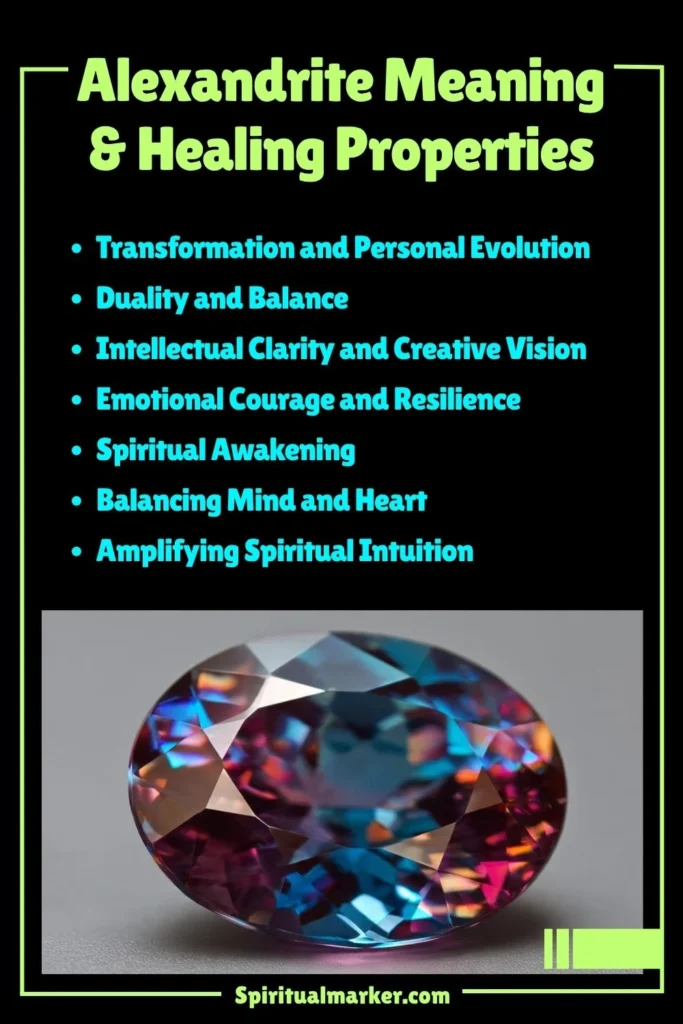
Alexandrite has fascinated gemologists, spiritual seekers, and collectors since its discovery in 19th-century Russia. Its dramatic color change is not a trick of the eye. It is a genuine optical phenomenon caused by the stone’s unusual chemical structure. In natural daylight, Alexandrite appears green or teal. Under incandescent or artificial light, it shifts toward red, raspberry, or violet. This ability to exist between two visual realities at once has shaped nearly every layer of its symbolic and spiritual meaning.
Across spiritual traditions, Alexandrite is considered a stone of transformation, duality, and balance. It represents the ability to hold two truths simultaneously without losing inner clarity. Many crystal practitioners connect it with personal evolution, adaptability, and the kind of spiritual insight that develops through lived experience rather than theory. Its energy is often described as intellectually stimulating, emotionally grounding, and quietly powerful.
This article explores the full meaning of Alexandrite, its spiritual symbolism, healing properties, historical background, and how people use it in spiritual practice today. You will also find practical guidance on wearing and caring for Alexandrite jewelry while honoring both its physical nature and spiritual significance.
Key Takeaways
- Alexandrite symbolizes transformation, duality, balance, and personal evolution through its unique color-changing phenomenon.
- Many spiritual traditions associate Alexandrite with the crown and heart chakras, supporting both emotional wisdom and higher spiritual insight.
- People use Alexandrite during meditation, life transitions, emotional healing, and creative pursuits because of its balancing energy.
- Alexandrite is one of the rarest gemstones on Earth, with natural specimens from Russia among the most valuable in existence.
- Wearing Alexandrite jewelry is believed to strengthen adaptability, self-awareness, and spiritual clarity during periods of significant change.
What Is Alexandrite?
Alexandrite is a chromium-bearing variety of chrysoberyl, a mineral composed of beryllium aluminum oxide. What makes it genuinely extraordinary among gemstones is its alexandrite effect, the technical name for its dramatic color shift. No other gemstone of significant popularity changes color as clearly or as strikingly as high-quality Alexandrite.
The color change happens because chromium absorbs specific wavelengths of light differently. Sunlight carries more blue and green wavelengths, pushing the stone toward green. Incandescent light carries more red wavelengths, pulling the stone toward red. The human eye perceives this as a complete color transformation rather than a subtle shift in tone.
In gem quality assessments, the strength and clarity of the color change determines value. A fine Alexandrite shifts from pure green in daylight to deep raspberry red under lamplight. Lesser specimens may shift from grayish green to purplish brown. Russian Alexandrites, which are the original and most prized specimens, typically display the most saturated and dramatic color change of any specimens found anywhere in the world.
Many people confuse Alexandrite with color-change sapphires or garnets. However, Alexandrite remains distinct in composition, rarity, and the intensity of its optical shift. Spiritually, no other gemstone carries the same concentrated symbolism around duality, transformation, and living between two states of being.
Origins and Formation
Alexandrite forms in pegmatites and metamorphic rocks where chromium, beryllium, and aluminum exist together under precise geological conditions. That combination is extremely rare in nature. Chromium and beryllium rarely share the same geological environment because they require very different chemical conditions to appear together. When those conditions align, Alexandrite forms. The rarity of that alignment explains why natural Alexandrite remains one of the most expensive gemstones per carat in the world.
The stone was discovered in Russia’s Ural Mountains in 1830, reportedly on the birthday of Tsar Alexander II. It was named in his honor. Early Russian specimens displayed the most vivid color change ever recorded, shifting between emerald green and deep red. Because those were the colors of Imperial Russia, Alexandrite quickly became a national gemstone and a symbol of pride.
Russia’s original deposits became largely depleted during the 20th century. New deposits have since appeared in Sri Lanka, Brazil, East Africa, Madagascar, India, and Zimbabwe. Brazilian Alexandrite, particularly from Minas Gerais, has produced some impressive specimens. Sri Lankan stones often show a softer color shift but carry beautiful clarity. However, fine Russian Alexandrite still commands the highest prices among collectors and spiritual practitioners alike.
Synthetic Alexandrite is widely available and often used in commercial jewelry. Lab-grown Alexandrite carries the same chemical composition as natural specimens but lacks the geological history and rarity that make natural stones so significant in spiritual traditions.
Key Properties
| Property | Details |
|---|---|
| Mineral Family | Chrysoberyl |
| Chemical Composition | Beryllium aluminum oxide with chromium |
| Color in Daylight | Green, teal, blue-green |
| Color in Artificial Light | Red, raspberry, violet |
| Hardness | 8.5 on the Mohs scale |
| Chakra Association | Crown chakra, Heart chakra |
| Primary Symbolism | Transformation, duality, balance, clarity |
| Main Sources | Russia, Brazil, Sri Lanka, East Africa |
| Transparency | Transparent to translucent |
| Energy Style | Intellectually stimulating, emotionally balancing |
Historical Significance of Alexandrite
Russian aristocracy embraced Alexandrite immediately after its discovery. The stone carried the dual colors of the Russian Imperial Guard, and many believed it brought good fortune, protection in battle, and royal favor. It became deeply woven into Russian cultural identity throughout the 19th century.
Beyond Russia, Victorian-era jewelers across Europe quickly adopted Alexandrite into fine jewelry because its color-change quality created an element of magic that no other stone could replicate. Victorian England associated Alexandrite with luck, love, and emotional fidelity. Engagement rings, brooches, and commemorative pieces from this era frequently featured Alexandrite alongside diamonds and pearls.
In Hindu spiritual traditions, certain texts describe gemstones with chromatic properties as energetically aligned with celestial bodies. Some practitioners link Alexandrite with Mercury, associating it with intelligence, communication, creative thinking, and adaptability. These connections reinforced the stone’s association with sharp mental clarity and personal evolution.
In Japanese spiritual culture, Alexandrite became popular during the 20th century and was associated with good omens, prosperity, and the wisdom to navigate life’s changing circumstances. Its ability to appear different under changing conditions resonated with philosophical ideas about impermanence and the wisdom of adaptability.
Modern metaphysical traditions have expanded these associations significantly. Crystal healers today connect Alexandrite with emotional transformation, spiritual evolution, and the courage to embrace change. Its history stretches across cultures, but its core symbolism remains remarkably consistent: the ability to hold beauty, strength, and wisdom across changing conditions.
5 Spiritual Meanings of Alexandrite
1. Transformation and Personal Evolution
Alexandrite’s most fundamental spiritual meaning is transformation. Its color-changing nature is not simply an aesthetic curiosity. Spiritually, it represents the human ability to adapt, evolve, and reveal different dimensions of self under changing life circumstances.
Real transformation rarely feels elegant while it is happening. People going through major personal changes often experience confusion, fear, grief, or disorientation. A person leaving a long-term relationship, shifting careers, or recovering from significant loss may feel temporarily lost between identities. They are no longer who they were before, yet have not fully arrived at who they are becoming.
Alexandrite spiritually mirrors this in-between state. It exists simultaneously between green and red, between two complete identities, while remaining wholly itself in both. Many spiritual traditions view this as its most powerful teaching. The stone reminds you that transformation does not require losing yourself. It requires trusting that you remain whole even when your circumstances, roles, or self-perception are shifting dramatically.
Crystal practitioners often bring Alexandrite into their practice during major life transitions. Career reinvention, grief recovery, divorce, relocation, and spiritual awakening are common contexts. The stone symbolizes not just the change itself, but the inner wisdom and resilience that carry a person from one chapter of life into the next.
Ancient philosophical traditions often described wisdom as the ability to hold opposing truths without losing balance. The Stoics, Vedic teachers, and Buddhist philosophers all emphasized adaptability as a mark of mature spiritual development. Alexandrite embodies this ancient insight within its optical nature. Its green-to-red shift reflects the duality that exists within every human experience, the tension between stability and change, knowing and not knowing, ending and beginning.
Its symbolism becomes especially meaningful during periods when change feels forced rather than chosen. Circumstances do not always allow people to transform gradually. Sometimes loss, illness, or external events demand rapid adaptation. Alexandrite represents finding inner steadiness within those forced transitions. Its energy is associated with personal resilience, creative problem-solving, and the courage to continue forward even when the path ahead is unclear.
2. Duality and Balance
The spiritual meaning of duality sits at the heart of Alexandrite’s symbolism. Many people experience internal conflict between different aspects of themselves. Ambition competes with contentment. Logic battles emotion. The desire for connection conflicts with the need for solitude. These tensions are not signs of imbalance. They are natural features of conscious human experience.
Alexandrite symbolizes the wisdom of holding duality without forcing resolution. Not every internal tension requires choosing one side and eliminating the other. A person can be both cautious and courageous. Both introverted and deeply loving. Both analytical and deeply intuitive. Alexandrite spiritually represents the richness of that complexity rather than the anxiety of contradiction.
In many Eastern philosophical traditions, balance does not mean the elimination of opposites. The Taoist concept of yin and yang describes a world where opposing forces constantly interact, flow into each other, and create wholeness through their relationship. Alexandrite visually embodies this idea. Its green and red are not in conflict. They are both authentic expressions of the same stone viewed under different conditions.
Many spiritual practitioners use Alexandrite to support decision-making during periods of internal conflict. When facing genuinely difficult choices involving competing values, the stone symbolizes the patience to see multiple perspectives clearly before acting. Its energy is associated with mental clarity, emotional steadiness, and the ability to recognize nuance in complex situations.
Duality also applies to the relationship between inner and outer life. Many people present a carefully managed version of themselves to the external world while experiencing a very different internal emotional reality. Alexandrite spiritually encourages alignment between inner truth and outer expression. Its symbolism centers on authenticity and the gradual reduction of the gap between who you feel yourself to be and how you present yourself in daily life.
This balance between inner and outer reality has practical spiritual implications. People who live in significant misalignment between their inner values and outer behavior often experience chronic low-grade emotional discomfort. Alexandrite’s symbolic teaching encourages honest self-reflection as the first step toward resolving that disconnect, not through dramatic confrontation but through patient, honest self-awareness over time.
3. Intellectual Clarity and Creative Vision
Alexandrite is frequently associated with sharp mental clarity, creative inspiration, and visionary thinking. Its connection with the crown chakra, the energy center linked with higher thought, spiritual insight, and mental expansion, gives it a different quality from purely emotionally focused stones.
Many creative practitioners, writers, musicians, scientists, and artists have historically valued stones associated with Mercury, the planet of communication and intellect, for their supposed influence on mental flow. Alexandrite’s traditional association with Mercury in Hindu gem traditions reflects this long-standing belief that the stone supports intellectual agility, quick thinking, and inspired creative problem-solving.
Creative blocks often stem from mental rigidity. When a person becomes fixed on one way of seeing a problem, creative solutions remain invisible. Alexandrite symbolically encourages seeing from multiple angles simultaneously, much as it presents multiple visual realities depending on the light source. Many practitioners use it during creative work, academic study, or complex decision-making when fresh perspective feels elusive.
Writers experiencing creative paralysis, musicians seeking new harmonic directions, and professionals navigating complex negotiations have all been drawn to Alexandrite’s energy within creative and intellectual healing traditions. Its symbolism does not promise miraculous creative breakthroughs. Rather, it represents the mental flexibility and openness that allow original ideas to emerge.
Intellectual clarity in spiritual traditions also involves recognizing which beliefs and mental frameworks no longer serve your growth. Over time, people accumulate assumptions, prejudices, and mental habits that shape perception in ways that are not always helpful. Alexandrite symbolizes the mental courage to question established mental patterns and remain genuinely open to seeing reality differently.
This quality connects Alexandrite’s intellectual symbolism with its transformation meaning. Personal evolution requires both emotional willingness and mental flexibility. The stone spiritually supports both dimensions simultaneously, which is one reason so many practitioners describe its energy as unusually comprehensive compared to stones with more narrowly defined metaphysical associations.
4. Emotional Courage and Resilience
Alexandrite is not primarily viewed as a soft emotional stone, unlike rose quartz or green opal. Its emotional associations tend to center on courage, resilience, and the psychological strength to face difficult realities without emotional collapse. Many crystal traditions describe its energy as emotionally fortifying rather than emotionally soothing.
Emotional courage is different from emotional numbness. A person who is emotionally numb feels little because they have shut themselves off from emotional experience. A person with emotional courage feels everything but develops the inner resources to process those feelings without being overwhelmed by them. Alexandrite spiritually represents the development of that emotional strength.
People recovering from trauma, grief, profound loss, or chronic emotional difficulty sometimes feel that gentle emotional stones do not match where they are emotionally. They do not need softness. They need strength. Alexandrite serves this emotional need. Its energy is associated with standing firmly in emotional truth, acknowledging pain without pretending it does not exist, and continuing to move forward despite emotional difficulty.
Resilience in psychological research is consistently linked with adaptability. Studies show that people who recover most effectively from adversity tend to share a common quality: they can adjust their expectations, responses, and strategies as circumstances change rather than remaining rigidly fixed on how things “should” be. Alexandrite spiritually embodies this adaptive resilience. Its ability to remain beautiful and whole while shifting between completely different visual states mirrors the psychological capacity to remain fundamentally yourself while adapting to circumstances beyond your control.
Many practitioners also associate Alexandrite with emotional honesty. Because the stone itself does not pretend to be only one thing, its symbolism encourages people to stop pretending that life is simpler or less painful than it actually is. Emotional honesty, according to many healing traditions, is the true beginning of resilience. You cannot heal what you will not acknowledge.
5. Spiritual Awakening and Higher Consciousness
In many metaphysical traditions, Alexandrite is considered a high-vibration stone associated with spiritual awakening, expanded consciousness, and the development of spiritual intuition. Its crown chakra connection places it among stones believed to support access to higher states of awareness and spiritual insight.
Spiritual awakening rarely unfolds as a single dramatic moment. More often, it develops gradually through accumulated experiences, reflective practices, emotional healing, and a growing willingness to question previously unexamined assumptions about reality, self, and purpose. Alexandrite symbolizes this gradual deepening of spiritual awareness rather than overnight enlightenment.
Many meditation practitioners and spiritual seekers use Alexandrite to support deeper states of contemplation and inner stillness. Its association with clarity and expanded perception makes it useful for practices aimed at moving beyond surface-level mental activity into more expansive states of awareness. Some describe it as a stone that helps dissolve the boundary between ordinary thinking and intuitive knowing.
Spiritual traditions across multiple cultures describe advanced spiritual development in terms of the ability to perceive unity beneath apparent diversity. Different phenomena appear separate on the surface but share a common underlying reality. Alexandrite’s dual-color nature carries this teaching in a visually immediate way. One stone, two realities, one underlying truth. Many practitioners view this as a precise physical metaphor for advanced spiritual perception.
Its energy is also associated with psychic sensitivity and intuitive accuracy. Some practitioners believe Alexandrite strengthens the ability to read situations accurately beyond what rational analysis alone can reveal. This is not about supernatural claims but about the development of deeply integrated knowing that draws on emotional intelligence, experiential wisdom, and pattern recognition simultaneously.
Spiritual growth also requires the courage to release certainty. Many people seek spiritual practice partly because they want definitive answers about life, death, purpose, and reality. Mature spiritual development often involves becoming comfortable with mystery rather than eliminating it. Alexandrite symbolically reflects the capacity to live fully and wisely within uncertainty, adapting with grace rather than demanding that life conform to fixed expectations.
6 Healing Properties of Alexandrite
1. Supporting Emotional Transformation
Alexandrite is a powerful ally during emotional transformation because its energy does not try to rush or soften the process. It reflects emotional change as something real, necessary, and ultimately strengthening. Many crystal practitioners turn to it when they are navigating emotional states that feel too complex or intense for gentler stones.
Emotional transformation involves moving through layers of feeling rather than around them. People often try to bypass difficult emotions through distraction, denial, or forced positivity. While those strategies may provide temporary relief, they frequently leave emotional residue that accumulates and resurfaces later. Alexandrite’s healing symbolism encourages authentic emotional processing at whatever pace feels genuine.
Its grounding quality prevents emotional overwhelm during this process. Many practitioners describe it as providing emotional structure, a stable inner framework from which to examine difficult feelings without losing psychological footing. That stability is particularly valuable during grief, trauma recovery, or significant relationship endings when emotional disorientation can feel destabilizing.
Emotional transformation also involves the gradual development of new emotional patterns. Old patterns of reactivity, emotional avoidance, or emotional suppression do not disappear immediately. They shift slowly as new emotional responses are practiced consistently. Alexandrite symbolically reflects this patient, layered quality of emotional growth, reminding you that genuine transformation builds steadily over time.
2. Balancing Mind and Heart
A recurring tension in human experience involves the relationship between intellect and emotion. Many people feel pulled between what they think they should do and what they feel drawn toward. This tension creates internal friction that can manifest as chronic indecision, emotional exhaustion, or a persistent sense of living slightly out of alignment with oneself.
Alexandrite is believed to support the balance between mind and heart because of its dual chakra associations. Its crown chakra connection supports mental clarity, higher reasoning, and intellectual organization. Its heart chakra connection encourages emotional awareness, compassion, and authentic feeling. Together, these associations make it one of the few stones specifically linked with integrating thought and feeling rather than prioritizing one over the other.
Psychological research supports the value of this integration. Emotional intelligence, which involves accurately recognizing, understanding, and managing emotions while using them wisely in thinking and decision-making, consistently predicts better outcomes in relationships, professional performance, and personal well-being than pure intellectual ability alone. Alexandrite spiritually reflects this integration as a central healing property.
Many practitioners use it when navigating decisions that involve both logical and emotional dimensions simultaneously. Major life choices rarely reduce to pure logic or pure feeling. A person deciding whether to accept a job offer in a new city may have compelling intellectual reasons to go and compelling emotional reasons to stay. Alexandrite’s healing energy symbolizes the clarity needed to weigh both honestly and make a decision that honors the whole person.
3. Building Adaptability During Life Changes
Adaptability is one of the most practically valuable psychological qualities in human life. People who adapt effectively to changing circumstances tend to experience greater resilience, lower chronic stress, stronger emotional health, and greater professional success than those who require fixed conditions to function well. Alexandrite’s healing properties center significantly on building this quality.
Life changes arrive in many forms. Some are chosen: a new career, a deliberate lifestyle shift, or a conscious decision to leave an unhealthy relationship. Others are unchosen: job loss, illness, bereavement, or external circumstances that force rapid adaptation regardless of readiness. Alexandrite’s healing symbolism applies to both types, though it becomes especially significant when change arrives without invitation.
During unchosen transitions, the instinctive emotional response often involves resistance. Resistance is natural and emotionally understandable. A person wants things to return to how they were before. They grieve the lost reality. They may feel anger, fear, or profound sadness about what can no longer exist. Alexandrite does not symbolize bypassing those feelings. It represents carrying those feelings forward with grace rather than being immobilized by them.
The stone’s healing property in this context involves reinforcing the inner knowledge that change can be survived. For many people, the deepest fear is not the specific change itself but the belief that they may not be capable of navigating it. Alexandrite’s symbolism quietly challenges that belief. It represents a proven capacity for transformation and the inherent resilience available when you allow it to surface.
4. Stimulating Creative Healing
Creative expression has long been recognized as a powerful healing modality. Art therapy, music therapy, journaling, movement, and other creative practices help people process emotions that resist verbal articulation. Grief, trauma, confusion, and complex emotional experiences often feel too large or too layered for ordinary conversation. Creativity provides a different access point.
Alexandrite is associated with creative healing because of its connection with both intellectual clarity and emotional depth simultaneously. Creative work benefits from both qualities. Purely intellectual creative practice can feel cold, technical, and emotionally disconnected. Purely emotional creative practice can feel chaotic and directionless. The integration of mental clarity and emotional authenticity creates the conditions where truly resonant creative expression tends to emerge.
Many artists, writers, and musicians who work with crystals report that Alexandrite supports creative periods marked by thematic complexity. Work that explores contradiction, duality, change, or multidimensional human experience may benefit particularly from its energy. The stone itself embodies those themes so completely that its symbolic resonance with complex creative work feels natural.
Creative healing also involves allowing imperfect expression without judgment. Many people abandon creative healing practices because they feel they are not skilled enough to make “good” creative work. Alexandrite’s healing association with self-compassion and process-over-outcome thinking supports the willingness to create for the sake of emotional release rather than external evaluation.
5. Reducing Existential Anxiety
Existential anxiety refers to the deep unease that arises when people confront life’s fundamental uncertainties. Questions about purpose, identity, meaning, mortality, and the reliability of circumstances can create a persistent low-level psychological discomfort that no practical solution can fully resolve because the questions themselves resist definitive answers.
Alexandrite is specifically connected with this type of anxiety within metaphysical traditions because its nature addresses uncertainty directly. The stone does not pretend to be only one thing. It shifts, adapts, and remains beautiful through its own instability. For people struggling with existential anxiety, this can feel genuinely reassuring rather than merely symbolic.
Many spiritual traditions suggest that existential anxiety diminishes as acceptance of uncertainty deepens. When a person stops demanding certainty before engaging fully with life, the anxiety’s grip tends to loosen. Practices that support this acceptance include meditation, philosophical reflection, contemplative prayer, and working with symbols that embody graceful uncertainty. Alexandrite functions powerfully in this symbolic role.
Its healing association with existential anxiety also involves reconnecting with personal identity beneath changing circumstances. Many people feel anxious when major life changes challenge their sense of who they are. A person defined by their career may feel existentially lost after job loss. Someone defined by a relationship may feel identity-less after a breakup. Alexandrite symbolically reminds you that your core self remains constant even when the circumstances that once seemed to define you have changed.
6. Amplifying Spiritual Intuition
Many crystal practitioners use Alexandrite to support the development of spiritual intuition, the capacity to access accurate knowing that moves beyond ordinary rational analysis. This property reflects its crown chakra association and its historical connection with higher forms of perception across multiple cultural traditions.
Spiritual intuition is not magical thinking. It represents the integration of experiential wisdom, emotional intelligence, subconscious pattern recognition, and mindful awareness into a form of knowing that sometimes arrives faster and more accurately than step-by-step reasoning alone. Many people experience moments of intuitive knowing that later prove accurate in ways they struggle to explain purely rationally.
Alexandrite is believed to strengthen the access to and accuracy of this intuitive capacity. By supporting mental clarity and emotional openness simultaneously, its energy may create the internal conditions where intuitive knowing can surface more reliably. Many practitioners describe the stone as helping them distinguish genuine intuition from emotionally biased thinking, a critical distinction in spiritual development.
Its use in divination practices, contemplative prayer, and spiritual discernment reflects this property. In situations requiring wisdom rather than simply information, Alexandrite’s energy is associated with the quality of inner stillness and expanded awareness that supports genuinely insightful perception.
How to Wear Alexandrite Jewelry for Spiritual Growth
Wearing Alexandrite jewelry is one of the most direct ways to maintain consistent energetic contact with the stone throughout daily life. Because its healing properties are associated with both the crown and heart chakras, different jewelry styles may support different intentions.
Rings are among the most traditional settings for Alexandrite. In many gem traditions, particularly those with roots in Vedic astrology and crystal healing, gemstone rings allow the stone consistent contact with the skin. The index finger and middle finger are traditionally associated with intention and personal power. Wearing Alexandrite on either may strengthen its association with personal clarity and decision-making.
Pendants worn near the heart emphasize its emotional healing properties. When you want to focus Alexandrite’s energy on emotional courage, relationship clarity, or heart-centered transformation, a pendant positioned at the center of the chest aligns it with the heart chakra’s location.
Earrings may support its crown chakra connection, particularly during meditation, creative work, or intellectual pursuits. Some practitioners wear Alexandrite earrings during writing sessions, study, or spiritual practice to encourage mental clarity and expanded perception.
Combining Alexandrite with complementary crystals is a common practice in crystal healing traditions. Clear quartz amplifies Alexandrite’s clarity properties. Labradorite shares its quality of revealing hidden dimensions and may deepen its intuitive associations. Amethyst supports its spiritual clarity and contemplative energy. Black tourmaline adds grounding when Alexandrite’s higher vibrational energy feels unanchored.
Many people wear Alexandrite during particularly important or emotionally complex days. Before difficult conversations, major decisions, creative presentations, or emotionally significant events, wearing the stone serves as a tangible reminder of the qualities you intend to embody: clarity, adaptability, balance, and resilience.
Caring for Alexandrite Jewelry
Alexandrite is one of the more durable gemstones, rating 8.5 on the Mohs hardness scale. This makes it significantly harder and less physically delicate than many crystals commonly used in spiritual practice. However, durability does not mean invulnerability. Proper care still matters for preserving both its physical beauty and long-term structural integrity.
Store Alexandrite separately from other jewelry to prevent contact scratches from or against other stones. Even though Alexandrite is hard, rubbing against diamonds or other very hard stones repeatedly may cause minor surface abrasion over time. A dedicated soft pouch or padded compartment works well.
Clean Alexandrite using warm water, mild soap, and a soft bristle brush. Avoid ultrasonic cleaners if the stone contains inclusions or fractures, as vibration may worsen existing internal weaknesses. Steam cleaning is generally safe for clean, inclusion-free Alexandrite but should be avoided for stones with visible internal features.
Avoid prolonged exposure to harsh chemicals. Chlorine in swimming pools, bleach-based cleaning products, and acidic substances can affect certain metal settings even if the stone itself remains unaffected. Remove Alexandrite rings and bracelets before cleaning, swimming, or using chemical-based household products.
The color-change quality of Alexandrite requires no special preservation. It is a permanent optical property built into the stone’s chemical structure rather than a treatment or coating that fades over time. Natural daylight and incandescent light will continue producing the color shift regardless of age.
For energetic cleansing, many practitioners prefer moonlight exposure during full moons, sound cleansing with singing bowls, or visualization practices. Because Alexandrite is associated with high vibration energy, some practitioners cleanse it more frequently during periods of heavy emotional or spiritual use. Others find that burying it briefly in dry soil reconnects it with grounding earth energy after extended use in high-energy practice.
Table: Alexandrite Meaning at a Glance
| Aspect | Details |
|---|---|
| Primary Meaning | Transformation, duality, and personal evolution |
| Chakra Association | Crown chakra and heart chakra |
| Main Spiritual Symbolism | Balance, adaptability, clarity, resilience |
| Color in Daylight | Green, teal, blue-green |
| Color Under Artificial Light | Red, raspberry, violet |
| Hardness | 8.5 Mohs |
| Main Sources | Russia, Brazil, Sri Lanka, East Africa |
| Emotional Associations | Courage, resilience, authenticity, clarity |
| Popular Jewelry Types | Rings, pendants, earrings |
| Spiritual Uses | Meditation, creative work, life transitions, intuition |
| Care Needs | Mild soap, soft brush, separate storage |
| Planetary Association | Mercury (in Vedic traditions) |
A Final Note
Alexandrite stands apart from nearly every other gemstone because its meaning is inseparable from its nature. Most stones carry symbolic associations built from cultural interpretation over centuries. Alexandrite’s symbolism grows directly from what the stone actually does. It transforms. It holds two realities at once. It remains whole through change.
Its spiritual teachings around transformation, duality, resilience, and clarity feel especially relevant today. Change arrives faster and less predictably than most people can comfortably process. The ability to adapt while maintaining inner integrity, to see from multiple perspectives without losing a stable sense of self, and to find beauty in the space between endings and beginnings represents a form of wisdom that Alexandrite has symbolized for nearly two centuries.
Whether you are drawn to Alexandrite for its extraordinary beauty, its metaphysical properties, or the personal resonance its symbolism creates, the stone rewards attention. Look at it in sunlight, then move it under a lamp. Watch its entire color shift completely while remaining the same stone throughout. That visual moment carries the stone’s deepest teaching without requiring any words at all.
If Alexandrite has drawn your attention, consider what that connection might reflect about where you currently are in your own journey. People rarely gravitate toward symbols that have nothing to do with their inner life. The gemstone that calls to you most strongly may be speaking to the qualities you are in the process of developing, the transformation already quietly unfolding within you.