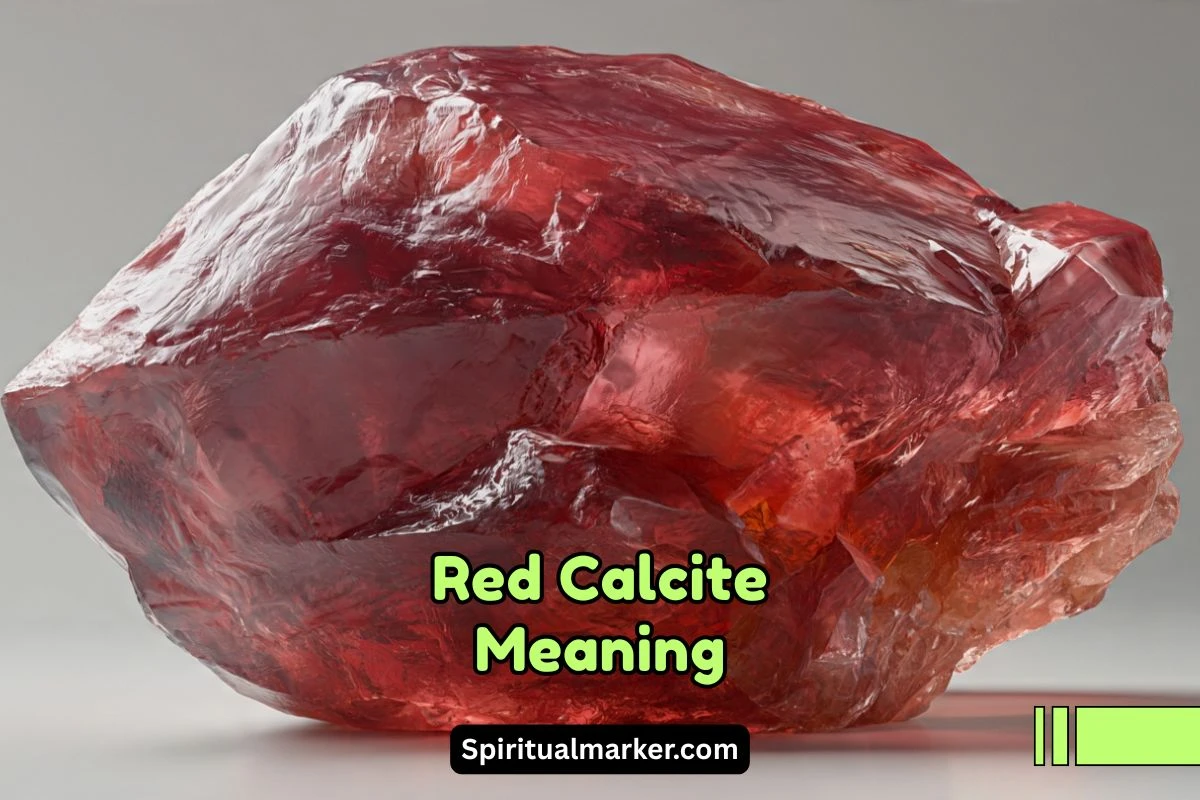
Red calcite glows with a warm, vibrant energy. Its color evokes fire, passion, and vitality. In spiritual practice, this stone carries stimulating and grounding energy.
The red calcite meaning often involves energy, motivation, and emotional healing. It is a stone of the root and sacral chakras, helping to boost vitality and creativity. A spiritual meaning of yellow calcite shares that calcite focus, though yellow carries a more mental energy.
Red calcite is used in crystal healing to overcome fatigue, increase confidence, and stimulate passion. It can also symbolize courage and action. The stone's energy is warm and motivating.
If you feel drawn to red calcite, it may signal a need for energy. A spiritual meaning of garnet also deals with red stones, though garnet carries a more grounding energy.
5 Key Takeaways
- Red calcite symbolizes vitality, courage, emotional resilience, and root chakra activation.
- Many spiritual traditions connect red calcite with physical energy, grounding, and life-force restoration.
- People often use red calcite during burnout recovery, fear-based patterns, low motivation, and spiritual disconnection.
- Red calcite ranks between 3 and 3.5 on the Mohs hardness scale, making it softer than many popular crystals.
- Wearing or carrying red calcite close to the body may strengthen feelings of safety, personal power, and energetic stability.
What Is Red Calcite?
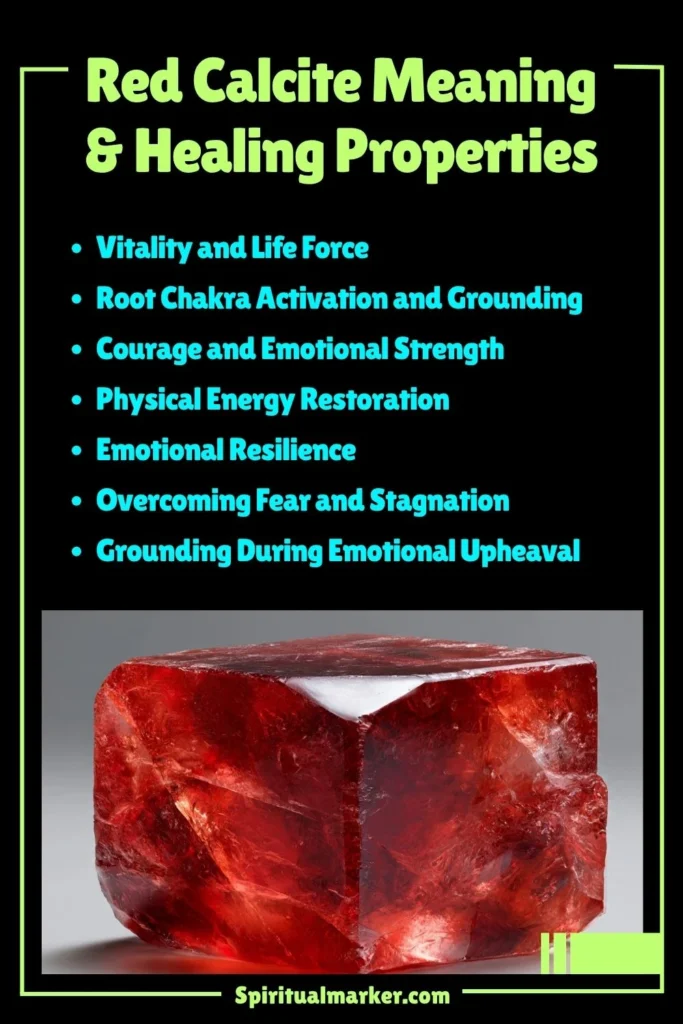
Red calcite is a calcium carbonate mineral that belongs to the calcite family. It gets its distinctive red, orange-red, or brick-red color from iron oxide impurities embedded within its crystalline structure. These iron compounds are responsible for the warm, earthy tones that make red calcite visually striking. No two pieces look exactly alike. Some show deep crimson hues, while others appear coral, rust, or brownish-red depending on mineral concentrations and regional geology.
Calcite itself is one of the most common minerals on Earth. It forms in a wide variety of geological environments including limestone caves, hydrothermal veins, and sedimentary rock beds. Red calcite in particular tends to form in areas where iron-rich fluids have moved through calcium carbonate deposits over long periods of geological time. That slow, pressurized formation contributes to its symbolic association with patience, endurance, and inner strength.
Many people compare red calcite to red jasper or carnelian because all three stones share warm red tones and energizing reputations. However, red calcite differs structurally. It is notably softer, more translucent in thin sections, and carries a distinctly earthy, grounding energy rather than the more stimulating charge often associated with carnelian. Spiritually, red calcite feels more stabilizing than activating. It grounds rather than excites.
Origins and Formation
Red calcite forms through a process called mineral precipitation. When calcium-rich water moves through rock formations and evaporates, it deposits calcium carbonate that slowly crystallizes over time. Iron-rich groundwater introduces the iron oxide compounds that give the stone its signature red coloring. This process often occurs inside caves, fractures, and sedimentary layers where conditions remain stable for long geological periods.
Major deposits of red calcite appear across several regions worldwide. Mexico produces some of the most recognized specimens, valued for their deep, consistent red coloring and relatively large crystal formations. The United States, particularly in states like Arizona and New Mexico, also yields quality red calcite. Additional sources include Peru, Morocco, Romania, and parts of Eastern Europe where iron-rich geological formations are common.
Mexican red calcite, sometimes called rojo calcite, holds particular significance among crystal collectors and spiritual practitioners. Its color tends toward rich brick-red and terra cotta shades that feel visually warm and deeply earthy. Many healers specifically seek out Mexican specimens for root chakra work because the color resonates strongly with grounding and physical vitality symbolism.
The stone’s relatively soft structure also plays a role in its symbolic meaning. Calcite does not resist transformation the way harder minerals do. It dissolves slowly in acidic conditions, shapes itself into caves and caverns, and exists in a state of gradual geological change. Many spiritual traditions view this as a metaphor for emotional flexibility and the willingness to release rigid patterns that no longer serve.
Key Properties
| Property | Details |
|---|---|
| Color | Brick red, crimson, coral, rust, orange-red |
| Composition | Calcium carbonate (CaCO₃) with iron oxide inclusions |
| Hardness | 3 to 3.5 on the Mohs scale |
| Chakra Association | Primarily the root chakra (Muladhara) |
| Symbolism | Vitality, courage, grounding, emotional resilience |
| Common Sources | Mexico, USA, Peru, Morocco, Romania |
| Transparency | Translucent to opaque |
| Energy Style | Grounding, energizing, stabilizing, courage-building |
Historical Use and Cultural Significance
Red stones have carried deep symbolic weight across cultures for as long as recorded history. Ancient Egyptians associated red minerals with life-giving blood, the power of the sun, and protection from spiritual harm. Red ochre, a naturally occurring iron-rich pigment closely related to the compounds that color red calcite, appears in burial sites, ritual art, and ceremonial objects dating back more than 100,000 years. Researchers have found red ochre used in some of the earliest known human spiritual rituals.
In Mesoamerican cultures, red was the color of the east and the rising sun. It represented new beginnings, life force, and the animating energy that moves through all living things. Red minerals and stones featured prominently in ritual contexts across Aztec and Mayan traditions. While calcite specifically was not always named, red earth minerals formed an important part of ceremonial life, art, and spiritual practice.
In traditional Chinese medicine and spiritual philosophy, red is associated with fire energy, the heart, and yang vitality. Red stones were considered tonifying, meaning they were believed to strengthen and restore depleted physical and spiritual energy. This aligns closely with how modern crystal healers use red calcite today.
European alchemical traditions also valued red minerals as symbols of transformation, passion, and the integration of physical and spiritual energies. The color red appeared repeatedly in alchemical illustrations representing the final stages of spiritual transformation, a concept known as the rubedo or reddening. Red calcite, with its earthy stability and warming energy, fits naturally into this symbolic history.
5 Spiritual Meanings of Red Calcite
1. Vitality and Life Force
The most fundamental red calcite meaning centers on vitality. The stone’s deep red color connects directly with the symbolic language of blood, fire, and the raw energy of being alive. Many spiritual traditions view the color red as the most physically anchored color in the visible spectrum. It represents the body itself, the pulse of life, and the animating force that keeps a person moving, creating, and engaging with the world around them.
When a person experiences genuine physical exhaustion, not simply tiredness but the kind of deep fatigue that settles into the bones and dims motivation, red calcite symbolizes the restoration of that core energy. It does not represent excitement or nervous stimulation. Its symbolism is much more foundational. Red calcite points toward the steady, persistent energy that makes it possible to show up every day even when life feels heavy.
This meaning becomes especially relevant in a modern world where burnout has become increasingly common. Research published in sources like the World Health Organization’s classification of burnout as an occupational phenomenon highlights how widespread chronic energy depletion has become. Red calcite symbolically addresses this depletion at its deepest level by reconnecting a person with the life force energy that exhaustion quietly erodes.
Many practitioners describe red calcite as a stone for people who have given too much for too long. Its energy symbolizes replenishment rather than forced motivation. That distinction matters enormously. Forcing energy produces short-term results. Restoring foundational vitality creates lasting change. Red calcite spiritually represents the slower, more sustainable path back to genuine physical and emotional aliveness.
2. Root Chakra Activation and Grounding
Red calcite holds one of its strongest spiritual associations with the root chakra, known in Sanskrit as Muladhara. The root chakra sits at the base of the spine and governs a person’s fundamental sense of safety, stability, belonging, and physical groundedness. When this energy center functions well, a person feels secure in their body, anchored in the present moment, and capable of meeting life’s challenges from a stable emotional foundation.
A disrupted root chakra creates recognizable patterns. A person may feel chronically anxious without clear cause, disconnected from their body, financially fearful, physically unwell, or emotionally reactive in ways that feel disproportionate to circumstances. Many people live with low-grade root chakra imbalance for years without identifying its source. Red calcite spiritually addresses this foundational disruption.
The root chakra governs what is sometimes called survival energy, the primal, instinctual drive to exist safely and meet basic needs. When that energy feels threatened or depleted, it ripples upward through every other aspect of life. Relationships feel unstable. Creativity feels blocked. Spiritual connection feels distant. Red calcite symbolically works at the root of these challenges by restoring the grounded foundation that all other growth requires.
Grounding itself is a concept that appears across many spiritual traditions. Ancient earth-based religions treated physical groundedness as a sacred act, a way of honoring the body’s connection with the living earth beneath it. Modern mindfulness practices recognize the psychological value of present-moment physical awareness. Red calcite bridges both worlds. It symbolizes grounding as both a spiritual practice and a psychological necessity.
3. Courage and Emotional Strength
Red calcite carries strong symbolism around courage, not the dramatic heroic kind, but the quieter, more personal courage that gets people through genuinely difficult life experiences. The courage to leave something that no longer serves. The courage to stay present during grief. The courage to set a boundary that feels frightening. The courage to begin again after failure. These everyday acts of bravery require deep emotional reserves, and red calcite symbolically supports exactly that reservoir.
Fear has a way of contracting a person’s world. When fear becomes the dominant emotional experience, choices narrow, creativity diminishes, and relationships suffer. Many people live in chronic low-level fear so normalized that they no longer recognize it as fear at all. They simply know that certain situations feel impossible, certain conversations feel overwhelming, and certain changes feel unthinkable. Red calcite symbolizes the energetic warmth that slowly loosens those contractions.
In many ancient warrior traditions, red stones were carried into battle or worn as protective talismans. This was not merely superstition. It reflected a genuine psychological reality. Symbolic objects that represent courage, protection, and strength can measurably affect a person’s confidence and resolve. Modern psychology calls this enclothed cognition, the way symbolic objects and clothing influence mental states and behavior. Red calcite functions as a physical symbol of inner courage.
Emotional strength and courage also connect deeply with resilience. Resilience is not the absence of pain or difficulty. It is the capacity to move through pain without being permanently defeated by it. Red calcite symbolizes that enduring quality. Its earthy, stable red energy represents the part of a person that can absorb difficulty, process it honestly, and continue forward with greater emotional depth than before.
4. Passion and Personal Power
Red calcite symbolizes passion in its most grounded, sustainable form. This is not the frantic passion of unchecked impulse. It is the deep, steady passion that comes from knowing what truly matters and committing to it regardless of obstacles. Many people lose touch with genuine passion during long periods of stress, obligation, or emotional suppression. Red calcite spiritually represents the rediscovery of that authentic inner drive.
Personal power is a concept often misunderstood in spiritual circles. True personal power does not mean dominance over others. It means sovereignty over oneself. It means making choices from a place of clarity and self-awareness rather than fear, obligation, or external pressure. Red calcite’s symbolic connection with the root chakra grounds this personal power in physical reality rather than keeping it abstract or conceptual.
Many people who feel powerless in their lives have actually disconnected from their body’s wisdom. Trauma, chronic stress, emotional suppression, and prolonged anxiety can all create a sense of dissociation from the physical self. When you lose the body, you often lose your sense of personal agency along with it. Red calcite symbolically helps restore that mind-body connection, which forms the foundation of authentic personal power.
Passion and personal power also influence creativity. Many artists, writers, entrepreneurs, and healers experience periods where creative energy simply vanishes. The ideas stop flowing. Projects feel hollow. Motivation disappears. This creative depletion often connects to deeper energetic or emotional exhaustion. Red calcite symbolizes the restoration of creative fire by addressing its foundational source, the raw vital energy that passion draws from.
5. Protection and Energetic Boundaries
Red calcite carries protective symbolism that appears consistently across multiple spiritual traditions. Red stones in general have long been associated with creating a strong energetic field around the person carrying them. This protective quality is not aggressive or forceful. It is more like a steady, warm boundary that says clearly: this far and no further. Red calcite represents that kind of grounded, self-respecting protection.
Energetic boundaries are a concept that bridges spiritual traditions and modern psychology. Psychologically, healthy boundaries allow a person to maintain their own emotional identity while engaging fully with others. Without boundaries, people absorb the emotional states and energy of everyone around them, becoming emotionally exhausted, resentful, or destabilized. Red calcite symbolically supports the energetic equivalent of this psychological necessity.
Some spiritual practitioners use red calcite specifically when entering environments that feel energetically draining. Places with intense collective stress, emotionally volatile relationships, or situations that consistently leave a person feeling depleted may benefit from the stabilizing protection this stone symbolizes. The grounding quality of its root chakra energy helps maintain a person’s energetic coherence even in challenging external circumstances.
Protection symbolism in red calcite also extends inward. Many people need protection not from external threats but from their own internal critic, the harsh, relentless voice that amplifies self-doubt, shame, and fear. Red calcite’s warm, grounding energy symbolically creates a barrier against that internal erosion. It represents the steadiness that allows a person to acknowledge difficulty without being destroyed by self-judgment.
6 Healing Properties of Red Calcite
1. Physical Energy Restoration
Red calcite has earned a strong reputation as a physical energy stone among crystal healing practitioners. Its root chakra association directly connects it with the body’s most fundamental energy systems. Many people seek out red calcite specifically when they feel physically exhausted beyond normal tiredness, when rest does not seem to restore energy, or when the body feels heavy and unmotivated despite adequate sleep.
Within crystal healing traditions, red calcite is believed to support the adrenal glands, the blood, and the circulatory system. These beliefs do not replace medical treatment, but they reflect an intuitive understanding that red calcite’s energy speaks to the physical body in particularly direct ways. Its warming, vitalizing symbolism aligns with the body parts most associated with sustained physical energy.
Physical energy restoration through red calcite also relates to motivation. Motivation is not purely psychological. It has a deep somatic, or body-based, component. When the body feels depleted, the mind often follows. Decision-making becomes harder. Simple tasks feel monumental. Enthusiasm fades. Red calcite symbolically addresses this physical root of motivational depletion rather than treating motivation as a purely mental challenge that willpower alone can fix.
Many practitioners place red calcite near the base of the spine during meditation or lying-down healing sessions. This placement intentionally aligns the stone with the root chakra’s location, amplifying the symbolic connection between the stone’s energy and the body’s foundational vitality center. Others simply carry a tumbled red calcite stone in a pocket throughout the day, maintaining ongoing physical contact with its grounding energy.
2. Emotional Resilience
Red calcite supports emotional resilience in a particularly grounded way. Where some healing stones address emotional pain through softness and release, red calcite approaches emotional healing through stability. It strengthens the emotional foundation so that difficult feelings can be experienced without becoming overwhelming. This distinction is important. Resilience is not the absence of emotional pain. It is the capacity to remain functional and self-aware while moving through it.
People often turn to red calcite during periods of emotional crisis not for comfort in the traditional sense but for stability. When grief, fear, anger, or deep disappointment threatens to sweep a person away, red calcite symbolizes the ground beneath their feet. It represents the part of a person that does not collapse under emotional weight. That stabilizing quality is genuinely rare among healing stones and makes red calcite uniquely valuable during acute emotional difficulty.
Emotional resilience also involves the capacity to recover. Not every difficult emotion passes quickly. Grief in particular can stretch across months and years. The grieving process, as documented across psychological research including Elisabeth Kübler-Ross’s foundational work on loss, rarely moves in a straight line. Red calcite symbolizes the steady inner resource that makes long-term emotional recovery possible without the person losing themselves in the process.
For people who tend toward emotional volatility, red calcite’s grounding energy offers a kind of energetic anchor. Emotional reactivity often intensifies when a person feels physically or energetically ungrounded. Reconnecting with the body’s stability through red calcite’s symbolic and physical presence can help reduce the intensity of emotional reactions, not by suppressing emotion but by creating a more stable container for emotional experience.
3. Overcoming Fear and Stagnation
One of the most significant red calcite healing properties involves its relationship with fear and emotional stagnation. Fear is one of the most common reasons people remain stuck in situations, relationships, or emotional patterns that no longer serve them. Fear of the unknown, fear of failure, fear of judgment, and fear of change create invisible walls that can confine a person’s life far more effectively than any external obstacle.
Red calcite’s courage symbolism directly addresses fear-based stagnation. Rather than bypassing fear or pretending it does not exist, red calcite represents the ability to feel fear clearly and move forward anyway. This is a fundamentally different approach than denial or suppression. It honors the fear’s presence while refusing to allow it to define the boundaries of possibility. That courageous orientation is one of the most practically powerful aspects of red calcite’s healing symbolism.
Stagnation also appears as creative or professional blockage. Writers, artists, and entrepreneurs sometimes describe extended periods where they cannot access their usual creative flow. These blocks often have both psychological and energetic dimensions. Red calcite symbolically addresses the energetic stagnation that keeps creative life force trapped beneath fear, self-doubt, or emotional exhaustion. Its warming, vitalizing energy represents movement where stillness has calcified into blockage.
Many people also experience spiritual stagnation, periods where their spiritual practice feels dry, meaningless, or disconnected. Meditation produces no sense of peace. Prayer feels hollow. Spiritual readings fail to resonate. This kind of stagnation often signals a need to return to foundational energy work rather than seeking higher-level spiritual experiences. Red calcite points a person back to the root, the most fundamental level of energetic and spiritual health.
4. Grounding During Emotional Upheaval
When life shifts dramatically, grounding becomes one of the most critical spiritual and psychological needs. Major life changes like divorce, job loss, relocation, sudden illness, bereavement, or significant relationship ruptures can create a feeling of being unmoored, as though the reliable ground of everyday life has dissolved beneath your feet. This disorientation is natural but deeply uncomfortable. Red calcite’s primary healing gift in these moments is its ability to symbolically restore the sense of solid ground.
Grounding during emotional upheaval is not about avoiding pain or forcing premature stability. It is about maintaining enough physical and emotional rootedness to remain present with what is happening without being completely destabilized. Research in trauma recovery consistently highlights the importance of physical grounding techniques because the body processes shock and disruption in physical, somatic ways. Red calcite’s root chakra energy supports this body-based stabilization process symbolically and experientially.
Many crystal practitioners recommend holding red calcite during particularly turbulent emotional moments, not as a magical solution, but as a physical anchor for awareness. The act of holding something solid, warm, and physically present can help redirect a spiraling mind back into the body. This somatic redirection is one of the key mechanisms by which grounding practices of all kinds provide genuine psychological relief during distress.
Red calcite’s earthy, stable energy also provides emotional permission to slow down during upheaval. Modern culture often pressures people to recover quickly, move on efficiently, and return to productivity as fast as possible after disruption. Red calcite symbolizes a different wisdom. It represents the understanding that real stability requires time, presence, and genuine emotional honesty rather than performed recovery.
5. Support for the Physical Body
Crystal healing traditions frequently associate red calcite with physical body support, particularly in areas related to blood, circulation, and physical vitality. These associations reflect the stone’s symbolic connection with the life-giving properties of the color red and its root chakra governance of physical health and survival energy. While crystal healing is not a medical practice and does not replace professional healthcare, many people find value in its symbolic and complementary support.
Some practitioners associate red calcite with supporting the immune system, the body’s primary protective mechanism. This connection mirrors the stone’s broader symbolism of protection and energetic boundary maintenance. A well-functioning immune system requires adequate rest, reduced stress, proper nutrition, and emotional equilibrium, all areas where red calcite’s symbolic support may play a complementary role.
Red calcite is also sometimes connected with reproductive vitality and hormonal balance in traditional crystal healing systems. The root chakra governs not just survival and safety but also the body’s fundamental biological drives and physical processes. Stones that work with root chakra energy are often thought to support these more foundational physical systems alongside their psychological and spiritual healing roles.
People recovering from physical illness sometimes incorporate red calcite into their healing environment. Placing it in a recovery space, holding it during periods of physical weakness, or using it as a meditation focal point can provide symbolic support for the body’s natural healing processes. This symbolic reinforcement matters because the mind and body are not separate systems. Belief, intention, and symbolic support genuinely influence physiological recovery in measurable ways.
6. Amplifying Motivation and Drive
Red calcite carries strong symbolism around motivation and the drive to act. Many people experience periods where they know what they should do, want to do, or have committed to doing, yet find themselves unable to initiate action. This gap between intention and action is one of the most frustrating human experiences. It is rarely about laziness. More often it reflects depleted energy, unresolved fear, or disconnection from deeper purpose.
Red calcite addresses this motivational gap at its energetic root. Rather than offering the sharp, anxiety-driven urgency that sometimes passes for motivation in stressed modern lives, red calcite symbolizes the steady, embodied drive that comes from genuine vitality. This kind of motivation feels sustainable. It does not exhaust itself in a burst of intense productivity followed by complete collapse. It keeps moving at a pace the whole person can sustain.
For people working toward long-term goals, whether personal, professional, creative, or spiritual, red calcite offers particularly relevant support. Long-term goal pursuit requires the kind of persistent, grounded motivation that weatherizes across setbacks, obstacles, and periods of slow progress. Red calcite’s enduring, earthy energy symbolizes exactly that quality of motivation: not flashy or dramatic, but deep, steady, and reliably present.
Motivation also connects with identity. People tend to take consistent action in areas where they have a clear, positive sense of who they are and what they value. Red calcite’s connection with personal power and self-sovereignty supports motivational clarity by strengthening the sense of authentic self from which genuine, lasting motivation naturally flows.
How to Use Red Calcite for Spiritual Growth
People incorporate red calcite into their spiritual practices in many different ways depending on their intentions, preferences, and belief systems. The most important principle is consistency. Red calcite’s grounding energy works best when maintained as a regular presence rather than turned to only in crisis moments.
Meditation is one of the most effective ways to work with red calcite. Hold the stone in your hands or place it at the base of your spine during lying-down meditation. Focus your awareness on the physical sensation of the stone and its weight. Let your attention settle into your body rather than your thoughts. This body-based meditation approach aligns directly with red calcite’s grounding purpose and helps deepen its symbolic effects through physical presence.
Many people carry red calcite as a touchstone throughout the day. Tumbled pieces work especially well for this purpose. When stress rises, reach for the stone and hold it briefly. Feel its weight and texture. Take a slow breath. This simple practice activates the body’s grounding response through sensory engagement and symbolic association, a combination that compounds effectiveness over time.
Placing red calcite in your living or working environment also provides ongoing energetic support. Many practitioners place it near their desk to support motivated, grounded work. Others keep it beside their bed to support physical rest and energy restoration during sleep. Some place it near the entrance of their home as a symbolic protective boundary at the threshold of their personal space.
Red calcite pairs effectively with complementary stones. Black tourmaline deepens the grounding and protective qualities. Carnelian amplifies creative motivation and passionate energy. Hematite intensifies the grounding and physical strength symbolism. Clear quartz can amplify the overall energetic intention while adding clarity to red calcite’s stabilizing foundation.
How to Wear Red Calcite Jewelry
Wearing red calcite as jewelry keeps its symbolic energy in ongoing contact with your physical body throughout the day. Because of its root chakra association, many practitioners choose to wear red calcite in ways that maintain proximity to the lower body. Anklets and lower-body jewelry feel particularly aligned with the stone’s grounding symbolism, keeping its energy close to the earth-connected lower chakra region.
However, red calcite worn anywhere on the body carries value. Pendants worn near the chest keep the stone’s warmth close to the physical heart and help maintain ongoing energetic contact. Bracelets allow easy access for mindful touch during stressful moments. Rings keep the stone present in your hands, which are the primary instruments through which you interact with and shape the world around you.
Because red calcite ranks relatively low on the Mohs hardness scale at 3 to 3.5, jewelry settings need to offer genuine protection. Bezel settings, which fully enclose the stone’s edge, provide significantly more protection than prong settings that leave the stone more exposed. Avoid wearing red calcite jewelry during intense physical activity, sports, or situations involving impact.
Many people wear red calcite intentionally during challenging life periods, setting a clear spiritual intention when they put it on each morning. This intentional approach deepens the stone’s psychological and symbolic effectiveness by anchoring it to conscious awareness and deliberate spiritual practice rather than simply treating it as an accessory.
Caring for Red Calcite
Red calcite requires careful handling because of its relatively soft structure. With a Mohs rating of 3 to 3.5, it scratches easily and should never be stored with harder stones like quartz, amethyst, or citrine. Keep red calcite in a soft fabric pouch or a padded compartment within a jewelry box. Separate storage prevents surface scratches that dull the stone’s appearance over time.
Cleaning red calcite requires a gentle approach. Use a soft, slightly damp cloth to wipe the surface clean. Avoid soaking red calcite in water for extended periods because prolonged water exposure can compromise the stone’s surface quality. Never use harsh chemical cleaners, ultrasonic cleaning machines, or steam cleaning methods. These approaches are appropriate for harder, denser stones but can damage calcite’s more delicate structure.
Keep red calcite away from direct sunlight for extended periods. While brief sunlight exposure is generally harmless, prolonged UV exposure can fade the stone’s warm color over time. Avoid leaving it on windowsills or in vehicles where heat and light intensity can both damage its color and structural integrity.
For energetic cleansing, many practitioners prefer methods that do not involve extended water contact. Moonlight cleansing works beautifully for red calcite. Place it on a windowsill during the full moon where indirect moonlight can reach it overnight. Sound cleansing with singing bowls, bells, or chanting is another effective method. Smoke cleansing with herbs like sage, cedar, or palo santo is also widely used and carries no risk of physical damage to the stone.
Red Calcite Meaning at a Glance
| Aspect | Details |
|---|---|
| Primary Meaning | Vitality, courage, and grounding |
| Chakra Association | Root chakra (Muladhara) |
| Main Spiritual Symbolism | Life force, personal power, protection |
| Common Colors | Brick red, crimson, coral, rust |
| Hardness | 3 to 3.5 Mohs |
| Main Sources | Mexico, USA, Peru, Morocco, Romania |
| Emotional Associations | Courage, resilience, motivation, stability |
| Popular Uses | Meditation, grounding, motivation, protection |
| Spiritual Uses | Root chakra work, burnout recovery, fear release |
| Care Needs | Gentle cleaning, avoid soaking, separate storage |
A Final Note
Red calcite stands apart from many healing stones because its energy is both deeply physical and genuinely spiritual. It does not ask you to transcend your body or float above your circumstances. It asks you to come back into your body, plant your feet, feel your own weight, and remember that you have more inner resources than fear or exhaustion have led you to believe.
Its red calcite meaning centers on what is most fundamental: the will to live fully, the courage to act authentically, and the grounded strength to endure whatever life brings without losing yourself in the process. Whether you are drawn to its warm color, its root chakra symbolism, or its long association with vitality and protection, red calcite offers something rare in the modern world: a reminder that real power grows from the ground up.
If you feel called to work with red calcite, consider starting simply. Hold it. Breathe with it. Let it remind you of the steady earth beneath everything. The most profound spiritual work often begins exactly there, in the quiet recognition that you are more grounded than you knew.