
A beauty mark on the face draws the eye. It sits on the cheek, near the lip, or beside the eye, adding character. Beyond aesthetics, many cultures attach spiritual meaning to these marks.
The meaning of beauty marks on the face often depends on location and gender. A mark on the cheek may signal charm, while one near the eye can point to intuition. A spiritual meaning of mole on the cheek shares that facial focus, though moles and beauty marks carry similar symbolism.
For females, a beauty mark above the lip may signal sensuality or expressiveness. For males, the same mark can point to leadership or determination. The side of the face can add detail to the message.
If you have a beauty mark, it may carry a personal message. A spiritual meaning of mole on the chin also deals with facial marks, though the chin relates more to willpower.
Key Takeaways
- Beauty marks on the face have been interpreted differently across cultures, yet most traditions link them to personality traits, life path, or spiritual symbolism.
- The location of a beauty mark plays a central role in its meaning, with each area of the face connected to specific life aspects such as relationships, career, or emotional tendencies.
- Spiritual interpretations often view beauty marks as karmic indicators or energetic points tied to past experiences or soul lessons.
- Ancient systems like Samudrika Shastra and Chinese face reading offer structured frameworks for interpreting facial marks.
- While many beliefs suggest beauty marks can indicate luck or destiny, interpretations vary widely and should be approached with balance.
What is a Beauty Mark?
A beauty mark is typically a small dark spot or mole on the skin, often appearing on the face. Scientifically, it forms due to clusters of pigmented cells called melanocytes. These marks can be present from birth or develop over time due to genetics, sun exposure, or hormonal changes.
While dermatology classifies them as harmless skin features in most cases, history tells a richer story. In many cultures, beauty marks were admired, even enhanced artificially, to symbolize charm, mystery, or sensuality. Over time, they became associated with deeper meanings tied to personality and fate.
From a symbolic standpoint, a beauty mark is often viewed as a visible imprint of something unseen. It becomes a point of interpretation, where physical appearance intersects with spiritual belief.
What Does a Beauty Mark or Spot on the Face Symbolize?
The symbolism of beauty marks often centers on identity, destiny, and hidden traits. Many belief systems suggest that the face acts as a map of life experiences, where each mark reflects a specific aspect of a person’s journey.
Spiritually, beauty marks are sometimes considered signs of past life influences or karmic residues. They may indicate lessons carried forward or energies that shape current experiences. In some interpretations, they represent strengths such as resilience, intelligence, or emotional depth. In others, they point toward challenges that encourage growth.
There is also a psychological layer to this symbolism. When people assign meaning to physical features, it often reflects a desire to understand themselves more deeply. In that sense, beauty marks become mirrors, not just marks.
Spiritual Meanings of Beauty Marks on the Face
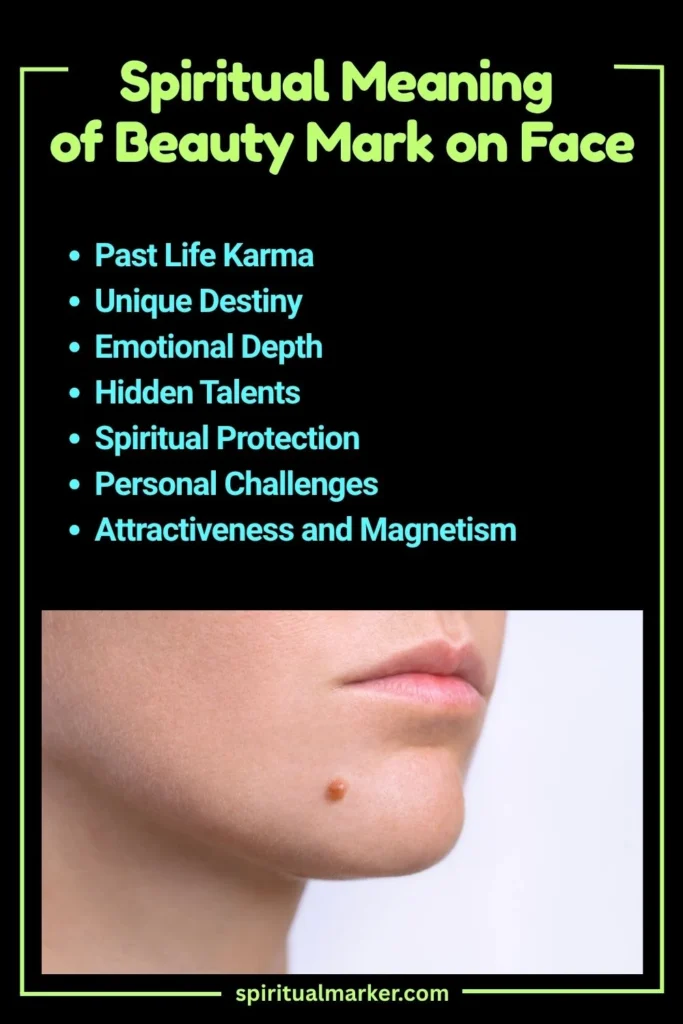
1. Past Life Karma
One of the most enduring interpretations is that beauty marks are tied to past life karma. This belief is especially prominent in traditions influenced by reincarnation, such as Vedic philosophy. The idea suggests that the soul carries impressions from previous lives, and these impressions sometimes manifest physically in the present body.
In this context, beauty marks are thought to represent unresolved experiences. They may symbolize emotional wounds, unfinished lessons, or even significant events from a previous incarnation. A mark on the forehead, for example, is often associated with leadership or intellectual authority in a past life, hinting that the soul once held influence or responsibility.
The depth of color and size is also given meaning in some traditions. Darker or more pronounced marks are sometimes interpreted as more recent karmic imprints, suggesting that the memory or influence of that past life remains strong. Lighter marks may point to older, more distant experiences that have softened over time.
From a psychological lens, this belief can also be understood as a symbolic way of explaining innate tendencies. When we feel drawn to certain roles, fears, or patterns without clear explanation, the idea of karmic carryover offers a narrative that connects the past with the present.
2. Unique Destiny
Many spiritual interpretations frame beauty marks as indicators of destiny. Rather than focusing on the past, this perspective looks forward. It treats these marks as signs that the individual carries a specific life path or purpose.
In this view, beauty marks act as subtle markers of identity at a soul level. They are seen as reminders that each person has a distinct role to play, shaped by a combination of personal energy and universal design. Some traditions describe them as spiritual signatures, small but meaningful indicators that you are aligned with a particular journey.
This does not imply a rigid or fixed fate. Instead, it suggests a framework within which choices are made. A person with a prominent facial mark may feel drawn toward leadership, creativity, or service, not because the mark dictates behavior, but because it reflects an underlying orientation of the self.
There is also a cultural dimension here. In historical Chinese face reading, facial features, including moles, were used to interpret personality traits and life potential. While modern perspectives may approach this with skepticism, the symbolic language remains influential in shaping how people perceive themselves.
3. Emotional Depth
Beauty marks near the eyes often carry associations with emotional depth and sensitivity. The eyes themselves are widely regarded as expressive centers of emotion, so marks in this area naturally attract symbolic interpretation.
Spiritual readings frequently connect these marks with empathy, compassion, and a heightened ability to feel and understand others. They are thought to indicate a soul that has experienced intense emotional connections, possibly across multiple lifetimes.
This sensitivity can be both a strength and a challenge. On one hand, it allows for deep relationships and meaningful bonds. On the other, it may make the individual more vulnerable to emotional strain or overwhelm. The mark becomes a visual reminder of this duality.
From a modern perspective, this interpretation aligns with the idea that some individuals are naturally more emotionally attuned. Whether framed spiritually or psychologically, the meaning resonates with lived experience.
4. Hidden Talents
Another common belief is that beauty marks point to hidden or underdeveloped talents. Marks on the cheeks or near the eyes are often linked with creativity, communication, and artistic expression.
This idea suggests that the soul carries abilities that have not yet fully surfaced. These talents may have been cultivated in previous lives or exist as natural inclinations waiting to be recognized. The mark serves as a symbolic prompt, encouraging awareness of these latent gifts.
In historical contexts, facial features were often read as indicators of character and potential. Artists, performers, and leaders were sometimes described in terms that highlighted unique physical traits, including beauty marks, as signs of charisma or originality.
Whether taken literally or metaphorically, this interpretation invites reflection. It encourages us to consider what abilities we may be overlooking or underestimating within ourselves.
5. Spiritual Protection
In many traditions, beauty marks are viewed as protective symbols. This belief appears in both religious and folk contexts, where physical features are sometimes interpreted as signs of divine presence or safeguarding.
From this perspective, a beauty mark is not random. It is seen as a form of spiritual marking, indicating that the individual is watched over or guided by a higher force. Some interpretations describe these marks as energetic seals that concentrate positive energy or ward off negativity.
In Christian-influenced thought, such markings have occasionally been framed as signs of blessing or favor. In other cultures, they are linked with luck, prosperity, or protection from harm.
Even outside spiritual frameworks, the idea of protection resonates on a symbolic level. It reflects a human desire to feel secure and supported, especially in uncertain environments.
6. Personal Challenges
Not all interpretations are positive. Some traditions view beauty marks as indicators of personal challenges or obstacles. These challenges are often framed as karmic tests, situations that the individual is meant to face and work through.
The location of the mark is considered significant. A mark near the mouth might be linked to communication difficulties or misunderstandings, while one on the forehead could point to struggles with decision-making or authority.
This perspective does not suggest inevitability. Instead, it frames challenges as opportunities for growth. The mark becomes a symbol of areas where effort, awareness, and resilience are needed.
From a broader standpoint, this interpretation reflects a common human pattern. We often look for meaning in our struggles, and symbolic systems like this provide a way to understand and contextualize them.
7. Attractiveness and Magnetism
Beauty marks have long been associated with charm and allure. In Western culture, they were even artificially applied in certain historical periods to enhance attractiveness.
Spiritually, this magnetism is often interpreted as an energetic quality. The mark is thought to amplify presence, making the individual more noticeable or influential in social settings. Marks near the lips or cheeks are especially linked with charisma and persuasive ability.
This interpretation connects physical appearance with interpersonal dynamics. It suggests that certain features may influence how others perceive and respond to us, not only visually but energetically.
At the same time, it is important to recognize the cultural dimension. Standards of beauty vary widely, and what is considered attractive in one context may not hold the same meaning in another.
8. Intuitive Abilities
Marks located near the forehead, eyebrows, or the area often referred to as the third eye are frequently associated with intuition and spiritual awareness.
In many belief systems, this region is linked with perception beyond the physical senses. A beauty mark here is sometimes interpreted as a sign of heightened insight, inner vision, or connection to deeper layers of consciousness.
This does not necessarily imply supernatural abilities. It can also be understood as strong intuition, the ability to read situations, people, and emotions with clarity. The symbolism emphasizes awareness rather than mysticism alone.
Across cultures, the idea of intuitive intelligence is widely valued. Whether framed spiritually or psychologically, it reflects a capacity to navigate complexity with sensitivity and insight.
9. Resilience and Inner Strength
Some interpretations focus on resilience. Beauty marks are seen as symbols of endurance, marking individuals who have faced and overcome adversity.
This meaning often appears in narratives that emphasize growth through difficulty. The mark becomes a visual representation of strength, a reminder that challenges have been met and survived.
In certain traditions, multiple marks are thought to amplify this symbolism, suggesting a life path shaped by repeated tests and the ability to withstand them.
From a contemporary viewpoint, this interpretation aligns with the idea of personal narrative. People often attach meaning to physical traits as part of their story, using them as symbols of identity and experience.
10. Individuality and Self-Expression
At its core, the most universal meaning of beauty marks may be individuality. They set us apart, making each face distinct and recognizable.
Spiritually, this uniqueness is often linked to the concept of the soul’s journey. Each person carries a different story, and beauty marks are seen as part of that expression. They reflect identity in a way that goes beyond conventional standards.
This interpretation resonates strongly in modern contexts, where self-expression and authenticity are increasingly valued. Rather than viewing differences as flaws, they are seen as defining features.
The symbolic meaning here is less about destiny or karma and more about presence. It highlights the idea that who you are is already meaningful, without the need for external validation.
Meaning of Beauty Marks on Different Locations of Your Face
Head Top
A beauty mark on the top of the head is often linked with a sense of higher awareness. This area is traditionally associated with the crown, which in many spiritual systems represents connection to something beyond ordinary perception. People with a mark here are often believed to possess an intuitive nature that goes beyond surface-level understanding.
In a broader sense, this placement reflects a tendency to think deeply about life. You may find yourself drawn to big questions about purpose, existence, or personal growth. There is often a quiet sensitivity present, even if it is not always expressed outwardly. Some traditions interpret this as a sign of protection or guidance, suggesting that you may feel supported in unseen ways during important life decisions.
At the same time, this placement can also point to internal pressure. When awareness is heightened, overthinking can follow. Balancing insight with grounded action becomes essential for those who resonate with this meaning.
Forehead
The forehead has long been viewed as a map of destiny. In face reading traditions, it reflects intellect, decision-making, and the path one takes in life. A beauty mark in this area is often associated with ambition and the ability to shape one’s future through conscious choices.
You may feel a strong desire to move forward, to build something meaningful, or to leave a mark in your personal or professional life. There is often a natural leadership quality here, even if it expresses itself quietly. People with this placement may find that opportunities come through their ability to think ahead and plan effectively.
Culturally, the forehead is also linked with clarity of thought. A mark here can symbolize moments in life where decisions carry weight. It suggests that your life path may not be random but shaped by consistent effort and awareness. However, this can also bring challenges, especially when expectations become too high or when you feel responsible for outcomes beyond your control.
Eyebrow
A beauty mark within the eyebrow is often interpreted as a sign of strong social ties. This placement suggests that relationships play a central role in your life, whether through friendships, family, or professional networks.
You may notice that support often comes when you need it most. This does not always mean life is easy, but it does suggest that you are rarely alone in navigating challenges. There is often a natural ability to connect with others, to build trust, and to maintain meaningful bonds over time.
From a symbolic perspective, eyebrows frame the eyes, which represent perception. A mark here can indicate that your understanding of people is influenced by experience and interaction. You may learn about yourself through others, growing stronger through shared experiences.
At times, this placement can also point to dependency on social validation. The challenge lies in maintaining individuality while still valuing connection.
Between Eyebrows
The space between the eyebrows is often referred to as the third eye in spiritual traditions. A beauty mark here is commonly associated with intuition, inner vision, and awareness beyond logic.
You may find that you sense things before they are spoken. This can appear as gut feelings, emotional sensitivity, or a strong sense of knowing without clear explanation. In many cultures, this placement is seen as a sign of wisdom that develops over time rather than something immediate.
This area also represents focus and direction. A mark here can suggest that your life involves moments of deep reflection, where you pause, reassess, and shift your path based on inner clarity rather than external pressure.
However, heightened intuition can also lead to confusion if not balanced. When emotions and instincts overlap, it becomes important to separate fear from genuine insight.
In the Eye
A beauty mark within or directly on the eye carries layered meanings due to the rarity and sensitivity of this area.
On the eyelid, it is often linked with emotional adaptability. You may adjust easily to changing situations, yet feel deeply affected by them internally. There is a fluidity in how you respond to life, which can be both a strength and a vulnerability.
At the corners of the eye, the meaning shifts toward relationships. This placement reflects how you engage with others emotionally. It may suggest strong bonds, but also lessons tied to trust, attachment, or communication.
Marks on the sclera are rare and often interpreted symbolically as indicators of intense emotional experiences. This does not imply negativity, but rather depth. Life may bring moments that shape you profoundly.
The iris, being central to vision, carries the idea of uniqueness and inner depth. A mark here is often seen as a sign that your perspective on life differs from others. You may approach situations with originality, sometimes feeling misunderstood but also capable of offering insights others might overlook.
Around the Eye
Marks around the eyes reflect perception and emotional awareness. This area is closely tied to how we see and interpret the world, both literally and emotionally.
If you have a beauty mark here, you may be naturally empathetic. You might pick up on subtle cues in conversations, noticing what others feel even when they do not express it openly. This sensitivity can make you a supportive presence in relationships.
At the same time, being perceptive can lead to emotional fatigue. When you absorb too much from your surroundings, it becomes harder to separate your feelings from those of others. This placement highlights the importance of emotional boundaries while still valuing your ability to understand people deeply.
Nose
The nose is often associated with wealth, self-worth, and personal value in traditional face reading. A beauty mark here can reflect your relationship with material stability and confidence.
You may experience fluctuations in financial matters or shifts in how you perceive success. This does not necessarily mean instability, but rather a dynamic journey where growth comes through experience rather than consistency.
On a personal level, this placement also connects to self-esteem. It suggests that your sense of worth may evolve over time, influenced by achievements, setbacks, and self-reflection. There is often a strong desire to prove yourself, not only to others but also to yourself.
Cheek
Cheek beauty marks are often associated with courage and public presence. This area reflects how you present yourself to the world and how you engage with social environments.
You may feel driven to take action, to stand firm in your beliefs, or to express yourself openly. There is often a visible confidence here, even if it is built through experience rather than natural ease.
In some traditions, cheek marks also relate to recognition. This does not always mean fame, but it can indicate that your efforts are noticed by others. You may find yourself in positions where your actions influence or inspire people around you.
At the same time, this placement can highlight challenges related to vulnerability. Being seen comes with both appreciation and scrutiny.
Chin
The chin represents stability, persistence, and grounding. A beauty mark here is often linked with determination and the ability to stay committed over time.
You may approach life with patience, willing to endure difficulties in order to reach long-term goals. There is often a steady energy present, one that values consistency over quick results.
This placement also connects to personal foundations. It reflects how you build your life, whether through relationships, career, or personal values. There is often a desire for security, both emotionally and practically.
However, strong persistence can sometimes turn into resistance. Knowing when to adapt becomes just as important as staying firm.
Jawline
The jawline symbolizes strength, resilience, and assertiveness. A beauty mark here often reflects a person who is driven and willing to take control of their path.
You may have a strong sense of direction, preferring to act rather than wait. There is often a clear boundary between what you accept and what you reject, which can make decision-making more straightforward.
This placement also highlights endurance. You may face challenges directly, pushing through obstacles with determination. While this can lead to success, it can also create tension when flexibility is needed.
The key theme here is balance between strength and adaptability.
Mouth
The area around the mouth is closely tied to communication, pleasure, and relationships. A beauty mark here often indicates expressive ability and social charm.
You may find it easy to articulate your thoughts, engage in conversation, and connect with others through words. There is often a natural charisma present, which can influence both personal and professional interactions.
This placement also connects to enjoyment. It reflects how you experience pleasure, whether through food, relationships, or creative expression. Life may feel richer when shared and expressed openly.
At times, this can lead to overindulgence or reliance on external validation. Awareness helps maintain balance between expression and restraint.
Tongue
A beauty mark on the tongue is rare and carries symbolic weight related to speech and truth. This placement suggests that words hold power in your life.
You may influence others through what you say, whether in direct communication or subtle expression. There is often an ability to persuade, teach, or inspire through language.
This also highlights responsibility. Words can heal, but they can also harm. People with this placement may experience moments where communication shapes outcomes in significant ways.
It points to the importance of intention behind speech, as well as awareness of how words are received.
Ear
The ears are often associated with wisdom, longevity, and good fortune in traditional interpretations. A beauty mark here suggests a life shaped by learning and experience.
You may value listening as much as speaking. There is often an openness to understanding different perspectives, which contributes to personal growth over time.
This placement is also linked with prosperity, not only in a financial sense but in life experiences. It suggests a journey where knowledge accumulates gradually, leading to a sense of fulfillment.
At the same time, it can indicate sensitivity to external influences. Being open to learning also means being selective about what you absorb.
Astrological Significance of Beauty Marks
According to Samudrika Shastra
Samudrika Shastra, an ancient Indian system of physiognomy, studies body features to interpret personality and destiny. In this tradition, beauty marks on the face are considered highly significant. Each location corresponds to a specific life aspect.
For example, a mark on the forehead is often linked with intelligence and future success. Marks near the lips may symbolize sensuality or strong communication skills. A mark on the chin can indicate stability and determination.
This system emphasizes that the placement, size, and even color of the mark influence its interpretation. It treats the face as a structured map where every feature holds meaning.
According to Chinese Face Reading
Chinese face reading, also known as Mian Xiang, views the face as a reflection of life energy and fortune. Beauty marks are interpreted in relation to energy flow and balance.
Marks on the upper face, such as the forehead, are associated with early life and family background. Middle facial marks relate to career and relationships, while lower face marks connect to later life and legacy.
In this system, a well-placed beauty mark can signify luck, prosperity, or harmony. However, marks in certain areas may indicate obstacles or emotional struggles. The interpretation often depends on symmetry and overall facial harmony.
Both traditions highlight a common idea. The face is not random. It is meaningful, layered, and connected to life patterns.
Meaning of Beauty Marks on Face for Females and Males
Traditional interpretations often differ based on gender, reflecting cultural roles and expectations.
For females, beauty marks are frequently associated with charm, emotional intelligence, and relational dynamics. A mark near the eye might symbolize sensitivity or deep emotional awareness. Marks near the lips are often linked with attraction and expressive communication.
For males, interpretations tend to emphasize ambition, strength, and authority. A mark on the forehead may suggest leadership qualities, while one on the cheek could indicate courage or assertiveness.
It is important to approach these interpretations with awareness. They are shaped by historical contexts where gender roles were more rigid. Today, many people view these meanings more fluidly, focusing on personal resonance rather than fixed definitions.
What Does the Bible Say About Beauty Marks?
The Bible does not directly address beauty marks or facial spots in a symbolic or spiritual sense. However, it provides clear guidance on how physical appearance should be understood.
In 1 Samuel 16:7, it is written:
“Man looks at the outward appearance, but the Lord looks at the heart.”
This verse emphasizes that inner character holds greater value than physical features. Similarly, in Proverbs 31:30:
“Charm is deceptive, and beauty is fleeting; but a woman who fears the Lord is to be praised.”
These teachings suggest that while physical attributes may attract attention, they do not define a person’s worth or spiritual standing. The focus remains on integrity, faith, and inner qualities.
From a biblical perspective, beauty marks are neutral. They neither signify blessing nor misfortune.
Myths and Superstitions Associated with Beauty Marks
Across cultures, beauty marks have inspired a wide range of myths and superstitions. Some believe that a mark on the face indicates a past life wound or significant event. Others see it as a sign of luck, especially if placed in certain areas.
In some traditions, a mark near the mouth suggests a love for luxury or indulgence. A mark near the eye might be interpreted as a sign of emotional struggles or tears. There are also beliefs that certain marks bring wealth, while others indicate obstacles.
These interpretations often vary widely and sometimes contradict each other. What is considered lucky in one culture may be viewed differently in another. This highlights how symbolic meanings are shaped by collective beliefs rather than universal truths.
Cultural and Religious Significance
Beauty marks have held cultural and symbolic importance across many societies.
In ancient India, facial marks were studied as part of broader spiritual and physical analysis systems. They were believed to reveal aspects of karma and destiny.
In Chinese culture, face reading integrated beauty marks into a complex system of energy interpretation. Marks were seen as indicators of fortune, relationships, and life phases.
In European history, especially during the 17th and 18th centuries, artificial beauty marks became fashionable. They were used to convey messages about personality, status, or even political affiliation.
In Middle Eastern traditions, beauty marks are often viewed as signs of natural beauty and individuality.
Similarly, in some African cultures, facial markings, including natural spots, are associated with identity and heritage.
In modern global culture, beauty marks are often celebrated as unique features that enhance individuality rather than define destiny.
Is It Good Luck to Have Beauty Marks on Your Face?
The idea of beauty marks as good luck depends entirely on perspective. In some traditions, specific placements are considered highly fortunate, symbolizing wealth, success, or love. In others, the same placements might suggest challenges or lessons.
From a broader viewpoint, beauty marks are neither inherently lucky nor unlucky. Their meaning comes from the interpretation we assign to them. For many people today, they are simply part of natural beauty, without any attached prediction.
What remains consistent across cultures is the idea that these marks invite reflection. They encourage us to think about identity, uniqueness, and the stories we carry.
Table: Meaning of Beauty Marks on Face
| Location | Common Interpretation | Spiritual Insight |
|---|---|---|
| Forehead | Intelligence, success | Strong life direction |
| Eyebrow | Creativity, expression | Balanced thinking |
| Between eyebrows | Intuition | Spiritual awareness |
| Cheek | Courage, social life | Emotional strength |
| Near lips | Communication, attraction | Expressive energy |
| Chin | Stability, determination | Grounded nature |
| Nose | Ambition, wealth | Material focus |
| Near eyes | Sensitivity | Emotional depth |
Final Thoughts
Beauty marks sit at an interesting intersection of science, culture, and belief. On one hand, they are simple biological features. On the other, they carry layers of meaning shaped by centuries of interpretation. You may find yourself drawn to one perspective more than another, and that is completely natural.
If you view beauty marks spiritually, they can serve as gentle reminders of individuality and personal growth. If you prefer a scientific lens, they remain unique traits that make your appearance distinct. Both views can coexist without conflict.
What matters most is how you choose to see yourself. Rather than letting interpretations define you, you can use them as tools for reflection. Your identity is far more complex than any single mark, and your story continues to evolve beyond what is visible on the surface.
You Might Also Like
1) Meanings of Birthmarks – Types, Shapes, Locations & Colors
2) Spiritual Meaning of Birthmark on Buttock for Females & Males
3) Spiritual Meaning of Sneezing in A Row: 2, 3, 4, 5 Times
4) Spiritual Meaning of Birthmark in Eye (Right and Left)
5) Biting Tongue in Sleep Spiritual Meaning: Signs and Superstitions
References
- https://timesofindia.indiatimes.com/astrology/others/10-birthmarks-and-the-secrets-of-past-karma/articleshow/115767771.cms
- https://timeslife.com/life-hacks/10-birth-marks-which-are-scars-of-your-past-karma/articleshow/120693877.html
- https://www.facebook.com/100064942262025/posts/spiritual-meaning-of-beauty-spotsspiritually-a-beauty-spot-mole-is-believed-to-b/1270980375076693/
- https://www.instagram.com/reel/DTIABYoAoDQ/
- https://www.spiritualmarker.com/moles-on-the-face-meaning-for-females-and-males/
- https://spiritualmeansof.com/spiritual-meanings-of-beauty-marks-on-your-face/
- https://www.healthkura.com/spots-beauty-marks-on-face-spiritually/
FAQs
1. What is the spiritual meaning of a beauty mark on the face?
In spiritual traditions, a beauty mark on the face is seen as a symbolic sign connected with personality or destiny. Different face areas represent different life energies. For example, marks on the forehead are sometimes linked with intuition and wisdom. Marks near the lips connect to charm and communication skills. A mark on the cheek might represent emotional passion or sensitivity. Marks near the eyes can symbolize perception and awareness. These interpretations vary across cultures but consistently view beauty marks as meaningful rather than random.
2. Do beauty marks have different meanings by location?
Yes, the location of a beauty mark changes its spiritual meaning. A mark on the forehead often signifies wisdom and strong intuition. A mark near the lips is associated with charm and expressive abilities. A mark on the cheek can represent emotional depth or creativity. A mark near the eye might symbolize perception and awareness. A mark on the chin is sometimes connected with determination and strong will. These interpretations come from traditional beliefs passed down through generations. They offer a fun way to think about physical features.
3. Are beauty marks considered lucky in spiritual beliefs?
In many traditions, beauty marks are viewed as lucky or meaningful signs. They are not seen as flaws but as marks of distinction. Some cultures believed that certain beauty marks indicated success, charisma, or prosperity. Others associated them with special talents or gifts. For example, a mark on the forehead might indicate wisdom. A mark near the lips might suggest eloquence. These beliefs add a layer of meaning to natural features. While they are not scientifically proven, they enrich cultural traditions.
4. Does the gender of a person affect the meaning of a beauty mark?
In some traditions, yes, gender can affect the interpretation. For instance, a mark on the right side of the face might mean different things for men and women. In certain cultures, beauty marks on women are seen as signs of beauty and charm. On men, they might be interpreted as signs of strength or leadership. However, not all traditions distinguish by gender. Many simply focus on the location of the mark. The interpretations are cultural and vary widely. Today, people often view beauty marks as unique personal features regardless of gender.