
Pegasus is a mythical winged horse of Greek mythology. Born from the blood of Medusa, Pegasus symbolizes freedom, inspiration, and divine connection. Across cultures, this creature carries deep spiritual meaning.
The Pegasus spiritual meaning often involves transcendence, creativity, and the power of the imagination. Pegasus is a symbol of the soul’s ability to rise above earthly limitations. A spiritual meaning of a horse shares that horse-focused symbolism, though a regular horse lacks the magical wings.
Some traditions view Pegasus as a guide for poets and artists. Others see it as a sign of spiritual awakening. The context of where you see Pegasus can add detail.
If Pegasus appears in your life, it may be a call to rise above. A spiritual meaning of a hummingbird also deals with winged creatures, though hummingbirds carry a different, more delicate energy.
What Does Pegasus Symbolize Spiritually?
At its core, Pegasus symbolizes elevation. Not just physical elevation through flight, but emotional and spiritual rising. It represents the moment when we move beyond limitation and begin to see life from a wider perspective.
Spiritually, Pegasus often reflects the union between instinct and inspiration. The horse represents grounded strength, while the wings symbolize higher awareness. Together, they create a balance between the physical and the spiritual. This balance is something many of us seek without always realizing it.
Pegasus is also closely tied to the idea of divine guidance. In many interpretations, its appearance signals that you are being supported in unseen ways. It can represent intuition becoming stronger, creativity flowing more freely, or a sense that you are being gently guided toward something meaningful.
At the same time, Pegasus does not represent escape. It represents expansion. There is a difference. Instead of running away from life, it encourages rising within it. Seeing clearly. Moving with purpose. Trusting that growth often requires both courage and surrender.
10 Spiritual Meanings of Pegasus
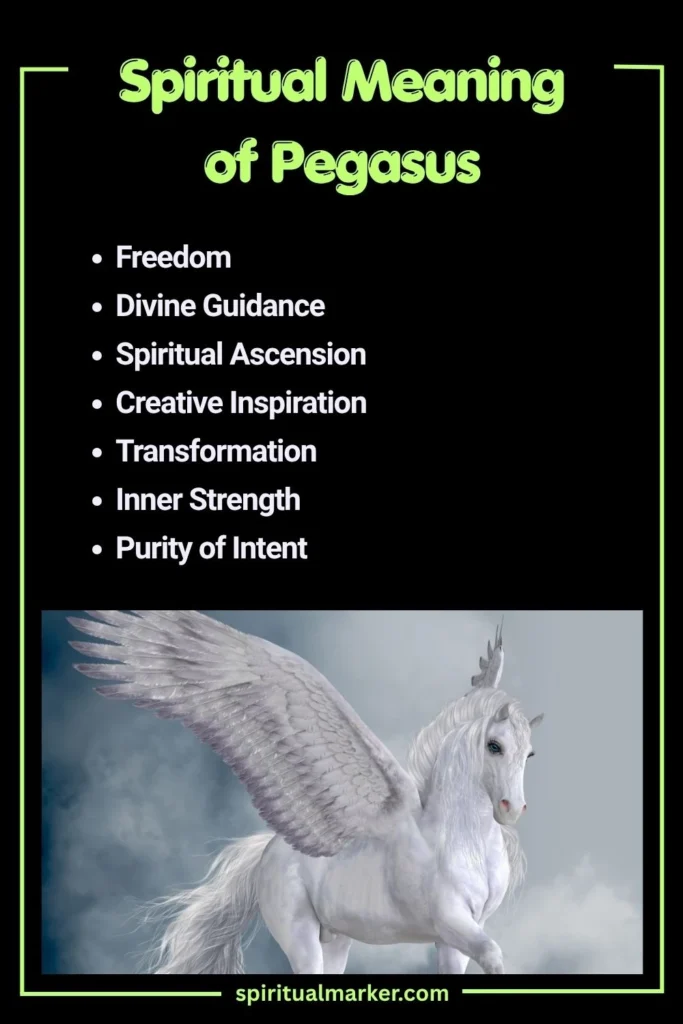
When we encounter the image of Pegasus, something instinctive stirs within us. A winged horse is not just unusual, it feels symbolic of a deeper truth we sense but cannot always articulate.
Across mythology, literature, and spiritual interpretation, Pegasus has never been a passive figure. It moves, ascends, inspires, and transforms. That is why its meanings are not simple labels but layered experiences that mirror our own inner journey.
Below, each meaning unfolds with depth, context, and nuance so you can understand not just what Pegasus represents, but why it continues to resonate so strongly.
1) Freedom
At its core, Pegasus represents a form of freedom that goes beyond physical movement. When we think about freedom in daily life, we often imagine external circumstances such as independence, travel, or choice. Pegasus challenges that limited view. Its flight symbolizes liberation from invisible constraints, the beliefs, fears, and emotional burdens that quietly shape how we live.
In Greek mythology, Pegasus is not bound by the earth in the way ordinary horses are. Its wings allow it to transcend gravity itself. Spiritually, gravity becomes a metaphor for everything that keeps us grounded in limitation. This includes self doubt, societal expectations, and inherited narratives about who we are allowed to become.
What makes this symbolism powerful is that Pegasus does not reject the earth entirely. It rises from it. This suggests that true freedom is not about escape but about elevation. You are still part of your reality, but you are no longer defined by its restrictions.
There is also a deeper psychological layer. Freedom through Pegasus often reflects a moment of internal release. It may appear during periods of transition when you begin to question old patterns or feel an urge to redefine your path. In this sense, Pegasus becomes less about external change and more about internal permission.
2) Divine Guidance
Pegasus is often understood as a bridge between the human and the divine. In many interpretations, it functions as a celestial messenger, carrying wisdom from higher realms into human awareness. This aligns with broader mythological patterns where winged beings serve as intermediaries between worlds.
In Greek tradition, Pegasus is associated with the gods, particularly as a servant of Zeus. It carries thunderbolts, symbolizing its role in transmitting divine power. This imagery translates spiritually into the idea that guidance does not always come in direct or obvious forms. Instead, it often arrives through intuition, inspiration, or sudden clarity.
When Pegasus appears symbolically in your life, it may reflect a heightened sensitivity to inner direction. You may find yourself drawn toward certain choices without fully understanding why. This does not necessarily mean the guidance is supernatural in a literal sense. It can also represent the alignment of your conscious and subconscious mind, where deeper truths begin to surface.
There is also a cultural parallel in religious traditions that speak of divine instruction or protection. Pegasus echoes this concept but expresses it through myth rather than doctrine. It invites you to trust that guidance exists, while also encouraging discernment in how you interpret it.
3) Spiritual Ascension
Few symbols capture the idea of ascension as vividly as a winged horse in flight. Pegasus embodies the movement from lower awareness to higher understanding. This is not a physical ascent but a shift in consciousness.
In spiritual philosophy, ascension often refers to the process of expanding awareness beyond immediate, material concerns. It involves questioning assumptions, seeking meaning, and cultivating a broader perspective on life. Pegasus represents this journey in motion.
Its flight suggests effort and momentum. Ascension is not passive. It requires intention, reflection, and sometimes discomfort. Just as Pegasus must rise against gravity, you must often move against ingrained habits or limiting beliefs.
At the same time, the image of effortless flight reminds us that ascension is not purely struggle. There are moments of flow, clarity, and grace where growth feels natural rather than forced. Pegasus captures both aspects, the challenge of rising and the beauty of what lies above.
4) Creative Inspiration
Pegasus holds a special place in artistic and literary traditions. According to myth, it created the Hippocrene spring with a strike of its hoof, a source of poetic inspiration linked to the Muses. This connection transforms Pegasus into a symbol of creative awakening.
Creativity here is not limited to art. It includes any form of expression that brings something new into existence. Writing, problem solving, innovation, and even personal reinvention all fall under this umbrella.
What Pegasus represents is the moment when inspiration feels almost external, as if ideas are flowing through you rather than being forced. This aligns with how many artists describe their process. There is a sense of tapping into something larger than oneself.
At a deeper level, Pegasus also symbolizes the courage required to create. Inspiration alone is not enough. You must act on it. The act of flight becomes a metaphor for taking that leap, trusting your vision even when it feels uncertain.
5) Transformation
Transformation is a recurring theme in mythology, and Pegasus embodies it in a subtle but powerful way. Born from extraordinary circumstances, often linked to the blood of Medusa in myth, Pegasus emerges from chaos into beauty and purpose.
This origin story reflects a universal pattern. Transformation often arises from moments of disruption or difficulty. What appears destructive on the surface can give rise to something entirely new.
Spiritually, Pegasus represents the ability to evolve without losing essence. It does not become something else. It becomes more fully itself. This distinction is important. Transformation is not about abandoning who you are but about uncovering deeper layers of your identity.
In personal terms, Pegasus may appear symbolically during periods of growth where you feel both challenged and expanded. It reminds you that change is not a deviation from your path but a continuation of it.
6) Inner Strength
At first glance, Pegasus may seem delicate due to its wings and graceful movement. Yet it is fundamentally a horse, a creature associated with power, endurance, and instinct. This combination creates a unique symbol of strength that is both grounded and elevated.
Inner strength, in this context, is not about force or dominance. It is about resilience, the ability to move forward despite uncertainty. Pegasus does not resist its nature. It integrates its physical power with its capacity for flight.
This duality reflects how strength operates within us. It is not purely emotional or purely physical. It is a balance of determination, adaptability, and self awareness.
Pegasus encourages a redefinition of strength. Instead of equating it with rigidity, it presents strength as fluid and dynamic. You are strong not because you never struggle, but because you continue to rise.
7) Purity of Intent
Pegasus is often associated with purity, not in a moralistic sense but in terms of clarity and authenticity. Its actions in myth are purposeful and aligned with a higher order. It does not act out of selfishness or confusion.
Spiritually, this translates into the idea of intention. When your actions are guided by clear, sincere motives, they carry a different kind of energy. They become more focused and impactful.
Purity of intent also involves self reflection. It asks you to examine why you pursue certain goals. Are they driven by external validation, or do they reflect your true values?
Pegasus represents the alignment between intention and action. When these two are in harmony, your path becomes more coherent. You experience less internal conflict and greater clarity in your decisions.
8) Connection to Higher Realms
The wings of Pegasus are not just tools for flight. They symbolize access to dimensions beyond ordinary perception. This does not necessarily imply literal other worlds. It can also refer to states of consciousness, insight, and awareness.
Throughout history, humans have sought connection with something greater, whether through religion, philosophy, or personal reflection. Pegasus embodies this desire and the possibility of fulfilling it.
This connection often manifests as moments of insight or transcendence. You may feel a sense of perspective that goes beyond immediate concerns. Problems that once seemed overwhelming begin to look different.
Pegasus reminds us that while we live in a physical world, our experience of it is shaped by perception. Expanding that perception can change everything.
9) Overcoming Limitations
One of the most striking aspects of Pegasus is its defiance of natural law. Horses do not fly, yet Pegasus does. This impossibility is precisely what makes it such a powerful symbol.
In human terms, limitations often feel absolute. We internalize them as facts rather than conditions. Pegasus challenges this mindset by embodying the idea that boundaries can be transcended.
This does not mean ignoring reality. It means recognizing that many limits are more flexible than they appear. Growth often begins with questioning assumptions and exploring what lies beyond them.
Pegasus represents the courage to test those boundaries. It encourages you to consider possibilities that may initially seem unrealistic but hold the potential for transformation.
10) Harmony Between Earth and Spirit
Perhaps the most profound meaning of Pegasus lies in its balance. It is both a creature of the earth and a being of the sky. This dual nature reflects the human experience itself.
We live in a physical world with practical needs and responsibilities. At the same time, we seek meaning, connection, and transcendence. These two aspects can feel in conflict, but Pegasus shows they can coexist.
Harmony between earth and spirit is not about choosing one over the other. It is about integration. You can pursue spiritual growth while remaining grounded. You can engage with the material world without losing sight of deeper purpose.
Pegasus embodies this balance effortlessly. It does not struggle to reconcile its dual nature. It simply exists as both.
Pegasus in Greek Mythology and Its Significance
To understand the depth of Pegasus as a symbol, it helps to return to its roots in Greek mythology. Pegasus was said to be born from the blood of Medusa after she was slain by Perseus. This origin alone is rich with meaning. From chaos and destruction, something pure and powerful emerged.
Pegasus later became associated with the hero Bellerophon, who tamed the winged horse with the help of divine intervention. Together, they accomplished great feats, including defeating the Chimera. However, the story takes a turn when Bellerophon, driven by ambition, attempts to ride Pegasus to Mount Olympus. This act of pride leads to his downfall, while Pegasus continues onward to serve the gods.
This narrative introduces an important layer to Pegasus symbolism. It is not just about power or elevation. It is also about humility. The myth reminds us that spiritual gifts and abilities are not meant to inflate the ego, but to align us with something greater.
Pegasus eventually found a place among the stars as a constellation, reinforcing its connection to the divine and eternal. This transition from earth to sky reflects a broader theme found in many spiritual traditions. The idea that true transformation involves rising beyond the temporary and connecting with the timeless.
Cultural and Artistic Interpretations
Across cultures and artistic movements, Pegasus has been reimagined in ways that reflect the values and beliefs of different eras. In ancient Greece, it was closely tied to the Muses and seen as a symbol of poetic inspiration. Writers and artists believed that Pegasus could strike the ground and create springs of creative energy.
During the Renaissance, Pegasus became a symbol of intellectual and artistic elevation. Painters and poets used its image to represent the pursuit of beauty, truth, and higher knowledge. It was no longer just a mythological creature. It became an emblem of human potential.
In modern literature and film, Pegasus often appears as a companion to heroes. It represents loyalty, courage, and the ability to rise above adversity. These interpretations reflect a shift toward personal empowerment, where the myth becomes a tool for storytelling and self-discovery.
In spiritual communities, Pegasus is sometimes associated with awakening and ascension. It is seen as a guide that helps individuals move beyond fear and into clarity. This interpretation blends ancient symbolism with contemporary spiritual practices.
Even in popular culture, Pegasus retains its core essence. Whether in fantasy art, tattoos, or symbolic jewelry, it continues to represent freedom, transformation, and the pursuit of something beyond the ordinary.
Is Pegasus a Symbol of Freedom or Divine Guidance?
This question often comes up because Pegasus seems to embody both ideas so strongly. On one hand, its wings clearly symbolize freedom. The ability to move without restriction, to rise above boundaries, and to explore new perspectives.
On the other hand, its connection to the divine suggests guidance. Pegasus is not just flying randomly. It is often portrayed as moving with purpose, guided by a higher force or serving a greater mission.
The truth is that these meanings are not separate. They are deeply connected. True freedom is not just about doing whatever we want. It is about aligning with what feels right at a deeper level. In that sense, divine guidance becomes the foundation of meaningful freedom.
When we view Pegasus through this lens, it becomes a symbol of conscious movement. It encourages us to trust our instincts while remaining open to something greater. It invites us to explore, but also to listen. To rise, but not lose our sense of direction.
How Pegasus Energy Reflects in Your Life
There are moments in life when everything feels heavy. Responsibilities, expectations, and uncertainty can create a sense of limitation. This is often when the symbolism of Pegasus becomes most relevant.
You may notice a sudden desire for change. A pull toward creativity or self-expression. A feeling that you are meant to move beyond your current situation. These experiences can reflect what many describe as Pegasus energy.
This energy often shows up during periods of transformation. It can feel like a mix of excitement and fear. You are being called to grow, but growth requires stepping into the unknown. Pegasus reminds us that we are capable of rising, even when we feel grounded by doubt.
It can also appear through inspiration. Ideas that seem to come out of nowhere. Moments of clarity that shift your perspective. These are often subtle, but powerful signs of inner movement.
At times, Pegasus energy challenges us. It asks us to let go of limiting beliefs and trust in our potential. This is not always comfortable. But it is often necessary for growth.
Final Thoughts
The spiritual meaning of Pegasus is layered, evolving, and deeply personal. It represents freedom, but also responsibility. It symbolizes elevation, but also grounding. And, it reflects both the desire to rise and the need to remain aligned with something greater.
If you find yourself drawn to Pegasus, it may be worth reflecting on where you are in your life right now. Are you seeking freedom, or are you searching for direction? Are you ready to expand, or are you still holding onto something that keeps you grounded?
There is no single interpretation that fits everyone. That is part of what makes this symbol so powerful. It adapts to your journey, offering meaning that feels relevant and timely.
As you move forward, consider allowing the symbolism of Pegasus to guide your reflection. Not as a rigid belief, but as a lens. A way of seeing your experiences with more clarity and intention. Sometimes, the act of looking upward is enough to remind us that we are capable of rising.
References
- https://hellofearless.com/blogs/blog/pegasus-spiritual-meaning-dream-meaning-symbolism-more
- https://initiativenetwork.org/mythical-legendary-pegasus-symbol-freedom/
- https://www.youtube.com/watch?v=YVcGIq3IW34
- https://www.whatspiritual.com/pegasus-spiritual-meaning-symbolism-and-mythology/
- https://mymythos.org/archetype/pegasus/
- https://www.mythical-creatures-dna.com/pegasus/
- https://www.youtube.com/watch?v=-x2UgBnTnFo
- https://www.facebook.com/groups/448375071077888/posts/826620176586707/