Mirrors reflect more than just your face. They show you your image, but also your self-perception. Across cultures, mirrors carry deep spiritual meaning and symbolism.
The spiritual meaning of a mirror often involves self-reflection, truth, and the soul. Mirrors can reveal what you hide from yourself. A spiritual meaning of breaking glass accidentally shares that reflective focus, though breaking glass adds a note of sudden change.
Some traditions view mirrors as portals or windows to other realms. Others see them as tools for self-discovery. The way you feel when you look in a mirror can add detail.
If mirrors feel significant to you, they may be calling you to look deeper. A spiritual meaning of mirror and its deep symbolism explores that theme, though every reflection carries a personal message.
What Does a Mirror Symbolize?
First, a mirror symbolizes truth and self-awareness. It reflects what already exists without alteration.
For this reason, many spiritual paths see mirrors as tools of honesty. Essentially, you cannot hide from your own reflection.
Yet, mirrors also symbolize a clear duality. They show only the outer self, not the inner one.
Spiritually, this creates tension between appearance and reality. Many teachings suggest personal growth starts here. It begins when both sides finally align.
Mirrors additionally represent gateways or portals. Since they show another version of the world, cultures believed they could connect realms.
Accordingly, this belief explains their use in rituals, dreams, and folklore.
Psychological Power of the Mirror
Psychology actually supports part of this symbolism. When you look into a mirror, your brain processes identity. You recognize yourself as you.
Still, you also observe yourself as an object separate from you. This action creates self-reflection in both a literal and mental sense.
People often face emotions they normally avoid. Guilt, confidence, fear, and pride can surface quickly during this quiet observation.
Because of this effect, mirrors directly influence mood and awareness. In spiritual psychology, this moment holds great power.
You are forced to confront who you are now. It is not about who you pretend to be.
10 Spiritual Meanings of Mirror
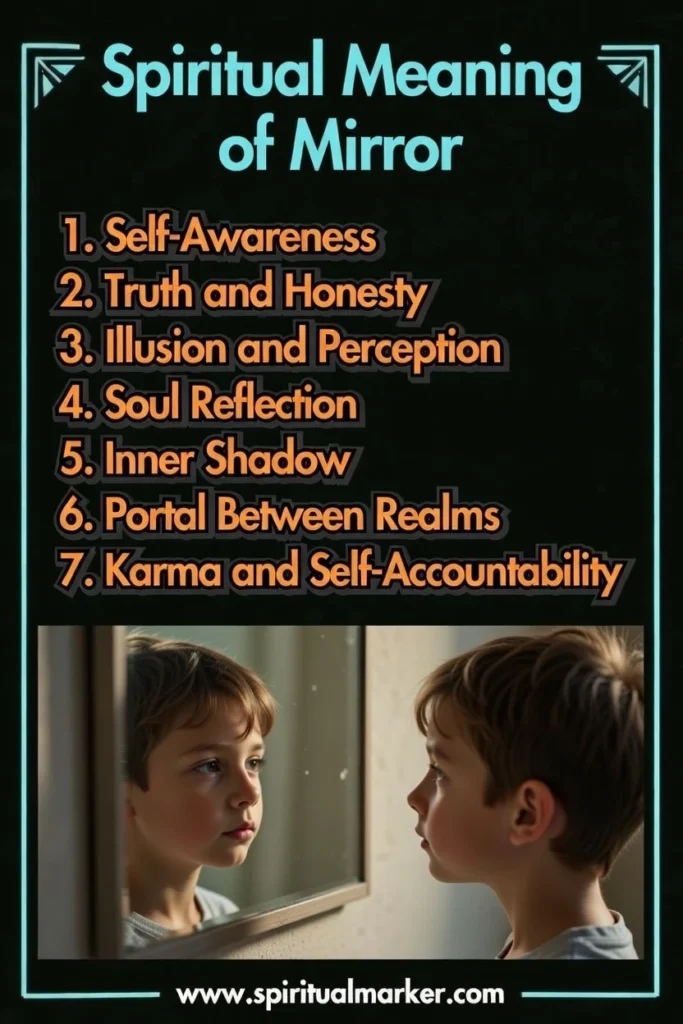
Mirrors carry profound spiritual symbolism across cultures, often representing introspection and the bridge between physical and metaphysical realities. The listed meanings draw from esoteric traditions, psychology like Jung’s shadow self, and mystical practices such as scrying.
1) Self-Awareness
Mirrors hold a quiet power when it comes to self-awareness. At first glance, they reflect physical features. Yet with sustained attention, they begin to reveal patterns of thought, emotion, and behavior that usually run unnoticed.
Standing before a mirror often triggers subtle questions. Who am I beneath habits? Why do I react the way I do? This moment of pause invites mindfulness.
Spiritually, mirrors encourage you to observe yourself without distraction. Facial expressions, posture, and even eye contact can expose emotional states you may have ignored.
Over time, this practice strengthens awareness of how inner beliefs shape outward actions. That awareness becomes a foundation for growth.
Additionally, mirrors sharpen presence. When you look closely, the mind slows down. You become anchored in the now.
This alignment between awareness and values allows conscious choices rather than automatic reactions. Growth begins here, quietly, honestly, and steadily.
2) Truth and Honesty
Mirrors symbolize truth in its raw form. They do not soften reality or disguise imperfections. What appears is what exists in that moment.
Spiritually, this reflects the importance of self-honesty as a path toward integrity and healing. When you face a mirror, there is no audience to impress. No role to perform.
This creates a rare space where denial fades. Many spiritual traditions view this confrontation as sacred because truth acknowledged becomes truth transformed. Without honesty, progress stalls.
In reflective practices, mirrors are used to sit with discomfort rather than avoid it. Vulnerability surfaces. Weaknesses show themselves.
Yet this exposure does not diminish you. Instead, it creates wholeness. Accepting truth builds trust within yourself, which then extends outward into relationships and decisions.
3) Illusion and Perception
Mirrors also represent illusion, reminding us that perception is not always reality. A reflection can appear accurate while still lacking depth. This duality makes mirrors powerful symbols in philosophy and spirituality.
What you see may depend on angle, light, or expectation. In the same way, beliefs and biases shape how reality appears in daily life.
Spiritually, mirrors challenge the ego by exposing how easily appearances can deceive. They ask you to question assumptions rather than accept them blindly.
This symbolism encourages discernment. Instead of judging situations by surface impressions, you learn to look beneath them.
Inner clarity grows when you recognize how projections influence experience. The mirror teaches that truth often lives beyond the obvious.
4) Soul Reflection
On a deeper level, mirrors are believed to reflect the soul’s essence, not merely the body. Many mystical traditions view mirrors as gateways to inner wisdom, ancestral memory, or divine guidance.
When gazing softly into a mirror for extended periods, emotions may rise unexpectedly. Memories surface. Desires and fears reveal themselves.
This process connects conscious awareness with the subconscious, allowing insight to flow freely. In ritual settings, mirrors are tools for spiritual communication.
They help seekers access intuition and higher guidance. Rather than showing who you appear to be, the mirror reveals who you are becoming.
It bridges physical identity with spiritual purpose, encouraging alignment between the two.
5) Inner Shadow
Mirrors have a unique ability to expose the inner shadow, the hidden aspects of the psyche described in Jungian psychology. These include suppressed emotions, unacknowledged fears, and traits society labels undesirable.
Facing the mirror can bring discomfort because it reflects more than beauty or confidence. It reflects vulnerability, anger, envy, or grief.
Spiritually, this confrontation is necessary. Avoidance strengthens the shadow. Awareness softens it.
By recognizing both light and dark aspects of yourself, integration occurs. Balance replaces inner conflict.
Instead of rejecting flaws, you learn from them. Mirrors teach that wholeness comes from acceptance, not perfection. Growth happens when every part of the self is seen and honored.
6) Spiritual Awakening
Mirrors often appear at turning points in spiritual life. During meditation or vivid dreams, gazing into a mirror signals a shift in awareness. You begin to see beyond habits, roles, and old labels.
Instead of reacting on autopilot, you start questioning who you are beneath the surface. A clear reflection points to inner alignment. Your thoughts, emotions, and actions move in the same direction.
As a result, decisions feel lighter and intuition sharpens. In contrast, a distorted or blurred reflection highlights inner friction. Something asks to be released.
This might be fear, outdated beliefs, or a version of yourself that no longer fits. Because mirrors strip away comforting illusions, they often feel intense. Yet that intensity fuels awakening.
You stop identifying with appearances and start recognizing consciousness itself. Growth follows clarity, and clarity arrives when you dare to truly look.
7) Portal Between Realms
Across cultures, mirrors hold a reputation as gateways between worlds. In scrying practices, seekers stare into reflective surfaces to receive visions or symbolic messages. The mirror becomes still, then subtle images rise from the unconscious or spiritual plane.
In Feng Shui, mirrors manipulate energy flow. Placed intentionally, they redirect stagnant or harmful forces. In mystical traditions, they also act as bridges where spirits, ancestors, or guides communicate.
This belief explains why many cultures cover mirrors after a death. The act protects the living and helps the soul transition without lingering attachments. Rather than viewing mirrors as passive objects, spiritual systems treat them as active thresholds.
They connect what you see with what you sense. Physical reality meets the unseen, and awareness expands beyond ordinary perception.
8) Karma and Self-Accountability
Mirrors carry a blunt message. What you project returns to you. This idea sits at the heart of karmic reflection and mirror theory. Your relationships, challenges, and repeated patterns reflect inner attitudes and unresolved lessons.
When life feels confrontational, the mirror asks a hard question. What am I contributing to this cycle? Through honest self-observation, you reclaim responsibility. Blame loses power, and insight takes its place.
This process feels uncomfortable at first. However, it unlocks freedom. By adjusting thoughts and actions, outcomes shift. Positive intentions gain strength because they align with integrity.
The mirror does not judge. It teaches. Awareness transforms karma into conscious choice.
9) Protection or Vulnerability
Mirrors protect and expose at the same time. In energy work and Feng Shui, they deflect negativity. A mirror facing a harmful direction reflects destructive energy away, acting as a spiritual shield.
At the same time, mirrors invite emotional openness. When you look deeply, defenses fall. Old wounds surface. Truth becomes visible.
This vulnerability feels risky, yet it allows healing. Growth rarely occurs behind armor. A broken mirror intensifies this symbolism. It warns of fractured perceptions or shaken identities.
Still, breakage also clears space. Illusions collapse, and authenticity steps forward. Protection and vulnerability exist as partners, not opposites.
10) Transformation and Clarity
Mirrors symbolize the journey from confusion to understanding. When an old identity no longer serves you, the mirror reflects that tension. Breaking from it represents rebirth, not loss.
Through reflection, intentions sharpen. You stop chasing distractions and start aligning with purpose. Rituals involving mirrors amplify this process because focus multiplies energy.
What you hold in awareness grows stronger. Clarity arrives through repeated introspection. Each look reveals another layer. Over time, the image stabilizes.
You recognize yourself without distortion. Transformation then feels natural, guided by insight rather than force. In spiritual work, mirrors do not change you. They reveal who you are becoming.
Sleeping In Front of a Mirror: Spiritual Meaning
Sleeping in front of a mirror carries strong spiritual beliefs. Many traditions specifically warn against this practice.
They believe mirrors absorb and reflect energy constantly. This is thought to be especially active during sleep.
During rest, the conscious mind relaxes its guard. Spiritual beliefs suggest the soul also becomes more open at this time.
A mirror facing the bed may reflect this energy back to the sleeper. Often, this leads to reported restlessness or very vivid dreams.
Many people report feelings of anxiety from this setup. They experience repeated awakenings or a general emotional heaviness.
Spiritually, this happens because mirrors can amplify thoughts and emotions. Interestingly, simply turning the mirror away often brings immediate peace.
What Does a Broken Mirror Symbolize?
A broken mirror primarily symbolizes distorted truth. Its reflection splits into many disconnected pieces.
Spiritually, this represents a state of confusion or a fractured personal identity. It also symbolizes the forceful end of an illusion.
When a mirror breaks, it cannot show a clear image anymore. Some beliefs state this event forces a person to stop. They must cease living within a false self-image.
In many cultures, broken mirrors carry superstitions of fear. Yet from a spiritual view, they also mark a necessary change.
An old state of being or a false perception has ended. Now, something new must be built in its place.
Spiritual Meaning of Breaking a Mirror
Breaking a mirror can be a startling event. Spiritually, it often signals a powerful inner disruption. This event may reflect built up emotional stress that has reached a limit. It can also point to suppressed anger that finally surfaces.
Alternatively, it might indicate a sudden and jarring moment of awareness. A long held belief about oneself might shatter in an instant.
In a spiritual sense, this break can mean the soul is actively rejecting an old identity. The reflection that once felt familiar is now gone. This clearing away of the old self makes space for a necessary transformation.
While common superstition focuses only on seven years of bad luck, the deeper spiritual meaning focuses on potential growth. This growth, however, is always born from a place of discomfort and change.
The most important factor is your personal response to the event. Choosing fear can strengthen any perceived negative energy around it. In contrast, choosing calm reflection can open a path toward healing.
You can ask what needed to break. Then, you can begin to piece together a new and more truthful self-image.
Do Mirrors Reflect Spirit?
Many spiritual traditions hold a specific belief about mirrors. They believe mirrors reflect far more than just physical light. It is thought they also reflect personal energy and even the spirit itself.
This core belief explains why mirrors are common in many spiritual practices. For example, they appear in rituals for cleansing spaces. They are tools in divination practices like scrying. Mirrors are also used in protection practices to deflect harmful intent.
Some teachings say mirrors can reveal hidden emotions or spiritual states to the viewer. Others propose that spirits can use mirrors as temporary doorways. The reason given is that mirrors do not judge.
They only show what is present. This belief also helps explain why mirrors can feel intense in certain conditions. In deep silence or darkness, the mind becomes more alert. In those moments, the energy around a mirror can feel strangely amplified.
Mirrors Significance in Cultures and Religions
Different cultures interpret mirrors in their own unique ways. Still, several common themes appear across many traditions.
- Ancient China: Mirrors symbolized truth and were used for soul protection.
- Japanese Shinto: Mirrors represented divine presence and were housed in shrines.
- Hinduism: Mirrors were seen as symbols of Maya, or the illusion of the physical world.
- African folklore: Mirrors were tools for spirit communication and revelation.
- Western mysticism: Mirrors were viewed as portals to other realms and tools for self-knowledge.
Looking across these cultures, mirrors are rarely seen as neutral objects. Instead, they consistently carry associations of power, mystery, and respect. Their function moves far beyond the practical into the deeply symbolic and spiritual.
Biblical Meanings of a Mirror (with relevant bible verses)
In Biblical texts, a mirror is a powerful symbol for self examination. It represents a tool for honest spiritual reflection.
For instance, the book of James makes a direct comparison. It says God’s word acts like a mirror for the believer.
James 1:23-24 states a person who hears the word but does not obey is like someone who looks at their face in a mirror and then forgets what they look like. Therefore, scripture does not merely show a physical image.
Instead, it reveals the true condition of the inner soul. It highlights moral flaws that need correction. It also shows virtues that should be strengthened.
Ignoring this reflective process means ignoring an opportunity for growth. However, carefully studying and applying what is seen leads to greater wisdom.
Consequently, the Biblical focus is less on superstition or fear. The emphasis is on gaining moral and spiritual clarity.
Through this practice, the mirror becomes an essential instrument. Its purpose is to guide a person toward spiritual maturity and alignment with divine principles.
Another verse, from 2 Corinthians 3:18, supports this idea. It describes believers reflecting the Lord’s glory as if looking into a mirror, which transforms them into His image.
Myths and Superstitions Associated with Mirrors
Many cultural myths and superstitions surround mirrors. These beliefs are found in traditions across the world.
A common practice involves covering mirrors in a house after a death occurs. People once believed this prevented the soul of the deceased from becoming trapped in the glass.
Another widespread belief advises against placing mirrors directly facing a bed or a door. Some think this arrangement allows energy or spirits to pass improperly between worlds.
Various superstitions claim mirrors can steal fragments of a person’s soul. Others warn that mirrors, especially when broken, can invite negative forces or bring seven years of bad luck.
Modern thinking often questions the logic behind these ideas. Still, their emotional and cultural power remains surprisingly strong.
These stories have survived for centuries because mirrors touch a deep part of the human psyche. They are linked to identity and the unseen.
Often, these rules and fears function as a form of protection. They aim to guard sacred spaces like the home or the vulnerable state of sleep from unknown influences.
Final Thoughts
Mirrors hold meaning far beyond simple glass and light. On a spiritual level, they reflect core identity, ambient energy, and unvarnished truth.
Essentially, they ask one persistent question. Who are you when all pretenses and social masks are removed?
Using a mirror with conscious awareness can strongly support personal and spiritual growth. Conversely, ignoring its message or reacting with superstitious fear only reflects inner confusion.
The symbolism of the mirror itself stays constant and neutral. The individual’s response to the reflection decides the final outcome.
A mirror does not lie or judge. It simply waits to show what is placed before it.
You Might Also Like
1) Spiritual Meaning of Breaking Glass Accidentally
2) Blue Eyes Spiritual Meaning, Facts and Personality
3) Spiritual Meaning of Cotton Buds, Balls or Wools
4) Spiritual Meaning of Purple Sky and Its Powerful Symbolism
5) Finding Pennies Spiritual Meaning: 1, 2, 3, 4 Pennies
References
- https://www.meaningfulspirit.com/spiritual-meanings-of-mirrors-and-their-symbolism/
- https://spiritualmojo.com/looking-at-self-in-mirror-spiritual-meaning/
- https://steamedstudio.co.uk/mirrors/the-symbolism-of-mirrors/
- https://spiritualmojo.com/mirrors-spiritual-meaning/
- https://www.facebook.com/EzenwanyiOmaMmiri/posts/mirrors-are-spiritual-tools-for-examining-ones-inner-self-looking-at-the-mirror-/1270214958443337/
FAQs
1. What is the spiritual meaning of a mirror?
The spiritual meaning of a mirror centers on truth, self-awareness, and the reflection of the soul. Mirrors show us exactly what is present without illusion or distortion. This honesty makes mirrors powerful tools for self-examination and personal growth. In spiritual traditions, mirrors also represent the boundary between physical and spiritual realms. Some believe mirrors can reveal hidden aspects of ourselves or the world. The mirror also symbolizes introspection and the journey inward. It encourages you to look honestly at your thoughts, feelings, and actions. This self-reflection is essential for authentic spiritual development.
2. Why are mirrors used in spiritual protection?
Mirrors have been used for spiritual protection across many cultures and traditions. The reflective surface is believed to bounce negative energy back to its source. This prevents harmful energy from entering your space or affecting you personally. Many people place mirrors facing outward on doors or windows for protection. Some traditions use small mirrors in jewelry or clothing for personal protection. The belief is that any negative intention directed toward you will be reflected away. This practice appears in various forms across African, Asian, and European traditions. While the effectiveness is a matter of faith, many find comfort in mirror protection.
3. What does a broken mirror symbolize spiritually?
A broken mirror carries significant spiritual symbolism in many traditions. The most well-known superstition is that breaking a mirror brings seven years of bad luck. This belief has roots in ancient Roman culture, where mirrors were associated with the soul. Breaking a mirror was thought to damage the soul or its reflection. In modern spiritual interpretation, a broken mirror might signal a need for self-reflection. It could indicate that your self-perception is fragmented or needs healing. Some view it as a sign that old beliefs or illusions are breaking away. Regardless of interpretation, many traditions suggest respectful disposal of broken mirror pieces rather than simply throwing them away.
4. How can I use mirrors in my spiritual practice?
You can incorporate mirrors into your spiritual practice in several meaningful ways. Use a mirror for self-reflection meditation by gazing gently at your own eyes. This practice can help you connect with your inner self and develop self-compassion. Place mirrors in your home intentionally to direct energy flow. Some practitioners use mirrors for scrying or divination, looking for visions in the reflective surface. You might also use a mirror for affirmations, speaking positive statements to your reflection. For protection, place a small mirror facing outward near your front door. Remember to keep your mirrors clean, as spiritual traditions often view clean mirrors as clear energetic portals. Trust your intuition about how to use mirrors in your personal practice.