Neck pain often feels physical. You may blame poor posture, stress, or long hours at a desk. Yet, many people sense something deeper beneath the discomfort. The body rarely speaks without reason. It sends signals when something feels out of balance, both physically and emotionally.
Interestingly, the neck sits between the head and the heart. It connects logic with emotion. Because of this, pain in this area can carry powerful spiritual meaning. It may point to inner conflict, suppressed feelings, or resistance to change.
In this post, we will look beyond the surface. You will see how neck pain can reflect emotional struggles and energy imbalances. More importantly, you will learn how to respond with awareness and healing.
The Deeper Message Behind Neck Pain
The body often whispers before it shouts. Neck pain can be one of those whispers. At first, it might feel mild and easy to ignore. Over time, it can grow stronger and harder to dismiss.
From a spiritual view, pain is not random. It acts as a messenger. It asks you to pause and reflect. What are you holding onto? Where are you feeling stuck?
The neck allows movement and flexibility. You turn your head to see new perspectives. You nod in agreement or shake your head in refusal. When pain appears, it can suggest resistance. It may mean you are unwilling to look at something clearly.
At the same time, tension in the neck can reflect pressure. You might feel burdened by expectations or responsibilities. As a result, your body carries that weight.
Therefore, instead of fighting the pain, it helps to listen. Awareness becomes the first step toward healing.
What Does Neck Pain Symbolize Metaphysically?
Metaphysically, neck pain often relates to rigidity. It can signal a lack of flexibility in thoughts or beliefs. When you hold onto one viewpoint too tightly, your body may respond with tension.
Another common meaning involves responsibility. Many people carry emotional loads without realizing it. They feel responsible for others’ happiness or problems. Over time, this creates strain.
In addition, the neck connects to communication. It sits close to the throat chakra, which governs expression. If you struggle to speak your truth, energy can become blocked. This blockage may show up as stiffness or pain.
There is also a link to control. When life feels uncertain, people often try to control outcomes. This creates inner pressure. The neck then absorbs that stress.
Finally, neck pain can point to inner conflict. The mind says one thing, while the heart feels another. This tension creates imbalance. The body reacts by tightening.
10 Spiritual Meanings of Neck Pain
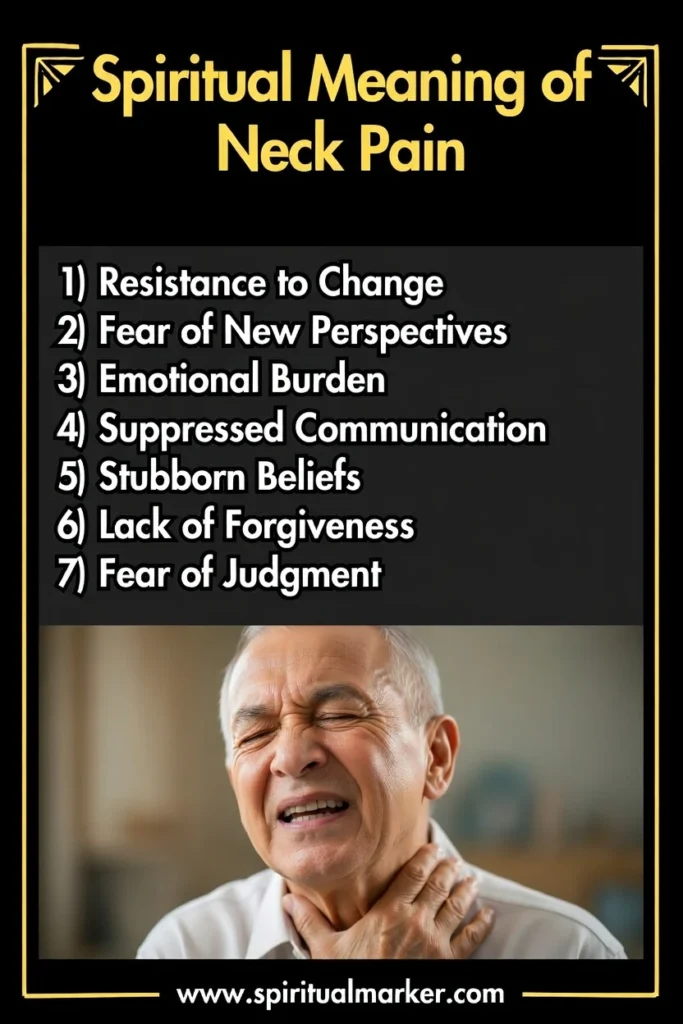
When you look at neck pain through a spiritual lens, it stops being only a physical issue. Instead, it starts to feel like a quiet message. The body speaks in sensations. It whispers before it shouts. And the neck, sitting between the head and the heart, often carries some of the most meaningful signals.
Let’s go deeper into each of these spiritual meanings of neck pain, not as abstract ideas, but as lived emotional patterns you may recognize in your own life.
1. Resistance to Change
At first, resistance does not look dramatic. It feels subtle. You delay a decision. You stay in a situation longer than you should. And, you tell yourself, “This is fine,” even when something inside you feels restless.
Over time, that inner resistance builds pressure.
Your neck reflects this in a very physical way. When you resist change, your body mirrors that refusal to move. The stiffness becomes symbolic. You are not turning. You are not shifting. You are holding your ground, even when life gently pushes you forward.
In many spiritual teachings, neck pain represents a blocked transition. Life wants evolution. However, fear prefers familiarity. As a result, your muscles tighten, almost as if they are trying to freeze time.
If you pay attention, you may notice this pattern. Neck pain often appears during major life phases. Career shifts. Relationship changes. Personal growth moments. The discomfort is not random. It reflects the tension between who you are and who you are becoming.
2. Fear of New Perspectives
The neck allows movement. You turn your head to see what is around you. That simple motion carries deep symbolic meaning.
When you experience neck pain, it may signal a deeper hesitation. You may not want to “look” at something. Maybe it is a truth you have avoided. Maybe it is feedback that challenges your beliefs.
At an emotional level, fear of new perspectives creates inner rigidity. You start protecting your current worldview. You defend it. You avoid conversations that might shake it.
As this pattern continues, the body follows. The neck tightens because it mirrors that unwillingness to turn toward something new.
Spiritual traditions often say that growth requires openness. Yet openness feels uncomfortable. It asks you to admit that you do not know everything. It invites change. And that can feel threatening.
Therefore, neck pain becomes a gentle nudge. It asks, “What are you refusing to see?” Once you answer that honestly, the tension often begins to soften.
3. Emotional Burden or Responsibility
Think about the phrase, “carrying the weight of the world.” It is not just poetic. It is physical.
Many people who struggle with chronic neck pain also carry emotional loads that feel too heavy. They take care of everyone. They worry constantly. They rarely rest mentally.
At first, this feels like strength. You become reliable. Others depend on you. However, beneath that strength lies exhaustion.
The neck and shoulders become storage areas for this weight. Stress hormones tighten the muscles. Over time, that tension becomes your normal state.
From a spiritual viewpoint, this meaning points to imbalance. You give too much. You hold too much. Yet you do not release enough.
As a result, the body creates discomfort to draw attention. It says, “This is too heavy.” Not because you are weak, but because you are human.
When you start sharing responsibility or setting boundaries, you often notice something interesting. The body responds quickly. The pain eases. The weight lifts, both emotionally and physically.
4. Suppressed Communication
The neck surrounds the throat. This area connects closely with self-expression.
When you hold back your words, your body does not forget. It stores that silence. Every time you choose not to speak your truth, tension builds.
In spiritual practices, this area relates to communication energy. When that energy gets blocked, it often shows up as neck pain, throat tightness, or stiffness.
You may notice this especially after difficult conversations. Maybe you wanted to say something, but you stayed quiet. Maybe you felt misunderstood, yet you did not correct it.
Over time, this creates pressure. The unspoken words do not disappear. Instead, they sit in your body.
This does not mean you should say everything impulsively. Instead, it highlights the importance of honest expression. When you speak clearly and calmly, the body relaxes. It no longer needs to hold that tension.
So, if your neck often feels tight, ask yourself a simple question. “What am I not saying?” The answer can be surprisingly revealing.
5. Inner Conflict Between Heart and Mind
The neck sits between two powerful centers. Above it, the mind thinks. Below it, the heart feels.
When these two fall out of alignment, tension appears.
For example, your mind may tell you to stay in a safe job. At the same time, your heart may crave something more meaningful. This creates a silent battle.
You move forward, yet you hesitate. You decide, yet you doubt. This internal push and pull creates stress, and the neck becomes the physical expression of that conflict.
Many spiritual perspectives describe this as blocked alignment. You are split between logic and emotion.
As this continues, your body tries to hold both sides. That effort creates stiffness. It feels like you are being pulled in opposite directions.
When you finally choose alignment, even if the decision feels difficult, something shifts. The body responds. The tension reduces because the internal fight ends.
6. Stubborn Beliefs or Rigid Thinking
Rigidity does not only exist in the body. It begins in the mind.
When you hold onto beliefs too tightly, you limit flexibility. You stop questioning. You stop adapting. You insist on one way of thinking, even when life presents new information.
This mental rigidity often reflects physically as neck pain. The stiffness mirrors your unwillingness to bend.
Spiritual teachings often connect flexibility with growth. Trees that bend in the wind survive storms. In contrast, rigid branches break.
The same principle applies here. When your thinking becomes too fixed, your body follows that pattern.
However, this does not mean abandoning your values. It simply means allowing space for new insights. When you soften your perspective, your body often softens as well.
7. Lack of Forgiveness
Holding onto resentment feels heavy. At first, it may feel justified. You replay situations. You remember the hurt clearly.
Yet over time, that emotional weight turns inward.
Your body stores unresolved emotions. The jaw tightens. The shoulders rise. The neck becomes stiff. This is not coincidence.
From a spiritual angle, neck pain can reflect unprocessed anger or lack of forgiveness. Not because forgiveness excuses behavior, but because it frees you from carrying the pain.
When you hold onto past hurt, your body remains in a protective state. It stays tense, ready, guarded.
However, when you begin to release that resentment, even slowly, your body responds. The tension reduces. The muscles relax.
Forgiveness is not a single moment. It is a process. Still, every step you take lightens the load your body carries.
8. Overthinking and Mental Stress
Modern life encourages constant thinking. You analyze. You plan. You worry. Your mind rarely rests.
This mental overload does not stay in your head. It travels down into your body, especially into the neck.
When thoughts race, muscles tighten. The nervous system stays activated. Over time, this creates chronic discomfort.
From a spiritual perspective, neck pain reflects an overactive mind. You live in your thoughts more than in the present moment.
This disconnect creates imbalance. The head dominates, while the body absorbs the stress.
Simple practices can shift this pattern. Deep breathing. Walking. Quiet reflection. These bring attention back into the body.
As your mind slows down, your neck often follows. The tightness reduces because the pressure decreases.
9. Fear of Judgment
Many people carry a quiet fear. They worry about how others see them. They filter their words. They adjust their behavior to fit expectations.
This constant self-monitoring creates tension.
The neck and throat become protective zones. They tighten as if guarding your identity. You hesitate before speaking. You second-guess yourself.
Spiritually, this reflects a disconnection from your authentic voice. You hold back because you fear rejection or criticism.
However, this fear keeps you small. It limits expression. And over time, it shows up physically as neck pain or tightness.
When you begin to accept yourself more fully, something changes. You speak more freely. You move more naturally.
As confidence grows, the body relaxes. The need for protection decreases, and the tension slowly fades.
10. Difficulty Letting Go of Control
Control often feels safe. You plan everything. You try to manage outcomes. You hold tightly to expectations.
At first, this creates a sense of stability. Yet life rarely follows perfect plans. When reality shifts, control turns into stress.
Your body reacts quickly. The neck tightens because you are holding on too hard.
From a spiritual point of view, neck pain can signal resistance to surrender. Not giving up, but trusting the flow of life.
Letting go does not mean losing direction. Instead, it means allowing space for uncertainty. It means accepting that not everything can be controlled.
As you practice this, even in small ways, your body responds. The grip loosens. The tension decreases.
You begin to move with life instead of against it.
Emotional and Energy Blockages Linked to Neck Pain
Emotions do not disappear when ignored. Instead, they settle in the body. The neck becomes a common storage space for these hidden feelings.
For example, anger often creates tightness. You may feel stiff after holding back frustration. Similarly, guilt can weigh heavily. It creates a sense of pressure that the body must carry.
Another major factor is fear. When you fear change or uncertainty, your muscles tighten. The neck reacts quickly because it connects to awareness and alertness.
Energy blockages also play a role. The throat chakra sits near the neck. It governs truth, communication, and self-expression. When this energy center becomes blocked, you may struggle to speak honestly. Over time, this imbalance can manifest as pain.
In addition, emotional exhaustion can weaken the body’s natural flow. When energy cannot move freely, tension builds. This tension often settles in areas that already carry stress.
Therefore, healing requires more than physical treatment. It involves releasing stored emotions and restoring energy flow.
Cultural and Religious Interpretations of Neck Pain
Different cultures have long believed that the body reflects the soul’s condition. Neck pain holds meaning in many traditions.
In traditional Chinese medicine, the neck relates to energy flow, known as Qi. When Qi becomes blocked, pain arises. This blockage often connects to stress or emotional imbalance.
In Ayurveda, the body’s energy centers must stay balanced. Neck pain can signal disruption in the Vishuddha chakra. This chakra governs communication and truth.
Buddhist teachings often link physical discomfort to attachment. Neck pain may reflect clinging to certain beliefs or resisting change. Letting go becomes essential for relief.
In Hindu philosophy, the throat area represents purity and expression. When truth is suppressed, imbalance appears. The body responds with tension.
Native spiritual traditions often view pain as a teacher. Neck discomfort may suggest you need to see life from a different angle. It encourages awareness and openness.
In some African healing traditions, the neck symbolizes responsibility. Pain may indicate carrying burdens that do not belong to you.
Biblical Meaning of Pain in the Body and Spiritual Lessons
The Bible often speaks about the connection between the body and the spirit. While it may not mention neck pain directly, it offers deep insight into suffering and growth.
Pain can act as a form of correction or guidance. It encourages reflection and humility.
Proverbs 3:11-12 (KJV)
“My son, despise not the chastening of the Lord; neither be weary of his correction:
For whom the Lord loveth he correcteth; even as a father the son in whom he delighteth.”
This verse shows that discomfort can lead to growth. It reminds us that correction comes from care, not punishment.
Another powerful verse highlights the link between inner peace and physical well-being.
Proverbs 14:30 (KJV)
“A sound heart is the life of the flesh: but envy the rottenness of the bones.”
This suggests that emotional states affect the body. Negative feelings can create physical harm.
Additionally, the Bible speaks about surrendering burdens.
Matthew 11:28 (KJV)
“Come unto me, all ye that labour and are heavy laden, and I will give you rest.”
This verse encourages releasing emotional weight. Holding onto stress can manifest as physical pain, including in the neck.
Finally, forgiveness plays a key role.
Ephesians 4:31-32 (KJV)
“Let all bitterness, and wrath, and anger, and clamour, and evil speaking, be put away from you…
And be ye kind one to another, tenderhearted, forgiving one another…”
Unforgiveness can create tension. Letting go can bring both spiritual and physical relief.
Spiritual Healing Practices for Neck Pain and Energy Balance
Healing begins with awareness. Once you recognize the emotional link, you can take steps toward balance.
Start with mindful breathing. Slow, deep breaths help release tension. They calm the mind and relax the body.
Next, focus on gentle movement. Stretching the neck improves both physical and energy flow. Even simple movements can make a difference.
Meditation also plays a powerful role. It helps you observe thoughts without attachment. Over time, this reduces mental pressure.
Journaling can uncover hidden emotions. Writing allows you to express what you may not say out loud. This process clears internal blockages.
Another helpful practice involves affirmations. Positive statements can shift your mindset. For example, you might say, “I release control and trust the flow of life.”
Energy healing methods, such as chakra balancing, can restore flow. When the throat chakra opens, communication improves. This often reduces tension in the neck.
Forgiveness is equally important. Holding onto resentment creates heaviness. Letting go brings lightness and ease.
Finally, listen to your body. Rest when needed. Set boundaries when overwhelmed. These simple steps can prevent further strain.
Final Thoughts
Neck pain carries more meaning than it first appears. While physical causes exist, emotional and spiritual factors often play a hidden role.
The neck connects thought and feeling. When these fall out of balance, tension forms. Pain becomes a signal that something needs attention.
Instead of ignoring it, take time to reflect. Ask yourself what you are holding onto. Consider where you feel stuck or resistant.
Healing does not happen overnight. Yet, small steps create real change. Awareness, honesty, and self-care can restore balance.
When you listen to your body, you begin to understand yourself better. And through that understanding, true healing begins.
You Might Also Like
1) Spiritual Meaning of Back Pain: Lower, Mid and Upper Back
2) Spiritual Meaning of Foot Pain: Right and Left
3) Spiritual Meaning of Common Cold or Runny Nose
4) Spiritual Meaning of Burping and Biblical Symbolism
5) Spiritual Meaning of Head Itching (Different Areas)
References
- https://www.yourtango.com/health-wellness/metaphysical-meaning-neck-shoulder-pain
- https://www.youtube.com/watch?v=bcw76TvJuME
- https://drnavin.com/can-emotional-stress-cause-neck-pain/
- https://www.livingcentreclinic.com/stress-and-emotion-back-pain-neck-neck-pain/
- https://pmc.ncbi.nlm.nih.gov/articles/PMC10066660/
- https://medshun.com/article/what-does-neck-pain-mean-louise-hay
- http://shineonmassage.com/blog/2018/10/17/muscle-tension-caused-by-trapped-emotions