A Mongolian birthmark is a blue-gray mark that appears on the lower back or buttocks. It is common in babies of Asian, African, and Native American descent. Beyond genetics, many cultures attach spiritual meaning and superstition to this mark.
The Mongolian birthmark spiritual meaning often involves ancestral connection, protection, and destiny. Some traditions view it as a sign that the baby was touched by spirits before birth. A spiritual meaning of birthmarks types shapes locations shares that birthmark focus, though the Mongolian spot is specific.
Some superstitions say the mark fades as the child grows, taking spiritual protection with it. Others see it as a mark of good luck. The size and location can add detail.
If you have this birthmark, it may signal a special connection to your ancestors. A spiritual meaning of a birthmark on the buttock also deals with lower-body marks, though the buttock is more specific.
What Is a Mongolian Birthmark?
A Mongolian birthmark, also called a congenital dermal melanocytosis, appears as a bluish or gray patch on a baby’s skin. Doctors usually find it on the lower back or buttocks. Sometimes it shows up on the shoulders or legs. The mark often looks like a faint bruise, yet it does not hurt and fades with time.
Most babies who have this birthmark are of Asian, African, Native American, or Hispanic descent. However, it can appear in any ethnicity. Medical science explains it clearly. During fetal development, pigment cells get trapped in deeper layers of the skin. As a result, the skin shows that soft blue or slate color.
Even though science provides a simple answer, many cultures see something deeper. Across continents, people attach powerful spiritual meanings to unusual marks on the body. In fact, for centuries, birthmarks have sparked stories, beliefs, and mystical interpretations. When a baby arrives with a Mongolian birthmark, families often wonder whether it carries a hidden message.
That curiosity opens the door to spiritual exploration.
10 Spiritual Meanings of Mongolian Birthmark
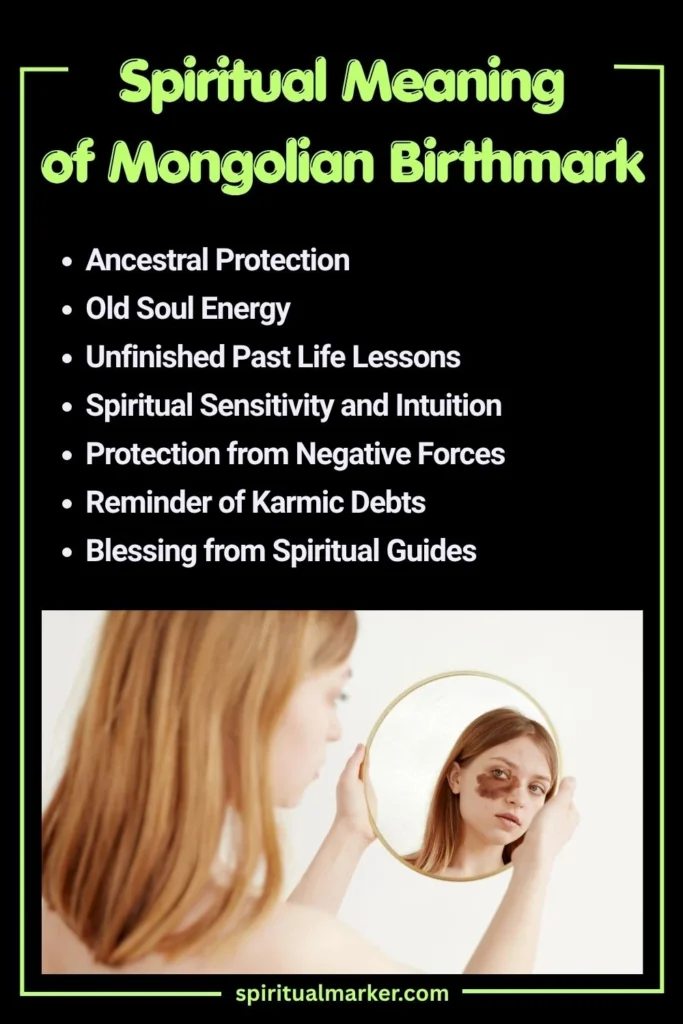
1. Ancestral Protection
Many Indigenous cultures see the Mongolian birthmark as more than skin deep. They believe it carries the touch of those who came before us. In several Native American and West African traditions, elders say ancestors place a spiritual seal on a newborn. That seal protects the child from harm, jealousy, and wandering spirits.
This belief rests on the idea that life does not begin at birth. Instead, the soul travels through a spiritual realm before entering the body. During that journey, ancestors recognize their bloodline. They then mark the child as one of their own. As a result, the birthmark becomes a quiet declaration of belonging.
Parents in such traditions often feel comfort when they notice the mark. They interpret it as a sign that the child will never walk alone. Even during illness or hardship, the family believes unseen hands guide and guard the bearer. Therefore, the mark acts as a lifelong shield, not only against danger but also against despair.
2. Old Soul Energy
In many spiritual circles, people speak of old souls. These individuals seem wise beyond their years. They often show calm thinking, deep empathy, and strong moral awareness from a young age. When a child has a Mongolian birthmark, some interpret it as proof of a long soul history.
The idea of reincarnation supports this view. According to various Eastern philosophies, the soul returns many times. With each life, it gathers lessons and memories. Although conscious memory fades, subtle impressions remain. The birthmark then serves as a physical echo of those past journeys.
Because of this belief, people sometimes notice patterns. A child with the mark may love ancient stories. They may also feel drawn to meditation, history, or spiritual topics. These interests seem natural rather than taught. Therefore, believers see the birthmark as a badge of accumulated wisdom.
3. Unfinished Past Life Lessons
Some esoteric teachings connect birthmarks to unresolved karma. In this view, the soul carries unfinished lessons into a new body. The Mongolian birthmark then becomes a visible reminder of that unfinished work.
Certain traditions even suggest that the spot reflects past trauma. For example, if someone died in a violent way, the soul may carry a subtle scar. That scar appears as a birthmark in the next life. Although modern medicine explains the mark biologically, spiritual thinkers focus on symbolic meaning.
As a result, the location of the mark gains importance. People may interpret it as a clue. They believe it hints at what needs healing now. This belief aligns with Vedic and Buddhist ideas of karma. Actions create impressions. Those impressions seek balance. Therefore, the birthmark calls the individual to grow, forgive, and evolve.
4. Spiritual Sensitivity and Intuition
Many spiritual communities link the Mongolian birthmark with heightened intuition. They believe the mark identifies souls who can sense more than others. Such individuals often pick up on emotions quickly. They may also experience strong gut feelings.
Because of this sensitivity, elders sometimes guide these children toward spiritual practices. They encourage prayer, meditation, or traditional rituals. The goal is to help the child manage their energy. Without guidance, sensitivity can feel overwhelming.
However, with support, it becomes a gift. The person may develop healing abilities or deep empathy. Some even feel drawn to shamanic paths or spiritual counseling. Therefore, the birthmark signals not weakness but spiritual potential.
5. Protection from Negative Forces
Across different cultures, people fear unseen forces. They speak of the evil eye, curses, or harmful spirits. Within such belief systems, protective symbols hold great value. The Mongolian birthmark often joins that list.
In African and Middle Eastern folklore, physical marks sometimes confuse or deter malevolent spirits. The mark acts as a distraction or barrier. Spirits, according to these stories, cannot easily attach to someone already claimed by ancestral power.
Families who hold this belief feel secure. They see the birthmark as a built in talisman. It does not require amulets or charms. Instead, protection lives within the skin itself. Therefore, the child grows up under a spiritual safeguard believed to last a lifetime.
6. Reminder of Karmic Debts
Karmic philosophy teaches that every action carries consequence. Some consequences unfold quickly. Others stretch across lifetimes. Within this framework, the Mongolian birthmark can symbolize unresolved emotional debts.
For instance, a soul may have betrayed trust in a past life. It may have abandoned love or misused power. In the next incarnation, the soul seeks correction. The birthmark then becomes a subtle reminder to act with integrity.
Interestingly, many Mongolian birthmarks fade during childhood. Spiritual thinkers connect this fading with karmic resolution. As the individual learns lessons and balances relationships, the mark softens. In that way, the skin mirrors inner growth.
7. Blessing from Spiritual Guides
Beyond ancestors, some traditions speak of spirit guides. These guides assist souls before and after birth. They help plan life paths and major lessons. When a child bears a Mongolian birthmark, believers may interpret it as a sign of divine oversight.
This belief offers comfort. It suggests that life unfolds with purpose. Even painful events hold meaning. The mark then acts as a reminder of unseen companionship.
During difficult seasons, individuals may look at their mark and feel reassurance. They believe guidance surrounds them, even if invisible. Therefore, the birthmark becomes both a symbol of destiny and a sign of support.
8. Strong Connection to Family Lineage
In Mongolian and other Indigenous worldviews, land and lineage matter deeply. Identity flows through bloodlines. The Mongolian birthmark, in this context, symbolizes rootedness.
Some elders call it a tribal stamp. They believe it binds the child to ancestral lands and stories. Even if the person moves far away, the mark ties them back to origin. It carries the memory of migration, survival, and community strength.
Families may perform rituals to honor this connection. They teach children about ancestors and heritage. As a result, the birthmark strengthens cultural pride. It reminds the individual that their life forms part of a much larger story.
9. Soul Chosen for Resilience
Another powerful interpretation views the birthmark as a sign of strength. According to this belief, certain souls volunteer for challenging paths. They choose growth through adversity.
The Mongolian birthmark then marks a resilient spirit. It suggests that the soul has faced hardship before and endured. Because of that history, it now carries inner toughness.
People who hold this view often notice courage in the bearer. Even in childhood, they may show determination. When obstacles appear, they adapt rather than collapse. Therefore, the mark becomes an emblem of endurance shaped by many lifetimes.
10. Destiny Linked to Transformation
Finally, some spiritual teachers describe the Mongolian birthmark as a sign of transformation. They believe these individuals walk paths of deep change. Their lives may involve spiritual awakening, healing journeys, or major identity shifts.
The mark signals movement rather than comfort. It points toward growth that reshapes beliefs and priorities. Such people may question reality early. They may seek truth beyond surface appearances.
Over time, this search leads to personal evolution. The person sheds old layers and discovers deeper purpose. In that sense, the birthmark becomes a quiet prophecy. It announces a life devoted to transformation and inner awakening.
Cultural Superstitions and Folklore Around Birthmarks
Across cultures, birthmarks rarely go unnoticed. People often create stories to explain what science cannot fully satisfy on an emotional level. As a result, folklore surrounding Mongolian birthmarks feels rich and layered.
In parts of East Asia, elders sometimes call it a “guardian’s touch.” They believe ancestors gently marked the child before birth. This mark signals protection and belonging. Families may see it as proof that their lineage watches over the newborn.
Meanwhile, in certain Central Asian traditions, people view the mark as a warrior’s sign. They connect the bluish patch to strength and endurance. Since the birthmark commonly appears in Mongolian populations, some folklore links it to ancient tribal identity and heritage pride.
In some African communities, birthmarks hold messages from the spirit world. A blue-gray patch might suggest that the child carries wisdom from beyond. Therefore, families treat the child with extra respect and care.
On the other hand, older European superstitions once painted birthmarks in a darker tone. Some believed that unusual skin marks came from strong cravings or shocks experienced by the mother during pregnancy. Although this idea lacks medical proof, it shaped generations of belief.
Native American stories also attach symbolic meaning to body markings. Certain tribes view them as signs of spiritual purpose. A child with a noticeable birthmark might be expected to grow into a healer or guide.
Religious Interpretations and Beliefs
Religion often shapes how families interpret physical signs. When it comes to birthmarks, many faith traditions offer symbolic insight.
In Hindu belief systems, birthmarks sometimes connect to karma. Some interpret them as impressions from past life experiences. If a soul carried strong emotional energy before rebirth, that energy could leave a subtle mark on the new body.
Buddhist thought also entertains karmic continuity. While mainstream teachings focus on liberation from suffering, folk interpretations suggest that unusual marks hint at unfinished spiritual work. Therefore, a Mongolian birthmark may symbolize lessons the soul continues to learn.
In certain Christian communities, interpretations vary. Some believers see birthmarks as part of God’s intentional design. They may view the mark as a reminder that every child arrives with divine purpose. Others avoid mystical explanations and focus on medical understanding.
Islamic tradition generally emphasizes that physical traits come from Allah’s will. Some families still hold cultural beliefs that link birthmarks to spiritual signs, yet formal doctrine does not assign them specific meanings.
In Chinese folk religion, birthmarks sometimes connect to reincarnation stories. People may believe that a mark matches a wound from a previous life. Although this idea belongs more to folklore than formal theology, it influences family narratives.
Similarly, in certain shamanic traditions, body markings signal spiritual gifts. A child born with a visible mark may be believed to possess healing energy or psychic awareness.
Karmic and Past Life Connections
The idea of karma adds another layer of meaning. Many spiritual seekers believe that the soul travels through multiple lifetimes. During each life, it learns lessons, forms bonds, and accumulates emotional energy.
A Mongolian birthmark may represent a karmic imprint. Some spiritual thinkers suggest that intense experiences in a past life leave subtle traces. When the soul reincarnates, that energy may show physically.
For example, if a person endured hardship or showed great courage, the birthmark could symbolize resilience carried forward. In this view, the mark does not represent punishment. Instead, it reflects growth in progress.
Past life regression stories often describe birthmarks that match earlier injuries. Although science does not support these claims, believers find them meaningful. They see patterns rather than coincidence.
Whether literal or symbolic, the karmic interpretation encourages reflection. It invites the person to ask deeper questions. What lessons might I be here to complete? What strengths did I bring with me?
These questions shift the focus from superstition to self-discovery.
What Does It Mean for Your Life Path?
If you or your child has a Mongolian birthmark, you may wonder how it shapes destiny. The truth depends on perspective.
From a medical standpoint, it simply marks pigment beneath the skin. In most cases, it fades during childhood. It does not affect health or personality.
However, from a spiritual angle, meaning grows through belief. When families treat the mark as a sign of protection, the child may grow up feeling chosen and supported. That belief can build confidence.
If someone views the birthmark as a symbol of resilience, they may develop a strong identity around endurance. This internal narrative influences life choices and reactions to challenges.
Spiritual meaning often works like a mirror. It reflects what you believe about yourself. If you see the birthmark as a blessing, you carry that mindset forward.
Therefore, the life path connection lies less in the mark itself and more in the story you attach to it. Stories shape identity. Identity shapes action.
Final Thoughts
A Mongolian birthmark begins as a simple skin variation. Science explains its cause clearly and calmly. Yet human imagination and spiritual tradition add layers of meaning that reach far beyond biology.
Across cultures, people interpret this bluish mark as protection, karma, ancestry, or destiny. Religious traditions offer both symbolic and cautious views. Folklore fills in emotional gaps with powerful narratives.
In the end, meaning remains personal. Some choose medical clarity and stop there. Others explore spiritual symbolism and find comfort in deeper stories.
Both perspectives can coexist peacefully. The birthmark itself stays silent. We give it a voice through belief, culture, and reflection.
When you look at such a mark, you see more than skin. You see history, faith, and human curiosity woven together.
References
- https://www.whatspiritual.com/spiritual-meanings-of-mongolian-birthmark-superstitions/
- https://spiritualfaqs.com/mongolian-spot-spiritual-meaning/
- https://symbolicwhispers.com/mongolian-spot-spiritual-meaning/
- https://www.mongolianz.com/post/2019/01/23/mysteries-of-the-mongolian-blue-spot/
- https://timesofindia.indiatimes.com/astrology/others/10-birthmarks-that-may-reveal-secrets-of-your-past-karma/articleshow/114772584.cms
- https://www.amicusmongolia.com/mongolia-blue-spot.html