A gray candle burns with a muted and neutral flame. Its color sits between black and white, balancing extremes. In spiritual practice, gray candles carry grounding and balancing energy.
The gray candle spiritual meaning often involves neutrality, compromise, and stability. Gray is used for meditation, grounding, and releasing attachment. A spiritual meaning of brown candle shares that candle focus, though brown represents earth and home.
Gray candles are used in rituals to find balance, reduce anxiety, and navigate transitions. They can also symbolize patience and neutrality. The intention behind the use matters most.
If you feel drawn to gray candles, it may signal a need for balance. A spiritual meaning of black candle also deals with candle symbolism, though black carries a more protective energy.
Key Takeaways
- Gray candles are deeply connected to neutrality, balance, and the resolution of conflict
- They are associated with wisdom, discernment, and seeing situations without emotional bias
- Spiritually, gray connects to psychic protection, neutralizing negative energy, and inner stillness
- Gray candles support practices related to shadow work, meditation, and releasing what no longer serves you
- Across traditions, gray is associated with transition, ancestral connection, and spiritual maturity
What Does a Gray Candle Symbolize?
At its core, a gray candle symbolizes neutrality. Not indifference, but a deliberate, centered stillness that allows you to see clearly without being pulled toward any extreme. It is the spiritual equivalent of stepping back from a heated situation and observing it with calm, open eyes.
Gray sits at the intersection of black and white, which gives it a layered symbolic significance. It does not reject either pole. Instead, it holds both simultaneously. In metaphysical systems, this makes gray a uniquely powerful color for situations that require balanced judgment, complex discernment, or the resolution of opposing forces.
There is also a strong connection between gray and the liminal, those transitional spaces between one chapter of life and another. Think of gray skies at dawn, not quite night, not yet full day. Think of fog, which conceals and reveals in equal measure. These are images that perfectly capture the spiritual energy of gray. It represents the space of becoming, where old identities are released and new ones have not yet fully formed.
Gray also carries a deep connection to ancestral and spiritual wisdom. In many traditions, the color of ash, stone, and aged wood points toward knowledge earned through time and experience. When you light a gray candle, you are symbolically aligning with that timeless, unhurried wisdom.
Finally, gray carries a quality of psychic shielding. While black is often used for strong protective work, gray offers a softer, more nuanced form of energetic protection. It neutralizes rather than blocks, deflects rather than confronts. For those navigating emotionally charged environments or psychically sensitive situations, this quality makes the gray candle especially relevant.
10 Spiritual Meanings of a Gray Candle
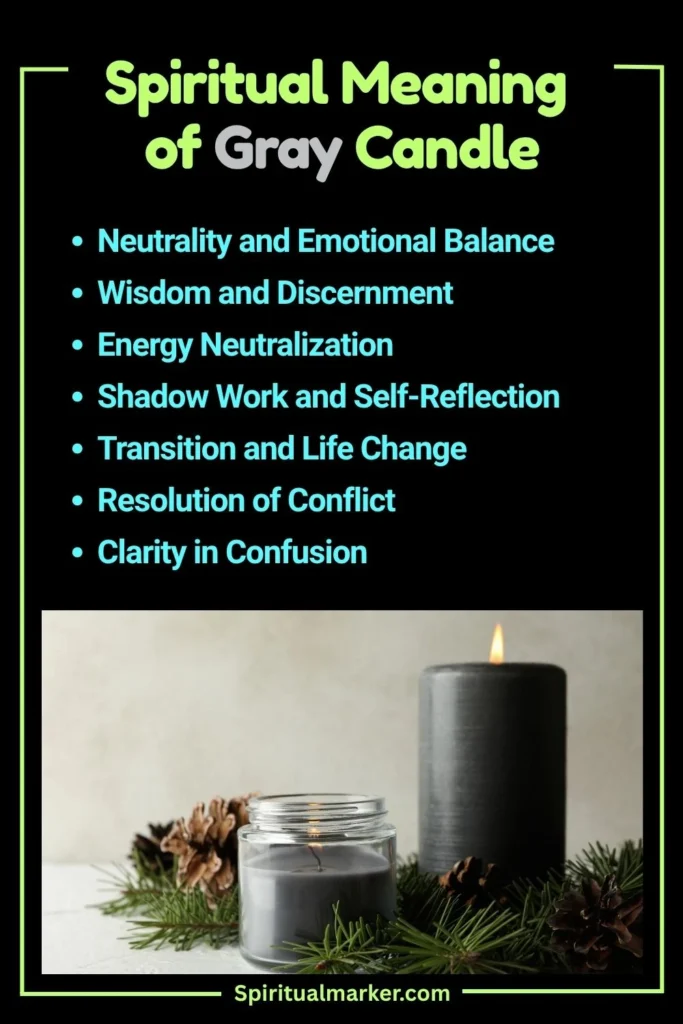
1. Neutrality and Emotional Balance
Life regularly presents situations where emotions run high and objectivity feels impossible. Grief, conflict, resentment, anxiety, these states cloud judgment and distort perception. The gray candle is uniquely suited to these moments because its primary spiritual association is neutrality.
This is not emotional detachment or coldness. It is the kind of centeredness that allows you to feel your emotions without being controlled by them. In many metaphysical traditions, gray is described as a balancing frequency, one that absorbs excess energy from any direction without amplifying it.
When you light a gray candle with the intention of finding balance, you are not suppressing what you feel. You are creating a symbolic space in which all of those feelings can exist without tipping the scales too far in any direction. It is an act of inner equilibrium, of allowing complexity to be complex rather than forcing premature resolution.
Psychologically, this mirrors the concept of equanimity, a state of mental calmness especially in difficult situations. Gray candle symbolism captures that state beautifully because the color itself visually represents neither extreme.
2. Wisdom and Discernment
Not all knowledge is equal. There is a significant difference between raw information and true wisdom, the kind that comes from experience, reflection, and honest self-examination. Gray has long been associated with this deeper form of knowing.
Think of the phrase “gray wisdom” or the image of an elder with silver hair. These cultural references point to something real. Wisdom is earned, not simply learned. It carries the weight of experience, and gray captures that weight in its very appearance.
In spiritual practice, a gray candle represents the ability to discern truth from illusion. It supports the kind of reflection where you look at a situation not through the lens of what you want to see, but through the lens of what is actually there. This is particularly valuable when facing decisions that involve competing loyalties, ambiguous circumstances, or long-term consequences that are difficult to predict.
Gray encourages you to slow down and think carefully rather than react impulsively. It is the color of the thoughtful pause, the deliberate question, the patient inquiry that eventually leads to real understanding.
3. Psychic Protection and Energy Neutralization
Among practitioners who work with energy, gray candles are frequently used as tools of psychic protection. The reasoning is rooted in the neutralizing quality of the color itself. Gray does not absorb negative energy the way black does, nor does it project positive energy outward the way white does. Instead, it disperses, neutralizes, and creates an energetic buffer zone.
This makes gray candles particularly useful for those who feel sensitive to the emotional states of others, those who describe themselves as empaths or who regularly find themselves drained after social interactions. The gray candle creates a kind of symbolic energetic boundary, not a wall, but a diffusion field.
In many folk magic and contemporary spiritual traditions, gray candles are burned to neutralize harmful intentions directed at you, to create psychic stillness before entering difficult environments, or to cleanse spaces that carry heavy emotional residue from past conflicts. The flame does not fight the negative energy. It simply dissolves it into neutral ground.
4. Shadow Work and Self-Reflection
Shadow work is one of the most demanding and transformative practices in personal spiritual development. It involves turning your attention toward the parts of yourself you prefer not to examine, the fears you avoid, the patterns you repeat without understanding why, the emotions you have buried beneath acceptable behavior.
Gray is the perfect symbolic companion for this kind of inner work because it exists between light and dark. It does not force you into full darkness, nor does it pretend everything is light. It holds both truths at once, which is exactly what honest self-reflection requires.
When you light a gray candle during journaling, meditation, or therapeutic reflection, you are creating a symbolic invitation to engage with your own complexity without judgment. The gray flame says: you do not need to be purely good or purely certain. You are allowed to be human, layered, and in process.
This work often feels uncomfortable, but it leads to genuine liberation. The gray candle honors that discomfort by refusing to rush past it. It says: sit here, look honestly, and trust that clarity will come in time.
5. Transition and Life Change
Every major transition in life passes through a gray zone. The period between ending one relationship and beginning another. The space between one career and the next. The months after a loss when nothing feels settled yet. These are gray times, not because they are hopeless, but because they are genuinely in-between.
Gray candles are deeply suited to these transitional spaces. They do not promise a specific outcome, which makes them honest rather than falsely optimistic. They represent the acceptance of process, the willingness to remain in uncertainty without forcing premature resolution.
In spiritual traditions that work with life cycles, this transitional energy is considered sacred rather than uncomfortable. The gray zone is where the most profound personal transformation happens because old patterns have dissolved but new ones have not yet fully formed. The gray candle honors that space and supports the inner work that happens within it.
Lighting a gray candle during a major life transition is a way of saying: I am willing to be in this process. I trust the journey even when the destination is not yet clear.
6. Resolution of Conflict
Few human experiences are as draining as ongoing conflict. Whether the tension exists between people, within a relationship, or internally between competing desires or values, unresolved conflict consumes enormous amounts of mental and emotional energy.
Gray candles carry a specific spiritual association with conflict resolution and reconciliation. The reasoning connects back to their neutralizing energy. When two opposing forces are brought into the symbolic space of gray, neither is elevated above the other. Both are acknowledged, both are held, and the possibility of common ground emerges.
This does not mean gray candles force resolution or guarantee reconciliation. It means they create the energetic conditions in which resolution becomes more possible. They remove the charge from a situation, allowing both parties, or both sides of an internal debate, to communicate without the distortion of defensiveness or anger.
In practices focused on peace and healing within relationships, gray candles are often burned alongside intentions for mutual understanding rather than personal victory. The goal is not to win but to arrive at clarity together.
7. Ancestral Connection and Spiritual Maturity
Across many cultures, ancestral wisdom is considered one of the most valuable spiritual resources available to the living. Gray, as the color of ash, stone, aged wood, and silver hair, holds a natural connection to this intergenerational knowledge.
In traditions that actively honor ancestors, such as practices found across West Africa, the African diaspora, Indigenous cultures worldwide, and many Asian spiritual traditions, gray often appears as a color of respectful remembrance and spiritual communication. It represents the thin veil between the living and those who have passed, particularly those who left behind wisdom worth carrying forward.
A gray candle burned with ancestral intention creates a symbolic bridge between present experience and accumulated wisdom across generations. It is an act of humility, an acknowledgment that you do not navigate life alone, that those who came before you have walked through similar uncertainties and found their way.
This spiritual meaning also connects to maturity in a broader sense. Gray symbolizes the wisdom that comes from having lived through difficulty and emerged with a deeper, more nuanced understanding of life.
8. Clarity in Confusion
When life presents you with genuinely complex situations where no answer is obviously right and every path carries some risk, gray is your ally. This is distinct from the mental clarity associated with yellow candles, which often deal with focus and decision-making from a place of relative order. Gray clarity works in a different register.
It is the kind of clarity that emerges when you stop demanding a simple answer and begin accepting the full complexity of a situation. It is what happens when you release the need to immediately classify something as good or bad, right or wrong, and simply observe it honestly.
In spiritual practice, a gray candle used with this intention creates a symbolic space in which mental rigidity softens. The demand for certainty loosens, and with it, the anxiety that often accompanies ambiguous situations begins to ease. What replaces it is not false certainty but a more grounded, honest acceptance of complexity that paradoxically makes navigation easier.
9. Letting Go and Release
One of the most significant spiritual uses of the gray candle is in practices focused on release. This is about more than forgiveness or moving on. It is about the energetic act of setting something down that you have been carrying far too long.
Gray sits between holding and releasing, which makes it the appropriate symbolic medium for this kind of work. It is not the stark finality of black. It is not the fresh beginning of white. It is the honest middle space where you acknowledge what has been, feel what needs to be felt, and consciously choose to stop carrying it.
This might apply to old beliefs that no longer serve you, emotional patterns rooted in past pain, resentment held toward yourself or others, or simply the accumulated weight of daily stress. The gray candle ceremony of release is an act of conscious unburdening, a symbolic declaration that you are choosing lightness without pretending the weight was never real.
10. Meditation and Inner Stillness
Gray is, perhaps more than any other color, the color of deep stillness. It does not excite or agitate. It does not project warmth or coolness with particular force. It simply is, steady, quiet, present.
For meditation practices focused on inner silence rather than specific outcomes, the gray candle is an ideal companion. Its neutral flame creates a visual focal point without directing the mind toward any particular emotional or intellectual destination. It simply holds space for whatever arises.
In this context, the gray candle is not a tool for achieving something. It is a support for being. It encourages the kind of awareness that arises naturally in stillness, where insight is not forced but simply allowed to surface. Many experienced meditators find that gray candles create a particularly clean energetic atmosphere for this kind of open, non-directed awareness.
Types of Gray Candle and Their Spiritual Meanings and Benefits
Not every gray candle carries identical symbolic energy. The shade, material, and form of the candle can subtly influence its spiritual associations.
Light Gray Candles carry a softer, more gentle energy. They are often associated with early-stage transition, quiet contemplation, and peaceful introspection. Light gray feels like the first light of morning before the sun has fully risen, expectant, open, and tender. People often use light gray candles during journaling sessions, early meditative practice, or gentle emotional processing.
Dark Gray Candles carry a weightier, more serious energy. They connect more deeply to shadow work, psychic protection, and the processing of heavy or complex emotional material. Dark gray is not ominous. It is simply more potent, suited to deeper work and more layered intentions. Practitioners often choose dark gray candles when working through grief, spiritual confusion, or long-standing energetic blockages.
Silver-Gray Candles occupy a luminous middle space. The shimmer of silver lifts the heaviness of pure gray and connects it to lunar energy, intuition, and psychic awareness. Silver-gray candles are often used in moon rituals, intuitive development practices, and work focused on spiritual communication and ancestral connection.
Smoke-Scented Gray Candles combine the visual symbolism of gray with the aromatic quality of smoke, which itself carries associations with purification, spiritual communication, and transformation across many traditions. These candles create an atmosphere particularly suited to meditative or ancestral work.
Gray Pillar Candles are frequently used in long-term ritual work because of their sustained burn time. Their sturdy, grounded form suits extended intentions, particularly those involving ongoing protection, sustained balance, or gradual transformation over time.
Gray Jar Candles carry the added symbolism of containment. The enclosed flame is often associated with inward-focused work, protected intentions, and sustained spiritual effort directed toward inner change rather than external manifestation.
Benefits of Using Gray Candles in Spiritual Practices
The benefits of incorporating gray candles into spiritual practice are numerous and deeply connected to everyday human experience.
The most immediate benefit is emotional stabilization. In a world that often demands extremes, the gray candle offers a symbolic anchor to the center. For those prone to emotional overwhelm, anxiety, or reactive patterns, working with gray candle energy creates a reliable touchstone of calm. It does not eliminate difficult emotions. It provides a stable container in which they can exist without becoming destabilizing.
Another significant benefit is enhanced discernment. Regular engagement with gray candle energy can support the development of more nuanced judgment. Rather than defaulting to black-and-white thinking, you begin to hold complexity more comfortably. This has real-world implications across relationships, professional decisions, and personal growth.
Psychic and energetic protection is another widely recognized benefit. For those who feel energetically sensitive or frequently drained by their environments, gray candle work creates a sustainable form of energetic self-care. The neutralizing quality of gray energy means that you are not building walls between yourself and the world. You are simply reducing the charge that external energies carry before they reach you.
Gray candles also offer profound support for grief and loss processing. They honor the reality that grief is not linear, simple, or quickly resolved. The gray candle holds space for the full complexity of loss without demanding that you be further along in the process than you actually are.
Finally, clarity and resolution emerge as consistent benefits across different traditions and approaches. Whether the confusion is intellectual, emotional, relational, or spiritual, gray candle practice consistently creates the conditions in which greater clarity becomes accessible.
Gray Candle Meaning in the Bible
The Bible does not explicitly reference gray candles, but biblical symbolism related to ashes, stone, refinement, and sacred stillness aligns deeply with the spiritual qualities the gray candle represents today.
Ashes, which are fundamentally gray, carry profound significance throughout Scripture. They are a symbol of humility, mourning, and transformation. The well-known phrase from Job captures this beautifully:
“I had heard of You by the hearing of the ear, but now my eye sees You; therefore I despise myself, and repent in dust and ashes.” — Job 42:5-6
This passage speaks to the transformative power of honest self-reckoning, which is precisely the energy of gray candle shadow work and inner reflection.
The imagery of stone also resonates with gray symbolism. Stone in Scripture represents permanence, foundation, and enduring wisdom. When Christ calls Peter “the rock,” the imagery conveys stability and trustworthiness across time, qualities that mirror the grounded wisdom of gray.
The spiritual value of stillness and waiting runs throughout the Psalms in ways that resonate with gray’s meditative quality.
“Be still, and know that I am God.” — Psalm 46:10
This command to stillness is not passive resignation. It is an active, intentional centering in the presence of something greater than immediate circumstances. The gray candle in contemplative Christian practice can serve as a physical focal point for exactly this kind of sacred stillness.
The prophet Elijah’s encounter with God in 1 Kings 19:12 describes the divine presence not in the dramatic fire or earthquake, but in the “still small voice,” the quiet, subtle, in-between space where truth is most clearly heard. Gray, as the color of that in-between space, connects naturally to this scriptural image of quiet divine encounter.
Using a Gray Candle During Prayer
People turn to gray candles in prayer for a wide range of intentions. Some seek peace in the middle of ongoing conflict. Others pray for the wisdom to navigate complex decisions where no option is obviously correct. Still others use the gray candle as a symbol of their willingness to release something, an old wound, a long-held resentment, a fear that has shaped their choices for too long.
The flame creates a visual focal point that naturally quiets mental noise during prayer. Its neutrality means it does not direct your emotional energy in any strong direction. Instead, it holds space for whatever you genuinely bring to the prayer.
A gray candle may feel especially meaningful during prayers focused on:
- Peace in the middle of conflict and relational tension
- Wisdom and discernment in complex or ambiguous decisions
- Letting go of grief, bitterness, or prolonged suffering
- Protection from negative energy in emotionally charged environments
- Ancestral connection and honoring those who have passed
- Transition and acceptance during major life changes
- Inner stillness and the spiritual discipline of waiting with trust
- Shadow work and honest self-examination before God
Many people pair gray candle prayer with scripture meditation, journaling, or silent contemplation. The combination of the candle’s grounding neutral energy with reflective written or verbal prayer creates a particularly powerful space for honest encounter with both self and the sacred.
Cultural and Religious Symbolism of Gray Candles
In Western esoteric and metaphysical traditions, gray is frequently associated with the element of ether or spirit, the fifth element that encompasses and transcends the classical four. This gives gray a connection to higher perception, liminal states, and the spaces between defined spiritual categories. In Wiccan and contemporary pagan practice, gray candles are used for spells and rituals involving neutrality, binding negative influences without harm, and navigating morally complex situations.
In Celtic spiritual traditions, gray holds strong associations with the spirit world and ancestral realms. The color of morning mist, stone circles, and the veil between worlds, gray appears frequently in Celtic mythology as the color of liminal beings and in-between places, riverbanks, forest edges, and dawn light. These settings were considered sacred precisely because they existed between defined categories.
In Tibetan Buddhism, the color associated with wisdom and the dissolution of delusion carries tones that approach silver-gray. Clear perception and the release of conceptual overlay, seeing things as they genuinely are rather than as the mind projects them to be, is a core spiritual goal that resonates deeply with gray candle symbolism.
In many African traditional religions and their diaspora expressions, including Candomble, Santeria, and Vodou, gray appears in the colors associated with certain Orishas and spirits connected to transition, death, ancestral memory, and the space between worlds. Gray is treated with deep respect in these traditions, recognized as a color of significant spiritual authority and ancestral power.
In Chinese spiritual tradition, gray connects to the concept of yin energy, the receptive, quiet, inward-turning quality that balances the active yang force. It is not considered negative but rather essential and complementary, the necessary counterpart to more active, outward energies.
In Japanese Zen aesthetic, the concept of wabi-sabi, which honors simplicity, impermanence, and the beauty of the unadorned and aged, resonates strongly with gray symbolism. The worn stone, the weathered wood, the quiet ash all represent a spiritual maturity that finds depth in apparent emptiness.
How to Use a Gray Candle for Manifestation and Healing
Using a gray candle for manifestation requires a slightly different mindset than working with more conventionally “positive” colors like yellow or green. Gray does not support manifesting from a place of desire or ambition. It supports manifesting from a place of clarity, release, and authentic alignment.
Before lighting a gray candle with a manifestation intention, the most valuable preparation is to clarify what you need to release in order for your intention to take root. Gray manifestation work often begins with an ending rather than a beginning. What old belief, pattern, or attachment is preventing the thing you want from arriving? The gray candle creates the energetic space to release that obstacle first.
For healing work, the gray candle is particularly valuable in situations involving complex grief, chronic anxiety, relational wounds, or the psychic residue of past trauma. It does not force healing to happen on a particular timeline. Instead, it creates a container of steady, neutral support within which healing can proceed at its natural pace.
The environment matters enormously in gray candle practice. A quiet, uncluttered space suits the gray candle’s energy better than a busy or stimulating environment. The goal is stillness, not excitement. Many practitioners pair their gray candle work with silence or soft ambient sound, dim lighting, and minimal sensory distraction.
What makes gray candle practice genuinely transformative is not the candle itself but the quality of presence you bring to it. The gray flame becomes a mirror for your inner state, reflecting both the clarity you have found and the confusion you are still working through, without judging either as failure.
When and Why You Should Light a Gray Candle
There are specific moments in life when the gray candle’s energy becomes especially relevant. These are typically times when the situation is genuinely complex, when simple optimism would feel hollow and dramatic action would feel premature.
You might feel drawn to light a gray candle when you are facing a decision that involves competing responsibilities or values with no clear right answer. In those moments, the mind often oscillates between options without arriving at clarity. The gray candle creates a symbolic pause, an invitation to stop cycling and simply sit with the complexity until genuine discernment emerges.
It also becomes meaningful during periods of grief or loss when the rawness has passed but the heaviness remains. You are no longer in crisis, but you are not yet on the other side. You are in the gray zone, and a gray candle honors exactly that space.
During energetically charged or conflict-heavy periods, whether in a relationship, workplace, or community, a gray candle can provide a daily ritual of re-centering and neutralization. It becomes a way of choosing not to amplify the tension, a small but consistent act of choosing balance over reaction.
There are also quieter, more ordinary reasons to light one. Sometimes, life simply feels heavy and layered without a clear cause. The gray candle needs no elaborate justification. It is appropriate whenever you need a quiet, grounded, honest moment of spiritual presence.
Table: Gray Candle Meaning at a Glance
| Aspect | Meaning and Significance |
|---|---|
| Primary Symbolism | Neutrality, balance, wisdom, transition |
| Chakra Association | Crown Chakra, Third Eye Chakra |
| Emotional Influence | Stability, calm, honest self-awareness |
| Spiritual Use | Shadow work, psychic protection, ancestral connection, release |
| Cultural Meaning | Liminality, ancestral wisdom, spiritual maturity |
| Best Use Cases | Conflict resolution, grief processing, complex decisions, deep meditation |
Final Thoughts
The gray candle does not offer easy promises. It does not glow with the warmth of optimism or the fire of passion. What it offers is something rarer and, in many ways, more valuable: honest, steady presence in the middle of complexity.
When you work with a gray candle, you are not reaching for a simple answer. You are creating space for the real answer, however long it takes to surface, however complicated it turns out to be. You are choosing depth over speed, wisdom over certainty, presence over performance.
In spiritual practice, gray candles serve those who are willing to do the inner work that the more dramatic colors do not invite. They are for the moments when you are brave enough to look honestly at what is there, to release what needs releasing, and to wait in the space between what was and what will be.
If you choose to bring a gray candle into your practice, let your intention be simple and honest. You do not need an elaborate ritual. You need the willingness to be present, to be still, and to trust that clarity is already on its way.
The flame will meet you exactly where you are.
References
- https://totallythedream.com/grey-candle-meaning/
- https://crystalspirits.co.za/products/3-grey-shabbat-candles
- https://originalbotanica.com/7-day-plain-candle-gray
- https://www.facebook.com/MkhuluMuhambi/posts/candles-part-2-candle-colour-meanings-burning-candles-for-spiritual-purposes-is-/289044572014798/
- https://spells8.com/gray-candles-meaning-stability-and-protection/
- https://gypsygemsjewelrybox.com/pages/gray-candle-meaning
- https://spiritualarts.org/the-power-of-candles/
- https://www.crystaldigest.com/candle-colors/gray-candles/
- https://www.naturesgardencrafts.com/blogs/articles/common-candle-color-meanings-understanding-the-significance