
You spot a goat standing still on a rocky ledge, staring straight at you. Or maybe one wandered into your dream last night and would not leave your mind all morning. Either way, you are left wondering what it means. Across centuries and continents, the goat spiritual meaning has carried weight far beyond the barnyard. This sure-footed animal shows up in scripture, myth, dreams, and old wives’ tales, and it rarely shows up by accident.
The goat symbolism and superstition surrounding this creature stretch from ancient Sumerian omen lists to modern dream journals. Goats have been praised as bringers of abundance and feared as signs of the devil, sometimes within the same culture. That contradiction is exactly what makes the goat so fascinating to study. It holds both light and shadow, and learning to read its message takes a closer look at where, when, and how it appears in your life.
This article walks through the spiritual meaning of goats, their place in world mythology and religion, what different colors and types of goats represent, and what it means when one wanders into your dreams. By the end, you will have a clear, grounded picture of what this ancient animal is trying to tell you.
Key Takeaways
Here are 5 important points to know before you begin:
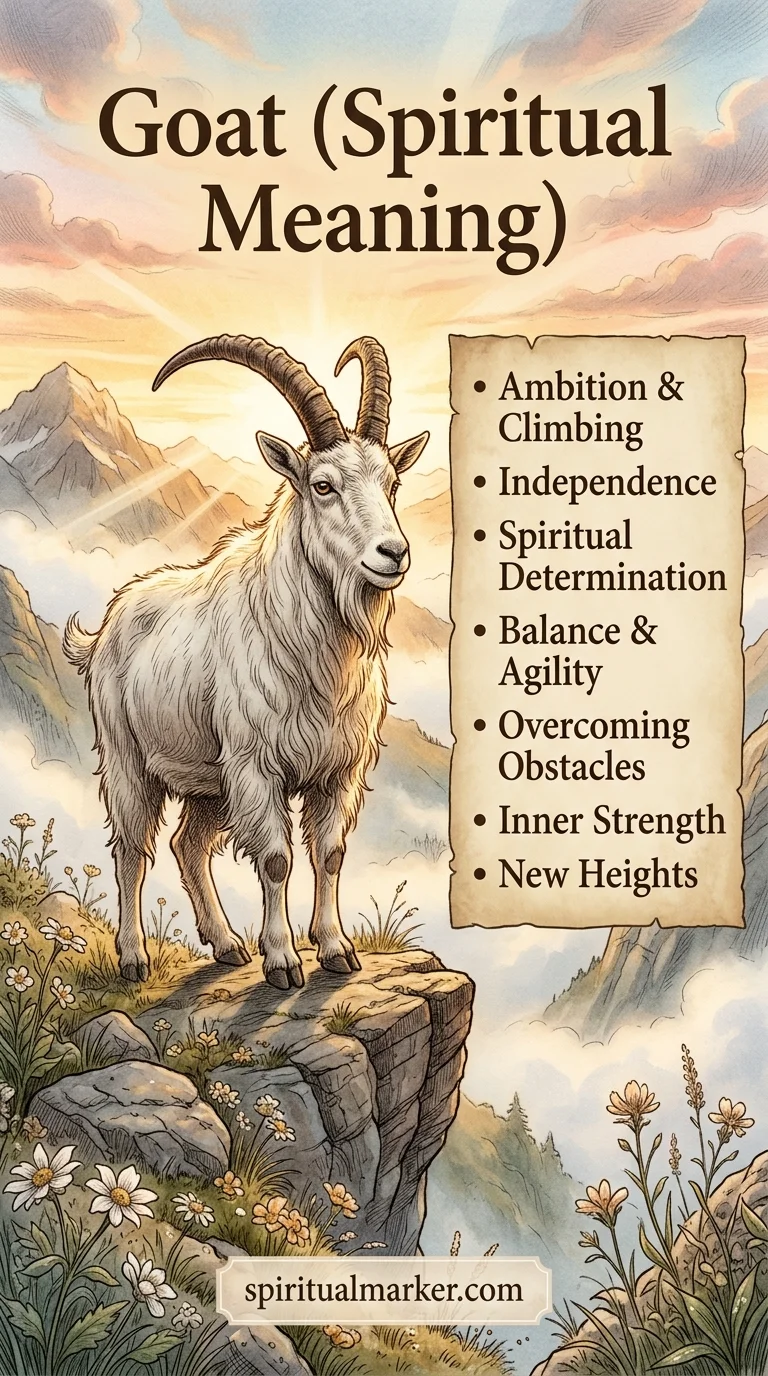
- The goat spiritual meaning centers on ambition, independence, resilience, and the willingness to climb toward a difficult goal.
- Goats carry a dual symbolism. They represent divine provision and fertility in many cultures, yet they also symbolize temptation, stubbornness, and the shadow self in others.
- Biblical goat symbolism is rooted in the scapegoat ritual of Leviticus 16, where goats carried the sins of the community into the wilderness.
- The color of a goat changes its message. White goats point to purity and guidance, while black goats point to transformation and hidden truth.
- Dreaming about goats often reflects your own determination, stubbornness, or an obstacle that demands patience and steady footing to overcome.
What Are Goats and Do They Hold Spiritual Power?
Goats are among the oldest domesticated animals on Earth. Humans have lived alongside them since roughly 8000 BC, which means goats have walked beside nearly every major civilization, religion, and folk tradition that followed. That long, shared history is exactly why the goat spiritual meaning runs so deep. Few animals have been woven into human survival and human belief systems for this many thousands of years.
Physically, goats are built for difficulty. They climb cliffs that would terrify most animals, balance on narrow ledges, and thrive in terrain that looks impossible from the ground. Mountain goats in the Rockies and ibexes in the Alps are known to climb above fourteen thousand feet without hesitation. That physical mastery over harsh, vertical landscapes is the foundation of the goat’s spiritual reputation. Spiritually, the goat represents the part of you that keeps climbing even when the path looks unstable.
Many spiritual traditions believe that animals carry messages from the unseen world, and goats are no exception. Their unshed horns, which grow in rings throughout their entire lives, have long been read as a record of accumulated wisdom. A goat’s horns are sometimes described as antennae tuned to a higher frequency, picking up guidance that the animal then carries through the physical world. Whether or not you take that literally, the symbolism is consistent. The goat is a creature that bridges earthly grit with something higher.
What Does Seeing a Goat Symbolize or Represent?
Seeing a goat, whether on a hillside, in a field, or wandering somewhere unexpected, is rarely just a coincidence in spiritual traditions. A goat sighting often arrives at a moment when you are being asked to make a decision, take a risk, or commit to a goal that feels far away. The animal’s natural confidence on dangerous terrain becomes a mirror for whatever steep climb you are currently facing in your own life.
The context of the sighting matters as much as the sighting itself. A goat calmly grazing suggests stability and grounded progress. A goat climbing or leaping between rocks points to ambition and forward motion, a nudge that you are capable of reaching higher than you currently believe. A goat that approaches you directly, rather than running off, is often read as a sign that you are being recognized by a spiritual guide that senses you need support right now.
Encountering more than one goat at a time shifts the message toward community. A herd suggests that you do not need to climb alone. It can be a reminder to lean on the people around you, collaborate more openly, or draw strength from others who share your ambition. The number and behavior of the goats you see often shapes the deeper meaning behind the encounter, so it helps to notice the small details rather than dismissing the moment as ordinary.
7 Spiritual Meanings of Goats
1. Ambition, Determination, and the Courage to Climb
One of the strongest spiritual meanings of goats is ambition and determination. Goats are remarkably capable climbers, and many species navigate steep, rocky landscapes that appear difficult or even impossible to cross. Their physical ability to move upward has naturally encouraged symbolic connections with progress, persistence, and reaching higher goals.
Spiritually, the goat can represent the willingness to continue moving when the path ahead is uncertain. Progress rarely happens under perfect conditions. There may be obstacles, setbacks, or moments when you cannot see the entire route. The goat’s symbolism focuses instead on taking the next secure step and continuing from there.
This meaning can become particularly relevant during periods when you are working toward a difficult goal. The goat represents persistence without requiring certainty about the final destination. Its climbing nature suggests that achievement often comes through patience, balance, and repeated effort rather than one dramatic leap.
2. Independence and Self-Reliance
The second spiritual meaning of goats is independence and self-reliance. Goats are adaptable animals that can survive in challenging environments and make use of vegetation that many other livestock cannot easily access. Their ability to navigate rugged terrain reinforces their reputation as capable and resourceful creatures.
As a spiritual symbol, this quality can represent learning to trust your own judgment. There are periods in life when outside opinions become overwhelming, particularly when everyone seems to have advice about the choices you should make. Goat symbolism offers a contrasting image of confidence, personal responsibility, and the ability to move forward using your own judgment.
However, independence does not mean complete isolation. Self-reliance works best when it is balanced with the ability to recognize when cooperation is valuable. The deeper symbolism concerns developing confidence in your abilities without becoming dependent on constant approval from others.
3. Fertility, Nourishment, and Abundance
Goats also carry longstanding associations with fertility and abundance. In agricultural societies, goats provided milk, meat, hides, and other resources, making them valuable animals for household survival. Their ability to reproduce and thrive in relatively difficult environments strengthened their connection with productivity and sustained provision.
This practical importance gradually became part of wider symbolic traditions. In ancient Mediterranean cultures, goat imagery sometimes appeared alongside deities and rituals connected with fertility, nature, agriculture, and seasonal growth. The specific meanings varied considerably by culture, but the recurring connection between goats and productive natural forces is significant.
Spiritually, goat symbolism can therefore represent nourishment, growth, prosperity, and the resources required to sustain life. Abundance here does not necessarily mean financial wealth. It can refer to a thriving household, productive work, supportive relationships, physical nourishment, or the steady development of something that requires time and care.
4. Stubbornness, Resistance, and Strong Will
A goat’s spiritual symbolism also has a challenging side: stubbornness and resistance. Goats have long been portrayed as strong-willed animals, and their behavior has contributed to their reputation for refusing to move when they do not want to cooperate. This characteristic has become a familiar metaphor for human stubbornness.
In spiritual symbolism, this trait can represent both strength and limitation. Determination can help you remain committed when circumstances become difficult, but excessive resistance can prevent growth. There is a meaningful difference between standing firmly for something important and refusing to reconsider simply because changing direction feels uncomfortable.
The goat therefore becomes a symbol of strong will that requires discernment. Sometimes persistence protects your values. At other times, flexibility prevents unnecessary conflict. This dual meaning makes the goat particularly relevant to situations where you may need to distinguish genuine conviction from resistance to change.
5. Release, Sacrifice, and Cleansing
The fifth spiritual meaning of goats is connected with release and cleansing, particularly through the biblical concept of the scapegoat. In Leviticus 16, a goat played a role in the ancient Israelite Day of Atonement ritual. The community’s sins were symbolically placed upon the goat, which was then sent away into the wilderness.
This historical religious practice has strongly influenced later interpretations of goat symbolism. The goat can represent the removal of guilt, the carrying away of burdens, and the restoration of spiritual cleanliness. It is important, however, to distinguish this specific biblical ritual from broader modern claims about goat symbolism. Different traditions have interpreted goats in very different ways.
In a personal spiritual context, the symbolism can represent the process of releasing something that has weighed heavily on you. Guilt, regret, resentment, or attachment to past mistakes can become emotional burdens. The goat’s association with carrying something away provides a powerful metaphor for acknowledging the past without allowing it to permanently define the present.
6. Spiritual Ascension and Higher Consciousness
Another important interpretation of goat symbolism involves spiritual ascension. This meaning draws heavily from the animal’s remarkable ability to climb steep mountains and rocky slopes. The physical movement upward becomes a metaphor for the human search for greater wisdom, awareness, and spiritual maturity.
Across various symbolic traditions, mountains represent places of revelation, difficulty, isolation, and contact with the sacred. Because goats naturally inhabit mountainous environments, they can become associated with the journey toward higher ground. The climb itself represents effort, discipline, and gradual progress.
This does not necessarily suggest that spiritual growth means becoming detached from ordinary life. Instead, the goat can symbolize rising above limited perspectives while remaining grounded in reality. Each step represents greater awareness, and the difficult terrain represents the challenges that often accompany personal development.
7. Duality, Instinct, and the Balance of Opposites
The seventh spiritual meaning of goats is duality. Few animals demonstrate such a wide range of symbolic interpretations. A goat can represent fertility and sacrifice, independence and stubbornness, earthly instinct and spiritual ascent. Its symbolism changes according to the cultural and religious context in which it appears.
This duality reflects something deeply human. We can be confident and uncertain, compassionate and defensive, determined and resistant at different moments. Spiritual traditions often use animals to express these contradictions because animals can embody qualities that humans recognize within themselves.
The goat therefore represents the coexistence of strength and limitation. Its wild instincts do not necessarily oppose wisdom, and its stubbornness does not erase its resourcefulness. Instead, these qualities exist together. The deeper symbolism lies in recognizing that personal growth often involves bringing seemingly opposite parts of ourselves into better balance.
Goat Meaning and Symbolism Across Cultures and Religions
The spiritual meaning of goats shifts noticeably depending on which culture or religious tradition you examine, yet certain threads remain constant nearly everywhere. In European folklore, goats were praised for their perseverance and industriousness, but folk sayings also warned against the dangers of impulsiveness, since a goat’s stubborn streak could just as easily lead it off a cliff as up one. Sailors in Scotland’s Western Isles once hung a male goat from a ship’s mast, believing the act would summon a favorable wind for the voyage ahead.
Middle Eastern traditions connect goats closely to fertility, abundance, and material wealth, while also using the animal as a caution against excess and temptation. This dual reading lines up closely with biblical symbolism, where goats represent both divine provision through milk and meat, and moral warning through stories of idolatry and sacrifice. In Chinese tradition, the goat, sometimes interpreted as a sheep depending on the dialect, is the eighth animal of the zodiac and represents peace, harmony, creativity, and a gentle, calm nature rather than aggression or rebellion.
Eastern and Indigenous belief systems tend to frame the goat as a spiritual guide or protector rather than a trickster. The goat in these traditions symbolizes wisdom, intuition, and a steady ability to navigate difficult terrain, both physically and spiritually. Among certain Native American groups along the northwestern coastal regions, mountain goat hair was woven into ceremonial blankets, and the animal’s high-altitude habitat connected it symbolically to the sky and the spirit realm above. Domestic goats themselves were absent from early Native American mythology, since they were not introduced to the Americas until European settlers arrived in the seventeenth century, but the wild mountain goat carried its own distinct spiritual weight long before that.
Goat Symbolism in World Mythologies
Greek mythology gives the goat one of its most enduring spiritual roles through Amalthea, the goat who nursed the infant Zeus on the island of Crete. One of her horns later became the cornucopia, the horn of plenty that provides unending nourishment, tying the goat permanently to themes of abundance and divine care. Greek mythology also gave us Pan, the half-goat, half-human god of the wild, music, and shepherds, whose presence represents untamed nature, fertility, and creative, free-spirited energy. The Satyrs, half-man and half-goat companions of Dionysus, extended this same wild, festive symbolism into the god of wine and revelry.
Norse mythology ties the goat to strength and divine sustenance through Thor, the god of thunder, whose chariot was pulled by two goats named Tanngrisnir and Tanngnjóstr. A second goat, Heiðrún, lived in Valhalla and produced an endless supply of mead for the gods, reinforcing the same theme of nourishment and abundance found in the Greek tradition. The repeated appearance of nursing or providing goats across unrelated mythologies, from Amalthea to Heiðrún, suggests this symbolism developed independently in multiple cultures rather than spreading from a single source.
The goat’s mythological reputation took a darker turn after the spread of Christianity across Europe. Pagan nature gods like Pan, already depicted with goat horns and hooves, were recast by early Christian writers as symbols of evil in an effort to discredit older belief systems. This shift eventually produced Baphomet, the goat-headed figure associated with occult practice, and cemented the goat’s lingering connection to darkness in Western pop culture. This negative branding was largely a political and religious tool rather than a reflection of the goat’s original symbolic meaning, which across most of the ancient world centered on provision, wildness, and divine favor rather than malevolence.
Goat Color Symbolism: White, Black, and Beyond
The color of a goat changes its spiritual message considerably, and paying attention to this detail can sharpen whatever sign you believe you are receiving. White goats are tied to purity, clarity, and divine guidance. Encountering or dreaming of a white goat often signals that your spirit is undergoing a kind of cleansing or renewal, a gentle confirmation that you are aligning with truth and your higher self rather than drifting from it.
Black goats carry a reputation that is frequently misunderstood. Rather than serving as a warning or a bad omen, black goats in most spiritual frameworks represent the shadow self, the hidden parts of your psyche that still need to be examined and integrated. A black goat appearing in your life is often an invitation to ask yourself what truth you have been avoiding, not a signal of danger. Brown goats lean toward stability, groundedness, and a strong connection to the natural world, while spotted goats reflect duality and the blending of opposites, a reminder that complexity and harmony are not mutually exclusive.
These color associations are not rigid rules carved in stone, but they offer a useful lens for interpreting an encounter more specifically. If a goat keeps appearing to you in dreams, meditation, or even casual daily life, its color is one of the clearest details worth recording before you try to decide what the message means.
Goat Biblical Meaning and Significance
In the Bible, goats carry one of the most layered and dual meanings of any animal mentioned in scripture. The most well known reference comes from Leviticus 16, which describes the ritual of the scapegoat. On the Day of Atonement, two goats were brought forward. One was sacrificed, while the other had the sins of the people symbolically placed upon it before being sent into the wilderness, carrying that guilt away from the community entirely. This is where the modern word scapegoat comes from, and it remains one of the clearest biblical pictures of spiritual release, forgiveness, and cleansing.
Goats also appear prominently in the Gospel of Matthew, where Jesus uses the image of separating sheep from goats as a metaphor for final judgment. In this parable, sheep represent the righteous and the obedient, while goats represent those who are turned away. This contrast has shaped centuries of Christian symbolism, positioning sheep as faithful followers of divine will and goats as a symbol of independence, rebellion, or moral failure. It is worth noting that this is a metaphorical use of the animal rather than a condemnation of goats themselves, since elsewhere in the Old Testament, goats are listed among acceptable and valuable sacrificial animals, milk providers, and sources of agricultural wealth.
Beyond Leviticus and Matthew, goats and goat hair appear throughout the construction details of the Tabernacle, used as covering material in the sacred tent that housed the Ark of the Covenant. This places the goat in close proximity to some of the most sacred objects described in the Old Testament. The biblical goat, taken as a whole, represents both the weight of sin being carried away and the practical, sustaining role goats played in the daily lives of ancient communities, a duality that echoes through nearly every other tradition this animal touches.
Goat Superstitions and Folk Beliefs Around the World
Folk superstition surrounding goats is rich, regionally specific, and often surprisingly practical. In parts of rural England, keeping a goat on a farm or at an inn was believed to bring good luck and protect the health of every other animal on the property. This belief had a grain of practical truth behind it. Farmers in the early twentieth century noted that the strong scent given off by goats seemed to ward off certain livestock diseases, and some kept goats specifically to calm anxious horses, since goats rarely panic and tend to lead other animals toward steadier behavior during emergencies.
In Scottish folklore, the urisk, a half-human, half-goat brownie spirit, was said to live on farms and bring prosperity to any household lucky enough to host one. By contrast, English and Scottish superstition also held that goats disappeared once every twenty-four hours to visit the devil and have their beards combed, a belief that fed directly into the animal’s later association with darker spiritual forces. Dream superstition carried its own specific warnings. Dreaming of a single goat was traditionally read as a sign of poor health on the horizon, while dreaming of a large group of goats was said to predict an unexpected inheritance.
Other regional beliefs are stranger still. One old superstition claimed that only goat’s blood had the power to soften a diamond, a belief with no scientific basis but a long folkloric life nonetheless. Sailors hanging a goat from a ship’s mast for favorable wind, the practice of killing a goat at Christmas for luck, and the protective reputation goats held on farms across the Denham Tracts all point to the same underlying theme. Across nearly every regional tradition, the goat’s superstitious reputation swings between protector and omen, rarely settling into one fixed role.
Goat Spirit Animal and Totem Meaning
If the goat feels like more than a passing symbol in your life, it may be functioning as your spirit animal or totem. People who carry the goat as a totem tend to be persistent, industrious, and fearless when obstacles appear in their path. They are rarely satisfied standing still and often feel pulled toward lofty goals, whether those goals are financial, creative, or deeply spiritual in nature.
Someone with a goat totem usually has a calming effect on the people around them, even during genuinely chaotic situations. This mirrors the goat’s real-world reputation for staying composed during emergencies, the same trait that made farmers trust goats to lead frightened horses to safety. If you have noticed that you are the steady presence others lean on during a crisis, the goat totem may explain why that role comes so naturally to you.
There is a cautionary side to this totem as well. People drawn to goat energy can occasionally tip into stubbornness, particularly around plans involving money, status, or ambition. The goat asks you to stay honest about whether your drive is rooted in genuine purpose or in an inflated ego compensating for deeper insecurity. Working consciously with goat energy means channeling its persistence without letting that same persistence turn into rigidity.
Dreaming About Goats: Spiritual and Psychological Meanings
Dreams involving goats tend to mirror whatever ambition, obstacle, or internal conflict is currently active in your waking life. A goat climbing steadily upward in a dream often reflects your own progress toward a goal, even if that progress feels slow or uncertain while you are awake. A goat that appears calm and grounded suggests emotional stability, while a goat that seems agitated, frightened, or aggressive usually points to unresolved inner conflict that has not yet surfaced into conscious awareness.
The color of the dream goat carries weight here too. A white goat in a dream often signals spiritual cleansing or a sense of alignment with your higher self, while a black goat in a dream tends to point toward the shadow self, asking you to confront a hidden truth rather than continue avoiding it. Psychologically, both interpretations land in similar territory. The dreaming mind frequently uses animals as stand-ins for parts of ourselves we have not fully acknowledged, and the goat’s natural duality makes it a fitting symbol for internal contradiction.
Context within the dream matters as much as the goat itself. Watching a goat give birth during a dream is often tied to new beginnings forming even in difficult circumstances, while dreaming of a goat that dies or is harmed can reflect anxiety about losing momentum on something you have worked hard to build. If a particular goat dream keeps repeating, it is usually worth paying close attention to, since recurring dream imagery tends to point toward something the subconscious mind feels has not yet been resolved.
Goats in Astrology: The Capricorn Connection
The goat holds a permanent place in the night sky through Capricorn, the zodiac sign represented by the sea goat and ruled by the planet Saturn. Anyone familiar with astrology knows Capricorn season carries a reputation for discipline, ambition, and long-term thinking, and that reputation traces directly back to the goat’s own natural behavior. A goat does not expect to reach the top of a mountain in one leap. It tests each foothold, adjusts its balance, and commits to a slow, careful climb that eventually gets it exactly where it intended to go.
This astrological goat symbolism reinforces nearly everything already covered about ambition and perseverance, but it adds a structural layer that other interpretations miss. Saturn governs time, boundaries, and consequence, which means Capricorn energy, and by extension goat energy, is less about chasing quick wins and more about building something durable. People who feel a strong pull toward goat symbolism often share this same instinct. They are willing to commit to years of unglamorous effort because they trust the climb will eventually pay off, even when nobody around them can yet see the summit they are working toward.
If you were born under Capricorn, or if goat symbolism keeps appearing in your life around major decisions, it may be worth examining whether you are honoring this same patient, structured approach. The goat does not rush past difficult terrain looking for a shortcut. It moves with intention, tests its footing, and trusts that steady effort outperforms impulsive leaps. That single lesson runs through the goat’s astrological symbolism just as clearly as it runs through its mythology, its biblical role, and its place in folklore.
What to Do When Goat Symbolism Keeps Appearing in Your Life
When the same symbol shows up again and again, whether through repeated sightings, recurring dreams, or an unexplainable pull toward goat imagery, it is rarely something to brush aside. The goat tends to surface most strongly during periods of transition, when you are weighing a difficult decision, starting something new, or quietly resisting a change you already know is necessary. Recognizing that timing is often the first real clue toward understanding what the symbol is asking of you.
Start by tracking the pattern rather than reacting to a single instance. Note the color of the goat, whether it was alone or with others, and what was happening in your life during the twenty four hours before and after the encounter. Over a few weeks, these small details tend to form a clearer picture than any single sighting ever could on its own. A white goat appearing during a stressful week might point toward an invitation to release tension and trust the process, while a black goat surfacing during a period of avoidance might be asking you to face something you have been sidestepping.
From there, sit with the feeling the goat leaves behind rather than immediately assigning it a label. Spiritual symbols rarely arrive with simple, one word answers attached, and the goat in particular resists easy categorization given how many contradictory meanings it carries across different traditions. Trust your own intuition alongside the cultural and biblical context covered here, since the most accurate interpretation is usually the one that combines outside wisdom with what you already sense to be true about your own circumstances.
A Final Note
The goat has carried spiritual weight for thousands of years, and that weight has never been simple. It nursed Zeus, pulled Thor’s chariot, absorbed the sins of entire communities, and somehow also became a symbol associated with the devil. Few animals hold that much contradiction inside a single image, and that contradiction is exactly why the goat continues to show up in dreams, scripture, and everyday encounters that feel impossible to ignore.
If a goat has recently crossed your path, in waking life or in sleep, take a moment to consider the details before you settle on a meaning. Notice its color, its behavior, and whether it appeared alone or with others. Sit with the feeling the encounter left behind rather than rushing to label it good or bad. Keeping a short journal of these moments can help you notice patterns over time, and if the symbolism continues to resonate, it may be worth exploring whether the goat is speaking to a specific area of your life that still needs your attention.